






How to use DOLANTINA 50 mg/ml INJECTABLE SOLUTION
Translated with AI
This page provides general information and does not replace a doctor’s consultation. Always consult a doctor before taking any medication. Seek urgent medical care if symptoms are severe.
Show originalContents of the leaflet
Introduction
PACKAGE LEAFLET: INFORMATION FOR THE USER
Dolantina 50 mg/ml solution for injection
Pethidine hydrochloride
Read all of this leaflet carefully before you start using this medicine.
- Keep this leaflet, you may need to read it again.
- If you have any further questions, ask your doctor or pharmacist.
- This medicine has been prescribed for you, do not pass it on to others, as it may harm them, even if their symptoms are the same as yours.
- If you experience any side effects, talk to your doctor or pharmacist. This includes any possible side effects not listed in this leaflet.
Contents of the pack:
- What is Dolantina and what is it used for
- What you need to know before you take Dolantina
- How to take Dolantina
- Possible side effects
- Storage of Dolantina
- Contents of the pack and further information
1. What is Dolantina and what is it used for
Dolantina belongs to a group of medicines called opioid analgesics, used to relieve severe pain.
Dolantina can be used in:
- Treatment of severe pain, including pain caused by operations or fractures, pain caused by nerve damage (neuralgia) or muscle spasms (smooth muscle spasms in the bile ducts, genital or urinary tract, etc.), angina pectoris or tabetic crises.
- Treatment of pain during childbirth, in case of uterine rigidity and spasms, painful contractions and pain during fetal expulsion.
- As pre-anesthetic medication.

2. What you need to know before you take Dolantina
Do not take Dolantina
- If you are allergic or have ever had an allergic reaction to pethidine.
- If you have severe respiratory problems.
- If you are being treated or have been treated in the last two weeks with certain antidepressant medications (monoamine oxidase inhibitors, MAOIs) such as iproniazid, nialamide, phenelzine, moclobemide, toloxatone or selegiline.
- If you are taking certain medications for pain relief (morphine agonist-antagonists) such as buprenorphine, nalbuphine or pentazocine.
- If you are taking ritonavir, a medication used to treat AIDS.
- If you have severe kidney problems.
- If you have severe liver problems.
- If you have been diagnosed with pheochromocytoma, a problem with the adrenal glands.
- If you have increased intracranial pressure or have recently had a head injury.
- If the patient is in a coma.
- If you have consumed a lot of alcohol.
- If you are at risk of intestinal obstruction.
- If you have severe diarrhea caused by antibiotics or poisoning.
- If you are at risk of seizures.
- If the patient is a child under 6 months old.
- If you are breastfeeding.
Be careful with Dolantina
- In case of pregnancy or if you are trying to become pregnant.
- If you have asthma. If your asthma is controlled, you can take this medication but with caution. Do not take this medication during an acute asthma attack.
- If you have bronchitis, air accumulation in the lungs (emphysema), pulmonary heart disease (a type of heart problem), severe obesity or severe spinal deformity.
- If you have any liver or bile duct disease.
- If you have kidney problems (this injection should not be administered if you have severe renal insufficiency).
- If you have prostate problems or difficulty urinating.
- If you have low thyroid or adrenal activity.
- If you have low blood pressure, if you are in severe shock, or if you are very weak.
- If you are elderly.
- If you have any intestinal disease such as Crohn's disease, ulcerative colitis.
- If you have recent abdominal discomfort whose cause has not been identified by your doctor.
- If you have a history of epilepsy (epileptic seizures).
- If you have a tendency to abuse drugs or have abused drugs in the past.
- If you have a rapid and irregular heartbeat.
- If you have cancer or a type of anemia called sickle cell anemia.
- If it is administered to children.
Use in athletes
Athletes are informed that this medication may produce a positive result in doping tests.
Use of other medications
Tell your doctor or pharmacist if you are using or have recently used any other medications, including those obtained without a prescription, homeopathic products, herbal remedies, and other health-related products, as it may be necessary to interrupt treatment or adjust the dose of one of them.
Do not use at the same time:
- If you are being or have been treated in the last two weeks with monoamine oxidase inhibitor (MAOI) medications such as iproniazid, nialamide, phenelzine, moclobemide, toloxatone or selegiline.
- Medications such as buprenorphine, nalbuphine or pentazocine.
- Ritonavir, a medication used to treat AIDS.
There is a risk of interaction with the following medications:
- Alcohol: may enhance sedative effects and decrease blood pressure.
- Antiarrhythmics, such as mexiletine.
- Antibiotics, such as ciprofloxacin.
- Antipsychotics, such as chlorpromazine.
- Antidiarrheal medications, such as loperamide and kaolin, as there is a risk of severe constipation.
- Antiepileptic medications, such as phenobarbital and phenytoin, as the depressant effect may increase.
- Antimuscarinic medications, such as atropine, as severe constipation and urinary retention may occur.
- Metoclopramide and domperidone.
- Cimetidine.
The concomitant use of pethidine hydrochloride and sedative medications such as benzodiazepines or related medications increases the risk of drowsiness, breathing difficulties (respiratory depression), coma, and can be fatal. Therefore, concomitant use should only be considered when other treatment options are not possible.
However, if your doctor prescribes pethidine hydrochloride along with sedative medications, the dose and duration of concomitant treatment should be limited by your doctor.
Tell your doctor about all sedative medications you are taking and follow your doctor's recommendations regarding the dose carefully. It may be helpful to inform friends or family members so they are aware of the signs and symptoms mentioned above. Contact your doctor when you experience such symptoms.
Use of Dolantina with food and beverages
Do not consume alcoholic beverages.
Pregnancy and breastfeeding
Consult your doctor or pharmacist before using any medication. It is not known if Dolantina causes developmental abnormalities in the fetus during pregnancy. The use of this medication is not recommended during the first trimester of pregnancy, and as a precaution, it is preferable not to use this medication during the second and third trimesters of pregnancy.
Dolantina may cause respiratory problems and sucking difficulties in the newborn.
Children born to mothers who receive treatment during prolonged periods and develop dependence may also develop dependence and exhibit withdrawal symptoms after birth.
Dolantina increases the risk of pneumonia for the mother during childbirth.
This medication should not be used while breastfeeding.
Driving and using machines
Ask your doctor if you can drive or use machines during treatment with Dolantina. It is essential to observe how this medication affects you before driving or using machines. Do not drive or use machines if you feel drowsy, dizzy, have blurred vision or double vision, or have difficulty concentrating.
3. How to take Dolantina
Follow the administration instructions for Dolantina indicated by your doctor. Consult your doctor or pharmacist if you have any doubts.
If you think the effect of Dolantina is too strong or too weak, tell your doctor or pharmacist.
Follow these instructions unless your doctor has given you different ones.
Duration of treatment
Your doctor will indicate the duration of your treatment with Dolantina.
Method of administration
Dolantina can be administered intramuscularly, subcutaneously, or through a slow intravenous injection, diluting the contents of the ampoule in a serum.
Dosage
The dose of pethidine hydrochloride should be adjusted according to the intensity of the pain and the response of each patient.
Treatment of severe pain, including post-operative pain
Adults
- 25 mg-100 mg every 4 hours, by intramuscular or subcutaneous injection.
- 25 mg-50 mg every 4 hours, by slow intravenous injection.
Elderly
Elderly patients may be more sensitive to the effects of pethidine hydrochloride, especially its effects on the central nervous system. The initial dose should not exceed 25 mg and may need to be reduced in case of repeated administrations.
Treatment of pain during childbirth
50 mg-100 mg by intramuscular or subcutaneous injection, as soon as regular contractions appear. The dose can be repeated after 1-3 hours if necessary, up to a maximum of 400 mg in 24 hours.
Pre-anesthetic medication
Administer approximately 1 hour before the procedure.
Adults
- 50 mg-100 mg by intramuscular injection.
Elderly
- 50 mg-100 mg by intramuscular injection.
Elderly patients may be more sensitive to the effects of pethidine.
Children
- 1.0 mg/kg - 2.0 mg/kg every 4 hours, by intramuscular injection.
Use in children
It is only indicated for use as pre-anesthetic medication. It is contraindicated in children under 6 months old.
Use in patients over 65 years old
Patients over 65 years old may be more sensitive to pethidine, so their doctor may prescribe a lower dose.
Special populations
Patient with liver insufficiency
The dose should be reduced in case of mild or moderate liver problems. It is contraindicated in case of severe liver insufficiency.
Patient with kidney insufficiency
The dose should be reduced in case of mild or moderate kidney problems. Its use is contraindicated in case of severe kidney insufficiency.
If you take more Dolantina than you should
If you have used more Dolantina than you should, consult your doctor, pharmacist, or call the Toxicology Information Service, phone: 91 562 04 20, indicating the medication and the amount used. It is advisable to take the packaging and the leaflet of the medication to your doctor or pharmacist.
Taking a high dose of Dolantina can cause decreased breathing ability, coma, stupor, and decreased pupil size. If the overdose is very high, it can lead to respiratory arrest and death.
The excitatory effects of Dolantina include tremors, muscle twitches, and convulsions. Other symptoms that may appear with high doses include coldness, cold and wet skin, and decreased body temperature, muscle weakness, low blood pressure, decreased heart rate, reduced blood circulation, cardiac arrest, confusion, severe dizziness, excessive sleepiness, nervousness or restlessness, hallucinations, lung swelling, and kidney problems.
If you forget to take Dolantina
In case of forgetting a dose, use the medication as soon as possible, continuing the treatment as prescribed. However, when the next dose is approaching, it is better not to administer the forgotten dose and wait for the next one. Do not request the administration of a double dose to compensate for the forgotten dose.
If you stop taking Dolantina
Your doctor will indicate the duration of your treatment with Dolantina. Do not stop treatment before, as pain may return and you may experience withdrawal symptoms.
If you have any other questions about the use of this product, ask your doctor or pharmacist.

4. Possible side effects
Like all medications, Dolantina can cause side effects, although not everyone will experience them.
Side effects have been classified by frequency as follows: Very common (affects more than 1 in 10 patients); common (affects between 1 and 10 in 100 patients); uncommon (affects between 1 and 10 in 1,000 patients); rare (affects between 1 and 10 in 10,000 patients); very rare (affects less than 1 in 10,000 patients); frequency not known (cannot be estimated from available data).
Cardiac disorders
Common: low blood pressure, decreased or increased heart rate, palpitations.
Nervous system disorders
Common: numbness, dizziness, sweating, confusion, euphoria or increased sense of well-being, hallucinations, headache, convulsions or tremors, decreased respiratory rate.
Eye disorders
Common: decreased pupil size and other vision changes.
Gastrointestinal disorders
Common: nausea and vomiting, constipation, dry mouth.
Renal and urinary disorders
Uncommon: urinary retention and decreased urine production.
Skin and subcutaneous tissue disorders
Rare: allergic reactions, injection site reactions.
If you think any of the side effects you are experiencing is serious or if you notice any side effects not mentioned in this leaflet, consult your doctor or pharmacist.
Reporting side effects
If you experience any side effects, consult your doctor or pharmacist, even if it is a possible side effect not listed in this leaflet. You can also report them directly through the Spanish Medicines Monitoring System: www.notificaram.es. By reporting side effects, you can help provide more information on the safety of this medication.
5. Storage of Dolantina
Keep out of the sight and reach of children.
Do not use this medication after the expiration date stated on the packaging after "EXP". The expiration date is the last day of the month indicated.
No special storage conditions are required, but it is recommended to store the ampoules in the outer packaging.
Do not use Dolantina if you notice the presence of particles.
Once the ampoules are opened or their contents are diluted, they should be administered immediately.
Medications should not be disposed of through wastewater or household waste. Deposit the packaging and medications you no longer need in the SIGRE collection point at the pharmacy. If in doubt, ask your pharmacist how to dispose of the packaging and medications you no longer need. This will help protect the environment.
6. Contents of the pack and further information
Composition of Dolantina:
- The active ingredient is pethidine hydrochloride 50 mg/ml.
- The other ingredients (excipients) are: water for injectable preparations.
Appearance and packaging of the product
Dolantina is a clear and colorless injectable solution. It is presented in 1 or 2 ml ampoules of colorless glass, type I, of high hydrolytic resistance.
The packaging size is 1 and 10 ampoules of colorless glass.
Marketing authorization holder and manufacturer
Kern Pharma, S.L.
Venus, 72 - Pol. Ind. Colón II
08228 Terrassa – Barcelona
Spain
This leaflet was revised in September 2021
Detailed and updated information on this medication is available on the website of the Spanish Agency for Medicines and Health Products (AEMPS) http://www.aemps.gob.es/
-

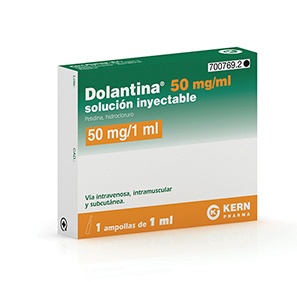
- Country of registration
- Dosage formINJECTABLE, 100 mg/2 ml pethidine hydrochloride
- ATC codeN02AB02
- Average pharmacy price1.76 EUR
- Active substance
- Prescription requiredYes
- Manufacturer
- This information is for reference only and does not constitute medical advice. Always consult a doctor before taking any medication. Oladoctor is not responsible for medical decisions based on this content.
- Alternatives to DOLANTINA 50 mg/ml INJECTABLE SOLUTIONDosage form: INJECTABLE, 50 mg/mlActive substance: pethidineManufacturer: Altan Pharmaceuticals SaPrescription requiredDosage form: INJECTABLE, 50 mg/mlActive substance: pethidineManufacturer: Laboratorios Basi Industria Farmaceutica S.A.Prescription requiredDosage form: TRANSDERMAL PATCH, 12 MCG/HActive substance: fentanylManufacturer: Aristo Pharma Iberia S.L.Prescription required

Online doctors for DOLANTINA 50 mg/ml INJECTABLE SOLUTION
Discuss questions about DOLANTINA 50 mg/ml INJECTABLE SOLUTION, including use, safety considerations and prescription review, subject to medical assessment and local regulations.









Get DOLANTINA 50 mg/ml INJECTABLE SOLUTION Prescription Online
Fill in a 2-min form
Tell us your symptoms, history, and what medicine you're requesting.
Pick a doctor or let us assign
Choose a specialist or we'll match you with the next available doctor.
Doctor reviews your case
Usually within 30 minutes. They may ask follow-up questions via chat.
Collect from any pharmacy
Electronic prescription sent to your email — valid across Spain.
Frequently Asked Questions
DOLANTINA 50 mg/ml INJECTABLE SOLUTION requires a prescription in Spain. You can check with a doctor online whether this medicine may be appropriate for your situation.
The active ingredient in DOLANTINA 50 mg/ml INJECTABLE SOLUTION is pethidine. This information helps identify medicines with the same composition but different brand names.
The average pharmacy price for DOLANTINA 50 mg/ml INJECTABLE SOLUTION is around 1.76 EUR. Prices may vary depending on the manufacturer and dosage form.
DOLANTINA 50 mg/ml INJECTABLE SOLUTION is manufactured by Kern Pharma S.L.. Pharmacy brands and packaging may differ depending on the distributor.
Doctors such as Family doctors, Psychiatrists, Dermatologists, Cardiologists, Endocrinologists, Gastroenterologists, Pulmonologists, Nephrologists, Rheumatologists, Hematologists, Infectious disease physicians, Allergists, Geriatricians, Paediatricians, Oncologists may assess whether DOLANTINA 50 mg/ml INJECTABLE SOLUTION is appropriate, depending on your situation and local regulations. You can book an online consultation to discuss your symptoms and possible next steps.
Spain has a well-developed healthcare infrastructure across major cities such as Madrid, Barcelona, Valencia, and Seville. Pharmacies are widely available and operate under strict regulations, ensuring access to prescribed medications.
You can buy DOLANTINA 50 mg/ml INJECTABLE SOLUTION in Madrid, Barcelona, Seville, or Valencia at any local pharmacy with a valid prescription.
To obtain a prescription, you can use Oladoctor:
Other medicines with the same active substance (pethidine) include PETIDINE HYDROCHLORIDE ALTAN 50 MG/ML INJECTABLE SOLUTION, PETIDINE BASE 50 mg/ml INJECTABLE SOLUTION, ABATTRA 12 MICROGRAMS/HOUR TRANSDERMAL PATCHES. These may have different brand names or formulations but contain the same therapeutic ingredient. Always consult a doctor before switching or starting a new medicine.
