


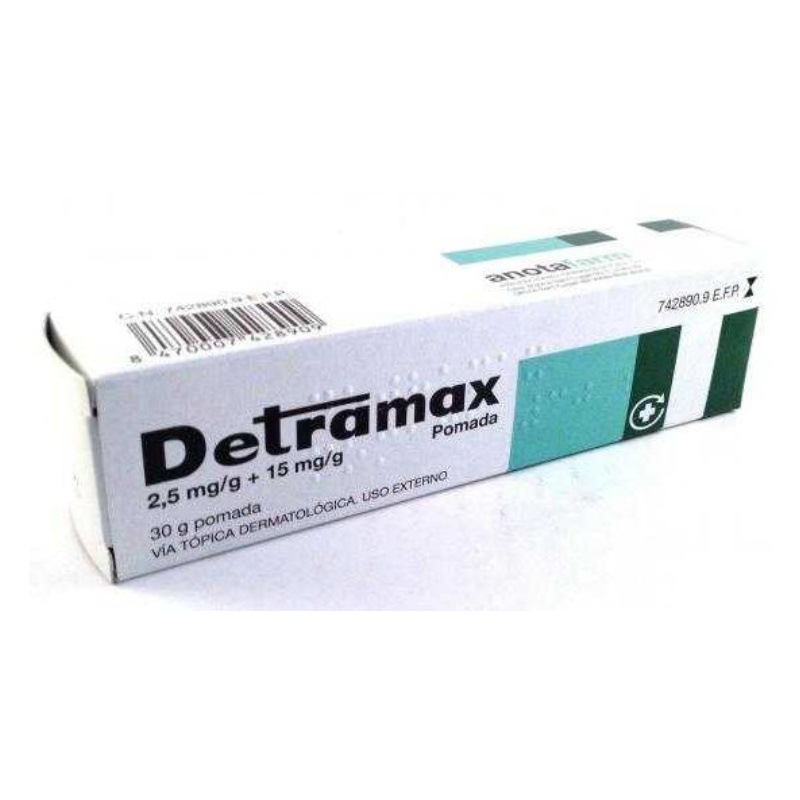
Detramax 2,5 mg/g + 15 mg/g pomada

Prescription review online
A doctor will review your case and decide whether a prescription is medically appropriate.

Talk to a doctor about this medicine
Discuss your symptoms and possible next steps in a quick online consultation.



How to use DETRAMAX 2.5 mg/g + 15 mg/g OINTMENT
Contents of the leaflet
- Introduction
- What is Detramax and what is it used for
- What you need to know before you start using Detramax
- How to use Detramax
- Possible side effects
- Storage of Detramax
- Contents of the pack and further information
Introduction
Package Leaflet: Information for the User
Detramax 2.5 mg/g + 15 mg/g Ointment
Hydrocortisone / Propanocaine Hydrochloride
Read this package leaflet carefully before you start using this medicine, because it contains important information for you.
Follow the instructions for administration of the medicine contained in this package leaflet or as indicated by your doctor or pharmacist .
- Keep this package leaflet, you may need to read it again.
- If you need advice or more information, consult your doctor or pharmacist.
- If you experience side effects, consult your doctor or pharmacist, even if they are side effects not listed in this package leaflet. See section 4.
- You should consult a doctor if it worsens or does not improve after 5-7 days.
Contents of the Package Leaflet
- What is Detramax and what is it used for
- What you need to know before you start using Detramax
- How to use Detramax
- Possible side effects
- Storage of Detramax
- Contents of the pack and further information
1. What is Detramax and what is it used for
It contains as active ingredients for cutaneous use, hydrocortisone (a corticosteroid), with anti-inflammatory action and propanocaine hydrochloride, with local anesthetic effect.
Detramax is indicated for the temporary symptomatic relief of itching and skin pain due to minor skin irritations that respond to corticosteroids, such as contact allergy to soaps, detergents, metals, insect bites, jellyfish, and nettles.

Not sure if this medicine is right for you?
Discuss your symptoms and treatment with a doctor online.
2. What you need to know before you start using Detramax
Do not use Detramax:
- If you are allergic to hydrocortisone, propanocaine, or any of the other components of this medicine (listed in section 6).
- On infected skin, by bacteria, fungi, or viruses (e.g., herpes or chickenpox).
- On wounds and mucous membranes (e.g., in eyes, mouth, as well as in the anal or genital area).
- In acne, or for the treatment of athlete's foot.
- For the treatment of ulcers.
- For irritation or itching caused by diapers.
- In case of tuberculosis or syphilis affecting the skin.
- On an area of redness or reaction around a vaccine.
- In areas affected by inflammation with redness of the skin on the face (rosacea) or inflammation around the mouth (perioral dermatitis).
Warnings and precautions
Consult your doctor or pharmacist before starting to use Detramax.
- Detramax should only be used for external treatment of the skin. No type of dressing should be applied to the treated area, unless indicated by the doctor.
- Corticosteroids (one of the active ingredients of this medicine) should not be used on large areas of the body or for prolonged periods, as this significantly increases the risk of side effects.
- Avoid contact with the eyes and mucous membranes and wash your hands after use.
- If you develop an allergy to the medicine, you should interrupt treatment.
- If you develop an infection during the use of this medicine, you should consult your doctor about its treatment.
- Contact your doctorif you experience blurred vision or other visual disturbances.
Children
Do not use in children under 12 years old unless prescribed by a doctor; in this case, it should be taken into account that diapers produce occlusion, which increases the absorption of the medicine.
Using Detramax with other medicines
Tell your doctor or pharmacist if you are using, have recently used, or may need to use any other medicine.
No interactions are known.
Pregnancy, breastfeeding, and fertility
If you are pregnant or breastfeeding, think you may be pregnant, or plan to become pregnant, consult your doctor or pharmacist before using this medicine.
As a general rule, during the first trimester of pregnancy, the ointment should not be applied.
It is recommended not to use this medicine during pregnancy unless your doctor considers it necessary, weighing the benefits against the potential risk.
Pregnant or breastfeeding women should not use Detramax on extensive skin areas or for a prolonged period, nor use occlusive dressings.
Do not apply Detramax to the breasts during breastfeeding.
Driving and using machines
Treatment with this medicine does not affect the ability to drive or use machines.
Detramax ointment contains cetyl alcohol, methyl parahydroxybenzoate (E-218), and propylene glycol
This medicine may cause local skin reactions (such as contact dermatitis) because it contains cetyl alcohol.
It may cause allergic reactions (possibly delayed) because it contains methyl parahydroxybenzoate (E218).
It may also cause skin irritation because it contains propylene glycol.
3. How to use Detramax
Follow the instructions for administration of the medicine contained in this package leaflet or as indicated by your doctor or pharmacist. In case of doubt, ask your doctor or pharmacist.
Topical use
Apply a small amount of ointment to the affected area 1 to 3 times a day with a gentle massage.
Wash your hands after each application.
If the symptoms persist for more than 5-7 days, according to the indication, or in case of worsening, you should interrupt treatment and consult your doctor.
Use in children
Do not use in children under 12 years old unless indicated by the doctor.
If you use more Detramax than you should
Using higher amounts of corticosteroids than recommended increases the risk of side effects.
In case of overdose or accidental ingestion, consult your doctor or pharmacist immediately, go to your doctor, or call the Toxicology Information Service Phone: 91 562 04 20, indicating the medicine and the amount applied/taken.
If you forget to use Detramax
Do not use a double dose to make up for forgotten doses.
If you forget to apply the ointment at the scheduled time, apply it as soon as possible and continue with the usual routine.

Started taking the medicine and have questions?
Discuss your symptoms and treatment with a doctor online.
4. Possible side effects
Like all medicines, this medicine can cause side effects, although not everybody gets them.
The side effects that may occur are mainly due to excessive use of the medicine or use with occlusive dressing.
An allergic reaction such as contact dermatitis may occur.
The use of corticosteroids on the skin can lead to skin atrophy (thinning of the skin), telangiectasia (small veins visible on the skin), stretch marks, especially during prolonged treatments, redness, hirsutism (hair growth), bruising, acne, delayed healing, rosacea (inflammation with redness of the skin on the face), perioral dermatitis (inflammation around the mouth), secondary infection such as fungal, on skin or mucous membranes.
Prolonged use or on extensive areas may cause absorption through the skin and systemic effects (in areas of the body other than the application site), such as glaucoma (increased eye pressure), blurred vision - with an unknown frequency (cannot be estimated from available data) or may cause a disorder characterized by swelling of the face, neck, and obesity.
Reporting of side effects
If you experience any side effects, consult your doctor or pharmacist, even if they are possible side effects not listed in this package leaflet. You can also report them directly through the Spanish Medicines and Health Products Agency (AEMPS) http://www.aemps.es/.
5. Storage of Detramax
No special storage conditions are required.
Keep this medicine out of the sight and reach of children.
Do not use this medicine after the expiration date stated on the packaging after CAD. The expiration date is the last day of the month indicated.
Medicines should not be disposed of via wastewater or household waste. Deposit the packaging and medicines you no longer need at the pharmacy's SIGRE point. If in doubt, ask your pharmacist how to dispose of the packaging and medicines you no longer need. This will help protect the environment.
6. Contents of the pack and further information
Composition of Detramax ointment
- The active ingredients are hydrocortisone and propanocaine hydrochloride. Each gram contains 2.5 mg of hydrocortisone (0.25%) and 15 mg of propanocaine hydrochloride (1.5%).
- The other ingredients are: glycerol (E422), propylene glycol, cetyl alcohol, methyl parahydroxybenzoate (nipagin) (E218), ethanol, and purified water.
Appearance of the product and contents of the pack
Detramax is a white, shiny ointment with a smooth texture, presented in aluminum tubes.
Each tube contains 30 g.
Marketing authorization holder and manufacturer
Holder
Anotaciones Farmacéuticas S.L.
Cal1e D’Amposta, nº 14-18, planta 2 puerta 2B,
08174 - Sant Cugat del Vallés. Barcelona (Spain).
Manufacturer
Laboratorios Bohm, S.A.
C/ Molinaseca, 23. Polígono Industrial Cobo Calleja, Fuenlabrada,
28947 Madrid (Spain).
Date of the last revision of this package leaflet: April 2022
Detailed and updated information on this medicine is available on the website of the Spanish Agency for Medicines and Health Products (AEMPS) http://www.aemps.es/
- Country of registration
- Dosage formOINTMENT, 1.5 g; 0.25 g
- ATC codeD07XA01
- Active substance
- Prescription requiredNo
- Manufacturer
- CompositionGLICEROL (E 422) (5 g mg), PROPILENGLICOL (5 g mg), ALCOHOL ETILICO (ETANOL) (0,6 ml mg), PARAHIDROXIBENZOATO DE METILO (E-218) (0,18 g mg), ALCOHOL CETOESTEARILICO POLIOXIETILENADO (17,5 g mg)
- This information is for reference only and does not constitute medical advice. Always consult a doctor before taking any medication. Oladoctor is not responsible for medical decisions based on this content.
- Alternatives to DETRAMAX 2.5 mg/g + 15 mg/g OINTMENTDosage form: CREAM, -Active substance: betamethasoneManufacturer: Faes Farma S.A.Prescription requiredDosage form: CREAM, 1 mg; 10 mg; 0.5 mg; 10 mgActive substance: betamethasoneManufacturer: Galenicum Derma S.L.U.Prescription requiredDosage form: OINTMENT, 0.64 mg ; 30 mgActive substance: betamethasoneManufacturer: Organon Salud S.L.Prescription required
Online doctors for DETRAMAX 2.5 mg/g + 15 mg/g OINTMENT
Discuss questions about DETRAMAX 2.5 mg/g + 15 mg/g OINTMENT, including use, safety considerations and prescription review, subject to medical assessment and local regulations.



Frequently Asked Questions
DETRAMAX 2.5 mg/g + 15 mg/g OINTMENT does not require a prescription in Spain. You can check with a doctor online whether this medicine may be appropriate for your situation.
The active ingredient in DETRAMAX 2.5 mg/g + 15 mg/g OINTMENT is hydrocortisone. This information helps identify medicines with the same composition but different brand names.
DETRAMAX 2.5 mg/g + 15 mg/g OINTMENT is manufactured by Anotaciones Farmaceuticas S.L.. Pharmacy brands and packaging may differ depending on the distributor.
Doctors such as Family doctors, Psychiatrists, Dermatologists, Cardiologists, Endocrinologists, Gastroenterologists, Pulmonologists, Nephrologists, Rheumatologists, Hematologists, Infectious disease physicians, Allergists, Geriatricians, Paediatricians, Oncologists may assess whether DETRAMAX 2.5 mg/g + 15 mg/g OINTMENT is appropriate, depending on your situation and local regulations. You can book an online consultation to discuss your symptoms and possible next steps.
The prescription is issued by a doctor after assessing your health. In Spain, DETRAMAX 2.5 mg/g + 15 mg/g OINTMENT is then dispensed in pharmacies with that prescription. An online consultation does not guarantee that a prescription will be issued: the decision always rests with the doctor.
To request a review, you can use Oladoctor:
Other medicines with the same active substance (hydrocortisone) include ALERGICAL 0.5 mg / 0.1 mg/g CREAM, CUATROCREM CREAM, DIPROSALIC OINTMENT. These may have different brand names or formulations but contain the same therapeutic ingredient. Always consult a doctor before switching or starting a new medicine.
