



ALERGICAL 0.5 mg / 0.1 mg/g CREAM

Prescription review online
A doctor will review your case and decide whether a prescription is medically appropriate.

Talk to a doctor about this medicine
Discuss your symptoms and possible next steps in a quick online consultation.



How to use ALERGICAL 0.5 mg / 0.1 mg/g CREAM
Contents of the leaflet
- Introduction
- What Alergical Cream is and what it is used for
- What you need to know before starting to use Alergical Cream
- How to use Alergical Cream
- Possible side effects
- Storage of Alergical Cream
- Contents of the package and additional information
Introduction
PROSPECTUS: INFORMATION FOR THE USER
Alergical 0.5 mg/ 0.1 mg/ g Cream
Betamethasone valerate/ Fluocinolone acetonide
Read the entire prospectus carefully before starting to use the medication.
- Keep this prospectus, as you may need to read it again.
- If you have any doubts, consult your doctor or pharmacist.
- This medication has been prescribed for you and should not be given to others, even if they have the same symptoms, as it may harm them.
- If you consider that any of the adverse effects you are suffering from is serious or if you notice any adverse effect not mentioned in this prospectus, inform your doctor or pharmacist.
Contents of the prospectus:
- What Alergical Cream is and what it is used for
- What you need to know before starting to use Alergical Cream
- How to use Alergical Cream
- Possible side effects
- Storage of Alergical Cream
- Contents of the package and additional information
1. What Alergical Cream is and what it is used for
Alergical Cream is an anti-inflammatory medication (an association of two corticosteroids) used on the skin to reduce inflammation, allergic reactions, and reactions with excessive cell multiplication (hyperproliferation). Therefore, it reduces redness (erythema), fluid accumulation (edema), and exudate on the inflamed skin. It also relieves itching, burning, or pain.
Alergical Cream is indicated for the treatment of acute forms of:
- Exogenous eczema due to causes such as allergy to a substance that has come into contact with the skin (allergic contact dermatitis), to substances of habitual use such as soap (irritant contact dermatitis), eczema with eruption and itching on hands and feet (dyshidrotic eczema), or common eczema.
- Eczema related to patient factors (endogenous eczema), such as atopic dermatitis or neurodermatitis.
- Skin eruption with inflammation and scaling (seborrheic eczema).
- Psoriasis (excluding psoriasis with widespread plaques).

Not sure if this medicine is right for you?
Discuss your symptoms and treatment with a doctor online.
2. What you need to know before starting to use Alergical Cream
Do not useAlergical Cream
- if you are allergic (hypersensitive) to betamethasone, fluocinolone, other corticosteroids, or any of the other components of Alergical Cream (see also section 6. Additional information)
- if you have tuberculosis, syphilis, or viral infections (e.g., chickenpox or herpes)
- in areas of skin affected by a red/pink inflammation on the face (rosacea), ulcers, acne, or skin diseases with skin thinning (atrophy)
- in a skin inflammation around the mouth (perioral dermatitis)
- in areas of skin showing a vaccination reaction, i.e., redness or inflammation after vaccination
- in the eyes, on mucous membranes (e.g., in the mouth), or on open wounds
- in children under 1 year of age
- in skin infections caused by bacteria or fungi (unless also treated with specific treatment)
Be careful with Alergical Cream
- If your doctor diagnoses a bacterial or fungal infection, you should also use the prescribed additional treatment for the infection, as otherwise, the infection may worsen.
- Alergical Cream should be used at the lowest possible dose and only for the strictly necessary time to relieve the skin condition.
- Corticosteroid anti-inflammatory drugs have significant effects on the body. Treatment should be avoided in extensive areas and for long periods, as this significantly increases the risk of adverse effects.
- Alergical Cream is contraindicated in children under 1 year of age and is not recommended for use in children under 12 years of age, as in children and adolescents during the growth period, it is more likely that corticosteroids will pass through the skin and have adverse effects on other areas of the body, such as interfering with growth.
- Eye contact, mouth, open wounds, or mucous membranes (e.g., genital area) should be avoided.
- Alergical Cream should not be applied to skin folds, such as the groin or armpits.
- If you have severely impaired circulation, corticosteroids should not be applied, as skin ulcers may occur.
- Alergical Cream should not be used under impermeable materials to air and water, such as bandages, dressings, or diapers, which are not very breathable.
- If you are being treated for psoriasis, medical supervision is recommended.
- If you use Alergical Cream for conditions other than those for which it has been prescribed, you may mask symptoms and make diagnosis and correct treatment difficult.
- Contact your doctor if you experience blurred vision or other visual disturbances.
Use of other medications
Inform your doctor or pharmacist if you are using or have recently used other medications, including those purchased without a prescription, especially if you are receiving treatment with other steroids. To date, no interactions with Alergical Cream have been described.
Pregnancy and breastfeeding
Consult your doctor or pharmacist before using any medication.
If you are pregnant or breastfeeding, you should not use Alergical Cream unless your doctor considers it appropriate.
As a general rule, during the first trimester of pregnancy, medications containing corticosteroids should not be applied to the skin.
If your doctor prescribes Alergical Cream during pregnancy, you should not use it on extensive areas of your body, nor for long periods, nor use occlusive dressings.
Do not apply Alergical Cream to the breasts during breastfeeding; do not let the child come into contact with treated areas.
Driving and using machines
Treatment with Alergical Cream does not affect the ability to drive or use machines.
Important information about some components of Alergical Cream
This medication may cause skin irritation because it contains propylene glycol.
It may cause allergic reactions (possibly delayed) because it contains propylparaben and methylparaben.
3. How to use Alergical Cream
Follow the instructions for administration of Alergical Cream indicated by your doctor. Consult your doctor if you have doubts.
The normal dose is:
Adults and children over 12 years
Apply a thin layer of Alergical Cream to the affected area, one to three times a day, rubbing gently. When a favorable response is achieved, the frequency can be reduced to the minimum necessary to maintain the effect.
Topical use.
The duration of treatment should not exceed 2 weeks. If you use the medication for a condition on the face, do not treat for more than one week. Always make the treatment as short as possible.
Use in children
Alergical Cream is contraindicated in children under 1 year of age and is not recommended in children under 12 years of age.
If you use more Alergical Cream than you should
No risk is expected after a single overdose of Alergical Cream. Repeated overdoses may produce adverse effects (see section 4).
In case of overdose or accidental ingestion, consult your doctor or pharmacist or go to a medical center, or call the Toxicology Information Service. Phone 91 562 04 20 (indicating the medication and the amount ingested).
If you forget to use Alergical Cream
Do not apply a double dose to make up for forgotten doses.
If you forget to apply the cream, apply the corresponding dose as soon as possible or, if the next application is near, wait until then.
If you interrupt treatment with Alergical Cream
Please contact your doctor before interrupting treatment without having completed the indicated period.
If you have any other doubts about the use of this product, ask your doctor or pharmacist.

Started taking the medicine and have questions?
Discuss your symptoms and treatment with a doctor online.
4. Possible side effects
Like all medications, Alergical Cream can produce side effects, although not all people experience them.
The use of corticosteroid drugs on the skin can produce side effects, especially after prolonged application, in extensive areas, with dressings or occlusive materials, and/or in children.
The use of corticosteroids on the skin can cause the following side effects:
? Skin thinning (atrophy)
? Dryness or cracking of the skin
? Itching or burning
- Redness (erythema)
- Appearance of red spots
- Bruises
- Inflammation of the hair follicles (folliculitis)
- Stretch marks
- Acne
- Infections
- Hair loss
- Increased hair growth
- Allergic skin reaction (contact dermatitis)
- Inflammation of the skin around the upper lip and chin (perioral dermatitis)
- Changes in skin color
- Side effects may occur not only in the treated area but also in completely different areas of the body. This occurs if the active ingredient passes through the skin into the body. This, for example, can increase eye pressure (glaucoma) or could produce a condition characterized by a rounded face, fat accumulation, hump, weakness, etc. (Cushing's syndrome); increased blood pressure, fluid retention (edema), osteoporosis, thyroid disorders, increased cholesterol, hyperglycemia, gastric ulcer, cataracts.
- With an unknown frequency (cannot be estimated from available data): blurred vision.
Reporting side effects
If you experience any type of side effect, consult your doctor or pharmacist, even if it is a possible side effect not listed in this prospectus. You can also report them directly through the Spanish Pharmacovigilance System for Human Use Medications: https://www.notificaRAM.es/. By reporting side effects, you can contribute to providing more information on the safety of this medication.
5. Storage of Alergical Cream
Keep below 30°C.
Keep out of the reach and sight of children.
Do not use Alergical Cream after the expiration date shown on the packaging, after CAD. The expiration date is the last day of the month indicated.
Medications should not be thrown down the drain or into the trash. Deposit the packaging and medications you no longer need at the SIGRE point in the pharmacy. If in doubt, ask your pharmacist how to dispose of the packaging and medications you no longer need. This will help protect the environment.
6. Contents of the package and additional information
Composition of Alergical 0.5 mg/ 0.1 mg/ g Cream:
- The active ingredients are Betamethasone valerate and Fluocinolone acetonide.
1 g of cream contains 0.5 mg of betamethasone valerate (0.05%) and 0.1 mg of fluocinolone acetonide (0.01%).
- The other components are: stearic acid, sorbitan monoesterate, sorbitan monooleate (polysorbate 80), polysorbate 60, propylene glycol, glycerol (E-422), liquid paraffin, propylparaben (E-216), methylparaben (E-218), citric acid, distilled water, lavender essence.
Appearance of the product and contents of the package
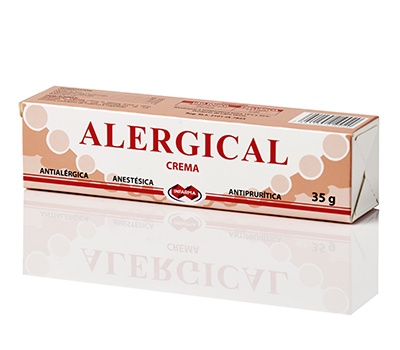
Alergical 0.5 mg/ 0.1 mg/ g Cream is a white or off-white cream presented in 30 g tubes.
Marketing authorization holder
Faes Farma, S.A.
Autonomia Etorbidea, 10
48940 Leioa (Bizkaia)
Spain
Manufacturer
Faes Farma Portugal, S.A.
Av. Elias Garcia nº 28, Amadora, 2700-327,
PORTUGAL
This prospectus was approved in March/2010.
Detailed and updated information about this medication is available on the website of the Spanish Agency for Medicines and Health Products (AEMPS) http://www.aemps.gob.es/
- Country of registration
- Dosage formCREAM, -
- ATC codeD07XC01
- Active substance
- Prescription requiredYes
- Manufacturer
- CompositionPROPILENGLICOL (25 mg mg), GLICEROL (E 422) (27 mg mg), PARAHIDROXIBENZOATO DE PROPILO (0,5 mg mg), PARAHIDROXIBENZOATO DE METILO (E-218) (1.8 mg mg), POLISORBATO 60 (28 mg mg), SORBITAN MONOESTEARATO (52 mg mg), POLISORBATO 80 (10 mg mg)
- This information is for reference only and does not constitute medical advice. Always consult a doctor before taking any medication. Oladoctor is not responsible for medical decisions based on this content.
- Alternatives to ALERGICAL 0.5 mg / 0.1 mg/g CREAMDosage form: CREAM, 1 mg; 10 mg; 0.5 mg; 10 mgActive substance: betamethasoneManufacturer: Galenicum Derma S.L.U.Prescription requiredDosage form: OINTMENT, 0.64 mg ; 30 mgActive substance: betamethasoneManufacturer: Organon Salud S.L.Prescription requiredDosage form: TOPICAL SOLUTION, 0.5 mg/g + 20 mg/gActive substance: betamethasoneManufacturer: Mibe Pharma Espana S.L.Prescription required
Online doctors for ALERGICAL 0.5 mg / 0.1 mg/g CREAM
Discuss questions about ALERGICAL 0.5 mg / 0.1 mg/g CREAM, including use, safety considerations and prescription review, subject to medical assessment and local regulations.



Get ALERGICAL 0.5 mg / 0.1 mg/g CREAM Prescription Online
Fill in a 2-min form
Tell us your symptoms, history, and what medicine you're requesting.
Pick a doctor or let us assign
Choose a specialist or we'll match you with the next available doctor.
Doctor reviews your case
Usually within 30 minutes. They may ask follow-up questions via chat.
Collect from any pharmacy
Electronic prescription sent to your email — valid across Spain.
Frequently Asked Questions
ALERGICAL 0.5 mg / 0.1 mg/g CREAM requires a prescription in Spain. You can check with a doctor online whether this medicine may be appropriate for your situation.
The active ingredient in ALERGICAL 0.5 mg / 0.1 mg/g CREAM is betamethasone. This information helps identify medicines with the same composition but different brand names.
ALERGICAL 0.5 mg / 0.1 mg/g CREAM is manufactured by Faes Farma S.A.. Pharmacy brands and packaging may differ depending on the distributor.
Doctors such as Family doctors, Psychiatrists, Dermatologists, Cardiologists, Endocrinologists, Gastroenterologists, Pulmonologists, Nephrologists, Rheumatologists, Hematologists, Infectious disease physicians, Allergists, Geriatricians, Paediatricians, Oncologists may assess whether ALERGICAL 0.5 mg / 0.1 mg/g CREAM is appropriate, depending on your situation and local regulations. You can book an online consultation to discuss your symptoms and possible next steps.
Spain has a well-developed healthcare infrastructure across major cities such as Madrid, Barcelona, Valencia, and Seville. Pharmacies are widely available and operate under strict regulations, ensuring access to prescribed medications.
You can buy ALERGICAL 0.5 mg / 0.1 mg/g CREAM in Madrid, Barcelona, Seville, or Valencia at any local pharmacy with a valid prescription.
To obtain a prescription, you can use Oladoctor:
Other medicines with the same active substance (betamethasone) include CUATROCREM CREAM, DIPROSALIC OINTMENT, SYRACERIN 0.5 mg/g + 20 mg/g CUTANEOUS SOLUTION. These may have different brand names or formulations but contain the same therapeutic ingredient. Always consult a doctor before switching or starting a new medicine.
