



DESARROL 50 mg /Ml + 25 Mg/Ml + 0.2 Mg/Ml Oral Solution

Prescription review online
A doctor will review your case and decide whether a prescription is medically appropriate.

Talk to a doctor about this medicine
Discuss your symptoms and possible next steps in a quick online consultation.



How to use DESARROL 50 mg/mL + 25 mg/mL + 0.2 mg/mL ORAL SOLUTION
Contents of the leaflet
- Introduction
- What is Desarrol and what is it used for
- What you need to know before taking Desarrol
- How to take Desarrol
- Possible side effects
- Storage of Desarrol
- Package contents and additional information
Introduction
Package Leaflet: Information for the User
Desarrol 50 mg/ml + 25mg/ml + 0.2 mg/ml Oral Solution
carnitine hydrochloride / arginine aspartate / cyproheptadine hydrochloride
Read the entire package leaflet carefully before starting to take the medicine, as it contains important information for you.
- Keep this package leaflet, as you may need to read it again.
- If you have any questions, consult your doctor or pharmacist.
- This medicine has been prescribed to you only, and you should not give it to others, even if they have the same symptoms as you, as it may harm them.
- If you experience side effects, consult your doctor or pharmacist, even if they are side effects not listed in this package leaflet. See section 4.
Contents of thepackage leaflet:
- What is Desarrol and what is it used for
- What you need to know before taking Desarrol
- How to take Desarrol
- Possible side effects
- Storage of Desarrol
- Package contents and additional information
1. What is Desarrol and what is it used for
Desarrol belongs to a group of medicines called appetite stimulants.
This medicine is indicated for the symptomatic treatment of loss of appetite in adults and children over 2 years of age.

Not sure if this medicine is right for you?
Discuss your symptoms and treatment with a doctor online.
2. What you need to know before taking Desarrol
Do not take Desarrol
- If you are allergic to cyproheptadine, arginine aspartate, carnitine, or any of the other components of this medicine (listed in section 6).
- In cases of asthma attacks.
- In children under 2 years of age.
- If you are pregnant or breastfeeding.
- If you have glaucoma (increased pressure inside the eye), enlarged prostate, problems with emptying the gallbladder or stomach, or difficulty urinating.
- If you are taking a type of medicine called a monoamine oxidase inhibitor (MAOI) for depression or Parkinson's disease.
- If you have porphyria (a rare, usually inherited disorder in which large amounts of porphyrin are eliminated in urine and feces).
- If you have severe kidney or liver disease.
- If you have a peptic ulcer (stomach ulcer).
Warnings and precautions
Consult your doctor or pharmacist before starting to take Desarrol.
Do not take this medicine continuously for more than 8 weeks.
If your symptoms worsen or persist after 4 weeks, stop taking the medicine and consult your doctor.
Consult your doctor before starting to take Desarrol:
- If during treatment you experience bruising, bleeding, pallor, fever, or sore throat, consult your doctor.
- If you have ever had asthma, or if you have hypothyroidism, heart disease, hypertension, or increased intraocular pressure.
- If you are taking antibiotics, as antihistamines like cyproheptadine can mask the first signs of auditory toxicity (ototoxicity) that some antibiotics have.
- Some antihistamines can decrease attention and, in children, can sometimes cause excitement.
- If you have kidney problems, you should consult your doctor because it may be necessary to monitor blood levels of a substance called carnitine.
- If you have kidney problems or are undergoing dialysis.
- If you are diabetic and are being treated with insulin or oral hypoglycemics (medicines used to treat diabetes), as Desarrol may cause a greater reduction in blood sugar levels. In these cases, your doctor will ask you to perform frequent checks on your blood sugar levels.
- If you are taking medicines that reduce blood coagulation (anticoagulants) (see section 2 "Other medicines and Desarrol" and section 4 "Possible side effects").
- If you have a history of seizures.
Interference with diagnostic tests: false negatives may appear in allergy tests and an increase in triglycerides in the blood. If Desarrol is administered with antibiotics, it may interfere with the determination of vitamin B12 and red blood cell values, resulting in lower values.
Children
This medicine is contraindicated in children under 2 years of age (see section 2 "Do not take Desarrol").
Special attention should be paid when determining the dose of Desarrol in children over 2 years of age due to the greater sensitivity to antihistamines in this population.
Overdose of some antihistamines in children can cause alterations in the nervous system, respiratory and cardiac arrest, and even fatal outcomes (see section "If you take more Desarrol than you should").
Other medicines and Desarrol
Tell your doctor or pharmacist if you are using, have recently used, or may need to use any other medicine.
Monoamine oxidase inhibitors (MAOIs) may potentiate the anticholinergic effects of cyproheptadine (see section "Do not take Desarrol").
Cyproheptadine may potentiate the toxicity of barbiturates, benzodiazepines, and alcohol, as well as other central nervous system depressants. Avoid consuming alcoholic beverages while being treated with Desarrol.
Cyproheptadine may potentiate the anticholinergic effects of anticholinergic drugs (imipramine, clozapine, atropine).
Cyproheptadine may reduce the antidepressant effect of medicines such as fluoxetine and paroxetine.
Alkalizing drugs, such as ethylenediamine, may potentiate the antihistamine action of cyproheptadine. Sympathomimetic drugs (ephedrine, salbutamol, isoprenaline) inhibit the sedative action of cyproheptadine.
Oral anticoagulants, estrogens, progesterone, diphenylhydantoin, griseofulvin also inhibit the antihistamine action.
The concomitant administration of L-carnitine with drugs that induce hypocarnitinemia (e.g., valproic acid, prodrugs containing pivalic acid, cephalosporins, cisplatin, carboplatin, and ifosfamide) may reduce the availability of L-carnitine.
Desarrol may interact with potassium-sparing diuretics such as amiloride, spironolactone, or triamterene. The administration of arginine may produce high levels of potassium in the blood, especially in patients with severe liver disease being treated with potassium-sparing diuretics.
In patients treated with coumarin anticoagulants and L-carnitine, isolated cases of increased International Normalized Ratio (INR) have been reported.
Pregnancy and breastfeeding
If you are pregnant or breastfeeding, think you may be pregnant, or plan to become pregnant, consult your doctor or pharmacist before using this medicine.
Do not use Desarrol during pregnancy or breastfeeding.
Driving and using machines
Desarrol may cause drowsiness and therefore decrease concentration and reflexes, although this effect usually disappears after a few days of continuous administration of the medicine. Therefore, driving vehicles or operating hazardous machinery or precision machinery is not recommended while being treated with this medicine.
Desarrol contains sorbitol, sodium, methylparaben (E-219), amaranth dye (E-123), and ethanol.
This medicine contains 1750 mg of sorbitol in each 10 ml dose. Sorbitol is a source of fructose. If your doctor has told you that you (or your child) have an intolerance to certain sugars, or have been diagnosed with hereditary fructose intolerance (HFI), a rare genetic disease in which the patient cannot break down fructose, consult your doctor before taking this medicine.
This medicine contains 59.5 mg of sodium (main component of table salt/cooking salt) in each 10 ml dose. This is equivalent to 3% of the maximum recommended daily sodium intake for an adult.
It can cause allergic reactions (possibly delayed).
It can cause allergic-type reactions.
This medicine contains 4.88 mg of alcohol (ethanol) in each 10 ml dose, equivalent to 0.6% ethanol (alcohol). The amount in each 10 ml dose of this medicine is equivalent to less than 1 ml of beer or 1 ml of wine.
The small amount of alcohol in this medicine does not produce any noticeable effect.
3. How to take Desarrol
Follow the administration instructions of this medicine exactly as indicated by your doctor or pharmacist. In case of doubt, consult your doctor or pharmacist again.
This medicine is for oral administration.
The recommended dose is:
Adults and adolescents over 14 years:10 ml three times a day (equivalent to a total daily dose of cyproheptadine of 5.19 mg). Do not exceed 16 mg of cyproheptadine per day.
Use in children:
Children from2 to4 years: 5 ml, three times a day (equivalent to a total daily dose of cyproheptadine of 2.6 mg). Do not exceed 12 mg of cyproheptadine per day.
Children from4 to6 years: 10 ml, twice a day (equivalent to a total daily dose of cyproheptadine of 3.46 mg). Do not exceed 12 mg of cyproheptadine per day.
Children over 7 years and under 14: 10 ml, three times a day (equivalent to a total daily dose of cyproheptadine of 5.19 mg). Do not exceed 16 mg of cyproheptadine per day.
Patient with renal insufficiency
This medicine is contraindicated in patients with severe renal insufficiency.
Do not exceed the recommended daily doses.
Method of administration
This medicine should be administered preferably 30 minutes before main meals.
If you take more Desarrol than you should
Overdose of some antihistamines in children can cause hallucinations, decreased nervous system function, seizures, respiratory or cardiac arrest, and even fatal outcomes.
In adults, excessive intake of this medicine can cause intoxication, characterized by sedation, whose intensity can be variable, from mild drowsiness to deep sleep, with muscle weakness and lack of coordination.
In children, intoxication can cause central nervous system stimulation between 30 minutes and 2 hours after ingestion of the product, with hallucinations or seizures and hyperpyrexia.
It can also cause dry mouth, dilated pupils, and gastrointestinal alterations such as diarrhea.
Consult your doctor or pharmacist immediately or go to the emergency department of the nearest hospital. Bring this package leaflet with you. You can also call the Toxicology Information Service at 91.562.04.20, indicating the medicine and the amount ingested.
If you forget to take Desarrol
Do not take a double dose to make up for forgotten doses.
If you have any other questions about the use of this medicine, ask your doctor or pharmacist.

Started taking the medicine and have questions?
Discuss your symptoms and treatment with a doctor online.
4. Possible side effects
Like all medicines, this medicine can cause side effects, although not everyone gets them.
Adverse reactions are generally mild and transient and are mainly due to cyproheptadine and are characterized by drowsiness or sedation that can be avoided by reducing the dose. Adverse reactions observed with arginine aspartate are mainly gastrointestinal. Anticholinergic effects (dry mouth, intestinal constipation, blurred vision, worsening of glaucoma) are more frequent in elderly patients.
In general, after administration of Desarrol, the following side effects have been described:
Frequent (may affect up to 1 in 10 people)
- Metabolic effects: Increased appetite/weight gain
- Effects on the nervous system: Sedation or drowsiness, more marked at the beginning of treatment.
- Gastrointestinal effects (or digestive): Nausea, vomiting, diarrhea, abdominal pain.
Rare (may affect up to 1 in 1,000 people)
- Psychiatric effects: Excitement, nervousness, restlessness, mental confusion, hallucinations (visual) and irritability, more frequent in cases of overdose, euphoria.
- Effects on the skin: Erythema (redness of the skin), purpura, sweating, and photosensitivity.
Very rare (may affect up to 1 in 10,000 people)
- Effects on the immune system: In rare cases, angioedema (sudden swelling of the face and neck that can cause respiratory problems), anaphylactic shock (severe allergic reaction).
- Gastrointestinal effects (or digestive): abdominal cramps.
- General and administration site effects: Body odor.
- Investigations: increased International Normalized Ratio in patients treated with coumarin anticoagulants (see section 2 "Warnings and precautions" and "Other medicines and Desarrol").
Frequency not known (cannot be estimated from available data)
- Effects on the blood and lymphatic system: Leukopenia (decrease in white blood cell count), neutropenia (decrease in a type of white blood cell), agranulocytosis (decrease in a type of white blood cell), thrombocytopenia (decrease in platelet count), hemolytic anemia (decrease in red blood cell count), and some cases of thrombocytopenia (decrease in platelet count) and hematuria (blood in the urine) have been reported.
- Effects on the immune system: Hypersensitivity to some of the components
- Psychiatric effects: Insomnia, agitation, aggressive behavior, altered concentration (decreased concentration), memory alterations (deficit).
- Effects on the nervous system: Motor incoordination, tremors, orthostatic hypotension (decrease in blood pressure when standing up), dizziness, muscle weakness or fatigue (myasthenia), headache, paresthesia (tingling sensation), neuritis (inflammation of the nerves); in patients with renal insufficiency, the administration of carnitine may cause myasthenia (a disease characterized by muscle weakness).
- Effects on the eyes: Excessive dilation of the pupils (mydriasis), alterations in visual accommodation.
- Effects on the ear: Tinnitus (ringing in the ears, buzzing, internal noises), vertigo (more frequent in elderly patients).
- Effects on the heart: Palpitations, tachycardia, abnormal heart contractions (extrasystoles)
- Respiratory, thoracic, and mediastinal effects: Thickening of bronchial secretions, dryness of mucous membranes (nasal, pharyngeal), nasal congestion.
- Gastrointestinal effects: Dry mouth, epigastric pain, constipation
- Effects on the liver: Alteration of liver function (increase in transaminases), liver failure, jaundice (yellowing of the skin and eyes), cholestatic and/or cytolytic hepatitis.
- Effects on the skin: Urticaria
- Renal and urinary effects: Frequent urination, difficulty urinating, urinary retention.
- General and administration site effects: Fatigue, edema.
Reporting of side effects
If you experience any type of side effect, consult your doctor or pharmacist, even if it is a possible side effect not listed in this package leaflet. You can also report them directly through the Spanish Pharmacovigilance System for Human Use Medicines: https://www.notificaRAM.es/. By reporting side effects, you can contribute to providing more information on the safety of this medicine.
5. Storage of Desarrol
Keep out of sight and reach of children.
No special storage conditions are required.
Do not use this medicine after the expiration date stated on the packaging after EXP. The expiration date is the last day of the month indicated.
Medicines should not be disposed of via wastewater or household waste. Place the packaging and medicines you no longer need in the SIGRE point of the pharmacy. In case of doubt, ask your pharmacist how to dispose of the packaging and medicines you no longer need. This will help protect the environment.
6. Package contents and additional information
Composition ofDesarrol 50 mg/25mg/0.2 mg/ml Oral Solution
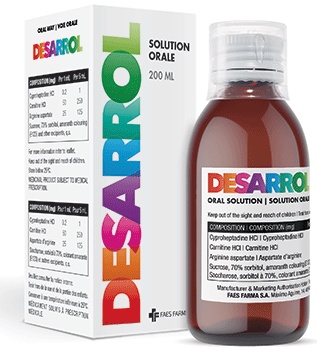
- The active ingredients are cyproheptadine hydrochloride, arginine aspartate, and carnitine hydrochloride. Each ml of solution contains 0.2 mg of cyproheptadine hydrochloride, 50 mg of carnitine hydrochloride, and 25 mg of arginine aspartate.
- The other ingredients (excipients) are: sorbitol (E-420), sucralose (E-955), methylparaben (E-219), raspberry flavor (contains ethanol), sodium hydroxide, amaranth dye (E123), and purified water.
Appearance of the product and package contents
Desarrol is presented in a glass bottle with a polypropylene/polyethylene high-density (PP/HDPE) cap with a child-resistant closure, which contains 200 ml of oral solution and a dosing cup.
Marketing authorization holder
Faes Farma, S.A.
Autonomia Etorbidea, 10
48940 Leioa (Bizkaia)
Spain
Manufacturer
Faes Farma, S.A.
Parque Científico y Tecnológico de Bizkaia
Ibaizabal Bidea, Edificio 901
48160 Derio (Bizkaia)
Spain
Date of the last revision of this package leaflet:February 2025
Detailed and updated information on this medicine is available on the website of the Spanish Agency for Medicines and Health Products (AEMPS) http://www.aemps.gob.es/
- Country of registration
- Dosage formORAL SOLUTION/SUSPENSION, -
- ATC codeA15ZZ91
- Active substance
- Prescription requiredYes
- Manufacturer
- CompositionAMARANTO (CI=16185,E-123) (0,5 mg mg), SOLUCION DE SORBITOL 70% (1250 mg mg), METIL PARABEN SODICO (7,5 mg mg), HIDROXIDO DE SODIO (E 524) (c.s.p (ajuste de PH) - mg)
- This information is for reference only and does not constitute medical advice. Always consult a doctor before taking any medication. Oladoctor is not responsible for medical decisions based on this content.
- Alternatives to DESARROL 50 mg/mL + 25 mg/mL + 0.2 mg/mL ORAL SOLUTIONDosage form: ORAL SOLUTION/SUSPENSION, 1000 mg / 3 mgActive substance: Appetite stimulantsManufacturer: Faes Farma S.A.Prescription requiredDosage form: INJECTABLE, 100 U/mlActive substance: insulin glargineManufacturer: Eli Lilly Nederland B.V.Prescription requiredDosage form: TABLET, 2 mgActive substance: loperamideManufacturer: Uxa Farma S.A.Prescription not required
Online doctors for DESARROL 50 mg/mL + 25 mg/mL + 0.2 mg/mL ORAL SOLUTION
Discuss questions about DESARROL 50 mg/mL + 25 mg/mL + 0.2 mg/mL ORAL SOLUTION, including use, safety considerations and prescription review, subject to medical assessment and local regulations.









Get DESARROL 50 mg/mL + 25 mg/mL + 0.2 mg/mL ORAL SOLUTION Prescription Online
Fill in a 2-min form
Tell us your symptoms, history, and what medicine you're requesting.
Pick a doctor or let us assign
Choose a specialist or we'll match you with the next available doctor.
Doctor reviews your case
Usually within 30 minutes. They may ask follow-up questions via chat.
Collect from any pharmacy
Electronic prescription sent to your email — valid across Spain.
Frequently Asked Questions
DESARROL 50 mg/mL + 25 mg/mL + 0.2 mg/mL ORAL SOLUTION requires a prescription in Spain. You can check with a doctor online whether this medicine may be appropriate for your situation.
The active ingredient in DESARROL 50 mg/mL + 25 mg/mL + 0.2 mg/mL ORAL SOLUTION is Appetite stimulants. This information helps identify medicines with the same composition but different brand names.
DESARROL 50 mg/mL + 25 mg/mL + 0.2 mg/mL ORAL SOLUTION is manufactured by Faes Farma S.A.. Pharmacy brands and packaging may differ depending on the distributor.
Doctors such as Family doctors, Psychiatrists, Dermatologists, Cardiologists, Endocrinologists, Gastroenterologists, Pulmonologists, Nephrologists, Rheumatologists, Hematologists, Infectious disease physicians, Allergists, Geriatricians, Paediatricians, Oncologists may assess whether DESARROL 50 mg/mL + 25 mg/mL + 0.2 mg/mL ORAL SOLUTION is appropriate, depending on your situation and local regulations. You can book an online consultation to discuss your symptoms and possible next steps.
Spain has a well-developed healthcare infrastructure across major cities such as Madrid, Barcelona, Valencia, and Seville. Pharmacies are widely available and operate under strict regulations, ensuring access to prescribed medications.
You can buy DESARROL 50 mg/mL + 25 mg/mL + 0.2 mg/mL ORAL SOLUTION in Madrid, Barcelona, Seville, or Valencia at any local pharmacy with a valid prescription.
To obtain a prescription, you can use Oladoctor:
Other medicines with the same active substance (Appetite stimulants) include DYNAMOGÉN 3 MG/1 G/10ML ORAL SOLUTION, ABASAGLAR 100 units/mL KwikPen prefilled pen injector solution, ABECLIN 2 mg TABLETS. These may have different brand names or formulations but contain the same therapeutic ingredient. Always consult a doctor before switching or starting a new medicine.
