



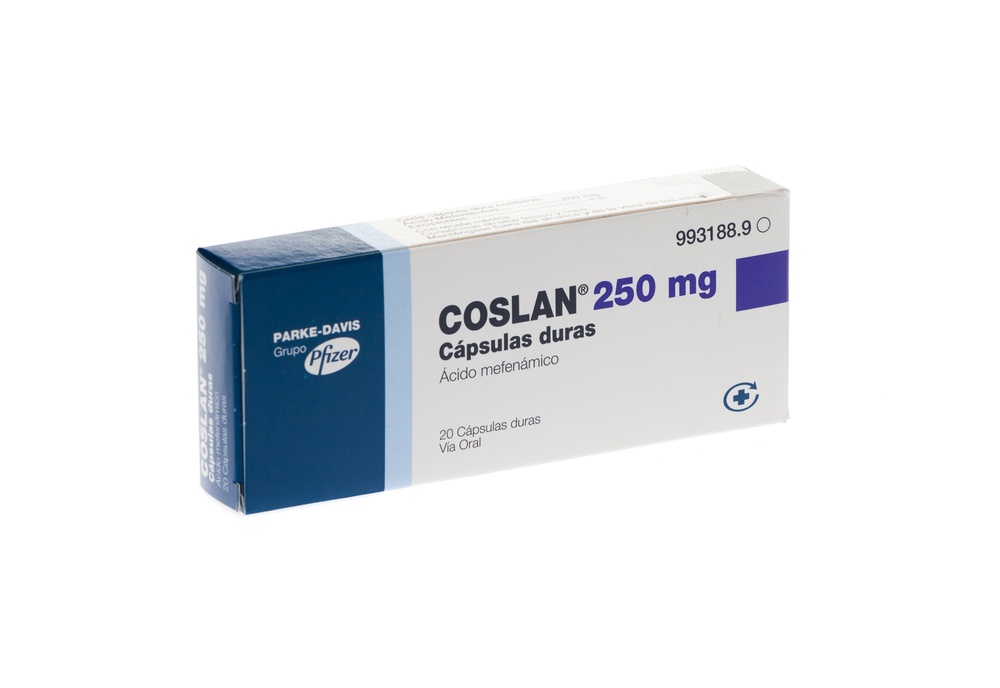
COSLAN 250 mg Hard Capsules

Prescription review online
A doctor will review your case and decide whether a prescription is medically appropriate.

Talk to a doctor about this medicine
Discuss your symptoms and possible next steps in a quick online consultation.



How to use COSLAN 250 mg HARD CAPSULES
Contents of the leaflet
- Introduction
- What is Coslan and what is it used for
- What you need to know before you take Coslan
- How to take Coslan
- Possible side effects
- Storage of Coslan
- Package Contents and Additional Information
Introduction
Package Leaflet: Information for the User
Coslan 250 mg Hard Capsules
Mefenamic Acid
Read all of this leaflet carefully before you start taking this medicine because it contains important information for you.
- Keep this leaflet, you may need to read it again.
- If you have any further questions, ask your doctor or pharmacist.
- This medicine has been prescribed for you only. Do not pass it on to others. It may harm them, even if their signs of illness are the same as yours.
- If you get any side effects, talk to your doctor or pharmacist. This includes any possible side effects not listed in this leaflet. See section 4.
Contents of the Pack
- What is Coslan and what is it used for
- What you need to know before you take Coslan
- How to take Coslan
- Possible side effects
- Storing Coslan
- Contents of the pack and other information
1. What is Coslan and what is it used for
Coslan belongs to a group of medicines called non-steroidal anti-inflammatory and anti-rheumatic drugs. The active ingredient of this medicine, mefenamic acid, has analgesic (pain-relieving), anti-inflammatory (reduces inflammation), and antipyretic (reduces fever) effects.
Coslan is indicated for the treatment of acute painful conditions of mild to moderate intensity, inflammatory manifestations, and febrile conditions of any cause. It is also used to treat painful or difficult menstruation (dysmenorrhea), excessive menstruation (menorrhagia), and for the symptomatic treatment of rheumatoid arthritis.

Not sure if this medicine is right for you?
Discuss your symptoms and treatment with a doctor online.
2. What you need to know before you take Coslan
It is important to use the smallest dose that relieves your pain and do not take this medicine for longer than necessary to control your symptoms.
Do not take Coslan
- If you are allergic to the active substance or any of the other ingredients of this medicine (listed in section 6).
- If you are in the third trimester of pregnancy.
- If you are allergic (hypersensitive) to acetylsalicylic acid or other non-steroidal anti-inflammatory drugs, it should not be administered to patients who present symptoms of bronchospasm, allergic rhinitis, or urticaria.
- If you have had a stomach or duodenal ulcer or have suffered a perforation of the digestive tract while taking a non-steroidal anti-inflammatory drug.
- If you have an active or recurrent peptic ulcer/gastrointestinal hemorrhage (two or more episodes of ulceration or bleeding confirmed).
- If you suffer from chronic inflammation of the upper or lower gastrointestinal tract.
- If you are going to undergo or have recently undergone heart artery surgery (bypass).
- If you have severe renal and hepatic impairment.
- If you have severe heart failure.
Warnings and Precautions
Consult your doctor or pharmacist before starting to take this medicine.
- If you have had or develop an ulcer, bleeding, or perforation in the stomach or duodenum, which may be manifested by intense or persistent abdominal pain and/or black stools, or even without previous warning symptoms.
- The risk of gastrointestinal bleeding, ulcer, or perforation is higher when using high doses and prolonged treatments, in patients with a history of peptic ulcers, and in elderly patients. In these cases, your doctor will consider the possibility of associating a stomach protective medication.
- If you are taking medications that alter blood coagulation, such as corticosteroids, oral anticoagulants, or antiplatelet agents of the acetylsalicylic acid type. You should also discuss the use of other medications that could increase the risk of such bleeding, such as corticosteroids and selective serotonin reuptake inhibitor antidepressants.
- If you suffer from Crohn's disease or ulcerative colitis, as medications of the Coslan type may worsen these conditions.
- If you have diarrhea, consult your doctor, as you may need to reduce the dose or suspend treatment.
- If you have liver or kidney problems (hepatic or renal insufficiency).
- If you have asthma (a disease of the bronchi characterized by difficult and tiring breathing, coughing, scarce expectoration, and wheezing when breathing), as crises may worsen.
- If during treatment, you present a skin rash or diarrhea. In this case, you should interrupt treatment and immediately inform your doctor.
- If you have ever presented with generalized fixed drug eruption (round or oval plaques with redness and swelling of the skin that usually reappear in the same site(s), blisters, urticaria, and itching) erythematous (redness of the skin) and edematous (swelling) after taking mefenamic acid.
- Potentially fatal skin reactions, such as DRESS syndrome, generalized fixed drug eruption, Stevens-Johnson syndrome, and toxic epidermal necrolysis, have been reported with the use of mefenamic acid, and treatment should be discontinued after the first appearance of skin rash, blisters, and skin peeling, mucosal lesions, or any other sign of hypersensitivity. If you present a skin rash or these other signs and symptoms of the skin or mucosa (such as inside the cheeks or lips), consult a doctor immediately and tell them that you are taking this medicine.
- If you have ever presented with fixed drug eruption (round or oval plaques with redness and swelling of the skin that usually reappear in the same site(s), blisters, urticaria, and itching) after taking mefenamic acid.
Cardiovascular or cerebrovascular precautions
- Medicines like Coslan may be associated with a moderate increase in the risk of suffering heart attacks ("myocardial infarctions") or strokes. This risk is more likely to occur when using high doses and prolonged treatments. Do not exceed the recommended dose or treatment duration.
The increase in this risk appears to be similar in patients with or without known cardiovascular disease or risk factors for cardiovascular disease. However, patients with known cardiovascular disease or risk factors for cardiovascular disease may have a higher risk.
If you have heart problems, a history of strokes, or think you may be at risk for these conditions (for example, you have high blood pressure, suffer from diabetes, have high cholesterol, or are a smoker), you should consult your doctor or pharmacist about this treatment.
- Also, this type of medication can cause fluid retention and edema (swelling caused by the accumulation of fluids in the body's tissues), especially in patients with heart failure and/or high blood pressure (hypertension).
Taking Coslan with other medicines
Tell your doctor or pharmacist if you are taking, have recently taken, or might take any other medicines.
- Medicines that alter blood coagulation (such as oral anticoagulants of the warfarin and coumarin type, and new oral anticoagulants: apixaban, dabigatran, rivaroxaban), antiplatelet agents of the acetylsalicylic acid type.
- Medicines that could increase the risk of ulcers or gastrointestinal bleeding, such as corticosteroids (medicines for asthma, allergies, ulcerative colitis, etc.).
- Medicines for depression (selective serotonin reuptake inhibitors).
- Medicines for controlling blood pressure, including diuretics, angiotensin-converting enzyme inhibitors, angiotensin II receptor antagonists (ARA II), and beta blockers.
- Other non-steroidal anti-inflammatory drugs different from acetylsalicylic acid, including selective COX-2 inhibitors.
- Medicines for the treatment of diabetes (insulin and oral medications that lower blood sugar levels).
- Lithium (medication for the treatment of bipolar disorder).
- Methotrexate (medication for psoriasis, rheumatoid arthritis, etc.).
- Cyclosporin, tacrolimus (medicines to prevent transplant rejection).
Interference with analytical tests
If you are going to undergo any diagnostic tests (including urine tests), inform your doctor that you are taking this medicine, as it may alter the results.
Taking Coslan with food, drinks, and alcohol
This medicine should be taken with a glass of water during or after food intake. You should not consume alcoholic beverages during treatment with this medicine, as it may increase the risk of adverse effects.
Pregnancy, breastfeeding, and fertility
If you are pregnant or breastfeeding, think you may be pregnant, or are planning to have a baby, ask your doctor or pharmacist for advice before taking this medicine.
Pregnancy
Consult your doctor or pharmacist before taking any medicine.
Non-steroidal anti-inflammatory drugs may cause kidney and heart problems in the fetus. Non-steroidal anti-inflammatory drugs may affect the tendency of mothers and their babies to bleed and delay or prolong labor more than expected.
From the 20th week of pregnancy, non-steroidal anti-inflammatory drugs may cause kidney problems in the fetus if taken for more than a few days, which can lead to low levels of amniotic fluid surrounding the baby (oligohydramnios) or narrowing of a blood vessel (ductal constriction) in the baby's heart. If you need treatment for more than a few days, your doctor may recommend additional monitoring. In these cases, the dose and duration will be limited to the minimum possible.
Breastfeeding
You should not take Coslan if you are breastfeeding your child, as part of the medicine may pass into breast milk.
Fertility
It may alter fertility in women who are trying to conceive; you should avoid using this medicine.
Driving and using machines
The influence of Coslan on the ability to drive and use machines is not known, as no appropriate studies have been conducted. However, Coslan may cause blurred vision, dizziness, and drowsiness, which may affect your ability to drive and use machines.
Coslan contains lactose
This medicine contains lactose. If your doctor has told you that you have an intolerance to some sugars, consult them before taking this medicine.
This medicine contains less than 1 mmol of sodium (23 mg) per capsule; this is essentially "sodium-free".
3. How to take Coslan
Follow exactly the administration instructions of this medicine indicated by your doctor or pharmacist. In case of doubt, consult your doctor or pharmacist again.
The recommended dose is:
Adults and adolescents over 14 years: 500 mg (2 hard capsules) three times a day. The dose may be reduced to 250 mg (1 capsule) four times a day, in patients who cannot tolerate the dose of 500 mg.
In the case of painful or difficult menstruation (dysmenorrhea) or excessive menstruation (menorrhagia), you should start taking the medicine at the beginning of pain or bleeding and continue while symptoms persist, according to your doctor's advice.
Method of administration:
It is recommended to swallow the capsule whole with a glass of water during or after food intake.
Use in children and adolescents
The safety and efficacy of this medicine in children under 14 years have not been established.
If you take more Coslan than you should
If you have accidentally taken too many capsules, consult your doctor immediately.
You may need medical attention.
With the recommended doses, the drug is very well tolerated, and intoxication is practically only present in cases of overdose or massive ingestion for non-therapeutic purposes. Intoxication manifests as gastrointestinal and nervous disorders. In cases of overdose, convulsions, acute renal failure, coma, confusion, dizziness, and hallucinations have been reported. Overdose can cause death.
After accidental overdose, the stomach should be emptied immediately by inducing vomiting or by gastric lavage, followed by the administration of activated charcoal. Vital functions should be monitored and maintained. Hemodialysis is of little value, as mefenamic acid and its metabolites are strongly bound to plasma proteins.
In case of overdose or accidental ingestion, consult the Toxicology Information Service.
Telephone 91 562 04 20.
If you forget to take Coslan
Do not take a double dose to make up for forgotten doses.
If you stop taking Coslan
If you have any other doubts about the use of this medicine, ask your doctor or pharmacist.

Started taking the medicine and have questions?
Discuss your symptoms and treatment with a doctor online.
4. Possible side effects
Like all medicines, this medicine can cause side effects, although not everybody gets them.
Side effects are rare and mild at the recommended doses for relieving pain (analgesic), they are detected quickly and can be easily controlled when they are due to overdose or prolonged use.
Common side effects (may affect between 1 and 10 in every 100 people):
- Increased eosinophils (eosinophilia).
- Constipation.
Uncommon side effects (may affect between 1 and 10 in every 1,000 people):
- Drowsiness.
- Abdominal pain, diarrhea, nausea with or without vomiting.
Frequency not known (cannot be estimated from the available data):
- Significant decrease in the number of white blood cells in the blood (agranulocytosis), some types of decrease in the number of red blood cells (aplastic anemia and autoimmune hemolytic anemia), decrease in blood production that originates in the bone marrow (bone marrow hypoplasia), decrease in the percentage of red blood cells in relation to the total blood volume (decrease in hematocrit), low white blood cell count (leucopenia), low platelet count (thrombocytopenia), purpura, inhibition of platelet aggregation.
- Anaphylaxis (excessive sensitivity reaction to certain substances).
- Intolerance to glucose in diabetic patients, low sodium levels in body fluids (hyponatremia), fluid retention.
- Nervousness.
- Aseptic meningitis (inflammation of the meninges), blurred vision, convulsions, dizziness, headache (cephalalgia), insomnia.
- Ocular irritation, reversible loss of color vision.
- Ear pain.
- Palpitations.
- Low blood pressure (hypotension), high blood pressure (hypertension).
- Asthma, difficulty breathing (dyspnea).
- Gastritis, gastrointestinal bleeding, stomach and intestinal ulcers, gastrointestinal perforation, loss of appetite (anorexia), indigestion (dyspepsia), enterocolitis, gas (flatulence), stomach ulcers with or without bleeding, blood in stools (melena), vomiting blood (hematemesis), mouth ulcers (stomatitis), colitis, worsening of colitis and Crohn's disease, heartburn (pyrosis), pancreatitis, presence of fat in the stools (steatorrhea).
- Yellowing of the skin and eyes (cholestatic jaundice), liver damage (rare), mild liver toxicity, hepatitis, decreased renal function in people with liver disease (hepato-renal syndrome).
- Swelling of the face, lips, tongue, and/or throat (angioedema), generalized peeling of the skin (exfoliative dermatitis), swelling of some parts of the body such as the face or larynx (laryngeal edema, facial edema), a type of skin rash (erythema multiforme), sweating, sensation of itching (pruritus), rash, hives on the skin usually accompanied by itching (urticaria). Blistering reactions including Stevens-Johnson syndrome and toxic epidermal necrolysis (Lyell's syndrome).
- A characteristic skin allergic reaction known as generalized fixed drug eruption, which usually reappears in the same site(s) when taking the medicine again and can be seen as round or oval plaques or erythematous (redness of the skin) and edematous (swelling) plaques or blisters (urticaria), sometimes with significant skin peeling. The frequency of this is not known (it cannot be estimated from the available data).
- A characteristic skin allergic reaction known as fixed drug eruption, which usually reappears in the same site(s) when taking the medicine again and can be seen as round or oval plaques with redness and swelling of the skin, blisters (urticaria), itching. The frequency of this is not known (it cannot be estimated from the available data).
- Painful, difficult, and incomplete urination (dysuria), presence of blood in the urine (hematuria), kidney failure (including papillary necrosis and tubulointerstitial nephritis, glomerulonephritis, nephrotic syndrome).
- Fluid retention (edema).
- Alteration in urine tests (urinary urobilinogen (false positive)), abnormal liver function test.
Other side effects in children and adolescents
In children and adolescents, low body temperature (hypothermia) may occur.
Reporting of side effects
If you experience any side effects, talk to your doctor or pharmacist, even if it is possible side effects not listed in this leaflet. You can also report side effects directly through the Spanish Pharmacovigilance System for Human Use Medicines: https://www.notificaram.es. By reporting side effects, you can help provide more information on the safety of this medicine.
5. Storage of Coslan
It does not require special storage conditions.
Keep this medicine out of sight and reach of children.
Do not use this medicine after the expiration date that appears on the blister pack and on the outer packaging after CAD. The expiration date is the last day of the month indicated.
Do not use this medicine if you notice that the packaging is damaged or open.
Medicines should not be thrown away through wastewater or household waste. Deposit the packaging and medicines you no longer need at the SIGRE Point of the pharmacy. In case of doubt, ask your pharmacist how to dispose of the packaging and medicines you no longer need. This way, you will help protect the environment.
6. Package Contents and Additional Information
Coslan Composition
- The active ingredient is mefenamic acid.
- The other components (excipients) are lactose monohydrate and magnesium stearate (E572) and sodium lauryl sulfate.
The components of the capsule are: gelatin, titanium dioxide (E171), iron oxide (E172), and indigotine (E132).
The components of the ink (color code 10A1) are: shellac lacquer, black iron oxide (E172), n-butyl alcohol, propylene glycol, isopropyl alcohol, purified water, purified ethanol, and 28% ammonium hydroxide.
Or
The components of the ink (color code 1014) are: shellac lacquer, dehydrated alcohol, isopropyl alcohol, butyl alcohol, propylene glycol, concentrated ammonia solution, black iron oxide (E172), potassium hydroxide, and purified water.
Appearance of the Product and Package Contents
Coslan is presented in hard gelatin capsules, with a light blue opaque cap and an ivory body. The body and cap are printed with "Parke Davis" in black. Coslan is available in a blister pack of aluminum/PVC laminate.
Each package contains 20 capsules.
Marketing Authorization Holder and Manufacturer
Marketing Authorization Holder:
Pfizer, S.L.
Avda. de Europa, 20 B
Parque Empresarial La Moraleja
28108 Alcobendas (Madrid) - Spain
Manufacturer:
Pfizer Manufacturing Deutschland GmbH
Mooswaldalle 1
79108 Freiburg Im Breisgau
Germany
Date of the Last Revision of this Leaflet: April 2024
Detailed and updated information on this medicine is available on the website of the Spanish Agency for Medicines and Health Products (AEMPS) http://www.aemps.gob.es/
- Country of registration
- Dosage formCAPSULE, 250 mg
- ATC codeM01AG01
- Average pharmacy price1.67 EUR
- Active substance
- Prescription requiredYes
- Manufacturer
- CompositionLACTOSA (95 mg mg)
- This information is for reference only and does not constitute medical advice. Always consult a doctor before taking any medication. Oladoctor is not responsible for medical decisions based on this content.
- Alternatives to COSLAN 250 mg HARD CAPSULESDosage form: TABLET, 100 mgActive substance: aceclofenacManufacturer: Laboratorios Cinfa S.A.Prescription requiredDosage form: TABLET, 100 mgActive substance: aceclofenacManufacturer: Kern Pharma S.L.Prescription requiredDosage form: TABLET, 100 mgActive substance: aceclofenacManufacturer: Laboratorios Normon S.A.Prescription required
Online doctors for COSLAN 250 mg HARD CAPSULES
Discuss questions about COSLAN 250 mg HARD CAPSULES, including use, safety considerations and prescription review, subject to medical assessment and local regulations.









Get COSLAN 250 mg HARD CAPSULES Prescription Online
Fill in a 2-min form
Tell us your symptoms, history, and what medicine you're requesting.
Pick a doctor or let us assign
Choose a specialist or we'll match you with the next available doctor.
Doctor reviews your case
Usually within 30 minutes. They may ask follow-up questions via chat.
Collect from any pharmacy
Electronic prescription sent to your email — valid across Spain.
Frequently Asked Questions
COSLAN 250 mg HARD CAPSULES requires a prescription in Spain. You can check with a doctor online whether this medicine may be appropriate for your situation.
The active ingredient in COSLAN 250 mg HARD CAPSULES is mefenamic acid. This information helps identify medicines with the same composition but different brand names.
The average pharmacy price for COSLAN 250 mg HARD CAPSULES is around 1.67 EUR. Prices may vary depending on the manufacturer and dosage form.
COSLAN 250 mg HARD CAPSULES is manufactured by Pfizer S.L.. Pharmacy brands and packaging may differ depending on the distributor.
Doctors such as Family doctors, Psychiatrists, Dermatologists, Cardiologists, Endocrinologists, Gastroenterologists, Pulmonologists, Nephrologists, Rheumatologists, Hematologists, Infectious disease physicians, Allergists, Geriatricians, Paediatricians, Oncologists may assess whether COSLAN 250 mg HARD CAPSULES is appropriate, depending on your situation and local regulations. You can book an online consultation to discuss your symptoms and possible next steps.
Spain has a well-developed healthcare infrastructure across major cities such as Madrid, Barcelona, Valencia, and Seville. Pharmacies are widely available and operate under strict regulations, ensuring access to prescribed medications.
You can buy COSLAN 250 mg HARD CAPSULES in Madrid, Barcelona, Seville, or Valencia at any local pharmacy with a valid prescription.
To obtain a prescription, you can use Oladoctor:
Other medicines with the same active substance (mefenamic acid) include ACECLOFENAC CINFA 100 mg FILM-COATED TABLETS, ACECLOFENAC KERN PHARMA 100 MG FILM-COATED TABLETS, ACECLOFENAC NORMON 100 mg FILM-COATED TABLETS. These may have different brand names or formulations but contain the same therapeutic ingredient. Always consult a doctor before switching or starting a new medicine.
