



CLORURO 5 mg /Ml Injectable Solution

Prescription review online
A doctor will review your case and decide whether a prescription is medically appropriate.

Talk to a doctor about this medicine
Discuss your symptoms and possible next steps in a quick online consultation.



How to use METHYLTHIONINIUM CHLORIDE PROVEBLUE 5 mg/ml INJECTABLE SOLUTION
Contents of the leaflet
- Introduction
- Package Leaflet: Information for the User
- Read all of this leaflet carefully before you are given this medicine because it contains important information for you.
- Contents of the Package Leaflet
- What is Methylthioninium Chloride Proveblue and what is it used for
- What you need to know before you are given Methylthioninium Chloride Proveblue
- Warnings and Precautions
- Photosensitivity
- Monitoring Tests
- Children
- Other Medicines and Methylthioninium Chloride Proveblue
- Pregnancy and Breast-feeding
- Driving and Using Machines
- How Methylthioninium Chloride Proveblue is Administered
- Adults, Children Over 3 Months, and Elderly
- Infants Under 3 Months
- If You Receive More Methylthioninium Chloride Proveblue Than You Should
- Possible Side Effects
- Reporting of Side Effects
- Storage of Methylthioninium Chloride Proveblue
- Contents of the Pack and Further Information
- Appearance and Packaging
- Marketing Authorisation Holder
- Manufacturer
- Tel: + 44 (0)1277 266600
- Date of Last Revision
Introduction
Package Leaflet: Information for the User
Methylthioninium Chloride Proveblue 5 mg/ml Solution for Injection
Methylthioninium Chloride

Not sure if this medicine is right for you?
Discuss your symptoms and treatment with a doctor online.
Read all of this leaflet carefully before you are given this medicine because it contains important information for you.
- Keep this leaflet, you may need to read it again.
- If you have any further questions, ask your doctor or nurse.
- If you get any side effects, talk to your doctor or nurse, even if you think they might be unrelated to the medicine. See section 4.
Contents of the Package Leaflet
- What is Methylthioninium Chloride Proveblue and what is it used for
- What you need to know before you are given Methylthioninium Chloride Proveblue
- How Methylthioninium Chloride Proveblue is administered
- Possible side effects
- Storage of Methylthioninium Chloride Proveblue
- Contents of the pack and further information

Started taking the medicine and have questions?
Discuss your symptoms and treatment with a doctor online.
1. What is Methylthioninium Chloride Proveblue and what is it used for
Methylthioninium chloride (also known as methylthioninium) belongs to a group of medicines called antidotes.
Methylthioninium Chloride Proveblue will be administered to you or your child (0-17 years) to treat blood problems caused by exposure to certain medicines or chemicals that can cause a disease called methaemoglobinaemia.
In methaemoglobinaemia, the blood contains too much methaemoglobin (an abnormal form of haemoglobin that cannot carry oxygen around the body effectively).
This medicine will help to normalise the haemoglobin and restore oxygen transport in the blood.
2. What you need to know before you are given Methylthioninium Chloride Proveblue
You must not be given Methylthioninium Chloride Proveblue:
- if you are allergic to methylthioninium chloride or to other thiazine derivatives
- if your body does not produce enough of the enzyme G6PD (glucose-6-phosphate dehydrogenase)
- if your body does not produce enough of the enzyme NADPH (nicotinamide adenine dinucleotide phosphate) reductase
- if the blood disorder has been caused by nitrite during treatment of cyanide poisoning
- if the blood disorder was caused by chlorate poisoning.
Warnings and Precautions
Talk to your doctor or nurse before you are given Methylthioninium Chloride Proveblue
- if you have moderate or severe kidney disease; the dose may need to be reduced (< 1 mg/kg)
- if your blood disorder has been caused by a chemical called aniline, found in dyes; the dose may need to be reduced, and the total cumulative dose must not exceed 4 mg/kg (see section 3 of this leaflet)
- if your blood disorder has been caused by a medicine called dapsone (used to treat leprosy and other skin diseases); the dose may need to be reduced, and the total cumulative dose must not exceed 4 mg/kg (see section 3)
- if you have hyperglycaemia or diabetes mellitus, as these conditions may worsen due to the glucose solution used for dilution of the medicine
- urine and stools may turn a blue-green colour and the skin may turn blue when you are treated with Methylthioninium Chloride Proveblue. This colour change is expected and will disappear when treatment is stopped.
If any of the above applies to you, talk to your doctor.
Photosensitivity
Methylthioninium chloride may cause a photosensitivity reaction on the skin (similar to sunburn) when exposed to intense light sources such as phototherapy, operating room lights, and pulse oximeters.
Protective measures against light exposure should be taken.
Monitoring Tests
You will have monitoring tests during and after treatment with Methylthioninium Chloride Proveblue.
Children
Special care is needed with Methylthioninium Chloride Proveblue:
- in newborns and infants under 3 months, lower doses are recommended (see section 3 of this leaflet).
Other Medicines and Methylthioninium Chloride Proveblue
Tell your doctor, pharmacist, or nurse if you are using or have recently used or might use any other medicines.
You must not be given Methylthioninium Chloride if you are taking certain medicines for depression or anxiety that affect a chemical in the brain called serotonin. If used together, methylthioninium chloride can cause serotonin syndrome, which can be life-threatening. These medicines are:
- selective serotonin reuptake inhibitors (SSRIs) such as citalopram, escitalopram, fluoxetine, fluvoxamine, paroxetine, sertraline, and zimeldine
- bupropion
- buspirone
- clomipramine
- mirtazapine
- venlafaxine
- monoamine oxidase inhibitors.
However, if intravenous administration of Methylthioninium Chloride cannot be avoided, you should be given the lowest possible dose and monitored for 4 hours after administration.
If you are unsure whether you should be given this medicine, talk to your doctor.
Pregnancy and Breast-feeding
If you are pregnant or breast-feeding, think you may be pregnant or are planning to have a baby, ask your doctor for advice before being given this medicine.
The use of Methylthioninium Chloride Proveblue is not recommended during pregnancy unless clearly necessary, for example in a life-threatening situation.
Due to the lack of data on whether methylthioninium chloride passes into human milk, breast-feeding should be interrupted for 8 days after treatment with this medicine.
Driving and Using Machines
Do not drive or use tools or machines as methylthioninium chloride has a moderate influence on the ability to drive and use machines.
3. How Methylthioninium Chloride Proveblue is Administered
Your doctor will inject this medicine into a vein (intravenously) slowly over a period of 5 minutes.
Adults, Children Over 3 Months, and Elderly
The usual dose is 1 to 2 mg per kilogram of body weight, i.e. 0.20 to 0.4 ml per kilogram, administered over a period of 5 minutes. A second dose may be administered after one hour if necessary.
The maximum recommended cumulative dose during the entire treatment is 7 mg/kg.
If the blood disorder has been caused by aniline or dapsone, the total cumulative dose must not exceed 4 mg/kg (see section 2).
Treatment should not usually last more than one day.
Infants Under 3 Months
The recommended dose is 0.3 to 0.5 mg/kg of body weight, i.e. 0.06 to 0.1 ml/kg, administered over a period of 5 minutes.
A repeated dose (0.3 to 0.5 mg/kg of body weight, i.e. 0.06-0.1 ml/kg) may be administered after one hour in case of persistence or recurrence of symptoms. Treatment should not usually last more than one day.
This medicine may be diluted in 50 ml of glucose 5% injection solution (50 mg/ml) to avoid local pain, especially in children.
If You Receive More Methylthioninium Chloride Proveblue Than You Should
Since this medicine will be administered to you while you are in the hospital, it is unlikely that you will receive too much or too little; however, tell your doctor if you notice any of the following side effects:
- nausea
- stomach pain
- chest pain
- dizziness
- headache
- sweating
- confusion
- increased methaemoglobin (an abnormal form of haemoglobin in the blood)
- high blood pressure
- breathing difficulties
- abnormal heart rhythm
- tremor
- skin colour changes (your skin may turn blue)
- reduction in the number of red blood cells, which can cause paleness, shortness of breath, and weakness
- jaundice (yellowing of the skin and eyes); only reported in infants
If you have any other questions about the use of this medicine, ask your doctor or pharmacist.
4. Possible Side Effects
Like all medicines, Methylthioninium Chloride Proveblue can cause side effects, although not everybody gets them.
These effects are the same in adults and children, except for jaundice, which has only been reported in infants.
- Very Common Side Effects(may affect more than 1 in 10 people)
- pain in the limbs
- dizziness
- sweating
- skin colour changes. Your skin may turn blue
- blue or green urine
- numbness and tingling
- abnormal taste in the mouth
- nausea
- Common Side Effects(may affect up to 1 in 10 people):
- stomach pain
- chest pain
- headache
- anxiety
- pain at the injection site
- vomiting
- Frequency Not Known(frequency cannot be estimated from the available data):
- serotonin syndrome when Methylthioninium Chloride Proveblue is taken with certain medicines for depression or anxiety, see section 2
- reduction of haemoglobin levels (a protein in red blood cells that carries oxygen in the blood) in blood tests
- reduction in the number of red blood cells, which can cause paleness, shortness of breath, and weakness
- tissue damage at the injection site
- jaundice (yellowing of the skin and eyes); only reported in infants
- speech problems
- increased or decreased blood pressure
- agitation
- lack of oxygen
- irregular heartbeats, including abnormally slow or fast heart rate
- severe allergic reactions (anaphylactic reaction, which can cause swelling of the throat or face, difficulty breathing, or a severe rash)
- increased methaemoglobin (an abnormal form of haemoglobin in the blood)
- breathing difficulties
- confusion
- tremor
- hiccups
- fever
- rapid breathing
- dilated pupils
- change in stool colour. Stools may appear green or blue
- increased sensitivity of the skin to light (photosensitivity).
Reporting of Side Effects
If you experience any side effects, talk to your doctor or pharmacist, or nurse, even if you think they might be unrelated to the medicine. You can also report side effects directly via the national reporting system listed in Appendix V. By reporting side effects, you can help provide more information on the safety of this medicine.
5. Storage of Methylthioninium Chloride Proveblue
Keep this medicine out of the sight and reach of children.
Do not use this medicine after the expiry date which is stated on the carton and on the label of the ampoule after EXP. The expiry date refers to the last day of the month stated.
Do not refrigerate or freeze. Store the ampoule in the original packaging to protect it from light.
The medicine should be used immediately after opening or dilution.
Do not use Methylthioninium Chloride Proveblue if the solution shows signs of change, is cloudy or contains precipitates or particles.
Disposal of unused medicine and all materials that have come into contact with it should be done according to local regulations.
6. Contents of the Pack and Further Information
Composition of Methylthioninium Chloride Proveblue
- The active substance is methylthioninium chloride.
Each ml of solution contains 5 mg of methylthioninium chloride. Each 10 ml ampoule contains 50 mg of methylthioninium chloride. Each 2 ml ampoule contains 10 mg of methylthioninium chloride.
- The other ingredient is water for injections.
Appearance and Packaging
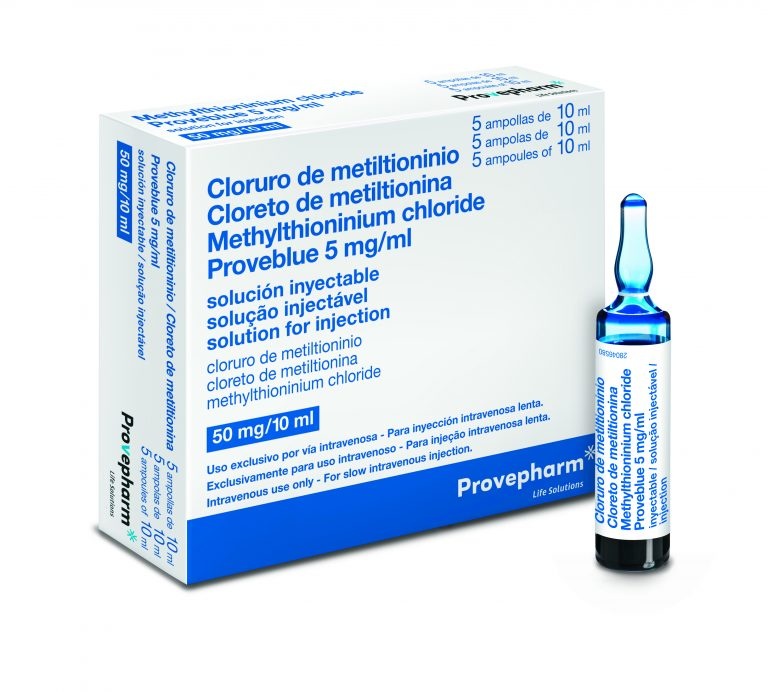
Methylthioninium Chloride Proveblue is a clear, dark blue solution for injection, supplied in transparent glass ampoules.
Each carton contains a tray with 5 ampoules of 10 ml. Each carton contains a tray with 5 ampoules of 2 ml. Each carton contains a tray with 20 ampoules of 2 ml.
Marketing Authorisation Holder
Provepharm SAS
22 rue Marc Donadille, 13013 Marseille, France
Manufacturer
Pierrel S.p.A.
s.s. Appia 7 bis, 46/48, 81043 Capua, Italy
Cenexi
52, Rue Marcel et Jacques Gaucher, 94120 Fontenay-sous-Bois, France
You can obtain further information on this medicine from the local representative of the Marketing Authorisation Holder:
België/Belgique/Belgien
Lamepro B.V.
Tel: + 31 (0) 76-5600030
Lietuva
Provepharm SAS
Tel: +33 (0)4 91 08 69 30
26
????????
Provepharm SAS
Tel: + 33 (0)4 91 08 69 30
Luxembourg/Luxemburg
Lamepro B.V.
Tel: + 31 (0) 76-5600030
Ceskárepublika
LERAM pharmaceuticals s.r.o
Tel: +420 737 657 454
Magyarország
Mediwings Pharma Kft.
Tel.: + 36 28 410 463
Danmark
Pharmanovia A/S
Tlf: + 45 33 33 76 33
Malta
Provepharm SAS
Tel: + 33 (0)4 91 08 69 30
Deutschland
Dr. Franz Köhler Chemie GmbH
Tel: + 49 (0) 6251-1083-0
Nederland
Lamepro B.V
Tel: + 31 (0) 76-5600030
Eesti
Provepharm SAS
Tel: + 33 (0)4 91 08 69 30
Norge
Pharmanovia A/S
Tlf: + 45 33 33 76 33
Ελλ?δα
a VIPharma International AE
Τηλ: + 30-210-6194170
Österreich
Dr. Franz Köhler Chemie GmbH
Tel: + 49 (0) 6251-1083-0
España
Fresenius Kabi España, S.A.U.
Tel: + 34 93 225 65 65
Polska
AB Pharm Sp. z o.o.
Tel: + 48 694 775 205
France
Provepharm SAS
Tél: + 33 (0)4 91 08 69 30
Portugal
Labesfal - Laboratórios Almiro
Tel: + 351 232 831100
Hrvatska
Provepharm SAS
Tel: + 33 (0)4 91 08 69 30
Ireland
Laboratoires ETHYPHARM
Tel: + 33 1 41 12 65 63
România
Dynamic Medical Solutions
Tel: + 40 (0)725596648
Slovenija
Provepharm SAS
Tel: + 33 (0)4 91 08 69 30
Ísland
Pharmanovia A/S
Sími: + 45 33 33 76 33
Slovenská republika
LERAM pharmaceuticals s.r.o
Tel: +420 737 657 454
Italia
Medac Pharma S.r.l.
Tel: + 39 06 51 59 121
Suomi/Finland
Pharmanovia A/S
Puh/Tel: + 45 33 33 76 33
Κ?προς
Isangen Pharma Cyprus Ltd
Τηλ: + 357-24-638833
Sverige
Pharmanovia A/S
Tel: + 45 33 33 76 33
Latvija
Provepharm SAS
Tel: + 33 (0)4 91 08 69 30
United Kingdom
Martindale Pharmaceuticals Ltd
Tel: + 44 (0)1277 266600
Date of Last Revision
Detailed information on this medicine is available on the European Medicines Agency website: http://www.ema.europa.eu/.
<
This information is intended only for healthcare professionals:
Preparation for Intravenous Administration
Use the product immediately after opening. Inject slowly over 5 minutes.
Methylthioninium Chloride Proveblue is hypotonic and may be diluted in 50 ml of glucose 5% injection solution (50 mg/ml) to avoid local pain, especially in the paediatric population. It must not be diluted in sodium chloride 9 mg/ml (0.9%) injection solution, as it has been shown that chloride reduces the solubility of methylthioninium chloride.
Section 3 of the leaflet provides additional information on the administration of Methylthioninium Chloride Proveblue.
Disposal of unused medicine and all materials that have come into contact with it should be done according to local regulations.
- Country of registration
- Dosage formINJECTABLE, 5 mg/ml
- ATC codeV03AB17
- Active substance
- Prescription requiredYes
- Manufacturer
- This information is for reference only and does not constitute medical advice. Always consult a doctor before taking any medication. Oladoctor is not responsible for medical decisions based on this content.
- Alternatives to METHYLTHIONINIUM CHLORIDE PROVEBLUE 5 mg/ml INJECTABLE SOLUTIONDosage form: INJECTABLE, 5 mg/mlActive substance: methylthioninium chlorideManufacturer: ProvepharmPrescription requiredDosage form: INJECTABLE, 0.5 mg/5 mlActive substance: flumazenilManufacturer: Cheplapharm Arzneimittel GmbhPrescription requiredDosage form: INJECTABLE, 1 mg flumazenil/10 mlActive substance: flumazenilManufacturer: Cheplapharm Arzneimittel GmbhPrescription required
Online doctors for METHYLTHIONINIUM CHLORIDE PROVEBLUE 5 mg/ml INJECTABLE SOLUTION
Discuss questions about METHYLTHIONINIUM CHLORIDE PROVEBLUE 5 mg/ml INJECTABLE SOLUTION, including use, safety considerations and prescription review, subject to medical assessment and local regulations.









Get METHYLTHIONINIUM CHLORIDE PROVEBLUE 5 mg/ml INJECTABLE SOLUTION Prescription Online
Fill in a 2-min form
Tell us your symptoms, history, and what medicine you're requesting.
Pick a doctor or let us assign
Choose a specialist or we'll match you with the next available doctor.
Doctor reviews your case
Usually within 30 minutes. They may ask follow-up questions via chat.
Collect from any pharmacy
Electronic prescription sent to your email — valid across Spain.
Frequently Asked Questions
METHYLTHIONINIUM CHLORIDE PROVEBLUE 5 mg/ml INJECTABLE SOLUTION requires a prescription in Spain. You can check with a doctor online whether this medicine may be appropriate for your situation.
The active ingredient in METHYLTHIONINIUM CHLORIDE PROVEBLUE 5 mg/ml INJECTABLE SOLUTION is methylthioninium chloride. This information helps identify medicines with the same composition but different brand names.
METHYLTHIONINIUM CHLORIDE PROVEBLUE 5 mg/ml INJECTABLE SOLUTION is manufactured by Provepharm. Pharmacy brands and packaging may differ depending on the distributor.
Doctors such as Family doctors, Psychiatrists, Dermatologists, Cardiologists, Endocrinologists, Gastroenterologists, Pulmonologists, Nephrologists, Rheumatologists, Hematologists, Infectious disease physicians, Allergists, Geriatricians, Paediatricians, Oncologists may assess whether METHYLTHIONINIUM CHLORIDE PROVEBLUE 5 mg/ml INJECTABLE SOLUTION is appropriate, depending on your situation and local regulations. You can book an online consultation to discuss your symptoms and possible next steps.
Spain has a well-developed healthcare infrastructure across major cities such as Madrid, Barcelona, Valencia, and Seville. Pharmacies are widely available and operate under strict regulations, ensuring access to prescribed medications.
You can buy METHYLTHIONINIUM CHLORIDE PROVEBLUE 5 mg/ml INJECTABLE SOLUTION in Madrid, Barcelona, Seville, or Valencia at any local pharmacy with a valid prescription.
To obtain a prescription, you can use Oladoctor:
Other medicines with the same active substance (methylthioninium chloride) include Methylthioninium Chloride Proveblue 5 mg/ml Injectable Solution, ANEXATE 0.5 mg/5 ml INJECTABLE SOLUTION, ANEXATE 1 mg/10 ml INJECTABLE SOLUTION. These may have different brand names or formulations but contain the same therapeutic ingredient. Always consult a doctor before switching or starting a new medicine.
