



AXURA 5 mg /Pulsation Oral Solution

Prescription review online
A doctor will review your case and decide whether a prescription is medically appropriate.

Talk to a doctor about this medicine
Discuss your symptoms and possible next steps in a quick online consultation.



How to use AXURA 5 mg/PULSATION, ORAL SOLUTION
Contents of the leaflet
- Introduction
- What Axura is and what it is used for
- What you need to know before you take Axura
- How to take Axura
- Possible side effects
- Storage of Axura
- Container Contents and Additional Information
Introduction
Package Leaflet: Information for the User
Axura 5 mg/pump oral solution
Memantine hydrochloride
Read all of this leaflet carefully before you start taking this medicine because it contains important information for you.
- Keep this leaflet, you may need to read it again.
- If you have any further questions, ask your doctor or pharmacist.
- This medicine has been prescribed for you only. Do not pass it on to others. It may harm them, even if their signs of illness are the same as yours.
- If you get any side effects, talk to your doctor or pharmacist. This includes any possible side effects not listed in this leaflet. See section 4.
Contents of the pack
- What Axura is and what it is used for
- What you need to know before you take Axura
- How to take Axura
- Possible side effects
- Storage of Axura
- Contents of the pack and other information
1. What Axura is and what it is used for
How Axura works
Axura contains the active substance memantine hydrochloride.
Axura belongs to a group of medicines called anti-dementia medicines.
Memory loss in Alzheimer's disease is due to a disturbance in brain signals. The brain contains so-called N-methyl-D-aspartate (NMDA) receptors that are involved in the transmission of important nerve signals in learning and memory. Axura belongs to a group of medicines called NMDA receptor antagonists. Axura acts on these receptors, improving the transmission of nerve signals and memory.
What Axura is used for
Axura is used in the treatment of patients with moderate to severe Alzheimer's disease.

Not sure if this medicine is right for you?
Discuss your symptoms and treatment with a doctor online.
2. What you need to know before you take Axura
Do not take Axura
- if you are allergic (hypersensitive) to memantine hydrochloride or any of the other ingredients of this medicine (listed in section 6).
Warnings and precautions
Consult your doctor or pharmacist before taking Axura
- if you have a history of epileptic seizures (convulsions)
- if you have recently suffered a myocardial infarction (heart attack), if you suffer from congestive heart failure or if you have uncontrolled hypertension (high blood pressure).
In these situations, treatment should be carefully supervised and your doctor should regularly re-evaluate the clinical benefit of Axura.
If you have kidney problems, your doctor should closely monitor your kidney function and, if necessary, adjust the dose of memantine.
The use of memantine should be avoided with other medicines such as amantadine (for the treatment of Parkinson's disease), ketamine (a medicine generally used to produce anesthesia), dextromethorphan (a medicine for the treatment of cough) and other NMDA antagonists.
Children and adolescents
Axura is not recommended for use in children and adolescents under 18 years of age.
Taking Axura with other medicines
Tell your doctor or pharmacist if you are using or have recently used or might use any other medicines.
In particular, the administration of Axura may produce changes in the effects of the following medicines and it may be necessary for your doctor to adjust the dose:
- amantadine, ketamine, dextromethorphan
- dantrolene, baclofen
- cimetidine, ranitidine, procainamide, quinidine, quinine, nicotine
- hydrochlorothiazide (or any combination with hydrochlorothiazide)
- anticholinergics (substances generally used to treat movement disorders or intestinal spasms)
- anticonvulsants (substances used to prevent and eliminate convulsions)
- barbiturates (substances generally used to induce sleep)
- dopaminergic agonists (substances such as L-dopa, bromocriptine)
- neuroleptics (substances used in the treatment of mental illnesses)
- oral anticoagulants
If you are hospitalized, inform your doctor that you are taking Axura.
Taking Axura with food and drinks
You should inform your doctor if you have recently changed or intend to change your diet substantially (e.g. from a normal diet to a strict vegetarian diet) or if you have renal tubular acidosis (RTA, excess of acid-producing substances in the blood due to kidney dysfunction) or severe urinary tract infections (urinary tract), as your doctor may need to adjust the dose of the medicine.
Pregnancy and breastfeeding
If you are pregnant or breastfeeding, think you may be pregnant or are planning to have a baby, ask your doctor or pharmacist for advice before taking this medicine.
Pregnancy
The use of memantine is not recommended in pregnant women.
Breastfeeding
Women taking Axura should stop breastfeeding.
Driving and using machines
Your doctor will inform you whether your illness allows you to drive and use machines safely. Additionally, Axura may alter your reaction ability, so driving or operating machines may be inappropriate.
Axura contains sorbitol
This medicine contains 100 mg of sorbitol per gram, which is equivalent to 200 mg/4 pumps. Sorbitol is a source of fructose. If your doctor has told you that you have an intolerance to some sugars, or if you have been diagnosed with hereditary fructose intolerance (HFI), a rare genetic disorder by which the patient cannot break down fructose, talk to your doctor before taking or receiving this medicine.
Additionally, this medicine contains potassium, less than 1 mmol (39 mg) per dose, i.e. essentially potassium-free.
3. How to take Axura
Follow exactly the administration instructions of this medicine as indicated by your doctor. In case of doubt, ask your doctor or pharmacist
Posology
One pump contains 5 mg of memantine hydrochloride.
The recommended dose of Axura in adult and elderly patients is four pumps, equivalent to 20 mg per day.
To reduce the risk of side effects, this dose is gradually achieved by following the daily scheme:
week 1 | one pump |
week 2 | two pumps |
week 3 | three pumps |
week 4 and subsequent | four pumps |
The usual starting dose is one pump (1 x 5 mg) once a day for the first week. This dose is increased to two pumps once a day for the second week (1 x 10 mg) and to 3 pumps (1 x 15 mg) once a day for the third week. From the fourth week onwards, the recommended dose is four pumps once a day (1 x 20 mg).
Posology for patients with reduced renal function
If you have kidney problems, your doctor will decide on the appropriate dose for your condition. In this case, your doctor should periodically monitor your kidney function.
Administration
Axura should be administered orally once a day. To get the most out of your medication, you should take it every day and at the same time. The solution should be taken with a little water. The solution can be taken with or without food.
For detailed instructions on the preparation and handling of the product, see the end of this leaflet.
Duration of treatment
Continue taking Axura as long as it benefits you. Your doctor should evaluate your treatment periodically.
If you take more Axura than you should
- Generally, taking an excessive amount of Axura should not cause you any harm. You may experience an increase in the symptoms described in section 4 "Possible side effects".
- If you take an overdose of Axura, contact your doctor or seek medical advice, as you may need medical attention.
If you forget to take Axura
- If you realize that you have forgotten to take your dose of Axura, wait and take the next dose at the usual time.
- Do not take a double dose to make up for the forgotten dose.
If you have any further questions on the use of this medicine, ask your doctor or pharmacist.

Started taking the medicine and have questions?
Discuss your symptoms and treatment with a doctor online.
4. Possible side effects
Like all medicines, this medicine can cause side effects, although not everybody gets them.
Side effects are usually mild to moderate.
Common (may affect up to 1 in 10 people):
- Headache, drowsiness, constipation, elevated liver function tests, dizziness, balance disorder, shortness of breath, high blood pressure, and hypersensitivity to the medicine
Uncommon (may affect up to 1 in 100 people):
- Fatigue, fungal infections, confusion, hallucinations, vomiting, gait disturbance, heart failure, and venous thrombosis/thromboembolism
Rare (may affect up to 1 in 10,000 people):
- Seizures
Frequency not known (frequency cannot be estimated from the available data):
- Pancreatitis, hepatitis (inflammation of the liver), and psychotic reactions
Alzheimer's disease has been associated with depression, suicidal ideation, and suicide. These events have been reported in patients treated with Axura.
Reporting of side effects
If you experience any side effects, talk to your doctor or pharmacist, even if they are not listed in this leaflet. You can also report side effects directly through the national reporting system included in Annex V. By reporting side effects, you can help provide more information on the safety of this medicine.
5. Storage of Axura
Keep out of the sight and reach of children.
Do not use this medicine after the expiry date which is stated on the carton and on the label of the bottle after EXP. The expiry date is the last day of the month stated.
Do not store above 30°C.
Once opened, the contents of the bottle should be used within 3 months.
The bottle with the pump mounted must be stored and transported only in an upright position.
Medicines should not be disposed of via wastewater or household waste. Place the packaging and any unused medicine in the pharmacy's SIGRE point. If you have any further questions on the disposal of the packaging or unused medicine, ask your pharmacist. This will help protect the environment.
6. Container Contents and Additional Information
Axura Composition
The active ingredient is memantine hydrochloride.
Each actuation of the dispenser releases 0.5 ml of solution containing 5 mg of memantine hydrochloride, equivalent to 4.16 mg of memantine.
The other components are potassium sorbate, sorbitol E 420, and purified water.
Product Appearance and Container Contents
Axura, oral solution, is a clear, colorless to slightly yellowish solution.
Axura, oral solution, is available in 50 ml, 100 ml, or multiple packaging with 500 ml (10 x 50 ml).
Only some pack sizes may be marketed.
Marketing Authorization Holder
Merz Pharmaceuticals GmbH
Eckenheimer Landstr. 100
D-60318 Frankfurt/Main
Germany
Manufacturer
Merz Pharma GmbH + Co. KGaA
Eckenheimer Landstr. 100
D-60318 Frankfurt/Main
Germany
You can request more information about this medicinal product by contacting the local representative of the marketing authorization holder.
Belgium/Belgique/Belgiën Merz Pharmaceuticals GmbH Tel: +49 (0)69 1503 – 0 | Lithuania Merz Pharmaceuticals GmbH Tel: +49 (0)69 1503 – 0 |
Greece Merz Pharmaceuticals GmbH Tel: +49 (0)69 1503 – 0 | Luxembourg/Luxemburg HANFF Global Health Solutions s.à r.l. Tel: +352 45 07 07-1 |
Czech Republic Merz Pharmaceuticals GmbH Tel: +49 (0)69 1503 – 0 | Hungary Merz Pharmaceuticals GmbH Tel: +49 (0)69 1503 – 0 |
Denmark Merz Pharmaceuticals GmbH Tel: +49 (0)69 1503 – 0 | Malta Clinipharm Co. Ltd Tel: +356 21 43 74 15 |
Germany Merz Pharmaceuticals GmbH Tel: +49 (0)69 1503 - 0 | Netherlands Merz Pharmaceuticals GmbH Tel: +49 (0)69 1503 – 0 |
Estonia Merz Pharmaceuticals GmbH Tel: +49 (0)69 1503 – 0 | Norway Merz Pharmaceuticals GmbH Tel: +49 (0)69 1503 – 0 |
Greece Merz Pharmaceuticals GmbH Tel: +49 (0)69 1503 - 0 | Austria Merz Pharma Austria GmbH Tel: +43 1 865 88 95 |
Spain Merz Therapeutics Iberia, S.L.U. Tel: +34 91 117 89 17 | Poland Centrala Farmaceutyczna CEFARM SA Tel: +48 22 634 02 22 |
France Merz Pharmaceuticals GmbH Tel: +49 (0)69 1503 – 0 | Portugal Merz Therapeutics Iberia, S.L.U. Tel: +34 91 117 89 17 |
Croatia Merz Pharmaceuticals GmbH Tel: +49 (0)69 1503 – 0 | Romania Merz Pharmaceuticals GmbH Tel: +49 (0)69 1503 – 0 |
Ireland Merz Pharmaceuticals GmbH Tel: +49 (0)69 1503 – 0 | Slovenia Merz Pharmaceuticals GmbH Tel: +49 (0)69 1503 - 0 |
Iceland Merz Pharmaceuticals GmbH Tel: +49 (0)69 1503 – 0 | Slovakia Merz Pharmaceuticals GmbH Tel: +49 (0)69 1503 – 0 |
Italy Merz Pharmaceuticals GmbH Tel: +49 (0)69 1503 - 0 | Finland Merz Pharmaceuticals GmbH Tel: +49 (0)69 1503 – 0 |
Cyprus Merz Pharmaceuticals GmbH Tel: +49 (0)69 1503 - 0 | Sweden Merz Pharmaceuticals GmbH Tel: +49 (0)69 1503 – 0 |
Latvia Merz Pharmaceuticals GmbH Tel: +49 (0)69 1503 – 0 | United Kingdom (Northern Ireland) Merz Pharmaceuticals GmbH Tel: +49 (0)69 1503 – 0 |
Date of the last revision of this leaflet: (MM/YYYY).
Detailed information on this medicinal product is available on the European Medicines Agency website: http://www.ema.europa.eu.
Instructions for the Correct Use of the Dispenser
The solution should not be poured or dispensed directly into the mouth from the bottle or dispenser. Measure the dose in a spoon or in a glass of water using the dispenser.
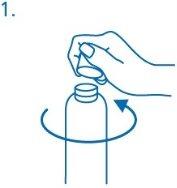
Remove the screw cap from the bottle:
The cap should be turned counterclockwise, completely unscrewed, and removed (fig. 1).
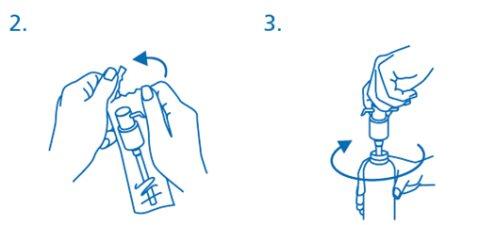
Assembling the dispenser on the bottle:
Remove the dispenser from the plastic bag (fig. 2) and place it on top of the bottle. Carefully insert the plastic tube into the bottle. Keep the dispenser on the bottle neck and turn it clockwise until it is firmly attached (fig. 3). The dispenser should only be screwed on once when starting use and should never be unscrewed.
How the dispenser works:
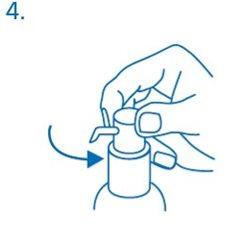
The dispenser head has two positions and can be easily turned
- counterclockwise to open
- clockwise to close.
The dispenser head should not be pressed down while it is in the closed position. The solution can only be dispensed in the open position. To open, turn the dispenser head in the direction indicated by the arrow until it can no longer be turned (about one-eighth of a turn, fig. 4). The dispenser is then ready for use.
Preparing the dispenser.
When used for the first time, the dispenser does not dispense the correct amount of oral solution. Therefore, it must be prepared (primed) by pressing the dispenser head down completely five times in a row (fig. 5).
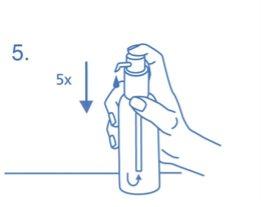
The solution thus dispensed should be discarded. The next time the dispenser head is pressed down completely (equivalent to one actuation), it will dispense the correct dose (fig. 6)
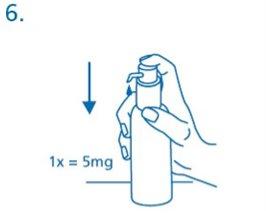
Correct use of the dispenser.
Place the bottle on a flat, horizontal surface, for example on a table, and it should only be used in a vertical position. Place a glass with a little water or a spoon under the spout. Press the dispenser head down firmly but calmly and steadily - not too slowly (fig. 7, fig. 8).
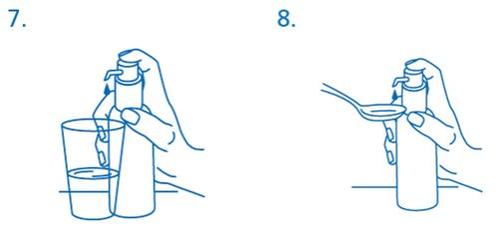
The dispenser head can then be released and is ready for the next actuation.
The dispenser should only be used with Axura solution in the provided bottle, not for other products or containers. If the dispenser does not function correctly, consult your doctor or pharmacist. Close the dispenser after using Axura.
- Country of registration
- Dosage formORAL SOLUTION/SUSPENSION, 5 mg
- ATC codeN06DX01
- Active substance
- Prescription requiredYes
- Manufacturer
- CompositionSORBATO POTASICO (2 mg mg), SORBITOL LIQUIDO NO CRISTALIZABLE (E420) (100 mg mg)
- This information is for reference only and does not constitute medical advice. Always consult a doctor before taking any medication. Oladoctor is not responsible for medical decisions based on this content.
- Alternatives to AXURA 5 mg/PULSATION, ORAL SOLUTIONDosage form: TABLET, 10 mgActive substance: memantineManufacturer: Merz Pharmaceuticals GmbhPrescription requiredDosage form: TABLET, 10 mgActive substance: memantineManufacturer: Merz Pharmaceuticals GmbhPrescription requiredDosage form: TABLET, 20 mgActive substance: memantineManufacturer: Merz Pharmaceuticals GmbhPrescription required
Online doctors for AXURA 5 mg/PULSATION, ORAL SOLUTION
Discuss questions about AXURA 5 mg/PULSATION, ORAL SOLUTION, including use, safety considerations and prescription review, subject to medical assessment and local regulations.









Get AXURA 5 mg/PULSATION, ORAL SOLUTION Prescription Online
Fill in a 2-min form
Tell us your symptoms, history, and what medicine you're requesting.
Pick a doctor or let us assign
Choose a specialist or we'll match you with the next available doctor.
Doctor reviews your case
Usually within 30 minutes. They may ask follow-up questions via chat.
Collect from any pharmacy
Electronic prescription sent to your email — valid across Spain.
Frequently Asked Questions
AXURA 5 mg/PULSATION, ORAL SOLUTION requires a prescription in Spain. You can check with a doctor online whether this medicine may be appropriate for your situation.
The active ingredient in AXURA 5 mg/PULSATION, ORAL SOLUTION is memantine. This information helps identify medicines with the same composition but different brand names.
AXURA 5 mg/PULSATION, ORAL SOLUTION is manufactured by Merz Pharmaceuticals Gmbh. Pharmacy brands and packaging may differ depending on the distributor.
Doctors such as Family doctors, Psychiatrists, Dermatologists, Cardiologists, Endocrinologists, Gastroenterologists, Pulmonologists, Nephrologists, Rheumatologists, Hematologists, Infectious disease physicians, Allergists, Geriatricians, Paediatricians, Oncologists may assess whether AXURA 5 mg/PULSATION, ORAL SOLUTION is appropriate, depending on your situation and local regulations. You can book an online consultation to discuss your symptoms and possible next steps.
Spain has a well-developed healthcare infrastructure across major cities such as Madrid, Barcelona, Valencia, and Seville. Pharmacies are widely available and operate under strict regulations, ensuring access to prescribed medications.
You can buy AXURA 5 mg/PULSATION, ORAL SOLUTION in Madrid, Barcelona, Seville, or Valencia at any local pharmacy with a valid prescription.
To obtain a prescription, you can use Oladoctor:
Other medicines with the same active substance (memantine) include AXURA 10 mg FILM-COATED TABLETS, AXURA 10 mg FILM-COATED TABLETS, AXURA 20 mg FILM-COATED TABLETS. These may have different brand names or formulations but contain the same therapeutic ingredient. Always consult a doctor before switching or starting a new medicine.
