



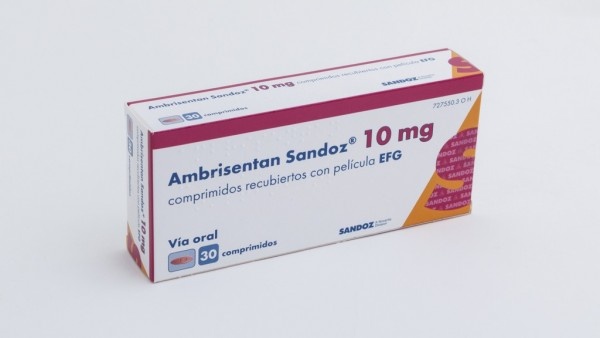
AMBRISENTAN 10 mg Film-Coated Tablets

Prescription review online
A doctor will review your case and decide whether a prescription is medically appropriate.

Talk to a doctor about this medicine
Discuss your symptoms and possible next steps in a quick online consultation.



How to use AMBRISENTAN VIVANTA 10 mg FILM-COATED TABLETS
Contents of the leaflet
- Introduction
- What is Ambrisentan Vivanta and what is it used for
- What you need to know before you take Ambrisentan Vivanta
- How to take Ambrisentan Vivanta
- Possible side effects
- Storage of Ambrisentan Vivanta
- Contents of the pack and other information
Introduction
Package Leaflet: Information for the User
Ambrisentan Vivanta 5 mg film-coated tablets EFG
Ambrisentan Vivanta 10 mg film-coated tablets EFG
Read all of this leaflet carefully before you start taking this medicine because it contains important information for you.
- Keep this leaflet, you may need to read it again.
- If you have any further questions, ask your doctor, pharmacist, or nurse.
- This medicine has been prescribed for you only. Do not pass it on to others. It may harm them, even if their symptoms are the same as yours.
- If you get any side effects, talk to your doctor, pharmacist, or nurse. This includes any possible side effects not listed in this leaflet. See section 4.
Contents of the pack
- What is Ambrisentan Vivanta and what is it used for
- What you need to know before you take Ambrisentan Vivanta
- How to take Ambrisentan Vivanta
- Possible side effects
- Storage of Ambrisentan Vivanta
- Contents of the pack and other information
1. What is Ambrisentan Vivanta and what is it used for
This medicine contains the active substance ambrisentan. It belongs to a group of medicines called other antihypertensives (used to treat high blood pressure).
It is indicated for the treatment of pulmonary arterial hypertension (PAH) in adults, adolescents, and children from 8 years of age and older. PAH consists of high blood pressure in the blood vessels (the pulmonary arteries) that carry blood from the heart to the lungs. In people with PAH, these arteries become narrower, so the heart has to work harder to pump blood to the lungs. This makes people feel tired, dizzy, and have difficulty breathing.
Ambrisentan widens the pulmonary arteries, making it easier for the heart to pump blood through them. This reduces blood pressure and alleviates symptoms.
Ambrisentan may also be used in combination with other medicines used to treat PAH.

Not sure if this medicine is right for you?
Discuss your symptoms and treatment with a doctor online.
2. What you need to know before you take Ambrisentan Vivanta
Do not take this medicine
- if you are allergicto ambrisentan, soy, or any of the other ingredients of this medicine (listed in section 6).
- If you are pregnant,if you are planning to become pregnant,or if you may become pregnantbecause you are not using a reliable method of birth control (contraceptive). Please read the information in the "Pregnancy" section.
- If you are breast-feeding, read the information under the heading “Breast-feeding”.
- If you have liver disease. Consult your doctor, who will decide if this medicine is suitable for you.
- If you have pulmonary fibrosisof unknown cause (idiopathic pulmonary fibrosis).
Warnings and precautions
Consult your doctor before starting to take this medicine:
- if you have liver problems
- if you have anemia (reduced number of red blood cells)
- if you have swelling of the hands, ankles, or feet caused by fluid retention (peripheral edema)
- if you have pulmonary veno-occlusive disease (a disease where the veins in the lungs are blocked).
→ Your doctor will decideif this medicine is suitable for you.
You will need to have regular blood tests
Before starting to take this medicine, and periodically while taking it, your doctor will perform blood tests to check:
- if you have anemia
- if your liver is working properly.
→It is essential that you have these blood tests regularly while taking ambrisentan.
Signs that your liver may not be working properly include:
- loss of appetite
- nausea
- vomiting
- high temperature (fever)
- stomach pain (abdomen)
- yellowing of the skin or eyes (jaundice)
- darkening of the urine
- itching of the skin.
If you notice any of these circumstances:
→ Inform your doctor immediately.
Children
Do not give this medicine to children under 8 years of age, as the safety and efficacy in this age group are unknown.
Other medicines and Ambrisentan Vivanta
Tell your doctor or pharmacistif you are taking, have recently taken, or might take any other medicines.
If you start taking cyclosporin A(a medicine used after a transplant or to treat psoriasis), your doctor may need to adjust your dose of this medicine.
If you are taking rifampicin(an antibiotic used to treat severe infections), your doctor will monitor you when you start taking this medicine.
If you are taking other medicines for PAH (iloprost, epoprostenol, sildenafil), your doctor may need to monitor you.
→ Inform your doctor or pharmacistif you are taking this medicine.
Pregnancy
This medicine may harm the fetus conceived before, during, or shortly after treatment.
→ If there is a possibility that you may become pregnant, use a reliable contraceptive methodwhile taking this medicine. Consult your doctor about this.
→ Do not take ambrisentan if you are pregnant or plan to become pregnant.
→ If you become pregnant or think you may be pregnantwhile taking this medicine, consult your doctor immediately.
If you are a woman of childbearing age, your doctor will ask you to have a pregnancy testbefore starting to take this medicine and periodically while taking this medicine.
Breast-feeding
It is unknown whether the active substance of this medicine can pass into breast milk.
→ Do not breast-feed while taking this medicine.Consult your doctor about this.
Fertility
If you are a man taking ambrisentan, this medicine may decrease your sperm count. Talk to your doctor if you have any questions or concerns about this.
Driving and using machines
Ambrisentan may cause side effects such as low blood pressure, dizziness, fatigue (see section 4) that may affect your ability to drive and use machines. The symptoms of your disease may also reduce your ability to drive or use machines.
→ Do not drive or use machines if you do not feel well.
Ambrisentan Vivanta contains lactose
The tablets contain small amounts of a sugar called lactose. If your doctor has told you that you have an intolerance to some sugars:
→ Consult your doctorbefore taking this medicine.
Ambrisentan Vivanta contains sodium
This medicine contains less than 1 mmol of sodium (23 mg) per tablet; this is essentially “sodium-free”.
3. How to take Ambrisentan Vivanta
Follow exactly the instructions for administration of this medicine given by your doctor or pharmacist.In case of doubt, consult your doctor or pharmacist again.
How much Ambrisentan Vivanta to take
Adults
The usual dose of this medicine is one 5 mg tablet, once a day. Your doctor may decide to increase your dose to 10 mg, once a day.
If you are taking cyclosporin A, do not take more than one 5 mg tablet, once a day.
Adolescents and children from 8 years to less than 18 years of age
Usual starting dose of Ambrisentan Vivanta | |
Weight of 35 kg or more | One 5 mgtablet, once a day |
Weight of at least 20 kg and less than 35 kg | 2.5 mg(half a 5 mg tablet),once a day |
Your doctor may decide to increase your dose. It is essential that children attend their regular medical appointments, as their dose needs to be adjusted as they grow or gain weight.
If taken in combination with cyclosporin A, the dose of ambrisentan should be limited to 2.5 mg once a day in adolescents and children who weigh less than 50 kg or to 5 mg once a day if they weigh 50 kg or more.
How to take Ambrisentan Vivanta
It is best to take the tablet at the same time every day. Swallow the Ambrisentan Vivanta 10 mg tablet whole, with a glass of water. Do not divide, crush, or chew the tablets. You can take this medicine with or without food.
The Ambrisentan Vivanta 5 mg tablet can be divided into equal doses.
If you take more Ambrisentan Vivanta than you should
If you take too many tablets, you may be more likely to have side effects, such as headache, flushing, dizziness, nausea (feeling sick), or low blood pressure, which can cause a mild feeling of dizziness:
→ Ask your doctor or pharmacist for adviceif you take more tablets than prescribed.
In case of overdose or accidental ingestion, consult your doctor or pharmacist immediately or call the Toxicology Information Service, phone: 91 562 04 20.
If you forget to take Ambrisentan Vivanta
If you forget to take a dose, take it as soon as you remember and then continue as before.
→ Do not take a double dose to make up for forgotten doses.
If you stop taking Ambrisentan Vivanta
Ambrisentan is a treatment that you will need to continue taking to control your PAH.
→Do not stop taking Ambrisentan Vivanta unless your doctor tells you to.
If you have any further questions on the use of this medicine, ask your doctor or pharmacist.

Started taking the medicine and have questions?
Discuss your symptoms and treatment with a doctor online.
4. Possible side effects
Like all medicines, this medicine can cause side effects, although not everybody gets them.
Serious side effects
Tell your doctorif you get any of these:
Allergic reactions
This is a common side effect that may affect up to 1 in 10people. You may notice:
- a rash or itching and swelling (usually of the face, lips, tongue, or throat), which can cause difficulty breathing or swallowing.
Swelling (edema), especially of the ankles and feet
This is a very common side effect that may affect more than 1 in 10people.
Heart failure
This is because the heart does not pump enough blood. This is a common side effect that may affect up to 1 in 10people. The symptoms include:
- difficulty breathing
- extreme tiredness
- swelling in the ankles and legs.
Low number of red blood cells (anemia)
This is a very common side effect that may affect more than 1 in 10people. Sometimes this requires a blood transfusion. The symptoms include:
- tiredness and weakness
- difficulty breathing
- general feeling of being unwell.
Low blood pressure (hypotension)
This is a common side effect that may affect up to 1 in 10people. The symptoms include:
- dizziness
→Tell your doctor immediatelyif you (or your child) suffer from these effects or if they occur suddenly after taking Ambrisentan Vivanta.
It is essential to have regular blood tests, to check if you have anemia and that your liver is working properly. Make sure you have also read the information in section 2on "the need for regular blood tests" and "signs that your liver may not be working properly".
Other side effects
Very common(may affect more than 1 in 10people)
- headache
- dizziness
- palpitations (rapid or irregular heartbeats)
- difficulty breathing that worsens shortly after starting to take Ambrisentan Vivanta
- runny nose or stuffy nose, congestion or pain in the nasal passages
- nausea
- diarrhea
- feeling of tiredness.
In combination with tadalafil (another medicine for PAH)
In addition to the above:
- flushing
- vomiting
- chest pain/discomfort.
Common(may affect up to 1 in 10people)
- blurred vision or other changes in vision
- fainting
- abnormal results in blood tests for liver function
- increased nasal secretion
- constipation
- stomach pain (abdomen)
- chest pain/discomfort
- flushing
- vomiting
- feeling of weakness
- nasal bleeding
- skin rash.
In combination with tadalafil
In addition to the above, except for abnormal results in blood tests for liver function:
- ringing in the ears (tinnitus).
Uncommon(may affect up to 1 in 100people)
- liver damage
- inflammation of the liver caused by the body's own immune system (autoimmune hepatitis).
In combination with tadalafil
- sudden loss of hearing.
Side effects in children and adolescents
These are expected to be similar to those listed above for adults.
Reporting of side effects
If you experience any side effects, talk to your doctor, pharmacist, or nurse, even if it is possible that they are not listed in this leaflet. You can also report side effects directly through the Spanish Medicines Agency's website: https://www.notificaram.es. By reporting side effects, you can help provide more information on the safety of this medicine.
5. Storage of Ambrisentan Vivanta
Keep this medicine out of the sight and reach of children.
Do not use this medicine after the expiry date that appears on the packaging after EXP. The expiry date is the last day of the month indicated.
This medicine does not require any special storage conditions.
Medicines should not be disposed of via wastewater or household waste. Return the packaging and any unused medicine to a pharmacy for proper disposal. If you have any questions, ask your pharmacist how to dispose of the packaging and any unused medicine. This will help protect the environment.
6. Contents of the pack and other information
Composition of Ambrisentan Vivanta
The active substance is ambrisentan.
Each film-coated tablet contains 5 or 10 mg of ambrisentan.
The other ingredients are: lactose monohydrate, microcrystalline cellulose (PH102), sodium croscarmellose, magnesium stearate.
Tablet coating: partially hydrolyzed polyvinyl alcohol (E1203), talc (E553b), titanium dioxide (E171), macrogol 4000/PEG 3350 (E1521), red iron oxide (E172), yellow iron oxide (E172) (only for 5 mg).
Appearance and packaging
Ambrisentan Vivanta 5 mg film-coated tablets EFG are yellow, capsule-shaped, biconvex, approximately 6.9 mm long and 3.5 mm wide, scored on both sides, engraved with “A” and “5” on one side and smooth on the other.
The tablet can be divided into equal doses.
Ambrisentan Vivanta 10 mg film-coated tablets EFG are pink, oval-shaped, biconvex, approximately 10 mm long and 5 mm wide, engraved with “A” on one side and “10” on the other.
Ambrisentan Vivanta is supplied as 5 mg and 10 mg film-coated tablets in blister packs, in packs of 10x1 or 30x1 or 60x1 tablets and packs of 30 tablets.
Not all pack sizes may be marketed.
Marketing authorization holder
Vivanta Generics s.r.o.
Trtinová 260/1, Cakovice
196 00 Prague 9,
Czech Republic
Manufacturer
Pharmadox Healthcare Limited,
KW20A Kordin Industrial Park, Paola, PLA3000, Malta
Or
MSN Labs Europe Limited,
KW20A Corradino Park, Paola, PLA3000, Malta
You can request more information about this medicine by contacting the local representative of the marketing authorization holder:
Local representative:
Vivanta Generics s.r.o., branch in Spain
C/Guzmán el Bueno, 133, edificio Britannia
28003 Madrid
This medicine is authorized in the Member States of the European Economic Area under the following names:
Germany: Ambrisentan Vivanta 5 mg/10 mg film-coated tablets
Cyprus: Ambrisentan MSN 5 mg/10 mg film-coated tablets
Spain: Ambrisentan Vivanta 5 mg/10 mg film-coated tablets EFG
Date of the last revision of this leaflet: September 2023
Detailed and up-to-date information on this medicine is available on the website of the Spanish Agency for Medicines and Health Products (AEMPS) http://www.aemps.gob.es/
- Country of registration
- Dosage formTABLET, 10 mg
- ATC codeC02KX02
- Active substance
- Prescription requiredYes
- Manufacturer
- CompositionLACTOSA MONOHIDRATO (73 mg mg), CROSCARMELOSA SODICA (12 mg mg)
- This information is for reference only and does not constitute medical advice. Always consult a doctor before taking any medication. Oladoctor is not responsible for medical decisions based on this content.
- Alternatives to AMBRISENTAN VIVANTA 10 mg FILM-COATED TABLETSDosage form: TABLET, 10 mgActive substance: ambrisentanManufacturer: Accord Healthcare S.L.U.Prescription requiredDosage form: TABLET, 5 mgActive substance: ambrisentanManufacturer: Accord Healthcare S.L.U.Prescription requiredDosage form: TABLET, 10 mgActive substance: ambrisentanManufacturer: Alembic Pharmaceuticals Europe LimitedPrescription required
Online doctors for AMBRISENTAN VIVANTA 10 mg FILM-COATED TABLETS
Discuss questions about AMBRISENTAN VIVANTA 10 mg FILM-COATED TABLETS, including use, safety considerations and prescription review, subject to medical assessment and local regulations.
Get AMBRISENTAN VIVANTA 10 mg FILM-COATED TABLETS Prescription Online
Fill in a 2-min form
Tell us your symptoms, history, and what medicine you're requesting.
Pick a doctor or let us assign
Choose a specialist or we'll match you with the next available doctor.
Doctor reviews your case
Usually within 30 minutes. They may ask follow-up questions via chat.
Collect from any pharmacy
Electronic prescription sent to your email — valid across Spain.
Frequently Asked Questions
AMBRISENTAN VIVANTA 10 mg FILM-COATED TABLETS requires a prescription in Spain. You can check with a doctor online whether this medicine may be appropriate for your situation.
The active ingredient in AMBRISENTAN VIVANTA 10 mg FILM-COATED TABLETS is ambrisentan. This information helps identify medicines with the same composition but different brand names.
AMBRISENTAN VIVANTA 10 mg FILM-COATED TABLETS is manufactured by Vivanta Generics S.R.O.. Pharmacy brands and packaging may differ depending on the distributor.
Doctors such as Family doctors, Psychiatrists, Dermatologists, Cardiologists, Endocrinologists, Gastroenterologists, Pulmonologists, Nephrologists, Rheumatologists, Hematologists, Infectious disease physicians, Allergists, Geriatricians, Paediatricians, Oncologists may assess whether AMBRISENTAN VIVANTA 10 mg FILM-COATED TABLETS is appropriate, depending on your situation and local regulations. You can book an online consultation to discuss your symptoms and possible next steps.
Spain has a well-developed healthcare infrastructure across major cities such as Madrid, Barcelona, Valencia, and Seville. Pharmacies are widely available and operate under strict regulations, ensuring access to prescribed medications.
You can buy AMBRISENTAN VIVANTA 10 mg FILM-COATED TABLETS in Madrid, Barcelona, Seville, or Valencia at any local pharmacy with a valid prescription.
To obtain a prescription, you can use Oladoctor:
Other medicines with the same active substance (ambrisentan) include AMBRISENTAN ACCORD 10 mg FILM-COATED TABLETS, AMBRISENTAN ACCORD 5 mg FILM-COATED TABLETS, AMBRISENTAN ALEMBIC 10 mg FILM-COATED TABLETS. These may have different brand names or formulations but contain the same therapeutic ingredient. Always consult a doctor before switching or starting a new medicine.
