


BENELYTE SOLUTION FOR INFUSION



How to use BENELYTE SOLUTION FOR INFUSION
Translated with AI
This page provides general information and does not replace a doctor’s consultation. Always consult a doctor before taking any medication. Seek urgent medical care if symptoms are severe.
Show originalContents of the leaflet
Introduction
Package Leaflet: Information for the User
Benelyte Solution for Infusion
(Sodium Chloride, Potassium Chloride, Calcium Chloride Dihydrate, Magnesium Chloride Hexahydrate, Sodium Acetate Trihydrate, and Glucose Monohydrate)
Read all of this leaflet carefully before you start using this medicine because it contains important information for you.
- Keep this leaflet, you may need to read it again.
- If you have any further questions, ask your doctor, pharmacist, or nurse.
- If you get any side effects, talk to your doctor, pharmacist, or nurse. This includes any possible side effects not listed in this leaflet. See section 4.
Contents of the Package Leaflet
- What is Benelyte and what is it used for
- What you need to know before you use Benelyte
- How to use Benelyte
- Possible side effects
- Storage of Benelyte
- Contents of the pack and other information
1. What is Benelyte and what is it used for
Benelyte is a solution for intravenous infusion (in a vein). It contains minerals called electrolytes that affect the amount of water in your body and other important processes. It also contains carbohydrates.
Benelyte is used in newborns (from 0 to ≤28 days), infants (28 days to ≤2 years), children (from 2 to ≤12 years), and adolescents (12 to ≤14 years) to:
- Help restore fluid and normal electrolyte (salt) balance after surgery. It also contains glucose, which provides a source of energy.
- Act as a plasma volume substitute used to restore blood volume.
- Help restore fluid and electrolyte deficiencies.
It is used as a transport solution for other electrolytes and medications.

2. What you need to know before you use Benelyte
Do not use Benelyte
- if your child is allergic (hypersensitive) to sodium chloride, potassium chloride, calcium chloride, magnesium chloride, sodium acetate, glucose, or any of the other components of this medicine (listed in section 6).
- For premature newborns and neonates (≤28 days of age): Your child should not receive a certain antibiotic called ceftriaxone as an intravenous infusion at the same time as this medicine.
- if your child has excess water in their body (hyperhydration)
Warnings and Precautions
Tell your doctor, pharmacist, or nurse before your child is given Benelyte if your child has:
- less acid in the body than normal (metabolic alkalosis)
- abnormally high blood sugar levels (hyperglycemia)
- abnormally low potassium levels in the blood (hypokalemia)
- abnormally high sodium levels in the blood (hypernatremia)
- abnormally high chloride levels in the blood (hyperchloremia)
- kidney failure or decreased kidney function
- has been treated with a certain antibiotic called ceftriaxone; it must not be mixed or administered simultaneously with any solution containing calcium given by intravenous infusion. Your doctor is aware of this and will not administer them together, either through different infusion lines or different infusion sites.
- However, in children over 28 days, your doctor may administer calcium and ceftriaxone sequentially, one after the other, if infusion lines are used at different sites or if the infusion lines are replaced or if they are thoroughly flushed with physiological saline solution between infusions, to avoid precipitation. If you or your child suffer from low blood volume, your doctor will avoid administering calcium and ceftriaxone sequentially.
While your child is being given this medicine, the levels of electrolytes in the blood, water balance, blood glucose levels, and acid-base status should be monitored from time to time.
When administering the medicine, caution should be exercised in children, especially in newborns and infants, as lactic acidosis (an increase in lactic acid in the body) may occur. This should be taken into consideration in children born with problems using lactate.
Using Benelyte with other medicines
Tell your doctor or pharmacist if your child is using, has recently used, or might use any other medicines.
Concomitant use with ceftriaxone (an antibiotic) is not recommended when administered intravenously (see section Warnings and Precautions).
Pregnancy and Breastfeeding
Benelyte is for use in children only (under 14 years of age).
3. How to use Benelyte
Your doctor or another healthcare professional will give your child this medicine by infusion into a vein (intravenous drip).
Dose
The doctor will decide the amount of medicine to be given to your child, depending on their age, weight, clinical condition, and other treatment they are receiving. The individual needs for fluids, electrolytes, and energy will be taken into account. Your doctor will decide the correct dose for your child.
Follow exactly the administration instructions of Benelyte given by your doctor or pharmacist. If you are unsure, consult your doctor or pharmacist again.
If you use more Benelyte than you should
It is unlikely that your child will be given an incorrect dose, as the medicine will be administered by a doctor or another healthcare professional.
An overdose may cause excess fluid in the body (hyperhydration) and excess sugar in the blood (hyperglycemia).
The doctor will determine the appropriate treatment to normalize your child's condition, which may include stopping the infusion, monitoring the salt levels in your child's blood, and administering appropriate medications to treat the symptoms (e.g., diuretics, insulin).
If you have any other questions about the use of this medicine, ask your doctor or pharmacist.

4. Possible side effects
Like all medicines, this medicine can cause side effects, although not everybody gets them.
Frequency not known(cannot be estimated from the available data)
Local reactions at the injection site due to the administration technique:
- fever (febrile response)
- infection at the infusion site
- irritation and inflammation of the vein into which the solution is infused (phlebitis). This can cause redness, pain, or burning and inflammation along the vein into which the solution is being administered
- formation of a blood clot (thrombosis) at the infusion site, causing pain, swelling, or redness in the area of the clot
- leakage of the infusion solution into the tissues surrounding the vein (extravasation). This can damage tissues and cause scarring.
Reporting of side effects
If you get any side effects, talk to your doctor, pharmacist, or nurse. This includes any possible side effects not listed in this leaflet. You can also report side effects directly via the Spanish Medicines Surveillance System for Human Use: www.notificaRAM.es. By reporting side effects, you can help provide more information on the safety of this medicine.
5. Storage of Benelyte
Keep this medicine out of the sight and reach of children.
Do not use this medicine after the expiry date which is stated on the label or carton after EXP. The expiry date refers to the last day of the month stated.
This medicine does not require any special storage conditions.
Use only if the solution is clear, without visible particles, and if the container is not damaged.
Use immediately after the first opening. From a microbiological point of view, the product should be used immediately. If not used immediately, the in-use storage times and conditions are the responsibility of the user and normally should not be more than 24 hours at 2°C-8°C, unless the storage and opening are performed under controlled and validated aseptic conditions.
When combined with other infusion solutions, the current general guidelines for the administration of total fluids should be taken into account for the calculation of the dose for the corresponding age group.
The individual needs for water, electrolytes, and carbohydrates should be calculated and replaced accordingly; in particular, in premature newborns, low birth weight, and also in all other exceptional therapeutic situations. The balance needs to be more accurate in premature patients, in the youngest, and in those with low weight.
Form of administration
Intravenous route.
Duration of administration
The duration of administration depends on the patient's needs for fluids and electrolytes.
Incompatibilities
The compatibility of the medicines to be added to Benelyte should be evaluated before addition. In general, it can be stated that the following medicines (groups) should not be mixed with Benelyte:
- Medicines that could form poorly soluble precipitates with the constituents of the solution. (The preparation contains Ca2+ ions. Precipitation may occur with the addition of inorganic phosphate, hydrogen carbonate/carbonate, or oxalate).
- Medicines that are not stable in an acidic pH range or do not have optimal efficacy or that decompose
Infusion solutions containing glucose should not be administered simultaneously in the same infusion equipment with blood due to the possibility of pseudo-agglutination.
6. Contents of the pack and other information
Composition of Benelyte:
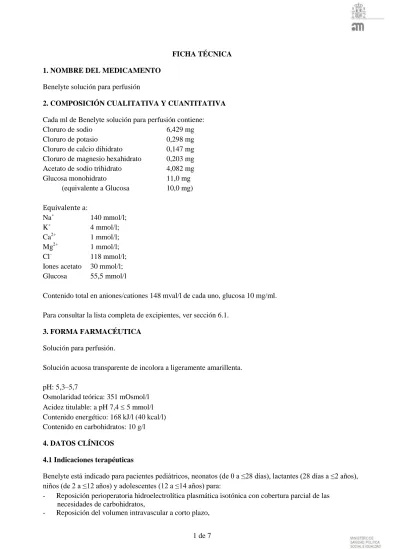
Each ml of Benelyte solution for infusion contains:
Sodium Chloride 6.429 mg
Potassium Chloride 0.298 mg
Calcium Chloride Dihydrate 0.147 mg
Magnesium Chloride Hexahydrate 0.203 mg
Sodium Acetate Trihydrate 4.082 mg
Glucose Monohydrate 11.0 mg
(equivalent to Glucose 10.0 mg)
The other ingredients are: hydrochloric acid 37% (for pH adjustment), sodium hydroxide (for pH adjustment), and water for injections.
Appearance and pack contents
Benelyte is a clear, colorless to slightly yellowish aqueous solution for infusion.
Benelyte is available in low-density polyethylene (KabiPac) bottles of 100 ml, 250 ml, and 500 ml as the primary packaging, closed with a polyethylene or polyethylene/polypropylene plug with a polyisoprene seal.
Pack sizes:
40 x 100 ml bottles
20 x 250 ml bottles
10 x 500 ml bottles
Not all pack sizes may be marketed.
Marketing Authorisation Holder and Manufacturer
Marketing Authorisation Holder
Fresenius Kabi España, S.A.U.
Marina 16-18,
08005-Barcelona
Manufacturer
Fresenius Kabi Polska Sp. z o.o.
ul. Sienkiewicza 25,
PL-99-300 Kutno
Poland
This medicine is authorised in the Member States of the European Economic Area and in the United Kingdom (Northern Ireland) under the following names:
Austria | ELO-MEL paediatric Infusionslösung |
Belgium | Benelyte oplossing voor infusie/solution pour perfusion/Infusionslösung |
Bulgaria Croatia Czech Republic | Benelyte ???????? ?????????? ??????? Benelyte solution for infusion Benelyte otopina za infuzij Benelyte |
Denmark Estonia Germany | Benelyte Benelyte Benelyte Infusionslösung |
Finland | Benelyte Infuusioneste, liuos |
France | Pedialyte, solution pour perfusion |
Hungary | Benelyte oldatos infúzió |
Ireland | Paedisol solution for infusion |
Latvia Lithuania Luxembourg | Benelyte škidums infuzijam Benelyte infuzinis tirpalas Benelyte Infusionslösung |
Netherlands | Benelyte oplossing voor infusie |
Norway | Benelyte |
Poland | Benelyte |
Portugal | Benelyte |
Romania Slovenia | Benelyte solu?ie perfuzabila Benelyte raztopina za infundiranje |
Slovakia | Benelyte |
Spain | Benelyte solución para perfusión |
Sweden | Benelyte |
United Kingdom (Northern Ireland) | Minorsol solution for infusion |
Date of last revision of this leaflet: August 2023
Detailed and up-to-date information on this medicine is available on the website of the Spanish Agency for Medicines and Health Products (AEMPS) (http://www.aemps.gob.es/).
-----------------------------------------------------------------------------------------------------------------------
This information is intended only for healthcare professionals
For more information, consult the Summary of Product Characteristics.
Posology
The dose for perioperative intravenous infusion therapy depends on the needs for fluids, electrolytes, and glucose:
During the first hour, for example, 10 to 20 ml/kg/hour, and then adjust the infusion rate according to the basic requirements and correction with monitoring of relevant cardiovascular and laboratory parameters.
The following reference values apply to fluid needs:
Newborns (from 0 to ≤28 days), infants (28 days to ≤1 year):
100 - 140 ml/kg body weight/day
Infants from 1 to ≤ 2 years:
80 - 120 ml/kg body weight/day
Children from 2 to ≤ 5 years:
80 - 100 ml/kg body weight/day
Children from 5 to ≤ 10 years:
60 - 80 ml/kg body weight/day
Children from 10 to ≤12 years and adolescents from 12 to ≤14 years:
50 - 70 ml/kg body weight/day
For short-term intravascular volume replacement, the dose should be administered individually according to fluid needs.
For the treatment of isotonic dehydration in the pediatric population, the infusion rate and daily dose should be determined individually according to the nature and severity of the hydroelectrolytic imbalance by monitoring relevant cardiovascular and laboratory parameters.
If Benelyte is used in combination with other infusion solutions, the current guidelines for the administration of total fluids should be taken into account for the calculation of the dose for the corresponding age group.
The individual needs for water, electrolytes, and carbohydrates should be calculated and replaced accordingly; in particular, in premature newborns, low birth weight, and also in all other exceptional therapeutic situations. The balance needs to be more accurate in premature patients, in the youngest, and in those with low weight.
Form of administration
Intravenous route.
Duration of administration
The duration of administration depends on the patient's needs for fluids and electrolytes.
Incompatibilities
The compatibility of the medicines to be added to Benelyte should be evaluated before addition. In general, it can be stated that the following medicines (groups) should not be mixed with Benelyte:
- Medicines that could form poorly soluble precipitates with the constituents of the solution. (The preparation contains Ca2+ ions. Precipitation may occur with the addition of inorganic phosphate, hydrogen carbonate/carbonate, or oxalate).
- Medicines that are not stable in an acidic pH range or do not have optimal efficacy or that decompose
Infusion solutions containing glucose should not be administered simultaneously in the same infusion equipment with blood due to the possibility of pseudo-agglutination.
- Country of registration
- Active substance
- Prescription requiredYes
- Manufacturer
- This information is for reference only and does not constitute medical advice. Always consult a doctor before taking any medication. Oladoctor is not responsible for medical decisions based on this content.
- Alternatives to BENELYTE SOLUTION FOR INFUSIONDosage form: INJECTABLE INFUSION, 0.09 g / 0.07 g / 1.6 g / 0.17 g / 12.5 g / 0.19 g / 1.23 gActive substance: electrolytes with carbohydratesManufacturer: Fresenius Kabi España, S.A.U.Prescription requiredDosage form: INJECTABLE PERFUSION, 0.31 g / 21.9 mg / 0.03 g / 0.6 gActive substance: electrolytes with carbohydratesManufacturer: Fresenius Kabi España, S.A.U.Prescription requiredDosage form: INJECTABLE PERFUSION, 3.3% + 0.3% + 0.02 mEq/mlActive substance: electrolytes with carbohydratesManufacturer: Fresenius Kabi España, S.A.U.Prescription required
Online doctors for BENELYTE SOLUTION FOR INFUSION
Discuss questions about BENELYTE SOLUTION FOR INFUSION, including use, safety considerations and prescription review, subject to medical assessment and local regulations.











Frequently Asked Questions
