



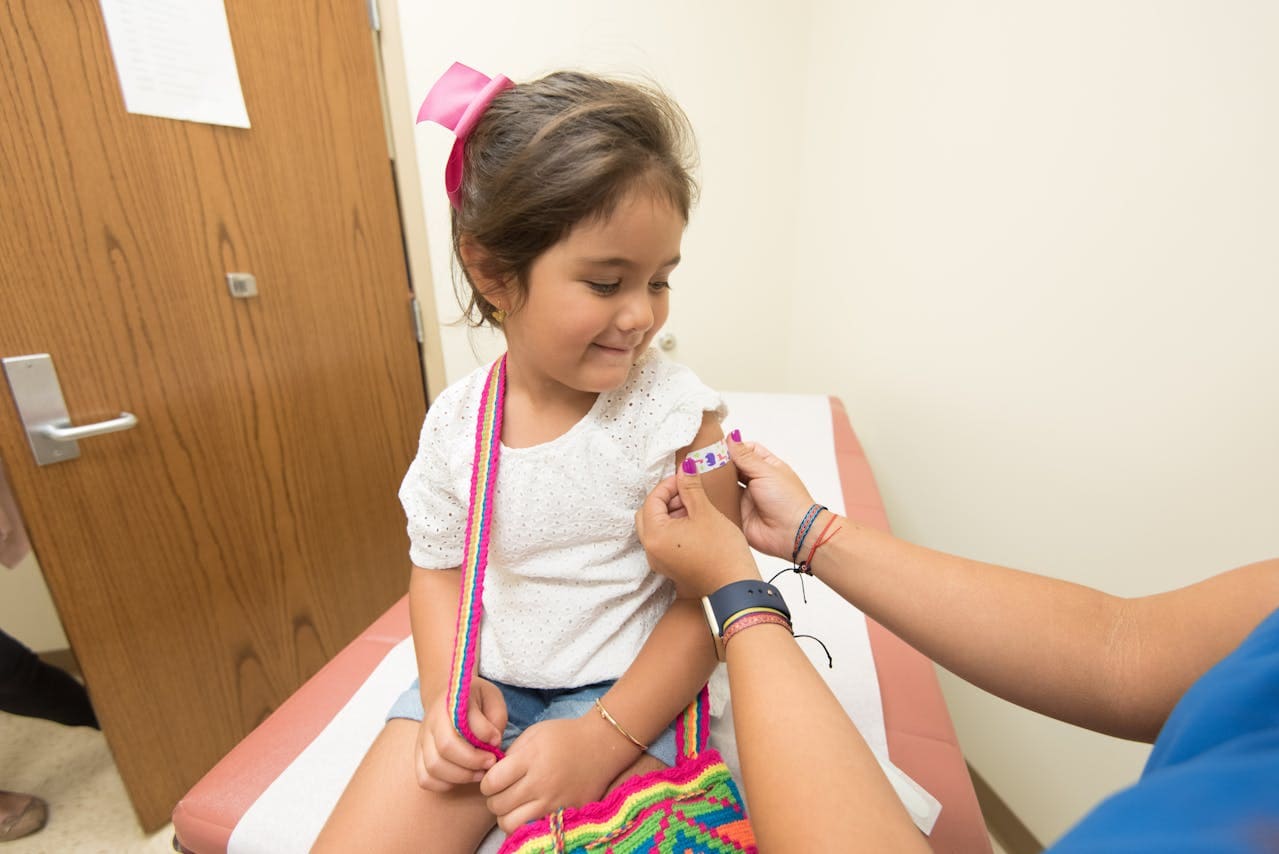
If you’re moving to Spain with children or planning a long stay, working out how paediatric care runs here is one of the biggest parts of settling in. Choosing a paediatrician, following the local vaccination schedule, knowing where to go at 2 a.m. — the Spanish system takes a while to read.
Spain has one of the strongest public health systems in Europe, and children under 18 are entitled to a wide range of state-funded care. Many foreign families still add a private paediatrician on top of it, usually for faster access, a shared language or appointments that fit around work.
This guide covers how to access children’s healthcare in Spain, how to register your child with a paediatrician, what the public system covers and when private care is the more practical option.
Getting access to children’s healthcare in Spain
Public healthcare for children
The national health system (Sistema Nacional de Salud, SNS) provides free or low-cost care for under-18s: routine check-ups, vaccinations, paediatric consultations, emergency care and specialist referrals. It is tax-funded and available to families who are resident and properly registered.
To get access, parents need to:
Register at their local health centre (centro de salud)
Provide proof of address, an NIE (foreigner identification number) and social security affiliation
Obtain a health card (tarjeta sanitaria) for the child
Once registered, the child is assigned a paediatrician through the health centre that covers your address.
Private healthcare for children
Public paediatric care is reliable, but waiting times can be long, especially in high-demand cities. Many foreign families choose private paediatricians for faster access, more flexibility and consultations in their own language.
Private health insurance in Spain usually covers paediatric services, including consultations, diagnostics and some specialist treatment. You can also pay per visit — typically €50 to €100, depending on the region.
If you would rather see a paediatrician in your own language, or you need an appointment today, you can book an online paediatric consultation from home.
Paediatric services in Spain
What the paediatrician does
In Spain, children under 14 are assigned a paediatrician within the public system. The paediatrician runs routine check-ups, tracks growth and development, issues medical certificates, prescribes medication and refers on to specialists. From 14, teenagers usually move to a family doctor.
Public paediatricians work in local health centres and are allocated by address. Appointments are free, though availability varies by region.
Finding and registering with a paediatrician
In the public system the allocation is automatic on registration. You can request a change of paediatrician, but the choice is often limited.
Privately you pick the doctor yourself, can usually get a same-day slot and speak the language you are comfortable in. If you are looking for paediatricians and other specialists who consult in your language, you can check profiles and availability before booking.
Children’s health check-ups in Spain
Regular check-ups are central to paediatric care here: they track growth and development and catch problems early. They are recommended from birth through adolescence, in both the public and private systems.
Check-ups in the public system
Children have scheduled paediatric appointments at set ages: several during the first year, then at 12 and 24 months, and after that at 4, 6, 10 and 13 years. A check-up usually includes:
Physical and developmental assessment
Growth and weight monitoring
Nutritional advice
Vision and hearing tests
Vaccination schedule update
They take place at your assigned health centre and are free for registered families.
Check-ups in the private sector
Private check-ups can be scheduled more flexibly and more often. Private paediatricians tend to give more time per appointment, offer personalised advice and consult in several languages — which matters when you are describing a child’s symptoms in a second language.
Childhood vaccination in Spain
Spain runs a well-structured national immunisation programme. It is managed regionally, with consistent guidelines across the country. All recommended vaccines are free in the public system for children with a health card.
The vaccination schedule
The Spanish schedule normally covers:
Hepatitis B
Diphtheria, tetanus and whooping cough (DTP)
Polio
Haemophilus influenzae type B
Pneumococcal infections
Meningococcal disease
Measles, mumps and rubella (MMR)
Chickenpox
Human papillomavirus (HPV, for pre-teens and teenagers)
Vaccines are given during paediatric check-ups at the health centre and recorded in the child’s medical history.
If your child was vaccinated abroad
Bring a copy of the vaccination record when you register. The paediatrician will review it and tell you what is missing under the Spanish schedule, or whether your region adds anything specific. Nothing has to start from scratch: vaccines given abroad are recognised if they are documented with dates and vaccine names.
Private paediatricians follow the same national schedule and can also offer vaccines that sit outside the public programme, such as travel vaccines.
Specialist and hospital care for children
Most needs are covered by the paediatrician, but some children need specialist care — dermatology, cardiology, neurology, gastroenterology or mental health support. Access depends on whether you are in the public or private system.
Specialists in the public system
You need a referral from your assigned paediatrician. Referrals are processed within the public network and appointments can take weeks or months, depending on availability. Care is free, but consultations are usually in Spanish only.
Specialists in the private sector
Private care offers faster access and a free choice of doctor, including those who consult in English or other languages. Private hospitals and clinics in Madrid, Barcelona, Valencia and Málaga have well-developed paediatric departments.
Several common childhood problems can be handled online without a referral: allergy treatment, atopic dermatitis and eczema, conjunctivitis or a cold that isn’t clearing.
Children’s dental care in Spain
Children’s dental care is not fully included in the public system. Some regions offer limited services, but most families use private paediatric dentists for prevention and routine treatment.
Public dental cover
In certain autonomous communities (Madrid and Catalonia among them), children aged 6 to 16 can access basic services: an annual check-up, sealants or cavity treatment. These are provided in public dental units or contracted private clinics. Availability depends on regional policy and appointments can be limited.
Private dental care
Most foreign families go private, which usually means:
Shorter waiting times
English-speaking dentists
Preventive and cosmetic services
More flexible scheduling
Dental insurance is optional but common. Many family health policies in Spain include it as an add-on.
Children’s mental health services
More families are seeking professional support for anxiety, behavioural problems, ADHD, learning difficulties or the emotional strain that comes with an international move.
Public mental health services
The public system gives access to child psychologists and psychiatrists, but only through a paediatric referral. It is free, and it usually means:
Long waiting lists
Limited availability outside major cities
Consultations almost always in Spanish
That is why many foreign families look outside the public system.
Private child psychologists and psychiatrists
Private care offers faster access, multilingual clinicians and online consultations from home. Two reasons account for much of the demand: ADHD assessment and treatment, where the public route can take more than a year, and a consultation with a psychiatrist when anxiety or mood is getting in the way of school and family life.
Paediatric emergencies in Spain
A medical emergency with a child is frightening anywhere, and more so in a new country. Spain’s emergency system is effective and open to residents and visitors alike.
In a serious emergency
For difficulty breathing, seizures, a very high fever or a serious injury, call 112 — the national emergency number, free and available 24/7. Operators speak Spanish and English, particularly in urban areas.
The child will be taken to the nearest hospital emergency department. In public hospitals emergency care is free if the child is registered in the system. Tourists and uninsured families may have to pay upfront or present travel insurance.
When it isn’t life-threatening
If your child has a moderate fever, a rash or stomach pain and the situation isn’t serious, you can:
Go to the health centre during daytime hours
Use an out-of-hours walk-in centre (punto de atención continuada)
Deal with it through an urgent online consultation — most useful at night or at the weekend, when the real question is whether this needs A&E now or can wait until morning
Prevention and resources for foreign families
Spain puts real weight on preventive paediatric medicine: regular check-ups, developmental assessment, vaccination and health education programmes throughout childhood.
Regional programmes
Autonomous communities add their own initiatives, such as:
School medical check-ups
Dental hygiene campaigns
Nutrition and physical activity programmes
Ask at your health centre which programmes are running in your region.
Support online
Learning a new health system is hard work, and harder with children. If you need a quick consultation in your own language, you can see which doctors are available and book the same day — in English, German, French, Italian, Hebrew, Russian and other languages.

Комментарии
Будьте первым, кто прокомментирует эту статью.
Войдите, чтобы оставить комментарий
Ваш комментарий увидят другие читатели после модерации.