


ERITROMICINA NORMON 500 MG COMPRIMIDOS RECUBIERTOS
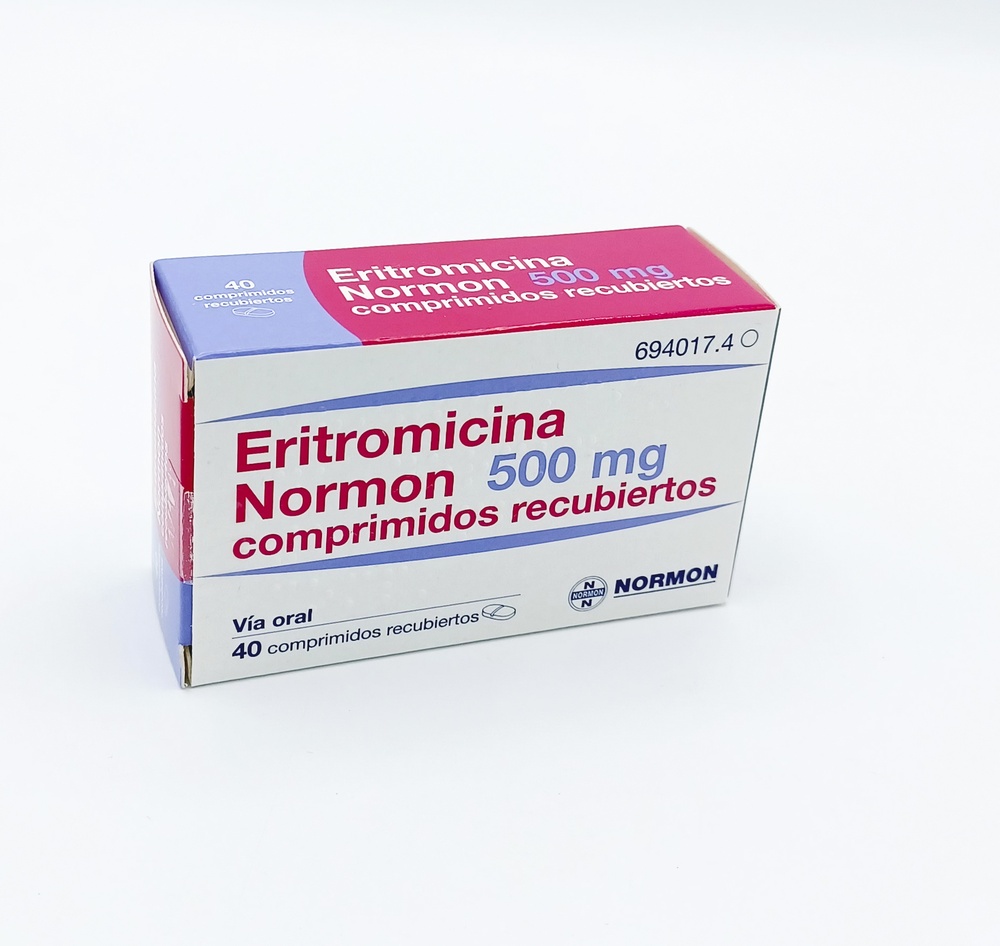



Cómo usar ERITROMICINA NORMON 500 MG COMPRIMIDOS RECUBIERTOS
Traducción generada por IA
Este contenido ha sido traducido automáticamente y se ofrece solo con fines informativos. No sustituye la consulta con un profesional sanitario.
Ver originalContenido del prospecto
Introducción
Prospecto: información para el paciente
Eritromicina Normon 500 mg comprimidos recubiertos
eritromicina etilsuccinato
Lea todo el prospecto detenidamente antes de empezar a tomar este medicamento, porque contiene información importante para usted.
- Conserve este prospecto, ya que puede tener que volver a leerlo.
- Si tiene alguna duda, consulte a su médico o farmacéutico.
- Este medicamento se le ha recetado solamente a usted, y no debe dárselo a otras personas aunque tengan los mismos síntomas que usted, ya que puede perjudicarles.
- Si experimenta efectos adversos, consulte a su médico o farmacéutico, incluso si se trata de efectos adversos que no aparecen en este prospecto. Ver sección 4.
Contenido del prospecto
- Qué es Eritromicina Normon y para qué se utiliza
- Qué necesita saber antes de empezar a tomar usar Eritromicina Normon
- Cómo tomar Eritromicina Normon
- Posibles efectos adversos
5 Conservación de Eritromicina Normon
- Contenido del envase e información adicional
1. Qué es Eritromicina Normon y para qué se utiliza
Eritromicina Normon contiene eritromicina etilsuccinato, un antibiótico que pertenece a un grupo de antibióticos llamado “macrólidos”, y actúa evitando el crecimiento y la multiplicación de bacterias.
Los antibióticos se utilizan para tratar infecciones bacterianas y no sirven para tratar infecciones víricas como la gripe o el catarro. Es importante que siga las instrucciones relativas a la dosis, el intervalo de administración y la duración del tratamiento indicados por su médico. No guarde ni reutilice este medicamento. Si una vez finalizado el tratamiento le sobra antibiótico, devuélvalo a la farmacia para su correcta eliminación. No debe tirar los medicamentos por el desagüe ni a la basura. |
Eritromicina se usa para el tratamiento de:
- Infecciones de la garganta como amigdalitis, dolor de garganta (faringitis) y difteria (infección bacteriana grave que produce dolor de garganta, fiebre, inflamación de los ganglios y debilidad)
- Infección del pulmón (neumonía)
- Infección de piel, músculos, tendones y grasa
- Inflamación del tracto digestivo (enterocilitis) y deposiciones blandas frecuentes (diarrea)
- Tos ferina
- Uretritis (inflamación del conducto que vacia la vejiga), cervicitis (inflamación del cuello del útero) o inflamación de la mucosa del recto (última parte del tubo digestivo)
- Conjuntivitis (irritación y enrojecimiento del área que cubre el ojo) del recién nacido causada por Chlamydia trachomatis
- Linfogranuloma venéreo (infección de transmisión sexual causada por un microorganismo llamado Chlamydia trachomatis)
Eritromicina también se usa para la prevención de las siguientes infecciones:
- Prevención de recaidas de la fiebre reumática (fiebre aguda no contagiosa que se caracteriza por inflamación y dolor de las articulaciones) en pacientes alérgicos a penicilina.
- Prevención posexposición a Corynebacterium diphteriae(microorganismo que produce la difteria)
- Prevención posexposición a Bordetella pertussis(microorganismo que produce la tos ferina)

2. Qué necesita saber antes de empezar a tomar Eritrocimina Normon
No tome Eritromicina
- Si es alérgico a eritromicina o a cualquiera de los demás componentes de este medicamento (incluidos en la sección 6).
- Si es alérgico a algún antibiótico macrólido, tal como azitromicina y claritromicina que se emplean para tratar infecciones bacterianas respiratorias, de garganta o nasales.
- Si está tomando terfenadina o astemizol (antihistamínicos utilizados para tratar la alergia), cisaprida (utilizado para problemas del movimiento intestinal), pimozida (antipsicótico) y ergotamina o dihidroergotamina (utilizados para el tratamiento de las migrañas).
- Si tiene niveles anormalmente bajos de potasio o magnesio en sangre (hipomagnesemia o hipopotasemia).
- Si usted o alguien de su familia tiene antecedentes de alteraciones del ritmo cardíaco (arritmia cardíaca ventricular o Torsades de pointes) o una alteración en el electrocardiograma (registro eléctrico del corazón) denominada “síndrome de prolongación del intervalo QT”.
- Si está tomando medicamentos para reducir el colesterol, tales como simvastatina o lovastatina.
- Si está tomando actualmente un medicamento llamado lomitapida (usado para reducir el aumento de las grasas en sangre, como el colesterol y los triglicéridos). Tomar este medicamento al mismo tiempo que la eritromicina puede provocar un aumento de las enzimas producidas por las células hepáticas (transaminasas), lo que indica que el hígado está bajo estrés y puede provocar problemas hepáticos.
Advertencias y precauciones
Consulte a su médico o farmacéutico antes de empezar a tomar eritromicina.
- Si sufre problemas cardíacos o problemas con la frecuencia cardíaca, como anomalías en el ECG (intervalo QT prolongado) o ralentización del latido cardíaco (bradicardia).
- Si sufre una degradación muscular anormal que puede producir problemas renales (rabdomiolisis). La fiebre, las náuseas, los vómitos y el dolor muscular anormal son indicativos de daño muscular.
- Si tiene problemas hepáticos, informe a su médico para que pueda ajustar el tratamiento a su caso.
- Si está embarazada y le han confirmado que sufre una enfermedad de transmisión sexual denominada sífilis. En este caso, eritromicina puede no ser eficaz para prevenir el contagio de esta infección al recién nacido. Debe recibir tratamiento con un régimen adecuado de penicilina. Consulte a su médico antes de tomar eritromicina.
- Si sufre inflamación del colon de leve a grave (colitis pseudomembranosa).
- Si está tomando otros medicamentos que se sabe que producen alteraciones graves del ritmo cardíaco.
- Si tiene problemas de corazón.
- Si ha experimentado previamente deposiciones blandas frecuentes después del uso reciente de antibióticos.
- Si sufre o es problable que sufra pérdida de visión.
- Si sufre una enfermedad que se denomina miastenia gravis, que produce debilidad muscular.
- Si está a punto de someterse a pruebas analíticas. Este medicamento interfiere con los resultados de los análisis de orina.
El uso repetido o prolongado de eritromicina puede producir resistencia en bacterias u hongos. En este caso, se debe interrumpir el tratamiento y adoptar las medidas adecuadas.
Si está tomando eritromicina para tratar la neumonía, verifíquelo con su médico o farmacéutico, ya que eritromicina no es el tratamiento de referencia por la frecuente resistencia del patógeno principal. En este caso solo se usará combinado con otros antibióticos.
Niños y adolescentes
Si está tratando a un niño pequeño y está irritable o vomita cuando come, contacte con su médico de inmediato.
Otros medicamentos y Eritromicina Normon
Informe a su médico o farmacéutico si está utilizando, ha utilizado recientemente o pudiera tener que utilizar cualquier otro medicamento, incluso los medicamentos sin receta.
Es especialmente importante que le informe si está tomando alguno de los medicamentos y tratamientos indicados a continuación.
La administración de eritromicina puede aumentar el efecto de:
- Medicamentos para tratar la ansiedad (como las benzodiacepinas o el hexobarbital)
- Alcaloides ergóticos (medicamentos para tratar la migraña)
- Carbamazepina (medicamento para el tratamiento de las convulsiones epilépticas)
- Ciclosporina (medicamento para el tratamiento de enfermedades reumáticas y para prevenir el rechazo de transplantes)
- Medicamentos para tratar alergias (como la terfenadina, el astemizol y la mizolastina)
- Medicamentos para infecciones producidas por hongos (como el fluconazol, el ketoconazol y el itraconazol)
- Medicamentos para reducir nivel de lípidos en sangre (como la lovastatina y la simvastatina)
- Rifabutina (medicamento para el tratamiento de la tuberculosis)
- Anticoagulantes p. ej., warfarina, acenocoumarol y rivaroxaban (usado para diluir la sangre)
- Digoxina (medicamento para el tratamiento de problemas cardíacos)
- Omeprazol (medicamento para tratar el ardor de estómago y la indigestión)
- Tratamiento para reducir el reflujo (como la cisaprida)
- Pimozida (medicamento usado para tratar los problemas de conducta)
- Teofilina (medicamento para tratar el asma y otros problemas respiratorios como la enfermedad pulmonar obstructiva crónica (EPOC))
- Alfentanilo (medicamento que se emplea para anestesiar al paciente antes de una intervención quirúrgica)
- Bromocriptina (medicamento para tratar la enfermedad de Parkinson)
- Antiinflamatorios (como la metilprednisolona)
- Cilostazol (medicamento para tratar el dolor de las extremidades inferiores provocado por la mala circulación)
- Vinblastina (medicamento para el tratamiento del cáncer)
- Sildenafilo (medicamento para tratar la disfunción eréctil)
- Tratamiento de trastornos de la frecuencia cardíaca o paludismo (como la quinidina)
- Colchicina (medicamento para tratar los problemas de las articulaciones, como la gota y la artritis)
- Zopiclona (medicamento para tratar los trastornos del sueño)
- Corticosteroides administrados por vía oral, por inyección o inhalados (usados para ayudar a inhibir la acción del sistema inmunitario del organismo. Esto es útil para tratar una amplia variedad de patologías).
Los siguientes medicamentos podrían reducir el efecto de eritromicina:
- Rifampicina (para el tratamiento de algunas infecciones),
- Fenitoína, carbamazepina, fenobarbital (tratamiento de las convulsiones)
- Hierba de San Juan (hierba medicinal para tratar la depresión)
La administración de eritromicina puede disminuir el efecto de:
- Anticonceptivos (medicamentos usados para el control de la natalidad)
- Tratamiento anti-VIH llamados inhibidores de la proteasa
- Tratamiento para las infecciones (como la clindamicina, la lincomicina, el cloranfenicol, la estreptomicina, las tetraciclinas, la colistina)
El uso de eritromicina junto con bloqueantes de los canales de calcio, como verapamilo, puede provocar bajada de la tensión arterial, descenso del ritmo cardíaco o acidificación de la sangre.
El uso de eritromicina junto con cimetidina (medicamento utilizado para el tratamiento de úlceras) puede provocar un aumento en sangre de eritromicina.
El uso de eritromicina junto con hidroxicloroquina o cloroquina (usados para tratar patologías como la artritis reumatoide o para tratar o prevenir el paludismo) puede aumentar las posibilidades de sufrir ritmos cardíacos anómalos y otros efectos secundarios graves que afecten al corazón.
Uso de Eritromicina Normon con los alimentos y bebidas
Eritromicina se puede administrar antes o después de las comidas.
Embarazo, lactancia y fertilidad
Si está embarazada o en periodo de lactancia, cree que podría estar embarazada o tiene intención de quedarse embarazada, hable con su médico o farmacéutico antes de utilizar este medicamento.
Eritromicina puede atravesar la placenta en mujeres embarazadas y excretarse en la leche materna. La información de estudios sobre el riesgo de anomalías congénitas no es coherente, pero algunos estudios han notificado anomalías cardíacas tras el uso de eritromicina al comienzo del embarazo.
Eritromicina se debe usar en mujeres durante el embarazo o el período de lactancia solo si se considera absolutamente necesario.
Conducción y uso de máquinas
Eritromicina tiene una influencia leve sobre la capacidad para conducir o utilizar máquinas. Si experimenta síntomas como mareos o somnolencia, no conduzca ni use máquinas.
Advertencia sobre excipientes
Este medicamento contiene menos de 1 mmol de sodio (23 mg) por comprimido; esto es, esencialmente “exento de sodio”.
Este medicamento puede producir reacciones alérgicas porque contiene Rojo cochinilla A, (Ponceau 4 R) (E-124). Puede provocar asma, especialmente en pacientes alérgicos al ácido acetilsalicílico.
3. Cómo tomar Eritromicina Normon
Siga exactamente las instrucciones de administración de este medicamento indicadas por su médico. En caso de duda, consulte de nuevo a su médico o farmacéutico.
Es importante que siga las instrucciones relativas a la dosis, la pauta de administración y la duración del tratamiento prescrito por su médico.
Sólo para uso oral.
El comprimido se puede partir en dosis iguales
La dosis recomendada es:
Adultos y adolescentes
La dosis recomendada es 2 ó 4 comprimidos al día divididos en 3 ó 4 tomas es la dosis habitual. Esta dosis se puede aumentar hasta 8 comprimidos por día, según la gravedad de la infección.
Niños mayores de 8 años de edad
La dosis recomendada es 1 ó 2 g/día divididos en 3 ó 4 tomas. Esta dosis se puede aumentar hasta 4 g por día, según la gravedad de la infección.
Niños de 2 a 8 años
Su médico le prescribirá la forma farmacéutica de eritromicina más apropiada según la edad, el peso y la dosis.
Para niños normalmente se recomienda el uso de suspensiones de eritromicina
Pacientes de edad avanzada
La dosis recomendada es 2 ó 4 comprimidos al día divididos en 3 ó 4 tomas es la dosis habitual. Esta dosis se puede aumentar hasta 8 comprimidos por día, según la gravedad de la infección.
Pacientes con problemas del hígado o del riñón
Informe a su médico si tiene problemas renales o hepáticos, ya que su podría tener que modificar la dosis.
Duración del tratamiento
La duración del tratamiento depende de la persona y del tipo y la gravedad de la infección. Para ser eficaz, este antibiótico se debe usar con regularidad a las dosis prescritas y durante el tiempo que le indique su médico. No deje de tomar este medicamento, aunque se sienta mejor, la interrupción temprana de este tratamiento puede hacer que reaparezca la infección.
Si toma más Eritromicina Normon de la que debe
Los síntomas habituales son náuseas, vómitos y diarreas.
Se debe interrumpir el tratamiento e instaurar un tratamiento de soporte.
En caso de sobredosis o ingestión accidental, consulte inmediatamente a su médico o farmacéutico o llame al Servicio de Información Toxicológica, teléfono: 91 562 04 20, indicando el medicamento y la cantidad ingerida.
Si olvidó tomar Eritromicina Normon
En caso de olvido de una dosis, tome otra tan pronto como sea posible. Luego continúe como se le ha indicado. No tome una dosis doble para compensar las dosis olvidadas.
Si interrumpe el tratamiento con Eritromicina Normon
Es importante que termine el ciclo de tratamiento indicado por su médico, aun cuando comience a sentirse mejor después de unos días. Si deja de tomar este medicamento antes de lo indicado por su médico, es posible que la infección no se haya curado del todo y los síntomas vuelvan a aparecer o incluso empeoren.
No deje de tomar este medicamento sin informar antes a su médico.
Si tiene cualquier otra duda sobre el uso de este medicamento, pregunte a su médico o farmacéutico.

4. Posibles efectos adversos
Al igual que todos los medicamentos, este medicamento puede producir efectos adversos, aunque no todas las personas los sufran.
Póngase en contacto con un médico cuanto antes si experimenta una reacción cutánea grave: una erupción roja y escamosa con bultos bajo la piel y ampollas (pustulosis exantemática). La frecuencia de este efecto adverso se considera como no conocida (no puede estimarse a partir de los datos disponibles).
Algunos efectos adversos pueden ser graves, si experimenta alguno de los siguientes, deje de tomar el medicamento y acuda a consulta médica de inmediato:
- Picor en la piel y sarpullido enrojecido
- Reacción alérgica grave con inflamación de la lengua, la garganta, la cara o los labios (angioedema)
- Sensación de aturdimiento o desmayo, estrechamiento de las vías respiratorias, que puede producir sibilancias o dificultades para respirar (reacción alérgica grave)
- Pérdida de audición, zumbidos en el oído o sensación de desequilibrio (ototoxicidad) en pacientes ancianos con enfermedad renal o hepática
- Latido cardíaco irregular (rápido o lento)
- Reacciones cutáneas graves, como aparición de ampollas en la piel, la boca, los labios, los ojos y los genitales (síntomas de una reacción alérgica rara denominada síndrome de Stevens-Johnson /necrolisis epidérmica tóxica).
- Degradación muscular anormal que puede producir problemas renales (rabdomiolisis)
- Debilidad muscular y fatiga (miastenia gravis)
- Inflamación del riñón o incapacidad del riñón de funcionar adecuadamente (nefritis tubulointersticial)
- Si los análisis revelan un recuento bajo de glóbulos blancos (eosinofilia)
- Si se le ha indicado que tiene el páncreas inflamado
- Ritmos cardíacos anómalos (como palpitaciones, latido cardíaco más rápido, latido cardíaco irregular potencialmente mortal denominado Torsades de pointes o trazado cardíaco anómalo del ECG) o parada cardíaca
Otros efectos adversos incluyen:
Muy frecuentes (pueden afectar a más de 1 de cada 10 personas):
- Falta de apetito
- Sensación de malestar (náuseas)
- Vómitos
- Dolor de estómago
- Diarrea (deposiciones blandas frecuentes)
Frecuentes (pueden afectar hasta 1 de cada 10 personas):
- Cambios en los niveles de las enzimas hepáticas
Poco frecuentes (pueden afectar hasta 1 de cada 100 personas):
- Urticaria
Raras (pueden afectar hasta 1 de cada 1.000 personas):
- Latidos del corazón acelerados
- Inflamación del hígado
- Resultados anormales en las pruebas de la función hepática
Muy raras (pueden afectar hasta 1 de cada 10.000 personas):
- Aturdimiento/desmayos
- Convulsiones/ataques
- Estado confusional (estado de ánimo o mental anormal)
- Alteración temporal de la consciencia (crisis psicomotoras)
- Infección del intestino grueso (colon)
- Erupción cutánea (Eritema multiforme)
- Reacción en la piel
Frecuencia no conocida (no se puede estimar con los datos disponibles):
- Ver u oír cosas que no son reales (alucinaciones)
- Incapacidad de ver adecuadamente
- Hipotensión
- Inflamación intestinal
- Cambios en los niveles de las enzimas hepáticas, incapacidad del hígado para funcionar adecuadamente (es posible que detecte amarilleamiento de la piel, orina oscura, deposiciones claras o picor en la piel)
- Pequeños vasos sanguíneos dejan pasar líquido a los tejidos, causando inflamación
- Picor
- Dolor en el pecho
- Fiebre
- Malestar
Efectos adversos adicionales en niños y adolescentes:
- Síntomas de empeoramiento de los vómitos, deshidratación y aumento del apetito (esto podría ser una señal de estenosis pilórica hipertrófica infantil)
Comunicación de efectos adversos
Si experimenta cualquier tipo de efecto adverso, consulte a su médico o farmacéutico, incluso si se trata de posibles efectos adversos que no aparecen en este prospecto. También puede comunicarlos directamente a través del Sistema Español de Farmacovigilancia de Medicamentos de Uso Humano: https://www.notificaram.es. Mediante la comunicación de efectos adversos usted puede contribuir a proporcionar más información sobre la seguridad de este medicamento.
5. Conservación de Eritromicina Normon
No requiere condiciones especiales de conservación.
Mantener este medicamento fuera de la vista y del alcance de los niños.
No utilice este medicamento después de la fecha de caducidad que aparece en la caja después de CAD. La fecha de caducidad es el último día del mes que se indica.
Los medicamentos no se deben tirar por los desagües ni a la basura. Deposite los envases y los medicamentos que no necesita en el punto SIGRE de la farmacia. En caso de duda pregunte a su farmacéutico cómo deshacerse de los envases y de los medicamentos que no necesita. De esta forma, ayudará a proteger el medio ambiente.
6. Contenido del envase e información adicional
Composición de Eritromicina Normon
El principio activo es eritromicina (en forma de etilsuccinato). Cada comprimido recubierto contiene 500 mg de eritromicina etilsuccinato.
Los demás componentes (excipientes) son:
- Núcleo: estearato de magnesio, almidón de maíz, povidona y carboximetilalmidón sódico de patata (tipo A).
- Recubrimiento: hipromelosa, glicerol (E-422), macrogol 6000, rojo cochinilla A (Ponceau 4R) (E-124) y dióxido de titanio (E-171).
Aspecto del producto y contenido del envase
Eritromicina Normon 500 mg se presenta en comprimidos recubiertos de color rosa, oblongos y ranurados.
Cada envase contiene 30 o 40 comprimidos y envases clínicos con 500 comprimidos recubiertos.
Puede que solamente estén comercializados algunos tamaños de envases.
Titular de autorización de comercialización y responsable de la fabricación
Laboratorios Normon, S.A.
Ronda de Valdecarrizo, 6
28760 Tres Cantos – Madrid
España
Fecha de la última revisión de este prospecto:abril 2023
La información detallada de este medicamento está disponible en la página web de la Agencia Española de Medicamentos y Productos Sanitarios (AEMPS) http://www.aemps.gob.es/.
- País de registro
- Forma farmacéuticaCOMPRIMIDO, ERITROMICINA ETILSUCCINATO 500 mg
- Código ATCJ01FA01
- Precio medio en farmacia5.76 EUR
- Principio activo
- Requiere recetaSí
- Fabricante
- Esta información es de carácter general y no sustituye la consulta con un profesional sanitario.
- Alternativas a ERITROMICINA NORMON 500 MG COMPRIMIDOS RECUBIERTOSForma farmacéutica: INYECTABLE PERFUSION, 50 mg/mlPrincipio activo: EritromicinaFabricante: PanpharmaRequiere recetaForma farmacéutica: SOLUCIÓN/SUSPENSIÓN ORAL, 500 mg eritromicina etilsuccinato/5 mlPrincipio activo: EritromicinaFabricante: Amdipharm LimitedRequiere recetaForma farmacéutica: INYECTABLE PERFUSION, 1 g eritromicinaPrincipio activo: EritromicinaFabricante: Amdipharm LimitedRequiere receta


Médicos online para ERITROMICINA NORMON 500 MG COMPRIMIDOS RECUBIERTOS
Comenta la dosis, los posibles efectos secundarios, interacciones, contraindicaciones o la revisión de receta de ERITROMICINA NORMON 500 MG COMPRIMIDOS RECUBIERTOS, sujeto a valoración médica y a la normativa local.











Preguntas frecuentes
