



ZEJULA 100 mg Comprimidos Recubiertos Con Pelicula

Revisión de receta online
Un médico revisará tu caso y determinará si la prescripción es médicamente apropiada.

Habla con un médico sobre este medicamento
Comenta tus síntomas y las opciones de tratamiento en una consulta online.



Cómo usar ZEJULA 100 MG COMPRIMIDOS RECUBIERTOS CON PELICULA
Contenido del prospecto
- Introducción
- Qué es Zejula y para qué se utiliza
- Qué necesita saber antes de empezar a tomar Zejula
- Cómo tomar Zejula
- Posibles efectos adversos
- Conservación de Zejula
- Contenido del envase e información adicional
Introducción
Prospecto: información para el paciente
Zejula 100 mg comprimidos recubiertos con película
niraparib
Lea todo el prospecto detenidamente antes de empezar a tomar este medicamento, porque contiene información importante para usted.
- Conserve este prospecto, ya que puede tener que volver a leerlo.
- Si tiene alguna duda, consulte a su médico, farmacéutico o enfermero.
- Este medicamento se le ha recetado solamente a usted, y no debe dárselo a otras personas aunque tengan los mismos síntomas que usted, ya que puede perjudicarles.
- Si experimenta efectos adversos, consulte a su médico, farmacéutico o enfermero, incluso si se trata de efectos adversos que no aparecen en este prospecto. Ver sección 4.
Contenido del prospecto
- Qué es Zejula y para qué se utiliza
- Qué necesita saber antes de empezar a tomar Zejula
- Cómo tomar Zejula
- Posibles efectos adversos
- Conservación de Zejula
- Contenido del envase e información adicional
1. Qué es Zejula y para qué se utiliza
Qué es Zejula y cómo actúa
Zejula contiene el principio activo llamado niraparib. Niraparib es un tipo de medicamento antineoplásico denominado inhibidor de la PARP. Los inhibidores de la PARP bloquean una enzima llamada poli [difosfato de adenosina ribosa] polimerasa (PARP). La PARP ayuda a las células a reparar el ADN dañado, por lo que su bloqueo significa que no se puede reparar el ADN de las células cancerosas. Esto se traduce en la muerte de las células tumorales, lo que ayuda a controlar el cáncer.
Para qué se utiliza Zejula
Zejula se utiliza en las mujeres adultas para el tratamiento del cáncer de ovario, de las trompas de Falopio (una parte del aparato reproductor femenino que conecta los ovarios con el útero) o del peritoneo (la membrana que recubre el abdomen).
Zejula se utiliza para el cáncer que ha:
- respondido al tratamiento anterior con quimioterapia basada en platino, o
- reaparecido (recaída) después de que el cáncer haya respondido al tratamiento anterior con quimioterapia estándar basada en platino.

¿No estás seguro de si este medicamento es adecuado para ti?
Comenta tus síntomas y tratamiento con un médico online.
2. Qué necesita saber antes de empezar a tomar Zejula
No tome Zejula
- si es alérgica al niraparib o a alguno de los demás componentes de este medicamento (incluidos en la sección 6).
- si está en periodo de lactancia.
Advertencias y precauciones
Consulte a su médico, farmacéutico o enfermero antes de empezar a tomar este medicamento o mientras toma este medicamento, si alguna de las siguientes condiciones le aplica:
Número bajo de células de la sangre
Zejula reduce el recuento de células de la sangre, por ejemplo, el número de glóbulos rojos (anemia), el número de glóbulos blancos (neutropenia) o el número de plaquetas (trombocitopenia). Entre los signos y síntomas que es necesario controlar se cuentan la fiebre o la infección, y los moretones o sangrado anormales (ver la sección 4 para más información). Su médico le hará análisis de sangre con regularidad durante su tratamiento.
Síndrome mielodisplásico/leucemia mieloide aguda
Raras veces el bajo recuento de células sanguíneas puede ser un signo de problemas más graves con la médula ósea, como el "síndrome mielodisplásico" (SMD) o la "leucemia mieloide aguda" (LMA). Es posible que su médico desee analizar su médula ósea para detectar estos problemas.
Hipertensión arterial
Zejula puede producir un aumento de la presión arterial, que en algunos casos puede ser grave. Su médico le medirá la presión arterial con regularidad durante su tratamiento. También puede darle un medicamento para tratar la hipertensión arterial y, si es necesario, ajustarle la dosis de Zejula. Su médico puede aconsejarle un control de la presión arterial en el domicilio y darle instrucciones de que contacte con él en caso de un aumento de la presión arterial.
Síndrome de encefalopatía posterior reversible (PRES)
Un efecto adverso neurológico raro llamado PRES se ha asociado con el tratamiento con Zejula. Si tiene dolor de cabeza, cambios en la visión, confusión o convulsiones con o sin presión arterial alta, contacte con su médico.
Niños y adolescentes
Los niños menores de 18 años no deben recibir Zejula. No se ha estudiado este medicamento en este grupo de edad.
Otros medicamentos y Zejula
Informe a su médico o farmacéutico si está tomando, ha tomado recientemente o pudiera tener que tomar cualquier otro medicamento.
Zejula puede afectar al funcionamiento de otros medicamentos. Es especialmente importante que mencione cualquier medicamento que contenga el principio activo metformina (utilizado para reducir el azúcar en sangre), ya que su médico podría necesitar ajustar la dosis de metformina.
Embarazo
No se debe tomar Zejula durante el embarazo, ya que podría dañar al bebé. Si está embarazada, cree que podría estar embarazada o tiene intención de quedarse embarazada, consulte a su médico antes de tomar este medicamento.
Si usted es una mujer que podría quedarse embarazada, debe utilizar un método anticonceptivo altamente efectivo mientras esté tomando Zejula, y debe seguir usando un método anticonceptivo altamente efectivo durante 6 meses después de tomar la última dosis. Su médico le pedirá que confirme que no está embarazada mediante una prueba de embarazo antes de empezar el tratamiento. Póngase inmediatamente en contacto con su médico si se queda embarazada mientras toma Zejula.
Lactancia
No se debe tomar Zejula si está en periodo de lactancia, ya que no se sabe si pasa a la leche materna. Si está dando el pecho, debe parar antes de empezar a tomar Zejula, y no debe volver a dar el pecho hasta 1 mes después de tomar la última dosis. Consulte a su médico antes de tomar este medicamento.
Conducción y uso de máquinas
Cuando esté tomando Zejula, puede que se sienta débil, desconcentrada, cansada o mareada y, por lo tanto, puede afectar a su capacidad para conducir y utilizar máquinas. Tenga precaución al conducir o utilizar máquinas.
Zejula contiene lactosa
Si su médico la ha indicado que padece una intolerancia a ciertos azúcares, consulte con él antes de tomar este medicamento.
3. Cómo tomar Zejula
Siga exactamente las instrucciones de administración de este medicamento indicadas por su médico o farmacéutico. En caso de duda, consulte de nuevo a su médico o farmacéutico.
Para el cáncer de ovario que ha respondido al primer tratamiento con quimioterapia basada en platino
La dosis inicial recomendada es de 200 mg (dos comprimidos de 100 mg), tomados juntos una vez al día, sin alimentos (al menos 1 hora antes o 2 horas después de una comida) o con una comida ligera. Si pesa ≥ 77 kg y tiene un recuento de plaquetas ≥ 150 000/μl antes de comenzar el tratamiento, la dosis inicial recomendada es de 300 mg (tres comprimidos de 100 mg), tomados juntos una vez al día, sin alimentos (al menos 1 hora antes o 2 horas después de una comida) o con una comida ligera.
Para el cáncer de ovario que reaparece (recaída)
La dosis inicial recomendada es de 300 mg (tres comprimidos de 100 mg) tomados juntos una vez al día, sin alimentos (al menos 1 hora antes o 2 horas después de una comida) o con una comida ligera.
Tome Zejula aproximadamente a la misma hora todos los días. Si toma Zejula al acostarse, puede ayudarle a hacer frente a las náuseas.
Su médico podría ajustar su dosis de inicio si padece problemas de hígado.
Su médico puede recomendar una dosis más baja si sufre efectos adversos (como náuseas, cansancio, sangrado o cardenales anormales o anemia).
Su médico la verá con regularidad y usted seguirá tomando Zejula con normalidad siempre que obtenga un beneficio y no sufra efectos adversos inaceptables.
Si toma más Zejula del que debe
Si toma una dosis más alta de la normal, consulte inmediatamente a su médico.
Si olvidó tomar Zejula
No tome otra dosis si olvida una dosis o vomita después de tomar Zejula. Tome la siguiente dosis a la hora programada. No tome una dosis doble para compensar las dosis olvidadas.
Si tiene cualquier otra duda sobre el uso de este medicamento, pregunte a su médico, farmacéutico o enfermero.

¿Has empezado a tomar el medicamento y tienes preguntas?
Comenta tus síntomas y tratamiento con un médico online.
4. Posibles efectos adversos
Al igual que todos los medicamentos, este medicamento puede producir efectos adversos, aunque no todas las personas los sufran.
Contactede inmediatocon su médico si nota alguno de los siguientes efectos adversos GRAVES - puede necesitar tratamiento médico urgente:
Muy frecuentes(pueden afectar a más de 1 de cada 10 personas)
- Cardenales o sangrado durante un tiempo más prolongado del habitual si se lastima: estos pueden ser signos de un bajo recuento de plaquetas (trombocitopenia).
- Tener dificultad para respirar, sentirse muy cansado, tener la piel pálida o la frecuencia cardiaca elevada pueden ser signos de un bajo recuento de glóbulos rojos (anemia).
- Fiebre o infección: el bajo recuento de glóbulos blancos (neutropenia) puede aumentar el riesgo de infección. Los signos pueden incluir fiebre, escalofríos, sensación de debilidad o de confusión, tos, dolor o sensación de ardor al orinar. Algunas infecciones pueden ser graves y pueden provocar la muerte.
- Disminución del número de glóbulos blancos en sangre (leucopenia).
Frecuentes(pueden afectar hasta 1 de cada 10 personas)
- Reacción alérgica (incluyendo una reacción alérgica grave que puede poner en peligro su vida). Los signos incluyen erupción cutánea elevada y con picazón (habón urticarial) e hinchazón, a veces de la cara o la boca (angioedema), que causan dificultad para respirar y colapso o pérdida de conciencia.
- Bajo recuento de células de la sangre debido a un problema en la médula ósea o cáncer en la sangre originado en la médula ósea, como el “síndrome mielodisplásico” (SMD) o la “leucemia mieloide aguda” (LMA).
Poco frecuentes(pueden afectar hasta 1 de cada 100 personas)
- Fiebre con bajo recuento de glóbulos blancos (neutropenia febril).
- Disminución del número de glóbulos rojos, glóbulos blancos y plaquetas (pancitopenia).
Raras(pueden afectar hasta 1 de cada 1 000 personas)
- Un aumento repentino de la presión arterial, que puede ser una emergencia médica que podría provocar daños en los órganos o poner en peligro su vida.
- Una afección cerebral con síntomas que incluyen convulsiones (ataques), dolor de cabeza, confusión y cambios en la visión (Síndrome de encefalopatía posterior reversible o PRES), que es una emergencia médica que podría provocar daños en los órganos o poner en peligro su vida.
Hable con su médico si presenta cualquier otro efecto adverso. Estos pueden ser los siguientes:
Muy frecuentes(pueden afectar a más de 1 de cada 10 personas)
- Sensación de malestar (náuseas)
- Disminución del número de glóbulos blancos en sangre
- Disminución del número de plaquetas en sangre
- Disminución del número de glóbulos rojos en sangre (anemia)
- Sensación de cansancio
- Sensación de debilidad
- Estreñimiento
- Vómitos
- Dolor de estómago
- Dificultad para dormir
- Dolor de cabeza
- Disminución del apetito
- Moqueo o nariz congestionada
- Diarrea
- Falta de aliento
- Dolor de espalda
- Dolor articular
- Hipertensión arterial
- Indigestión (dispepsia)
- Mareos
- Tos
- Infección de las vías urinarias
- Palpitaciones (sensación de pulso acelerado o que late más rápido de lo normal).
Frecuentes(pueden afectar hasta 1 de cada 10 personas)
- Reacción de tipo quemadura solar después de la exposición a la luz
- Hinchazón de los pies, tobillos, piernas y/o manos
- Niveles bajos de potasio en la sangre
- Inflamación o hinchazón de las vías respiratorias entre la boca y la nariz y los pulmones, bronquitis
- Sensación de hinchazón abdominal
- Sensación de preocupación, nerviosismo o inquietud
- Sensación de tristeza, depresión
- Sangrado nasal
- Disminución de peso
- Dolor muscular
- Deterioro de la concentración, entendimiento, memoria y pensamiento (deterioro cognitivo)
- Color rosado en los ojos (conjuntivitis)
- Latidos rápidos del corazón que pueden causar mareo, dolor en el pecho o dificultad al respirar
- Boca seca
- Inflamación de la boca y/o del tubo digestivo
- Erupción
- Aumento de los valores de los análisis en la sangre
- Análisis de sangre anormal
- Sabor anormal en la boca.
Poco frecuentes(pueden afectar hasta 1 de cada 100 personas)
- Estado de confusión
- Inflamación de los pulmones que puede causar falta de aliento y dificultad para respirar (neumonitis no infecciosa).
Comunicación de efectos adversos
Si experimenta cualquier tipo de efecto adverso, consulte a su médico, farmacéutico o enfermero, incluso si se trata de efectos adversos que no aparecen en este prospecto. También puede comunicarlos directamente a través del sistema nacional de notificación incluido en el Apéndice V. Mediante la comunicación de efectos adversos usted puede contribuir a proporcionar más información sobre la seguridad de este medicamento.
5. Conservación de Zejula
Mantener este medicamento fuera de la vista y del alcance de los niños.
No utilice este medicamento después de la fecha de caducidad que aparece en la caja después de CAD y el blíster después de EXP. La fecha de caducidad es el último día del mes que se indica.
Este medicamento no requiere ninguna temperatura especial de conservación.
Conservar en el embalaje original para proteger los comprimidos de la absorción de agua en condiciones de humedad elevada.
Los medicamentos no se deben tirar por los desagües ni a la basura. Pregunte a su farmacéutico cómo deshacerse de los envases y de los medicamentos que ya no necesita. De esta forma, ayudará a proteger el medio ambiente.
6. Contenido del envase e información adicional
Composición de Zejula
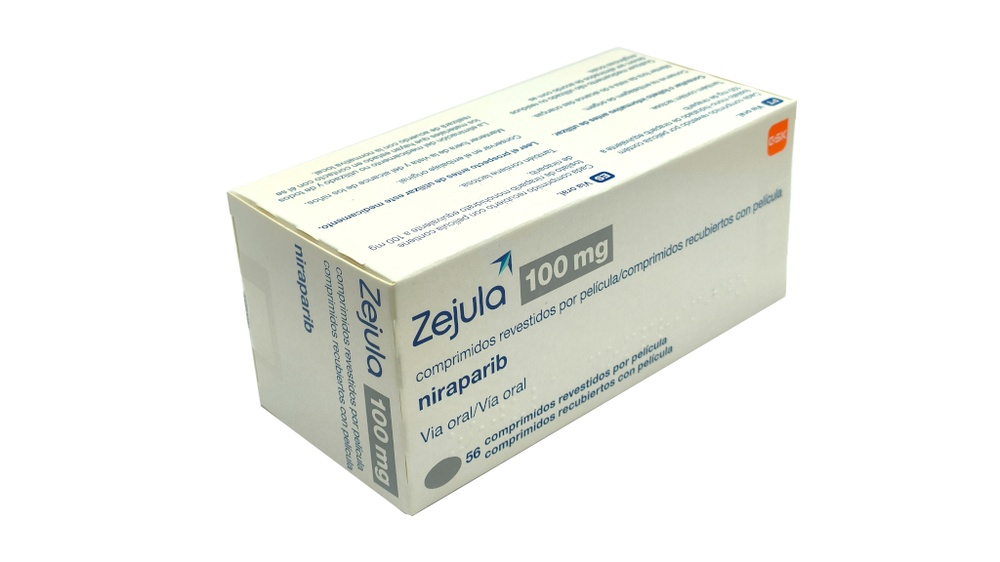
- El principio activo es niraparib. Cada comprimido recubierto con película contiene tosilato de niraparib monohidrato equivalente a 100 mg de niraparib.
- Los demás componentes (excipientes) son:
Núcleo del comprimido: crospovidona, lactosa monohidrato, estearato de magnesio, celulosa microcristalina (E 460), povidona (E 1201), sílice coloidal hidratada.
Recubrimiento del comprimido: alcohol polivinílico (E 1203), dióxido de titanio (E 171), macrogol (E 1521), talco (E 553b), óxido de hierro negro (E 172).
Este medicamento contiene lactosa. Para más información, consulte la sección 2.
Aspecto de Zejula y contenido del envase
Zejula 100 mg comprimidos recubiertos con película son comprimidos recubiertos con película de color gris, de forma ovalada, marcados con “100” en una cara y “Zejula” en la otra.
Los comprimidos recubiertos con película están envasados en blísteres o blísteres resistentes a niños, en estuches de:
- 84 comprimidos recubiertos con película
- 56 comprimidos recubiertos con película
Puede que solamente estén comercializados algunos tamaños de envases.
Titular de la autorización de comercialización
GlaxoSmithKline (Ireland) Limited
12 Riverwalk
Citywest Business Campus
Dublín 24
Irlanda
Responsable de la fabricación
GlaxoSmithKline Trading Services Ltd.
12 Riverwalk
Citywest Business Campus
Dublín 24
Irlanda
Millmount Healthcare Ltd.
Block 7, City North Business Campus,
Stamullen, Co Meath
Irlanda
Glaxo Wellcome, S.A.
Avda. Extremadura, 3
09400 Aranda de Duero
Burgos
España
Pueden solicitar más información respecto a este medicamento dirigiéndose al representante local del titular de la autorización de comercialización:
België/Belgique/Belgien GlaxoSmithKline Pharmaceuticals s.a./n.v. Tél/Tel: + 32 (0) 10 85 52 00 | Lietuva GlaxoSmithKline (Ireland) Limited Tel: + 370 80000334 |
| Luxembourg/Luxemburg GlaxoSmithKline Pharmaceuticals s.a./n.v. Belgique/Belgien Tél/Tel: + 32 (0) 10 85 52 00 |
Ceská republika GlaxoSmithKline, s.r.o. Tel: + 420 222 001 111 | Magyarország GlaxoSmithKline (Ireland) Limited Tel.: + 36 80088309 |
Danmark GlaxoSmithKline Pharma A/S Tlf.: + 45 36 35 91 00 | Malta GlaxoSmithKline (Ireland) Limited Tel: + 356 80065004 |
Deutschland GlaxoSmithKline GmbH & Co. KG Tel.: + 49 (0)89 36044 8701 | Nederland GlaxoSmithKline BV Tel: + 31 (0)33 2081100 |
Eesti GlaxoSmithKline (Ireland) Limited Tel: + 372 8002640 | Norge GlaxoSmithKline AS Tlf: + 47 22 70 20 00 |
Ελλáδa GlaxoSmithKline Movoπpóσωπη A.E.B.E. Τηλ: + 30 210 68 82 100 | Österreich GlaxoSmithKline Pharma GmbH Tel: + 43 (0)1 97075 0 |
España GlaxoSmithKline, S.A. Tel: + 34 900 202 700 | Polska GSK Services Sp. z o.o. Tel.: + 48 (0)22 576 9000 |
France Laboratoire GlaxoSmithKline Tél: + 33 (0)1 39 17 84 44 | Portugal GlaxoSmithKline – Produtos Farmacêuticos, Lda. Tel: + 351 21 412 95 00 |
Hrvatska GlaxoSmithKline (Ireland) Limited Tel: +385 800787089 | Ireland GlaxoSmithKline (Ireland) Limited Tel: + 353 (0)1 4955000 |
România GlaxoSmithKline (Ireland) Limited Tel: + 40 800672524 | Slovenija GlaxoSmithKline (Ireland) Limited Tel: + 386 80688869 |
Ísland Vistor ehf. Sími: + 354 535 7000 | Slovenská republika GlaxoSmithKline (Ireland) Limited Tel: + 421 800500589 |
Italia GlaxoSmithKline S.p.A. Tel: + 39 (0)45 7741111 | Suomi/Finland GlaxoSmithKline Oy Puh/Tel: + 358 (0)10 30 30 30 |
Κúπρος GlaxoSmithKline (Ireland) Limited Τηλ: + 357 80070017 | Sverige GlaxoSmithKline AB Tel: + 46 (0)8 638 93 00 |
Latvija GlaxoSmithKline (Ireland) Limited Tel: + 371 80205045 |
Fecha de la última revisión de este prospecto:
Otras fuentes de información
La información detallada de este medicamento está disponible en la página web de la Agencia Europea de Medicamentos: https://www.ema.europa.eu.
- País de registro
- Forma farmacéuticaCOMPRIMIDO, 100 mg
- Código ATCL01XK02
- Principio activo
- Requiere recetaSí
- Fabricante
- ComposiciónLACTOSA MONOHIDRATO (34,66 mg mg)
- Esta información es de carácter general y no sustituye la consulta con un profesional sanitario.
- Alternativas a ZEJULA 100 MG COMPRIMIDOS RECUBIERTOS CON PELICULAForma farmacéutica: CAPSULA, 100 mgPrincipio activo: niraparibFabricante: Glaxosmithkline (Ireland) LimitedRequiere recetaForma farmacéutica: COMPRIMIDO, 100 MG/500 MGPrincipio activo: niraparib and abirateroneFabricante: Janssen-Cilag International N.VRequiere recetaForma farmacéutica: COMPRIMIDO, 50 MG/500 MGPrincipio activo: niraparib and abirateroneFabricante: Janssen-Cilag International N.VRequiere receta
Médicos online para ZEJULA 100 MG COMPRIMIDOS RECUBIERTOS CON PELICULA
Comenta la dosis, los posibles efectos secundarios, interacciones, contraindicaciones o la revisión de receta de ZEJULA 100 MG COMPRIMIDOS RECUBIERTOS CON PELICULA, sujeto a valoración médica y a la normativa local.
Obtén una receta de ZEJULA 100 MG COMPRIMIDOS RECUBIERTOS CON PELICULA online
Rellena un formulario de 2 minutos
Cuéntanos tus síntomas, historial y el medicamento que necesitas.
Elige un médico o nosotros te asignamos uno
Escoge un especialista o te conectamos con el próximo médico disponible.
El médico revisa tu caso
Normalmente en 30 minutos. Puede hacerte preguntas adicionales por chat.
Recógela en cualquier farmacia
Receta electrónica enviada a tu correo, válida en toda España.
Preguntas frecuentes
ZEJULA 100 MG COMPRIMIDOS RECUBIERTOS CON PELICULA requiere receta en España. Puedes confirmarlo con un médico online según tu caso.
El principio activo de ZEJULA 100 MG COMPRIMIDOS RECUBIERTOS CON PELICULA es niraparib. Esta información ayuda a identificar medicamentos con la misma composición pero con diferentes nombres comerciales.
ZEJULA 100 MG COMPRIMIDOS RECUBIERTOS CON PELICULA es fabricado por Glaxosmithkline (Ireland) Limited. La marca y el envase pueden variar según el distribuidor.
Los Médicos de familia, Psiquiatras, Dermatólogos, Cardiólogos, Endocrinólogos, Gastroenterólogos, Neumólogos, Nefrólogos, Reumatólogos, Hematólogos, Infectólogos, Alergólogos, Geriatras, Pediatras, Oncólogos pueden valorar la prescripción de ZEJULA 100 MG COMPRIMIDOS RECUBIERTOS CON PELICULA cuando esté clínicamente indicado. Puedes reservar una videoconsulta para comentar tu caso y las opciones de tratamiento.
España cuenta con una infraestructura sanitaria bien desarrollada en ciudades principales como Madrid, Barcelona, Valencia y Sevilla. Las farmacias están ampliamente disponibles y operan bajo estrictas regulaciones, garantizando el acceso a medicamentos con receta.
Puedes comprar ZEJULA 100 MG COMPRIMIDOS RECUBIERTOS CON PELICULA en Madrid, Barcelona, Sevilla o Valencia en cualquier farmacia local con una receta válida.
Para obtener una receta, puedes utilizar Oladoctor:
Otros medicamentos con el mismo principio activo (niraparib) incluyen ZEJULA 100 MG CAPSULAS DURAS, AKEEGA 100 MG/500 MG COMPRIMIDOS RECUBIERTOS CON PELICULA, AKEEGA 50 MG/500 MG COMPRIMIDOS RECUBIERTOS CON PELICULA. Pueden tener diferentes nombres comerciales o formulaciones, pero contienen el mismo componente terapéutico. Consulta siempre con un médico antes de cambiar o iniciar un nuevo medicamento.
