


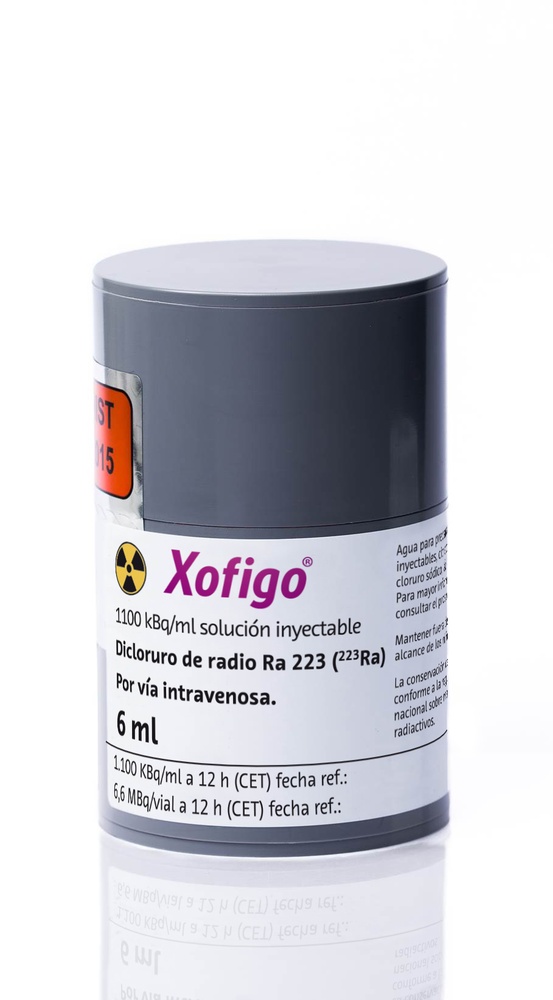
Xofigo 1000 kBq/ml injectable solution

Prescription review online
A doctor will review your case and decide whether a prescription is medically appropriate.

Talk to a doctor about this medicine
Discuss your symptoms and possible next steps in a quick online consultation.



How to use Xofigo 1100 kBq/ml injectable solution
Contents of the leaflet
- Introduction
- What is Xofigo and what is it used for
- What you need to know before you are given Xofigo
- How to use Xofigo
- Possible side effects
- Storage of Xofigo
- Container contents and additional information
Introduction
Package Leaflet: Information for the Patient
Xofigo 1100 kBq/ml solution for injection
radium Ra 223 dichloride (223Ra)
This medicine is subject to additional monitoring, which will allow quick identification of new safety information. You can help by reporting any side effects you may get. See the end of section 4 for how to report side effects.
Read all of this leaflet carefully before you are given this medicine because it contains important information for you.
- Keep this leaflet, you may need to read it again.
- If you have any further questions, ask your doctor, who will be responsible for the procedure.
- If you experience any side effects, talk to your doctor, even if they are not listed in this leaflet. See section 4.
Contents of the pack:
- What is Xofigo and what is it used for
- What you need to know before you are given Xofigo
- How to use Xofigo
- Possible side effects
- Storage of Xofigo
- Contents of the pack and other information
1. What is Xofigo and what is it used for
This medicine contains the active substance radium Ra 223 dichloride (223Ra) (radium-223 dichloride).
Xofigo is used to treat adults with advanced prostate cancer that is resistant to medical or surgical treatments that lower testosterone (hormone) levels, and has spread to the bone, and is causing symptoms (e.g. pain).
Xofigo contains the radioactive substance radium-223, which mimics calcium and is taken up by bone. When injected into the patient, radium-223 reaches the bone where the cancer has spread and emits short-range radiation (alpha particles), which destroys the surrounding cancer cells.

Not sure if this medicine is right for you?
Discuss your symptoms and treatment with a doctor online.
2. What you need to know before you are given Xofigo
Xofigo must not be given
- In combination with abiraterone and prednisone/prednisolone (which are used together to treat prostate cancer).
Warnings and precautions
Talk to your doctor before you are given Xofigo
- Xofigo must not be given in combination with abiraterone and prednisone/prednisolone due to a possible increased risk of bone fractures and deaths. Additionally, there are concerns about the effects of Xofigo when given with other medicines used to treat prostate cancer that has spread. Tell your doctor if you are already taking any of these medicines.
- If you are going to receive Xofigo after treatment with abiraterone and prednisone/prednisolone, you must wait at least 5 days before starting treatment with Xofigo.
- If you are going to receive another cancer treatment after Xofigo, you must wait at least 30 days before starting the other treatment.
- Xofigo is not recommended if the cancer in your bones is not causing symptoms, such as pain.
- Xofigo may cause a decrease in the number of blood cells and platelets in the blood.
Before starting treatment and before each subsequent dose, your doctor will perform a blood test.Based on the results of these tests, your doctor will decide whether treatment can start, continue, or should be delayed or stopped.
- If you have decreased production of blood cells in the bone marrow, e.g. if you have received chemotherapy (other medicines used to kill cancer cells) and/or radiation therapy, you may be at higher risk and your doctor will give you Xofigo with caution.
- If your tumour has spread extensively to the bone, you may be more likely to have a decrease in your blood cells and platelets, and your doctor will give you Xofigo with caution.
- There are limited data that do not suggest any important difference in blood cell production in patients who receive chemotherapy after Xofigo compared to those who do not receive Xofigo.
- There are no data on the use of Xofigo in patients with Crohn's disease(a long-term inflammatory disease of the intestines) and ulcerative colitis(a long-term inflammation of the colon). Due to the excretion of Xofigo in the faeces, Xofigo may worsen acute inflammation of the intestines. Therefore, if you have these diseases, your doctor will carefully consider whether you can be treated with Xofigo.
- If you have untreated or suspected spinal cord compression(pressure on the spinal cord nerves that can be caused by a tumour or other injury), your doctor will first treat this condition with standard treatment before starting or continuing treatment with Xofigo.
- If you have osteoporosis, or a known increased risk of fractures (e.g. recent bone fracture, fragility) or are taking or have taken corticosteroids(e.g. prednisone/prednisolone), please inform your doctor. You may be at higher risk of bone fractures. Your doctor may prescribe a medicine to prevent bone fractures before starting or continuing treatment with Xofigo.
- If you experience new or unusual painor swelling in a bone areabefore, during, or after treatment with Xofigo, talk to your doctor.
- If you have a bone fracture, your doctor will first stabilize the fractured bone before starting or continuing treatment with Xofigo.
- If you are taking or have taken bisphosphonatesor have received prior chemotherapy before Xofigo, inform your doctor. A risk of osteonecrosis of the jaw(dead tissue in the jawbone, mainly seen in patients who have been treated with bisphosphonates) cannot be excluded (see section 4).
- Xofigo contributes to your overall long-term cumulative radiation exposure. Long-term cumulative radiation exposure may increase your risk of developing cancer (in particular, bone cancer and leukaemia) and genetic abnormalities. No cases of cancer caused by Xofigo have been reported in clinical studies with up to three years of follow-up.
Your doctor will perform tests to determine the health of your bones before deciding whether you can receive Xofigo. During treatment and for 2 years after starting treatment with Xofigo, your doctor will continuously monitor the health of your bones.
Children and adolescents
This medicine is not intended for use in children and adolescents.
Other medicines and Xofigo
No studies have been performed on interactions with other medicines.
Xofigo must not be given in combination with abiraterone and prednisone/prednisolone due to a possible increased risk of bone fractures or deaths. Additionally, there are concerns about the effects of Xofigo when given with other systemic medicines used to treat prostate cancer that has spread. Inform your doctor if you are already taking any of these medicines.
If you are taking or have taken bisphosphonates or other medicines to protect the health of your bones or corticosteroids (e.g. prednisone/prednisolone) before Xofigo, inform your doctor. You may be at higher risk of bone fractures.
If you are taking calcium, phosphate, and/or vitamin D, your doctor will carefully consider whether you should temporarily stop taking these before starting treatment with Xofigo.
There are no data on the use of Xofigo at the same time as chemotherapy(other medicines used to kill cancer cells). The combined use of Xofigo and chemotherapy may further decrease the number of blood cells and platelets in the blood.
Tell your doctor if you are taking, have recently taken, or might take any other medicines, including those obtained without a prescription.
Pregnancy and breast-feeding
Xofigo must not be used in women and must not be given to women who are, or may be, pregnant or breast-feeding.
Contraceptive methods in women and men
If you have sexual intercourse with a woman who could become pregnant, you are advised to use effective contraceptive methods during treatment with Xofigo and for 6 months after treatment.
Fertility
There is a potential risk that the radiation emitted by Xofigo may affect your fertility. Ask your doctor how this may affect you, especially if you plan to have children in the future. If you wish, ask for advice on sperm preservation before starting treatment.
Driving and using machines
Xofigo is unlikely to affect your ability to drive or use machines.
Xofigo contains sodium
Depending on the volume administered, this medicine may contain up to 54 mg of sodium (a major component of cooking/table salt) per dose unit. This is equivalent to 2.7% of the maximum recommended daily intake of sodium for an adult.
3. How to use Xofigo

Started taking the medicine and have questions?
Discuss your symptoms and treatment with a doctor online.
There is strict legislation on the use, handling, and disposal of medicines like Xofigo. It will only be used in special controlled areas. This radiopharmaceutical will only be handled and administered by trained and qualified personnel in safe conditions. These personnel will take special care to use this radiopharmaceutical safely and will keep you informed of their actions.
The dose you receive will depend on your body weight. The doctor responsible for the procedure will calculate the amount of Xofigo to be used in your case.
The recommended amount of Xofigo is 55 kBq (Becquerel, the unit used to express radioactivity) per kilogram of body weight.
No dose adjustment is needed if you are 65 years of age or older or if you have reduced kidney or liver function.
Administration of Xofigo and procedure
Xofigo will be slowly injected through a needle inserted into one of your veins (intravenously). The healthcare professional will flush the intravenous access line or cannula before and after the injection with a sodium chloride solution.
Duration of the procedure
- Xofigo is given every 4 weeks for a total of 6 injections.
- There are no data available on the safety and efficacy of treatment with more than 6 injections of Xofigo.
After administration of Xofigo
- Be careful when handling materials such as bedding that come into contact with body fluids (e.g. urine spill, faeces, vomit, etc.). Xofigo is mainly excreted in the faeces. Your doctor will tell you if you need to take any special precautions after receiving this medicine. If you have any doubts, talk to your doctor.
If you are given more Xofigo than you should
Overdose is unlikely to occur. However, in case of accidental overdose, your doctor will start the relevant supportive treatment and examine you for changes in blood cell counts and gastrointestinal symptoms (e.g. diarrhoea, nausea [feeling sick], vomiting).
If you have any further questions on the use of Xofigo, ask the doctor responsible for the procedure.
4. Possible side effects
Like all medicines, this medicine can cause side effects, although not everybody gets them.
The most serious side effectsin patients treated with Xofigo are
- decrease in the number of platelets in the blood(thrombocytopenia),
- decrease in the number of neutrophils, a specific type of white blood cell(neutropenia, which can increase the risk of infection).
Contact your doctor immediately if you noticethe following symptoms, as they may be signs of thrombocytopenia or neutropenia (see above):
- any unusual bruising,
- bleedingmore than usual after an injury,
- fever,
- if you seem to be getting many infections.
Your doctor will perform blood tests before starting treatment and before each injection to check the number of blood cells and platelets (see also section 2).
The most common side effectsin patients treated with Xofigo (very common [may affect more than 1 in 10 people]) are:
- diarrhoea, nausea (feeling sick), vomiting, thrombocytopenia (decrease in the number of platelets in the blood), and bone fractures.
Risk of dehydration: tell your doctor if you have any of the following symptoms: dizziness, increased thirst, decreased urination (urine output) or dry skin, as these can be symptoms of dehydration. It is important to avoid dehydration by drinking plenty of fluids.
Other possible side effects are listed below by frequency:
Common(may affect up to 1 in 10 people)
- decrease in the number of white blood cells (leucopenia)
- decrease in the number of neutrophils, a specific type of white blood cell (neutropenia, which can increase the risk of infection)
- decrease in the number of red and white blood cells and platelets in the blood (pancytopenia)
- reactions at the injection site (e.g. skin redness [erythema], pain, and swelling)
Uncommon(may affect up to 1 in 100 people)
- decrease in the number of lymphocytes, a specific type of white blood cell (lymphopenia)
- weak bones (osteoporosis)
Xofigo contributes to your overall long-term cumulative radiation exposure. Long-term cumulative radiation exposure may increase your risk of developing cancer (in particular, bone cancer and leukaemia) and genetic abnormalities. No cases of cancer caused by Xofigo have been reported in clinical studies with up to three years of follow-up.
If you have symptoms of pain, swelling, or numbness of the jaw, a "heavy jaw feeling" or tooth loss, contact your doctor. Cases of osteonecrosis of the jaw(dead tissue in the jawbone, mainly seen in patients who have been treated with bisphosphonates) have occurred in patients treated with Xofigo. All these cases were only seen in patients who received bisphosphonates before or at the same time as Xofigo and chemotherapy before Xofigo.
Reporting of side effects
If you experience any side effects, talk to your doctor, even if they are not listed in this leaflet. You can also report side effects directly via the national reporting system listed in Appendix V. By reporting side effects, you can help provide more information on the safety of this medicine.
5. Storage of Xofigo
You will not need to store this medicine. This medicine is stored under the responsibility of the specialist in suitable facilities. The storage of radiopharmaceuticals will be carried out in accordance with national regulations on radioactive materials.
This information is intended only for the specialist:
Xofigo must not be used after the expiry date stated on the vial and lead container.
This medicine does not require any special storage temperature.
Do not use Xofigo if you notice discolouration, particles, or defects in the container.
6. Container contents and additional information
Xofigo composition
- The active ingredientis: radium chloride Ra 223 (223Ra) (radium chloride-223 (223Ra)). Each ml of solution contains 1100 kBq of radium chloride-223 (223Ra), corresponding to 0.58 ng of radium-223 on the calibration date. Each vial contains 6 ml of solution (6600 kBq of radium chloride-223 (223Ra) on the calibration date).
- The other componentsare: water for injectable preparations, sodium citrate, sodium chloride, and diluted hydrochloric acid (see the end of section 2 for additional information on sodium).
Product appearance and container contents
Xofigo is a clear and colorless injectable solution. It is supplied in a clear glass vial closed with a gray rubber stopper and an aluminum seal. The vial contains 6 ml of solution and is stored in a lead container.
Marketing authorization holder
Bayer AG
51368 Leverkusen
Germany
Manufacturer
Bayer AS
Drammensveien 288
NO-0283 Oslo
Norway
You can request more information about this medication by contacting the local representative of the marketing authorization holder:
Belgium / Belgium / Belgium Bayer SA-NV Tel: +32-(0)2-535 63 11 | Lithuania UAB Bayer Tel: +37 05 23 36 868 |
Bulgaria Bayer Bulgaria EOOD Tel: +359 (0)2-424 72 80 | Luxembourg / Luxembourg Bayer SA-NV Tel: +32-(0)2-535 63 11 |
Czech Republic Bayer s.r.o. Tel: +420 266 101 111 | Hungary Bayer Hungária KFT Tel: +36 14 87-41 00 |
Denmark Bayer A/S Tlf: +45-45 23 50 00 | Malta Alfred Gera and Sons Ltd. Tel: +35 621 44 62 05 |
Germany Bayer Vital GmbH Tel: +49 (0)214-30 513 48 | Netherlands Bayer B.V. Tel: +31-23-799 1000 |
Estonia Bayer OÜ Tel: +372 655 8565 | Norway Bayer AS Tlf: +47 -23 13 05 00 |
Greece Bayer Hellas ABE Tel: +30 210 61 87 500 | Austria Bayer Austria Ges. m. b. H. Tel: +43-(0)1-711 46-0 |
Spain Bayer Hispania S.L. Tel: +34-93-495 65 00 | Poland Bayer Sp. z o.o. Tel: +48 22 572 35 00 |
France Bayer HealthCare Tél (N° vert): +33-(0)800 87 54 54 | Portugal Bayer Portugal, Lda. Tel: +351 21 416 42 00 |
Croatia Bayer d.o.o. Tel: + 385-(0)1-6599 900 | Romania SC Bayer SRL Tel: +40 21 529 59 00 |
Ireland Bayer Limited Tel: +353 1 216 3300 | Slovenia Bayer d. o. o. Tel: +386 (0)1 58 14 400 |
Iceland Icepharma hf. Tel: +354 540 8000 | Slovak Republic Bayer, spol. s r.o. Tel: +421 2 59 21 31 11 |
Italy Bayer S.p.A. Tel: +39 02 397 81 | Finland Bayer Oy Tel: +358 20 785 21 |
Cyprus NOVAGEM Limited Tel: +357 22 48 38 58 | Sweden Bayer AB Tel: +46 (0) 8 580 223 00 |
Latvia SIA Bayer Tel: +371 67 84 55 63 |
Date of the last revision of this leaflet {MM/YYYY}.
Detailed information about this medication is available on the European Medicines Agency website: http://www.ema.europa.eu.
<-----------------------------------------------------------------------------------------------------------------------------
This information is intended only for healthcare professionals:
The Summary of Product Characteristics or the Product Characteristics of Xofigo is included in its entirety in a section at the end of the printed leaflet in the product packaging, in order to provide healthcare professionals with additional scientific and practical information on the administration and use of this radiopharmaceutical.
- Country of registration
- Dosage formINJECTABLE, 1000 kBq/ml at reference date
- ATC codeV10XX03
- Active substance
- Prescription requiredYes
- Manufacturer
- CompositionCLORURO DE SODIO (6,3 mg mg), CITRATO DE SODIO (E-331) (7,2 mg mg)
- This information is for reference only and does not constitute medical advice. Always consult a doctor before taking any medication. Oladoctor is not responsible for medical decisions based on this content.
- Alternatives to Xofigo 1100 kBq/ml injectable solutionDosage form: INJECTABLE PERFUSION, 370 MBq/mlActive substance: lutetium (177Lu) oxodotreotideManufacturer: Advanced Accelerator ApplicationsPrescription requiredDosage form: INJECTABLE, 1 000 MBq/mlActive substance: lutetium (177Lu) vipivotide tetraxetanManufacturer: Novartis Europharm LimitedPrescription requiredDosage form: RADIOPHARMACEUTICAL, 1.6 mg/mlActive substance: ibritumomab tiuxetan (90Y)Manufacturer: Ceft Biopharma S.R.O.Prescription required
Online doctors for Xofigo 1100 kBq/ml injectable solution
Discuss questions about Xofigo 1100 kBq/ml injectable solution, including use, safety considerations and prescription review, subject to medical assessment and local regulations.









Frequently Asked Questions
Xofigo 1100 kBq/ml injectable solution requires a prescription in Spain. You can check with a doctor online whether this medicine may be appropriate for your situation.
The active ingredient in Xofigo 1100 kBq/ml injectable solution is radium (223Ra) dichloride. This information helps identify medicines with the same composition but different brand names.
Xofigo 1100 kBq/ml injectable solution is manufactured by Bayer Ag. Pharmacy brands and packaging may differ depending on the distributor.
Doctors such as Family doctors, Psychiatrists, Dermatologists, Cardiologists, Endocrinologists, Gastroenterologists, Pulmonologists, Nephrologists, Rheumatologists, Hematologists, Infectious disease physicians, Allergists, Geriatricians, Paediatricians, Oncologists may assess whether Xofigo 1100 kBq/ml injectable solution is appropriate, depending on your situation and local regulations. You can book an online consultation to discuss your symptoms and possible next steps.
The prescription is issued by a doctor after assessing your health. In Spain, Xofigo 1100 kBq/ml injectable solution is then dispensed in pharmacies with that prescription. An online consultation does not guarantee that a prescription will be issued: the decision always rests with the doctor.
To request a review, you can use Oladoctor:
Other medicines with the same active substance (radium (223Ra) dichloride) include LUTATHERA 370 MBq/mL SOLUTION FOR INFUSION, PLUVICTO 1000 MBq/mL Injectable Solution and Perfusion Solution, ZEVALIN 1.6 mg/ml, REACTIVE KIT FOR THE PREPARATION OF A RADIOPHARMACEUTICAL FOR PERFUSION. These may have different brand names or formulations but contain the same therapeutic ingredient. Always consult a doctor before switching or starting a new medicine.
