



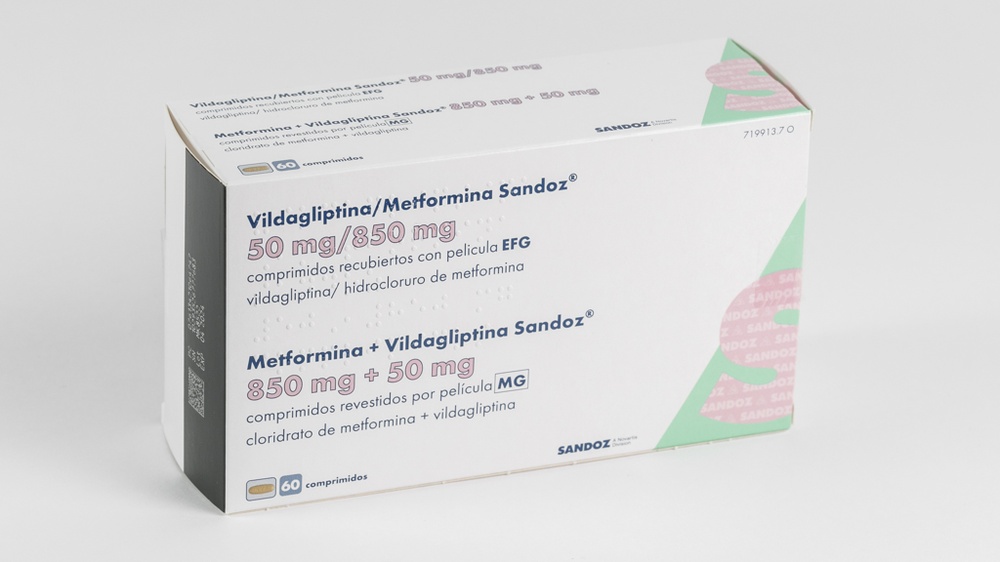
VILDAGLIPTINA 50 mg/850 mg Comprimidos Recubiertos Con Película

Revisión de receta online
Un médico revisará tu caso y determinará si la prescripción es médicamente apropiada.

Habla con un médico sobre este medicamento
Comenta tus síntomas y las opciones de tratamiento en una consulta online.



Cómo usar VILDAGLIPTINA/METFORMINA SANDOZ 50 MG/850 MG COMPRIMIDOS RECUBIERTOS CON PELICULA EFG
Contenido del prospecto
- Introducción
- Qué es Vildagliptina/Metformina Sandoz y para qué se utiliza
- Qué necesita saber antes de empezar a tomar Vildagliptina/Metformina Sandoz
- Cómo tomar Vildagliptina/Metformina Sandoz
- Posibles efectos adversos
- Conservación de Vildagliptina/Metformina Sandoz
- Contenido del envase e información adicional
Introducción
Prospecto: información para el paciente
Vildagliptina/Metformina Sandoz50 mg/850 mg comprimidos recubiertos con película EFG
Vildagliptina/Metformina Sandoz50 mg/1.000 mg comprimidos recubiertos con película EFG
vildagliptina/hidrocloruro de metformina
Lea todo el prospecto detenidamente antes de empezar a tomar este medicamento, porque contiene información importante para usted.
- Conserve este prospecto, ya que puede tener que volver a leerlo.
- Si tiene alguna duda, consulte a su médico o farmacéutico.
- Este medicamento se le ha recetado solamente a usted, y no debe dárselo a otras personas aunque tengan los mismos síntomas que usted, ya que puede perjudicarles.
- Si experimenta efectos adversos, consulte a su médico o farmacéutico, incluso si se trata de efectos adversos que no aparecen en este prospecto. Ver sección 4.
Contenido del prospecto
- Qué es Vildagliptina/Metformina Sandoz y para qué se utiliza
- Qué necesita saber antes de empezar a tomar Vildagliptina/Metformina Sandoz
- Cómo tomar Vildagliptina/Metformina Sandoz
- Posibles efectos adversos
- Conservación de Vildagliptina/Metformina Sandoz
Contenido del envase e información adicional
1. Qué es Vildagliptina/Metformina Sandoz y para qué se utiliza
Los principios activos de Vildagliptina/Metformina Sandoz, vildagliptina y metformina, pertenecen a un grupo de medicamentos llamados “antidiabéticos orales”.
Vildagliptina/metformina se utiliza para tratar pacientes adultos con diabetes tipo 2. Este tipo de diabetes también se conoce como diabetes mellitus no dependiente de insulina. Vildagliptina/metformina se utiliza cuando la diabetes no se puede controlar con dieta y ejercicio solamente y/o con otros medicamentos utilizados para tratar la diabetes (insulina o sulfonilureas).
La diabetes tipo 2 aparece si el organismo no produce suficiente insulina o si la insulina producida no funciona adecuadamente. También puede aparecer si el organismo produce demasiado glucagón.
La insulina y el glucagón se producen en el páncreas. La insulina ayuda a reducir los niveles de azúcar en sangre, especialmente después de las comidas. El glucagón promueve la producción de azúcar por el hígado y hace que aumenten los niveles de azúcar en sangre.
Cómo actúa Vildagliptina/Metformina Sandoz
Ambos principios activos, vildagliptina y metformina, ayudan a controlar los niveles de azúcar en sangre. El principio activo vildagliptina estimula el páncreas para que produzca más insulina y menos glucagón. El principio activo metformina ayuda al organismo a utilizar mejor la insulina. Este medicamento ha demostrado reducir el azúcar en sangre, hecho que ayudará a prevenir complicaciones de su diabetes.

¿No estás seguro de si este medicamento es adecuado para ti?
Comenta tus síntomas y tratamiento con un médico online.
2. Qué necesita saber antes de empezar a tomar Vildagliptina/Metformina Sandoz
No tome Vildagliptina/Metformina Sandoz
- si es alérgico a vildagliptina, a metformina o a alguno de los demás componentes de este medicamento (incluidos en la sección 6). Si cree que pudiera ser alérgico a cualquiera de estos componentes, consulte a su médico antes de tomar vildagliptona/metformina,
- si tiene diabetes no controlada con, por ejemplo, hiperglucemia grave (glucosa alta en sangre), náuseas, vómitos, diarrea, pérdida rápida de peso, acidosis láctica (ver “Riesgo de acidosis láctica” a continuación) o cetoacidosis. La cetoacidosis es un trastorno en el que las sustancias llamadas “cuerpos cetónicos” se acumulan en la sangre, lo que puede conducir a un pre-coma diabético. Los síntomas incluyen dolor de estómago, respiración rápida y profunda, somnolencia o que su aliento desarrolle un aroma afrutado poco habitual,
- si ha tenido recientemente un ataque al corazón o si tiene una insuficiencia cardiaca o problemas circulatorios graves o dificultades respiratorias que puedan ser un signo de problemas de corazón,
- si tiene una reducción grave de la función renal,
- si tiene una infección grave o una deshidratación grave (pérdida de agua masiva del organismo),
- si le van realizar una radiología de contraste (tipo específico de prueba diagnóstica con rayos X y un medio de contraste inyectable). Para más información, ver la sección “Advertencias y precauciones”,
- si tiene problemas de hígado,
- si bebe alcohol en exceso (a diario o sólo ocasionalmente),
- si está dando el pecho (ver también “Embarazo y lactancia”).
Advertencias y precauciones
Consulte a su médico o farmacéutico antes de empezar a tomar Vildagliptina/Metformina Sandoz.
Riesgo de acidosis láctica
Vildagliptina/metformina puede ocasionar un efecto adverso muy raro, pero muy grave, llamado acidosis láctica, en especial si sus riñones no funcionan de forma adecuada. El riesgo de desarrollar acidosis láctica también se ve aumentado con la diabetes descontrolada, infecciones graves, el ayuno prolongado o la ingesta de alcohol, la deshidratación (ver más información a continuación), problemas en el hígado y cualquier trastorno médico en el que una parte del cuerpo tenga un suministro reducido de oxígeno (como enfermedades agudas y graves del corazón).
Si cualquiera de lo anterior es aplicable a usted, consulte a su médico para obtener más instrucciones.
Consulte rápidamente a su médico para que le indique cómo proceder si:
- Se sabe que padece una enfermedad de herencia genética que afecta a las mitocondrias (los componentes que producen energía en el interior de las células), como el síndrome de MELAS (encefalopatía mitocondrial, miopatía, acidosis láctica y episodios similares a ictus) o la diabetes de herencia materna y sordera (MIDD).
- Presenta alguno de los siguientes síntomas tras el inicio del tratamiento con metformina: convulsión, deterioro de las capacidades cognitivas, dificultad con los movimientos corporales, síntomas indicativos de daño nervioso (p. ej., dolor o entumecimiento), migraña y sordera.
Deje de tomar vildagliptina/metformina durante un corto periodo de tiempo si tiene un trastorno que pueda estar asociado con la deshidratación(pérdida significativa de líquidos corporales), como vómitos intensos, diarrea, fiebre, exposición al calor o si bebe menos líquido de lo normal. Consulte con su médico para obtener más instrucciones.
Deje de tomar vildagliptina/metformina y póngase en contacto con un médico o con el hospital más cercano inmediatamente si experimenta cualquiera de los síntomas que produce la acidosis láctica,ya que este trastorno puede dar lugar a coma.
Los síntomas de la acidosis láctica incluyen:
- vómitos,
- dolor de estómago (dolor abdominal),
- calambres musculares,
- sensación general de malestar, con un cansancio intenso,
- dificultad para respirar,
- reducción de la temperatura corporal y de la frecuencia de los latidos del corazón.
La acidosis láctica es una urgencia médica y se debe tratar en un hospital.
Vildagliptina/metformina no es un sustituto de la insulina. Por lo tanto, no deberá tomar vildagliptina/metformina para el tratamiento de la diabetes tipo 1.
Consulte a su médico o farmacéutico antes de empezar a tomar vildagliptina/metformina si tiene o ha tenido una enfermedad del páncreas.
Consulte a su médico o farmacéutico antes de empezar a tomar vildagliptina/metformina si está tomando un medicamento antidiabético conocido como una sulfonilurea. Su médico podría querer reducir su dosis de sulfonilurea cuando la tome conjuntamente con vildagliptina/metformina para evitar un nivel bajo de glucosa en sangre (hipoglucemia).
Si ha tomado anteriormente vildagliptina pero ha tenido que dejar de tomarla debido a una enfermedad del hígado, no debe tomar este medicamento.
Las lesiones de la piel son complicaciones frecuentes de la diabetes. Siga las recomendaciones de su médico o enfermero para el cuidado de la piel y de los pies. Preste especial atención a la aparición de ampollas o úlceras mientras esté tomando vildagliptina/metformina. Si esto ocurre, debe consultar a su médico inmediatamente.
Si necesita someterse a una cirugía mayor debe dejar de tomar vildagliptina/metformina mientras se le realice el procedimiento y durante un tiempo después del mismo. Su médico decidirá cuándo debe interrumpir el tratamiento con vildagliptina/metformina y cuándo reiniciarlo.
Debe realizarse pruebas de la función del hígado antes de iniciar el tratamiento con vildagliptina/metformina, a intervalos de tres meses durante el primer año y después de forma periódica. Esto se realiza para detectar lo antes posible cualquier signo que indique un aumento en las enzimas hepáticas (transaminasas).
Durante el tratamiento con vildagliptina/metformina, su médico comprobará la función de sus riñones, al menos una vez al año o de manera más frecuente si usted es una persona de edad avanzada y/o si su función renal está empeorando.
Su médico controlará periódicamente sus niveles de azúcar en sangre y orina.
Niños y adolescentes
La administración de vildagliptina/metformina no está recomendada en niños y adolescentes menores de 18 años.
Otros medicamentos y Vildagliptina/Metformina Sandoz
Si necesita que se le administre en su torrente sanguíneo una inyección de un medio de contraste que contiene yodo, por ejemplo, en el contexto de una radiografía o de una exploración, debe dejar de tomar vildagliptina/metformina antes de la inyección o en el momento de la misma. Su médico decidirá cuándo debe interrumpir el tratamiento con vildagliptina/metformina y cuándo reiniciarlo.
Informe a su médico si está tomando, ha tomado recientemente o pudiera tener que tomar cualquier otro medicamento. Puede que necesite análisis más frecuentes de la glucosa en sangre y de la función renal, o puede que su médico tenga que ajustar la dosis de vildagliptina/metformina. Es especialmente importante mencionar lo siguiente:
- glucocorticoides, generalmente utilizados para tratar la inflamación,
- agonistas beta-2 generalmente utilizados para tratar trastornos respiratorios,
- otros principios activos utilizados para tratar la diabetes,
- medicamentos que incrementan la producción de orina (diuréticos),
- medicamentos utilizados para tratar el dolor y la inflamación (AINEs e inhibidores de la COX-2, como ibuprofeno y celecoxib),
- ciertos medicamentos para tratar la hipertensión (inhibidores de la ECA y antagonistas del receptor de la angiotensina II),
- determinados principios activos que afectan a tiroides,
- determinados principios activos que afectan al sistema nervioso,
- determinados principios activos utilizados para tratar la angina de pecho (p. ej., ranolazina),
- determinados principios activos utilizados para tratar la infección por VIH (p. ej., dolutegravir),
- determinados principios activos utilizados para tratar un tipo específico de cáncer de tiroides (cáncer de tiroides medular) (p. ej., vandetanib),
- determinados principios activos utilizados para tratar la acidez de estómago y las úlceras pépticas (p. ej., cimetidina).
Toma de Vildagliptina/Metformina Sandoz con alcohol
Evite la ingesta excesiva de alcohol mientras toma vildagliptina/metformina, ya que esto puede incrementar el riesgo de acidosis láctica (ver sección “Advertencias y precauciones”).
Embarazo y lactancia
- Si está embarazada, cree que podría estar embarazada o tiene intención de quedarse embarazada, consulte a su médico antes de utilizar este medicamento. Su médico le informará sobre los riesgos potenciales de tomar vildagliptina/metformina durante el embarazo,
- No tome vildagliptina/metformina si está embarazada o está dando el pecho (ver también “No tome Vildagliptina/Metformina Sandoz”).
Consulte a su médico o farmacéutico antes de utilizar cualquier medicamento.
Conducción y uso de máquinas
Si se siente mareado mientras toma vildagliptina/metformina, no conduzca o maneje herramientas o máquinas.
3. Cómo tomar Vildagliptina/Metformina Sandoz
La dosis de vildagliptina/metformina que debe tomar cada persona varía dependiendo de su estado. Su médico le indicará exactamente la dosis de vildagliptina/metformina que debe tomar.
Siga exactamente las instrucciones de administración de este medicamento indicadas por su médico. En caso de duda, consulte de nuevo a su médico o farmacéutico.
La dosis recomendada es un comprimido recubierto con película de 50 mg/850 mg o de 50 mg/1000 mg dos veces al día.
Si usted tiene una función renal reducida, su médico le puede recetar una dosis menor. Su médico también podrá recetarle una dosis más baja si está tomando un medicamento para la diabetes, como una sulfonilurea.
Su médico le podrá recetar este medicamento solo o junto con determinados medicamentos que disminuyan el nivel de azúcar en su sangre.
Cuándo y cómo tomar Vildagliptina/Metformina Sandoz
- Trague los comprimidos enteros con un vaso de agua.
- Tome un comprimido por la mañana y otro por la noche con las comidas o justo después de comer. La toma del comprimido después de las comidas disminuirá el riesgo de molestias digestivas.
Siga cualquier recomendación dietética de su médico. En particular, si sigue una dieta para el control del peso en diabéticos, continúe con la dieta mientras esté tomando vildagliptina/metformina.
Si toma más Vildagliptina/Metformina Sandoz del que debe
Si ha tomado más Vildagliptina/Metformina Sandoz del que debe, consulte inmediatamente a su médico, a su farmacéutico o llame al Servicio de Información Toxicológica, teléfono: 91 562 04 20, indicando el medicamento y la cantidad utilizada.
Si ha tomado demasiados comprimidos de vildagliptina/metformina, o si otra persona ha tomado sus comprimidos, consulte a su médico o farmacéutico inmediatamente.Puede necesitar atención médica. Si ha de visitar a un médico o ir al hospital más próximo, lleve consigo el envase y este prospecto.
Si olvidó tomar Vildagliptina/Metformina Sandoz
Si se olvida de tomar un comprimido, tómelo con la siguiente comida, a no ser que sea ya la hora de tomar la dosis habitual. No tome una dosis doble (dos comprimidos a la vez) para compensar las dosis olvidadas.
Si interrumpe el tratamiento con Vildagliptina/Metformina Sandoz
Continúe tomando este medicamento mientras su médico se lo recete para que le siga controlando su azúcar en sangre. No interrumpa el tratamiento con vildagliptina/metformina a no ser que su médico se lo indique. Si tiene cualquier duda acerca de la duración del tratamiento, consulte a su médico.
Si tiene cualquier otra duda sobre el uso de este medicamento, pregunte a su médico o farmacéutico.

¿Has empezado a tomar el medicamento y tienes preguntas?
Comenta tus síntomas y tratamiento con un médico online.
4. Posibles efectos adversos
Al igual que todos los medicamentos, este medicamento puede producir efectos adversos, aunque no todas las personas los sufran.
Debe dejar de tomar vildagliptina/metformina y acudir a su médico inmediatamentesi experimenta alguno de los siguientes efectos adversos:
- Acidosis láctica(muy raro: puede afectar hasta 1 persona de cada 10.000): vildagliptina/metformina puede causar un efecto adverso muy raro, pero muy grave, llamado acidosis láctica (ver sección “Advertencias y precauciones”). Si esto le ocurre, debe dejar de tomar vildagliptina/metformina y ponerse en contacto con un médico o el hospital más cercano inmediatamente, ya que la acidosis láctica puede conducir al coma,
- angioedema (raros: puede afectar hasta 1 de cada 1.000 personas): síntomas que incluyen hinchazón de cara, lengua o garganta, dificultad al tragar, dificultad al respirar, aparición repentina de sarpullido o urticaria, que pueden ser indicativos de una reacción llamada “angioedema”,
- enfermedad del hígado (hepatitis) (poco frecuentes: puede afectar hasta 1 de cada 100 personas): síntomas que incluyen coloración amarillenta de la piel y ojos, náuseas, pérdida de apetito o coloración oscura de la orina, que pueden ser indicativos de una enfermedad del hígado (hepatitis),
- inflamación del páncreas (pancreatitis) (poco frecuente: puede afectar hasta 1 de cada 100 personas): síntomas que incluyen dolor intenso y persistente en el abdomen (área del estómago), que puede llegar hasta su espalda, así como náuseas y vómitos.
Otros efectos adversos
Algunos pacientes han experimentado los siguientes efectos adversos mientras tomaban vildagliptina/metformina:
- Frecuentes (pueden afectar más de 1 de cada 10 personas):, dolor de garganta, congestión nasal, fiebre, erupción con picor, sudoración excesiva, dolor en las articulaciones, mareos, dolor de cabeza, temblor incontrolado, estreñimiento, náuseas (malestar), vómitos, diarrea, flatulencia, acidez, dolor en el estómago y en la zona del estómago (dolor abdominal).
- Poco frecuentes (pueden afectar hasta 1 de cada 100 personas): fatiga, debilidad, gusto metálico, niveles bajos de glucosa en sangre, pérdida de apetito, tobillos o pies hinchados (edema), escalofríos, inflamación del páncreas, dolor muscular.
- Muy raros (pueden afectar hasta 1 de cada 10.000 personas): signos de tener un elevado nivel de ácido láctico en la sangre (conocido como acidosis láctica) como somnolencia o mareos, vómitos y náuseas graves, dolor abdominal, latido irregular del corazón o respiración profunda, acelerada; enrojecimiento de la piel, picor; disminución de los niveles de vitamina B12 (palidez, cansancio, síntomas mentales tales como confusión o alteraciones de la memoria).
Desde la comercialización de este producto, también han sido notificados los siguientes efectos adversos:
- frecuencia no conocida (no puede estimarse a partir de los datos disponibles): descamación localizada de la piel o ampollas, inflamación de los vasos sanguíneos (vasculitis), que puede provocar erupciones en la piel o manchas puntiagudas, planas, rojas y redondas debajo de la piel o hematomas.
Comunicación de efectos adversos
Si experimenta cualquier tipo de efecto adverso, consulte a su médico o farmacéutico, incluso si se trata de posibles efectos adversos que no aparecen en este prospecto. También puede comunicarlos directamente a través del Sistema Español de Farmacovigilancia de medicamentos de Uso Humano: https://www.notificaram.es. Mediante la comunicación de efectos adversos usted puede contribuir a proporcionar más información sobre la seguridad de este medicamento.
5. Conservación de Vildagliptina/Metformina Sandoz
Mantener este medicamento fuera de la vista y del alcance de los niños.
No utilice este medicamento después de la fecha de caducidad que aparece en el blíster y en la caja después de CAD/EXP. La fecha de caducidad es el último día del mes que se indica.
No conservar a temperatura superior a 30°C.
Conservar en el embalaje original para protegerlo de la humedad.
Los medicamentos no se deben tirar por los desagües ni a la basura. Deposite los envases y los medicamentos que no necesita en el Punto SIGRE de la farmacia. En caso de duda pregunte a su farmacéutico cómo deshacerse de los envases y de los medicamentos que no necesita. De esta forma, ayudará a proteger el medio ambiente.
6. Contenido del envase e información adicional
Composición de Vildagliptina/Metformina Sandoz:
- Los principios activos son vildagliptina e hidrocloruro de metformina:
Vildagliptina/Metformina Sandoz 50 mg/850 mg contiene 50 mg de vildagliptina y 850 mg de hidroclorudo de metformina (correspondientes a 660 mg de metformina).
Vildagliptina/Metformina Sandoz 50 mg/1.000 mg contiene 50 mg de vildagliptina y 1.000 mg de hidroclorudo de metformina (correspondientes a 780 mg de metformina).
- Los demás componentes son: hidroxipropilcelulosa, estearato de magnesio, hipromelosa 2910 3cP, dióxido de titanio (E 171), óxido de hierro amarillo (E 172), macrogol 4000 y talco.
Aspecto del producto y contenido del envase
Vildagliptina/Metformina Sandoz 50 mg/850 mg
Comprimidos recubiertos con película de color amarillo con bordes biselados, ovalados con “NVR” en una cara y “SEH” en la otra.
Longitud: aproximadamente 20,1 mm.
Ancho: aproximadamente 8,0 mm.
Vildagliptina/Metformina Sandoz 50 mg/1.000 mg
Comprimidos recubiertos con película de color amarillo oscuro con bordes biselados, ovalados, con “NVR” en una cara y “FLO” en la otra.
Longitud: aproximadamente 21,1 mm.
Ancho: aproximadamente 8,4 mm.
Vildagliptina/Metformina Sandoz se envasa en blísteres de Aluminio/Aluminio (PA/Alu/PVC//Alu) o en blísteres de policlorotrifluoroetileno (PCTFE)/PVC//Alu o en blísteres de cloruro de polivinilo/polietileno/cloruro de polivinilideno/aluminio (PVC/PE/PVDC//Alu).
Vildagliptina/Metformina Sandoz está disponible en envases con 10, 30, 60, 120, 180 o 360 comprimidos recubiertos con película y en multienvases que contienen 120 (2 packs de 60), 180 (3 packs de 60) o 360 (6 packs de 60) comprimidos recubiertos con película.
Puede que solamente estén comercializados algunos tamaños de envases.
Titular de la autorización de comercialización y responsable de la fabricación
Titular de la autorización de comercialización
Sandoz Farmacéutica, S.A.
Centro Empresarial Parque Norte
Edificio Roble
C/ Serrano Galvache, 56
28033 Madrid
España
Responsable de la fabricación
Lek Pharmaceuticals d.d.
Verovškova ul 57
1526 Ljubljana
Eslovenia
o
Novartis Pharma GmbH
Roonstrasse 25
90429 Nürnberg
Alemania
o
Salutas Pharma GmbH
Otto-von-Guericke-Allee 1
39179 Barleben,
Alemania
o
Lek Pharmaceuticals d.d.
Trimlini 2D,
9220 Lendava,
Eslovenia
o
Novartis Pharmaceutical Manufacturing LLC
Verovškova ulica 57,
1000 Ljubljana
Eslovenia
Novartis Farmacéutica, S.A.
Gran Via de les Corts Catalanes, 764, 08013
Barcelona,
España
Fecha de la última revisión de este prospecto:Abril 2025.
La información detallada de este medicamento está disponible en la página web de la Agencia Española de Medicamentos y Productos Sanitarios (AEMPS) http://www.aemps.gob.es/
- País de registro
- Forma farmacéuticaCOMPRIMIDO, 50 mg/850 mg
- Código ATCA10BD08
- Precio medio en farmacia36.19 EUR
- Principio activo
- Requiere recetaSí
- Fabricante
- Esta información es de carácter general y no sustituye la consulta con un profesional sanitario.
- Alternativas a VILDAGLIPTINA/METFORMINA SANDOZ 50 MG/850 MG COMPRIMIDOS RECUBIERTOS CON PELICULA EFGForma farmacéutica: COMPRIMIDO, 50 mg/1000 mgPrincipio activo: metformin and vildagliptinFabricante: Medochemie LimitedRequiere recetaForma farmacéutica: COMPRIMIDO, 50 mg/850 mgPrincipio activo: metformin and vildagliptinFabricante: Medochemie LimitedRequiere recetaForma farmacéutica: COMPRIMIDO, 50/1000 mgPrincipio activo: metformin and vildagliptinFabricante: Novartis Europharm LimitedRequiere receta
Médicos online para VILDAGLIPTINA/METFORMINA SANDOZ 50 MG/850 MG COMPRIMIDOS RECUBIERTOS CON PELICULA EFG
Comenta la dosis, los posibles efectos secundarios, interacciones, contraindicaciones o la revisión de receta de VILDAGLIPTINA/METFORMINA SANDOZ 50 MG/850 MG COMPRIMIDOS RECUBIERTOS CON PELICULA EFG, sujeto a valoración médica y a la normativa local.

Obtén una receta de VILDAGLIPTINA/METFORMINA SANDOZ 50 MG/850 MG COMPRIMIDOS RECUBIERTOS CON PELICULA EFG online
Rellena un formulario de 2 minutos
Cuéntanos tus síntomas, historial y el medicamento que necesitas.
Elige un médico o nosotros te asignamos uno
Escoge un especialista o te conectamos con el próximo médico disponible.
El médico revisa tu caso
Normalmente en 30 minutos. Puede hacerte preguntas adicionales por chat.
Recógela en cualquier farmacia
Receta electrónica enviada a tu correo, válida en toda España.
Preguntas frecuentes
VILDAGLIPTINA/METFORMINA SANDOZ 50 MG/850 MG COMPRIMIDOS RECUBIERTOS CON PELICULA EFG requiere receta en España. Puedes confirmarlo con un médico online según tu caso.
El principio activo de VILDAGLIPTINA/METFORMINA SANDOZ 50 MG/850 MG COMPRIMIDOS RECUBIERTOS CON PELICULA EFG es metformin and vildagliptin. Esta información ayuda a identificar medicamentos con la misma composición pero con diferentes nombres comerciales.
El precio medio en farmacia de VILDAGLIPTINA/METFORMINA SANDOZ 50 MG/850 MG COMPRIMIDOS RECUBIERTOS CON PELICULA EFG es de aproximadamente 36.19 EUR. Puede variar según el fabricante y la forma farmacéutica.
VILDAGLIPTINA/METFORMINA SANDOZ 50 MG/850 MG COMPRIMIDOS RECUBIERTOS CON PELICULA EFG es fabricado por Sandoz Farmaceutica S.A.. La marca y el envase pueden variar según el distribuidor.
Los Médicos de familia, Psiquiatras, Dermatólogos, Cardiólogos, Endocrinólogos, Gastroenterólogos, Neumólogos, Nefrólogos, Reumatólogos, Hematólogos, Infectólogos, Alergólogos, Geriatras, Pediatras, Oncólogos pueden valorar la prescripción de VILDAGLIPTINA/METFORMINA SANDOZ 50 MG/850 MG COMPRIMIDOS RECUBIERTOS CON PELICULA EFG cuando esté clínicamente indicado. Puedes reservar una videoconsulta para comentar tu caso y las opciones de tratamiento.
España cuenta con una infraestructura sanitaria bien desarrollada en ciudades principales como Madrid, Barcelona, Valencia y Sevilla. Las farmacias están ampliamente disponibles y operan bajo estrictas regulaciones, garantizando el acceso a medicamentos con receta.
Puedes comprar VILDAGLIPTINA/METFORMINA SANDOZ 50 MG/850 MG COMPRIMIDOS RECUBIERTOS CON PELICULA EFG en Madrid, Barcelona, Sevilla o Valencia en cualquier farmacia local con una receta válida.
Para obtener una receta, puedes utilizar Oladoctor:
Otros medicamentos con el mismo principio activo (metformin and vildagliptin) incluyen DALTEX 50 MG/1000 MG COMPRIMIDOS RECUBIERTOS CON PELICULA EFG, DALTEX 50 MG/850 MG COMPRIMIDOS RECUBIERTOS CON PELICULA EFG, EUCREAS 50 mg/1000 mg COMPRIMIDOS RECUBIERTOS CON PELICULA. Pueden tener diferentes nombres comerciales o formulaciones, pero contienen el mismo componente terapéutico. Consulta siempre con un médico antes de cambiar o iniciar un nuevo medicamento.
