



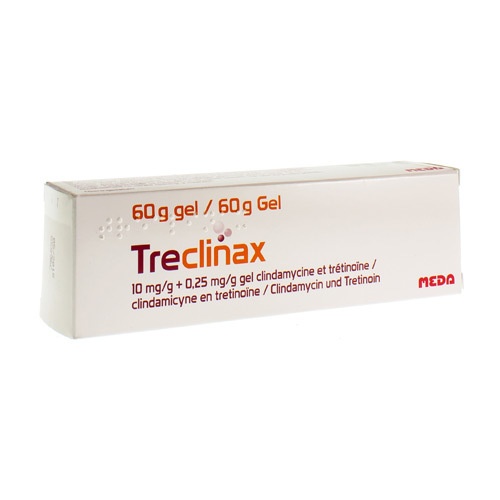
TRECLINAC 10 mg /G Gel

Revisión de receta online
Un médico revisará tu caso y determinará si la prescripción es médicamente apropiada.

Habla con un médico sobre este medicamento
Comenta tus síntomas y las opciones de tratamiento en una consulta online.



Cómo usar TRECLINAC 10 MG/G + 0,25 MG/G GEL
Contenido del prospecto
- Introducción
- Qué es Treclinac y para qué se utiliza
- Qué necesita saber antes de empezar a usar Treclinac
- Cómo usar Treclinac
- Posibles efectos adversos
- Conservación de Treclinac
- Contenido del envase e información adicional
Introducción
Prospecto: información para el usuario
Treclinac 10 mg/g + 0,25 mg/g Gel
clindamicina/tretinoína
Lea todo el prospecto detenidamente antes de empezar a usar el medicamento, porque contiene información importante para usted.
- Conserve este prospecto, ya que puede tener que volver a leerlo.
- Si tiene alguna duda, consulte a su médico o farmacéutico.
- Este medicamento se le ha recetado solamente a usted y no debe dárselo a otras personas aunque tengan los mismos síntomas que usted, ya que puede perjudicarles.
- Si experimenta efectos adversos, consulte a su médico o farmacéutico, incluso si se trata de efectos adversos que no aparecen en este prospecto. Ver sección 4.
Contenido del prospecto:
- Qué es Treclinac y para qué se utiliza
- Qué necesita saber antes de empezar a usar Treclinac
- Cómo usar Treclinac
- Posibles efectos adversos
- Conservación de Treclinac
- Contenido del envase e información adicional
1. Qué es Treclinac y para qué se utiliza
Treclinac contiene clindamicina y tretinoína como principios activos.
Clindamicina es un antibiótico. Limita el crecimiento de las bacterias asociadas con el acné y la inflamación causada por estas bacterias.
Tretinoína normaliza el crecimiento de las células superficiales de la piel y estimula la eliminación normal de las células que obstruyen los folículos pilosos en zonas con acné. Se impide así la acumulación de sebo y la formación de las lesiones precoces del acné (espinillas y granos).
Estos principios activos son más efectivos cuando se combinan que cuando se usan por separado.
Los antibióticos se utilizan para tratar infecciones bacterianas y no sirven para tratar infecciones víricas. Es importante que siga las instrucciones relativas a la dosis, el intervalo de administración y la duración del tratamiento indicadas por su médico. No guarde ni reutilice este medicamento. Si una vez finalizado el tratamiento le sobra antibiótico, devuélvalo a la farmacia para su correcta eliminación. No debe tirar los medicamentos por el desagüe ni a la basura. |
Treclinac se utiliza sobre la piel para tratar el acné en pacientes a partir de 12 años.

¿No estás seguro de si este medicamento es adecuado para ti?
Comenta tus síntomas y tratamiento con un médico online.
2. Qué necesita saber antes de empezar a usar Treclinac
NO use Treclinac:
- Si está embarazada.
- Si planea quedarse embarazada.
- Si es alérgico a la clindamicina, tretinoína o a cualquiera de los demás componentes de este medicamento (incluidos en la sección 6).
- Si es alérgico a la lincomicina.
- Si padece enfermedad inflamatoria crónica del intestino (ej. Enfermedad de Crohn o colitis ulcerosa).
- Si tiene antecedentes de colitis con el uso anterior de antibióticos, caracterizada por diarrea significativa o anormal, o dolores abdominales.
- Si usted, o un miembro de su familia, ha padecido alguna vez cáncer de piel.
- Si padece un eczema agudo, que se caracteriza por piel inflamada, roja, seca y con escamas.
- Si sufre rosácea, una enfermedad de la piel que afecta al rostro y que se caracteriza por enrojecimiento, granos y descamación.
- Si sufre cualquier otro trastorno inflamatorio agudo de la piel (ej., foliculitis), especialmente alrededor de la boca (dermatitis perioral).
- Si padece determinadas formas de acné vulgar caracterizadas por lesiones de acné pustular o de acné nódulo-quístico profundo (acné conglobata y acné fulminante).
Si se encuentra en cualquiera de las situaciones anteriores, no use este medicamento y consulte con su médico.
Advertencias y precauciones
- Evite el contacto de este medicamento con la boca, ojos, membranas mucosas y con la piel lesionada o eczematosa. Tenga cuidado cuando se aplique sobre áreas sensibles de la piel. En caso de contacto accidental con los ojos, enjuague la zona con abundante agua templada.
- Si usted es una mujer en edad fértil, no debe usar Treclinac a menos que esté utilizando un método anticonceptivo (ver también sección “Embarazo, lactancia y fertilidad”).
- Si se produce una diarrea prolongada o importante, o si sufre calambres abdominales, interrumpa el uso de este medicamento y consulte a su médico inmediatamente.
- Si tiene un eczema atópico (inflamación y picor crónico de la piel), consulte con su médico antes de usar este medicamento.
- Evite la exposición a la luz natural o artificial (como una lámpara solar). Esto se debe a que este medicamento puede hacer que su piel sea más susceptible a las quemaduras solares y a otros efectos perjudiciales del sol.
Siempre que esté al aire libre, utilice un eficaz producto de protección con Factor de Protección Solar (FPS) de al menos 30, junto con elementos de protección (por ejemplo, un sombrero).
Si a pesar de estas medidas, se quema el rostro con el sol interrumpa la medicación hasta que su piel esté curada.
- Informe a su médico en caso de que aparezca una inflamación aguda de la piel cuando utilice este medicamento.
- Treclinac no se debe aplicar al mismo tiempo con otros productos usados sobre la piel, incluidos los cosméticos (ver también la sección “Uso de Treclinac con otros medicamentos”) .
Uso de Treclinac con otros medicamentos
Comunique a su médico o farmacéutico si está utilizando, o ha utilizado recientemente o podría tener que utilizar cualquier otro medicamento, incluso los adquiridos sin receta o medicamentos a base de plantas. Esto se debe a que Treclinac puede afectar al mecanismo de acción de otros medicamentos. Del mismo modo, otros medicamentos pueden afectar a la forma de actuar de Treclinac.
Si ha usado cualquier producto que contiene sulfuros, ácido salicílico, peróxido de benzoilo o resorcinol, o cualquier agente químico abrasivo, necesita esperar hasta que el efecto de estos haya disminuido antes de empezar a usar este medicamento. Su médico le indicará cuándo empezar a usar Treclinac.
Durante el tratamiento con Treclinac no use limpiadores ni soluciones jabonosas medicadas que tienen un potente efecto desecante. Tenga precaución cuando utilice los siguientes productos que tienen un efecto desecante: jabones abrasivos, jabones y cosméticos, y productos con altas concentraciones de alcohol, astringentes, sustancias especiadas o minerales.
Consulte a su médico antes de usar este medicamento junto con otros medicamentos que contienen eritromicina o metronidazol, aminoglucósidos, otros antibióticos o corticosteroides, o si está recibiendo medicamentos para el bloqueo neuromuscular, por ejemplo, relajantes musculares usados en la anestesia.
Warfarina o medicamentos similares - utilizados para diluir la sangre. Es más probable que tenga una hemorragia. Su médico puede tener que hacerle análisis de sangre con regularidad para comprobar que su sangre se coagula correctamente.
Embarazo, lactancia y fertilidad
NO use Treclinac si está embarazada o tiene intención de quedarse embarazada. Su médico puede darle más información.
No use este medicamento si está en periodo de lactancia. Se desconoce si Treclinac puede pasar a la leche materna y causar daño en el recién nacido.
Si es una mujer en edad fértil, adopte medidas contraceptivas mientras utilice este medicamento y hasta un mes después de finalizar el tratamiento.
Conducción y uso de máquinas
Es improbable que Treclinac tenga algún efecto sobre la capacidad para conducir o manejar máquinas.
Treclinac contiene parahidroxibenzoato de metilo, parahidroxibenzoato de propilo, butilhidroxitoluenoy polisorbato 80
Este medicamento puede producir reacciones alérgicas (posiblemente retardadas) porque contiene parahidroxibenzoato de metilo (E218) y parahidroxibenzoato de propilo (E216).
Este medicamento puede producir reacciones locales en la piel (como, dermatitis de contacto), o irritación de los ojos y membranas mucosas porque contiene butilhidroxitolueno (E321).
Este medicamento puede producir reacciones alérgicas porque contiene polisorbato 80 (E433).
3. Cómo usar Treclinac
Siga exactamente las instrucciones de administración de este medicamento indicadas por su médico. En caso de duda, consulte de nuevo a su médico o farmacéutico.
La dosis recomendada es:
Diariamente, a la hora de acostarse, se debe aplicar una cantidad de Treclinac equivalente al tamaño de un guisante.
Método de administración
Lávese cuidadosamente la cara con un jabón suave y agua templada, y seque la piel dando ligeros toques con una toalla. Deposite una cantidad de medicamento equivalente al tamaño de un guisante sobre la yema de un dedo. Aplique ligeramente el gel, depositándolo sobre la frente, barbilla, nariz y ambas mejillas y luego extiéndalo uniformemente sobre toda la cara.
No utilice más cantidad que la sugerida por su médico, ni lo haga con mayor frecuencia de la indicada. Un exceso de medicación puede irritar la piel, sin proporcionar resultados más rápidos o mejores.
Duración de tratamiento
Para obtener resultados óptimos con Treclinac, es necesario usar el producto de manera apropiada y no interrumpir su aplicación en cuanto comience a mejorar el acné. Normalmente, pueden transcurrir varias semanas antes de alcanzar un efecto óptimo. En algunos casos, pueden ser precisas hasta 12 semanas. Consulte con su médico si los síntomas persisten durante más de 12 semanas ya que su médico necesitará revaluar su tratamiento.
Si usa más Treclinac del que debe
No obtendrá resultados más rápidos o mejores si se aplica más Treclinac del recomendado. Si se aplica demasiado se puede producir enrojecimiento, descamación o molestias. En estos casos, se debe lavar cuidadosamente la cara con un jabón suave y agua templada. El uso de este medicamento se interrumpirá hasta que hayan desaparecido todos estos síntomas.
Una sobredosis puede también tener como consecuencia efectos secundarios en el estómago e intestino: incluyendo dolor de estómago, náuseas, vómitos y diarrea. En tales casos, se debe interrumpir el uso de este medicamento y deberá contactar con su médico.
Treclinac está indicado únicamente para el uso sobre la piel. En caso de ingestión accidental, póngase en contacto con su médico o acuda a un centro médico, o llame al Servicio de Información Toxicológica. Teléfono (91) 562 04 20, indicando el medicamento y la cantidad ingerida.
Si olvidó usar Treclinac
Si olvidó usar Treclinac a la hora de acostarse, deberá aplicar la siguiente dosis a la hora habitual. No aplique una dosis doble para compensar la dosis olvidada.
Si tiene cualquier otra duda sobre el uso de este medicamento, pregunte a su médico o farmacéutico.

¿Has empezado a tomar el medicamento y tienes preguntas?
Comenta tus síntomas y tratamiento con un médico online.
4. Posibles efectos adversos
Al igual que todos los medicamentos, este medicamento puede producir efectos adversos, aunque no todas las personas los sufran.
Poco frecuentes:pueden afectar hasta 1 de cada 100 personas
- Acné, piel seca, enrojecimiento de la piel, aumento de la producción de sebo, reacción de fotosensibilidad, picor, exantema, exantema exfoliante, exfoliación cutánea, quemaduras solares.
- Reacciones en el lugar de aplicación, tales como, quemazón, piel inflamada, desecación y enrojecimiento de la piel.
Raros: pueden afectar hasta 1 de cada 1.000 personas
- Hipersensibilidad.
- Hipofunción de la glándula tiroidea (síntomas que pueden incluir fatiga, debilidad, ganancia de peso, sequedad capilar, piel rugosa y pálida, pérdida de pelo, incremento de la sensibilidad al frio).
- Dolor de cabeza.
- Irritación de ojos.
- Gastroenteritis (inflamación de cualquier parte del tracto gastrointestinal), náusea.
- Inflamación de la piel, herpes simplex (calenturas), exantema macular (manchas pequeñas, lisas, rojas), hemorragias cutáneas, sensación de ardor en la piel, pérdida de pigmentación de la piel, piel irritada.
- Síntomas en el lugar de aplicación tales como irritación, hinchazón, lesión superficial de la piel, cambio de coloración, picor, descamación.
- Sensación de calor, dolor.
Comunicación de efectos adversos:
Si experimenta cualquier tipo de efecto adverso, consulte a su médico o farmacéutico, incluso si se trata de posibles efectos adversos que no aparecen en este prospecto. También puede comunicarlos directamente a través del Sistema Español de Farmacovigilancia de medicamentos de Uso Humanos: https://www.notificaram.es. Mediante la comunicación de efectos adversos usted puede contribuir a proporcionar más información sobre la seguridad de este medicamento.
5. Conservación de Treclinac
Mantener este medicamento fuera de la vista y del alcance de los niños.
No conservar a temperatura superior a 25° C. No congelar.
Mantener el tubo perfectamente cerrado.
No utilice este medicamento después de la fecha de caducidad que aparece en la caja y en el tubo después de “CAD”. La fecha de caducidad es el último día del mes que se indica.
Caducidad después de la primera apertura: 3 meses.
Los medicamentos no se deben tirar por los desagües ni a la basura. Deposite los envases y los medicamentos que no necesita en el Punto SIGRE de la farmacia. En caso de duda pregunte a su farmacéutico cómo deshacerse de los envases y de los medicamentos que no necesita. De esta forma, ayudará a proteger el medio ambiente.
6. Contenido del envase e información adicional
Composición de Treclinac
- Los principios activos son clindamicina y tretinoína.
1 g de gel contiene 10 mg (1%) de clindamicina (como fosfato de clindamicina) y 0,25 mg (0,025%) de tretinoína.
- Los demás componentes son: agua purificada, glicerol, carbómero, parahidroxibenzoato de metilo (E 218), polisorbato 80 (E433), edetato disódico, ácido cítrico anhidro, parahidroxibenzoato de propilo (E 216), butilhidroxitolueno (E321), trometamol.
Aspecto de Treclinac y contenido del envase
Este medicamento es un gel amarillo translúcido.
Este medicamento está disponible en tubos de aluminio que contienen 30 g o 60 g de gel.
Puede que solamente estén comercializados algunos tamaños de envase.
Titular de la Autorización de Comercialización y responsable de la fabricación
Titular de la Autorización de Comercialización
Viatris Healthcare Limited
Damastown Industrial Park
Mulhuddart, Dublín 15
Dublín
Irlanda
Responsable de la fabricación
MEDA Pharma GmbH & Co.KG
Benzstrasse, 1
61352 Bad Homburg (Alemania)
o
Madaus GmbH
Lütticher Straße 5
53842 Troisdorf
Alemania
Pueden solicitar más información respecto a este medicamento dirigiéndose al representante local del titular de la autorización de comercialización:
Viatris Pharmaceuticals, S.L.
C/ General Aranaz, 86
28027 Madrid
España
Fecha de la última revisión de este prospecto:Octubre 2024
La información detallada y actualizada de este medicamento está disponible en la página web de la Agencia Española de Medicamentos y Productos Sanitarios (AEMPS) https://www.aemps.gob.es
- País de registro
- Forma farmacéuticaGEL, 10 mg/g + 0,25 mg/g
- Código ATCD10AF51
- Principio activo
- Requiere recetaSí
- Fabricante
- ComposiciónBUTILHIDROXITOLUENO (E321) (0,2 mg mg), EDETATO DE DISODIO (0,5 mg mg), POLISORBATO 80 (0,6 mg mg), PARAHIDROXIBENZOATO DE METILO (E-218) (1,5 mg mg), PARAHIDROXIBENZOATO DE PROPILO (0,3 mg mg), GLICEROL (E 422) (118,0 mg mg)
- Esta información es de carácter general y no sustituye la consulta con un profesional sanitario.
- Alternativas a TRECLINAC 10 MG/G + 0,25 MG/G GELForma farmacéutica: GEL, clindamicina 10mg/g + peróxido de benzoílo 30mg/gPrincipio activo: clindamycin, combinationsFabricante: Glaxosmithkline S.A.Requiere recetaForma farmacéutica: GEL, 1% p/p CLINDAMICINA; 5% p/p PERÓXIDO DE BENZOILOPrincipio activo: clindamycin, combinationsFabricante: Glaxosmithkline S.A.Requiere recetaForma farmacéutica: GEL, 10 mg/g + 50 mg/gPrincipio activo: clindamycin, combinationsFabricante: Industrial Farmaceutica Cantabria S.A.Requiere receta
Médicos online para TRECLINAC 10 MG/G + 0,25 MG/G GEL
Comenta la dosis, los posibles efectos secundarios, interacciones, contraindicaciones o la revisión de receta de TRECLINAC 10 MG/G + 0,25 MG/G GEL, sujeto a valoración médica y a la normativa local.



Obtén una receta de TRECLINAC 10 MG/G + 0,25 MG/G GEL online
Rellena un formulario de 2 minutos
Cuéntanos tus síntomas, historial y el medicamento que necesitas.
Elige un médico o nosotros te asignamos uno
Escoge un especialista o te conectamos con el próximo médico disponible.
El médico revisa tu caso
Normalmente en 30 minutos. Puede hacerte preguntas adicionales por chat.
Recógela en cualquier farmacia
Receta electrónica enviada a tu correo, válida en toda España.
Preguntas frecuentes
TRECLINAC 10 MG/G + 0,25 MG/G GEL requiere receta en España. Puedes confirmarlo con un médico online según tu caso.
El principio activo de TRECLINAC 10 MG/G + 0,25 MG/G GEL es clindamycin, combinations. Esta información ayuda a identificar medicamentos con la misma composición pero con diferentes nombres comerciales.
TRECLINAC 10 MG/G + 0,25 MG/G GEL es fabricado por Viatris Healthcare Limited. La marca y el envase pueden variar según el distribuidor.
Los Médicos de familia, Psiquiatras, Dermatólogos, Cardiólogos, Endocrinólogos, Gastroenterólogos, Neumólogos, Nefrólogos, Reumatólogos, Hematólogos, Infectólogos, Alergólogos, Geriatras, Pediatras, Oncólogos pueden valorar la prescripción de TRECLINAC 10 MG/G + 0,25 MG/G GEL cuando esté clínicamente indicado. Puedes reservar una videoconsulta para comentar tu caso y las opciones de tratamiento.
España cuenta con una infraestructura sanitaria bien desarrollada en ciudades principales como Madrid, Barcelona, Valencia y Sevilla. Las farmacias están ampliamente disponibles y operan bajo estrictas regulaciones, garantizando el acceso a medicamentos con receta.
Puedes comprar TRECLINAC 10 MG/G + 0,25 MG/G GEL en Madrid, Barcelona, Sevilla o Valencia en cualquier farmacia local con una receta válida.
Para obtener una receta, puedes utilizar Oladoctor:
Otros medicamentos con el mismo principio activo (clindamycin, combinations) incluyen DUAC 10 MG/G + 30 MG/G GEL, DUAC 10 MG/G +50 MG/G GEL, DUOCLIN 10 MG/G + 50 MG/G GEL. Pueden tener diferentes nombres comerciales o formulaciones, pero contienen el mismo componente terapéutico. Consulta siempre con un médico antes de cambiar o iniciar un nuevo medicamento.
