


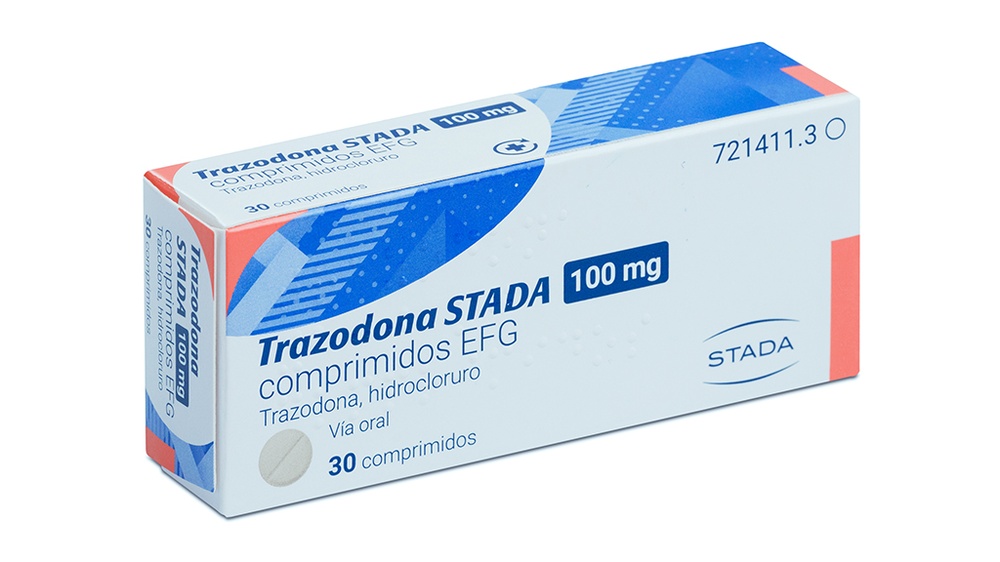
Trazodona Stada 100 mg comprimidos

Revisión de receta online
Un médico revisará tu caso y determinará si la prescripción es médicamente apropiada.

Habla con un médico sobre este medicamento
Comenta tus síntomas y las opciones de tratamiento en una consulta online.



Cómo usar TRAZODONA STADA 100 MG COMPRIMIDOS EFG
Contenido del prospecto
- Introducción
- Qué es Trazodona Stada y para qué se utiliza
- Qué necesita saber antes de empezar a tomar Trazodona Stada
- Cómo tomar Trazodona Stada
- Posibles efectos adversos
- Conservación de Trazodona Stada
- Contenido del envase e información adicional
Introducción
Prospecto: información para el usuario
Trazodona Stada 100 mg comprimidos EFG
trazodona hidrocloruro
Lea todo el prospecto detenidamente antes de empezar a tomar este medicamento, porque contiene información importante para usted.
- Conserve este prospecto, ya que puede tener que volver a leerlo.
- Si tiene alguna duda, consulte a su médico o farmacéutico.
- Este medicamento se le ha recetado solamente a usted, y no debe dárselo a otras personas aunque tengan los mismos síntomas que usted, ya que puede perjudicarles.
- Si experimenta efectos adversos, consulte a su médico o farmacéutico, incluso si se trata de efectos adversos que no aparecen en este prospecto. Ver sección 4.
Contenido del prospecto
- Qué es Trazodona Stada y para qué se utiliza
- Qué necesita saber antes de empezar a tomar Trazodona Stada
- Cómo tomar Trazodona Stada
- Posibles efectos adversos
- Conservación de Trazodona Stada
- Contenido del envase e información adicional
1. Qué es Trazodona Stada y para qué se utiliza
El nombre de este medicamento es Trazodona Stada. Este medicamento contiene un principio activo llamado hidrocloruro de trazodona que pertenece al grupo de medicamentos llamados antidepresivos.
Trazodona puede utilizarse para tratar síntomas de depresión (episodios depresivos mayores).

¿No estás seguro de si este medicamento es adecuado para ti?
Comenta tus síntomas y tratamiento con un médico online.
2. Qué necesita saber antes de empezar a tomar Trazodona Stada
No tomeTrazodona Stada y consulte a su médico si:
- Si es alérgico al hidrocloruro de trazodona o a alguno de los demás componentes de este medicamento (incluidos en la sección 6). Los signos de una reacción alérgica incluyen: erupción de la piel, problemas para tragar o respirar, hinchazón de los labios, cara, garganta o lengua.
- Si ha tenido recientemente un ataque al corazón.
- Si ha tenido una intoxicación con alcohol o una intoxicación con medicamentos para dormir.
No tome este medicamento si se encuentra en alguna de las circunstancias anteriores. Si no está seguro, consulte a su médico o farmacéutico antes de empezar a tomar trazodona.
Advertencias y precauciones
Consulte a su médico o farmacéutico antes de empezar a tomar trazodona.
Tenga especial cuidado con Trazodona Stada
Pensamientos suicidas y empeoramiento de su depresión
Si usted está deprimido, a veces, podría tener pensamientos de autolesión o suicidas. Estos pensamientos pueden aumentar al inicio del tratamiento con antidepresivos, ya que estos medicamentos tardan normalmente unas dos semanas en actuar, incluso a veces más tiempo.
Puede ser más propenso a pensar de esta manera:
- Si ha tenido previamente pensamientos de autolesión o suicidio.
- Si usted es un adulto joven. Ensayos clínicos han demostrado un mayor riesgo de conductas suicidas en adultos menores de 25 años con enfermedades psiquiátricas que fueron tratadas con un antidepresivo.
Si tiene pensamientos de autolesión o suicidas en cualquier momento, póngase en contacto con su médico o vaya a un hospital de inmediato.
Tal vez le resulte útil contarle a un familiar o allegadoque está deprimido y pedirle que lea este prospecto. Podría preguntarle si piensa que su depresión o ansiedad está empeorando, o si está preocupado por cambios en su comportamiento.
Se han reportado casos de trastornos hepáticos graves con el uso de trazodona. Si experimenta cualquiera de los siguientes síntomas, debe informar a su médico inmediatamente:
- Debilidad (astenia)
- Pérdida de apetito (anorexia)
- Náuseas, vómitos
- Dolor de estómago
- Coloración amarillenta de la piel y/o de los ojos (ictericia)
Niños y adolescentes
Trazodona no debe utilizarse en niños y adolescentes menores de 18 años.
Personas de edad avanzada
Los pacientes de edad avanzada que toman trazodona pueden experimentar leves aturdimientos y mareos al ponerse de pie o estar tumbados. También pueden sentirse más somnolientos de lo habitual.
Es necesaria una mayor precaución, especialmente si el paciente sufre otras dolencias y toma medicación para tratarlas, junto con trazodona.
Hable con su médico o farmacéutico antes de tomar Trazodona Stada si usted:
- Tiene o ha tenido ataques o convulsiones (epilepsia).
- Tiene problemas graves de riñón o hígado.
- Tiene una enfermedad del corazón (como insuficiencia cardiovascular, angina de pecho, trastornos de conducción o bloqueos AV de diferente grado, arritmias, infarto de miocardio reciente, síndrome de QT largo congénito o bradicardia).
- Tiene bajos niveles de potasio en la sangre (hipopotasemia) que pueden causar debilidad muscular, contracciones nerviosas, ritmo cardíaco anormal.
- Tiene bajos niveles de magnesio en la sangre (hipomagnesemia).
- Tiene una próstata agrandada.
- Tiene presión arterial baja (hipotensión).
- Tiene una glándula tiroides hiperactiva (hipertiroidismo).
- Tiene problemas para orinar o necesita orinar frecuentemente.
- Tiene glaucoma de ángulo estrecho (un trastorno del ojo).
- Tiene esquizofrenia u otro tipo de trastorno mental.
- Es una persona de edad avanzada, ya que puede ser más propenso a los efectos secundarios.
- Está tomando buprenorfina, naloxona (un analgésico potente). El uso de buprenorfina y naloxona con trazodona puede causar síndrome serotoninérgico, lo que puede poner en riesgo su vida (ver “Otros medicamentos y Trazodona Stada”)
- Está embarazada, intentando quedarse embarazada o en periodo de lactancia.
Si tiene problemas en el hígado, el riñón o el corazón, sufre de epilepsia, tiene presión ocular elevada (glaucoma), problemas para orinar o con la próstata, es probable que su médico quiera examinarlo periódicamente mientras toma trazodona.
Se han notificado trastornos graves de hígado con un potencial desenlace mortal con el uso de trazodona.
Deje de tomar trazodona y hable con su médico de inmediato si experimenta coloración amarillenta de la piel o la parte blanca de los ojos (ictericia) o signos como astenia, anorexia, náuseas, vómitos, dolor abdominal (ver Sección 4. "Posible efectos adversos").
Si tiene esquizofrenia u otros trastornos psicóticos, la administración de antidepresivos puede provocar un posible empeoramiento de los síntomas psicóticos. Los pensamientos paranoides pueden intensificarse.
Durante la terapia con trazodona, una fase depresiva puede cambiar de una psicosis maníaco-depresiva a una fase maníaca. En ese caso, trazodona se debe suspender.
Si le duele la garganta, tiene fiebre o síntomas parecidos a los de la gripe mientras toma trazodona debe hablar con su médico de inmediato. En estos casos, se recomienda realizar un análisis de sangre ya que la agranulocitosis, un trastorno sanguíneo, puede manifestarse clínicamente con estos síntomas.
Se recomienda precaución cuando se usa trazodona junto con otros medicamentos conocidos por prolongar el intervalo QT o que se sabe que aumentan el riesgo de síndrome serotoninérgico/síndrome neuroléptico maligno (ver "Otros medicamentos y Trazodona Stada” y Sección 4. "Posibles efectos adversos").
Si no está seguro de que algo de lo anterior le aplique a usted, hable con su médico o farmacéutico antes de tomar trazodona.
Otros medicamentos y Trazodona Stada
Informe a su médico o farmacéutico si está tomando, ha tomado recientemente o pudiera tener que tomar cualquier otro medicamento.
Esto incluye medicamentos que puede comprar sin prescripción médica, incluyendo medicamentos a base de plantas. Esto es debido a que trazodona puede afectar a la forma en que otros medicamentos actúan. Además, algunos medicamentos pueden afectar a la forma de actuación de trazodona.
Informe a su médico si está tomando alguno de los siguientes medicamentos:
- IMAOs (inhibidores de la monoaminooxidasa), como tranilcipromina, fenelzina e isocarboxazida (para la depresión) o selegilina (para la enfermedad de Parkinson), o los ha tomado en las dos últimas semanas.
- Otros antidepresivos.
- Fenotiazinas: medicamentos antipsicóticos usados en el tratamiento de la esquizofrenia y otros trastornos mentales.
- Buprenorfina y naloxona: usado para el tratamiento del dolor. Estos medicamentos pueden interaccionar con trazodona y usted puede experimentar síntomas como contracción involuntaria y rítmica de músculos, incluyendo los músculos que controlan los movimientos del ojo, agitación, alucinaciones, coma, sudores excesivos, temblor, reflejos exagerados, aumento de la tensión muscular, temperatura corporal superior a 38°C. Contacte con su médico si experimenta alguno de estos síntomas.
- Sedantes (tranquilizantes o medicamentos para dormir).
- Medicamentos utilizados para tratar la epilepsia, tales como carbamazepina y fenitoína.
- Medicamentos utilizados para tratar la presión arterial alta, por ejemplo, clonidina.
- Digoxina: utilizada para tratar problemas del corazón.
- Medicamentos utilizados para tratar infecciones por hongos, tales como ketoconazol e itraconazol.
- Algunos medicamentos utilizados para tratar el VIH, como ritonavir e indinavir.
- Eritromicina: antibiótico usado para tratar infecciones.
- Levodopa (usado en el tratamiento de la enfermedad de Parkinson).
- Hierba de San Juan (una planta medicinal).
- Warfarina (utilizada para evitar la formación de coágulos en la sangre).
- Triptófano.
- Triptanes (medicamentos utilizados para tratar la migraña).
- Medicamentos que se sabe que prolongan el intervalo QT en el ECG, como los antiarrítmicos de clase IA y III (un grupo de medicamentos que se usan para suprimir los ritmos anormales del corazón).
- Medicamentos utilizados para tratar alergias como antihistamínicos.
- La píldora anticonceptiva (anticonceptivos orales).
- Relajantes musculares (grupo de medicamentos que tienen la capacidad de relajar o reducir la tensión muscular).
Anestésicos
Si usted va a ser sometido a una anestesia (para una operación), informe a su médico o dentista de que está tomando trazodona.
Toma de Trazodona Stada con alcohol
Debe evitar beber alcohol mientras toma trazodona.
Embarazo y lactancia
Si está embarazada o en periodo de lactancia, cree que podría estar embarazada o tiene intención de quedarse embarazada, consulte a su médico antes de utilizar este medicamento.
Solo debe tomar trazodona durante el embarazo si así se lo indica su médico.
Tomar trazodona durante el embarazo puede provocar que su bebé experimente síntomas de abstinencia cuando nazca. En este caso, su doctor debe monitorizar al recién nacido.
Si está en periodo de lactancia o tiene planeado amamantar, consulte con su médico o farmacéutico antes de tomar cualquier medicamento.
Conducción y uso de máquinas
Trazodona puede provocar que se sienta somnoliento o mareado. También puede causarle visión borrosa y confusión. Si esto le sucede, no conduzca o manipule herramientas o maquinaria.
Trazodona Stada contiene sodio
Este medicamento contiene menos de 23 mg de sodio (1 mmol) por comprimido; esto es, esencialmente “exento de sodio”.
3. Cómo tomar Trazodona Stada
Siga exactamente las instrucciones de administración de este medicamento indicadas por su médico o farmacéutico. En caso de duda, consulte de nuevo a su médico o farmacéutico.
La dosis recomendada es
Adultos:
- Los adultos, generalmente, empiezan tomando 150 mg al día en una o varias dosis.
- Su médico puede incrementar la dosis cada 3-4 días en intervalos de 50 mg, hasta un máximo de 300 mg al día, dependiendo de su condición.
- Para adultos hospitalizados, la dosis puede llegar a incrementarse hasta 600 mg al día.
Pacientes de edad avanzada:
Las personas de edad avanzada o aquellas que son frágiles, generalmente, recibirán una dosis inicial de 100 mg al día.
Uso en niños y adolescentes
Los niños y adolescentes menores de 18 años no deben tomar trazodona.
Forma de administración
- Administrar el medicamento por vía oral.
- Trague el comprimido entero con un vaso de agua.
- Tomar durante o después de una comida. Esto puede ayudar a reducir las posibilidades de padecer efectos adversos.
- Si le han indicado tomar trazodona solamente una vez al día, entonces, debe tomarla antes de acostarse.
- Si siente que el efecto de su medicamento es demasiado débil o fuerte, no cambie la dosis usted mismo, consulte a su médico.
El comprimido se puede dividir en dosis iguales. Cada mitad del comprimido contiene 50 mg de hidrocloruro de trazodona.
Duración del tratamiento
Por lo general, tardará de dos a cuatro semanas en empezar a sentirse mejor.
Cuando se encuentre la dosis correcta, debe continuar durante al menos cuatro semanas. Su médico volverá a evaluar periódicamente su dosis dependiendo de su estado y determinará si es necesario continuar con un tratamiento de mantenimiento.
En general, el tratamiento con un antidepresivo debe continuar hasta que se haya sentido bien durante cuatro a seis meses.
Si toma más Trazodona Stada de la que debe
En caso de sobredosis o ingestión accidental consulte inmediatamente a su médico o farmacéutico, vaya al servicio de urgencias del hospital más cercano o llame al Servicio de Información Toxicológica, teléfono: 91 562 04 20, indicando el medicamento y la cantidad ingerida. Lleve el envase del medicamentos con usted para que el médico sepa lo que ha tomado.
Los síntomas que pueden aparecer son: malestar general, sueño, mareo o desmayo, convulsiones, confusión, alteraciones respiratorias o del corazón.
Si olvidó tomar Trazodona Stada
Si olvida tomar una dosis, tómela en cuanto lo recuerde, sin embargo, si es casi la hora para la siguiente dosis, no tome la dosis olvidada.
No tome una dosis doble para compensar las dosis olvidadas.
Si interrumpe el tratamiento con Trazodona Stada
No interrumpa el tratamiento con trazodona hasta que su médico se lo diga. No interrumpa el tratamiento con trazodona porque se siente mejor. Cuando su médico le indique que deje de tomar estos comprimidos, le ayudará a dejar el tratamiento de forma gradual.
Si tiene cualquier otra duda sobre el uso de este medicamento, pregunte a su médico o farmacéutico.

¿Has empezado a tomar el medicamento y tienes preguntas?
Comenta tus síntomas y tratamiento con un médico online.
4. Posibles efectos adversos
Al igual que todos los medicamentos, este medicamento puede producir efectos adversos, aunque no todas las personas los sufran.
Se han notificado casos de ideas suicidas y comportamiento suicida durante el tratamiento con trazodona o poco después de la interrupción del tratamiento (ver la sección 2. "Qué necesita saber antes de empezar a tomar Trazodona Stada")
Deje de tomar este medicamento y contacte a su médico inmediatamente si experimenta cualquiera de los siguientes efectos adversos:
- Reacción alérgica, picor, piel con bultos e irritada, erupción cutánea, hinchazón de manos, cara o garganta (edema), opresión en el pecho o dificultad para respirar.
- Erección prolongada y dolorosa del pene (priapismo).
- Erupción cutánea.
- Fiebre inexplicable, dolor de garganta o síntomas parecidos a la gripe.
- Coloración amarilla de los ojos (ictericia) o de la piel, orina muy oscura, dolor en la espalda.
Debe consultar a su médico o farmacéutico si experimenta cualquiera de los siguientes efectos, especialmente si son prolongados o empeoran:
Muy frecuentes: pueden afectar a más de 1 de cada 10 personas• nerviosismo, mareos, somnolencia **• boca secaFrecuentes: pueden afectar hasta 1 de cada 10 personas• trastorno expresivo del sistema nervioso central que afecta la capacidad de usar y comprender palabras (afasia expresiva)• desorientación, confusión, agitación (muy ocasionalmente empeorando hasta el delirio), trastorno mental caracterizado por grandes explosiones de excitación violenta (manía), arrebatos agresivos y la experiencia de parecer ver algo que no está realmente allí (alucinaciones)• reacciones alérgicas• aumento de peso, anorexia y aumento del apetito• cambios en la visión, como visión borrosa, dificultad para enfocar, a veces presión alta en el ojo (glaucoma)• palpitaciones, ritmo cardíaco irregular o rápido (bradicardia o taquicardia)• mareos al levantarse repentinamente (hipotensión ortostática), desmayo (síncope), presión arterial alta• cambios en el sentido del gusto, gases (flatulencia), indigestión (molestias digestivas) con síntomas como sensación de plenitud en la parte superior del estómago, eructos, sensación de malestar o náuseas e indigestión ácida (dispepsia), inflamación del estómago o del intestino delgado (gastroenteritis), estreñimiento o diarrea, dolor de estómago• bultos o manchas en la piel y picazón• sentirse débil (astenia), dolor en el pecho, en la espalda o en las extremidades• sudoración, sofocos, hinchazón (edema), síntomas similares a la gripe• picazón y dolor en los ojos (prurito ocular)• tinnitus (zumbido en los oídos), dolor de cabeza, temblor• nariz bloqueada, congestionada y con dolor (congestión nasal/sinusal)
Poco frecuentes: pueden afectar hasta 1 de cada 100 personas• pérdida de peso• dificultad para respirar (disnea)• disminución del deseo sexual• condición similar al síndrome serotoninérgico, caracterizado por (extrema) inquietud, confusión, excitabilidad, ver cosas que no existen (alucinaciones), escalofríos, sudoración, aumento de los reflejos y contracciones musculares repentinas, fiebre alta, rigidez y convulsiones - especialmente si usted está tomando otros medicamentos antidepresivosRaros: pueden afectar hasta 1 de cada 1.000 personas• trastornos sanguíneos muy graves (escasez de glóbulos blancos) acompañados de fiebre alta repentina, dolor de garganta y úlceras en la boca graves (agranulocitosis), aumento de la cantidad de un tipo de glóbulos blancos en la sangre (eosinofilia), trastorno de la sangre (escasez de glóbulos blancos) acompañado de una mayor sensibilidad a las infecciones (leucopenia), trastorno de la sangre (escasez de plaquetas) acompañado de manchas azules y tendencia a la hemorragia (trombocitopenia) y anemia. Su médico sabrá valorar esto.• contracción repentina de los músculos (mioclono)• obstrucción del flujo biliar, que puede causar ictericia, alteración de la función del hígado, enzimas del hígado elevadasMuy raros: pueden afectar hasta 1 de cada 10.000 personas• erección prolongada y dolorosa de su pene (priapismo).• un grupo de efectos secundarios debido al uso de medicamentos neurolépticos como trazodona (síndrome neuroléptico maligno), como: aumento de la sudoración y la fiebre, cambios en la función del cuerpo (latidos cardíacos rápidos, cambios en la presión arterial, aumento/disminución de la salivación), disminución del nivel de conciencia, palidez de la piel, erupciones en la piel/descamación en todo el cuerpo, mudez, inmovilidad del cuerpo (estupor), pueden ocurrir durante el tratamiento con trazodona
Frecuencia no conocida: la frecuencia no puede estimarse a partir de los datos disponibles• empeoramiento de los delirios, sensación de miedo o vergüenza que le impide comportarse de forma natural, inhibición, ansiedad, ideas suicidas y comportamiento suicida *• alteraciones del sueño (pesadillas, incapacidad para dormir)• liberación excesiva de hormona antidiurética• si se siente cansado, débil o confundido y tiene músculos doloridos, rígidos o descoordinados, esto puede deberse a un bajo nivel de sodio en la sangre. Póngase en contacto con su médico si tiene estos síntomas (hiponatremia).• vértigo, inquietud, disminución del estado de alerta, alteración de la memoria, hormigueo o entumecimiento (parestesia), movimiento corporal anormal e incontrolado (distonía)• latidos cardíacos rápidos e irregulares, desmayos que podrían ser síntomas de una afección potencialmente mortal conocida como Torsades de Pointes.• alteración del ritmo cardíaco (llamada "prolongación del intervalo QT", que se ve en el ECG, actividad eléctrica del corazón)• dolor muscular, rigidez en las articulaciones o dolor• perforación intestinal, obstrucción del intestino causada por la parálisis de los músculos intestinales (íleo paralítico), calambres gastrointestinales y paso del estómago a través de los músculos abdominales y formación de un bulto en la piel (hernia de hiato), aumento de la salivación• debilidad, fatiga, fiebre• dificultad o interrupción al orinar• sudoración excesiva* Se han notificado casos de ideas suicidas y comportamiento suicida durante el tratamiento con trazodona o poco después de la interrupción del tratamiento (ver sección 2. "Qué necesita saber antes de empezar a tomar Trazodona Stada”)**Somnolencia. Esto generalmente ocurre al comenzar el tratamiento. Por lo general, desaparece cuando continúa tomando su medicamento.
Comunicación de efectos adversos
Si experimenta cualquier tipo de efecto adverso, consulte con su médico, farmacéutico o enfermero, incluso si se trata de efectos adversos que no aparecen en este prospecto. También puede comunicarlos directamente a través del Sistema Español de Farmacovigilancia de Medicamentos de Uso Humano www.notificaram.es. Mediante la comunicación de efectos adversos puede contribuir a proporcionar más información sobre la seguridad de este medicamento.
5. Conservación de Trazodona Stada
Mantener este medicamento fuera de la vista y del alcance de los niños.
No utilice este medicamento después de la fecha de caducidad que aparece en el envase y el blíster después de “CAD”. La fecha de caducidad es el último día del mes que se indica.
Este medicamento no requiere condiciones especiales de conservación. Conservar en el embalaje original para protegerlo de la luz.
Los medicamentos no se deben tirar por los desagües ni a la basura. Deposite los envases y los medicamentos que no necesita en el Punto SIGRE de la farmacia. En caso de duda pregunte a su farmacéutico cómo deshacerse de los envases y de los medicamentos que no necesita. De esta forma ayudará a proteger el medio ambiente.
6. Contenido del envase e información adicional
Composición de Trazodona Stada
- El principio activo es trazodona hidrocloruro.
- Trazodona Stada 100 mg comprimidos: cada comprimido contiene 100 mg de trazodona hidrocloruro.
Los demás componentes son celulosa microcristalina, glicolato sódico de almidón (Tipo A) (procedente de la patata), almidón pregelatinizado (procedente del maíz), sílice anhidra coloidal y estearato de magnesio.
Aspecto del producto y contenido del envase
Trazodona Stada 100 mg: comprimidos de color blanco a blanquecino, redondos, biconvexos, sin recubrimiento, de 9,52 mm de diámetro, grabados con “IT” y “II” a cada lado de la ranura por una cara y lisos por la otra cara.
Los comprimidos están disponibles en blísteres de OPA-Aluminio-PVC/Aluminio, PVC-PVdC/Aluminio y PVC/Aluminio.
Tamaños de envase:
100 mg: 20, 30, 50, 56, 60 o 100 comprimidos en blíster. También disponible en blíster precortado unidosis de 56 x 1.
Puede que solamente estén comercializados algunos tamaños de envases.
Titular de la autorización de comercialización y responsable de la fabricación
Titular de la autorización de comercialización
Laboratorio STADA, S.L.
Frederic Mompou, 5
08960 Sant Just Desvern (Barcelona)
España
Responsable de fabricación
Accord Healthcare B.V.,
Winthontlaan 200,
3526 KV Utrecht,
Países Bajos
Laboratori Fundació DAU
C/ C, 12-14 Pol. Ind. Zona Franca,
08040 Barcelona,
España
Accord Healthcare Polska Sp.z o.o.,
ul. Lutomierska 50,95-200 Pabianice,
Polonia
Este medicamento está autorizado en los estados miembros del Espacio Económico Europeo y en el Reino Unido (Irlande del Norte) con los siguientes nombres:
España: Trazodona Stada 100 mg comprimidos EFG
Irlanda: Trazodone hydrochloride 50/100/150 mg tablets
Países Bajos: Trazodone hydrochloride Accord 50/100/150 mg, tabletten
Reino Unido
(Irlanda del Norte): Trazodone hydrochloride 50/100/150 mg tablets
Fecha de la última revisión de este prospecto:julio 2023.
La información detallada de este medicamento está disponible en la página web de la Agencia Española de Medicamentos y Productos Sanitarios (AEMPS) (http://www.aemps.gob.es/).
- País de registro
- Forma farmacéuticaCOMPRIMIDO, 1
- Código ATCN06AX05
- Precio medio en farmacia3.17 EUR
- Principio activo
- Requiere recetaSí
- Fabricante
- Esta información es de carácter general y no sustituye la consulta con un profesional sanitario.
- Alternativas a TRAZODONA STADA 100 MG COMPRIMIDOS EFGForma farmacéutica: COMPRIMIDO, 100 mgPrincipio activo: trazodoneFabricante: Angelini Pharma Espana S.L.Requiere recetaForma farmacéutica: COMPRIMIDO, 100 mgPrincipio activo: trazodoneFabricante: Laboratorios Cinfa S.A.Requiere recetaForma farmacéutica: COMPRIMIDO, 100 mgPrincipio activo: trazodoneFabricante: Laboratorios Normon S.A.Requiere receta
Médicos online para TRAZODONA STADA 100 MG COMPRIMIDOS EFG
Comenta la dosis, los posibles efectos secundarios, interacciones, contraindicaciones o la revisión de receta de TRAZODONA STADA 100 MG COMPRIMIDOS EFG, sujeto a valoración médica y a la normativa local.








Preguntas frecuentes
TRAZODONA STADA 100 MG COMPRIMIDOS EFG requiere receta en España. Puedes confirmarlo con un médico online según tu caso.
El principio activo de TRAZODONA STADA 100 MG COMPRIMIDOS EFG es trazodone. Esta información ayuda a identificar medicamentos con la misma composición pero con diferentes nombres comerciales.
El precio medio en farmacia de TRAZODONA STADA 100 MG COMPRIMIDOS EFG es de aproximadamente 3.17 EUR. Puede variar según el fabricante y la forma farmacéutica.
TRAZODONA STADA 100 MG COMPRIMIDOS EFG es fabricado por Laboratorio Stada S.L.. La marca y el envase pueden variar según el distribuidor.
Los Médicos de familia, Psiquiatras, Dermatólogos, Cardiólogos, Endocrinólogos, Gastroenterólogos, Neumólogos, Nefrólogos, Reumatólogos, Hematólogos, Infectólogos, Alergólogos, Geriatras, Pediatras, Oncólogos pueden valorar la prescripción de TRAZODONA STADA 100 MG COMPRIMIDOS EFG cuando esté clínicamente indicado. Puedes reservar una videoconsulta para comentar tu caso y las opciones de tratamiento.
La receta la emite un médico tras valorar tu estado de salud. En España, TRAZODONA STADA 100 MG COMPRIMIDOS EFG se dispensa en las farmacias con esa receta médica. Una consulta online no garantiza su emisión: la decisión corresponde siempre al médico.
Para solicitar una valoración puedes usar Oladoctor:
Otros medicamentos con el mismo principio activo (trazodone) incluyen DEPRAX 100 MG COMPRIMIDOS RECUBIERTOS CON PELICULA EFG, TRAZODONA CINFA 100 MG COMPRIMIDOS EFG, TRAZODONA NORMON 100 MG COMPRIMIDOS EFG. Pueden tener diferentes nombres comerciales o formulaciones, pero contienen el mismo componente terapéutico. Consulta siempre con un médico antes de cambiar o iniciar un nuevo medicamento.
