


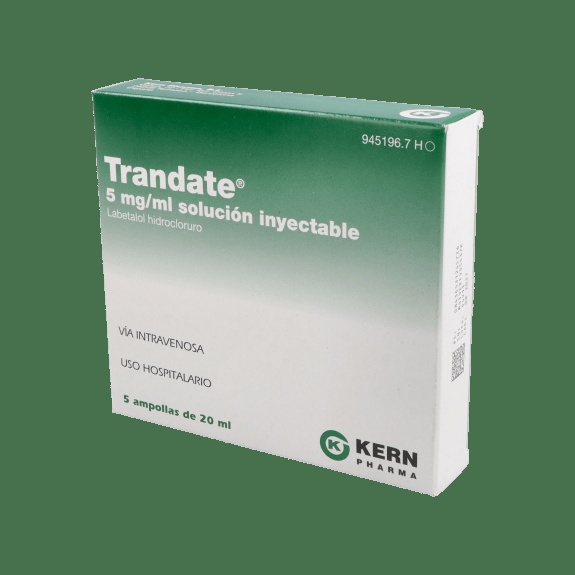
Trandate 100 mg/20 ml solución inyectable

Revisión de receta online
Un médico revisará tu caso y determinará si la prescripción es médicamente apropiada.

Habla con un médico sobre este medicamento
Comenta tus síntomas y las opciones de tratamiento en una consulta online.



Cómo usar TRANDATE 5 mg/ml SOLUCIÓN INYECTABLE
Contenido del prospecto
- Introducción
- Qué es Trandate y para qué se utiliza
- Qué necesita saber antes de empezar a usar Trandate
- Cómo usar Trandate
- Posibles efectos adversos
- Conservación de Trandate
- Contenido del envase e información adicional
Introducción
Prospecto: información para el usuario
Trandate 5 mg/ml solución inyectable
Hidrocloruro de labetalol
Lea todo el prospecto detenidamente antes de empezar a usar el medicamento, porque contiene información importante para usted.
- Conserve este prospecto, ya que puede tener que volver a leerlo.
- Si tiene alguna duda, consulte a su médico, farmacéutico o enfermero.
- Este medicamento se le ha recetado a usted y no debe dárselo a otras personas, aunque tengan los mismos síntomas de la enfermedad, ya que puede perjudicarles.
- Si experimenta efectos adversos, consulte a su médico, farmacéutico o enfermero, incluso si se trata de efectos adversos que no aparecen en ese prospecto.
Contenido del prospecto:
- Qué es Trandate y para qué se utiliza
- Qué necesita saber antes de empezar a usar Trandate
- Cómo usar Trandate
- Posibles efectos adversos
- Conservación de Trandate
- Contenido del envase e información adicional
1. Qué es Trandate y para qué se utiliza
Trandate pertenece al grupo de medicamentos denominados alfa- y beta-bloqueantes.
Trandate está indicado en el tratamiento de:
- Hipertensión grave (tensión arterial alta), incluyendo la del embarazo, cuando sea esencial un rápido control de la presión sanguínea
- Anestesia, cuando está indicada una técnica hipotensora
- Episodios hipertensivos (tensión arterial alta) tras infarto agudo de miocardio.
Trandate no ejerce acción perjudicial sobre la función del riñón y es particularmente adecuado para ser utilizado en pacientes hipertensos con disfunción del riñón.

¿No estás seguro de si este medicamento es adecuado para ti?
Comenta tus síntomas y tratamiento con un médico online.
2. Qué necesita saber antes de empezar a usar Trandate
No use Trandate
- Si es alérgico al hidrocloruro de labetalol, o a cualquier otro componente de Trandate.
- Si padece bloqueo auriculo-ventricular de segundo y tercer grado (bloqueo cardiaco).
- En caso de shock cardiogénico (fallo del corazón).
- En caso de hipotensión (tensión arterial baja) prolongada y grave.
- Si sufre bradicardia (disminución del ritmo del corazón) grave.
- Si padece asma u obstrucción de las vías respiratorias.
- En caso de hipertensión (tensión arterial alta), tras infarto agudo de miocardio, cuando existe
vasoconstricción periférica que sugiere bajo gasto cardíaco.
Advertencias y precauciones
Se debe tener especial cuidado en pacientes con reserva cardíaca escasa (capacidad del corazón para funcionar por encima de su nivel normal) y fallo cardíaco. Estos casos deben controlarse con un glucósido cardíaco (medicamento para controlar el ritmo del corazón) y un diurético (medicamento para aumentar la eliminación de líquidos) antes de iniciar la terapia con Trandate.
No es necesario suspender el tratamiento con Trandate antes de la anestesia, si bien los pacientes deben recibir atropina por vía intravenosa antes de la inducción.
Riesgo de reacción anafiláctica (reacción alérgica grave): Los pacientes con antecedentes de reacción anafiláctica grave a alguna variedad de alérgenos (sustancias que pueden producir reacciones alérgicas), que estén tomando β-bloqueantes (medicamentos para el tratamiento de la tensión arterial alta) pueden ser más sensibles al repetirse la exposición, bien accidental, de diagnóstico o terapéutica. Estos pacientes pueden no responder a las dosis habituales de adrenalina que se usan para tratar las reacciones alérgicas.
Niños y adolescentes
No se ha establecido la seguridad y eficacia de este medicamento en niños.
Interacción de Trandate con otros medicamentos
Informe a su médico o farmacéutico si está utilizando, o ha utilizado recientemente cualquier otro medicamento, incluso los adquiridos sin receta médica, ya que puede ser necesario interrumpir el tratamiento o ajustar la dosis de alguno de ellos.
Debe tener especial cuidado con la administración simultánea con los siguientes medicamentos:
Agentes antiarrítmicos de Clase I o antagonistas del calcio del tipo verapamilo (medicamentos que se usan para suprimir o prevenir las alteraciones del ritmo cardíaco).
Trandate puede potenciar los efectos hipotensores del halotano.
Embarazo, lactancia y fertilidad
Consulte a su médico o farmacéutico antes de utilizar cualquier medicamento.
Se han notificado casos de dolor y fenómeno de Raynaud en los pezones (ver sección 4).
Embarazo
Trandate sólo debe usarse en el primer trimestre de embarazo si el potencial beneficio supera al potencial riesgo.
Lactancia
Trandate se excreta por la leche materna aunque no se han descrito efectos adversos en niños lactantes.
Conducción y uso de máquinas
No se ha descrito ningún efecto sobre la capacidad para conducir o utilizar máquinas debido al uso de este medicamento.
Uso en deportistas
Se informa a los deportistas que este medicamento contiene un componente que puede establecer un resultado analítico en el control de dopaje como positivo.
3. Cómo usar Trandate
Siga exactamente las instrucciones de administración de Trandate indicadas por su médico. Consulte a su médico o farmacéutico si tiene dudas.
Si estima que la acción de Trandate es demasiado fuerte o débil, comuníqueselo a su médico o farmacéutico.
Trandate está indicado para utilizar por vía intravenosa en pacientes hospitalizados.
Los pacientes deben recibir el fármaco estando siempre en posición supina (tendido sobre la espalda) o lateral izquierda (tumbado de lado hacia la izquierda).
Evitar levantar al paciente antes de que transcurran 3 horas ya que puede aparecer una hipotensión postural excesiva.
Adultos
Inyección en bolus
Si es esencial reducir la presión sanguínea rápidamente, deberá administrarse una dosis de 50 mg mediante inyección intravenosa durante al menos un minuto y repetir, si fuera necesario, a intervalos de 5 minutos hasta que se produzca una respuesta satisfactoria. La dosis total no debe exceder de 200 mg.
El efecto máximo sucede generalmente dentro de los 5 primeros minutos y dura unas 6 horas aunque puede prolongarse hasta 18 horas.
Perfusión Intravenosa
Debe emplearse una solución de 1 mg/ml. Diluir, por ejemplo, el contenido de dos ampollas (200 mg) en 200 ml con solución inyectable de cloruro sódico y glucosa o glucosa al 5%.
Hipertensión en embarazo
Comenzar la perfusión con 20 mg/hora, a continuación se puede duplicar la dosis cada 30 minutos hasta que se obtenga una respuesta satisfactoria o se alcance una dosis de 160 mg/hora. Ocasionalmente pueden necesitarse dosis más altas.
Episodios hipertensivos tras infarto agudo de miocardio
Comenzar la perfusión con 15 mg/hora y aumentar gradualmente hasta un máximo de 120 mg/horas dependiendo del control de la presión sanguínea.
Hipertensión debida a otras causas
Infundir a una velocidad de unos 2 mg/min hasta que se obtenga una respuesta satisfactoria, luego detener la perfusión. La dosis eficaz es, generalmente, de 50-200 mg pero pueden necesitarse dosis más grandes especialmente en pacientes con feocromocitoma. La velocidad de perfusión puede ajustarse de acuerdo con la respuesta, a discreción del médico.
Es deseable monitorizar la presión sanguínea y el ritmo cardíaco tras la inyección y durante la perfusión.
En la mayoría de los pacientes hay un pequeño descenso en el ritmo cardíaco; la bradicardia grave es poco habitual pero puede controlarse inyectando 1-2 mg de atropina intravenosa. Deberá vigilarse la función respiratoria, especialmente en pacientes con una alteración conocida.
Una vez que se ha reducido adecuadamente la presión sanguínea mediante bolus o perfusión, deberá sustituirse la terapia de mantenimiento con comprimidos de Trandate empezando con una dosis de 100 mg dos veces al día.
Trandate se ha administrado en pacientes con hipertensión no controlada que ya venían recibiendo otros agentes hipotensores incluyendo β-bloqueantes, sin efectos adversos.
Anestesia hipotensora
La inducción debe hacerse con agentes estándar, p. ej.: tiopentona sódica y la anestesia debe mantenerse con óxido nitroso y oxígeno con o sin halotano. La dosis inicial recomendada de Trandate es de 10-20 mg intravenosamente, dependiendo de la edad y estado del paciente. Los pacientes para los que el halotano está contraindicado requieren, generalmente, una dosis inicial más alta de Trandate (25-30 mg).
Si transcurridos 5 minutos no se obtuviera una hipotensión satisfactoria, deberán realizarse incrementos de 5-10 mg hasta que se alcance el nivel deseado de presión sanguínea.
El halotano y el labetalol actúan sinérgicamente. Por lo tanto, la concentración de halotano no debe exceder el 1-1,5% ya que puede ocurrir un descenso importante de la presión sanguínea.
Tras la inyección de Trandate, la presión sanguínea puede ajustarse rápida y fácilmente alterando la concentración de halotano y/o ajustando la inclinación de la mesa. La duración media de la hipotensión tras 20-25 mg de Trandate es de 50 minutos.
La hipotensión inducida por el labetalol es fácilmente reversible mediante 0,6 mg de atropina e interrumpiendo el halotano.
Si usa más Trandate del que debiera
En caso de sobredosis o inyección accidental, consulte inmediatamente a su médico o farmacéutico, o al Servicio de Información Toxicológica. Teléfono: 91 562 04 20. Se recomienda llevar el envase y el prospecto del medicamento al profesional sanitario.
Son esperados efectos cardiovasculares profundos tales como hipotensión postural excesiva (bajada de la tensión arterial por cambios súbitos de posición) y, a veces, bradicardia (descenso de la frecuencia cardiaca). Los pacientes deben permanecer echados en posición supina con las piernas levantadas. Se justifica el lavado gástrico o la inducción al vómito dentro de las primeras horas de ingestión; emplear un glucósido cardíaco (medicamento para controlar el ritmo del corazón) y un diurético (medicamento para aumentar la eliminación de líquidos) en caso de fallo cardíaco; en caso de broncospasmo, administrar un agonista β2 en aerosol (medicamentos para dilatar los bronquios). Deberán darse de 0,25 a 3 mg de atropina intravenosa para aliviar la bradicardia. Para mejorar la circulación, administrar una dosis inicial de 5 a 10 mcg de noradrenalina intravenosa, preferible a la isoprenalina, repitiéndose según la respuesta.
Alternativamente puede infundirse la noradrenalina a una velocidad de 5 mcg por minuto hasta que la respuesta sea satisfactoria.
En sobredosis grave debe administrarse, preferiblemente, glucagón vía intravenosa. Se deberá administrar una dosis inicial de 5 a 10 mg en glucosa o salina, seguida de una perfusión intravenosa de 5 mg/hora o lo que se necesite para mantener el rendimiento cardíaco.
Se ha descrito fracaso renal oligúrico tras sobredosis masiva de labetalol por vía oral. En un caso, el uso de dopamina para aumentar la presión sanguínea pudo haber agravado el fracaso renal.
La hemodiálisis elimina menos del 1% del clorhidrato de labetalol de la circulación.
Si tiene cualquier otra duda sobre el uso de este producto, pregunte a su médico o farmacéutico.

¿Has empezado a tomar el medicamento y tienes preguntas?
Comenta tus síntomas y tratamiento con un médico online.
4. Posibles efectos adversos
Al igual que todos los medicamentos, Trandate puede tener efectos adversos, aunque no todas las personas los sufran.
Trandate es generalmente bien tolerado. Puede producirse hipotensión postural si se permite a los pacientes que se coloquen en posición vertical antes de que transcurran 3 horas de la administración.
Entre los casos raros de hipersensibilidad se han descrito: erupción, prurito, angioedema y disnea.
También ha habido algunos casos de congestión nasal.
Ha habido casos raros de elevación de las pruebas funcionales hepáticas, ictericia (coloración amarillenta de la piel tanto hepatocelular como colestásica) y hepatitis (inflamación del hígado) y necrosis hepática (muerte del tejido del hígado). Estos signos y síntomas son reversibles generalmente al suspender el tratamiento.
Se han descrito algunos casos de bradicardia y de bloqueo cardíaco.
Con frecuencia no conocida (no puede estimarse a partir de los datos disponibles) se ha descrito dolor en los pezones: disminución intermitente del flujo de sangre a los pezones, lo que puede provocar entumecimiento, palidez y dolor en los pezones (fenómeno de Raynaud).
Si considera que alguno de los efectos adversos que sufre es grave o si aprecia cualquier efecto adverso no mencionado en este prospecto, informe a su médico o farmacéutico.
5. Conservación de Trandate
Mantener este medicamento fuera de la vista y del alcance de los niños.
Conservar en el embalaje original para protegerlo de la luz.
No utilizar Trandate después de la fecha de caducidad indicada en el envase después de CAD. La fecha de caducidad es el último día del mes que se indica.
Los medicamentos no se deben tirar por los desagües ni a la basura. Deposite los envases y los medicamentos que no necesita en el Punto SIGRE de la farmacia. En caso de duda pregunte a su farmacéutico cómo deshacerse de los envases y de los medicamentos que no necesita. De esta forma ayudará a proteger el medio ambiente.
6. Contenido del envase e información adicional
Composición de Trandate
- El principio activo es hidrocloruro de labetalol. Cada ampolla de 20 ml contiene 100 mg de hidrocloruro de labetalol.
- Los demás componentes (excipientes) son: hidróxido sódico, ácido clorhídrico y agua para preparaciones inyectables.
Aspecto del producto y contenido del envase
Envases con 5 ampollas de vidrio transparente de 20 ml con 100 mg de hidrocloruro de labetalol.
Otras presentaciones
Trandate 100 mg comprimidos: Envase con 30 comprimidos.
Trandate 200 mg comprimidos: Envase con 30 comprimidos.
Titular de la autorización de comercialización y responsable de la fabricación
Kern Pharma, S.L.
Polígono Ind. Colón II
Venus, 72
08228 Terrassa (Barcelona)
Este prospecto ha sido aprobado en Diciembre 2021.
La información detallada y actualizada de este medicamento está disponible en la página web de la Agencia Española de Medicamentos y Productos Sanitarios (AEMPS) http://www.aemps.es/.
-------------------------------------------------------------------------------------------------------------------
Esta información está destinada únicamente a médicos o profesionales del sector sanitario:
Trandate es compatible con los siguientes fluidos intravenosos:
- Glucosa 5%
- Cloruro sódico al 0,18% en glucosa al 4%
- Cloruro potásico al 0,3% en glucosa al 5%
- Solución de lactato sódico compuesto.
Desechar las mezclas no utilizadas a las 24 horas de su preparación.
Trandate es incompatible con solución inyectable de bicarbonato sódico al 4,2% p/v.
- País de registro
- Forma farmacéuticaINYECTABLE, 100 mg labetalol hidrocloruro/20 ml
- Código ATCC07AG01
- Principio activo
- Requiere recetaSí
- Fabricante
- ComposiciónHIDROXIDO DE SODIO (E 524) (CSP pH 3,3-3,7 - mg)
- Esta información es de carácter general y no sustituye la consulta con un profesional sanitario.
- Alternativas a TRANDATE 5 mg/ml SOLUCIÓN INYECTABLEForma farmacéutica: INYECTABLE, 5 mg/mlPrincipio activo: labetalolFabricante: S.A.L.F. S.P.A. Laboratorio FarmacologicoRequiere recetaForma farmacéutica: COMPRIMIDO, 100 mgPrincipio activo: labetalolFabricante: Kern Pharma S.L.Requiere recetaForma farmacéutica: COMPRIMIDO, 200 mgPrincipio activo: labetalolFabricante: Kern Pharma S.L.Requiere receta
Médicos online para TRANDATE 5 mg/ml SOLUCIÓN INYECTABLE
Comenta la dosis, los posibles efectos secundarios, interacciones, contraindicaciones o la revisión de receta de TRANDATE 5 mg/ml SOLUCIÓN INYECTABLE, sujeto a valoración médica y a la normativa local.
Preguntas frecuentes
TRANDATE 5 mg/ml SOLUCIÓN INYECTABLE requiere receta en España. Puedes confirmarlo con un médico online según tu caso.
El principio activo de TRANDATE 5 mg/ml SOLUCIÓN INYECTABLE es labetalol. Esta información ayuda a identificar medicamentos con la misma composición pero con diferentes nombres comerciales.
TRANDATE 5 mg/ml SOLUCIÓN INYECTABLE es fabricado por Kern Pharma S.L.. La marca y el envase pueden variar según el distribuidor.
Los Médicos de familia, Psiquiatras, Dermatólogos, Cardiólogos, Endocrinólogos, Gastroenterólogos, Neumólogos, Nefrólogos, Reumatólogos, Hematólogos, Infectólogos, Alergólogos, Geriatras, Pediatras, Oncólogos pueden valorar la prescripción de TRANDATE 5 mg/ml SOLUCIÓN INYECTABLE cuando esté clínicamente indicado. Puedes reservar una videoconsulta para comentar tu caso y las opciones de tratamiento.
La receta la emite un médico tras valorar tu estado de salud. En España, TRANDATE 5 mg/ml SOLUCIÓN INYECTABLE se dispensa en las farmacias con esa receta médica. Una consulta online no garantiza su emisión: la decisión corresponde siempre al médico.
Para solicitar una valoración puedes usar Oladoctor:
Otros medicamentos con el mismo principio activo (labetalol) incluyen LABETALOL S.A.L.F. 5 MG/ML SOLUCION INYECTABLE Y PARA PERFUSION EFG, TRANDATE 100 mg, COMPRIMIDOS RECUBIERTOS, TRANDATE 200 mg COMPRIMIDOS RECUBIERTOS. Pueden tener diferentes nombres comerciales o formulaciones, pero contienen el mismo componente terapéutico. Consulta siempre con un médico antes de cambiar o iniciar un nuevo medicamento.
