



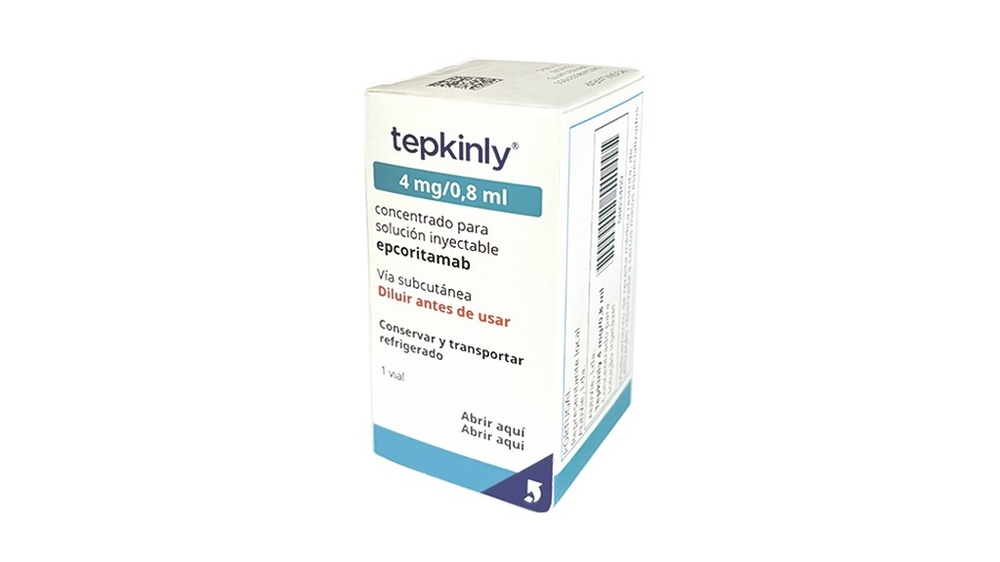
TEPKINLY 4 mg /0,8 Ml Solucion Inyectable

Revisión de receta online
Un médico revisará tu caso y determinará si la prescripción es médicamente apropiada.

Habla con un médico sobre este medicamento
Comenta tus síntomas y las opciones de tratamiento en una consulta online.



Cómo usar TEPKINLY 4 MG/0,8 ML SOLUCION INYECTABLE
Contenido del prospecto
- Introducción
- Qué es Tepkinly y para qué se utiliza
- Qué necesita saber antes de empezar a usar Tepkinly
- Cómo usar Tepkinly
- Posibles efectos adversos
- Conservación de Tepkinly
- Contenido del envase e información adicional
Introducción
Prospecto: información para el paciente
Tepkinly 4 mg/0,8 ml solución inyectable
epcoritamab
Este medicamento está sujeto a seguimiento adicional, lo que agilizará la detección de nueva información sobre su seguridad. Puede contribuir comunicando los efectos adversos que pudiera usted tener. La parte final de la sección 4 incluye información sobre cómo comunicar estos efectos adversos.
Lea todo el prospecto detenidamente antes de empezar a usar este medicamento, porque contiene información importante para usted.
- Conserve este prospecto, ya que puede tener que volver a leerlo.
- Su médico le entregará una tarjeta de información para el paciente. Léala detenidamente y siga las instrucciones que contiene. Lleve siempre consigo esta tarjeta de información para el paciente.
- Muestre siempre la tarjeta de información para el paciente al médico o enfermero o si acude al hospital.
- Si tiene alguna duda, consulte a su médico, farmacéutico o enfermero.
- Si experimenta efectos adversos, consulte a su médico, farmacéutico o enfermero, incluso si se trata de posibles efectos adversos que no aparecen en este prospecto. Ver sección 4.
Contenido del prospecto
- Qué es Tepkinly y para qué se utiliza
- Qué necesita saber antes de empezar a usar Tepkinly
- Cómo usar Tepkinly
- Posibles efectos adversos
- Conservación de Tepkinly
- Contenido del envase e información adicional
1. Qué es Tepkinly y para qué se utiliza
Qué es Tepkinly
Tepkinly es un medicamento para el cáncer que contiene el principio activo epcoritamab. Tepkinly se usa solo (monoterapia) para tratar a pacientes adultos que tienen un tipo de cáncer de la sangre denominado linfoma B difuso de células grandes (LBDCG) o linfoma folicular (LF) cuando la enfermedad ha vuelto o no ha respondido al tratamiento previo después de al menos dos tratamientos previos.
Cómo funciona Tepkinly
Epcoritamab está diseñado específicamente para ayudar a su propio sistema inmunitario a atacar a las células cancerosas (linfoma). Epcoritamab actúa adhiriéndose a las células inmunitarias y las células cancerosas de su cuerpo, juntándolas, para que su sistema inmunitario pueda destruir las células cancerosas.

¿No estás seguro de si este medicamento es adecuado para ti?
Comenta tus síntomas y tratamiento con un médico online.
2. Qué necesita saber antes de empezar a usar Tepkinly
No use Tepkinly
Si es alérgico al epcoritamab o a alguno de los demás componentes de este medicamento (incluidos en la sección 6).
En caso de duda, consulte a su médico o enfermero antes de que le administren Tepkinly.
Advertencias y precauciones
Consulte a su médico, farmacéutico o enfermero antes de empezar a usar Tepkinly si
- tiene o ha tenido problemas con su sistema nervioso, tales como crisis convulsivas
- tiene una infección
- se tiene que poner una vacuna o sabe que necesitará alguna en el futuro cercano.
Si alguna de las anteriores se aplica a usted (o no está seguro), consulte a su médico o enfermero antes de que le administren Tepkinly.
Informe a su médico de inmediato si presenta síntomas de alguno de los siguientes efectos adversos enumerados debajo durante o después del tratamiento con Tepkinly. Es posible que necesite tratamiento médico adicional.
- Síndrome de liberación de citoquinas:una enfermedad potencialmente mortal que causa fiebre, vómitos, dificultad para respirar/falta de aliento, escalofríos, latido cardiaco rápido, dolor de cabeza y mareo o ligero aturdimiento, asociada a los medicamentos que estimulan las células T.
- Antes de cada inyección subcutánea, es posible que le administren medicamentos que ayudan a reducir los posibles efectos del síndrome de liberación de citoquinas.
- ICANS (síndrome de neurotoxicidad asociada a células inmunoefectoras):los síntomas pueden incluir problemas con el uso del lenguaje (incluido el habla, la comprensión, la escritura y la lectura), somnolencia, confusión/desorientación, debilidad muscular, crisis convulsivas, hinchazón de una parte del cerebro y pérdida de memoria.
- Infecciones:es posible que experimente signos de infección, como fiebre de 38 °C o más, escalofríos, tos o dolor al orinar que pueden variar en función del lugar del cuerpo donde se encuentre la infección.
- Síndrome de lisis tumoral:algunas personas pueden presentar niveles inusuales de algunas sales en la sangre, debido a la rápida descomposición de las células cancerosas durante el tratamiento. Esto se denomina síndrome de lisis tumoral (SLT).
- Su médico o enfermero le harán análisis de sangre para comprobar si presenta esta situación. Antes de cada inyección subcutánea, debe estar bien hidratado y es posible que le administren otros medicamentos que pueden ayudar a reducir los niveles elevados de ácido úrico y a reducir los posibles efectos del síndrome de lisis tumoral.
- Brote tumoral:como su cáncer es destruido, podría reaccionar y parece que empeora – esto se llama “reacción de brote tumoral”.
Niños y adolescentes
Tepkinly no se recomienda en niños y adolescentes menores de 18 años de edad, puesto que no hay información sobre su uso en este grupo de edad.
Otros medicamentos y Tepkinly
Informe a su médico o farmacéutico si está tomando o usando, ha tomado o usado recientemente o pudiera tener que tomar o usar cualquier otro medicamento. Esto incluye medicamentos obtenidos sin receta y medicamentos a base de plantas medicinales.
Embarazo
Si está embarazada, cree que podría estar embarazada o tiene intención de quedarse embarazada, consulte a su médico o farmacéutico antes de utilizar este medicamento. No utilice Tepkinly durante el embarazo porque puede afectar al feto. Su médico puede pedirle que se haga una prueba de embarazo antes de iniciar el tratamiento.
Anticoncepción
Si es usted una mujer que puede quedarse embarazada, debe usar métodos anticonceptivos efectivos para evitar quedarse embarazada mientras toma Tepkinly y durante al menos 4 meses tras la última dosis de Tepkinly. Si se queda embarazada durante este tiempo, debe hablar de inmediato con su médico.
Hable con su médico o enfermero sobre los métodos anticonceptivos adecuados.
Lactancia
No debe dar lactancia materna durante el tratamiento con Tepkinly y durante al menos 4 meses tras la última dosis. No se sabe si Tepkinly pasa a la leche materna y si podría afectar a su bebé.
Fertilidad
Se desconoce el efecto de Tepkinly sobre la fertilidad de hombres y mujeres.
Conducción y uso de máquinas
Debido a los posibles síntomas de ICANS, debe actuar con precaución al conducir, montar en bicicleta o usar maquinaria pesada o potencialmente peligrosa. Si tiene actualmente tales síntomas, evite estas actividades y contacte con su médico, enfermero o farmacéutico. Ver sección 4 para obtener más información sobre efectos adversos.
Tepkinly contiene sodio
Este medicamento contiene menos de 1 mmol de sodio (23 mg) por vial; esto es, esencialmente "exento de sodio".
Tepkinly contiene sorbitol
Este medicamento contiene 21,9 mg de sorbitol en cada vial, equivalentes a 27,33 mg/ml.
Tepkinly contiene polisorbato
Este medicamento contiene 0,42 mg de polisorbato 80 en cada vial, equivalente a 0,4 mg/ml. El polisorbato 80 puede causar reacciones alérgicas. Informe a su médico si tiene cualquier alergia conocida.
3. Cómo usar Tepkinly
Un médico con experiencia en el tratamiento del cáncer se ocupará de su tratamiento. Siga el calendario de tratamiento que le explique su médico.
Tepkinly le será administrado por un médico o enfermero como una inyección subcutánea.
Tepkinly se le administrará en ciclos de 28 días, de acuerdo con un calendario de dosis que le proporcionará su médico.
Tepkinly se le administrará de acuerdo con el calendario siguiente
Ciclo | Calendario de dosis |
Ciclos 1 a 3 | Semanalmente |
Ciclos 4 a 9 | Cada dos semanas |
Ciclos 10 y posteriores | Cada cuatro semanas |
Es posible que le administren otros medicamentos antes de administrarle Tepkinly. Esto es para ayudar a prevenir reacciones como el síndrome de liberación de citoquinas y la fiebre en el Ciclo 1 (y potencialmente en ciclos futuros).
Estos medicamentos pueden incluir
- Corticoesteroides: como dexametasona, prednisolona o equivalente
- Un antihistamínico: como difenhidramina
- Paracetamol
Si tiene linfoma B difuso de células grandes (LBDCG)
La primera dosis completa (48 mg) de Tepkinly se le administrará el día 15 del Ciclo 1. Su médico supervisará cómo está funcionando su tratamiento y le solicitará estar en un hospital durante 24 horas después de la primera dosis completa (48 mg) porque es cuando es más probable que se produzcan reacciones como SLC, ICANS y fiebre.
Si tiene linfoma folicular (LF)
La primera dosis completa (48 mg) de Tepkinly se le administrará el día 22 del Ciclo 1.
Se le administrará Tepkinly mientras su médico piense que usted se está beneficiando del tratamiento.
Es posible que su médico retrase o detenga completamente el tratamiento con Tepkinly si experimenta ciertos efectos adversos.
Si olvidó usar Tepkinly
Si olvida o se salta una cita médica, pida otra inmediatamente. Para que el tratamiento sea plenamente eficaz, es muy importante no saltarse ninguna dosis.
Si interrumpe el tratamiento con Tepkinly
No interrumpa el tratamiento con Tepkinly a no ser que lo haya hablado con su médico. Esto se debe a que interrumpir el tratamiento puede hacer que su estado empeore.
Si tiene cualquier otra duda sobre el uso de este medicamento, pregunte a su médico, farmacéutico o enfermero.

¿Has empezado a tomar el medicamento y tienes preguntas?
Comenta tus síntomas y tratamiento con un médico online.
4. Posibles efectos adversos
Al igual que todos los medicamentos, este medicamento puede producir efectos adversos, aunque no todas las personas los sufran.
Efectos adversos graves
Informe de inmediato a su médico si observa cualquiera de los síntomas de los siguientes efectos adversos graves. Es posible que experimente solo uno o algunos de estos síntomas.
Síndrome de liberación de citoquinas (SLC) (Muy frecuente:puede afectar a más de 1 de cada 10 personas)
Los síntomas pueden incluir
- fiebre
- vómitos
- mareo o ligero aturdimiento
- escalofríos
- latido rápido del corazón
- dificultad para respirar/falta de aliento
- dolor de cabeza
Síndrome de neurotoxicidad asociada a células inmunoefectoras (ICANS) (Frecuente:puede afectar hasta 1 de cada 10 personas)
- los efectos sobre el sistema nervioso, cuyos síntomas pueden producirse días o incluso semanas después de recibir la inyección, pueden ser sutiles al principio. Algunos de esos síntomas pueden ser signos de una reacción inmunitaria grave denominada “síndrome de neurotoxicidad asociada a células inmunoefectoras” (ICANS). Los síntomas pueden incluir
- dificultad para hablar o escribir
- somnolencia
- confusión/desorientación
- debilidad muscular
- convulsiones
- pérdida de memoria
Síndrome de lisis tumoral (SLT) (Frecuente:puede afectar hasta 1 de cada 10 personas)
Los síntomas pueden incluir
- fiebre
- escalofríos
- vómitos
- confusión/desorientación
- dificultad para respirar
- convulsiones
- ritmo cardiaco irregular
- orina oscura o turbia
- cansancio inusual
- dolor muscular o articular
Otros efectos adversos
Informe inmediatamente a su médico o enfermero si nota alguno de los siguientes efectos adversos o empeoran:
Muy frecuentes:pueden afectar a más de 1 de cada 10 personas
- Infección vírica
- neumonía (infección pulmonar)
- infecciones del tracto respiratorio superior (infección de las vías respiratorias)
- apetito disminuido
- dolor en huesos, articulaciones, ligamentos y músculos
- dolor en la zona del abdomen
- dolor de cabeza
- náuseas
- diarrea
- erupción cutánea
- cansancio
- reacciones en la zona de inyección
- fiebre
- inflamación
Mostrados en los análisis de sangre
- niveles bajos de un tipo de glóbulos blancos que lucha contra las infecciones (neutropenia)
- niveles bajos de glóbulos rojos, lo que puede causar cansancio, palidez y falta de aliento (anemia)
- niveles bajos de plaquetas, lo que puede dar lugar a sangrado y moratones (trombocitopenia)
- descenso de un tipo de glóbulo blanco llamado linfocito, que puede afectar a la capacidad del organismo para combatir las infecciones (linfopenia)
Frecuentes:pueden afectar hasta 1 de cada 10 personas
- fiebre debido a una infección cuando se tienen niveles bajos de glóbulos blancos (neutropenia febril)
- inflamación dolorosa de los ganglios linfáticos, dolor de pecho, tos o dificultad para respirar, dolor en la zona del tumor (brote del tumor)
- infecciones fúngicas (causadas por un tipo de hongo llamado cándida)
- infecciones en la piel
- reacción que el cuerpo tiene a una infección (sepsis)
- una rápida descomposición de células tumorales en la sangre resultando en cambios químicos en la sangre y daño a los órganos, incluyendo los riñones, el corazón y el hígado (síndrome de lisis tumoral)
- latido cardiaco irregular
- fluido extra alrededor de los pulmones que puede hacer difícil respirar (derrame pleural)
- vómitos
- erupción cutánea
- picor (prurito)
Mostrado en los análisis de sangre:
- nivel bajo de fosfatos, potasio, magnesio o sodio
- nivel incrementado de creatinina en sangre, un producto de deshecho del tejido muscular
- un incremento de los niveles sanguíneos de proteínas del hígado, que puede mostrar problemas con el hígado
Comunicación de efectos adversos
Si experimenta efectos adversos, consulte a su médico, farmacéutico o enfermero, incluso si se trata de posibles efectos adversos que no aparecen en este prospecto. También puede comunicarlos directamente a través del sistema nacional de notificación incluido en el Apéndice V. Mediante la comunicación de efectos adversos, usted puede contribuir a proporcionar más información sobre la seguridad de este medicamento.
5. Conservación de Tepkinly
El médico, enfermero o farmacéutico conservará Tepkinly en el hospital o el centro médico. Para conservar Tepkinly correctamente
- Mantener este medicamento fuera de la vista y del alcance de los niños
- No utilice este medicamento después de la fecha de caducidad que aparece en la etiqueta del vial y en el embalaje después de EXP. La fecha de caducidad es el último día del mes que se indica.
- Conservar y transportar refrigerado (entre 2 ºC y 8 ºC).
- No congelar.
- Conservar el vial en el embalaje exterior para protegerlo de la luz.
- Tepkinly 4 mg/0,8 ml es una solución concentrada que debe diluirse antes de usarla.
- Diluir antes del uso subcutáneo para las dosis de 0,16mg y 0,8mg.
- No se requiere dilución para la dosis de 3mg.
- Si no se usa inmediatamente, la solución preparada puede conservarse a entre 2 ºC y 8 ºC durante un máximo de 24 horas desde el momento de la preparación.
- Dentro de estas 24 horas, la solución preparada se puede conservar durante un máximo de 12 horas a temperatura ambiente (20 ºC - 25 ºC) desde el inicio de la preparación hasta la administración.
- Permita que la solución alcance la temperatura ambiente antes de usarla.
Su médico, enfermero o farmacéutico desechará el medicamento que no se haya usado de acuerdo con la normativa local. De esta forma, ayudará a proteger el medio ambiente.
6. Contenido del envase e información adicional
Composición de Tepkinly
- El principio activo es epcoritamab. Cada vial de 0,8 ml contiene 4 mg de epcoritamab a una concentración de 5 mg/ml.
- Los demás excipientes son trihidrato de acetato de sodio, ácido acético, sorbitol (E420), polisorbato 80, agua para preparaciones inyectables (ver sección 2 “Tepkinly contiene sodio” y “Tepkinly contiene sorbitol”).
Aspecto de Tepkinly y contenido del envase
Tepkinly es una solución inyectable. Es una solución entre incolora y ligeramente amarilla que se suministra en un vial de vidrio.
Cada embalaje contiene 1 vial.
Titular de la autorización de comercialización
AbbVie Deutschland GmbH & Co. KG
Knollstrasse
67061 Ludwigshafen
Alemania
Responsable de fabricación
AbbVie S.r.l.
S.R. 148 Pontina, km 52 SNC
04011 Campoverde di Aprilia (LT)
Italia
Pueden solicitar más información respecto a este medicamento dirigiéndose al representante local del titular de la autorización de comercialización:
België/Belgique/Belgien AbbVie SA Tél/Tel: +32 10 477811 | Lietuva AbbVie UAB Tel: +370 5 205 3023 |
| Luxembourg/Luxemburg AbbVie SA Belgique/Belgien Tél/Tel: +32 10 477811 |
Ceská republika AbbVie s.r.o. Tel: +420 233 098 111 | Magyarország AbbVie Kft. Tel: +36 1 455 8600 |
Danmark AbbVie A/S Tlf: +45 72 30-20-28 | Malta V.J.Salomone Pharma Limited Tel: +356 22983201 |
Deutschland AbbVie Deutschland GmbH & Co. KG Tel: 00800 222843 33 (gebührenfrei) Tel: +49 (0) 611 / 1720-0 | Nederland AbbVie B.V. Tel: +31 (0)88 322 2843 |
Eesti AbbVie OÜ Tel: +372 623 1011 | Norge AbbVie AS Tlf: +47 67 81 80 00 |
Ελλáδα AbbVie ΦΑΡΜΑΚΕΥΤΙΚΗ Α.Ε. Τηλ: +30 214 4165 555 | Österreich AbbVie GmbH Tel: +43 1 20589-0 |
España AbbVie Spain, S.L.U. Tel: +34 91 384 09 10 | Polska AbbVie Sp. z o.o. Tel: +48 22 372 78 00 |
France AbbVie Tél: +33 (0) 1 45 60 13 00 | Portugal AbbVie, Lda. Tel: +351 (0)21 1908400 |
Hrvatska AbbVie d.o.o. Tel: +385 (0)1 5625 501 | Ireland AbbVie Limited Tel: +353 (0)1 4287900 |
România AbbVie S.R.L. Tel: +40 21 529 30 35 | Slovenija AbbVie Biofarmacevtska družba d.o.o. Tel: +386 (1)32 08 060 |
Ísland Vistor hf. Tel: +354 535 7000 | Slovenská republika AbbVie s.r.o. Tel: +421 2 5050 0777 |
Italia AbbVie S.r.l. Tel: +39 06 928921 | Suomi/Finland AbbVie Oy Puh/Tel: +358 (0)10 2411 200 |
Κúπρος Lifepharma (Z.A.M.) Ltd Τηλ: +357 22 34 74 40 | Sverige AbbVie AB Tel: +46 (0)8 684 44 600 |
Latvija AbbVie SIA Tel: +371 67605000 | United Kingdom (Northern Ireland) AbbVie Deutschland GmbH & Co. KG Tel: +44 (0)1628 561090 |
Fecha de la última revisión de este prospecto 06/2025
Este medicamento se ha autorizado con una «aprobación condicional». Esta modalidad de aprobación significa que se espera obtener más información de este medicamento.
La Agencia Europea de Medicamentos revisará la información nueva de este medicamento al menos una vez al año y este prospecto se actualizará cuando sea necesario.
Otras fuentes de información
La información detallada de este medicamento está disponible en la página web de la Agencia Europea de Medicamentos: http://www.ema.europa.eu. También existen enlaces a otras páginas web sobre enfermedades raras y medicamentos huérfanos.
El prospecto y la tarjeta de información para pacientes más recientes y aprobados de este medicamento están disponibles escaneando el código QR incluido en este prospecto y en el cartonaje exterior con un smartphone. La misma información también está disponible en la siguiente URL: www.tepkinly.eu
Código QR a incluir
Para escuchar o solicitar una copia de este prospecto en
En la página web de la Agencia Europea de Medicamentos puede encontrarse este prospecto en todas las lenguas de la Unión Europea/Espacio Económico Europeo.
Esta información está destinada únicamente a profesionales sanitarios:
Epcoritamab se prepara y se administra como una inyección subcutánea.
Cada vial de epcoritamab es para un solo uso únicamente.
Cada vial contiene un sobrellenado que permite la extracción de la cantidad indicada.
Epcoritamab debe ser diluido y administrado por un profesional sanitario utilizando una técnica aséptica.
No es necesario filtrar la solución diluida.
Epcoritamab se debe inspeccionar visualmente para detectar partículas y cambios de color antes de su administración. La solución inyectable debe ser una solución incolora a ligeramente amarilla. No utilizar si la solución presenta cambios de color, está turbia o contiene partículas extrañas.
Instrucciones de preparación de la dosis de preparación de 0,16 mg - se requieren 2 diluciones
Utilice una jeringa y una aguja nueva, del tamaño adecuado, para cada paso de transferencia.
- Preparar el vial de Tepkinly
- Saque un vial de 4 mg/0,8 ml de Tepkinly con la cápsula de cierre azul clarode la nevera.
- Deje que el vial alcance la temperatura ambiente durante no más de 1 hora.
- Agite suavemente el vial de Tepkinly.
NOagite en un vórtice ni agite vigorosamente el vial.
- Realizar la primera dilución
- Etiquete un vial vacío del tamaño adecuado como “dilución A”.
- Transfiera 0,8 ml de Tepkinlyal vial de dilución A.
- Transfiera 4,2 ml de solución estéril de cloruro de sodio 9 mg/ml (0,9 %)al vial de dilución A. La solución diluida inicial contiene 0,8 mg/ml de epcoritamab.
- Agite suavemente el vial de dilución Adurante 30-45 segundos.
- Realizar la segunda dilución
- Etiquete un vial vacío del tamaño adecuado como “dilución B”.
- Transfiera 2 ml de solucióndel vial de dilución Aal vial de dilución B. El vial de dilución Aya no es necesario y se debe desechar.
- Transfiera 8 ml de solución estéril de cloruro de sodio 9 mg/ml (0,9 %)al vial de dilución Bpara obtener una concentración final de 0,16 mg/ml.
- Agite suavemente el vial de dilución Bdurante 30 – 45 segundos.
- Extraer la dosis
Extraiga 1 ml de epcoritamab diluidodel vial de dilución Bcon una jeringa. El vial de dilución Bya no es necesario y se debe desechar.
- Etiquetar la jeringa
Etiquete la jeringa con el nombre del producto, la concentración de dosis (0,16 mg) la fecha y la hora del día.
- Deseche el vial y la parte de Tepkinly que no se haya utilizado de acuerdo con la normativa local.
Instrucciones de preparación de la dosis intermedia de 0,8 mg - se requiere 1 dilución
Utilice una jeringa, un vial y una aguja, del tamaño adecuado, para cada paso de transferencia.
- Preparar el vial de Tepkinly
- Saque un vial de 4 mg/0,8 ml de Tepkinly con la cápsula de cierre azul clarode la nevera.
- Deje que el vial alcance la temperatura ambiente durante no más de 1 hora.
- Agite suavemente el vial de Tepkinly.
NOagite en vórtice ni agite vigorosamente el vial.
- Realizar la dilución
- Etiquete un vial vacío del tamaño adecuado como “dilución A”.
- Transfiera 0,8 ml de Tepkinlyal vial de dilución A.
- Transfiera 4,2 ml de solución estéril de cloruro de sodio 9 mg/ml (0,9 %)al vial de dilución Apara obtener una concentración final de 0,8 mg/ml.
- Agite suavemente el vial de dilución Adurante 30-45 segundos.
- Extraer la dosis
Extraiga 1 ml de epcoritamab diluidodel vial de dilución Acon una jeringa. El vial de dilución Aya no es necesario y se debe desechar.
- Etiquetar la jeringa
Etiquete la jeringa con el nombre del producto, la concentración de dosis (0,8 mg), fecha y la hora del día.
- Deseche el vial y la parte de Tepkinly que no se haya utilizado de acuerdo con la normativa local.
Instrucciones de preparación de la segunda dosis intermedia de 3 mg (no se requiere dilución)
La dosis de 3 mg de epcoritamab únicamente se requiere para los pacientes con LF.
- Preparar el vial de Tepkinly
- Saque un vial de 4 mg/0,8 ml de Tepkinly con la cápsula de cierre azul clarode la nevera.
- Deje que el vial alcance la temperatura ambiente durante no más de 1 hora.
- Agite suavemente el vial de Tepkinly.
NOagite en vórtice ni agite vigorosamente el vial.
- Extraer la dosis
Extraiga 0,6mlde epcoritamab con una jeringa.
- Etiquetar la jeringa
Etiquete la jeringa con la concentración de dosis (3 mg), la fecha y la hora del día.
- Deseche el vial y la parte de Tepkinly que no se haya utilizado de acuerdo con la normativa local.
Trazabilidad
Con objeto de mejorar la trazabilidad de los medicamentos biológicos, el nombre y el número de lote del medicamento administrado deben estar claramente registrados.
- País de registro
- Forma farmacéuticaINYECTABLE, 4 mg/0,8 ml
- Código ATCL01FX27
- Principio activo
- Requiere recetaSí
- Fabricante
- ComposiciónACETATO DE SODIO TRIHIDRATO (3,53 mg/ml mg), SORBITOL (27,30 mg/ml mg), POLISORBATO 80 (0,40 mg/ml mg)
- Esta información es de carácter general y no sustituye la consulta con un profesional sanitario.
- Alternativas a TEPKINLY 4 MG/0,8 ML SOLUCION INYECTABLEForma farmacéutica: INYECTABLE, 48 mgPrincipio activo: EpcoritamabFabricante: Abbvie Deutschland Gmbh & Co. KgRequiere recetaForma farmacéutica: INYECTABLE PERFUSION, 50 MGPrincipio activo: Brentuximab vedotinaFabricante: Takeda Pharma A/SRequiere recetaForma farmacéutica: INYECTABLE PERFUSION, 100 mgPrincipio activo: belantamab mafodotinFabricante: Glaxosmithkline Trading Services LimitedRequiere receta
Médicos online para TEPKINLY 4 MG/0,8 ML SOLUCION INYECTABLE
Comenta la dosis, los posibles efectos secundarios, interacciones, contraindicaciones o la revisión de receta de TEPKINLY 4 MG/0,8 ML SOLUCION INYECTABLE, sujeto a valoración médica y a la normativa local.
Obtén una receta de TEPKINLY 4 MG/0,8 ML SOLUCION INYECTABLE online
Rellena un formulario de 2 minutos
Cuéntanos tus síntomas, historial y el medicamento que necesitas.
Elige un médico o nosotros te asignamos uno
Escoge un especialista o te conectamos con el próximo médico disponible.
El médico revisa tu caso
Normalmente en 30 minutos. Puede hacerte preguntas adicionales por chat.
Recógela en cualquier farmacia
Receta electrónica enviada a tu correo, válida en toda España.
Preguntas frecuentes
TEPKINLY 4 MG/0,8 ML SOLUCION INYECTABLE requiere receta en España. Puedes confirmarlo con un médico online según tu caso.
El principio activo de TEPKINLY 4 MG/0,8 ML SOLUCION INYECTABLE es Epcoritamab. Esta información ayuda a identificar medicamentos con la misma composición pero con diferentes nombres comerciales.
TEPKINLY 4 MG/0,8 ML SOLUCION INYECTABLE es fabricado por Abbvie Deutschland Gmbh & Co. Kg. La marca y el envase pueden variar según el distribuidor.
Los Médicos de familia, Psiquiatras, Dermatólogos, Cardiólogos, Endocrinólogos, Gastroenterólogos, Neumólogos, Nefrólogos, Reumatólogos, Hematólogos, Infectólogos, Alergólogos, Geriatras, Pediatras, Oncólogos pueden valorar la prescripción de TEPKINLY 4 MG/0,8 ML SOLUCION INYECTABLE cuando esté clínicamente indicado. Puedes reservar una videoconsulta para comentar tu caso y las opciones de tratamiento.
España cuenta con una infraestructura sanitaria bien desarrollada en ciudades principales como Madrid, Barcelona, Valencia y Sevilla. Las farmacias están ampliamente disponibles y operan bajo estrictas regulaciones, garantizando el acceso a medicamentos con receta.
Puedes comprar TEPKINLY 4 MG/0,8 ML SOLUCION INYECTABLE en Madrid, Barcelona, Sevilla o Valencia en cualquier farmacia local con una receta válida.
Para obtener una receta, puedes utilizar Oladoctor:
Otros medicamentos con el mismo principio activo (Epcoritamab) incluyen TEPKINLY 48 MG SOLUCION INYECTABLE, ADCETRIS 50 MG POLVO PARA CONCENTRADO PARA SOLUCION PARA PERFUSION, BLENREP 100 MG POLVO PARA CONCENTRADO PARA SOLUCION PARA PERFUSION. Pueden tener diferentes nombres comerciales o formulaciones, pero contienen el mismo componente terapéutico. Consulta siempre con un médico antes de cambiar o iniciar un nuevo medicamento.
