



TEPADINA 100 mg Solución Inyectable Para Perfusión

Revisión de receta online
Un médico revisará tu caso y determinará si la prescripción es médicamente apropiada.

Habla con un médico sobre este medicamento
Comenta tus síntomas y las opciones de tratamiento en una consulta online.



Cómo usar TEPADINA 100 MG POLVO PARA CONCENTRADO PARA SOLUCION PARA PERFUSION
Contenido del prospecto
- Introducción
- Qué es TEPADINA y para qué se utiliza
- Qué necesita saber antes de empezar a usar TEPADINA
- Cómo usar TEPADINA
- Posibles efectos adversos
- Conservación de TEPADINA
- Contenido del envase e información adicional
Introducción
Prospecto: Información para el usuario
TEPADINA 100 mg polvo para concentrado para solución para perfusión
tiotepa
Lea todo el prospecto detenidamente antes de empezar a usar el medicamento porque contiene información importante para usted.
- Conserve este prospecto, ya que puede tener que volver a leerlo.
- Si tiene alguna duda, consulte a su médico.
- Si experimenta efectos adversos, consulte a su médico, incluso si se trata de efectos adversos que no aparecen en este prospecto.Ver sección 4.
Contenido del prospecto:
- Qué es TEPADINA y para qué se utiliza
- Qué necesita saber antes de empezar a usar TEPADINA
- Cómo usar TEPADINA
- Posibles efectos adversos
- Conservación de TEPADINA
- Contenido del envase e información adicional
1. Qué es TEPADINA y para qué se utiliza
TEPADINA contiene tiotepa como principio activo, un medicamento que pertenece al grupo de los alquilantes.
TEPADINA se utiliza para preparar al paciente para un trasplante de médula ósea. Actúa destruyendo las células de la médula ósea. De esta forma puede recibir un trasplante de nuevas células de la médula ósea (células madre hematopoyéticas), que a su vez permiten al organismo producir células sanguíneas sanas.
TEPADINA puede utilizarse en adultos, niños y adolescentes.

¿No estás seguro de si este medicamento es adecuado para ti?
Comenta tus síntomas y tratamiento con un médico online.
2. Qué necesita saber antes de empezar a usar TEPADINA
No use TEPADINA
- si es alérgico a la tiotepa,
- si está embarazada o cree que puede estarlo,
- si está dando el pecho,
- si va a recibir la vacuna contra la fiebre amarilla con vacunas de virus vivos y bacterianas.
Advertencias y precauciones
Informe a su médico si tiene:
- problemas de hígado o riñón,
- problemas de corazón o de pulmones,
- convulsiones/crisis epilépticas o las ha tenido en el pasado (si se ha tratado con fenitoína o fosfenitoína).
Puesto que TEPADINA destruye las células de médula ósea responsables de producir células sanguíneas, tendrá que hacerse análisis de sangre periódicos durante el tratamiento para verificar sus recuentos de células.
Para la prevención y el tratamiento de infecciones, le suministrarán antiinfecciosos.
TEPADINA puede causar otro tipo de cáncer en el futuro. Su médico le explicará este tipo de riesgo.
Uso de TEPADINA con otros medicamentos
Informe a su médico si está utilizando, ha utilizado recientemente o podría tener que utilizar cualquier otro medicamento.
Embarazo, lactancia y fertilidad
Informe a su médico si está embarazada o cree que puede estarlo antes de recibir TEPADINA. No debe usar TEPADINA durante el embarazo.
Tanto mujeres como varones que usen TEPADINA deben utilizar métodos anticonceptivos eficaces durante el tratamiento.
Se ignora si este medicamento se excreta en la leche materna. Como medida de precaución, las mujeres no deben dar el pecho durante el tratamiento con TEPADINA.
TEPADINA puede afectar a la fertilidad masculina y femenina. Los pacientes varones deben recurrir a la conservación del esperma antes de iniciar el tratamiento y no engendrar ningún hijo mientras reciban tratamiento y durante el año siguiente a la finalización del mismo.
Conducción y uso de máquinas
Es probable que algunos efectos adversos de la tiotepa, como mareo, dolor de cabeza y visión borrosa, afecten a la capacidad para conducir y utilizar máquinas.
3. Cómo usar TEPADINA

¿Has empezado a tomar el medicamento y tienes preguntas?
Comenta tus síntomas y tratamiento con un médico online.
El médico calculará la dosis en función de su superficie o peso corporal y su enfermedad.
Cómo se administra TEPADINA
TEPADINA tiene que ser administrada por un profesional sanitario cualificado mediante perfusión intravenosa (goteo en una vena) tras la dilución de cada vial. Cada perfusión dura 2-4 horas.
Frecuencia de administración
Recibirá las perfusiones cada 12 o 24 horas. El tratamiento puede durar hasta 5 días. La frecuencia de administración y la duración del tratamiento dependerán de su enfermedad.
4. Posibles efectos adversos
Al igual que todos los medicamentos, TEPADINA puede producir efectos adversos, aunque no todas las personas los sufran.
Algunos efectos secundarios más graves del tratamiento con TEPADINA o del procedimiento del trasplante son:
- descenso de los recuentos de células sanguíneas circulantes (efecto esperado del medicamento como preparación para su trasplante)
- infección
- problemas hepáticos, como oclusión de una vena hepática
- ataque del injerto contra su organismo (enfermedad de injerto contra huésped)
- complicaciones respiratorias
Su médico le vigilará los recuentos de células sanguíneas y las enzimas hepáticas periódicamente para detectar y tratar estos acontecimientos.
Los efectos adversos de la TEPADINA se producen con determinadas frecuencias, que se definen a continuación:
Efectos adversos muy frecuentes (pueden afectar a más de 1 de cada 10 personas)
- una mayor predisposición a las infecciones
- inflamación generalizada (septicemia)
- disminución del recuento de leucocitos, plaquetas y eritrocitos (anemia)
- ataque de las células trasplantadas contra su organismo (enfermedad del injerto contra el huésped)
- mareo, cefalea, visión borrosa
- temblores incontrolados del cuerpo (convulsiones)
- sensación de hormigueo, pinchazos o entumecimiento (parestesia)
- pérdida parcial de la movilidad
- parada cardíaca
- náuseas, vómitos, diarrea
- inflamación de la mucosa oral (mucositis)
- irritación de estómago, esófago, intestino
- inflamación del colon
- anorexia, pérdida del apetito
- elevación de la glucosa en sangre
- exantema, prurito, descamación
- alteración del color de la piel (no debe confundirse con ictericia - ver más adelante)
- enrojecimiento de la piel (eritema)
- caída del cabello
- dolor de espalda y abdominal, dolor
- dolor muscular y articular
- actividad eléctrica anómala en el corazón (arritmia)
- inflamación del tejido pulmonar
- aumento de tamaño del hígado
- función alterada de algunos órganos
- oclusión de una vena hepática (enfermedad veno-oclusiva, EVO)
- coloración amarillenta de la piel y los ojos (ictericia)
- deterioro de la audición
- oclusión linfática
- presión arterial alta
- aumento del tamaño del hígado, elevación de enzimas renales y digestivas
- valores anormales de electrolitos en sangre
- aumento de peso
- fiebre, debilidad general, escalofríos
- hemorragia (sangrado)
- hemorragia nasal
- hinchazón general debido a retención de líquidos (edema)
- dolor o inflamación en el punto de inyección
- infección del ojo (conjuntivitis)
- disminución del recuento de espermatozoides
- sangrado vaginal
- ausencia de períodos menstruales (amenorrea)
- pérdida de memoria
- retraso en el aumento de peso y talla
- problemas de vejiga
- producción insuficiente de testosterona
- producción insuficiente de hormonas tiroideas
- escasa actividad de la hipófisis
- estado de confusión
Efectos adversos frecuentes (pueden afectar hasta 1 de cada 10 personas)
- ansiedad, confusión
- dilatación anormal de una de las arterias en el cerebro (aneurisma intracraneal)
- elevación de la creatinina
- reacciones alérgicas
- oclusión de un vaso sanguíneo (embolia)
- alteración del ritmo cardíaco
- insuficiencia cardiaca
- incapacidad cardiovascular
- deficiencia de oxígeno
- acumulación de líquidos en los pulmones (edema pulmonar)
- hemorragia pulmonar
- parada respiratoria
- sangre en la orina (hematuria) e insuficiencia renal moderada
- inflamación de la vejiga urinaria
- molestias al orinar y disminución de la producción de orina (disuria y oliguria)
- aumento de la cantidad de componentes de nitrógeno en sangre (elevación del BUN)
- cataratas
- insuficiencia hepática
- hemorragia cerebral
- tos
- estreñimiento y molestias gástricas
- obstrucción intestinal
- perforación de estómago
- cambios del tono muscular
- falta general de coordinación de los movimientos musculares
- hematomas asociados a un bajo recuento de plaquetas
- síntomas menopáusicos
- cáncer (segundas neoplasias principales)
- alteración de la función cerebral
- infertilidad masculina y femenina
Efectos adversos poco frecuentes (pueden afectar hasta 1 de cada 100 personas)
- inflamación y descamación de la piel (psoriasis eritrodérmica)
- delirio, nerviosismo, alucinaciones, agitación
- úlcera gastrointestinal
- inflamación del tejido muscular cardíaco (miocarditis)
- enfermedad cardíaca anormal (miocardiopatía)
Frecuencia no conocida: la frecuencia no puede estimarse a partir de los datos disponibles
- aumento de la presión sanguínea en las arterias (vasos sanguíneos) de los pulmones (hipertensión arterial pulmonar)
- daño cutáneo grave (p. ej., lesiones graves, bullas, etc.) que puede afectar a la superficie corporal completa, lo que puede resultar incluso mortal
- daño en un componente del cerebro (la llamada materia blanca) que puede ser incluso potencialmente mortal (leucoencefalopatía).
Comunicación de efectos adversos
Si experimenta cualquier tipo de efecto adverso, consulte a su médico o enfermero, incluso si se trata de posibles efectos adversos que no aparecen en este prospecto. También puede comunicarlos directamente a través del sistema nacional de notificación incluido en el Apéndice V. Mediante la comunicación de efectos adversos usted puede contribuir a proporcionar más información sobre la seguridad de este medicamento.
5. Conservación de TEPADINA
Mantener fuera de la vista y del alcance de los niños.
No utilice TEPADINA después de la fecha de caducidad que aparece en el envase después de "CAD".La fecha de caducidad es el último día del mes que se indica.
Almacenar y transportar refrigerado (2°C-8ºC).
No congelar.
Tras su reconstitución, el medicamento se mantiene estable durante 8 horas cuando se conserva a 2°C-8ºC.
Tras su dilución, el medicamento se mantiene estable durante 24 horas cuando se conserva a 2°C-8°C y durante 4 horas cuando se conserva a 25°C. Desde un punto de vista microbiológico, el producto debe ser utilizado inmediatamente.
La eliminación del medicamento no utilizado y de todos los materiales que hayan estado en contacto con él, se realizará de acuerdo con la normativa local.
6. Contenido del envase e información adicional
Composición de TEPADINA
- El principio activo es la tiotepa. Un vial contiene 100 mg de tiotepa. Tras la reconstitución, cada ml contiene 10 mg de tiotepa (10 mg/ml).
- TEPADINA no contiene ningún otro componente.
Aspecto del producto y contenido del envase
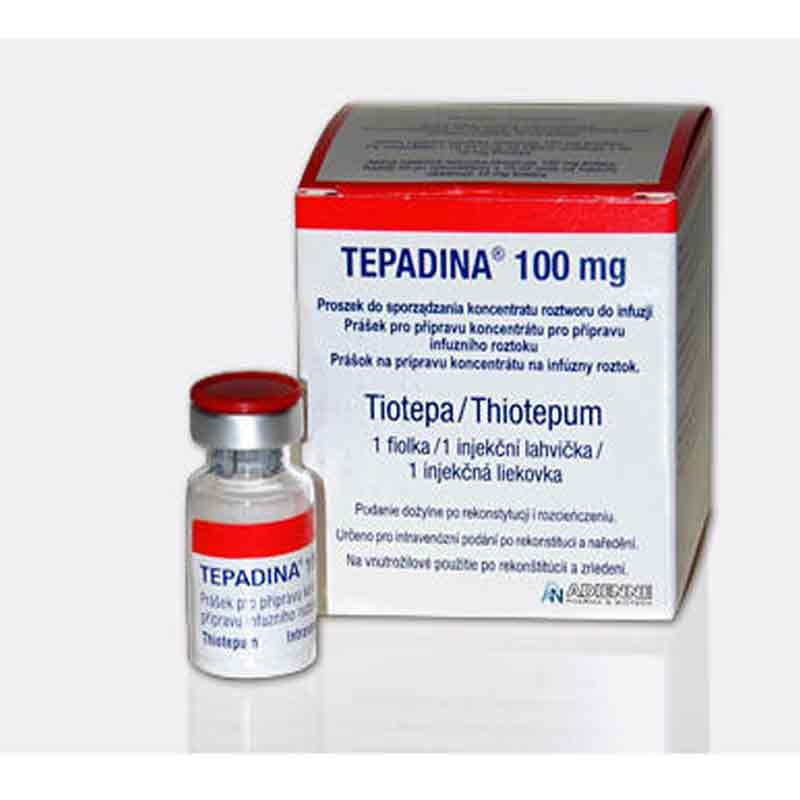
TEPADINA es un polvo cristalino de color blanco que se suministra en un vial de vidrio que contiene 100 mg de tiotepa.
Cada caja contiene 1 vial.
Titular de la autorización de comercialización y responsable de la fabricación
ADIENNE S.r.l. S.U.
Via Galileo Galilei, 19
20867 Caponago (MB) Italia
Tel: +39 02 40700445
Pueden solicitar más información respecto a este medicamento dirigiéndose al representante local del titular de la autorización de comercialización:
België/Belgique/Belgien Accord Healthcare bvba Tèl/Tel: +32 51 79 40 12 | Lietuva Accord Healthcare AB Tel: +46 8 624 00 25 | |
???????? Accord Healthcare Polska Sp. z o.o. Te?.: +48 22 577 28 00 | Luxembourg/Luxemburg Accord Healthcare bvba Tèl/Tel: +32 51 79 40 12 | |
Ceská republika Accord Healthcare Polska Sp. z o.o. Tel: +48 22 577 28 00 |
| |
Danmark Immedica Pharma AB Tlf: +46 (0)8 533 39 500 | Malta Accord Healthcare Ireland Ltd Tel: +44 (0) 208 901 3370 | |
Deutschland Accord Healthcare GmbH Tel: +49 89 700 9951 0 | Nederland Accord Healthcare B.V. Tel: +31 30 850 6014 | |
Eesti Accord Healthcare AB Tel: +46 8 624 00 25 | Norge Immedica Pharma AB Tlf: +46 (0)8 533 39 500 | |
Ελλ?δα aVIPHARMA International S.A. Τηλ: +30-210 6194 170 | Österreich Accord Healthcare GmbH Tel: +43 (0)662 424899-0 | |
España Accord Healthcare S.L.U. Tel: +34 93 301 00 64 | Polska Accord Healthcare Polska Sp. z o.o. Tel.: +48 22 577 28 00 | |
France Accord Healthcare France SAS Tél: +33 (0)320 401 770 | Portugal Accord Healthcare, Unipessoal Lda Tel: +351 214 697 835 | |
Hrvatska Accord Healthcare Polska Sp. z o.o. Tel: +48 22 577 28 00 | România Accord Healthcare Polska Sp. z o.o. Tel: +48 22 577 28 00 | |
Ireland Accord Healthcare Ireland Ltd Tel: +44 (0)1271 385257 | Slovenija Accord Healthcare Polska Sp. z o.o. Tel: +48 22 577 28 00 | |
Ísland Immedica Pharma AB Sími: +46 (0)8 533 39 500 | Slovenská republika Accord Healthcare Polska Sp. z o.o. Tel: +48 22 577 28 00 | |
Italia Accord Healthcare Italia Srl Tel: +39 02 943 23 700 | Suomi/Finland Immedica Pharma AB Puh/Tel: +46 (0)8 533 39 500 | |
Κ?προς aVIPHARMA International S.A. Τηλ: +30-210 6194 170 | Sverige Immedica Pharma AB Tel: +46 (0)8 533 39 500 | |
Latvija Accord Healthcare AB Tel: +46 8 624 00 25 | United Kingdom Accord-UK Ltd Tel: +44 (0)1271 385257 |
Fecha de la última revisión de este prospecto:
Otras fuentes de información
La información detallada de este medicamento está disponible en la página web de la Agencia Europea del Medicamento http://www.ema.europa.eu/.
Esta información está destinada únicamente a profesionales del sector sanitario:
GUÍA DE PREPARACIÓN
TEPADINA 100 mg polvo para concentrado para solución para perfusiónTiotepa
Lea esta guía antes de la preparación y administración de TEPADINA.
- PRESENTACIÓN
TEPADINA se suministra como 100 mg de polvo para concentrado para solución para perfusión.
TEPADINA tiene que ser reconstituida y diluida antes de su administración.
- PRECAUCIONES ESPECIALES DE ELIMINACIÓN Y OTRAS MANIPULACIONES
Generalidades
Se tendrán en cuenta los procedimientos adecuados de manipulación y eliminación de medicamentos antineoplásicos. Todos los procedimientos de transferencia tendrán que cumplir estrictamente las técnicas asépticas, empleando preferentemente una campana de seguridad de flujo laminar vertical. Al igual que con otros compuestos citotóxicos, se extremará la precaución durante la manipulación y preparación de soluciones de TEPADINA para evitar el contacto accidental con la piel o las mucosas. Pueden producirse reacciones tópicas asociadas a la exposición accidental a tiotepa. Por consiguiente, se recomienda el uso de guantes durante la preparación de la solución para perfusión. Si la solución de tiotepa entra en contacto accidentalmente con la piel, esta deberá lavarse bien con agua y jabón inmediatamente. Si la tiotepa entra en contacto accidentalmente con las mucosas, estas deberán lavarse bien con agua.
Cálculo de la dosis de TEPADINA
TEPADINA se administra en distintas dosis y en combinación con otros medicamentos quimioterápicos a pacientes que van a recibir un trasplante convencional de células madre hematopoyéticas (TCMH) por presentar enfermedades hematológicas o tumores sólidos.
La posología recomendada de TEPADINA en pacientes adultos y pediátricos depende del tipo de TCMH (autólogo o alogénico) y la enfermedad.
Posología en adultos
TCMH AUTÓLOGO
Enfermedades hematológicas
La dosis recomendada en las enfermedades hematológicas varía entre 125 mg/m2/día (3,38 mg/kg/día) y 300 mg/m2/día (8,10 mg/kg/día) mediante una sola perfusión diaria, administrada durante 2 a 4 días consecutivos antes de un TCMH autólogo dependiendo de la combinación con otros fármacos quimioterápicos, sin sobrepasar la dosis total acumulada máxima de 900 mg/m2 (24,32 mg/kg), durante todo el tratamiento de acondicionamiento.
LINFOMA
La dosis recomendada en las enfermedades hematológicas varía entre 125 mg/m2/día (3,38 mg/kg/día) y 300 mg/m2/día (8,10 mg/kg/día) mediante una sola perfusión diaria, administrada durante 2 a 4 días consecutivos antes de un TCMH autólogo dependiendo de la combinación con otros fármacos quimioterápicos, sin sobrepasar la dosis total acumulada máxima de 900 mg/m2 (24,32 mg/kg), durante todo el tratamiento de acondicionamiento.
LINFOMA DEL SISTEMA NERVIOSO CENTRAL (SNC)
La dosis recomendada es de 185 mg/m2/día (5 mg/kg/día) mediante una sola perfusión diaria, administrada durante 2 días consecutivos antes de un TCMH autólogo, sin sobrepasar la dosis total acumulada máxima de 370 mg/m2 (10 mg/kg), durante todo el tratamiento de acondicionamiento.
MIELOMA MÚLTIPLE
La dosis recomendada varía entre 150 mg/m2/día (4,05 mg/kg/día) y 250 mg/m2/día (6,76 mg/kg/día) mediante una sola perfusión diaria, administrada durante 3 días consecutivos antes de un TCMH autólogo dependiendo de la combinación con otros fármacos quimioterápicos, sin sobrepasar la dosis total acumulada máxima de 750 mg/m2 (20,27 mg/kg), durante todo el tratamiento de acondicionamiento.
Tumores sólidos
La dosis recomendada en los tumores sólidos varía entre 120 mg/m2/día (3,24 mg/kg/día) y
250 mg/m2/día (6,76 mg/kg/día) dividida en una o dos perfusiones diarias, administradas durante 2 a 5 días consecutivos antes de un TCMH autólogo dependiendo de la combinación con otros fármacos quimioterápicos, sin sobrepasar la dosis total acumulada máxima de 800 mg/m2 (21,62 mg/kg), durante todo el tratamiento de acondicionamiento.
CÁNCER DE MAMA
La dosis recomendada varía entre 120 mg/m2/día (3,24 mg/kg/día) y 250 mg/m2/día (6,76 mg/kg/día) mediante una sola perfusión diaria, administrada durante 3 a 5 días consecutivos antes de un TCMH autólogo dependiendo de la combinación con otros fármacos quimioterápicos, sin sobrepasar la dosis total acumulada máxima de 800 mg/m2 (21,62 mg/kg), durante todo el tratamiento de acondicionamiento.
TUMORES DEL SNC
La dosis recomendada varía entre 125 mg/m2/día (3,38 mg/kg/día) y 250 mg/m2/día (6,76 mg/kg/día) dividida en una o dos perfusiones diarias, administradas durante 3 a 4 días consecutivos antes de un TCMH autólogo dependiendo de la combinación con otros fármacos quimioterápicos, sin sobrepasar la dosis total acumulada máxima de 750 mg/m2 (20,27 mg/kg), durante todo el tratamiento de acondicionamiento.
CÁNCER DE OVARIO
La dosis recomendada es de 250 mg/m2/día (6,76 mg/kg/día) mediante una sola perfusión diaria, administrada durante 2 días consecutivos antes de un TCMH autólogo, sin sobrepasar la dosis total acumulada máxima de 500 mg/m2 (13,51 mg/kg), durante todo el tratamiento de acondicionamiento.
TUMORES DE CÉLULAS MADRE
La dosis recomendada varía entre 150 mg/m2/día (4,05 mg/kg/día) y 250 mg/m2/día (6,76 mg/kg/día) mediante una sola perfusión diaria, administrada durante 3 días consecutivos antes de un TCMH autólogo dependiendo de la combinación con otros fármacos quimioterápicos, sin sobrepasar la dosis total acumulada máxima de 750 mg/m2 (20,27 mg/kg), durante todo el tratamiento de acondicionamiento.
TCMH ALOGÉNICO
Enfermedades hematológicas
La dosis recomendada en las enfermedades hematológicas varía entre 185 mg/m2/día (5 mg/kg/día) y 481 mg/m2/día (13 mg/kg/día) dividida en una o dos perfusiones diarias, administradas durante 1 a 3 días consecutivos antes de un TCMH alogénico dependiendo de la combinación con otros fármacos quimioterápicos, sin sobrepasar la dosis total acumulada máxima de 555 mg/m2 (15 mg/kg), durante todo el tratamiento de acondicionamiento.
LINFOMA
La dosis recomendada es de 370 mg/m2/día (10 mg/kg/día) dividida en dos perfusiones diarias antes de un TCMH alogénico, sin sobrepasar la dosis total acumulada máxima de 370 mg/m2 (10 mg/kg), durante todo el tratamiento de acondicionamiento.
MIELOMA MÚLTIPLE
La dosis recomendada es de 185 mg/m2/día (5 mg/kg/día) mediante una sola perfusión diaria antes de un TCMH alogénico, sin sobrepasar la dosis total acumulada máxima de 185 mg/m2 (5 mg/kg), durante todo el tratamiento de acondicionamiento.
LEUCEMIA
La dosis recomendada varía entre 185 mg/m2/día (5 mg/kg/día) y 481 mg/m2/día (13 mg/kg/día) dividida en una o dos perfusiones diarias, administradas durante 1 o 2 días consecutivos antes de un TCMH alogénico dependiendo de la combinación con otros fármacos quimioterápicos, sin sobrepasar la dosis total acumulada máxima de 555 mg/m2 (15 mg/kg), durante todo el tratamiento de acondicionamiento.
TALASEMIA
La dosis recomendada es de 370 mg/m2/día (10 mg/kg/día) dividida en dos perfusiones diarias, administradas antes de un TCMH alogénico, sin sobrepasar la dosis total acumulada máxima de 370 mg/m2 (10 mg/kg), durante todo el tratamiento de acondicionamiento.
Posología en pacientes pediátricos
TCMH AUTÓLOGO
Tumores sólidos
La dosis recomendada en las enfermedades hematológicas varía entre 150 mg/m2/día (6 mg/kg/día) y 350 mg/m2/día (14 mg/kg/día) mediante una sola perfusión diaria, administrada durante 2 a 3 días consecutivos antes de un TCMH autólogo dependiendo de la combinación con otros fármacos quimioterápicos, sin sobrepasar la dosis total acumulada máxima de 1.050 mg/m2 (42 mg/kg), durante todo el tratamiento de acondicionamiento.
TUMORES DEL SNC
La dosis recomendada varía entre 250 mg/m2/día (10 mg/kg/día) y 350 mg/m2/día (14 mg/kg/día) mediante una sola perfusión diaria, administrada durante 3 días consecutivos antes de un TCMH autólogo dependiendo de la combinación con otros fármacos quimioterápicos, sin sobrepasar la dosis total acumulada máxima de 1.050 mg/m2 (42 mg/kg), durante todo el tratamiento de acondicionamiento.
TCMH ALOGÉNICO
Enfermedades hematológicas
La dosis recomendada en las enfermedades hematológicas varía entre 125 mg/m2/día (5 mg/kg/día) y 250 mg/m2/día (10 mg/kg/día) dividida en una o dos perfusiones diarias, administradas durante 1 a 3 días consecutivos antes de un TCMH alogénico dependiendo de la combinación con otros fármacos quimioterápicos, sin sobrepasar la dosis total acumulada máxima de 375 mg/m2 (15 mg/kg), durante todo el tratamiento de acondicionamiento.
LEUCEMIA
La dosis recomendada es de 250 mg/m2/día (10 mg/kg/día) dividida en dos perfusiones diarias, administradas antes de un TCMH alogénico, sin sobrepasar la dosis total acumulada máxima de 250 mg/m2 (10 mg/kg), durante todo el tratamiento de acondicionamiento.
TALASEMIA
La dosis recomendada varía entre 200 mg/m2/día (8 mg/kg/día) y 250 mg/m2/día (10 mg/kg/día) dividida en dos perfusiones diarias, administradas antes de un TCMH alogénico sin sobrepasar la dosis total acumulada máxima de 250 mg/m2 (10 mg/kg), durante todo el tratamiento de acondicionamiento.
CITOPENIA REFRACTARIA
La dosis recomendada es de 125 mg/m2/día (5 mg/kg/día) mediante una sola perfusión diaria, administrada durante 3 días consecutivos antes de un TCMH alogénico, sin sobrepasar la dosis total acumulada máxima de 375 mg/m2 (15 mg/kg), durante todo el tratamiento de acondicionamiento.
ENFERMEDADES GENÉTICAS
La dosis recomendada es de 125 mg/m2/día (5 mg/kg/día) mediante una sola perfusión diaria, administrada durante 2 días consecutivos antes de un TCMH alogénico, sin sobrepasar la dosis total acumulada máxima de 250 mg/m2 (10 mg/kg), durante todo el tratamiento de acondicionamiento.
ANEMIA FALCIFORME
La dosis recomendada es de 250 mg/m2/día (10 mg/kg/día) dividida en dos perfusiones diarias, administrada antes de un TCMH alogénico, sin sobrepasar la dosis total acumulada máxima de 250 mg/m2 (10 mg/kg), durante todo el tratamiento de acondicionamiento.
Reconstitución
TEPADINA debe reconstituirse con 10 ml de agua estéril para preparaciones inyectables.
Con una jeringa provista de una aguja, extraer en condiciones asépticas 10 ml de agua estéril para inyectables.
Inyectar el contenido de la jeringa en el vial perforando el tapón de caucho.
Retirar la jeringa y la aguja y mezclar manualmente mediante inversión repetida del vial.
Se usarán solo soluciones incoloras transparentes, sin partículas. Las soluciones reconstituidas pueden mostrar ocasionalmente opalescencia; todavía tales soluciones pueden ser administradas.
Dilución adicional en la bolsa de perfusión
La solución reconstituida es hipotónica y tiene que diluirse antes de su administración con 500 ml de solución inyectable con 9 mg/ml de cloruro sódico (0,9%) (1000 ml si la dosis es superior a 500 mg) o con un volumen apropiado de cloruro sódico de 9 mg/ml (0,9%) para obtener una concentración final de TEPADINA de entre 0,5 y 1 mg/ml.
Administración
TEPADINA solución para perfusión debe inspeccionarse visualmente para detectar la presencia de partículas antes de la administración. Deben desecharse las soluciones que contengan precipitados.
La solución de infusión debe administrarse en pacientes mediante un equipo de perfusión provisto de un filtro de 0,2 µm en línea. El filtrado no altera la potencia de la solución.
TEPADINA debe administrarse en condiciones asépticas mediante perfusión durante 2-4 horas a temperatura ambiente (25 °C aproximadamente) y en condiciones normales de iluminación.
Antes y después de cada perfusión, el catéter permanente deberá lavarse con aproximadamente 5 ml de solución inyectable con 9 mg/ml de cloruro sódico (0,9%).
Eliminación
TEPADINA es para un solo uso.
La eliminación del medicamento no utilizado y de todos los materiales que hayan estado en contacto con él, se realizará de acuerdo con la normativa local.
- País de registro
- Forma farmacéuticaINYECTABLE PERFUSION, 100 mg
- Código ATCL01AC01
- Principio activo
- Requiere recetaSí
- Fabricante
- Esta información es de carácter general y no sustituye la consulta con un profesional sanitario.
- Alternativas a TEPADINA 100 MG POLVO PARA CONCENTRADO PARA SOLUCION PARA PERFUSIONForma farmacéutica: INYECTABLE PERFUSION, 15 mgPrincipio activo: TiotepaFabricante: Adienne S.R.L.Requiere recetaForma farmacéutica: INYECTABLE PERFUSION, 400 mgPrincipio activo: TiotepaFabricante: Adienne S.R.L.Requiere recetaForma farmacéutica: INYECTABLE PERFUSION, 100 mgPrincipio activo: TiotepaFabricante: Esteve Pharmaceuticals GmbhRequiere receta
Médicos online para TEPADINA 100 MG POLVO PARA CONCENTRADO PARA SOLUCION PARA PERFUSION
Comenta la dosis, los posibles efectos secundarios, interacciones, contraindicaciones o la revisión de receta de TEPADINA 100 MG POLVO PARA CONCENTRADO PARA SOLUCION PARA PERFUSION, sujeto a valoración médica y a la normativa local.
Obtén una receta de TEPADINA 100 MG POLVO PARA CONCENTRADO PARA SOLUCION PARA PERFUSION online
Rellena un formulario de 2 minutos
Cuéntanos tus síntomas, historial y el medicamento que necesitas.
Elige un médico o nosotros te asignamos uno
Escoge un especialista o te conectamos con el próximo médico disponible.
El médico revisa tu caso
Normalmente en 30 minutos. Puede hacerte preguntas adicionales por chat.
Recógela en cualquier farmacia
Receta electrónica enviada a tu correo, válida en toda España.
Preguntas frecuentes
TEPADINA 100 MG POLVO PARA CONCENTRADO PARA SOLUCION PARA PERFUSION requiere receta en España. Puedes confirmarlo con un médico online según tu caso.
El principio activo de TEPADINA 100 MG POLVO PARA CONCENTRADO PARA SOLUCION PARA PERFUSION es Tiotepa. Esta información ayuda a identificar medicamentos con la misma composición pero con diferentes nombres comerciales.
TEPADINA 100 MG POLVO PARA CONCENTRADO PARA SOLUCION PARA PERFUSION es fabricado por Adienne S.R.L.. La marca y el envase pueden variar según el distribuidor.
Los Médicos de familia, Psiquiatras, Dermatólogos, Cardiólogos, Endocrinólogos, Gastroenterólogos, Neumólogos, Nefrólogos, Reumatólogos, Hematólogos, Infectólogos, Alergólogos, Geriatras, Pediatras, Oncólogos pueden valorar la prescripción de TEPADINA 100 MG POLVO PARA CONCENTRADO PARA SOLUCION PARA PERFUSION cuando esté clínicamente indicado. Puedes reservar una videoconsulta para comentar tu caso y las opciones de tratamiento.
España cuenta con una infraestructura sanitaria bien desarrollada en ciudades principales como Madrid, Barcelona, Valencia y Sevilla. Las farmacias están ampliamente disponibles y operan bajo estrictas regulaciones, garantizando el acceso a medicamentos con receta.
Puedes comprar TEPADINA 100 MG POLVO PARA CONCENTRADO PARA SOLUCION PARA PERFUSION en Madrid, Barcelona, Sevilla o Valencia en cualquier farmacia local con una receta válida.
Para obtener una receta, puedes utilizar Oladoctor:
Otros medicamentos con el mismo principio activo (Tiotepa) incluyen TEPADINA 15 MG POLVO PARA CONCENTRADO PARA SOLUCION PARA PERFUSION, TEPADINA 400 mg POLVO Y DISOLVENTE PARA SOLUCION PARA PERFUSION, THIOTEPA RIEMSER 100 mg POLVO PARA CONCENTRADO PARA SOLUCION PARA PERFUSION EFG. Pueden tener diferentes nombres comerciales o formulaciones, pero contienen el mismo componente terapéutico. Consulta siempre con un médico antes de cambiar o iniciar un nuevo medicamento.
