



SUPLECAL 94 mg /Ml Solución Inyectable

Revisión de receta online
Un médico revisará tu caso y determinará si la prescripción es médicamente apropiada.

Habla con un médico sobre este medicamento
Comenta tus síntomas y las opciones de tratamiento en una consulta online.



Cómo usar SUPLECAL MINIPLASCO SOLUCION INYECTABLE
Contenido del prospecto
- Introducción
- Qué es Suplecal Mini-Plasco y para qué se utiliza y para qué se utiliza
- Suplecal Mini-Plasco es una solución inyectable que pertenece a un grupo de medicamentos denominados suplementos minerales de calcio.
- Qué necesita saber antes de empezar a usar Suplecal Mini-Plasco
- Cómo usar Suplecal Mini-Plasco
- Posibles efectos adversos
- Conservación de Suplecal Mini-Plasco
- Contenido del envase e información adicional
Introducción
Prospecto: información para el usuario
Suplecal Mini-Plasco solución inyectable
Gluconato de calcio monohidrato
Lea todo el prospecto detenidamente antes de empezar a usar el medicamento, porque contiene información inportante para usted.
- Conserve este prospecto, ya que puede tener que volver a leerlo.
- Si tiene alguna duda, consulte a su médico o farmacéutico.
- Este medicamento se le ha recetado solamente a usted, y no debe dárselo a otras personas aunque tengan los mismos síntomas que usted, ya que puede perjudicarles.
- Si experimenta efectos adversos, consulte a su médico o farmacéutico, incluso si se trata de efectos adversos que no aparecen en este prospecto. Ver sección 4.
Contenido del prospecto:
- Qué es Suplecal Mini-Plasco y para qué se utiliza
- Antes de usar Suplecal Mini-Plasco
- Cómo usar Suplecal Mini-Plasco
- Posibles efectos adversos
- Conservación de Suplecal Mini-Plasco
- Contenido del envase e información adicional
1. Qué es Suplecal Mini-Plasco y para qué se utiliza y para qué se utiliza

¿No estás seguro de si este medicamento es adecuado para ti?
Comenta tus síntomas y tratamiento con un médico online.
Suplecal Mini-Plasco es una solución inyectable que pertenece a un grupo de medicamentos denominados suplementos minerales de calcio.
Suplecal Mini-Plasco se utiliza en los siguientes casos:
- para tratar el déficit agudo de calcio en sangre (hipocalcemia aguda) acompañado de síntomas agudos como la disminución de la sensibilidad cutánea (adormecimiento, picazón y ardor), rigidez muscular (tetania), calambres en manos y pies, cólicos, debilidad muscular y confusión que pueden derivar en convulsiones y síntomas cardiacos (frecuencia cardiaca irregular e incluso insuficiencia cardíaca aguda).
- para restaurar los electrolitos (sustancias con carga eléctrica que se encuentran en la sangre como: calcio, sodio, cloruros) durante la alimentación intravenosa (inyectada directamente en vena)
2. Qué necesita saber antes de empezar a usar Suplecal Mini-Plasco
No use Suplecal Mini-Plasco:
- Si es alérgico (hipersensible) al gluconato de calcio o a cualquiera de los demás componentes de Suplecal Mini-Plasco incluidos en la sección 6.
- Si usted tiene niveles elevados de calcio en sangre (hipercalcemia) como por ejemplo en pacientes con glándulas paratiroideas hiperactivas, niveles elevados de vitamina D en sangre, enfermedad tumoral con descomposición ósea, insuficiencia renal, osteoporosis debida a una falta de movilidad, sarcoidosis (una enfermedad crónica de causa desconocida que produce una inflamación caracterizada por la formación de gránulos en distintos órganos y tejidos del cuerpo) y el síndrome de leche y alcalinos (ingesta excesiva de calcio).
- Si usted presenta un aumento en la eliminación de calcio por la orina.
- En caso de intoxicación producida por unos medicamentos llamados glucósidos digitálicos (un tipo de medicamentos utilizados para tratar alteraciones del corazón como por ejemplo digoxina).
- Si está siendo tratado con medicamentos glucósidos digitálicos, excepto si usted tiene niveles extremadamente bajos de calcio en sangre que ponen en peligro su vida y que solamente pueden ser tratados inyectando calcio de forma inmediata.
No se debe administrar simultáneamente con el antibiótico ceftrixona, ni si se espera utilizar este producto en neonatos ≤ de 28 dias, aunque se utilice por distintas vías de perfusión, pueden producirse precipitados.
Advertencias y precauciones
Consulte a su médico o farmacéutico antes de empezar a usar Suplecal Mini-Plasco.
Si esta siendo tratado habitualmente con glucósidos digitálicos y excepcionalmente necesita una inyección de calcio de forma urgente (ver sección “No use Suplecal Mini-Plasco”), su médico monitorizará su función cardiaca de manera extremadamente cuidadosa. La monitorización asegurará que pueda ser tratado inmediatamente si su función cardiaca empeora, por ejemplo con una arritmia grave (frecuencia cardiaca irregular).
Su médico realizará controles periódicos de los niveles de calcio en sangre, especialmente si usted:
- está en tratamiento con dosis elevadas de vitamina D,
- sigue un tratamiento prolongado con suplementos de calcio o
- tiene insuficiencia renal (en este caso su médico ajustará la dosis dependiendo de los niveles de calcio en sangre).
Su médico considerará si este medicamento es adecuado para usted si padece de:
- formación de depósitos de calcio en los riñones (nefrocalcinosis)
- enfermedades del corazón
- sarcoidosis
En estos casos Suplecal Mini-Plasco únicamente será administrado en situaciones en las que se considere absolutamente imprescindible. Esto también debe aplicarse si está siendo tratado con adrenalina (ver “Uso de Suplecal Mini-Plasco con otros medicamentos”) o en ancianos.
Una insuficiencia renal puede ir acompañada de un aumento de los niveles de calcio en sangre y un aumento en la actividad de las glándulas paratiroideas. Si usted padece de insuficiencia renal, sólo debe recibir inyecciones de calcio si son absolutamente imprescindibles. De todas maneras sus niveles de calcio y fosfatos deben ser monitorizados.
Su médico tendrá especial cuidado si está recibiendo el antibiótico ceftriaxona y no se le administrará simultáneamente con gluconato de calcio incluso si es a través de diferentes líneas de infusión o diferentes sitios de infusión.
Suplecal Mini-Plasco debe ser inyectado lentamente con el fin de evitar una vasodilatación o una insuficiencia cardiaca.
Su frecuencia cardiaca o electrocardiograma deberán ser monitorizados cuando este medicamento se administre vía intravenosa.
Durante el tratamiento con sales de calcio, usted será monitorizado de manera extremadamente cuidadosa para asegurar unos niveles normales de calcio (ingesta de calcio frente a excreción de calcio) y para prevenir depósitos calcáreos en los tejidos. Los niveles de calcio en sangre y las cantidades de calcio excretadas en la orina serán monitorizadas, especialmente cuando se inyecten dosis elevadas de calcio.
El calcio es insoluble en el tejido graso y puede conducir a reacciones inflamatorias seguidas de formación de abscesos, endurecimiento y destrucción del tejido (necrosis) especialmente si se inyecta por error en estas zonas.
Si la solución se inyecta involuntariamente al lado de un vaso sanguíneo o no de forma suficientemente profunda en un músculo, puede dar lugar a irritación local del tejido, seguida de una descamación de la piel e incluso necrosis (ver sección 4). Su médico se asegurará de que la solución no drena hacia el tejido alrededor del vaso sanguíneo y observará cuidadosamente el lugar de la inyección.
Deben evitarse dosis elevadas de vitamina D.
Niños y adolescentes
En niños (< 18 años) Suplecal Mini-Plasco sólo debe inyectarse vía intravenosa, no vía intramuscular.
Uso de Suplecal Mini-Plasco con otros medicamentos
Comunique a su médico o farmacéutico si está utilizando, ha utilizado recientemente o podría tener que tomar cualquier otro medicamento.
Los efectos de los medicamentos para el corazón como la digoxina y otros medicamentos glucósidos digitálicos pueden verse incrementados por el calcio hasta el punto de causar intoxicación digitálica. Por lo tanto, si usted está siendo tratado con medicamentos glucósidos digitálicos, únicamente le administrarán inyecciones de calcio para el tratamiento de síntomas graves y que pongan en peligro su vida a causa de niveles extremadamente bajos de calcio en sangre.
Suplecal Mini-Plasco debe usarse con precaución junto con los siguientes medicamentos, ya que el uso conjunto puede alterar la eficacia de ambos tratamientos:
- Magnesio: calcio y magnesio inhiben mutuamente sus efectos.
- Adrenalina: la administración de calcio juntamente con adrenalina después de una intervención quirúrgica del corazón, disminuye los efectos de la adrenalina en el corazón y en la circulación.
El calcio puede disminuir los efectos de ciertos medicamentos utilizados para tratar enfermedades cardíacas (antagonistas de calcio).
La administración de ciertos medicamentos que aumentan la creación y eliminación de orina (como los diuréticos tiazídicos) junto con calcio pueden producir un incremento en los niveles de calcio en sangre (hipercalcemia), debido a que estos medicamentos reducen la excreción de calcio a través de los riñones.
La administración de calcio simultáneamente con ceftriaxona dará lugar a precipitación.
Embarazo y lactancia
Si esta embarazada o en periodo de lactancia, cree que podría estar embarazada o tiene intención de quedarse embarazada, consulte a su médico o farmacéutico antes de utilizar este medicamento
Embarazo:
El calcio atraviesa la placenta llegando a la circulación fetal donde alcanza niveles más elevados en la sangre del feto que en la materna.
Por lo tanto, las mujeres embarazadas solo deben recibir inyecciones de calcio si es absolutamente imprescindible. La dosis debe ser calculada cuidadosamente y los niveles de calcio en sangre deben ser monitorizados con frecuencia para evitar niveles de calcio en sangre excesivamente elevados ya que podrían perjudicar al feto.
Lactancia:
El calcio se excreta en la leche materna. Su médico debe tenerlo en cuenta cuando le administre calcio y usted esté amamantando a su hijo.
Conducción y uso de máquinas
Este medicamento no tiene influencia sobre la capacidad para conducir y utilizar máquinas.

¿Has empezado a tomar el medicamento y tienes preguntas?
Comenta tus síntomas y tratamiento con un médico online.
3. Cómo usar Suplecal Mini-Plasco
Siga exactamente las instrucciones de administración de este medicamento indicadas por su médico. En caso de duda, consulte de nuevo a su médico.
Su médico decidirá cuál es la dosis más adecuada para usted con el fin de elevar sus niveles de calcio en sangre para alcanzar valores normales. Esta dosis dependerá de su situación clínica y de los valores obtenidos en los análisis de sangre.
Este medicamento siempre lo administrará personal sanitario, directamente en vena y mediante una inyección lenta.
Adultos
La dosis inicial habitual es de 10 ml, es decir, una ampolla de Suplecal Mini-Plasco. Si es necesario, la dosis se puede repetir. Las siguientes dosis se ajustarán en función de sus niveles de calcio en sangre.
Uso en niños y adolescentes
El médico decidirá la dosis y el método de administración dependiendo de sus niveles de calcio en sangre y de la gravedad de los síntomas. En caso de síntomas leves que afecten a los nervios y a los músculos, se dará preferencia a las preparaciones orales de calcio.
Las dosis iniciales aproximadas son las siguientes:
- Bebés y niños menores de 3 años: 2 - 5ml
- Niños entre 3 y 12 años: 5 – 10 ml
- Niños mayores de 12 años y adolescentes: ver recomendaciones para adultos.
En el caso de niveles extremadamente bajos de calcio en sangre en recién nacidos o bebés con, por ejemplo, insuficiencia cardiaca, pueden ser necesarias dosis iniciales más elevadas con el fin de elevar rápidamente los niveles de calcio en sangre (hasta 2 ml por kg de peso corporal).
Si es necesario puede repetirse la administración de calcio. La concentración de las siguientes dosis dependerá de los niveles de calcio en sangre existentes. Después del tratamiento con terapia intravenosa, puede ser necesario seguir con un tratamiento con preparaciones orales de calcio, por ejemplo, en casos de deficiencia de vitamina D.
Uso en ancianos
En ocasiones algunos trastornos asociados con la edad avanzada, como la insuficiencia renal y la desnutrición (malnutrición), pueden afectar a la tolerancia del gluconato de calcio. Por lo tanto, se debe administrar una dosis más baja.
Método de administración
Suplecal Mini-Plasco le será administrado mediante una inyección intravenosa lenta o a través de una inyección profunda en un músculo grande. Debe ser administrado en posición acostada, especialmente si su función cardiaca tiene que ser monitorizada cuidadosamente durante la inyección.
Solo debe utilizarse la vía intramuscular en los casos en que no sea posible la vía intravenosa. Su médico se asegurará de que la inyección intramuscular se administre de manera suficientemente profunda, preferiblemente en el músculo mayor del glúteo.
La velocidad de administración debe ser lo suficientemente lenta.
Bebés, niños y adolescentes
La administración por vía intravenosa debe ser lenta o mediante una perfusión intravenosa lenta (goteo venoso), en ambos casos después de su dilución.
Este medicamento no debe inyectarse vía intramuscular o subcutánea en niños.
Si usa más Suplecal Mini-Plasco del que debe
Es poco probable que esto suceda ya que su médico decidirá la dosis más adecuada para usted.
Los síntomas de niveles elevados de calcio en sangre (hipercalcemia) incluyen: pérdida del apetito, nauseas, vómitos, estreñimiento, dolor de barriga, aumento de la formación de orina, incremento de la sensación de sed, perdida de líquidos, debilidad muscular, precipitación de calcio en los riñones, somnolencia, confusión, tensión arterial alta (hipertensión) y en casos graves, frecuencia cardiaca irregular, que puede derivar en paro cardiaco y pérdida de conciencia.
En caso de que la inyección intravenosa se realice de forma demasiado rápida, pueden darse síntomas de niveles elevados de calcio en sangre (hipercalcemia), sabor calcáreo, sofocos y una caída de la tensión arterial .
El tratamiento del exceso en la administración de este medicamento está dirigido a disminuir los niveles elevados de calcio en sangre.
Su médico decidirá el tratamiento que se le debe administrar. Éste puede incluir la administración de fluidos o medicamentos específicos para disminuir los niveles de calcio en sangre. En casos graves, puede ser necesaria diálisis.
Si tiene cualquier otra duda sobre el uso de este producto, pregunte a su médico o farmacéutico.
En caso de sobredosis o ingestión accidental, consulte inmediatamente a su médico o farmacéutico o llame al Servicio de Información Toxicológica (teléfono: 91.562 04 20) indicando el medicamento y la cantidad ingerida. Lleve este prospecto con usted.
4. Posibles efectos adversos
Al igual que todos los medicamentos, Suplecal Mini-Plasco puede producir efectos adversos aunque no todas las personas los sufran.
La frecuencia de los efectos secundarios se expresa de la siguiente manera:
Muy frecuentes (≥1/10)
Frecuentes (≥1/100 a < 1/10)
Poco frecuentes (≥ 1/1.000 a <1/100)
Raras (≥1/10.000 a < 1/1.000)
Muy raras (<1/10.000)
Frecuencia no conocida (no puede estimarse a partir de los datos disponibles)
Los efectos secundarios en el corazón, la circulación u otras funciones corporales pueden aparecer como síntomas de un nivel excesivamente elevado de calcio en sangre después de una sobredosis o de una inyección intravenosa demasiado rápida. La aparición y la frecuencia de dichos síntomas dependen directamente de la velocidad de inyección y de la dosis administrada.
Los siguientes efectos secundarios pueden ser graves. Si experimenta alguno de los siguientes efectos secundarios informe a su médico inmediatamente, ya que dejará de administrarle este medicamento.
Frecuencia no conocida (no puede estimarse a partir de los datos disponibles)
- frecuencia cardiaca lenta o irregular
- disminución de la tensión arterial (hipotensión)
- colapso circulatorio (potencialmente mortal)
Raras (afectan a entre 1 y 10 de cada 10.000)
Se han detectado reacciones adversas graves y en algunos casos mortales en prematuros y recién nacidos (<28 días de edad) que han sido tratados con ceftriaxona y calcio intravenoso. Se han observado precipitaciones de sal de ceftriaxona-calcio en pulmones y riñones post-mortem.
Otros efectos adversos incluyen:
Frecuencia no conocida (no puede estimarse a partir de los datos disponibles)
- vasodilatación
- sofocos, especialmente después de una administración demasiado rápida
- náuseas o vómitos
- sensación de calor
- sudoración
- la inyección intramuscular puede ir acompañada de dolor y enrojecimiento
Efectos secundarios cuando el medicamento es usado incorrectamente
- Si la inyección intramuscular no es lo suficientemente profunda, la solución puede penetrar en el tejido graso y ocasionar una inflamación, endurecimiento y destrucción (necrosis) de la piel.
- Se ha comunicado que después de la filtración de la solución de la vena a un tejido circundante, puede depositarse calcio en los tejidos blandos y puede ir acompañado de descamación y destrucción de la piel.
- El enrojecimiento de la piel y una sensación de ardor o dolor durante la inyección intravenosa pueden indicar una inyección involuntaria al lado de un vaso sanguíneo, lo que podría causar la destrucción del tejido.
Comunicación de efectos adversos
Si experimenta cualquier tipo de efecto adverso, consulte a su médico o farmacéutico, incluso si se trata de posibles efectos adversos que no aparecen en este prospecto. También puede comunicarlos directamente a través del Sistema Español de Farmacovigilancia de Medicamentos de Uso Humano: www.notificaRAM.es. Mediante la comunicación de efectos adversos usted puede contribuir a proporcionar más información sobre la seguridad de este medicamento.
5. Conservación de Suplecal Mini-Plasco
Mantener este medicamento fuera de la vista y del alcance de los niños.
No conservar a temperatura superior a 25ºC.
No utilice este medicamento después de la fecha de caducidad que aparece en el envase . La fecha de caducidad es el último día del mes que se indica.
No utilice este medicamento si observa que la solución no es clara, si observa partículas en el fondo o si el envase presenta signos visibles de deterioro.
Una vez abierta la ampolla, la solución debe ser usada inmediatamente.
Después de diluir la solución se debe administrar lo antes posible y no debe ser almacenada más de 24 horas entre 2 – 8 ºC.
No use este medicamento si usted observa los siguientes cambios:
Daños en la ampolla, decoloración, turbidez en la solución o presencia de partículas visibles en la solución.
6. Contenido del envase e información adicional
Composición de Suplecal Mini-Plasco:
- El principio activo es gluconato de calcio monohidrato para inyección.
- 1 ml de solución para inyección contiene 94 mg de gluconato de calcio para inyección, equivalentes a 0,21 mmol de calcio.
- 10 ml contienen 940 mg de gluconato de calcio para inyección, equivalentes a 2,10 mmol de calcio.
- Los demás excipientes son: D-sacarato de calcio tetrahidrato equivalentes a 0,02 mmol calcio por ml (o 0,15 mmol calcio por 10 ml).
- Los demás componentes son: agua para preparaciones inyectables.
El contenido total de calcio es de 0,23 mmol por ml (equivalente a 9,22 mg de calcio por ml) y 2,25 mmol por 10 ml (equivalente a 92,2 mg de calcio por 10 ml).
Aspecto del producto y contenido del envase
Suplecal Mini-Plasco es una solución inyectable (una solución que se administra mediante una jeringa) clara, de incolora a ligeramente marrón clara.
Se presenta en:
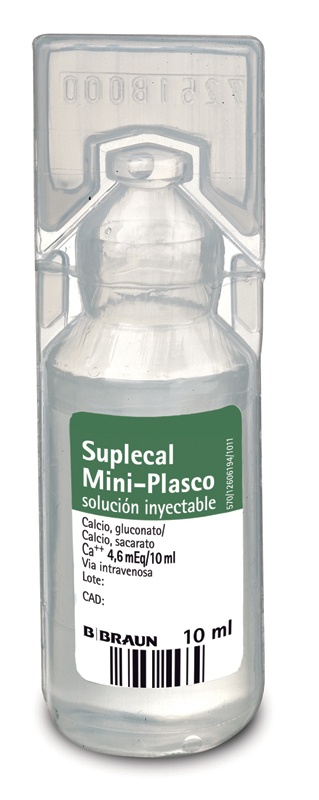
Ampollas de polietileno de baja densidad (MiniPlasco®) de 10 ml
disponible en cajas de 20 x 10 ml
Titular de la autorización de comercialización:
- Braun Medical, S.A.
Ctra. de Terrassa, 121
08191-Rubí (Barcelona)
España
Tl. 93 586 62 00
Responsable de la fabricación:
B.Braun Melsungen AG
Mistelweg 2
D-12357 (Berlin )
Alemania
Fecha de la última revisión de este prospecto:Enero 2019.
La información detallada de este medicamento está disponible en la página Web de la Agencia Española de Medicamentos y Productos Sanitarios (AEMPS) (http://www.aemps.gob.es/)
------------------------------------------------------------------------------------------------------
Esta información está destinada únicamente a médicos o profesionales del sector sanitario:
Posología y forma de administración
Posología
Población pediátrica (< 18 años)
La siguiente tabla muestra la dosis inicialhabitual:
Edad | Peso corporal (kg) | ml | Equiv. en mmol calcio |
3 meses-1 año | 5,5-10 | 2 - 5 | 0,45 – 1,13 |
3 -12 años | 14-38 | 5 – 10 | 1,13– 2,25 |
> 12 años | > 38 | ver dosis adultos |
Método de administración
En el caso de pacientes obesos se deberá elegir una aguja más larga para asegurar la inyección en el músculo y no en el tejido adiposo.
Si se precisa de más de una inyección, es necesario cambiar el lugar de inyección.
La velocidad de administración intravenosa no debe exceder de los 2 ml (0,45 mmol de calcio) por minuto.
Población pediátrica (< 18 años)
Con el fin de obtener velocidades de administración lentas y evitar irritación/necrosis en caso de extravasación accidental, solamente se debe administrar mediante inyecciones intravenosas lentas o perfusión intravenosa (ambas después de una dilución).
La velocidad de administración intravenosa en niños y adolescentes no debe exceder de los 5 ml por minuto de una dilución 1:10 de Suplecal Mini-Plasco.
Advertencias y precauciones especiales de empleo
No debe mezclarse o administrarse simultáneamente con soluciones intravenosas que contienen calcio, incluso a través de diferentes líneas de infusión o diferentes sitios de infusión. Las sales de calcio pueden formar complejos con ciertas sustancias y precipitar.
Las sales de calcio son incompatibles con agentes oxidantes, citratos, carbonatos solubles, bicarbonatos, fosfatos, oxalatos, tartratos y sulfatos.
La incompatibilidad física también se ha demostrado con anfotericina, cefalotina sodio, ceftriaxona, sodio novobiocina, proclorperazina y tetraciclinas.
Incompatibilidades
Como en todas las soluciones parenterales, antes de la adición de medicamentos se debe comprobar la compatibilidad de los mismos con la solución. En ausencia de estudios de compatibilidad, este medicamento no debe mezclarse con otros.
Dilución
Antes de utilizar este producto junto con otras soluciones con un conector Y o un set de bypass, se debe comprobar la compatibilidad de estos fluidos.
Tratamiento de urgencia en caso de sobredosis
El tratamiento inicial debe incluir la rehidratación y, en casos de hipercalcemia grave, puede ser necesario administrar una solución isotónica de cloruro de sodio mediante perfusión intravenosa para expandir el líquido extracelular. Se puede administrar calcitonina para disminuir la concentración de calcio sérico elevada. Puede administrarse furosemida para aumentar la excreción de calcio, pero deben evitarse los diuréticos tiazídicos, ya que pueden aumentar la absorción renal de calcio.
Los electrolitos séricos deben monitorizarse cuidadosamente durante todo el tratamiento de la sobredosis.
B|BRAUN
- País de registro
- Forma farmacéuticaINYECTABLE, 94 mg/ml
- Código ATCA12AA03
- Principio activo
- Requiere recetaSí
- Fabricante
- Esta información es de carácter general y no sustituye la consulta con un profesional sanitario.
- Alternativas a SUPLECAL MINIPLASCO SOLUCION INYECTABLEForma farmacéutica: SOLUCIÓN/SUSPENSIÓN ORAL, 20,88 mg/mlPrincipio activo: calcium phosphateFabricante: Farmasierra Laboratorios S.L.No requiere recetaPrincipio activo: Calcio carbonatoFabricante: Laboratorios Ern S.A.No requiere recetaForma farmacéutica: COMPRIMIDO, 1500 mg carbonato de calcio (equiv.600 mg calcio)Principio activo: Calcio carbonatoFabricante: Farmasierra Laboratorios S.L.No requiere receta
Médicos online para SUPLECAL MINIPLASCO SOLUCION INYECTABLE
Comenta la dosis, los posibles efectos secundarios, interacciones, contraindicaciones o la revisión de receta de SUPLECAL MINIPLASCO SOLUCION INYECTABLE, sujeto a valoración médica y a la normativa local.









Obtén una receta de SUPLECAL MINIPLASCO SOLUCION INYECTABLE online
Rellena un formulario de 2 minutos
Cuéntanos tus síntomas, historial y el medicamento que necesitas.
Elige un médico o nosotros te asignamos uno
Escoge un especialista o te conectamos con el próximo médico disponible.
El médico revisa tu caso
Normalmente en 30 minutos. Puede hacerte preguntas adicionales por chat.
Recógela en cualquier farmacia
Receta electrónica enviada a tu correo, válida en toda España.
Preguntas frecuentes
SUPLECAL MINIPLASCO SOLUCION INYECTABLE requiere receta en España. Puedes confirmarlo con un médico online según tu caso.
El principio activo de SUPLECAL MINIPLASCO SOLUCION INYECTABLE es gluconato de calcio. Esta información ayuda a identificar medicamentos con la misma composición pero con diferentes nombres comerciales.
SUPLECAL MINIPLASCO SOLUCION INYECTABLE es fabricado por B Braun Medical S.A.. La marca y el envase pueden variar según el distribuidor.
Los Médicos de familia, Psiquiatras, Dermatólogos, Cardiólogos, Endocrinólogos, Gastroenterólogos, Neumólogos, Nefrólogos, Reumatólogos, Hematólogos, Infectólogos, Alergólogos, Geriatras, Pediatras, Oncólogos pueden valorar la prescripción de SUPLECAL MINIPLASCO SOLUCION INYECTABLE cuando esté clínicamente indicado. Puedes reservar una videoconsulta para comentar tu caso y las opciones de tratamiento.
España cuenta con una infraestructura sanitaria bien desarrollada en ciudades principales como Madrid, Barcelona, Valencia y Sevilla. Las farmacias están ampliamente disponibles y operan bajo estrictas regulaciones, garantizando el acceso a medicamentos con receta.
Puedes comprar SUPLECAL MINIPLASCO SOLUCION INYECTABLE en Madrid, Barcelona, Sevilla o Valencia en cualquier farmacia local con una receta válida.
Para obtener una receta, puedes utilizar Oladoctor:
Otros medicamentos con el mismo principio activo (gluconato de calcio) incluyen CALCIO-20 EMULSION ORAL, CAOSINA 1.000 MG POLVO PARA SUSPENSIÓN ORAL., CARBOCAL 600 MG COMPRIMIDOS. Pueden tener diferentes nombres comerciales o formulaciones, pero contienen el mismo componente terapéutico. Consulta siempre con un médico antes de cambiar o iniciar un nuevo medicamento.
