



SULIQUA 100 UNIDADES/ML + 50 MICROGRAMOS/ML SOLUCIÓN INYECTABLE

Revisión de receta online
Un médico revisará tu caso y determinará si la prescripción es médicamente apropiada.

Habla con un médico sobre este medicamento
Comenta tus síntomas y las opciones de tratamiento en una consulta online.



Cómo usar SULIQUA 100 UNIDADES/ML + 50 MICROGRAMOS/ML SOLUCION INYECTABLE EN PLUMA PRECARGADA
Contenido del prospecto
- Introducción
- Qué es Suliqua y para qué se utiliza
- Qué necesita saber antes de empezar a usar Suliqua
- Cómo usar Suliqua
- Posibles efectos adversos
- Conservación de Suliqua
- Contenido del envase e información adicional
Introducción
Prospecto: información para el usuario
Suliqua 100 unidades/ml + 50 microgramos/ml solución inyectable en pluma precargada
Insulina glargina + lixisenatida
Lea todo el prospecto detenidamente antes de empezar a usar este medicamento, porque contiene información importante para usted.
- Conserve este prospecto, ya que puede tener que volver a leerlo.
- Si tiene alguna duda, consulte a su médico o farmacéutico o enfermero.
- Este medicamento se le ha recetado solamente a usted, y no debe dárselo a otras personas aunque tengan los mismos síntomas que usted, ya que puede perjudicarles.
- Si experimenta efectos adversos, consulte a su médico o farmacéutico, incluso si se trata de efectos adversos que no aparecen en este prospecto. Ver sección 4.
Contenido del prospecto
- Qué es Suliqua y para qué se utiliza
- Qué necesita saber antes de empezar a usar Suliqua
- Cómo usar Suliqua
- Posibles efectos adversos
- Conservación de Suliqua
- Contenido del envase e información adicional
1. Qué es Suliqua y para qué se utiliza
Suliqua es un medicamento inyectable para la diabetes que contiene dos principios activos:
- insulina glargina: una insulina de acción larga que ayuda a controlar el nivel de azúcar en sangre (glucosa) durante todo el día.
- lixisenatida: un “análogo de GLP-1” que ayuda a su cuerpo a producir su propia insulina adicional, como respuesta al aumento de azúcar en sangre y disminuye la absorción de azúcar de las comidas.
Suliqua se utiliza para el tratamiento de pacientes adultos con diabetes tipo 2, para ayudar a controlar los niveles de azúcar en sangre cuando estos son demasiado altos, es un complemento a la dieta y el ejercicio. Se administra con metformina con o sin inhibidores del cotransportador-2 de sodio-glucosa (SGLT2) (gliflozinas), cuando otros medicamentos no son suficientes para controlar sus niveles de azúcar en sangre.

¿No estás seguro de si este medicamento es adecuado para ti?
Comenta tus síntomas y tratamiento con un médico online.
2. Qué necesita saber antes de empezar a usar Suliqua
No use Suliqua
- Si es alérgico a insulina glargina o lixisenatida, o a alguno de los demás componentes de este medicamento (incluidos en la sección 6).
Advertencias y precauciones
Consulte a su médico, farmacéutico o enfermero antes de empezar a usar Suliqua si:
- tiene diabetes tipo 1, ya que Suliqua se utiliza para diabetes tipo 2 y este medicamento no será adecuado para usted.
- tiene cetoacidosis diabética (una complicación de la diabetes que ocurre cuando su organismo no es capaz de usar la glucosa porque no hay suficiente insulina), ya que este medicamento no será adecuado para usted.
- tiene un problema intestinal o gástrico grave, como una enfermedad de los músculos del estómago llamado "gastroparesia" que da lugar a un retraso en el vaciado gástrico. Debido a que Suliqua puede causar efectos adversos en el estómago (ver sección 4) no ha sido estudiado en pacientes con problemas gástricos o intestinales graves. Ver información relacionada con los medicamentos que no deben permanecer mucho tiempo en su estómago en la sección Otros medicamentos y Suliqua.
- si sabe que va a someterse a una intervención quirúrgica en la que se someterá a anestesia (estado de sueño), informe a su médico de que está tomando Suliqua.
- sufre una enfermedad grave del riñón o está sometido a diálisis, ya que el uso de este medicamento no estará recomendado.
Siga estrictamente las instrucciones de su médico sobre dosis, monitorización (análisis de sangre y orina), dieta y actividad física (trabajo físico y ejercicio) y técnica de inyección.
Debe prestar especial atención a lo siguiente:
- Niveles demasiado bajos de azúcar en sangre (hipoglucemia). Si su nivel de azúcar en sangre es demasiado bajo, siga la guía sobre hipoglucemia (ver información que aparece en el recuadro al final de este prospecto).
- Niveles demasiado altos de azúcar en sangre (hiperglucemia). Si su nivel de azúcar en sangre es demasiado alto, siga la guía sobre hiperglucemia (ver información que aparece en el recuadro al final de este prospecto).
- Asegúrese de utilizar el medicamento correcto. Siempre debe comprobar la etiqueta antes de cada inyección para evitar confusiones entre Suliqua y otras insulinas.
- Si tiene problemas visión, ver sección 3.
Mientras use este medicamento, preste atención a lo indicado a continuación y consulte a su médico, farmacéutico o enfermero antes de utilizar Suliqua si:
- tiene dolor intenso en la zona del estómago (abdomen) que no cesa. Esto puede ser un signo de inflamación del páncreas (pancreatitis aguda).
- experimenta pérdida de líquidos (deshidratación), por ejemplo, en caso de vómitos y diarrea. Es importante que beba una gran cantidad de líquidos para evitar la deshidratación, especialmente durante las primeras semanas de tratamiento con Suliqua.
Cambios en la piel en el punto de inyección
Se debe rotar el punto de inyección para evitar cambios en la piel, como bultos bajo la piel. La insulina puede no funcionar muy bien si se inyecta en una zona abultada (ver Cómo usar Suliqua). Póngase en contacto con su médico si actualmente está inyectándose en una zona abultada, antes de comenzar a inyectarse en una zona distinta. Su médico puede indicarle que compruebe sus niveles de azúcar en sangre más de cerca, y que ajuste la insulina o la dosis de sus otros medicamentos antidiabéticos.
Viajes
Antes de viajar, consulte con su médico. Tal vez tenga que comentar con él:
- Si su medicamento está disponible en el país que va a visitar.
- Cómo conseguir su medicamento, agujas y otros materiales.
- Cómo almacenar correctamente su medicamento durante el viaje.
- El horario de las comidas y de la administración de su medicamento.
- Los posibles efectos del traslado a zonas con diferencias horarias.
- Riesgos para la salud en los países que va a visitar.
- Qué debe hacer en situaciones de urgencia si no se encuentra bien o se pone enfermo.
Niños y adolescentes
No existe experiencia sobre el uso de Suliqua en niños y adolescentes menores de 18 años; por lo tanto, el uso de Suliqua no está recomendado en este grupo de edad.
Otros medicamentos y Suliqua
Informe a su médico, farmacéutico o enfermero si está tomando, ha tomado recientemente o podría tener que tomar cualquier otro medicamento. Si utiliza otro medicamento antidiabético, consulte con su médico si debe dejar de utilizar ese medicamento cuando comience el tratamiento con Suliqua.
Algunos medicamentos pueden cambiar su nivel de azúcar en sangre. Esto puede significar que su médico pueda necesitar cambiar su dosis de Suliqua. Por lo tanto, antes de tomar un medicamento pregunte a su médico, si afectará su nivel de azúcar en sangre y qué acción tomar, si fuera necesario. También necesita tener cuidado cuando deja de tomar un medicamento.
El efecto de algunos de los medicamentos que toma, puede verse afectado por Suliqua. Podría ser necesario que algunos medicamentos, como los antibióticos, anticonceptivos orales, estatinas (medicamentos como la atorvastatina para reducir el colesterol), comprimidos, cápsulas, gránulos, polvos o suspensiones orales gastrorresistentes que no deben permanecer demasiado tiempo en su estómago, tengan que tomarse al menos una hora antes o cuatro horas después de la inyección de Suliqua.
Su nivel de azúcar en sangre puede disminuir (hipoglucemia) si toma:
- Otros medicamentos para tratar la diabetes.
- Disopiramida, para algunos problemas de corazón.
- Fluoxetina, para la depresión.
- Antibióticos del grupo de las sulfonamidas, para tratar las infecciones.
- Fibratos, para reducir los niveles elevados de grasas en sangre.
- Inhibidores de la monoaminooxidasa (IMAOs), para la depresión o la enfermedad de Parkinson.
- Inhibidores de la enzima convertidora de angiotensina (ECA), para problemas de corazón o la presión arterial alta.
- Medicamentos para aliviar el dolor y bajar la fiebre como la pentoxifilina, propoxifeno y salicilatos (como el ácido acetilsalicílico).
- Pentamidina, para algunas infecciones causadas por parásitos. Este puede causar niveles demasiado bajos de azúcar en sangre que a veces va seguido de niveles demasiado altos de azúcar en sangre.
Su nivel de azúcar en sangre puede aumentar (hiperglucemia) si toma:
- Corticoides como cortisona y prednisolona, para la inflamación.
- Danazol, para la endometriosis.
- Diazóxido, para la presión sanguínea elevada.
- Inhibidores de la proteasa, para VIH.
- Diuréticos, para la presión sanguínea alta o la retención de líquidos.
- Glucacón, para niveles muy bajos de azúcar en sangre.
- Isoniazida, para la tuberculosis.
- Somatropina, una hormona del crecimiento.
- Hormonas tiroideas, para problemas de la glándula tiroides.
- Estrógenos y progestágenos, como en la píldora anticonceptiva para el control de la natalidad o estrogenos utilizados para la pérdida de masa ósea (osteoporosis).
- Clozapina, olanzapina y derivados de la fenotiazina, para problemas de salud mental.
- Medicamentos simpaticomiméticos como epinefrina (adrenalina), salbutamol y terbutalina, para el asma.
Su nivel de azúcar en sangre puede aumentar o diminuir si toma:
- Betabloqueantes o clonidina, para tensión arterial alta.
- Sales de litio, para problemas de salud mental.
Medicamentos que pueden reducir los signos de aviso de nivel bajo de azúcar en sangre
Los betabloqueantes y algunos medicamentos (como clonidina, guanetidina, reserpina - para la presión sanguínea alta) pueden hacer más difícil reconocer signos de aviso de que su nivel de azúcar en sangre es bajo (hipoglucemia). Pueden incluso ocultar o interrumpir los primeros signos de que su nivel de azúcar en sangre es demasiado bajo.
Si algo de lo anterior le sucede a usted (o no está seguro) contacte con su médico, farmacéutico o enfermero antes de utilizar este medicamento.
Warfarina y otros anticoagulantes
Informe a su médico si está tomando warfarina u otros anticoagulantes (medicamentos utilizados para prevenir la formación de coágulos en la sangre), ya que podría necesitar que le realizaran análisis de sangre con mayor frecuencia para comprobar su coagulación sanguínea (denominados “Cociente Internacional Normalizado” o control del INR).
Suliqua y alcohol
Sus niveles de azúcar en sangre pueden subir o bajar si bebe alcohol. Debe comprobar su nivel de azúcar en sangre más a menudo.
Embarazo y lactancia
Suliqua no debe utilizarse durante el embarazo. Se desconoce si Suliqua daña a su feto.
Suliqua no debe utilizarse durante la lactancia. Se desconoce si Suliqua pasa a leche materna.
Si está embarazada o en periodo de lactancia, cree que podría estar embarazada o tiene intención de quedarse embarazada, consulte a su médico o farmacéutico antes de utilizar este medicamento.
Conducción y uso de máquinas
Niveles demasiado bajos o demasiado altos de azucar en sangre (ver la información que aparece en el recuadro al final del prospecto) pueden afectar a su capacidad para conducir y usar herramientas o máquinas. Se puede ver afectada su concentración. Esto puede ser peligroso para usted y para otras personas.
Pregunte a su médico si puede conducir si:
- Su nivel de azúcar en sangre es a menudo demasiado bajo.
- Si le resulta difícil reconocer cuando su nivel de azúcar en sangre es demasiado bajo.
Suliqua contiene sodioEste medicamento contiene menos1 mmol de sodio (23 mg) por dosis, esto es, esencialmente “exento de sodio”.
Suliqua contiene metacresol
Este medicamento contiene metacresol que puede provocarreacciones alérgicas.
3. Cómo usar Suliqua
Siga exactamente las instrucciones de administración de este medicamento indicadas por su médico. Su médico puede decirle que use una dosis de Suliqua diferente a su anterior dosis de insulina o a su medicamento para reducir la glucosa, si lo usa. En caso de duda pregunte a su médico, farmacéutico o enfermero.
En función de su estilo de vida, sus controles de azúcar en sangre y su anterior insulina, su médico le dirá:
- Cuánto Suliqua necesita cada día y a qué hora.
- Cuándo comprobar su nivel de azúcar en sangre y si necesita realizar análisis de orina.
- Cuándo puede necesitar dosis más altas o más bajas.
Su médico puede decirle que utilice Suliqua con otros medicamentos para el nivel alto de azúcar en sangre.
Cuánto usar
Suliqua 100 unidades/ml + 50 microgramos/ml solución inyectable en pluma precargada:
- Esta pluma libera dosis de 10 a 40 pasos de dosis en una inyección, en pasos de 1 paso de dosis.
- Cada paso de dosis seleccionado contiene 1 unidad de insulina glargina y 0,5 microgramos de lixisenatida.
Su dosis de Suliqua se administra en “pasos de dosis”. La ventana de dosis de la pluma muestra el número de pasos de dosis.
No inyecte una dosis menor de 10 pasos de dosis. No inyecte una dosis mayor de 40 pasos de dosis. Si necesita una dosis mayor de 40 pasos de dosis, su médido le prescribirá una pluma diferente. Para pasos de dosis de 30-60 unidades, está disponible Suliqua 100 unidades/ml + 33 microgramos/ml solución inyectable en pluma precargada.
Muchos factores pueden influir en su nivel de azúcar en sangre. Debe conocer estos factores ya que así podrá reaccionar correctamente ante cambios de su nivel de azúcar en sangre y prevenir que suba o baje demasiado. Para más información, ver el recuadro que aparece al final del prospecto.
Uso en pacientes de edad avanzada (65 años y mayores)
Si tiene 65 años o es mayor, informe a su médico ya que puede necesitar una dosis más baja.
Si tiene problemas de riñón o de hígado
Si tiene problemas de riñón o de hígado, informe a su médico ya que puede necesitar dosis más bajas.
Cuándo inyectar Suliqua
Utilice Suliqua una vez al día, dentro de la hora anterior a una comida. Preferiblemente inyecte Suliqua antes de la misma comida todos los días, cuando haya elegido la comida más adecuada.
Antes de inyectar Suliqua
- Lea las “Instrucciones de Uso” que aparecen en este prospecto y use la pluma como se describe.
- Si no sigue todas estas instrucciones, puede obtener una cantidad superior o inferior de Suliqua.
Para evitar errores, compruebe siempre el envase y etiqueta de la pluma antes de cada inyección para asegurarse de que tiene la pluma correcta, especialmente si se inyecta más de un medicamento.
En caso de duda pregunte a su médico o farmacéutico.
Cómo inyectarse
- Suliqua se inyecta debajo de la piel (vía subcutánea o “SC”).
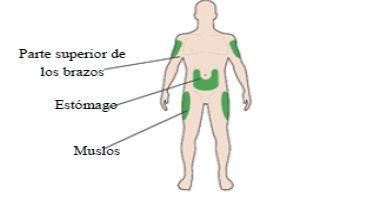
- Inyéctelo en la parte delantera de sus muslos, la parte superior de sus brazos o delantera de su cintura (abdomen).
- Cada día cambie de lugar dentro de un área de inyección. Esto reducirá el riesgo de que aparezcan hundimientos o bultos en la zona (para más información, ver “Otros efectos adversos”, en sección 4).
No use Suliqua
- si aparecen partículas en Suliqua. La solución debe ser transparente, incolora y con aspecto acuoso.
Otra información importante sobre el uso de las plumas precargadas
- Utilice siempre una aguja nueva para cada inyección. La reutilización de las agujas incrementa el riesgo de bloqueo que pueden dar lugar a infra o sobredosis. Deseche la aguja de forma segura después de cada uso.
- Para prevenir la trasmisión de infecciones, las plumas nunca deben utilizarse por más de una persona, incluso cuando se cambie la aguja.
- Utilice sólo agujas compatibles con la pluma de Suliqua (ver “Instrucciones de Uso”).
- Se debe realizar una prueba de seguridad antes de cada inyección.
- Deseche la aguja utilizada en un contenedor para objetos punzantes, o tal y como le dijo su farmacéutico o autoridad local.
Nunca utilice una jeringa para extraer la solución de la pluma, para evitar errores de dosificación y sobredosis potenciales.
Si su pluma está estropeada, no ha sido conservada adecuadamente, si no está seguro de que funciona correctamente o nota que su control de azúcar en sangre está empeorando de manera inexplicable:
- Deseche la pluma y utilice una nueva.
- Si piensa que tiene problemas con su pluma, informe a su médico, farmacéutico o enfermero.
Si usa más Suliqua del que debe
Si se ha inyectado demasiado medicamento, su nivel de azúcar en sangre puede descender mucho (hipoglucemia). Compruebe su nivel de azúcar en sangre y coma más para prevenir que su nivel de azúcar en sangre descienda demasiado (hipoglucemia). Si su nivel de azúcar en sangre baja demasiado, consulte el recuadro que aparece al final de este prospecto.
Si olvidó usar Suliqua
Si ha olvidado una dosis de Suliqua o si no se ha inyectado suficiente insulina, su nivel de azúcar en sangre puede aumentar mucho (hiperglucemia):
Cuando sea necesario Suliqua se puede inyectar antes de la siguiente comida.
- No se inyecte una dosis doble para compensar las dosis olvidadas.
- No realice dos inyecciones al día.
- Compruebe su nivel de azúcar en sangre e inyecte su próxima dosis a la hora habitual.
- Para más información sobre el tratamiento de la hiperglucemia, ver el recuadro que aparece al final de este prospecto.
Si interrumpe el tratamiento con Suliqua
No interrumpa su tratamiento sin consultar con su médico. Si lo hace, podría dar lugar a niveles muy altos de azúcar en sangre (hiperglucemia) y un aumento de ácido en sangre (cetoacidosis).
Si tiene cualquier otra duda sobre el uso de este medicamento, pregunte a su médico, farmacéutico o enfermero.

¿Has empezado a tomar el medicamento y tienes preguntas?
Comenta tus síntomas y tratamiento con un médico online.
4. Posibles efectos adversos
Al igual que todos los medicamentos, este medicamento puede producir efectos adversos, aunque no todas las personas los sufran.
Si nota signos de que su nivel de azúcar en sangre es demasiado bajo (hipoglucemia),actúe inmediatamente para subir su nivel de azúcar en sangre (ver el recuadro que aparece al final de este prospecto).
La hipoglucemia puede ser muy grave y es muy frecuente con medicamentos que contienen insulina (puede afectar a más de 1 de cada 10 personas).
Nivel bajo de azúcar en sangre significa que no hay suficiente azúcar en sangre.
Si su nivel de azúcar en sangre baja demasiado, se puede desmayar (perder el conocimiento).
Si el nivel de azúcar en sangre continúa siendo muy bajo durante demasiado tiempo, puede provocar daños en el cerebro y puede ser potencialmente mortal. Para más información, ver el recuadro que aparece al final de este prospecto.
Otros efectos adversos
Informe a su médico, farmacéutico o enfermero si nota alguno de los siguientes efectos adversos:
Cambios en la piel en el punto de inyección:
Si se inyecta insulina con demasiada frecuencia en el mismo lugar, el tejido graso se puede encoger (lipoatrofia) o hacerse más grueso (lipohipertrofia). Los bultos bajo la piel también pueden producirse por la acumulación de una proteína denominada amiloide (amiloidosis cutánea). Se desconoce con qué frecuencia pueden ocurrir estos cambios en la piel. La insulina puede no funcionar muy bien si se inyecta en una zona abultada. Cambie el punto de inyección para ayudar a evitar estos cambios en la piel.
Frecuentes(puede afectar hasta 1 de cada 10 personas)
- Sensación de mareo
- Sensación de enfermedad (náuseas)
- Vómitos
- Diarrea
- Reacciones cutáneas y alérgicas en el lugar de inyección: los signos pueden incluir enrojecimiento, dolor intenso al inyectar poco habitual, picor, habones, hinchazón o inflamación. Estas reacciones pueden extenderse alrededor del lugar de inyección. La mayor parte de las reacciones menores a la insulina desaparecen habitualmente en unos días o en pocas semanas.
Poco frecuentes(puede afectar hasta 1 de cada 100 personas)
- Resfriado, moqueo nasal, dolor de garganta
- Habones (urticaria)
- Dolor de cabeza
- Indigestión (dispepsia)
- Dolor de estómago
- Cansancio
- Cálculos biliares
- Inflamación de la vesícula biliar
- Cambio en el sentido del gusto.
Raro(puede afectar 1 de cada 1000 personas)
- Retraso en el vaciado del estómago.
Comunicación de efectos adversos
Si experimenta cualquier tipo de efecto adverso, consulte a su médico, farmacéutico o enfermero, incluso si se trata de posibles efectos adversos que no aparecen en este prospecto. También puede comunicarlos directamente a través del sistema nacional de notificación incluido en el Apéndice V. Mediante la comunicación de efectos adversos usted puede contribuir a proporcionar más información sobre la seguridad de este medicamento.
5. Conservación de Suliqua
Mantener este medicamento fuera de la vista y del alcance de los niños.
No utilice este medicamento después de la fecha de caducidad que aparece en el envase y en la etiqueta de la pluma después de CAD. La fecha de caducidad es el último día del mes que se indica.
Antes del primer uso
Conservar en nevera (entre 2 °C y 8 °C).
No congelar ni colocar cercar del compartimento de congelación o de un acumulador de frío.
Conservar la pluma precargada en el embalaje exterior para protegerla de la luz.
Después del primer uso o si se llevan como reserva
Conserve su pluma en uso por debajo de 25 ºC durante un máximo de 28 días. Deseche la pluma después de este periodo.
No vuelva a colocar la pluma en la nevera y no la congele. Mantenga la pluma fuera del calor directo o la luz directa. Coloque siempre el capuchón de la pluma cuando no la use para protegerla de la luz.
No deje la pluma dentro de un coche en un día excepcionalmente caluroso o frío.
No guarde la pluma con la aguja incorporada.
Los medicamentos no se deben tirar por los desagües ni a la basura. Pregunte a su farmacéutico cómo deshacerse de los envases y de los medicamentos que ya no necesita. De esta forma, ayudará a proteger el medio ambiente.
6. Contenido del envase e información adicional
Qué contiene Suliqua
- Los principios activos son insulina glargina y lixisenatida.
Cada pluma contiene 300 unidades de insulina glargina y 150 microgramos de lixisenatida en una solución de 3 ml. Cada ml contiene 100 unidades de insulina glargina y 50 microgramos de lixisenatida. Cada paso de dosis de Suliqua contiene 1 unidad de insulina glargina y 0,5 microgramos de lixisenatida.
Los otros componentes son: glicerol al 85%, metionina, metacresol, cloruro de zinc, ácido clorhídrico concentrado hidróxido sódico (para ajustar el pH) y agua para preparaciones inyectables. Ver también sección 2 “Qué necesita saber antes de empezar a usar Suliqua” para más información sobre sodio y metacresol.
Aspecto del producto y contenido del envase
Suliqua es una solución inyectable (inyección), transparente e incolora en un cartucho de vidrio dentro de una pluma precargada (SoloStar).
Envases de 3, 5 y 10 plumas precargadas.
Puede que solamente estén comercializados algunos tamaños de envases.
Las agujas no están incluidas en este envase.
Titular de la autorización de comercialización
Sanofi Winthrop Industrie
82 avenue Raspail
94250 Gentilly
Francia
Responsable de la fabricación:
Sanofi-Aventis Deutschland GmbH
Industriepark Höchst - 65926 Frankfurt am Main
Alemania
Pueden solicitar más información respecto a este medicamento dirigiéndose al representante local del titular de la autorización de comercialización:
België/Belgique/Belgien Sanofi Belgium Tél/Tel: +32 (0)2 710 54 00 | Lietuva Swixx Biopharma UAB Tel: +370 5 236 91 40 |
Swixx Biopharma EOOD Teπ.: +359 (0)2 4942 480 | Luxembourg/Luxemburg Sanofi Belgium Tél/Tel: +32 (0)2 710 54 00 (Belgique/Belgien) |
Ceská republika Sanofi s.r.o. Tel: +420 233 086 111 | Magyarország SANOFI-AVENTIS Zrt. Tel.: +36 1 505 0050 |
Danmark Sanofi A/S Tlf: +45 45 16 70 00 | Malta Sanofi S.r.l. Tel: +39 02 39394275 |
Deutschland Sanofi-Aventis Deutschland GmbH Tel.: 0800 52 52 010 Tel. aus dem Ausland: +49 69 305 21 131 | Nederland Sanofi B.V. Tel: +31 20 245 4000 |
Eesti Swixx Biopharma OÜ Tel: +372 640 10 30 | Norge sanofi-aventis Norge AS Tlf: +47 67 10 71 00 |
Ελλáδα Sanofi-Aventis Μονοπρóσωπη ΑΕΒΕ Τηλ: +30 210 900 16 00 | Österreich sanofi-aventis GmbH Tel: +43 1 80 185 – 0 |
España sanofi-aventis, S.A. Tel: +34 93 485 94 00 | Polska Sanofi Sp. z o.o. Tel.: +48 22 280 00 00 |
France Sanofi Winthrop Industrie Tél: 0 800 222 555 Appel depuis l’étranger : +33 1 57 63 23 23 | Portugal Sanofi - Produtos Farmacêuticos, Lda Tel: +351 21 35 89 400 |
Hrvatska Swixx Biopharma d.o.o. Tel: +385 1 2078 500 | România Sanofi Romania SRL Tel: +40 (0) 21 317 31 36 |
Ireland sanofi-aventis Ireland Ltd. T/A SANOFI Tel: +353 (0) 1 403 56 00 | Slovenija Swixx Biopharma d.o.o. Tel: +386 1 235 51 00 |
Ísland Vistor hf. Sími: +354 535 7000 | Slovenská republika Swixx Biopharma s.r.o. Tel: +421 2 208 33 600 |
Italia Sanofi S.r.l. Tel: 800 131212 (domande di tipo tecnico) 800 536389 (altre domande) | Suomi/Finland Sanofi Oy Puh/Tel: +358 (0) 201 200 300 |
Κúπρος C.A. Papaellinas Ltd. Τηλ: +357 22 741741 | Sverige Sanofi AB Tel: +46 (0)8 634 50 00 |
Latvija Swixx Biopharma SIA Tel: +371 6 616 47 50 | United Kingdom(Northern Ireland) sanofi-aventis Ireland Ltd. T/A SANOFI Tel: +44 (0) 800 035 2525 |
Fecha de la última revisión de este prospecto:<{MM/AAAA}><{mes AAAA}>.
Otras fuentes de información
La información detallada de este medicamento está disponible en la página web de la Agencia Europea de Medicamentos: http://www.ema.europa.eu/
HIPERGLUCEMIA E HIPOGLUCEMIA
Si toma insulina, siempre debe llevar lo siguiente:
- Alimentos que contengan azúcar como comprimidos de glucosa o una bebida azucarada (al menos 20 gramos).
- Información que indique que usted tiene diabetes.
Hiperglucemia (niveles altos de azúcar en sangre)
Si su nivel de azúcar en la sangre es muy alto (hiperglucemia), puede que no se haya inyectado suficiente insulina.
Razones por las que puede ocurrir una hiperglucemia
Algunos ejemplos:
- No se ha inyectado Suliqua o no se ha inyectado la cantidad suficiente.
- Su medicamento es menos efectivo, por ejemplo debido a que no se ha conservado correctamente.
- Su pluma no funciona correctamente.
- Está haciendo menos ejercicio que de costumbre.
- Tiene estrés - como angustia emocional o nerviosismo.
- Tiene una lesión, una infección o fiebre, o ha sido sometido a una operación.
- Está tomando o ha tomado ciertos medicamentos (ver sección 2, "Uso de Suliqua con otros medicamentos").
Signos de aviso de una hiperglucemia:
Sed, aumento de la necesidad de orinar, cansancio, piel seca, enrojecimiento de la cara, pérdida del apetito, tensión arterial baja, latido rápido del corazón y presencia de glucosa y cuerpos cetónicos en la orina. El dolor de estómago, la respiración profunda y rápida, sentir sueño o desmayarse (pérdida del conocimiento) pueden ser signos de una afección grave (cetoacidosis) producida por la falta de insulina.
Qué hacer si sufre una hiperglucemia
- Compruebe su nivel de azúcar en la sangre, si es alto, tal y como le indicó su médico o enfermero, compruebe su nivel de acetona en la orina, tan pronto como note cualquiera de los signos de aviso descritos antes.
- Contacte con su médico inmediatamente si tiene hiperglucemia o cetoacidosis graves. Esto se debe tratar siempre por un médico, normalmente en un hospital.
Hipoglucemia (niveles bajos de azúcar en sangre)
Si su nivel de azúcar en sangre desciende demasiado puede desmayarse (perder el conocimiento). La hipoglucemia grave puede producir un ataque al corazón o daño cerebral y puede poner en peligro su vida. Debe aprender a reconocer los signos que indican que su nivel de azúcar en sangre está disminuyendo, así podrá tomar las medidas necesarias para que la situación no se agrave.
Razones por las que puede ocurrir una hipoglucemia
Algunos ejemplos:
- Se inyecta demasiado Suliqua.
- Omite comidas o las retrasa.
- No come lo suficiente, o come alimentos que contienen menos hidratos de carbono de lo normal. Los edulcorantes artificiales no son hidratos de carbono.
- Bebe alcohol, especialmente si no come mucho.
- Pierde hidratos de carbono por vómitos o diarrea.
- Está haciendo más ejercicio de lo habitual o un tipo diferente de actividad física.
- Se está recuperando de una lesión, de una operación o de otros tipos de estrés.
- Se está recuperando de una enfermedad o fiebre,
- Está tomando o ha dejado de tomar determinados medicamentos (ver sección 2, "Otros medicamentos y Suliqua").
También es más probable que se produzca una hipoglucemia si:
- Acaba de empezar un tratamiento con Suliqua – si se produce una bajada de azúcar en sangre, es más probable que suceda por la mañana.
- Sus niveles de azúcar en la sangre son casi normales o inestables.
- Cambia el área de la piel en la que se inyecta Suliqua. Por ejemplo del muslo a la parte alta del brazo.
- Tiene una enfermedad grave del riñón o del hígado, o alguna otra enfermedad como el hipotiroidismo.
Signos de aviso de una hipoglucemia:
Los primeros signos pueden ser generalmente en su cuerpo. Ejemplos de signos de que su nivel de azúcar en sangre está bajando mucho o muy deprisa son: sudor, piel húmeda y pegajosa, ansiedad, latido rápido e irregular del corazón, tensión arterial alta y palpitaciones. Estos signos se producen a menudo antes de que aparezcan los signos de bajo nivel de azúcar en el cerebro.
Los signos en su cerebro incluyen: dolor de cabeza, sensación de mucha hambre, náuseas, vómitos, sensación de cansancio, somnolencia, agitación, problemas del sueño, comportamiento agresivo, dificultad para concentrarse, capacidad de reacción disminuida, depresión, sensación de confusión, dificultad para hablar (a veces, pérdida total del habla), cambio en la vista, temblor, incapacidad para moverse (parálisis), hormigueo en las manos o brazos, sensación de entumecimiento y hormigueo a menudo alrededor de la boca, sensación de mareo, pérdida de autocontrol, incapacidad para cuidar de uno mismo, convulsiones, pérdida de conocimiento.
Situaciones en las que los signos de una hipoglucemia pueden ser menos claros:
Los primeros signos de aviso de hipoglucemia pueden cambiar, atenuarse o faltar por completo si:
- Es una persona de edad avanzada.
- Ha padecido diabetes durante mucho tiempo.
- Sufre cierto tipo de enfermedad nerviosa (denominada “neuropatía diabética autónoma”).
- Ha sufrido recientemente una bajada grande de azúcar en sangre (por ejemplo, el día antes).
- Su nivel de azúcar en sangre permanece bajo.
- Su nivel de azúcar en sangre es siempre más o menos “normal” o su control de la diabetes ha mejorado bastante recientemente.
- Ha cambiado recientemente de una insulina animal a una insulina industrial como Suliqua.
- Está tomando o ha tomado ciertos medicamentos (ver sección 2, "Otros medicamentos y Suliqua").
En estos casos, puede sufrir una hipoglucemia grave (e incluso desmayarse) antes de saber qué está pasando. Esté siempre familiarizado con sus signos de aviso. Si fuera necesario, podría necesitar realizarse con mayor frecuencia análisis de azúcar en sangre. Esto puede ayudar a identificar episodios hipoglucémicos leves. Si le resulta difícil reconocer sus signos de aviso, debe evitar situaciones (como conducir un coche) que puedan ponerle en peligro a usted o a otras personas como consecuencia de la hipoglucemia.
Qué hacer si experimenta una hipoglucemia
- No se inyecte insulina. Ingiera inmediatamente de 15 a 20 gramos de azúcar, como glucosa, terrones de azúcar o una bebida azucarada. No beba o coma alimentos que contengan edulcorantes artificiales (como bebidas dietéticas), ya que estos no ayudan a tratar la bajada de azúcar en sangre.
- Puede necesitar comer algo (como pan o pasta) que aumente su nivel de azúcar en sangre a largo plazo, especialmente si su próxima comida no es adecuada. Pregunte a su médico o enfermero si no está seguro de qué debe comer.
Con Suliqua la recuperación de la bajada de azúcar puede retrasarse más porque contiene una insulina de acción prolongada (insulina glargina).
- Compruebe su nivel de glucosa en sangre después de 10-15 minutos de tomar azúcar. Si sus niveles de glucosa son todavía demasiado bajos (<4 mmol/l) o si la hipoglucemia reaparece, tome de nuevo otros 15 a 20 gramos de azúcar.
- Consulte inmediatamente con un médico si no es capaz de controlar la hipoglucemia o si ésta reaparece.
Qué deben hacer otras personas si usted sufre una hipoglucemia
Informe a sus familiares, amigos y personas cercanas que necesita ayuda médica urgente si no es capaz de tragar o si se desmaya (pierde el conocimiento).
Necesitará de glucosa o de glucagón (un medicamento que incrementa el nivel de azúcar en la sangre). Debe administrase aun cuando no tenga la certeza de que sufre una hipoglucemia.
Debe analizar su nivel de azúcar en la sangre inmediatamente después de la ingestión de glucosa para confirmar que padece realmente hipoglucemia.
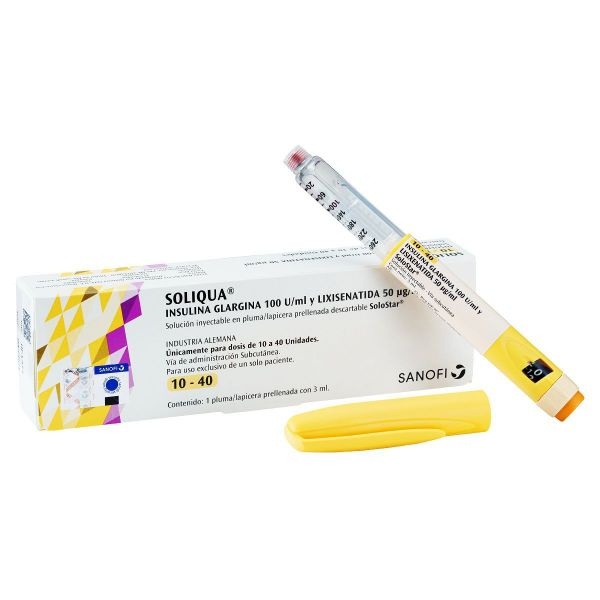
Suliqua 100 unidades/ml + 50 microgramos/ml solución inyectable en pluma precargada (10-40).
INTRUCCIONES DE USO
Lea el Prospecto y estas Instrucciones de Uso antes del Primer Uso de Suliqua
Suliqua (10-40) pluma SoloStar contiene insulina glargina y lixisenatida. La combinación de medicamentos en esta pluma es para la inyección diaria de 10 a 40 pasos de dosis de Suliqua.
- Nunca reutilice las agujas.Si lo hace, podría no obtener su dosis completa (infradosis) u obtener demasiada dosis (sobredosis), ya que la aguja se podría bloquear.
- Nunca utilice un jeringa para extraer el medicamento de su pluma.Si lo hace, podría no obtener la dosis correcta de medicamento.
Conserve estas Instrucciones de Uso para futuras consultas.
Información importante
- Nunca comparta su pluma – es solo para usted.
- Nunca use su pluma si está estropeada o si no está seguro de que funciona adecuadamente.
- Siempre realice una prueba de seguridad. Ver PASO 3.
- Siempre lleve una pluma de reserva y agujas de reserva, por si se pierden o dejan de funcionar.
- Siempre compruebe la etiqueta de la pluma antes de usarla para asegurarse que tiene la pluma correcta.
Aprender a inyectar
- Pregunte a su médico, farmacéutico o enfermero cómo inyectarse, antes de usar su pluma.
- Pida ayuda si tiene problemas con el manejo de la pluma, por ejemplo si tiene problemas de visión.
- Lea todas estas instrucciones antes de utilizar su pluma. Si no sigue todas estas instrucciones, puede recibir demasiada o demasiado poca cantidad de medicamento.
¿Necesita ayuda?
Si tiene preguntas sobre Suliqua, la pluma o la diabetes, pregunte a su médico, farmacéutico o enfermero.
Elementos adicionales que necesitará:
- una aguja nueva estéril (ver PASO 2).
- un contenedor resistente a los pinchazos para agujas (ver Deseche la pluma).
Lugares de inyección
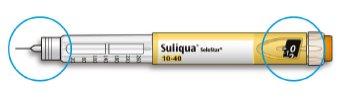
Conozca su pluma
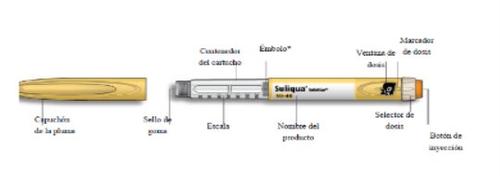
- No verá el émbolo hasta que no haya inyectado unas cuantas dosis
PASO 1: Compruebe su pluma
Para el uso de una nueva pluma por primera vez, saque de la nevera una pluma nueva al menos 1hora antes de su inyección. La inyección del
medicamento en frío es más dolorosa. Después de su uso la pluma se almacenará por debajo de 25ºC.
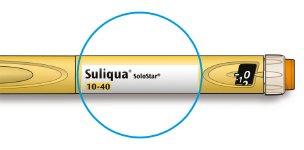
- Compruebe el nombre y la fecha de caducidad en la etiqueta de su pluma.
- Asegúrese de que tiene el medicamento correcto. Esta pluma es de color melocotón con un botón de inyección naranja.
- No use esta pluma si necesita una dosis diaria menor de 10 pasos de dosis o si necesita más de 40 pasos de dosis. Acuerde con su médico qué pluma es la adecuada para sus necesidades.
- Noutilice la pluma después de la fecha de caducidad.
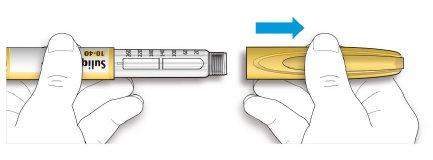
- Retire el capuchón de la pluma.
- Compruebe que el medicamento es transparente.
- Mire el contenedor del cartucho transparente. Nouse la pluma si el medicamento está turbio, tiene color o contiene partículas.
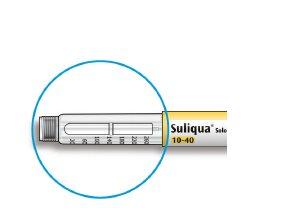
PASO 2: Coloque una aguja nueva
- Noreutilice las agujas. Utilice siempre una aguja nueva y estéril para cada inyección. Esto ayudará a evitar el bloqueo de las agujas, la contaminación y las infecciones.
- Siempre utilice agujas compatibles para su uso con su pluma Suliqua.
- Coja una aguja nueva y retire el sello protector.

- Mantenga la aguja recta y enrósquela en la pluma hasta que esté fija. No la apriete demasiado.
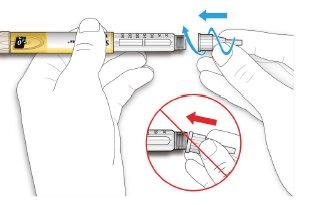
- Retire la tapa exterior de la aguja. Guárdela para más tarde.
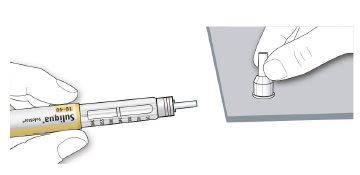
- Retire la tapa interior de la aguja y deséchela.
Si intenta volver a ponérsela, puede pincharse accidentalmente con la aguja.
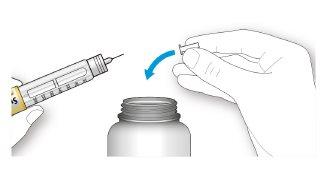
Manipular las agujas
- Tenga cuidado al manipular las agujas para evitar lesiones por punción e infección cruzada.
PASO 3: Realice una prueba de seguridad
Realice siempre una prueba de seguridad antes de cada inyección para:
- Comprobar que su pluma y aguja funcionan correctamente.
- Asegurarse que recibe la dosis correcta.
- Seleccione 2 pasos de dosis girando el selector de dosis hasta que el marcador de dosis se sitúe en la marca 2.
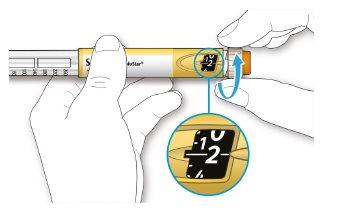
- Presione el botón de inyección hasta el fondo.
- Si sale medicamento de la punta de la aguja, su pluma funciona correctamente y el selector de dosis volverá a “0”.
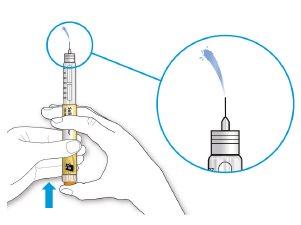
Si no sale líquido:
- Es posible que necesite repetir este paso hasta 3 veces, antes de ver salir medicamento.
- Si no sale medicamento después de la tercera vez, es posible que la aguja esté bloqueada. Si esto sucediese:
- cambie la aguja (ver PASO 6 y PASO 2),
- a continuación repita la prueba de seguridad (PASO 3).
- Nouse su pluma si aún no sale medicamento de la punta de la aguja. Use una pluma nueva.
- Nouse una jeringa para extraer el medicamento de su pluma.
Si ve burbujas de aire
- Es posible que vea burbujas de aire en el medicamento. Es algo normal, no le van a hacer daño.
PASO 4: Seleccione la dosis
- Use esta pluma solo para inyectar una dosis única diaria de 10 a 40 pasos de dosis.
- Noseleccione una dosis ni presione el botón de inyección mientras la aguja no esté colocada, ya que podría estropear su pluma.
- Asegúrese de que la aguja está colocada y que la dosis está en “0”.
- Gire el selector de dosis hasta que el marcador de dosis se alinee con su dosis.
- Si excede su dosis, puede girar hacia atrás.
- Si no quedan suficientes pasos de dosis en su pluma para que pueda administrar su dosis, el selector de dosis se detendrá en el número de pasos de dosis que quedan.
- Si no puede seleccionar su dosis prescrita completa, use una nueva pluma o inyecte los pasos de dosis que quedan y utilice una nueva pluma para completar su dosis. Únicamente en este caso, sería apropiado inyectar una dosis parcial de menos de 10 pasos de dosis. Siempre utilice otra pluma Suliqua (10-40) SoloStar para completar su dosis y no otra pluma.
Cómo leer la ventana de dosis
Los números pares se presentan en línea con el indicador de dosis y los números impares se presentan como una línea entre los números pares.

29 unidades seleccionadas
- Nouse esta pluma si su dosis diaria única es menor de 10 pasos de dosis, que aparece como números blancos sobre fondo negro.
Unidades de medicamento en su pluma
- Su pluma contiene un total de 300 pasos de dosis. Puede seleccionar su dosis en pasos de 1 paso de dosis.
- Nouse esta pluma si necesita una dosis única diaria menor de 10 pasos de dosis o mayor de 40 pasos de dosis. Consulte con su médico qué pluma es la adecuada para sus necesidades.
- Cada pluma contiene más de una sola dosis.
PASO 5: Inyectar la dosis
- Si le cuesta presionar el botón de inyección, nolo fuerce, ya que podría romper su pluma.
- Cambie la aguja (ver PASO 6Retire la aguja y PASO 2Coloque una aguja nueva) después realice la prueba de seguridad.
- Si todavía le cuesta presionar el botón de inyección, utilice una pluma nueva.
- Nouse una jeringa para extraer el medicamento de su pluma.
- Elija un lugar para la inyección como se mostraba en el dibujo anterior.
- Empuje la aguja dentro de su piel, tal y como le ha enseñado su médico, farmacéutico o enfermero.
- No toque el botón de inyección todavía.
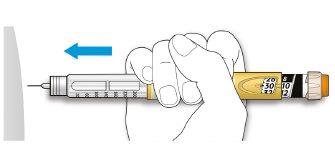
- Coloque el pulgar en el botón de inyección. Presiónelo hasta el fondo y manténgalo presionado.
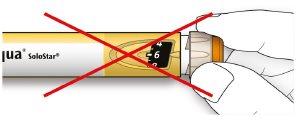
- Nopresione el botón de forma inclinada: su pulgar podría bloquear el selector de dosis y no permitir que este gire.
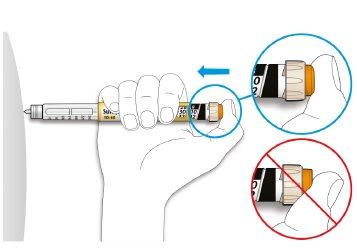
- Mantenga presionado el botón de inyección y cuando vea “0” en la ventana de dosis, cuente lentamente hasta 10.
- De este modo se asegurará de que recibe su dosis completa.
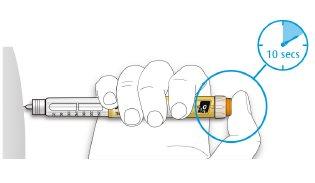
- Tras mantenerlo presionado y contar lentamente hasta 10, suelte el botón de inyección. A continuación, retire la aguja de la piel.
PASO 6: Retire la aguja
- Tenga cuidado al manipular las agujas para evitar lesiones por punción e infección cruzada.
- Novuelva a poner la tapa interior de la aguja.
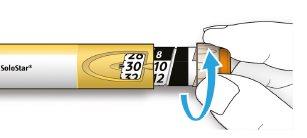
ASujete la parte más ancha de la tapa exterior la aguja. Mantenga la aguja recta y diríjala hacia la tapa exterior de la aguja. Después presione firmemente.
- La aguja puede pinchar la tapa si se coloca inclinada.
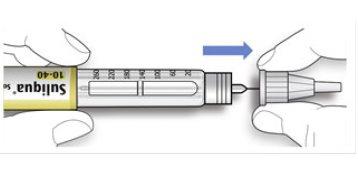
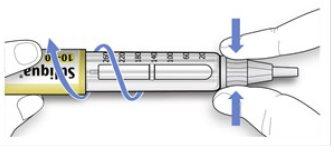
- Sujete y enrosque la parte más ancha de la tapa exterior de la aguja. Gire la pluma varias veces con su otra mano para retirar la aguja.
- Inténtelo de nuevo, si la aguja no salió la primera vez.
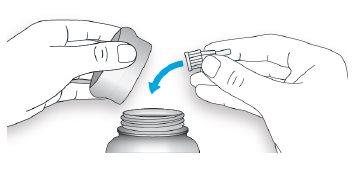
- Deseche la aguja usada en un contenedor resistente a pinchazos (ver “Desechar su pluma” al final de estas Instrucciones de Uso).
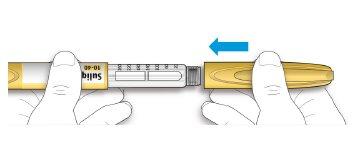
- Vuelva a colocar el capuchón de la pluma.
- No vuelva a meter la pluma en la nevera.
Cómo conservar su pluma
Antes del primer uso
- Conserve las plumas nuevas en la nevera, entre 2°C y 8°C.
- Nocongelar.
Después del primer uso
- Conserve su pluma a temperatura ambiente, por debajo de 25 ºC.
- Novuelva a meter su pluma en la nevera.
- Noguarde su pluma con la aguja incorporada.
- Guarde su pluma con el capuchón puesto.
- Sólo utilice su pluma durante 28 días,después de su primer uso
Cómo cuidar su pluma
Trate su pluma con cuidado
- Si cree que su pluma puede estar estropeada, nointente repararla. Use una nueva.
Proteja su pluma del polvo y la suciedad
- Puede limpiar el exterior de su pluma con un trapo húmedo (solo con agua). Nomoje, lave o lubrique su pluma, ya que podría dañarla.
Desechar su pluma
- Retire la aguja antes de desechar su pluma.
- Deseche su pluma usada tal y como le indique su profesional sanitario o la autoridad local.
- País de registro
- Forma farmacéuticaINYECTABLE, 100 U/ml + 50 microgramos/ml
- Código ATCA10AE54
- Principio activo
- Requiere recetaSí
- Fabricante
- ComposiciónGLICEROL (85%) (20 mg mg), SOLUCION DE HIDROXIDO DE SODIO (C.S.P. 4,5 pH mg)
- Esta información es de carácter general y no sustituye la consulta con un profesional sanitario.
- Alternativas a SULIQUA 100 UNIDADES/ML + 50 MICROGRAMOS/ML SOLUCION INYECTABLE EN PLUMA PRECARGADAForma farmacéutica: INYECTABLE, 100 U/ml + 33 microgramos/mlPrincipio activo: insulin glargine and lixisenatideFabricante: Sanofi Winthrop IndustrieRequiere recetaForma farmacéutica: INYECTABLE, 100 U/mlPrincipio activo: insulina glarginaFabricante: Eli Lilly Nederland B.V.Requiere recetaForma farmacéutica: INYECTABLE, DesconocidaPrincipio activo: insulina glarginaFabricante: Sanofi-Aventis Deutschland GmbhRequiere receta
Médicos online para SULIQUA 100 UNIDADES/ML + 50 MICROGRAMOS/ML SOLUCION INYECTABLE EN PLUMA PRECARGADA
Comenta la dosis, los posibles efectos secundarios, interacciones, contraindicaciones o la revisión de receta de SULIQUA 100 UNIDADES/ML + 50 MICROGRAMOS/ML SOLUCION INYECTABLE EN PLUMA PRECARGADA, sujeto a valoración médica y a la normativa local.









Obtén una receta de SULIQUA 100 UNIDADES/ML + 50 MICROGRAMOS/ML SOLUCION INYECTABLE EN PLUMA PRECARGADA online
Rellena un formulario de 2 minutos
Cuéntanos tus síntomas, historial y el medicamento que necesitas.
Elige un médico o nosotros te asignamos uno
Escoge un especialista o te conectamos con el próximo médico disponible.
El médico revisa tu caso
Normalmente en 30 minutos. Puede hacerte preguntas adicionales por chat.
Recógela en cualquier farmacia
Receta electrónica enviada a tu correo, válida en toda España.
Preguntas frecuentes
SULIQUA 100 UNIDADES/ML + 50 MICROGRAMOS/ML SOLUCION INYECTABLE EN PLUMA PRECARGADA requiere receta en España. Puedes confirmarlo con un médico online según tu caso.
El principio activo de SULIQUA 100 UNIDADES/ML + 50 MICROGRAMOS/ML SOLUCION INYECTABLE EN PLUMA PRECARGADA es insulin glargine and lixisenatide. Esta información ayuda a identificar medicamentos con la misma composición pero con diferentes nombres comerciales.
SULIQUA 100 UNIDADES/ML + 50 MICROGRAMOS/ML SOLUCION INYECTABLE EN PLUMA PRECARGADA es fabricado por Sanofi Winthrop Industrie. La marca y el envase pueden variar según el distribuidor.
Los Médicos de familia, Psiquiatras, Dermatólogos, Cardiólogos, Endocrinólogos, Gastroenterólogos, Neumólogos, Nefrólogos, Reumatólogos, Hematólogos, Infectólogos, Alergólogos, Geriatras, Pediatras, Oncólogos pueden valorar la prescripción de SULIQUA 100 UNIDADES/ML + 50 MICROGRAMOS/ML SOLUCION INYECTABLE EN PLUMA PRECARGADA cuando esté clínicamente indicado. Puedes reservar una videoconsulta para comentar tu caso y las opciones de tratamiento.
España cuenta con una infraestructura sanitaria bien desarrollada en ciudades principales como Madrid, Barcelona, Valencia y Sevilla. Las farmacias están ampliamente disponibles y operan bajo estrictas regulaciones, garantizando el acceso a medicamentos con receta.
Puedes comprar SULIQUA 100 UNIDADES/ML + 50 MICROGRAMOS/ML SOLUCION INYECTABLE EN PLUMA PRECARGADA en Madrid, Barcelona, Sevilla o Valencia en cualquier farmacia local con una receta válida.
Para obtener una receta, puedes utilizar Oladoctor:
Otros medicamentos con el mismo principio activo (insulin glargine and lixisenatide) incluyen SULIQUA 100 UNIDADES/ML + 33 MICROGRAMOS/ML SOLUCION INYECTABLE EN PLUMA PRECARGADA, ABASAGLAR 100 UNIDADES/ML KWIKPEN SOLUCION INYECTABLE EN PLUMA PRECARGADA, LANTUS 100 UNIDADES/ML SOLUCION INYECTABLE EN UN CARTUCHO. Pueden tener diferentes nombres comerciales o formulaciones, pero contienen el mismo componente terapéutico. Consulta siempre con un médico antes de cambiar o iniciar un nuevo medicamento.
