



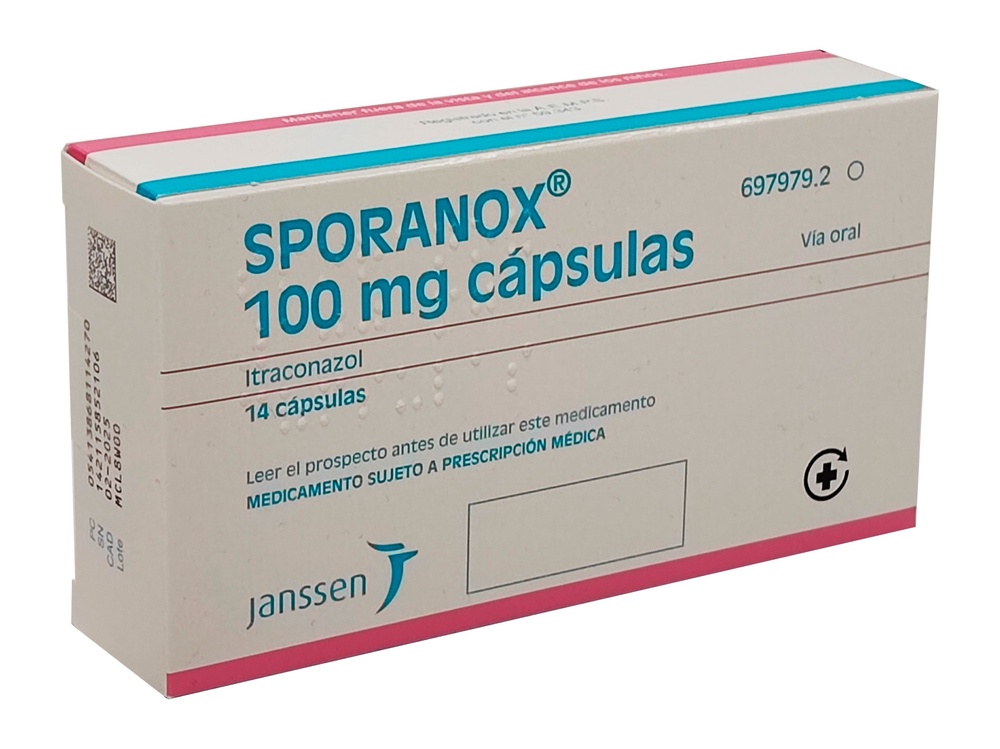
SPORANOX 100 mg Capsulas

Revisión de receta online
Un médico revisará tu caso y determinará si la prescripción es médicamente apropiada.

Habla con un médico sobre este medicamento
Comenta tus síntomas y las opciones de tratamiento en una consulta online.



Cómo usar SPORANOX 100 mg CAPSULAS
Contenido del prospecto
- Introducción
- Sporanox 100 mg cápsulas
- Qué es Sporanox 100 mg cápsulas y para qué se utiliza
- Qué necesita saber antes de empezar a tomar Sporanox 100 mg cápsulas
- Cómo tomar Sporanox 100 mg cápsulas
- Uso en Niños
- Posibles efectos adversos
- Conservación de Sporanox 100 mg cápsulas
- Contenido del envase e información adicional
Introducción
Prospecto: información para el usuario
Sporanox 100 mg cápsulas
Itraconazol
Lea todo el prospecto detenidamente antes de empezar a tomar este medicamento, porque tiene información importante para usted.
- Conserve este prospecto, ya que puede tener que volver a leerlo.
- Si tiene alguna duda, consulte a su médico o farmacéutico.
- Este medicamento se le ha recetado solamente a usted, y no debe dárselo a otras personas aunque tengan los mismos síntomas que usted, ya que puede perjudicarles.
- Si experimenta efectos adversos, consulte a su médico o farmacéutico, incluso si se trata de efectos adversos que no aparecen en este prospecto. Ver sección 4.
Contenido del prospecto
- Qué es Sporanox 100 mg cápsulas y para qué se utiliza
- Qué necesita saber antes de empezar a tomar Sporanox 100 mg cápsulas
- Cómo tomar Sporanox 100 mg cápsulas
- Posibles efectos adversos
- Conservación de Sporanox 100 mg cápsulas
- Contenido del envase e información adicional

¿No estás seguro de si este medicamento es adecuado para ti?
Comenta tus síntomas y tratamiento con un médico online.
1. Qué es Sporanox 100 mg cápsulas y para qué se utiliza
Sporanox pertenece al grupo de los medicamentos llamados “antifúngicos”.
Está indicado en el tratamiento de infecciones producidas por hongos de la vagina, piel, boca, ojos, uñas o de órganos internos.
2. Qué necesita saber antes de empezar a tomar Sporanox 100 mg cápsulas
No tome Sporanox 100 mg cápsulas
- si es alérgico(hipersensible) a cualquiera de los componentes de este medicamento (incluidos en la sección 6).
- si padece una enfermedad llamada insuficiencia cardiaca (también llamada insuficiencia cardiaca congestiva o ICC). Este medicamento podría empeorarla.
Si su médico valora que debe tomar este medicamento contacte inmediatamente con él si nota que le falta la respiración, gana peso de forma inesperada, tiene hinchadas las piernas, se siente inusualmente fatigado o comienza a despertarse por la noche.
- si usted está embarazada, piensa que podría estarlo o se puede quedar embarazada(ver sección embarazo).
- si está en edad fértil, deberá tomar medidas anticonceptivas adecuadas para evitar quedarse embarazada durante el tratamiento. Debido a que este medicamento puede permanecer tiempo en el organismo, deberá prolongar las medidas anticonceptivas hasta el siguiente periodo menstrual después de finalizar el tratamiento con este medicamento.
- no se puede utilizar Sporanox cápsulas junto con algunos medicamentos. Hay muchos medicamentos que interaccionan con Sporanox cápsulas, ver sección “Uso de otros medicamentos y Sporanox cápsulas” y el listado a continuación.
No tome Sporanox cápsulas si se encuentra en alguna de las situaciones anteriores. Si no está seguro, consulte a su médico o farmacéutico antes de empezar a tomar este medicamento.
Informe a su médico si está tomando cualquier medicamento antes de tomar Sporanox cápsulas.
Medicamentos que no debe tomar con Sporanox 100mg cápsulas
No utilice Sporanox 100mg cápsulassiestá tomando determinados medicamentos o dentro de las 2 semanas siguientes a la finalización de Sporanox cápsulas.
Ejemplos de estos medicamentos son:
Medicamentos para problemas de corazón, sangre o circulación
- aliskiren, eplerenona, lercanidipino o nisoldipino (para la hipertensión)
- bepridil, ivabradina o ranolazina (para la angina – dolor opresivo en el pecho)
- dabigatran o ticagrelor (para coágulos de sangre)
- disopiramida, dofetilida, dronedarona o quinidina (para problemas de latido del corazón irregular)
- finerenona (para problemas de riñón en pacientes con diabetes tipo 2)
- lomitapida, lovastatina o simvastatina (para reducir el colesterol)
- sildenafilo cuando se utiliza para tratar la hipertensión pulmonar (aumento de la presión de la sangre en los vasos sanguíneos de los pulmones)
Medicamentos para problemas de estómago o estreñimiento
- cisaprida (para trastornos del estómago)
- domperidona (para náuseas y vómitos)
- naloxegol (para el estreñimiento causado por tomar analgésicos opioides)
Medicamentos para dolores de cabeza, del sueño o problemas de la salud mental
- dihidroergotamina o ergotamina (alcaloides del cornezuelo del centeno utilizados para las migrañas)
- midazolam (por vía oral) o triazolam (para sedación o inducción del sueño)
- lurasidona, pimozida, quetiapina o sertindol (para la esquizofrenia, trastorno bipolar u otros trastornos de salud mental)
Medicamentos para problemas urinarios
- darifenacina (para la incontinencia urinaria)
- fesoterodina o solifenacina (para la vejiga urinaria irritada) cuando se utilizan en pacientes con determinados problemas renales o hepáticos
Medicamentos para tratar alergias
- astemizol, mizolastina o terfenadina (para alergias)
Medicamentos para problemas de erección y eyaculación
- avanafilo (para la disfunción eréctil)
- dapoxetina (para la eyaculación precoz)
- vardenafilo (para la disfunción eréctil) cuando se utiliza en varones mayores de 75 años
Otros medicamentos que contienen:
- colchicina (para la gota) cuando se utiliza en pacientes con problemas renales o hepáticos
- ergometrina (ergonovina) o metilergometrina (metilergonovina) alcaloides del cornezuelo del centeno utilizados después de dar a luz
- eliglustat (para la enfermedad de Gaucher) cuando se utiliza en pacientes que no pueden descomponer ciertos medicamentos en el organismo
- halofantrina (para la malaria)
- irinotecán (para el cáncer)
- isavuconazol (para las infecciones fúngicas)
- ombitasvir, paritaprevir, ritonavir con o sin dasabuvir (para tratar la hepatitis C)
- venetoclax (para la leucemia linfocítica crónica) cuando usted comience a tomar venetoclax por primera vez o cuando se tomen dosis crecientes al principio del tratamiento
- voclosporina (para tratar problemas renales relacionados con el lupus)
No tome Sporanox cápsulas si se encuentra en alguna de las situaciones anteriores. Si no está seguro, consulte a su médico o farmacéutico antes de empezar a tomar Sporanox cápsulas.
Recuerde: no tome ninguno de los medicamentos anteriores durante 2 semanas después de su último tratamiento con Sporanox cápsulas.
Esta no es una lista completa; informe a su médico si está tomando o tiene previsto tomar cualquiera de estos medicamentos o cualquier otro medicamento.
Advertencias y precauciones
Tenga especial cuidado con Sporanox 100 mg cápsulas
- si tiene problemas de corazón consulte a su médico. Informe inmediatamente a su médico si aparece dificultad al respirar, aumento de peso inesperado, hinchazón de piernas, fatiga inusual o insomnio, ya que pueden ser síntomas de insuficiencia cardiaca.
- si tiene algún problema de hígado. Puede ser necesario ajustar la dosis de este medicamento. Si alguno de los siguientes síntomas aparece durante el tratamiento con este medicamento, deje de tomarlo y consulte inmediatamente con su médico: falta de apetito, náuseas, vómitos, cansancio, dolor abdominal, ictericia (coloración amarillenta de la piel, ojos, mucosas y secreciones), orina muy oscura o heces pálidas. Si sigue un tratamiento con Sporanox cápsulas es muy posible que su médico le mande análisis de sangre de forma regular, ya que se han producido en casos muy raros trastornos en el hígado.
- si tiene algún problema de riñón consulte con su médico. Podría ser necesario ajustar la dosis de este medicamento.
- consulte con su médico o busque atención médica de inmediato si mientras está tomando Sporanox cápsulas tiene una reacción alérgica grave (caracterizada por una pronunciada erupción en la piel, picor, ronchas, dificultad para respirar y/o hinchazón de la cara).
- deje de tomar este medicamento y consulte inmediatamente con su médico si se vuelve demasiado sensible a la luz solar.
- deje de tomar Sporanox cápsulas y consulte con su médico inmediatamente si experimenta un trastorno grave de la piel, como una erupción generalizada con descamación de la piel y ampollas en la boca, ojos y genitales, o una erupción con pequeñas pústulas o ampollas.
- contacte con su médico si padece neutropenia, SIDA o ha recibido un trasplante de órgano. La dosis de este medicamento podría tener que ser ajustada.
- si ha sufrido una reacción alérgica debida a Sporanox cápsulas o a otro de los medicamentos utilizados para tratar infecciones por hongos (medicamentos conocidos como azoles) consulte a su médico. Una reacción de hipersensibilidad se puede reconocer, por ejemplo, por la aparición de erupción cutánea, picor, ronchas, respiración entrecortada o dificultad al respirar, y/o hinchazón de la cara. Si sufre una reacción alérgica grave, consulte inmediatamente con su médico.
- si tiene fibrosis quística consulte con su médico antes de tomar Sporanox cápsulas.
- deje de tomar Sporanox cápsulas y consulte inmediatamente con su médico si aparece cualquier sensación de hormigueo, entumecimiento, disminución de la sensibilidad o debilidad en las extremidades u otros problemas con los nervios en los brazos y piernas (neuropatía).
- deje de tomar este medicamento y contacte inmediatamente con su médico si no oye correctamente. En casos muy raros se ha producido una pérdida de audición temporal o permanente.
- informe a su médico si su visión se vuelve borrosa o ve doble, si escucha un zumbido en los oídos, si pierde la capacidad de controlar su orina u orina mucho más que de costumbre.
- no se recomienda la toma de este medicamento en pacientes de edad avanzada. Solamente en casos excepcionales puede ser prescrito por el médico.
Otros medicamentos y Sporanox 100mg cápsulas
Informe a su médico o farmacéutico si está tomando, ha tomado recientemente o pudiera tener que tomar cualquier otro medicamento, incluso los adquiridos sin receta.
Medicamentos que no debe tomar
Hay medicamentos que no debe tomarmientras esté tomando Sporanox. Estos medicamentos se recogen más arriba bajo el encabezamiento “Medicamentos que no debe tomar con Sporanox 100mg cápsulas”
No se recomienda el uso de ciertos medicamentos con Sporanox 100mg cápsulas.
Su médico puede decidir que no debe tomar algunos medicamentos al mismo tiempo que SPORANOX cápsulas o en las 2 semanas siguientes tras su finalización.
Ejemplos de estos medicamentos son:
Medicamentos para problemas de corazón, sangre o circulación
- apixaban, edoxaban, rivaroxaban o vorapaxar (para coágulos de sangre)
- atorvastatina (para reducir el colesterol)
- felodipino (para la hipertensión)
- riociguat o tadalafilo cuando se utilizan para tratar la hipertensión pulmonar (aumento de la presión de la sangre en los vasos sanguíneos de los pulmones)
Medicamentos para la epilepsia, dolores de cabeza o problemas de salud mental
- fenitoína, carbamazepina o fenobarbital (para la epilepsia)
- eletriptán (para las migrañas)
- Hierba de San Juan (Hypericum perforatum) (un medicamento a base de plantas utilizado para problemas de salud mental)
Medicamentos para problemas urinarios
- tamsulosina (para la incontinencia urinaria masculina)
- tolterodina (para la vejiga urinaria irritada)
Medicamentos para el cáncer
- axitinib, bosutinib, cabazitaxel, cabozantinib, ceritinib, cobimetinib, crizotinib, dabrafenib, dasatinib, docetaxel, entrectinib, glasdegib, ibrutinib, lapatinib, nilotinib, olaparib, pazopanib, regorafenib, sunitinib, talazoparib, trabectedina, trastuzumab emtansina, venetoclax (cuando usted esté en una dosis estable de venetoclax para la leucemia linfocítica crónica, o en cualquier momento del tratamiento de una leucemia mielógena aguda) o alcaloides de la vinca (tales como vinflunina, vinorelbina)
Medicamentos para la tuberculosis
- bedaquilina, isoniazida, rifabutina o rifampicina (para la tuberculosis)
Medicamentos para el virus de la inmunodeficiencia humana (VIH) o la hepatitis
- efavirenz o nevirapina (para el VIH/SIDA)
- elbasvir/grazoprevir, tenofovir alafenamida fumarato (TAF), tenofovir disoproxil fumarato (TDF) (para el VIH o la hepatitis)
Medicamentos utilizados después de un trasplante de órgano
- everolimus, rapamicina (también conocida como sirolimus), temsirolimus
Medicamentos para el aumento benigno del tamaño de la próstata
- alfuzosina, silodosina
Medicamentos para la inflamación, problemas pulmonares o alergias
- ciclesonida (para la inflamación, asma y alergias)
- ebastina (para las alergias)
- salmeterol (para el asma o la enfermedad pulmonar obstructiva crónica, EPOC)
Medicamentos para los problemas de erección y eyaculación
- tadalafilo o vardenafilo cuando se utilizan en varones de 75 años o menos (para la disfunción eréctil)
Otros medicamentos que contienen:
- colchicina (para la gota)
- fentanilo (para el dolor)
- lumacaftor/ivacaftor (para la fibrosis quística)
Recuerde: no tome ninguno de los medicamentos anteriores durante 2 semanas después de su último tratamiento con Sporanox cápsulas.
Esta lista no es completa, por lo que debe informar a su médico si está tomando o tiene previsto tomar alguno de estos medicamentos o cualquier otro medicamento.
Se debe tener cuidado al utilizar Sporanox 100mgcápsulas con determinados medicamentos.
Es posible que tenga más probabilidades de sufrir efectos adversos o que sea necesario modificar la dosis de Sporanox cápsulas o del otro medicamento. Ejemplos de estos medicamentos son:
Medicamentos para problemas de corazón, sangre o circulación
- bosentán cuando se utiliza para tratar la hipertensión pulmonar (aumento de la presión de la sangre en los vasos sanguíneos de los pulmones)
- antagonistas de los canales de calcio como las dihidropiridinas, tales como amlodipino, isradipino, nifedipino, nimodipino, diltiazem o verapamilo (para la hipertensión)
- cilostazol (para problemas circulatorios)
- “cumarinas” tales como la warfarina (para los coágulos de sangre)
- digoxina (para la fibrilación auricular)
- nadolol (para la hipertensión pulmonar o angina)
Medicamentos para problemas de estómago o diarrea
- aprepitant o netupitant (para las náuseas y vómitos durante el tratamiento del cáncer)
- loperamida (para la diarrea)
- antiácidos tales como aluminio, calcio, magnesio, o bicarbonato de sodio; anatagonistas de los receptores-H2 tales como, cimetidina, ranitidina e inhibidores de la bomba de protones tales como, lansoprazol, omeprazol, rabeprazol (para tratar problemas de acidez estomacal)
Medicamentos para trastornos del sueño o de la salud mental
- alprazolam, brotizolam, buspirona o midazolam (cuando se inyecta en una vena) (para la ansiedad o ayuda para la inducción del sueño)
- zopiclona (para la inducción del sueño)
- reboxetina o venlafaxina (para la depresión y la ansiedad)
- aripiprazol, cariprazina, haloperidol o risperidona (para la esquizofrenia, trastorno bipolar u otros problemas de salud mental)
- galantamina (para la enfermedad de Alzheimer)
- guanfacina (para el trastorno por déficit de atención con hiperactividad)
Medicamentos para problemas urinarios
- imidafenacina, fesoterodina, oxibutinina, solifenacina (para la vejiga urinaria irritada)
Medicamentos para el cáncer
- bortezomib, brentuximab vedotina, busulfán, erlotinib, gefitinib, idelalisib, imatinib, nintedanib, panobinostat, pemigatinib, ponatinib, ruxolitinib, sonidegib o tretinoína (oral)
Medicamentos para infecciones
- ciprofloxacino, claritromicina o eritromicina (para infecciones bacterianas)
- delamanida (para la tuberculosis)
- arteméter-lumefantrina o quinina (para tratar la malaria)
- prazicuantel (para lombrices y tenias)
Medicamentos para el virus de la inmunodeficiencia humana (VIH) o la hepatitis
- cobicistat, elvitegravir potenciado, maraviroc, ritonavir, darunavir potenciado con ritonavir, fosamprenavir potenciado con ritonavir, indinavir o saquinavir (para el VIH)
- glecaprevir/pibrentasvir (para la hepatitis)
Medicamentos utilizados después de un trasplante de órgano
- ciclosporina o tacrolimus
Medicamentos para el aumento de tamaño benigno de la próstata
- dutasterida
Medicamentos para problemas pulmonares, alergias o afecciones inflamatorias
- bilastina, o rupatadina (para la alergia)
- metilprednisolona o dexametasona, (medicamentos administrados por vía oral o inyectables para el asma, alergias o afecciones inflamatorias)
- budesonida o fluticasona (para el asma, alergias)
Medicamentos para los problemas de erección y eyaculación
- sildenafilo (para la disfunción eréctil)
Medicamentos para el dolor
- alfentanilo, buprenorfina, oxicodona o sufentanilo (para el dolor)
- meloxicam (para la inflamación y el dolor articular)
Otros medicamentos que contienen:
- alitretinoína (administrada por vía oral) (para el eccema)
- cabergolina (para la enfermedad de Parkinson)
- productos a base de cannabis, incluidos medicamentos (para náuseas y vómitos o espasmos musculares en pacientes con esclerosis múltiple)
- cinacalcet (para el exceso de actividad paratiroidea)
- dienogest o ulipristal (anticonceptivos)
- eliglustat (para la enfermedad de Gaucher) cuando se utiliza en pacientes que no pueden descomponer ciertos medicamentos en el organismo
- ivacaftor (para la fibrosis quística)
- metadona (para tratar la drogadicción)
- repaglinida o saxagliptina (para la diabetes)
Esta lista no es completa, por lo que debe informar a su médico si está tomando o tiene previsto tomar alguno de estos medicamentos, o cualquier otro medicamento, para que se puedan tomar las medidas adecuadas.
Debe haber suficiente acidez en el estómago para asegurar la absorción de Sporanox cápsulas. Por tanto, los medicamentos que neutralizan la acidez del estómago se deben usar al menos 2 horas antes de tomar Sporanox cápsulas o bien se deben usar después de dos horas de haber tomado este medicamento. Por la misma razón, si usted está tomando medicamentos que regulan la producción de ácido en el estómago, tome Sporanox cápsulas junto con una bebida de cola (ver sección 3 “Cómo tomar Sporanox 100 mg cápsulas”).
En caso de duda, consulte a su médico o farmacéutico.
Toma de Sporanox 100 mg cápsulas con los alimentos y bebidas
Tome este medicamento inmediatamente después de haber finalizado una de las comidas principales.
Si está tomando algún medicamento que regula la producción de ácido en el estómago se recomienda tomar este medicamento junto con una bebida de cola.
Embarazo y lactancia
Embarazo
Consulte a su médico o farmacéutico antes de utilizar cualquier medicamento.
No se utilizará Sporanox en caso de embarazo.
Si está en edad fértil y se puede quedar embarazada, consulte con su médico.
- Use anticonceptivos efectivos para asegurarse de no quedarse embarazada mientras está tomando el medicamento.
- Además, siga utilizando algún método anticonceptivo hasta su siguiente periodo menstrual después de haber dejado de tomar Sporanox cápsulas. Esto se debe a que Sporanox cápsulas puede permanecer cierto tiempo en el organismo después de dejar de tomarlo. (Ver sección 2 “No tome Sporanox 100 mg cápsulas”).
Lactancia
Consulte a su médico o farmacéutico antes de utilizar cualquier medicamento.
Si usted está dando el pecho consulte con su médico antes de tomar Sporanox. Esto se debe a que en la leche pueden aparecer pequeñas cantidades del medicamento.
Conducción y uso de máquinas
Sporanox a veces puede causar mareos, visión borrosa o doble o pérdida auditiva. Si esto le sucede a usted, no conduzca ni utilice máquinas o herramientas.
Información importante sobre algunos de los componentes de Sporanox 100 mg cápsulas
Si su médico le ha indicado que padece una intolerancia a ciertos azúcares, consulte con él antes de tomar este medicamento.

¿Has empezado a tomar el medicamento y tienes preguntas?
Comenta tus síntomas y tratamiento con un médico online.
3. Cómo tomar Sporanox 100 mg cápsulas
Siga exactamente las instrucciones de administración de este medicamento indicadas por su médico. En caso de duda, consulte de nuevo a su médico o farmacéutico. Recuerde tomar su medicamento.
Su médico le indicará la duración de su tratamiento con este medicamento. No suspenda el tratamiento antes. Si estima que la acción del medicamento es demasiado fuerte o débil, comuníqueselo a su médico o farmacéutico.
Cómo tomar Sporanox 100mg cápsulas
Usted debe tomar Sporanox cápsulas inmediatamente después de las comidas, pues así se absorbe mejor. Trague las cápsulas enteras con un poco de agua. La cantidad de cápsulas que usted debe tomar y durante cuánto tiempo depende del tipo de hongo y del lugar donde se localice la infección. Su médico le dirá exactamente cuánto Sporanox cápsulas debe tomar.
Debe haber suficiente acidez en el estómago para asegurar la absorción de este medicamento. Por tanto los medicamentos que neutralizan la acidez del estómago se deben usar después de dos horas de haber tomado este medicamento o bien se deben tomar dos horas antes de tomar Sporanox cápsulas. Por la misma razón, si usted está tomando medicamentos que regulan la producción de ácido en el estómago, tome Sporanox cápsulas junto con una bebida de cola.
Cuánto tomar
Las siguientes dosis son las más frecuentes:
TIPO DE INFECCIÓN | CÁPSULAS POR DÍA | DURACIÓN |
Infección vaginal | 2 cápsulas dos veces al día ó 2 cápsulas una vez al día | 1 día 3 días |
Infección de la piel | 2 cápsulas una vez al día ó 1 cápsula una vez al día | 7 días 2 semanas |
Si están afectadas las palmas de las manos o las plantas de los pies se pueden necesitar 2 cápsulas dos veces al día durante 7 días o 1 cápsula una vez al día durante 1 mes. | ||
Infecciones de la boca | 1 cápsula una vez al día | 2 semanas |
Infecciones de los ojos | 2 cápsulas una vez al día | 3 semanas |
Infecciones internas | 1 a 4 cápsulas diarias | periodos más largos |
? Infecciones de las uñas: dependiendo de sus necesidades personales su doctor optará por un tratamiento continuo o pulsátil.
- Tratamiento continuo para las infecciones de las uñas de los pies:
TIPO DE INFECCIÓN | CÁPSULAS POR DÍA | DURACIÓN |
Tratamiento continuo para uñas | 2 cápsulas una vez al día | 3 meses |
- Tratamiento pulsátil para las uñas:
Consiste en dos cápsulas dos veces al día durante 1 semana; después deje de tomar Sporanox 100 mg cápsulas durante 3 semanas. A continuación se repite el ciclo, una vez para las uñas de las manos y dos veces para las uñas de los pies (con o sin infección en las uñas de las manos). (Ver la siguiente tabla)
Semana 1 | Semana 2 | Semana 3 | Semana 4 | Semana 5 | Semana 6 | Semana 7 | Semana 8 | Semana 9 | Semana 10 | |
Uñas de los pies con o sin afectación de las uñas de las manos | Tomar 2 cápsulas dos veces al día | Sin tratamiento con Sporanox cápsulas | Tomar 2 cápsulas dos veces al día | Sin tratamiento con Sporanox cápsulas | Tomar 2 cápsulas dos veces al día | Interrumpir el tratamiento | ||||
Solo las uñas de las manos | Tomar 2 cápsulas dos veces al día | Sin tratamiento con Sporanox cápsulas | Tomar 2 cápsulas dos veces al día | Interrumpir el tratamiento |
En las infecciones de la piel las lesiones desaparecerán pocas semanas después de terminar el tratamiento. Esto es característico de las manchas producidas por hongos: el medicamento elimina al hongo en sí mismo pero la lesión no desaparece hasta que no crezca una nueva piel.
Las lesiones de las uñas desaparecerán de 6 a 9 meses después de terminar el tratamiento, ya que el medicamento solo elimina el hongo en sí mismo. La uña tiene que crecer y esto lleva varios meses. Por lo tanto no se preocupe si usted no nota mejoría durante el tratamiento: el medicamento se mantiene en sus uñas durante varios meses y cumple su misión. Por tanto, debe de interrumpir el tratamiento en el momento que le indique su médico aunque usted no vea ninguna mejoría.
Infecciones de los órganos internos:Se pueden necesitar dosis más altas y durante mucho tiempo.
Siga siempre las indicaciones de su médico, él adaptará el tratamiento a sus necesidades.
Uso en Niños
Sporanox cápsulas no debe utilizarse en niños. Solamente en casos excepcionales puede ser prescrito por el médico.
Si toma más Sporanox 100 mg cápsulas del que debiera
En caso de sobredosis o ingestión accidental, consulte inmediatamente a su médico o farmacéutico o al Servicio de Información Toxicológica, Teléfono 91 562 04 20, indicando el medicamento y la cantidad utilizada.
En caso de sobredosis accidental su médico le aplicará medidas de apoyo. Itraconazol no se elimina por hemodiálisis. No se conocen antídotos específicos.
Si olvidó tomar Sporanox 100 mg cápsulas
Si usted olvida tomar el medicamento, tome la siguiente dosis que le corresponda y continúe el tratamiento como le fue indicado por su médico. No tome una dosis doble para compensar las dosis olvidadas.
Si interrumpe el tratamiento con Sporanox 100 mg cápsulas
No interrumpa el tratamiento con Sporanox sin consultar con su médico ya que podrían reaparecer o empeorar los síntomas de su enfermedad.
Si tiene cualquier otra duda sobre el uso de este producto, pregunte a su médico o farmacéutico.
4. Posibles efectos adversos
Al igual que todos los medicamentos, Sporanox 100 mg cápsulas puede producir efectos adversos, aunque no todas las personas los sufran.
Si considera que alguno de los efectos adversos que sufre es grave o si aprecia cualquier efecto adverso no mencionado en este prospecto, informe a su médico o farmacéutico.
A continuación se mencionan los efectos adversos vistos durante la comercialización del medicamento y los ensayos clínicos.
Las reacciones adversas se clasificaron según la frecuencia utilizando el siguiente convenio:
Muy frecuentes: que afecta a más de 1 de cada 10 pacientes
Frecuentes: que afecta a entre 1 y 10 de cada 100 pacientes
Poco frecuentes: que afecta a entre 1 y 10 de cada 1.000 pacientes
Raros: que afecta a entre 1 y 10 de cada 10.000 pacientes
Muy raros: que afecta a menos de 1 de cada 10.000 pacientes
Frecuencia no conocida: no se puede estimar con los datos disponibles
? Infecciones e infestaciones
Poco frecuentes: sinusitis (irritación e hinchazón de los senos nasales), infección del tracto respiratorio superior, rinitis (inflamación de la mucosa de la nariz que cursa con producción de moco acuoso además de estornudos frecuentes)
? Trastornos de la sangre y del sistema linfático
Raros: leucopenia
- Trastornos del sistema inmunológico
Poco frecuentes: reacción exagerada de hipersensibilidad y alérgica
Raros: reacciones anafilácticas (alérgicas), enfermedad del suero (alergia que aparece tras la inyección de algunos sueros y se caracteriza por la aparición de urticaria, acumulación de líquidos, dolores articulares, fiebre y agotamiento extremo), edema angioneurótico (hinchazón por acumulación de líquidos que puede afectar a la boca y a las vías respiratorias superiores)
- Trastornos endocrinos
No conocida: síntomas de niveles elevados de la hormona "aldosterona" (como tensión arterial alta o niveles bajos de potasio en sangre), aunque el nivel en sangre de "aldosterona" sea normal o bajo
- Trastornos del metabolismo y de la nutrición
Raros: aumento de los triglicéridos
- Trastornos del sistema nervioso
Frecuentes: dolor de cabeza
Raros: temblor, sensación de hormigueo en las extremidades (parestesia), disminución de la sensibilidad (hipoestesia), gusto desagradable (mal sabor de boca)
? Trastornos oculares
Raros: perturbaciones visuales (incluyendo visión borrosa y visión doble)
? Trastornos del oído y del laberinto
Raros: pérdida auditiva permanente o transitoria, sensación subjetiva de ruidos en el oído
- Trastornos cardíacos
Raros: insuficiencia cardiaca congestiva, disminución de la frecuencia cardíaca
- Trastornos respiratorios, torácicos y mediastínicos
Raros: Respiración entrecortada, dificultad para respirar (disnea)
- Trastornos gastrointestinales
Frecuentes: dolor abdominal, náuseas
Poco frecuentes: vómitos, malestar asociado a las comidas, diarrea y estreñimiento, acumulación de gases en el intestino (flatulencia)
Raros: inflamación del páncreas
- Trastornos hepatobiliares:
Poco frecuentes: función hepática anormal
Raros: cantidades elevadas de bilirrubina en sangre (hiperbilirrubinemia), hepatotoxicidad grave (incluyendo casos de insuficiencia hepática aguda muy grave)
- Trastornos de la piel y del tejido subcutáneo
Poco frecuentes: urticaria, erupción, picor
Raros: necrólisis epidérmica tóxica (enfermedad grave de la piel que se caracteriza por erupción cutánea y la aparición de ampollas y escamas), síndrome de Stevens-Johnson (eritema grave de la piel, mucosa y ojos), un trastorno grave de la piel (sarpullido generalizado con descamación de la piel y ampollas en la boca, ojos y genitales, o sarpullido con pequeñas pústulas o ampollas), eritema multiforme (enfermedad de la piel que se caracteriza por la aparición de vesículas, ampollas…etc), dermatitis exfoliativa (enfermedad de la piel caracterizada por la descamación), vasculitis leucocitoclástica (inflamación de la pared de los vasos sanguíneos), alopecia (caída del cabello), fotosensibilidad (respuesta exagerada de la piel a la luz solar)
? Trastornos renales y urinarios
Raros: aumento de la frecuencia al orinar
- Trastornos del aparato reproductor y de la mama
Poco frecuentes: trastornos menstruales
Raros: disfunción eréctil
- Trastornos generales y alteraciones en el lugar de administración
Raros: edema (acumulación de líquido)
- Exploraciones complementarias
Raros: aumento de la creatina fosfoquinasa en sangre (parámetro que mide el funcionamiento hepático)
Descripción de determinados efectos adversos
A continuación se mencionan los efectos adversos asociados a itraconazol notificados en los ensayos clínicos de Sporanox solución oral y/o intravenoso, exceptuando el efecto adverso “inflamación en el lugar de la inyección” ya que este efecto es específico para la vía de administración por inyección.
Trastornos de la sangre y del sistema linfático: granulocitopenia, trombocitopenia (disminución de algunas células de la sangre).
Trastornos del sistema inmunológico: reacción anafilactoide
Trastornos del metabolismo y de la nutrición: hiperglucemia (aumento del azúcar en sangre), hiperpotasemia (aumento del potasio en sangre), hipopotasemia (disminución del potasio en sangre), hipomagnesemia (disminución del magnesio en sangre),
Trastornos psiquiátricos: sensación de confusión o desorientación
Trastornos del sistema nervioso: neuropatía periférica (afectación de los nervios periféricos con sensación de hormigueo, entumecimiento o debilidad en las extremidades), mareo, somnolencia.
Trastornos cardiacos: insuficiencia cardiaca, insuficiencia ventricular izquierda, taquicardia (ritmo cardiaco rápido)
Trastornos vasculares: tensión arterial alta (hipertensión), tensión arterial baja (hipotensión)
Trastornos respiratorios, torácicos y mediastínicos: edema pulmonar, ronquera, tos
Trastornos gastrointestinales: trastorno gastrointestinal
Trastornos hepatobiliares: Insuficiencia hepática, hepatitis, ictericia (coloración amarillenta de la piel, ojos, mucosas y secreciones)
Trastornos de la piel y del tejido subcutáneo: erupción rojiza de la piel (exantema eritematoso), sudoración excesiva
Trastornos musculoesqueléticos y del tejido conjuntivo: dolor o sensación de debilidad en los músculos (mialgia), dolor en las articulaciones (artralgia)
Trastornos renales y urinarios: insuficiencia renal, incontinencia urinaria (pérdida de orina)
Trastornos generales y alteraciones en el lugar de administración: acumulación excesiva de líquido en los tejidos del cuerpo (edema generalizado), acumulación de líquido en la cara (edema facial), dolor en el pecho, fiebre, dolor, cansancio, escalofríos
Exploraciones complementarias: aumento de la alanino aminotransferasa, aumento de la aspartato aminotransferasa, aumento de la fosfatasa alcalina en sangre, aumento de la lactato deshidrogenasa en sangre, aumento de la urea en sangre, aumento de la gamma-glutamiltransferasa, aumento de las enzimas hepáticas, análisis de orina anormal.
Efectos adversos en la población pediátrica
En base a los datos de ensayos clínicos en pacientes pediátricos, los efectos adversos notificados con más frecuencia fueron: dolor de cabeza, vómitos, dolor abdominal, diarrea, función hepática anormal, tensión arterial baja, náuseas y urticaria.
En general, la naturaleza de los efectos adversos es similar a la observada en pacientes adultos, aunque la incidencia es mayor en los pacientes pediátricos.
Si experimenta cualquiera de estos efectos adversos, acuda a su médico.
Si considera que alguno de los efectos adversos que sufre es grave o si aprecia cualquier efecto adverso no mencionado en este prospecto, informe a su médico o farmacéutico.
Comunicación de efectos adversos
Si experimenta cualquier tipo de efecto adverso, consulte a su médico o farmacéutico, incluso si se trata de posibles efectos adversos que no aparecen en este prospecto. También puede comunicarlos directamente a través del Sistema Español de Farmacovigilancia de medicamentos de Uso Humano: https://www.notificaram.es. Mediante la comunicación de efectos adversos usted puede contribuir a proporcionar más información sobre la seguridad de este medicamento.
5. Conservación de Sporanox 100 mg cápsulas
Mantener este medicamento fuera de la vista y del alcance de los niños.
No utilice Sporanox después de la fecha de caducidad que aparece en el envase. La fecha de caducidad es el último día del mes que se indica.
Este medicamento no requiere condiciones especiales de conservación.
Los medicamentos no se deben tirar por los desagües ni a la basura. Deposite los envases y los medicamentos que no necesita en el Punto SIGRE de la farmacia . En caso de duda pregunte a su farmacéutico cómo deshacerse de los envases y de los medicamentos que no necesita. De esta forma ayudará a proteger el medio ambiente.
6. Contenido del envase e información adicional
Composición deSporanox100 mg cápsulas
- El principio activo es itraconazol. Cada cápsula contiene 100 mg de itraconazol.
- Los demás componentes son: esferas de azúcar (sacarosa, almidón de maíz), hipromelosa y macrogol. Los componentes de la cápsula son: dióxido de titanio (E171), indigotindisulfonato sódico (E132), eritrosina sódica y gelatina.
Aspecto del producto y contenido del envase
Sporanox 100 mg cápsulas se presenta en cápsulas rosas y azules conteniendo 100 miligramos de itraconazol en envases de 14 cápsulas.
Titular de la autorización de comercialización y responsable de la fabricación:
Titular de la autorización de comercialización:
Janssen-Cilag, S.A.
Paseo del Club Deportivo 1, Edificio 16
28223 Pozuelo de Alarcón (Madrid)
España
Responsable de la fabricación:
Janssen-Cilag, SpA
Via C. Janssen
04100 Borgo San Michele
Latina (Italia)
Fecha de la última revisión de esteprospecto:junio 2025.
La información detallada de este medicamento está disponible en la página web de la Agencia Española de Medicamentos y Productos Sanitarios (AEMPS) (http://www.aemps.gob.es/)
- País de registro
- Forma farmacéuticaCAPSULA, 100 mg
- Código ATCJ02AC02
- Precio medio en farmacia12.99 EUR
- Principio activo
- Requiere recetaSí
- Fabricante
- ComposiciónSACAROSA (192 mg mg)
- Esta información es de carácter general y no sustituye la consulta con un profesional sanitario.
- Alternativas a SPORANOX 100 mg CAPSULASForma farmacéutica: CAPSULA, 100 mgPrincipio activo: ItraconazolFabricante: Esteve Pharmaceuticals S.A.Requiere recetaForma farmacéutica: CAPSULA, 100 mgPrincipio activo: ItraconazolFabricante: Isdin S.A.Requiere recetaForma farmacéutica: CAPSULA, 100 mgPrincipio activo: ItraconazolFabricante: Laboratorios Alter S.A.Requiere receta
Médicos online para SPORANOX 100 mg CAPSULAS
Comenta la dosis, los posibles efectos secundarios, interacciones, contraindicaciones o la revisión de receta de SPORANOX 100 mg CAPSULAS, sujeto a valoración médica y a la normativa local.









Obtén una receta de SPORANOX 100 mg CAPSULAS online
Rellena un formulario de 2 minutos
Cuéntanos tus síntomas, historial y el medicamento que necesitas.
Elige un médico o nosotros te asignamos uno
Escoge un especialista o te conectamos con el próximo médico disponible.
El médico revisa tu caso
Normalmente en 30 minutos. Puede hacerte preguntas adicionales por chat.
Recógela en cualquier farmacia
Receta electrónica enviada a tu correo, válida en toda España.
Preguntas frecuentes
SPORANOX 100 mg CAPSULAS requiere receta en España. Puedes confirmarlo con un médico online según tu caso.
El principio activo de SPORANOX 100 mg CAPSULAS es Itraconazol. Esta información ayuda a identificar medicamentos con la misma composición pero con diferentes nombres comerciales.
El precio medio en farmacia de SPORANOX 100 mg CAPSULAS es de aproximadamente 12.99 EUR. Puede variar según el fabricante y la forma farmacéutica.
SPORANOX 100 mg CAPSULAS es fabricado por Janssen Cilag S.A.. La marca y el envase pueden variar según el distribuidor.
Los Médicos de familia, Psiquiatras, Dermatólogos, Cardiólogos, Endocrinólogos, Gastroenterólogos, Neumólogos, Nefrólogos, Reumatólogos, Hematólogos, Infectólogos, Alergólogos, Geriatras, Pediatras, Oncólogos pueden valorar la prescripción de SPORANOX 100 mg CAPSULAS cuando esté clínicamente indicado. Puedes reservar una videoconsulta para comentar tu caso y las opciones de tratamiento.
España cuenta con una infraestructura sanitaria bien desarrollada en ciudades principales como Madrid, Barcelona, Valencia y Sevilla. Las farmacias están ampliamente disponibles y operan bajo estrictas regulaciones, garantizando el acceso a medicamentos con receta.
Puedes comprar SPORANOX 100 mg CAPSULAS en Madrid, Barcelona, Sevilla o Valencia en cualquier farmacia local con una receta válida.
Para obtener una receta, puedes utilizar Oladoctor:
Otros medicamentos con el mismo principio activo (Itraconazol) incluyen CANADIOL 100 mg CAPSULAS, HONGOSERIL 100 mg CAPSULAS, ITRACONAZOL ALTER 100 mg CAPSULAS DURAS EFG. Pueden tener diferentes nombres comerciales o formulaciones, pero contienen el mismo componente terapéutico. Consulta siempre con un médico antes de cambiar o iniciar un nuevo medicamento.
