



SORBISTERIT 379.5-474.5 g/500 mg Solución/Suspensión Oral/Rectal

Revisión de receta online
Un médico revisará tu caso y determinará si la prescripción es médicamente apropiada.

Habla con un médico sobre este medicamento
Comenta tus síntomas y las opciones de tratamiento en una consulta online.



Cómo usar SORBISTERIT POLVO PARA SUSPENSION ORAL/RECTAL
Contenido del prospecto
- Introducción
- Qué es Sorbisterit y para qué se utiliza
- Qué necesita saber antes de empezar a usar Sorbisterit
- Cómo usar Sorbisterit
- Posibles efectos adversos
- Conservación de Sorbisterit
- Contenido del envase e información adicional
Introducción
Prospecto: información para el usuario
Sorbisterit
Polvo para suspensión oral/rectal
poliestirensulfonato cálcico
Lea todo el prospecto detenidamente antes de empezar a usar este medicamento, porque contiene información importante para usted.
- Conserve este prospecto, ya que puede tener que volver a leerlo.
- Si tiene alguna duda, consulte a su médico o farmacéutico
- Este medicamento se le ha recetado solamente a usted, y no debe dárselo a otras personas aunque tengan los mismos síntomas que usted, ya que puede perjudicarles.
- Si experimenta efectos adversos, consulte a su médico o farmacéutico, incluso si se trata de efectos adversos que no aparecen en este prospecto. Ver sección 4.
Contenido del prospecto:
- Qué es Sorbisterit y para qué se utiliza
- Qué necesita saber antes de empezar a usar Sorbisterit
- Como usar Sorbisterit
- Posibles efectos adversos
- Conservación de Sorbisterit
- Contenido del envase e información adicional
1. Qué es Sorbisterit y para qué se utiliza
Sorbisterit se utiliza en el tratamiento de la hiperpotasemia (contenido elevado de potasio en sangre), en pacientes con problemas en el riñón y en pacientes sometidos a diálisis (eliminación de productos de desecho de la sangre). Sorbisterit es una resina de intercambio de cationes (estructura insoluble que libera ciertos iones y los cambia por otros) que intercambia potasio por calcio en el intestino. Como resultado, reduce el aporte de potasio a la sangre.

¿No estás seguro de si este medicamento es adecuado para ti?
Comenta tus síntomas y tratamiento con un médico online.
2. Qué necesita saber antes de empezar a usar Sorbisterit
No use Sorbisterit
- Si su sangre contiene demasiado poco potasio, manifestándose deforma grave por calambres musculares o debilidad y fatiga muscular
- Si su sangre contiene demasiado calcio
- Si es alérgico a resinas que contengan poliestirensulfonato cálcico o cualquiera de los demás componentesde este medicamento (incluidos en la sección 6).
- Si padece estreñimiento u obstrucción completa del intestino
- Si se está administrando sorbitol (un laxante)
- En recién nacidos por vía oral
- En recién nacidos con estreñimiento
Advertencias y precauciones
Consulte a su médico o farmacéutico antes de empezar a usar Sorbisterit
- Si lo va a usar por vía oral, debe estar sentado para prevenir la inhalación del líquido.
- Si padece estreñimiento, debe informar a su médico antes de usar este medicamento.
Cada día deben comprobarle el contenido de electrolitos de su sangre.
Consulte a su médico si cualquiera de los puntos anteriores le son de aplicación o lo han sido en el pasado.
Niños
Es necesario tener una precaución especial cuando se utiliza en niños y recién nacidos, ya que una dosis demasiado elevada o una dilución incorrecta puede causar que la resina tenga un efecto demasiado fuerte. Se debe tener especial precaución en individuos con bajo peso corporal sobre todo en recién nacidos debido a la aparición de hemorragias gastrointestinales y al riesgo de muerte en el tejido del colon (necrosis).
Otros medicamentos y Sorbisterit
Informe a su médicosi está utilizando, ha utilizado recientemente o podría tener que utilizar cualquier otro medicamento.
Tiene que evitarse la administración conjuntacon otros medicamentos administrados por vía oral. Sorbisterit tiene que tomarse al menos tres horas antes o tres horas después de tomar otros medicamentos orales. Para los pacientes con gastroparesia, se tiene que considerar una separación de seis horas.
Debe consultar a su médico especialmente si está utilizando:
- El sorbitolno debe usarse como laxante, ya que existe un riesgo de daño en el colon (necrosis)
- Medicamentos conteniendo potasio
- Medicamentos para tratar el ardor o laxantes, tales como hidróxido magnésico, hidróxido de aluminio o carbonato cálcico
- Medicamentos que aumentan la eficiencia del corazón, tales como digoxina (glucósidos cardíacos), ya que su acción puede incrementarse
- Litio:un antidepresivo, ya que su aporte puede verse reducido por Sorbisterit.
- L-tiroxina:Sorbisterit reduce el aporte y, por consiguiente, el efecto de este medicamento tiroideo.
- Medicamentos que interactúan con el calcio:
- Ciprofloxacinaoral, un antibiótico cuyo efecto se ve reducido por Sorbisterit
- Tetraciclinaoral, un antibiótico cuyo efecto se ve reducido por Sorbisterit
- Medicamentos que eliminan fluidos de los tejidos, tales como hidroclorotiazida (diuréticos tiazídicos) o furosemida o torasemida (diuréticos de asa)
- Cierto tipo de medicinas que afectan a las células nerviosas o fibras nerviosas(anticolinérgicos) ya que existe un riesgo aumentado de efectos secundarios de Sorbisterit en el estómago.
Uso de Sorbisterit con alimentos y bebidas
Sorbisterit no debe tomarse con zumos de fruta (p. ej. zumos de piña, pomelo, naranja, tomate o uva) ricos en potasio ya que esto puede afectar de forma negativa la acción de Sorbisterit.
Embarazo y lactancia
Si está embarazada o en periodo de lactancia, cree que podría estar embarazada o tiene intención de quedarse embarazada, consulte con su médico o farmacéutico antes de utilizar este medicamento.
No debe utilizar Sorbisterit durante el embarazo o la lactancia, a menos que su médico lo considere imprescindible.
Conducción y uso de máquinas
No hay efectos conocidos sobre la capacidad de conducir o usar máquinas.
Sorbisterit contiene sacarosa
Si su médico le ha indicado que padece una intolerancia a ciertos azúcares, consulte con él antes de tomar este medicamento.
3. Cómo usar Sorbisterit
Siga exactamente las instrucciones de administración de este medicamento indicadas por su médico o farmacéutico. En caso de duda, consulte de nuevo a su médico o farmacéutico.
El tiempo de duración del tratamiento depende de las medidas diarias del nivel de potasio en sangre.
La dosis recomendada es:
Uso oral
- Adultos y personas de edad avanzada:
1 cucharita de medida (20 g de polvo) de 1-3 veces por día, suspendido por agitación en unos 150 ml de líquido.
- Niños:
0,5 - 1 g de polvo por kilogramo de peso corporal al día, suspendido por agitación en unos 150 ml de líquido. Este preparado se administra, como mínimo, en tres dosis divididas durante un periodo de 24 horas.
Posibles líquidos son agua, té o bebidas refrescantes. Sorbisterit debe administrarse junto con las principales comidas con la parte superior del cuerpo en posición erguida.
Tiene que evitarse la administración conjunta con otros medicamentos administrados por vía oral (ver sección 2).
Uso rectal
- Adultos y personas de edad avanzada:
Después de utilizar un enema, 2 cucharitas de medida de Sorbisterit (40 g) se dispersan en 150 ml de solución de glucosa al 5% y se administran por vía rectal, de 1-3 veces por día.
Tiempo de retención: 6 horas
- Niños y recién nacidos:
Se realiza la administración por vía rectal si Sorbisterit no puede tragarse. 0,5 - 1 g de polvo por kilogramo de peso corporal al día, se dispersan en 150 ml de solución de glucosa al 5% y se administran, como mínimo, en tres dosis divididas durante un periodo de 24 horas. Seis horas después de su administración rectal, el colon debe ser irrigado para eliminar la resina.
Si nota que el efecto de Sorbisterit es demasiado fuerte o demasiado débil, consulte con su médico o farmacéutico.
Si usa más Sorbisterit del que debe
Si ha usado demasiado Sorbisterit avise inmediatamente a su médico o farmacéutico. En general, una sobredosis de Sorbisterit puede provocar un nivel reducido de potasio en sangre (hipopotasemia) con síntomas de calambres, molestias en las piernas mientras está sentado, debilidad extrema del cuerpo y en ocasiones parálisis. Puede darse un latido anormal del corazón. Otros efectos adversos de una sobredosis pueden ser una elevación del nivel de calcio en sangre (hipercalcemia) con síntomas como fatiga, debilidad muscular, necesidad de orinar frecuente, estreñimiento, latido anormal del corazón, fallo del riñón o coma. Además, una sobredosis puede producir estreñimiento, bloqueo completo del intestino y acumulación de fluidos.
Si olvidó usar Sorbisterit
Consulte con su médico o farmacéutico
No tome una dosis doble para compensar las dosis olvidadas
Si interrumpe el tratamiento con Sorbisterit
Esto puede provocar un aumento del contenido de potasio en la sangre.
Si tiene cualquier otra duda sobre el uso de este medicamento, pregunte a su médico o farmacéutico.

¿Has empezado a tomar el medicamento y tienes preguntas?
Comenta tus síntomas y tratamiento con un médico online.
4. Posibles efectos adversos
Al igual que todos los medicamentos, este medicamento puede producir efectos adversos, aunque no todas las personas los sufran.
Hable con su médico o enfermera inmediatamente si nota alguno de los siguientes efectos adversos graves:
- Dolor de estómago intenso, dolor rectal
- Distensión abdominal, estreñimiento severo
- Náuseas y vómitos intensos
- Heces negras, sanguinolentas o alquitranadas, tos con sangre o vómitos que parecen “posos del café”
La evaluación de los efectos adversos se basó en la siguiente frecuencia de datos:
Muy frecuentes: pueden afectar a más de 1 de cada 10 personas
Frecuentes: pueden afectar hasta 1 de cada 10 personas
Poco frecuentes: pueden afectar hasta 1 de cada 100 personas
Raras: pueden afectar hasta 1 de cada 1.000 personas
Muy raras: pueden afectar hasta 1 de cada 10.000 personas, incluyendo informes aislados.
Frecuencia no conocida: no puede estimarse a partir de los datos disponibles
Frecuentes:
- demasiado calcio en la sangre
- demasiado poco potasio en la sangre, manifestado en forma grave por calambres musculares o debilidad y fatiga muscular
- demasiado poco magnesio en la sangre
- nauseas
- vómitos
Poco frecuentes:
- estreñimiento
- diarrea
- úlceras estomacales
- daños en el colon, que pueden provocar una perforación del intestino (a veces con resultado de muerte)
- pérdida de apetito
- bloqueo intestinal
Raras:
- bloqueo intestinal completo, como resultado en casos graves de
- acumulación de la resina en el intestino
- “espesamiento” de las heces después de uso rectal en niños
- formación de tapones después de uso oral en recién nacidos
- se ha observado hemorragia anal después del uso rectal en prematuros y recién nacidos de bajo peso.
Muy raras:
- inflamación aguda del tracto respiratorio, manifestada por tos y vómitos y esputo, y/o un tipo particular de neumonía causada por inhalación de este medicamento.
Frecuencia no conocida:
- suministro deficiente de sangre al estómago o al intestino
- dolor de estómago intenso, dolor rectal
- heces negras, sanguinolentas o alquitranadas, tos con sangre o vómitos que parecen “posos del café”
En caso de usarlo vía oral, puede tener dificultades para tragar la gran cantidad de polvo disuelto.
Comunicación de efectos adversos
Si experimenta cualquier tipo de efecto adverso, consulte a su médico, farmacéutico o enfermero, incluso si se trata de posibles efectos adversos que no aparecen en este prospecto. También puede comunicarlos directamente a través del Sistema Español de Farmacovigilancia de Medicamentos de Uso Humano: https://www.notificaram.es. Mediante la comunicación de efectos adversos usted puede contribuir a proporcionar más información sobre la seguridad de este medicamento.
5. Conservación de Sorbisterit
Mantener este medicamento fuera de la vista y del alcance de los niños.
Mantener el envase perfectamente cerrado para protegerlo de la humedad.
No utilice este medicamento después de la fecha de caducidad que aparece en el envase después de CAD. La fecha de caducidad es el último día del mes que se indica.
Caducidad tras la primera apertura: 3 meses.
Los medicamentos no se deben tirar por los desagües ni a la basura. Deposite los envases y los medicamentos que no necesita en el Punto SIGRE de la farmacia. En caso de duda pregunte a su farmacéutico como deshacerse de los envases y de los medicamentos que no necesita. De esta forma ayudará a proteger el medio ambiente.
6. Contenido del envase e información adicional
Composición de Sorbisterit:
- El principio activo es poliestirensulfonato cálcico. 1 g de Sorbisterit contiene 759 a 949 mg de poliestirensulfonato cálcico. 20 g de Sorbisterit contienen 15,18 a18,98 g de poliestirensulfonato cálcico
- Los demás componentes son azúcar y ácido cítrico.
Aspecto del producto y contenido del envase
Sorbisterit es un polvo fino de color crema a marrón claro y está disponible en un bote de 500 g con una cuchara medidora.
Titular de la autorización de comercializacióny responsable de la fabricación
Titular de la autorización de comercialización
Fresenius Medical Care Nephrologica Deutschland GmbH
Else-Kröner-Straße 1, 61352 Bad Homburg v.d.H., Alemania
Responsable de la fabricación
Fresenius Medical Care Deutschland GmbH
Else-Kröner-Straße 1
61352 Bad Homburg v.d.H., Alemania
Representante local
Vifor Fresenius Medical Care Renal Pharma España S.L.
Avenida Diagonal 613
Barcelona 08028 - España
Fecha de la última revisión de este prospecto:08/2023
La información detallada y actualizada de este medicamento está disponible en la página Web de la Agencia Española de Medicamentos y Productos Sanitarios (AEMPS) http://www.aemps.gob.es/.
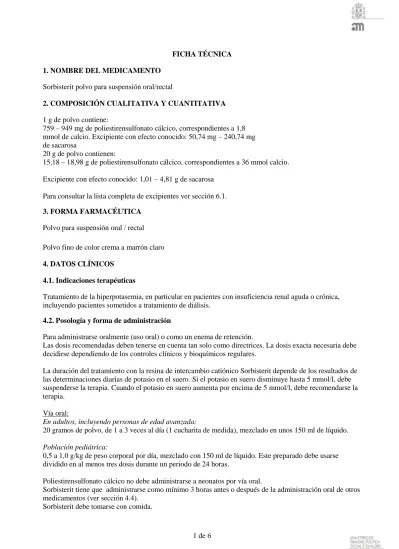
- País de registro
- Forma farmacéuticaSOLUCIÓN/SUSPENSIÓN ORAL/RECTAL, 379,5-474,5 g Poliestirensulfonato calcio/500 mg
- Código ATCV03AE01
- Precio medio en farmacia35.31 EUR
- Principio activo
- Requiere recetaSí
- Fabricante
- ComposiciónSACAROSA (25,37-120,37 g mg)
- Esta información es de carácter general y no sustituye la consulta con un profesional sanitario.
- Alternativas a SORBISTERIT POLVO PARA SUSPENSION ORAL/RECTALForma farmacéutica: SOLUCIÓN/SUSPENSIÓN ORAL, 99,75 G DE POLIESTIRENO SULFONATO CÁLCICO POR 100Principio activo: polystyrene sulfonateFabricante: Laboratorios Rubio S.A.Requiere recetaForma farmacéutica: SOLUCIÓN/SUSPENSIÓN ORAL, 99,75G/100GPrincipio activo: polystyrene sulfonateFabricante: Laboratorios Rubio S.A.Requiere recetaForma farmacéutica: COMPRIMIDO, 800 mgPrincipio activo: sevelamerFabricante: Sanofi Winthrop IndustrieRequiere receta
Médicos online para SORBISTERIT POLVO PARA SUSPENSION ORAL/RECTAL
Comenta la dosis, los posibles efectos secundarios, interacciones, contraindicaciones o la revisión de receta de SORBISTERIT POLVO PARA SUSPENSION ORAL/RECTAL, sujeto a valoración médica y a la normativa local.









Obtén una receta de SORBISTERIT POLVO PARA SUSPENSION ORAL/RECTAL online
Rellena un formulario de 2 minutos
Cuéntanos tus síntomas, historial y el medicamento que necesitas.
Elige un médico o nosotros te asignamos uno
Escoge un especialista o te conectamos con el próximo médico disponible.
El médico revisa tu caso
Normalmente en 30 minutos. Puede hacerte preguntas adicionales por chat.
Recógela en cualquier farmacia
Receta electrónica enviada a tu correo, válida en toda España.
Preguntas frecuentes
SORBISTERIT POLVO PARA SUSPENSION ORAL/RECTAL requiere receta en España. Puedes confirmarlo con un médico online según tu caso.
El principio activo de SORBISTERIT POLVO PARA SUSPENSION ORAL/RECTAL es polystyrene sulfonate. Esta información ayuda a identificar medicamentos con la misma composición pero con diferentes nombres comerciales.
El precio medio en farmacia de SORBISTERIT POLVO PARA SUSPENSION ORAL/RECTAL es de aproximadamente 35.31 EUR. Puede variar según el fabricante y la forma farmacéutica.
SORBISTERIT POLVO PARA SUSPENSION ORAL/RECTAL es fabricado por Fresenius Medical Care Nephrologica Deutschland Gmbh. La marca y el envase pueden variar según el distribuidor.
Los Médicos de familia, Psiquiatras, Dermatólogos, Cardiólogos, Endocrinólogos, Gastroenterólogos, Neumólogos, Nefrólogos, Reumatólogos, Hematólogos, Infectólogos, Alergólogos, Geriatras, Pediatras, Oncólogos pueden valorar la prescripción de SORBISTERIT POLVO PARA SUSPENSION ORAL/RECTAL cuando esté clínicamente indicado. Puedes reservar una videoconsulta para comentar tu caso y las opciones de tratamiento.
España cuenta con una infraestructura sanitaria bien desarrollada en ciudades principales como Madrid, Barcelona, Valencia y Sevilla. Las farmacias están ampliamente disponibles y operan bajo estrictas regulaciones, garantizando el acceso a medicamentos con receta.
Puedes comprar SORBISTERIT POLVO PARA SUSPENSION ORAL/RECTAL en Madrid, Barcelona, Sevilla o Valencia en cualquier farmacia local con una receta válida.
Para obtener una receta, puedes utilizar Oladoctor:
Otros medicamentos con el mismo principio activo (polystyrene sulfonate) incluyen RESINCALCIO POLVO PARA SUSPENSION ORAL, RESINSODIO POLVO PARA SUSPENSION ORAL, CARBONATO DE SEVELAMERO WINTHROP 800 MG COMPRIMIDOS RECUBIERTOS CON PELICULA. Pueden tener diferentes nombres comerciales o formulaciones, pero contienen el mismo componente terapéutico. Consulta siempre con un médico antes de cambiar o iniciar un nuevo medicamento.
