



SEROXAT 20 mg Comprimidos Recubiertos Con Película

Revisión de receta online
Un médico revisará tu caso y determinará si la prescripción es médicamente apropiada.

Habla con un médico sobre este medicamento
Comenta tus síntomas y las opciones de tratamiento en una consulta online.



Cómo usar SEROXAT 20 mg COMPRIMIDOS RECUBIERTOS CON PELICULA
Contenido del prospecto
- Introducción
- Qué es Seroxat y para qué se utiliza
- Qué necesita saber antes de empezar a tomar Seroxat
- Cómo tomar Seroxat
- Posibles efectos adversos
- Conservación de Seroxat
- Contenido del envase e información adicional
Introducción
Prospecto: información para el usuario
Seroxat 20 mg comprimidos recubiertos con película
paroxetina (como hidrocloruro hemihidrato)
Lea todo el prospecto detenidamente antes de empezar a tomar este medicamento, porque contiene información importante para usted.
- Conserve este prospecto, ya que puede tener que volver a leerlo.
- Si tiene alguna duda, consulte a su médico o farmacéutico.
- Este medicamento se le ha recetado solamente a usted, y no debe dárselo a otras personas aunque tengan los mismos síntomas que usted, ya que puede perjudicarles.
- Si experimenta efectos adversos, consulte a su médico o farmacéutico, incluso si se trata de efectos adversos que no aparecen en este prospecto. Ver sección 4.
Contenido del prospecto
- Qué es Seroxat y para qué se utiliza
- Qué necesita saber antes de empezar a tomar Seroxat
- Cómo tomar Seroxat
- Posibles efectos adversos
- Conservación de Seroxat
- Contenido del envase e información adicional
1. Qué es Seroxat y para qué se utiliza
Seroxat se utiliza para el tratamiento de la depresión y/o trastornos de ansiedad en adultos.Los trastornos de ansiedad para los que Seroxat está indicado son: trastorno obsesivo compulsivo (pensamientos obsesivos, repetitivos con comportamiento no controlado), trastorno de angustia (crisis de pánico, incluyendo los causados por agorafobia, que es el miedo a los espacios abiertos), trastorno de ansiedad social (tener miedo o evitar situaciones de contacto social), trastorno de estrés postraumático (ansiedad causada por un acontecimiento traumático) y trastorno de ansiedad generalizada (sentir normalmente mucha ansiedad y nervios).
Seroxat pertenece al grupo de medicamentos denominados inhibidores selectivos de la recaptación de serotonina (ISRS). No se conoce de modo preciso el mecanismo de acción de Seroxat y otros ISRS, pero ejercen su acción aumentando el nivel de serotonina en el cerebro. Tratar adecuadamente la depresión o el trastorno de ansiedad es importante para ayudarle a sentirse mejor.

¿No estás seguro de si este medicamento es adecuado para ti?
Comenta tus síntomas y tratamiento con un médico online.
2. Qué necesita saber antes de empezar a tomar Seroxat
No tome Seroxat
- si está siendo tratado con medicamentos denominados inhibidores de la enzima monoamino oxidasa(IMAO, incluyendo moclobemida y cloruro de metiltionina (azul de metileno)), o si ha estado bajo tratamiento con cualquiera de estos medicamentos en las dos últimas semanas. Su médico le aconsejará cómo debe empezar a tomar Seroxat una vez que haya dejado de tomar el IMAO
- si está tomando un medicamento antipsicóticodenominado tioridazina o el antipsicótico denominado pimozida
- si es alérgicoa paroxetina o a alguno de los demás componentes de este medicamento (incluidos en la sección 6).
Si está en alguna de estas situaciones, comuníqueselo a su médico y no tome Seroxat.
Advertencias y precauciones
Consulte con su médico o farmacéutico antes de empezar a tomar Seroxat
- si está tomando otros medicamentos (vea el apartado Otros medicamentos y Seroxat)
- si está tomando tamoxifeno para el tratamiento del cáncer de mama (o problemas de fertilidad). Seroxat puede hacer que tamoxifeno sea menos efectivo, por lo que su médico debería recomendarle tomar otro antidepresivo
- si padece algún problema de riñón, hígado o corazón
- si tiene una anomalía en el seguimiento de su corazón después de un electrocardiograma (ECG) conocida como prolongación del intervalo QT
- si tiene antecedentes familiares de prolongación del intervalo QT, enfermedades cardíacas como insuficiencia cardíaca, frecuencia cardíaca baja o niveles bajos de potasio o niveles bajos de magnesio
- si padece epilepsia o si presenta convulsiones o crisis epilépticas
- si ha tenido episodios maníacos (pensamientos o comportamientos excesivamente activos)
- si está siendo tratado con terapia electro-convulsiva (TEC)
- si tiene propensión al sangrado o a la aparición de hematomas, o está siendo tratado con algún medicamento que pueda aumentar el riesgo de hemorragia (incluyendo medicamentos tales como warfarina (acenocumarol), antipsicóticos como perfenazina o clozapina, antidepresivos tricíclicos, medicamentos para tratar el dolor y la inflamación llamados antiinflamatorios no esteroideos (AINEs), como ácido acetilsalicílico, ibuprofeno, celecoxib, etodolaco, diclofenaco, meloxicam)
- si padece diabetes
- si está tomando una dieta baja en sodio
- si padece glaucoma (tensión ocular elevada)
- si está embarazada o si piensa quedarse embarazada (vea el apartado Embarazo, lactancia y fertilidad)
- si tiene menos de 18 años de edad (vea el apartado Niños y adolescentes menores de 18 años de edad).
Si está en alguna de estas situacionesy aún no ha consultado a su médico, pregúntele sobre cómo tomar Seroxat.
Niños y adolescentes menores de 18 años de edad
Seroxat no deberá utilizarse en el tratamiento de niños y adolescentes menores de 18 años.Asimismo, debe saber que en pacientes menores de 18 años existe un mayor riesgo de efectos adversos como intentos de suicidio, ideas de suicidio y hostilidad (predominantemente agresión, comportamiento de confrontación e irritación) cuando se toma Seroxat. Pese a ello, el médico puede prescribir Seroxat a pacientes menores de 18 años cuando decida que es lo más conveniente para el paciente. Si su médico le ha prescrito Seroxat a usted o a su hijo menor de 18 años y desea comentar esta decisión, consulte a su médico. Debe informar a su médico si alguno de los síntomas que se han detallado anteriormente aparecen o empeoran cuando usted o su hijo menor de 18 años estén tomando Seroxat. Los efectos a largo plazo de Seroxat en lo que a la seguridad se refiere, relativos al crecimiento, la madurez y el desarrollo cognitivo y conductual en este grupo de edad todavía no se han demostrado.
En estudios realizados con Seroxat en pacientes menores de 18 años los efectos adversos frecuentes, que afectaron a menos de 1 de cada 10 niños o adolescentes fueron: un aumento en los pensamientos e intentos de suicidio, intento de autolesionarse, comportamientos hostiles, agresivos o poco amistosos, falta de apetito, temblores, sudoración anormal, hiperactividad (tener demasiada energía), agitación, emociones inestables (incluyendo llantos y cambios de estado de ánimo) y aparición de cardenales fortuitos o sangrado (como sangrado por la nariz). Estos efectos también se observaron en pacientes incluidos en estos estudios que no tomaron Seroxat, aunque con menor frecuencia.
Al interrumpir el tratamiento con Seroxat, en estos estudios algunos de los pacientes menores de 18 años notificaron tener efectos adversos de retirada. Estos efectos fueron muy similares a los observados en los adultos que interrumpieron el tratamiento con Seroxat (vea la sección 3). Además, los pacientes menores de 18 años experimentaron de forma frecuente (afectando a menos de 1 de cada 10), dolor de estómago, nerviosismo y emociones inestables (incluyendo llanto, cambios de estado de ánimo, intento de autolesionarse, pensamientos e intentos de suicidio).
Pensamientos de suicidio y empeoramiento de su depresión o trastorno de ansiedad
Si usted está deprimido y/o tiene trastornos de ansiedad, a veces puede tener pensamientos de hacerse daño a sí mismo o suicidarse. Éstos pueden aumentar al principio del tratamiento con antidepresivos, ya que todos estos medicamentos tardan un tiempo en hacer efecto, que normalmente es de unas dos semanas pero a veces puede ser más tiempo.
Es más probable que le suceda esto
- Si usted ya ha tenido previamente pensamientos de suicidio o de hacerse daño a sí mismo.
- Si es usted un adulto joven. Hay información de ensayos clínicos que muestran que existe un aumento del riesgo de conductas suicidas en adultos menores de 25 años con enfermedades psiquiátricas que estaban siendo tratados con algún antidepresivo.
Si tiene pensamientos de hacerse daño a sí mismo o suicidarse en cualquier momento, consulte a su médico o acuda al hospital inmediatamente.
Puede ser útil para usted explicarle a algún familiar o a un amigo cercanoque está deprimido o tiene trastornos de ansiedad, y pedirles que lean este prospecto. Puede pedirles también que le digan si piensan que su depresión o ansiedad está empeorando, o si están preocupados por los cambios en su conducta.
Efectos adversos importantes observados con Seroxat
Algunos pacientes que toman Seroxat desarrollan un trastorno llamado acatisia, y se sienten intranquilos y que no pueden sentarse o quedarse quietos. Otros pacientes desarrollan el llamado síndrome serotoninérgico o síndrome neuroléptico maligno, y pueden tener alguno o todos los síntomas siguientes: sentirse muy agitado o irritable, confusión, inquietud, sensación de calor, sudoración, temblor, escalofríos, alucinaciones (visiones o sonidos extraños), agarrotamiento muscular, movimientos bruscos repentinos o aumento del ritmo del corazón. La gravedad puede aumentar y conducir a una pérdida de consciencia. Consulte a su médicosi tiene alguno de estos síntomas. Para más información sobre este u otros efectos adversos de Seroxat, vea la sección 4.
Algunos medicamentos del grupo al que pertenece Seroxat (llamados ISRS) pueden causar síntomas de disfunción sexual (ver sección 4). En algunos casos, estos síntomas persisten después de suspender el tratamiento.
Otros medicamentos y Seroxat
Algunos medicamentos pueden modificar el efecto de Seroxat o hacer más probable que aparezcan algunos efectos adversos. Seroxat también puede modificar el efecto de algunos medicamentos. Por ejemplo:
- Medicamentos llamados inhibidores de la monoamino-oxidasa(IMAO, incluyendo moclobemida y cloruro de metiltionina (azul de metileno)). Vea el apartado No tome Seroxat.
- Los medicamentos conocidos por incrementar el riesgo de cambios en la actividad eléctrica del corazón (p. ej. los antipsicóticostioridazina o pimozida). Vea el apartado No tomeSeroxat.
- Ácido acetilsalicílico, ibuprofeno y otros medicamentos llamados antiinflamatorios no esteroideos como celecoxib, etodolaco, diclofenaco y meloxicam, usados para tratar el dolor y la inflamación.
- Tramadol, buprenorfina y petidina, analgésicos.
- Buprenorfina combinada con naloxona, tratamiento de sustitución para la adicción a los opiáceos.
- Medicamentos llamados triptanes, como el sumatriptán, usados para tratar la migraña.
- Otros antidepresivos, incluyendo otros inhibidores selectivos de la recaptación de serotonina y antidepresivos tricíclicos como clomipramina, nortriptilina y desipramina.
- Un suplemento de la dietallamado triptófano.
- Mivacurio y suxametonio (usados en anestesia).
- Medicamentos como el litio, risperidona, perfenazina, clozapina (antipsicóticos) usados para tratar algunas enfermedades psiquiátricas.
- Fentanilo, usado en anestesiao para tratar el dolor crónico.
- Una combinación de fosamprenavir y ritonavir, usada para tratar la infección por el virus de la inmunodeficiencia humana (VIH).
- Hierba de San Juan, una hierba medicinal para tratar la depresión.
- Fenobarbital, fenitoína, valproato de sodio o carbamacepina, usados para tratar las convulsioneso la epilepsia.
- Atomoxetina, medicamento usado para tratar el trastorno de déficit de atención e hiperactividad(TDAH).
- Prociclidina, usado para aliviar el temblor, especialmente en la enfermedad de Parkinson.
- Warfarina y otros medicamentos (denominados anticoagulantes) usados para hacer más líquida la sangre.
- Propafenona, flecainida y medicamentos usados para tratar los trastornos del ritmo cardiaco.
- Metoprolol, un beta-bloqueante usado para tratar la tensión arterial alta ylos trastornos cardiacos.
- Pravastatina, usado para tratar el colesterol elevado.
- Rifampicina, usado para tratar la tuberculosis(TB)y la lepra.
- Linezolid, un antibiótico.
- Tamoxifeno, usado para tratar el cáncer de mama(o problemas de fertilidad).
Si está tomando o ha tomado recientemente alguno de estos medicamentos, comuníqueselo a su médico y consulte qué debe hacer.Puede que su médico decida cambiar la dosis o prescribirle otro medicamento.
Comunique a su médico o farmacéutico si está tomando, ha tomado recientemente o podría tener que tomar cualquier otro medicamento,incluso los adquiridos sin receta.
Toma de Seroxat con alimentos, bebidas y alcohol
No consuma alcohol mientras esté tomando Seroxat. El alcohol puede empeorar sus síntomas o los efectos adversos.
Tomar Seroxat por la mañana con alimentos, puede reducir la probabilidad de que aparezcan náuseas.
Embarazo, lactancia y fertilidad
Si está embarazada o en periodo de lactancia, cree que podría estar embarazada o tiene intención de quedarse embarazada, consulte a su médico o farmacéutico antes de utilizar este medicamento.
En algunos estudios se ha observado un aumento del riesgo de malformaciones, en particular las que afectan al corazón, en recién nacidos cuyas madres tomaron Seroxat durante los primeros meses del embarazo. En la población general, aproximadamente 1 de cada 100 recién nacidos nacen con una malformación del corazón. Esta proporción aumentó hasta 2 de cada 100 recién nacidos en madres que tomaron Seroxat. Su médico de acuerdo con usted, podría cambiarle a otro tratamiento o interrumpir gradualmente el tratamiento con Seroxat mientras esté embarazada. Sin embargo, dependiendo de sus circunstancias, su médico podría recomendarle continuar tomando Seroxat.
Asegúrese de que su médico o matrona saben que está tomando Seroxat.Si toma Seroxat en la etapa final del embarazo puede producirse un mayor riesgo de sangrado vaginal abundante poco después del parto, especialmente si tiene antecedentes de alteraciones hemorrágicas. Su médico o matrona deben saber que usted está tomando Seroxat para poderle aconsejar. Los medicamentos como Seroxat pueden aumentar el riesgo de aparición de una enfermedad grave denominada hipertensión pulmonar persistente del recién nacido (HPP), cuando se toma durante el embarazo y particularmente al final de éste. La presión en los vasos sanguíneos que van entre el corazón y los pulmones es muy elevada en recién nacidos con hipertensión pulmonar persistente (HPP).
Si está tomando Seroxat en el último trimestre del embarazo, su recién nacido puede también presentar otros síntomas que normalmente comienzan durante las 24 primeras horas después del nacimiento. Entre estos síntomas se incluyen:
- dificultad para respirar
- piel azulada o aspecto de tener mucho calor o frío
- labios azulados
- vómitos o dificultades en las tomas de alimento
- sentirse muy cansado, dificultad para dormir o llanto frecuente
- rigidez o flacidez muscular
- temblores, temblores localizados o convulsiones
- reflejos exagerados.
Si su bebé tiene alguno de estos síntomas al nacer, o si está preocupado sobre la salud de su recién nacido, contacte con su médico o matrona, quienes le aconsejarán.
Seroxat pasa a la leche materna en muy pequeñas cantidades.Consulte a su médico si está tomando Seroxat antes de comenzar a amamantar. Su médico, de acuerdo con usted, podría aconsejarle mantener la lactancia materna mientras toma Seroxat.
Estudios con animales han mostrado que la paroxetina reduce la calidad del esperma. Teóricamente esto puede afectar a la fertilidad en humanos, pero todavía no se ha observado este impacto en las personas.
Conducción y uso de máquinas
Algunos de los efectos adversos que puede causar Seroxat son mareo, confusión, sensación de somnolencia o visión borrosa. Si usted sufre alguno de estos efectos, no conduzca vehículos ni use máquinas.
Seroxat contiene sodio
Este medicamento contiene menos de 23 mg de sodio (1 mmol) por comprimido; esto es, esencialmente “exento de sodio”.
3. Cómo tomar Seroxat
Siga exactamente las instrucciones de administración de este medicamento indicadas por su médico o farmacéutico.En caso de duda, consulte de nuevo a su médico o farmacéutico.
Algunas veces puede ser necesario que tome más de un comprimido o la mitad de un comprimido. La siguiente tabla le mostrará cuántos comprimidos debe tomar:
Dosis | Número de comprimidos a tomar |
10 mg | Medio comprimido |
20 mg | Un comprimido |
30 mg | Un comprimido y medio |
40 mg | Dos comprimidos |
50 mg | Dos comprimidos y medio |
60 mg | Tres comprimidos |
Las dosis normales para las diferentes indicaciones se detallan en la tabla siguiente:
Dosis inicial diaria | Dosis diaria recomendada | Dosis diaria máxima | |
Depresión | 20 mg | 20 mg | 50 mg |
Trastorno obsesivo compulsivo | 20 mg | 40 mg | 60 mg |
Trastorno de angustia | 10 mg | 40 mg | 60 mg |
Trastorno de fobia social | 20 mg | 20 mg | 50 mg |
Trastorno de estrés postraumático | 20 mg | 20 mg | 50 mg |
Trastorno de ansiedad generalizada | 20 mg | 20 mg | 50 mg |
Su médico le indicará qué dosis debe tomar cuando inicie el tratamiento con Seroxat.La mayoría de las personas comienzan a sentirse mejor después de un par de semanas. Si después de este tiempo no comienza a sentirse mejor, consulte a su médico que le indicará cómo actuar. Su médico puede decidir aumentar la dosis gradualmente, en incrementos de 10 mg, hasta la dosis máxima diaria.
Tome los comprimidos por la mañana, con alimentos.
Los comprimidos deben tragarse con agua.
Los comprimidos no deben masticarse.
Su médico le indicará la duración del tratamiento. Este periodo podrá prolongarse varios meses o incluso más tiempo.
Pacientes de edad avanzada
La dosis máxima para personas de más de 65 años es de 40 mg al día.
Pacientes con problemas en el riñón o en el hígado
Si padece insuficiencia hepática o renal grave, su médico puede aconsejarle tomar dosis más pequeñas de Seroxat que las habituales.
Si toma más Seroxat del que debe
En caso de sobredosis o ingestión accidental, consulte inmediatamente a su médico o farmacéutico o llame al Servicio de Información Toxicológica, teléfono: 91 562 04 20, indicando el medicamento y la cantidad ingerida.
No tome nunca más comprimidos de los que le ha recomendado su médico.
Una persona que haya tomado una sobredosis de Seroxat puede tener alguno de los síntomas que aparecen en la sección 4, Posibles efectos adversos,o alguno de los siguientes síntomas: fiebre, contracción involuntaria de los músculos.
Si olvidó tomar Seroxat
Tome su medicamento a la misma hora cada día.
Si se le olvida tomar una dosis y lo recuerda antes de acostarse, tómela inmediatamente. Tome la siguiente dosis a la hora habitual.
Si lo recuerda durante la noche o al día siguiente, omita la dosis olvidada. Usted podría sufrir algún síntoma de retirada, pero deberían desaparecer después de tomar la dosis siguiente a la hora habitual.
No tome una dosis doble para compensar las dosis olvidadas.
Qué debe hacer si no se siente mejor
Seroxat no mejorará sus síntomas de forma inmediata, todos los antidepresivos tardan un tiempo en actuar. Algunas personas comienzan a sentirse mejor después de un par de semanas, pero otras personas pueden requerir más tiempo. Algunas personas que toman antidepresivos se sienten peor antes de empezar a notar la mejoría. Si usted no empieza a sentirse mejor después de un par de semanas, comuníqueselo a su médico, que le indicará lo que debe hacer. Es posible que éste le haya citado al cabo de las 2 semanas de haber iniciado su tratamiento.
Si interrumpe el tratamiento con Seroxat
No interrumpa el tratamiento hasta que su médico se lo indique.
Cuando interrumpa el tratamiento con Seroxat, su médico le indicará cómo reducir las dosis lentamente durante un periodo de varias semanas o meses, esto ayudará a reducir el riesgo de sufrir síntomas de retirada. Una forma de hacerlo, es reducir gradualmente la dosis de Seroxat que esté tomando en 10 mg cada semana. La mayoría de las personas consideran que los posibles síntomas que ocurren cuando se interrumpe el tratamiento con Seroxat son leves y desaparecen por sí solos en dos semanas. Para otras personas, estos síntomas pueden ser más graves o durar más tiempo.
Si sufre efectos debidos a la retiradamientras esté interrumpiendo su tratamiento, el médico puede decidir que lo interrumpa más lentamente. Si experimenta síntomas de retirada graves, por favor, consulte a su médico. Éste podría aconsejarle que inicie el tratamiento de nuevo y que posteriormente lo interrumpa de una forma más lenta.
Aunque sufra algún efecto debido a la retirada, usted podrá ser capaz de interrumpir su tratamiento con Seroxat.
Posibles efectos de retirada cuando se interrumpe el tratamiento
Estudios han demostrado que 3 de cada 10 pacientes experimentan uno o más síntomas cuando interrumpen su tratamiento con Seroxat. Algunos de estos efectos ocurren con mayor frecuencia que otros.
Efectos adversos frecuentes
Pueden afectar hasta 1 de cada 10 personas
- Sentirse mareado, con inestabilidad o con alteraciones en el equilibrio.
- Hormigueo, sensaciones de quemazón y, con menor frecuencia, sensación de descarga eléctrica, incluso en la cabeza, zumbidos, silbidos, pitidos, campanilleo u otros ruidos persistentes en los oídos (acúfenos).
- Alteraciones del sueño (sueños muy vividos, pesadillas, incapacidad para dormir).
- Ansiedad.
- Dolores de cabeza.
Efectos adversos poco frecuentes
Pueden afectar hasta 1 de cada 100 personas
- Vómitos (náuseas).
- Sudoración (incluyendo sudoración nocturna).
- Inquietud o agitación.
- Temblor.
- Confusión o desorientación.
- Diarrea (heces blandas).
- Sentirse muy sensible o irritable.
- Alteraciones visuales.
- Palpitaciones rápidas o muy fuertes del corazón.
Consulte a su médico si le preocupan los efectos debidos a la retirada de Seroxat.
Si tiene cualquier otra duda sobre el uso de este medicamento, pregunte a su médico o farmacéutico.

¿Has empezado a tomar el medicamento y tienes preguntas?
Comenta tus síntomas y tratamiento con un médico online.
4. Posibles efectos adversos
Al igual que todos los medicamentos, este medicamento puede producir efectos adversos, aunque no todas las personas los sufran. Es más probable que los efectos adversos aparezcan durante las primeras semanas de tratamiento con Seroxat.
Informe a su médico si sufre cualquiera de los efectos adversos descritos a continuación durante el tratamiento con Seroxat.
Puede ser necesario que consulte a su médico o que acuda al hospital de inmediato.
Efectos adversos poco frecuentes
Pueden afectar hasta 1 de cada 100 personas
- Si tiene cardenales o sangrado inusuales,como sangre en el vómito o en las heces, contacte con su médico o acuda al hospital de inmediato.
- Si sufre imposibilidad de orinar, contacte con su médico o acuda al hospital de inmediato.
Efectos adversos raros
Pueden afectar hasta 1 de cada 1.000 personas
- Si experimenta convulsiones(crisis epilépticas), contacte con su médico o acuda al hospital de inmediato.
- Si tiene sensación de inquietud, incapacidad para permanecer sentado o permanecer quieto,denominada acatisia. Incrementar la dosis de Seroxat puede empeorar sus síntomas. Si se siente así, consulte a su médico.
- Cansancio, debilidad, confusión y dolor, rigidez y falta de coordinación muscular.Esto puede deberse a que el contenido de sodio en la sangre sea bajo. Si tiene estos síntomas, consulte a su médico.
Efectos adversos muy raros
Pueden afectar hasta 1 de cada 10.000 personas
- Reacciones alérgicas a Seroxat que pueden ser graves.
Si desarrolla erupción cutánea con enrojecimiento y bultos, hinchazón de la cara, párpados, labios, boca o lengua, picor o dificultad para respirar (respiración difícil) o tragar, y sensación de debilidad o tener un vahído que puede ocasionar un colapso o pérdida de consciencia, contacte con su médico o acuda al hospital de inmediato.
- Si nota alguno o todos los siguientes síntomas puede ser que sufra un síndrome serotoninérgico o síndrome neuroléptico maligno.Los síntomas incluyen: sentirse muy agitado o irritable, confusión, inquietud, sensación de calor, sudoración, temblor, escalofríos, alucinaciones (sonidos o visiones extraños), agarrotamiento muscular, movimientos bruscos repentinos o latidos rápidos del corazón. La gravedad puede aumentar y conducir a una pérdida de consciencia. Si se siente así, consulte con su médico.
- Glaucoma agudo.
Si le aparece un dolor en los ojos y visión borrosa, consulte con su médico.
Frecuencia no conocida
La frecuencia no puede estimarsea partir de los datos disponibles
- Algunas personas han experimentado pensamientos de causarse lesiones a sí mismos o suicidarse mientras tomaban Seroxat o al poco tiempo después de dejar el tratamiento (ver Pensamientos de suicidio y empeoramiento de su depresión o trastorno de ansiedaden la sección 2).
- Algunas personas han experimentado agresividad mientras tomaban Seroxat.
- Sangrado vaginal abundante poco después del parto (hemorragia posparto), ver Embarazo, lactancia y fertilidaden la sección 2 para más información.
Si experimenta estos efectos adversos, contacte con su médico.
Otros posibles efectos adversos durante el tratamiento:
Efectos adversos muy frecuentes
Pueden afectar a más de 1 de cada 10 personas
- Sensación de enfermedad (náuseas). Este efecto puede reducirse tomando su medicación por la mañana después del desayuno.
- Cambio en el deseo o función sexual, por ejemplo, falta de orgasmo y, en hombres, erección y eyaculación anormales.
Efectos adversos frecuentes
Pueden afectar hasta 1 de cada 10 personas
- Aumento de los niveles de colesterol en sangre.
- Disminución del apetito.
- Dificultad para dormir (insomnio) o somnolencia.
- Sueños anormales (incluyendo pesadillas).
- Mareo, temblores.
- Dolor de cabeza.
- Dificultad para concentrarse.
- Agitación.
- Debilidad inusual.
- Visión borrosa.
- Bostezo, sequedad de boca.
- Diarrea o estreñimiento.
- Vómitos.
- Ganancia de peso.
- Sudoración.
Efectos adversos poco frecuentes
Pueden afectar hasta 1 de cada 100 personas
- Aumentos transitorios de la presión arterial, o disminuciones transitorias de ésta que pueden provocar mareos o desmayos cuando se pone rápidamente de pie.
- Latidos del corazón más rápidos de lo normal.
- Falta de movimiento, rigidez, temblor o movimientos anormales de la boca y lengua.
- Dilatación de las pupilas.
- Erupción cutánea.
- Picor.
- Confusión.
- Alucinaciones (sonidos o visiones extraños).
- Incapacidad para orinar (retención urinaria) o incontinencia urinaria (micción incontrolada e involuntaria).
- Si es un paciente diabético puede notar la pérdida de control de los niveles de azúcar en sangre mientras tome Seroxat. Consulte a su médico sobre cómo ajustar su dosis de insulina o medicamentos para la diabetes.
- Disminución del recuento de glóbulos blancos.
Efectos adversos raros
Pueden afectar hasta 1 de cada 1.000 personas
- Secreción anormal de leche materna en hombres y mujeres.
- Disminución del ritmo del corazón.
- Efectos en el hígado que se ven en las pruebas de laboratorio que indican el funcionamiento del hígado.
- Ataques de pánico.
- Comportamientos o pensamientos muy activos (manía).
- Sentirse separado de uno mismo (despersonalización).
- Ansiedad.
- Necesidad irresistible de mover las piernas (Síndrome de Piernas Inquietas).
- Dolor en articulaciones o músculos.
- Aumento en sangre de una hormona llamada prolactina.
- Alteraciones del periodo menstrual (incluyendo periodos abundantes o irregulares, sangrado entre periodos y ausencia o retraso del periodo).
Efectos adversos muy raros
Pueden afectar hasta 1 de cada 10.000 personas
- Erupción cutánea, en la que pueden aparecer ampollas con aspecto de pequeñas dianas (puntos centrales oscuros rodeados de un área pálida, con un anillo oscuro alrededor) llamado eritema multiforme.
- Erupción extendida con ampollas y descamación de la piel, especialmente alrededor de la boca, nariz, ojos y genitales (síndrome de Stevens-Johnson).
- Erupción extendida por una gran superficie corporal con ampollas y descamación de la piel (necrólisis epidérmica tóxica).
- Alteraciones en el hígado que ponen de color amarillo la piel o el blanco de los ojos.
- Síndrome de secreción inadecuada de hormona antidiurética (SIHAD) que es un estado en el que el cuerpo desarrolla un exceso de agua y una disminución de la concentración de sodio (sal) como resultado de unas señales químicas inapropiadas. Los pacientes con SIHAD pueden sentirse gravemente enfermos o pueden no tener ningún síntoma.
- Retención de agua o líquido (que causan hinchazón de brazos o piernas).
- Sensibilidad a la luz del sol.
- Erección dolorosa y prolongada del pene.
- Disminución de la cantidad de plaquetas en sangre.
Frecuencia no conocida
La frecuencia no puede estimarsea partir de los datos disponibles
- Inflamación del colon (que causa diarrea).
- Rechinar de dientes.
Algunos pacientes han experimentado zumbidos, silbidos, pitidos, campanilleo u otros ruidos persistentes en los oídos (acúfenos) cuando toman Seroxat.
Se ha observado que las personas que toman medicamentos como Seroxat tienen mayor riesgo de fracturas de huesos.
Comunicación de efectos adversos
Si experimenta cualquier tipo de efecto adverso, consulte a su médico o farmacéutico, incluso si se trata de posibles efectos adversos que no aparecen en este prospecto. También puede comunicarlos directamente a través del Sistema Español de Farmacovigilancia de Medicamentos de Uso Humano: www.notificaRAM.es. Mediante la comunicación de efectos adversos usted puede contribuir a proporcionar más información sobre la seguridad de este medicamento.
5. Conservación de Seroxat
Mantener este medicamento fuera de la vista y del alcance de los niños.
No utilice este medicamento después de la fecha de caducidad (CAD) que aparece en el envase. La fecha de caducidad es el último día del mes que se indica.
No conservar a temperatura superior a 30ºC.
Conservar en el embalaje original para proteger de la luz.
Si usted está tomando medio comprimido, tenga cuidado de conservarlo de forma segura en el envase.
Los medicamentos no se deben tirar por los desagües ni a la basura. Deposite los envases y los medicamentos que no necesita en el Punto SIGRE de la farmacia. En caso de duda pregunte a su farmacéutico cómo deshacerse de los envases y de los medicamentos que no necesita. De esta forma, ayudará a proteger el medio ambiente.
6. Contenido del envase e información adicional
Composición de Seroxat
El principio activo es paroxetina (20 mg), como hidrocloruro hemihidrato.
Los demás componentes son:
En el núcleo del comprimido: hidrógeno fosfato de calcio dihidrato (E341), estearato de magnesio (E470b) y carboximetilalmidón sódico (tipo A) de patata.
En la cubierta del comprimido: hipromelosa (E464), dióxido de titanio (E171), macrogol 400 y polisorbato 80 (E433).
Aspecto del producto y contenido del envase
Seroxat 20 mg comprimidos recubiertos con película se presenta en forma de comprimidos blancos, ovalados, marcados con “20” en una cara y una línea de rotura en la otra cara. Cada envase de Seroxat contiene blísteres resistentes para niños de 4, 10, 14, 20, 28, 30, 50, 56, 60, 98, 100, 250 o 500 comprimidos.
Puede que solamente estén comercializados algunos tamaños de envase.
Titular de la autorización de comercialización:
GlaxoSmithKline, S.A.
P.T.M. C/ Severo Ochoa, 2
28760 Tres Cantos (Madrid)
Tel: +34 900 202 700
Responsable de la fabricación:
Delpharm Poznan Spólka Akcyjnaul. Grunwaldzka 18960-322 PoznanPolonia
Este medicamento está autorizado en los Estados miembros del Espacio Económico Europeo con los siguientes nombres:
Alemania, Austria, Bélgica, Chipre, Dinamarca Eslovaquia, Eslovenia, España, Estonia, Finlandia, Grecia, Irlanda, Islandia, Italia, Letonia, Lituania, Luxemburgo, Malta, Noruega, Países Bajos, Polonia, Portugal, República Checa, Suecia | Seroxat |
Francia | Deroxat |
Puede solicitar más información sobre su enfermedad dirigiéndose a una organización de pacientes. Consulte a su médico.
Fecha de la última revisión de este prospecto:diciembre 2023.
La información detallada y actualizada de este medicamento está disponible en la página Web de la Agencia Española de Medicamentos y Productos Sanitarios (AEMPS) http://www.aemps.gob.es/
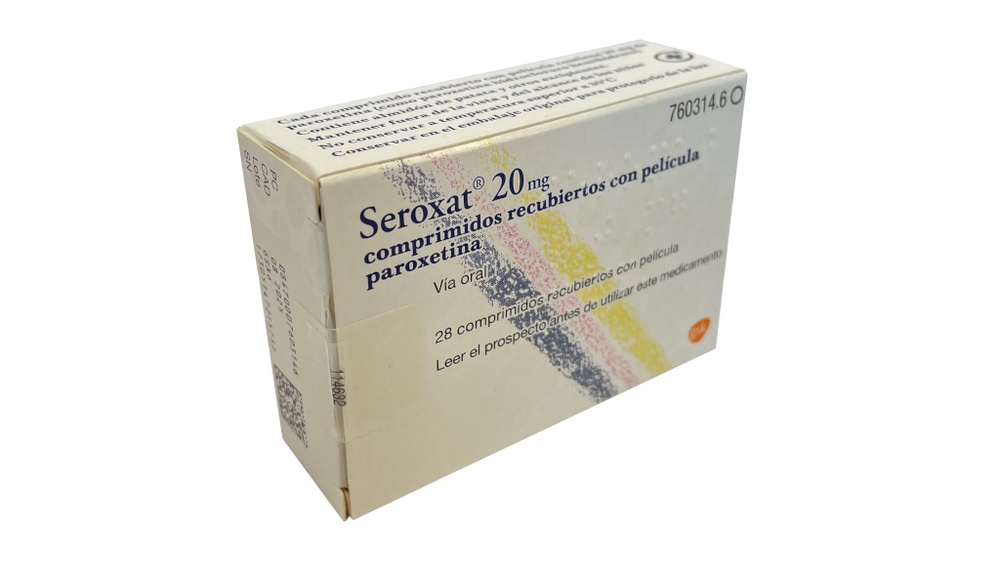
- País de registro
- Forma farmacéuticaCOMPRIMIDO, 20 mg paroxetina hidrocloruro
- Código ATCN06AB05
- Precio medio en farmacia3.04 EUR
- Principio activo
- Requiere recetaSí
- Fabricante
- ComposiciónCARBOXIMETILALMIDON SODICO (5,95 mg mg), POLISORBATO 80 (0,10 mg mg)
- Esta información es de carácter general y no sustituye la consulta con un profesional sanitario.
- Alternativas a SEROXAT 20 mg COMPRIMIDOS RECUBIERTOS CON PELICULAForma farmacéutica: COMPRIMIDO, 20 mgPrincipio activo: paroxetineFabricante: Angelini Pharma Espana S.L.Requiere recetaForma farmacéutica: SOLUCION/SUSPENSION GOTAS ORALES, 33 mg paroxetina/ mlPrincipio activo: paroxetineFabricante: Angelini Pharma Espana S.L.Requiere recetaForma farmacéutica: COMPRIMIDO, 20 mgPrincipio activo: paroxetineFabricante: Glaxosmithkline S.A.Requiere receta
Médicos online para SEROXAT 20 mg COMPRIMIDOS RECUBIERTOS CON PELICULA
Comenta la dosis, los posibles efectos secundarios, interacciones, contraindicaciones o la revisión de receta de SEROXAT 20 mg COMPRIMIDOS RECUBIERTOS CON PELICULA, sujeto a valoración médica y a la normativa local.







Obtén una receta de SEROXAT 20 mg COMPRIMIDOS RECUBIERTOS CON PELICULA online
Rellena un formulario de 2 minutos
Cuéntanos tus síntomas, historial y el medicamento que necesitas.
Elige un médico o nosotros te asignamos uno
Escoge un especialista o te conectamos con el próximo médico disponible.
El médico revisa tu caso
Normalmente en 30 minutos. Puede hacerte preguntas adicionales por chat.
Recógela en cualquier farmacia
Receta electrónica enviada a tu correo, válida en toda España.
Preguntas frecuentes
SEROXAT 20 mg COMPRIMIDOS RECUBIERTOS CON PELICULA requiere receta en España. Puedes confirmarlo con un médico online según tu caso.
El principio activo de SEROXAT 20 mg COMPRIMIDOS RECUBIERTOS CON PELICULA es paroxetine. Esta información ayuda a identificar medicamentos con la misma composición pero con diferentes nombres comerciales.
El precio medio en farmacia de SEROXAT 20 mg COMPRIMIDOS RECUBIERTOS CON PELICULA es de aproximadamente 3.04 EUR. Puede variar según el fabricante y la forma farmacéutica.
SEROXAT 20 mg COMPRIMIDOS RECUBIERTOS CON PELICULA es fabricado por Glaxosmithkline S.A.. La marca y el envase pueden variar según el distribuidor.
Los Médicos de familia, Psiquiatras, Dermatólogos, Cardiólogos, Endocrinólogos, Gastroenterólogos, Neumólogos, Nefrólogos, Reumatólogos, Hematólogos, Infectólogos, Alergólogos, Geriatras, Pediatras, Oncólogos pueden valorar la prescripción de SEROXAT 20 mg COMPRIMIDOS RECUBIERTOS CON PELICULA cuando esté clínicamente indicado. Puedes reservar una videoconsulta para comentar tu caso y las opciones de tratamiento.
España cuenta con una infraestructura sanitaria bien desarrollada en ciudades principales como Madrid, Barcelona, Valencia y Sevilla. Las farmacias están ampliamente disponibles y operan bajo estrictas regulaciones, garantizando el acceso a medicamentos con receta.
Puedes comprar SEROXAT 20 mg COMPRIMIDOS RECUBIERTOS CON PELICULA en Madrid, Barcelona, Sevilla o Valencia en cualquier farmacia local con una receta válida.
Para obtener una receta, puedes utilizar Oladoctor:
Otros medicamentos con el mismo principio activo (paroxetine) incluyen DAPAROX 20 mg COMPRIMIDOS RECUBIERTOS CON PELICULA, DAPAROX 33 mg/ml GOTAS ORALES EN SOLUCION, FROSINOR 20 mg COMPRIMIDOS RECUBIERTOS CON PELICULA. Pueden tener diferentes nombres comerciales o formulaciones, pero contienen el mismo componente terapéutico. Consulta siempre con un médico antes de cambiar o iniciar un nuevo medicamento.
