



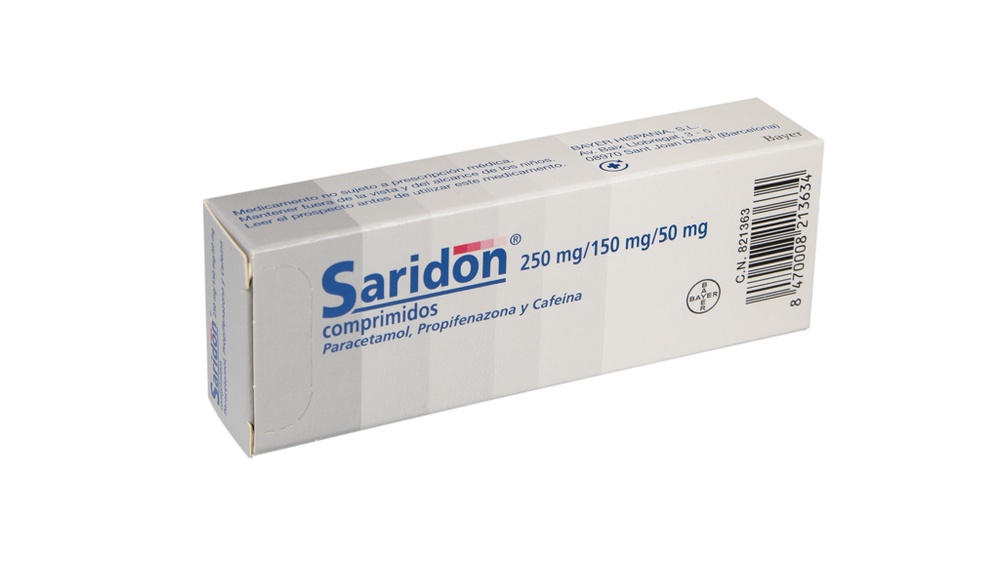
SARIDON 250 mg/150 mg /50 Mg Comprimidos

Revisión de receta online
Un médico revisará tu caso y determinará si la prescripción es médicamente apropiada.

Habla con un médico sobre este medicamento
Comenta tus síntomas y las opciones de tratamiento en una consulta online.



Cómo usar SARIDON 250 mg/150 mg/50 mg COMPRIMIDOS
Contenido del prospecto
- Introducción
- Qué es Saridon y para qué se utiliza
- Qué necesita saber antes de empezar a tomar Saridon
- Cómo tomar Saridon
- Posibles efectos adversos
- Conservación de Saridon
- Contenido del envase e información adicional
Introducción
Prospecto: información para el usuario
Saridon 250 mg/150 mg/50 mg comprimidos
Paracetamol/Propifenazona/Cafeína
Lea todo el prospecto detenidamente antes de empezar a tomar este medicamento, porque contiene información importante para usted.
Siga exactamente las instrucciones de administración del medicamento contenidas en este prospecto o las indicadas por su médico o farmacéutico.
- Conserve este prospecto, ya que puede tener que volver a leerlo.
- Si necesita consejo o más información, consulte con su farmacéutico.
- Si experimenta efectos adversos, consulte a su médico, farmacéutico o enfermero, incluso si se trata de efectos adversos que no aparecen en este prospecto. Ver sección 4.
- Debe consultar a un médico si empeora o si no mejora el dolor después de 5 días o la fiebre después de 3 días.
Contenido del prospecto
- Qué es Saridon y para qué se utiliza
- Qué necesita saber antes de empezar a tomar Saridon
- Cómo tomar Saridon
- Posibles efectos adversos
- Conservación de Saridon
- Contenido del envase e información adicional
1. Qué es Saridon y para qué se utiliza
Saridon es una asociación de paracetamol y propifenazona que actúan sobre el dolor y la fiebre y de cafeína que tiene una acción estimulante del sistema nervioso central.
Este medicamento está indicado en el alivio sintomático de los dolores leves o moderados como el dolor de cabeza, dolor dental o menstrual y estados febriles en adultos.

¿No estás seguro de si este medicamento es adecuado para ti?
Comenta tus síntomas y tratamiento con un médico online.
2. Qué necesita saber antes de empezar a tomar Saridon
No tome Saridon:
- Si es alérgico (hipersensible) al paracetamol, cafeína, propifenazona, metamizol, fenilbutazona u otras pirazolonas o a alguno de los demás componentes de este medicamento (incluidos en sección 6),
- Si padece enfermedad grave del riñón, hígado o corazón (insuficiencia renal, hepática o cardíaca),
- Si tiene hipertensión grave no controlada,
- Si padece alguna enfermedad metabólica como porfiria (trastorno raro, normalmente hereditario, en el que se elimina gran cantidad de porfirina en heces y orina) o déficit congénito de glucosa-6-fosfato-deshidrogenasa,
- Si sufre alteraciones sanguíneas (granulocitopenia, agranulocitosis),
- Si padece úlcera gastroduodenal activa,
- Si ha presentado reacciones alérgicas de tipo asmático (dificultad para respirar, ahogo, broncoespasmos y en algunos casos tos o pitidos al respirar) al tomar ácido acetilsalicílico o a otros antiinflamatorios no esteroideos,
- Durante el tercer trimestre del embarazo.
Advertencias y precauciones
Consulte a su médico o farmacéutico antes de empezar a tomar Saridon:
- Si padece anemia, hipertensión arterial, aumentada la función tiroidea (hipertiroidismo), gastritis (inflamación del estómago) así como enfermedades del riñón o hígado o si tiene más de 65 años,
- Si padece o ha padecido trastornos del corazón (arritmia cardíaca, isquemia miocárdica...) especialmente cuando realice ejercicio físico o se encuentre en lugares de elevada altitud,
- Si padece asma o enfermedades respiratorias graves (enfermedad pulmonar obstructiva crónica, enfisema, bronquitis crónica ya que se puede producir espesamiento de las secreciones y alterar la expectoración),
- Si observa enrojecimiento en la piel, erupción, ampollas o descamación, interrumpa el tratamiento y consulte con su médico,
- Si se encuentra deshidratado, padece desnutrición crónica o padece el síndrome de Gylbert (caracterizado por un nivel de bilirrubina elevado en sangre),
- Si padece alteraciones mentales que provocan excitación nerviosa, crisis en las que aparecen movimientos convulsivos, con o sin pérdida del sentido (epilepsia).
Durante el tratamiento con Saridon, informe inmediatamente a su médico si tiene enfermedades graves, como insuficiencia renal grave o sepsis (cuando las bacterias y sus toxinas circulan en la sangre, lo que provoca daños en los órganos), o si padece malnutrición, alcoholismo crónico o si también está tomando flucloxacilina (un antibiótico). Se ha notificado una enfermedad grave denominada acidosis metabólica (una anomalía en la sangre y los líquidos) en pacientes en estas situaciones cuando se utiliza paracetamol a dosis regulares durante un período prolongado o cuando se toma paracetamol junto con flucloxacilina. Los síntomas de acidosis metabólica pueden incluir: dificultad respiratoria grave con respiración profunda y rápida, somnolencia, sensación de malestar (náuseas) y vómitos.
No tome más cantidad de medicamento que la recomendada en el apartado 3. Cómo tomar Saridon.
No tome este medicamento de forma continuada ni junto con otros analgésicos.
Debe evitarse el uso simultáneo de este medicamento con otros medicamentos que contengan paracetamol, ya que las dosis altas pueden dar lugar a daño en el hígado. No use más de un medicamento que contenga paracetamol sin consultar al médico.
Se recomienda limitar el uso de productos que contengan cafeína cuando se esté en tratamiento con este medicamento.
En personas con dificultades para dormir, se recomienda no tomar este medicamento en las horas previas a acostarse, para evitar el posible insomnio.
Niños y adolescentes
No se recomienda el uso de este medicamento.
Interacción de Saridon con otros medicamentos
Informe a su médico o farmacéutico si está tomando o ha tomado recientemente o podría tener que tomar cualquier otro medicamento.
En particular, si está tomando alguno de los siguientes medicamentos, puede ser necesario modificar la dosis de alguno de ellos o la interrupción del tratamiento:
- alcohol etílico,
- otros analgésicos o antiinflamatorios no esteroideos (medicamentos que se utilizan para tratar el dolor y/o inflamación muscular),
- algunos antidepresivos, como los inhibidores selectivos de la recaptación de serotonina, inhibidores de la monoamino-oxidasa (IMAO) o el litio,
- anticoagulantes orales (medicamentos que se utilizan para “fluidificar” la sangre y evitar la aparición de coágulos) como warfarina,
- anticolinérgicos (medicamentos usados en el alivio de espasmos o contracciones de estómago, intestino y vejiga) como propantelina,
- anticonceptivos orales,
- antiepilépticos (medicamentos utilizados para tratar la epilepsia) como lamotrigina, fenitoína,
- antigotosos (medicamentos utilizados para el tratamiento de la gota) como el probenecid,
- antihistamínicos (utilizados para reducir los síntomas de las reacciones alérgicas),
- antiinfecciosos de tipo quinolonas o eritromicina (antibióticos para tratar infecciones),
- antituberculosos (medicamentos para tratar la tuberculosis) como isoniazida,
- barbitúricos (medicamentos utilizados para el tratamiento de las convulsiones),
- betabloqueantes (medicamentos para el control de la hipertensión),
- broncodilatadores (medicamentos para tratar el asma bronquial),
- calcio,
- cimetidina (utilizado para la acidez de estómago y la úlcera de estómago),
- citocromo P450,
- cloranfenicol (antibiótico usado para infecciones muy graves como fiebre tifoidea),
- colestiramina (medicamento utilizado para disminuir los niveles de colesterol en sangre),
- corticoides, ya que puede potenciar el riesgo de hemorragia digestiva,
- disulfiram (utilizados en el tratamiento de recuperación de pacientes alcohólicos),
- diuréticos e inhibidores de ECA (utilizados para tratar la tensión arterial alta),
- hierro (para el tratamiento de la anemia), se recomienda distanciar la toma al menos 2 horas,
- medicamentos que contienen cafeína o que producen estimulación del sistema nervioso central,
- medicamentos susceptibles de modificar la fórmula sanguínea (antimaláricos, antitiroideos, sulfonamidas….),
- metoclopramida, domperidona, tropisetrón y granisetrón (utilizados para evitar náuseas y vómitos),
- mexiletina (utilizado para corregir alteraciones del ritmo del corazón, como arritmias cardiacas),
- propanolol (utilizado en el tratamiento de la presión arterial y alteraciones del corazón),
- simpaticomiméticos (utilizados para aumentar la presión sanguínea),
- sustancias con amplio espectro de acción como benzodiacepinas u clozapina,
- tabaco,
- teofilina (utilizada para el combatir el asma bronquial),
- zidovudina (utilizada en el tratamiento de los pacientes infectados por el virus de la inmunodeficiencia humana, causante del SIDA).
- flucloxacilina (antiobiótico), debido a un riesgo grave de alteración de la sangre y los fluidos (denominada acidosis metabólica) que debe recibir un tratamiento urgente (ver sección 2)..
Toma de Saridon con alimentos, bebidas y alcohol
Si consume habitualmente alcohol (tres o más bebidas alcohólicas-cerveza, vino, licor,…- al día), tomar Saridon le puede provocar una hemorragia de estómago o daño en el hígado.
Limite el consumo de bebidas que contengan cafeína (café, té, chocolate y bebidas con cola), mientras esté tomando este medicamento.
Embarazo, lactancia y fertilidad
Si está embarazada o en periodo de lactancia, o cree que podría estar embarazada o tiene intención de quedarse embarazada, consulte a su médico o farmacéutico antes de utilizar este medicamento.
Embarazo
No tome Saridon si está en los últimos 3 meses de embarazo ya que podría dañar al feto o causar problemas en el parto.
Este medicamento puede causar problemas de riñón y corazón en el feto. Puede afectar a su tendencia al sangrado y a la de su bebé causando un posible retraso en el parto o que este se alargue más de lo esperado.
No deberá tomar Saridon durante los primeros 6 meses de embarazo a menos que sea absolutamente necesario y se lo aconseje su médico. Si usted
necesita un tratamiento durante este periodo o mientras está intentando quedarse embarazada, la dosis se limitará a la más baja durante el menor tiempo posible.
Si toma Saridon durante varios días a partir de la semana 20 de embarazo, este puede causar problemas renales en el feto que podrían provocar niveles bajos de líquido amniótico (oligohidramnios) o el estrechamiento de un vaso sanguíneo (conducto arterioso) en el corazón del bebé. Si necesita tratamiento durante varios días, su médico puede recomendarle un seguimiento adicional.
Conducción y uso de máquinas
No conduzca ni maneje maquinaria peligrosa, ya que este medicamento puede producir sueño o disminución de la capacidad de reacción a las dosis recomendadas.
3. Cómo tomar Saridon
Siga exactamente las instrucciones de administración de este medicamento contenidas en este prospecto o las indicadas por su médico o farmacéutico. En caso de dudas, pregunte a su médico o farmacéutico.
La dosis recomendada es:
Adultos: tomar de 1 a 2 comprimidos cada 4 ó 6 horas (6 ó 4 veces al día), según necesidad. No tomar más de 6 comprimidos (equivalente a 1500 mg de paracetamol/900 mg de propifenazona) cada 24 horas.
No tomar más de 3 g de paracetamol cada 24 horas (ver apartado Advertencias y precauciones).
Usar siempre la dosis menor que sea efectiva.
Pacientes con enfermedades del riñón o hígado o mayores de 65 años: antes de tomar este medicamento tienen que consultar al médico.
Uso en niños y adolescentes
No se recomienda el uso en menores de 18 años.
Forma de administración:
Este medicamento se administra por vía oral.
Los comprimidos se deben tragar enteros, partidos o triturados con alimentos o agua.
Tomar preferiblemente con alimentos si se notan molestias digestivas.
No se debe tomar la última dosis en las 6 horas anteriores a acostarse para evitar el posible insomnio, sobre todo en pacientes con dificultades para dormir.
La administración de este medicamento está supeditada a la aparición de los síntomas dolorosos o febriles. A medida que éstos desaparezcan debe suspenderse esta medicación.
Si el dolor se mantiene durante más de 5 días, la fiebre durante más de 3 días, o bien los síntomas empeoran o aparecen otros distintos, debe interrumpir el tratamiento y consultar a su médico.
Si toma más Saridondel que debiera
Los síntomas de sobredosis pueden ser: náuseas, mareos, vómitos, pérdida de apetito, ictericia (coloración amarillenta de la piel y los ojos), dolor abdominal, insuficiencia del riñón o hígado, sudores y malestar general.
Si ha ingerido una sobredosis, debe acudir inmediatamente a un centro médico aunque no note los síntomas, ya que a menudo éstos no se manifiestan hasta pasados 3 días desde la ingestión de la sobredosis, incluso en casos de intoxicación grave.
En caso de sobredosis o ingestión accidental, consulte inmediatamente a su médico o farmacéutico o acuda a un centro médico inmediatamente o llame al Servicio de Información Toxicológica, teléfono 91 562 04 20, indicando el medicamento y la cantidad ingerida.
Si tiene cualquier otra duda sobre el uso de este producto, pregunte a su médico o farmacéutico.

¿Has empezado a tomar el medicamento y tienes preguntas?
Comenta tus síntomas y tratamiento con un médico online.
4. Posibles efectos adversos
Al igual que todos los medicamentos, este medicamento puede tener efectos adversos, aunque no todas las personas los sufran.
Efectos adversos frecuentes (pueden afectar hasta 1 de cada 100 personas):
- Trastornos gastrointestinales como náuseas y vómitos.
Efectos adversos raros (pueden afectar hasta 1 de cada 1.000 personas):
- Hipotensión (disminución de la tensión),
- Niveles aumentados de transaminasas hepáticas (marcadores de la función del hígado),
- Malestar.
Efectos adversos muy raros (pueden afectar hasta 1 de cada 10.000 personas):
- Reacciones de tipo cutáneo como enrojecimiento o picor, alteración en la piel con formación de ampollas, urticaria, shock anafiláctico (reacción alérgica muy grave que puede llegar a producir la muerte), reacciones cutáneas graves,
- Disnea,
- Alteraciones en el recuento de células de la sangre como trombocitopenia, agranulocitosis, leucopenia, neutropenia, anemia hemolítica,
- Hipoglucemia (disminución de los niveles de glucosa en sangre),
- Hepatotoxicidad (ictericia: coloración amarillenta de piel y ojos),
- Piúria estéril (orina turbia), efectos adversos del riñón e hígado.
Efectos adversos cuya frecuencia no se ha podido establecer con exactitud:
- Molestias gastrointestinales como molestias de estómago, diarrea y dolor abdominal,
- Mareos, vértigo, somnolencia, inquietud, nerviosismo, dolor de cabeza o bien insomnio debido a la cafeína,
- Problemas respiratorios como broncoespasmo y asma incluyendo el síndrome de asma analgésico,
- Alteraciones sanguíneas como trombocitopenia púrpura y pancitopenia,
- Hiperglucemia (aumento de los niveles de glucosa en sangre),
- Trastornos en la piel como edema (hinchazón), angioedema alérgico, erupciones, erupciones pustulosas severas generalizadas (con pus), brotes, eritema multiforme, necrólisis epidérmica tóxica (enfermedad cutánea grave caracterizada por la aparición de ampollas),
- Alteraciones en el hígado como insuficiencia hepática, hepatitis, fallo hepático dependiente de la dosis, necrosis hepática (incluyendo resultados letales),
- Alternaciones en el riñón como un daño renal especialmente en caso de sobredosis.
- Una enfermedad grave que puede hacer que la sangre sea más ácida (denominada acidosis metabólica) en pacientes con enfermedad grave que utilizan paracetamol (ver sección 2).
El tratamiento debe ser suspendido inmediatamente, en el caso en el que el paciente experimente algún episodio de mareos o palpitaciones.
Dosis altas de cafeína pueden provocar palpitaciones, taquicardia y aumento de la tensión arterial.
Comunicación de efectos adversos
Si experimenta cualquier tipo de efecto adverso, consulte a su médico o farmacéutico, incluso si se trata de posibles efectos adversos que no aparecen en este prospecto. También puede comunicarlos directamente a través del Sistema Español de Farmacovigilancia de medicamentos de Uso Humano: https://notificaram.es. Mediante la comunicación de efectos adversos usted puede contribuir a proporcionar más información sobre la seguridad de este medicamento.
5. Conservación de Saridon
No requiere condiciones especiales de conservación.
Mantener este medicamento fuera de la vista y del alcance de los niños.
No utilice Saridon después de la fecha de caducidad que aparece en el envase, después de la abreviatura CAD. La fecha de caducidad es el último día del mes que se indica.
Los medicamentos no se deben tirar por los desagües ni a la basura. Deposite los envases y los medicamentos que no necesita en el Punto Sigre de la farmacia. En caso de duda pregunte a su farmacéutico cómo deshacerse de los envases y de los medicamentos que no necesita. De esta forma, ayudará a proteger el medio ambiente.
6. Contenido del envase e información adicional
Composición de Saridon
- Los principios activos son paracetamol, 250 mg; propifenazona, 150 mg y cafeína, 50 mg.
- Los demás componentes (excipientes) son: celulosa microcristalina, hidroxipropil metil celulosa, formaldehído-caseína, almidón de maíz, talco, estearato de magnesio, sílice coloidal anhidra.
Aspecto del producto y contenido del envase
Saridon son comprimidos redondos de color blanco. Se presenta en caja de cartón con dos blísters de PVC/Aluminio conteniendo 10 comprimidos cada uno.
Titular de la autorización de comercialización:Responsable de la fabricación:
BAYER HISPANIA, S.L. Delpharm Gaillard
Av. Baix Llobregat, 3 – 5 33, Rue de l’Industrie
08970 Sant Joan Despí (Barcelona) 74240 Gaillard
España Francia
Fecha de la última revisión de este prospecto: Enero 2025
La información detallada y actualizada de este medicamento está disponible en la página Web de la Agencia Española de Medicamentos y Productos Sanitarios (AEMPS) http://www.aemps.gob.es/
- País de registro
- Forma farmacéuticaCOMPRIMIDO, 250mg paracetamol/150mg propifenazona/50mg cafeína
- Código ATCN02BE51
- Principio activo
- Requiere recetaNo
- Fabricante
- ComposiciónCASEINA-FORMALDEHIDO (32,5 mg mg)
- Esta información es de carácter general y no sustituye la consulta con un profesional sanitario.
- Alternativas a SARIDON 250 mg/150 mg/50 mg COMPRIMIDOSForma farmacéutica: SOLUCIÓN/SUSPENSIÓN ORAL, 500 mg; 4 mg ; 10 mgPrincipio activo: paracetamol, combinations excl. psycholepticsFabricante: Aristo Pharma Iberia S.L.No requiere recetaForma farmacéutica: COMPRIMIDO, 500 mg/200 mgPrincipio activo: paracetamol, combinations excl. psycholepticsFabricante: Laboratorios Cinfa S.A.No requiere recetaForma farmacéutica: SOLUCIÓN/SUSPENSIÓN ORAL, 650 mg/2,8 mg/8,21 mgPrincipio activo: paracetamol, combinations excl. psycholepticsFabricante: Opella Healthcare Spain S.L.No requiere receta
Médicos online para SARIDON 250 mg/150 mg/50 mg COMPRIMIDOS
Comenta la dosis, los posibles efectos secundarios, interacciones, contraindicaciones o la revisión de receta de SARIDON 250 mg/150 mg/50 mg COMPRIMIDOS, sujeto a valoración médica y a la normativa local.









Obtén una receta de SARIDON 250 mg/150 mg/50 mg COMPRIMIDOS online
Rellena un formulario de 2 minutos
Cuéntanos tus síntomas, historial y el medicamento que necesitas.
Elige un médico o nosotros te asignamos uno
Escoge un especialista o te conectamos con el próximo médico disponible.
El médico revisa tu caso
Normalmente en 30 minutos. Puede hacerte preguntas adicionales por chat.
Recógela en cualquier farmacia
Receta electrónica enviada a tu correo, válida en toda España.
Preguntas frecuentes
SARIDON 250 mg/150 mg/50 mg COMPRIMIDOS no requiere receta en España. Puedes confirmarlo con un médico online según tu caso.
El principio activo de SARIDON 250 mg/150 mg/50 mg COMPRIMIDOS es paracetamol, combinations excl. psycholeptics. Esta información ayuda a identificar medicamentos con la misma composición pero con diferentes nombres comerciales.
SARIDON 250 mg/150 mg/50 mg COMPRIMIDOS es fabricado por Bayer Hispania S.L.. La marca y el envase pueden variar según el distribuidor.
Los Médicos de familia, Psiquiatras, Dermatólogos, Cardiólogos, Endocrinólogos, Gastroenterólogos, Neumólogos, Nefrólogos, Reumatólogos, Hematólogos, Infectólogos, Alergólogos, Geriatras, Pediatras, Oncólogos pueden valorar la prescripción de SARIDON 250 mg/150 mg/50 mg COMPRIMIDOS cuando esté clínicamente indicado. Puedes reservar una videoconsulta para comentar tu caso y las opciones de tratamiento.
España cuenta con una infraestructura sanitaria bien desarrollada en ciudades principales como Madrid, Barcelona, Valencia y Sevilla. Las farmacias están ampliamente disponibles y operan bajo estrictas regulaciones, garantizando el acceso a medicamentos con receta.
Puedes comprar SARIDON 250 mg/150 mg/50 mg COMPRIMIDOS en Madrid, Barcelona, Sevilla o Valencia en cualquier farmacia local con una receta válida.
Para obtener una receta, puedes utilizar Oladoctor:
Otros medicamentos con el mismo principio activo (paracetamol, combinations excl. psycholeptics) incluyen ANTICATARRAL EDIGEN POLVO PARA SOLUCION ORAL, ANTIDOL DUAL 500 MG/200 MG COMPRIMIDOS RECUBIERTOS CON PELÍCULA, BISOLGRIP FORTE GRANULADO PARA SOLUCION ORAL. Pueden tener diferentes nombres comerciales o formulaciones, pero contienen el mismo componente terapéutico. Consulta siempre con un médico antes de cambiar o iniciar un nuevo medicamento.
