



RENITECMAX 20 mg/6 mg Comprimidos

Revisión de receta online
Un médico revisará tu caso y determinará si la prescripción es médicamente apropiada.

Habla con un médico sobre este medicamento
Comenta tus síntomas y las opciones de tratamiento en una consulta online.



Cómo usar RENITECMAX 20 mg/ 6 mg COMPRIMIDOS
Contenido del prospecto
- Introducción
- Qué es Renitecmax y para qué se utiliza
- Qué necesita saber antes de empezar a tomar Renitecmax
- Cómo tomar Renitecmax
- Posibles efectos adversos
- Conservación de Renitecmax
- Contenido del envase e información adicional
Introducción
Prospecto:información para el usuario
Renitecmax 20mg/6mg comprimidos
maleato de enalapril/hidroclorotiazida
Lea todo el prospecto detenidamente antes de empezar a tomar este medicamento, porque contiene información importante para usted.
- Conserve este prospecto, ya que puede tener que volver a leerlo.
- Si tiene alguna duda, consulte a su médico o farmacéutico.
- Este medicamento se le ha recetado solamente a usted, y no debe dárselo a otras personas aunque tengan los mismos síntomas que usted, ya que puede perjudicarles.
- Si experimenta efectos adversos, consulte a su médico o farmacéutico, incluso si se trata de efectos adversos que no aparecen en este prospecto. Ver sección 4.
Contenido delprospecto
- Qué es Renitecmax y para qué se utiliza
- Qué necesita saber antes de empezar a tomar Renitecmax
- Cómo tomar Renitecmax
- Posibles efectos adversos
- Conservación de Renitecmax
- Contenido del envase e información adicional
1. Qué es Renitecmax y para qué se utiliza
Su médico le ha recetado Renitecmax para tratar su hipertensión (presión arterial elevada).
El principio activo enalapril de Renitecmax es un medicamento que pertenece al grupo de medicamentos denominados inhibidores de la enzima de conversión de la angiotensina (inhibidores ECA) y funciona dilatando sus vasos sanguíneos para facilitar el bombeo de la sangre del corazón hacia todas las partes de su cuerpo. El principio activo hidroclorotiazida de Renitecmax es un fármaco que pertenece al grupo de medicamentos denominados diuréticos (medicamentos que aumentan la eliminación de orina) y hace que los riñones eliminen mayor cantidad de agua y sales. Juntos, enalapril e hidroclorotiazida ayudan a reducir la presión arterial elevada.

¿No estás seguro de si este medicamento es adecuado para ti?
Comenta tus síntomas y tratamiento con un médico online.
2. Qué necesita saber antes de empezar a tomar Renitecmax
No tome Renitecmax
- si es alérgico al maleato de enalapril, hidroclorotiazida o a alguno de los demás componentes de este medicamento (incluidos en la sección 6)
- si ha sido tratado previamente con un medicamento del mismo grupo de fármacos que este medicamento (inhibidores de la ECA) y ha sufrido reacciones alérgicas con hinchazón de la cara, labios, lengua y/o garganta con dificultad para tragar o respirar. No debe tomar este medicamento si ha sufrido reacciones de este tipo sin una causa conocida, o si se le ha diagnosticado un angioedema hereditario o idiopático
- si es alérgico a cualquier medicamento derivado de las sulfonamidas. Si no está seguro, pregunte a su médico qué medicamentos son derivados de las sulfonamidas
- si no orina
- si tiene problemas de riñón graves
- si tiene diabetes o insuficiencia renal y le están tratando con un medicamento para bajar la presión arterial que contiene aliskirén
- si está embarazada de más de 3 meses. (También es mejor evitar Renitecmax al principio del embarazo ‑ ver sección Embarazo)
- si tiene problemas de hígado graves
- si ha tomado o está tomando en este momento sacubitril/valsartán, un medicamento utilizado para tratar un tipo de insuficiencia cardiaca a largo plazo (crónica) en adultos, ya que el riesgo de angioedema (hinchazón rápida debajo de la piel en un área como la garganta) es elevado.
Si no está seguro de si debe empezar a tomar este medicamento, consulte a su médico.
Advertencias y precauciones
Consulte a su médico o farmacéutico antes de empezar a tomar Renitecmax.
- Informe a su médico sobre cualquier problema médico que tenga o haya tenido o sobre cualquier alergia.
- Si ha tenido problemas respiratorios o pulmonares (como inflamación o líquido en los pulmones) tras la toma de hidroclorotiazida en el pasado. Si presenta disnea o dificultad para respirar grave después de tomar Renitecmax, acuda al médico inmediatamente.
- Informe a su médico si tiene una enfermedad de corazón, trastornos sanguíneos, problemas de hígado, si está siendo sometido a diálisis o si recibe tratamiento con diuréticos (comprimidos que aumentan la eliminación de orina) o si recientemente ha sufrido vómitos o diarrea intensos. Informe también a su médico si sigue una dieta pobre en sal, si toma suplementos de potasio, medicamentos ahorradores de potasio, sustitutos de la sal que contengan potasio, u otros medicamentos que puedan aumentar el potasio en sangre como por ejemplo, heparina (un medicamento que se usa para prevenir los coágulos), medicamentos con trimetoprima o cotrimoxazol, también conocido como trimetoprima/sulfametoxazol (medicamentos que se usan para tratar infecciones), tiene diabetes o cualquier problema de riñón (incluso el trasplante renal), ya que pueden provocar elevados niveles de potasio en la sangre que pueden ser graves. En estos casos, puede que su médico tenga que ajustar la dosis de Renitecmax o controlar sus niveles de potasio en sangre. Si tiene diabetes y está tomando antidiabéticos orales o insulina, debe controlarse estrechamente por si tuviera niveles bajos de glucosa en sangre, especialmente durante el primer mes de tratamiento con Renitecmax. Informe a su médico si ha padecido alguna vez una reacción alérgica con hinchazón de la cara, labios, lengua y/o garganta, con dificultad para tragar o respirar. Debe tener en cuenta que los pacientes de raza negra tienen mayor riesgo de padecer este tipo de reacciones a los inhibidores de la ECA.
- Informe a su médico si está a punto de someterse a un tratamiento llamado aféresis de LDL o a un tratamiento de desensibilización para reducir el efecto de una alergia a las picaduras de abeja o de avispa.
- Informe a su médico si tiene la presión arterial baja (puede notarlo como desfallecimiento o mareos, especialmente al ponerse en pie).
- Antes de cualquier intervención quirúrgica o anestesia (incluso en la consulta dental), informe al médico u odontólogo que está tomando Renitecmax, ya que puede producirse un descenso brusco de la presión arterial asociado a la anestesia.
- Informe al médico si padece una enfermedad vascular del colágeno (p. ej. lupus eritematoso, artritis reumatoide o escleroderma), está en tratamiento con medicamentos que suprimen su sistema inmunológico, está tomando los medicamentos alopurinol o procainamida o cualquier combinación de éstos.
- Informe al médico si le han realizado o le van a realizar una prueba antidopaje, ya que este medicamento puede dar un resultado positivo.
- Debe informar al médico si cree que está embarazada (o pudiera estarlo). No se recomienda este medicamento al principio del embarazo y no debe utilizarse si está embarazada de más de 3 meses, ya que puede causar graves daños a su bebé si se utiliza en esta etapa (ver sección Embarazo).
- Si está tomando alguno de los siguientes medicamentos, el riesgo de sufrir angioedema puede aumentar:
- racecadotril, un medicamento utilizado para tratar la diarrea.
- medicamentos utilizados para prevenir el rechazo al trasplante de órganos y para el cáncer (e.j., temsirolimus, sirolimus, everolimus).
- vildagliptina, un medicamento utilizado para tratar la diabetes.
- Si ha tenido cáncer de piel o si le aparece una lesión de la piel inesperada durante el tratamiento. El tratamiento con hidroclorotiazida, en particular su uso a largo plazo a dosis altas, puede aumentar el riesgo de algunos tipos de cáncer de piel y labios (cáncer de piel no‑melanoma). Proteja la piel de la exposición al sol y a los rayos UV mientras esté tomando Renitecmax
- Informe a su médico si está tomando alguno de los siguientes medicamentos utilizados para tratar la presión arterial alta:
- un antagonista de los receptores de angiotensina II (ARA) (también conocidos como "sartanes" ‑ por ejemplo, valsartán, telmisartán, irbesartán), en particular si sufre problemas renales relacionados con la diabetes.
- aliskirén.
- Informe a su médico si experimenta una disminución de la visión o dolor ocular, podrían ser síntomas de acumulación de líquido en la capa vascular del ojo (derrame coroideo) o un aumento de la presión en el ojo y se pueden producir en un plazo de entre unas horas y unas semanas después de tomar Renitecmax. Si no se trata, esto puede llevar a una pérdida de visión permanente. Puede tener un mayor riesgo de que aparezca si anteriormente ha tenido alergia a la penicilina o a la sulfonamida.
Puede que su médico le controle la función renal, la presión arterial y los niveles de electrolitos en la sangre (por ejemplo, potasio), a intervalos regulares.
Ver también la información bajo el encabezado “No tome Renitecmax”.
Niños y adolescentes
No se ha establecido la seguridad y la eficacia en niños.
Otros medicamentos y Renitecmax
Informe a su médico o farmacéutico si está tomando, ha tomado recientemente o pudiera tener que tomar cualquier otro medicamento. Puede que su médico deba modificar su dosis y/o tomar otras precauciones.
En general, Renitecmax puede tomarse con otros medicamentos. Para que pueda recetarle la dosis correcta de Renitecmax, es especialmente importante que su médico sepa si está tomando alguno de los siguientes medicamentos:
- Un antagonista de los receptores de angiotensina II (ARA) o aliskirén (ver también la información bajo los encabezados “No tome Renitecmax” y “Advertencias y precauciones”)
- Otros antihipertensivos (medicamentos que reducen la presión arterial elevada)
- Diuréticos (medicamentos que aumentan la eliminación de orina)
- Suplementos de potasio (incluidos los sustitutos de la sal), diuréticos ahorradores de potasio y otros medicamentos que pueden aumentar la cantidad de potasio en sangre (por ejemplo, trimetoprima y cotrimoxazol para infecciones causadas por bacterias; ciclosporina, un medicamento inmunosupresor que se usa para prevenir el rechazo de trasplantes de órganos; y heparina, un medicamento que se usa para diluir la sangre para prevenir los coágulos). Ver también la información en la sección “Advertencias y precauciones”
- Litio (medicamento utilizado para tratar la depresión maníaca o los trastornos bipolares)
- Antidepresivos tricíclicos (medicamentos para tratar la depresión)
- Antipsicóticos (medicamentos utilizados para tratar la esquizofrenia)
- Simpaticomiméticos (medicamentos utilizados en el tratamiento de ciertos problemas de corazón y de los vasos sanguíneos y en algunos medicamentos para el resfriado)
- Antidiabéticos (medicamentos utilizados para tratar la diabetes)
- Antiinflamatorios no esteroideos (AINES) (medicamentos utilizados para tratar el dolor y la artritis, incluyendo el tratamiento con oro)
- Inhibidor de mTOR (p. ej. temsirolimus, sirolimus, everolimus: medicamentos utilizados para tratar ciertos tipos de cáncer o para evitar que el sistema inmunológico rechace un órgano trasplantado). Ver también la información en el apartado “Advertencias y precauciones”
- Un medicamento que contiene un inhibidor de neprilisina como sacubitril (disponible en una combinación a dosis fija con valsartán), racecadotril o vildagliptina. Puede aumentar el riesgo de angioedema (hinchazón de la cara, labios, lengua o garganta con dificultad para tragar o respirar). Ver también la información en las secciones “No tome Renitecmax” y “Advertencias y precauciones”
- Citostáticos (medicamentos utilizados para tratar el cáncer)
Toma de Renitecmax con alimentos y bebidas
La mayoría de las personas toman Renitecmax con un poco de agua.
Embarazo y lactancia
Embarazo
Si está embarazada o en periodo de lactancia, cree que podría estar embarazada o tiene intención de quedarse embarazada, consulte a su médico antes de utilizar este medicamento. Normalmente su médico le aconsejará que deje de tomar Renitecmax antes de quedarse embarazada o tan pronto como sepa que está embarazada y le aconsejará tomar otro medicamento distinto de Renitecmax. No se recomienda este medicamento durante el embarazo y no debe tomarse si está embarazada de más de 3 meses, ya que puede causar graves daños a su bebé si se utiliza a partir del tercer mes del embarazo.
Lactancia
Informe a su médico si está en periodo de lactancia o está a punto de empezar la lactancia. No se recomienda este medicamento en madres que estén en periodo de lactancia.
Conducción y uso de máquinas
Las respuestas individuales a la medicación pueden variar. Ciertos efectos adversos que se han comunicado con este medicamento pueden afectar a la capacidad de algunos pacientes para conducir o manejar máquinas (ver Posibles efectos adversos).
Renitecmax contiene lactosa
Este medicamento contiene lactosa, que es un tipo de azúcar. Si su médico le ha indicado que padece una intolerancia a ciertos azúcares, consulte con él antes de tomar este medicamento.
Renitecmax contiene sodio
Este medicamento contiene menos de 23 mg de sodio (1 mmol) por comprimido; esto es, esencialmente “exento de sodio”.
Uso endeportistas: este medicamento contiene hidroclorotiazida que puede producir un resultado positivo en las pruebas de control de dopaje.
3. Cómo tomar Renitecmax
Su médico decidirá la dosis adecuada en función de su estado y de si está tomando otros medicamentos.
La dosis recomendada es un comprimido una vez al día. La mayoría de las personas toman este medicamento con un poco de agua.
Los pacientes con antecedentes de problemas de riñón pueden requerir una dosis menor de este medicamento.
El tratamiento previo con diuréticos debe interrumpirse 2‑3 días antes de empezar el tratamiento con este medicamento.
Siga exactamente las instrucciones de administración de este medicamento indicadas por su médico o farmacéutico. En caso de duda, consulte de nuevo a su médico o farmacéutico. Es muy importante que continúe tomando este medicamento durante el tiempo que su médico se lo recete. No tome más comprimidos de los de la dosis prescrita.
Si toma más Renitecmax del que debe
En caso de sobredosis, consulte a su médico inmediatamente para que pueda recibir atención médica lo antes posible. Los síntomas más probables serían sensación de mareo o vértigo debidos a un descenso brusco o excesivo de la presión arterial, sed intensa, tos, confusión, respiración rápida, ansiedad, una disminución de la cantidad de orina eliminada o frecuencia cardiaca rápida o lenta.
En caso de sobredosis o ingestión accidental consulte inmediatamente a su médico, farmacéutico o llame al Servicio de Información Toxicológica, teléfono 91 562 04 20, indicando el medicamento y la cantidad tomada. Se recomendará llevar el envase y el prospecto del medicamento al profesional sanitario.
Si olvidó tomar Renitecmax
Debe tomar este medicamento como se le haya recetado. No tome una dosis doble para compensar las dosis olvidadas. Limítese a tomar el comprimido siguiente como de costumbre.
Si interrumpe el tratamiento conRenitecmax
No deje de tomar su medicamento a menos que su médico le diga que lo haga.
Si tiene cualquier otra duda sobre el uso de este medicamento, pregunte a su médico o farmacéutico.

¿Has empezado a tomar el medicamento y tienes preguntas?
Comenta tus síntomas y tratamiento con un médico online.
4. Posibles efectos adversos
Al igual que todos los medicamentos, este medicamento puede producir efectos adversos, aunque no todas las personas los sufran.
Los siguientes términos se utilizan para describir con qué frecuencia se han comunicado los efectos adversos.
Muy frecuentes (pueden afectar al menos 1 de cada 10 pacientes tratados)
Frecuentes (pueden afectar al menos 1 de cada 100 pacientes pero menos de 1 de cada 10 pacientes tratados)
Poco frecuentes (pueden afectar al menos 1 de cada 1.000 pacientes pero menos de 1 de cada 100 pacientes tratados)
Raros (pueden afectar al menos 1 de cada 10.000 pacientes pero menos de 1 de cada 1.000 pacientes tratados)
Muy raros (pueden afectar a menos de 1 de cada 10.000 pacientes tratados)
Frecuencia no conocida (la frecuencia no puede estimarse a partir de los datos disponibles)
Neoplasias benignas, malignas y no especificadas (incluidos quistes y pólipos)
Frecuencia no conocida: cáncer de piel y labios (cáncer de piel no‑melanoma).
Trastornos de la sangre:
Poco frecuentes: anemia (incluyendo anemia aplásica y hemolítica)
Raros: cambios en los valores de la sangre como un menor número de glóbulos blancos o rojos, menor cantidad de hemoglobina, menor número de plaquetas en sangre, glándulas inflamadas en el cuello, axilas o ingle
Trastornos endocrinos:
Frecuencia no conocida: sobreproducción de la hormona antidiurética, lo que provoca retención de líquidos, generando debilidad, cansancio o confusión
Trastornos del metabolismo y de la nutrición:
Frecuentes: niveles bajos de potasio en sangre, aumento de los niveles de colesterol o grasas en sangre, niveles elevados de ácido úrico en sangre
Poco frecuentes: nivel bajo de glucosa en sangre (hipoglucemia), niveles bajos de magnesio en sangre (hipomagnesemia), enfermedad con dolor, hinchazón de las articulaciones causada por cristales de ácido úrico (gota)*
Raros: aumento de la glucosa en sangre
Muy raros: niveles elevados de calcio en sangre (hipercalcemia)
Trastornos del sistema nervioso:
Frecuentes: dolor de cabeza, depresión, desmayo (síncope), alteración del gusto
Poco frecuentes: confusión, somnolencia, insomnio, nerviosismo, sensación de hormigueo sin causa (parestesia), sensación de mareo (vértigo), disminución de la libido*
Raros: sueños extraños, problemas de sueño, debilidad muscular algunas veces debida a la disminución del potasio (paresia)
Trastornos oculares:
Muy frecuentes: visión borrosa
Frecuencia no conocida: disminución de la visión o dolor en los ojos debido a una presión elevada (signos posibles de acumulación de líquido en la capa vascular del ojo (derrame coroideo)).
Trastornos del oído:
Poco frecuentes: pitido en los oídos
Trastornos cardiacos y vasculares:
Muy frecuentes: mareos
Frecuentes: desvanecimiento debido a un descenso en la presión arterial (incluso un descenso en la presión arterial al levantarse rápidamente), angina o dolor en el pecho, cambios en el ritmo cardiaco, ritmo cardiaco rápido
Poco frecuentes: rubefacción, latido del corazón acelerado o irregular (palpitaciones), infarto de miocardio, accidente cerebrovascular posiblemente debido a una presión arterial excesivamente baja en pacientes de alto riesgo (pacientes con alteraciones del flujo sanguíneo del corazón y/o del cerebro)
Raros: escaso flujo sanguíneo en las extremidades (fenómeno de Raynaud)
Trastornos respiratorios:
Muy frecuentes: tos
Frecuentes: falta de aliento
Poco frecuentes: moqueo, dolor de garganta y ronquera, tirantez en el pecho asociada a asma
Raros: inflamación de la nariz, acumulación de líquido u otras sustancias en los pulmones (como se aprecia en rayos X), dificultad para respirar, dificultad respiratoria (incluyendo neumonitis, edema pulmonar, alveolitis alérgica/neumonía eosinofílica)
Muy raros: dificultad respiratoria aguda (los signos incluyen dificultad respiratoria grave, fiebre, debilidad y confusión)
Trastornos gastrointestinales:
Muy frecuentes: náuseas
Frecuentes: diarrea, dolor abdominal
Poco frecuentes: movimiento lento de la comida a través de su intestino (íleo), inflamación del páncreas (pancreatitis), vómitos, indigestión (dispepsia), estreñimiento, falta de apetito, dolor de estómago o irritación gástrica, boca seca, úlcera péptica, excesivo gas en el estómago o el intestino*
Raros: dolor en la boca (estomatitis/úlcera aftosa), lengua hinchada (glositis)
Muy raros: hinchazón en su intestino (angioedema intestinal)
Trastornos del hígado y de la vesícula biliar:
Raros: inflamación del hígado (hepatitis), insuficiencia hepática que puede ser mortal, coloración amarillenta de los ojos o la piel (ictericia), problemas de la vesícula biliar
Trastornos de la piel:
Frecuentes: erupción, reacciones alérgicas con hinchazón de la cara, labios, lengua, y/o garganta con dificultad para tragar o respirar
Poco frecuentes: aumento de la sudoración (diaforesis), picor (prurito), habones (urticaria), pérdida de pelo (alopecia)
Raros: reacción de hipersensibilidad grave con fiebre elevada, erupción cutánea con forma de diana (eritema multiforme), síndrome de Stevens-Johnson y necrólisis epidérmica tóxica (un trastorno grave de la piel en el que usted tiene la piel roja, descamada y con vesículas), erupción grave en la piel con pérdida de piel y de pelo (dermatitis exfoliativa), lupus eritematoso cutáneo (una enfermedad inmune), erupción roja con descamación de la piel (eritroderma), pequeñas vesículas en la piel llenas de líquido (pénfigo), manchas moradas o rojas en la piel (púrpura).
Frecuencia no conocida: Se ha comunicado un complejo sintomático que puede incluir todos o alguno de los siguientes síntomas: fiebre, inflamación de los vasos sanguíneos (serositis/vasculitis), dolor muscular (mialgia/miositis), dolor en las articulaciones (artralgia/artritis). También puede producirse erupción, fotosensibilidad u otras manifestaciones cutáneas.
Trastornos musculoesqueléticos, del tejido conjuntivo y de los huesos:
Frecuentes: calambres musculares**
Poco frecuentes: dolor en las articulaciones*
Trastornos renales y urinarios:
Poco frecuentes: problemas en el riñón (disfunción renal), insuficiencia renal, proteínas en orina (proteinuria)
Raros: menor cantidad de orina (oliguria), enfermedad del riñón (nefritis intersticial)
Trastornos del aparato reproductor y de la mama:
Poco frecuentes: impotencia
Raros: aumento del tamaño del pecho en hombres (ginecomastia)
Trastornos generales:
Muy frecuentes: debilidad
Frecuentes: dolor torácico, fatiga
Poco frecuentes: indisposición (malestar general), fiebre
Exploraciones complementarias:
Frecuentes: niveles elevados de potasio en sangre, niveles elevados de creatinina en sangre
Poco frecuentes: nivel elevado de urea en la sangre, nivel bajo de sodio en sangre
Raros: niveles elevados de las enzimas del hígado o de la bilirrubina.
También pueden producirse otros efectos adversos con menos frecuencia o raramente, y algunos pueden ser graves. Si necesita más información sobre los efectos adversos, consulte a su médico o farmacéutico. Ambos tienen una lista más completa de efectos adversos.
Informe rápidamente a su médico o farmacéutico rápidamente de éstos o cualquier otro síntoma inusual.
Deje de tomar Renitecmax y consulte a su médico inmediatamente en los siguientes casos:
- si aparece hinchazón de la cara, labios, lengua y/o garganta que pueden causar dificultad para tragar o respirar
- si aparece hinchazón de las manos, pies o tobillos
- si presenta urticaria
La dosis inicial puede causar un descenso de la presión arterial superior al que se producirá con el tratamiento continuo. Puede notarlo como desfallecimiento o mareo y tumbarse puede ayudarle. Si está preocupado, por favor, consulte a su médico.
Si experimenta efectos adversos, consulte a su médico o farmacéutico, incluso si se trata de efectos adversos que no aparecen en este prospecto.
- Sólo se observa con dosis de hidroclorotiazida de 12,5 mg y 25 mg.
** La frecuencia de los calambres musculares como "frecuente" se aplica a las dosis de hidroclorotiazida de 12,5 mg y 25 mg, mientras que la frecuencia del acontecimiento “poco frecuente” se aplica a la dosis de 6 mg de hidroclorotiazida.
Comunicación de efectos adversos:
Si experimenta cualquier tipo de efecto adverso, consulte a su médico, farmacéutico o enfermero, incluso si se trata de posibles efectos adversos que no aparecen en este prospecto. También puede comunicarlos directamente a través del Sistema Español de Farmacovigilancia de medicamentos de Uso Humano: https://www.notificaram.es. Mediante la comunicación de efectos adversos usted puede contribuir a proporcionar más información sobre la seguridad de este medicamento.
5. Conservación de Renitecmax
Mantener este medicamento fuera de la vista y del alcance de los niños.
Conservar en el embalaje original.
No utilice este medicamento después de la fecha de caducidad que aparece en la caja. La fecha de caducidad es el último día del mes que se indica.
Los medicamentos no se deben tirar por los desagües ni a la basura. Deposite los envases y los medicamentos que no necesita en el Punto SIGRE de la farmacia. En caso de duda pregunte a su farmacéutico cómo deshacerse de los envases y de los medicamentos que no necesita. De esta forma, ayudará a proteger el medio ambiente.
6. Contenido del envase e información adicional
Composición deRenitecmax
- Los principios activos son maleato de enalapril (20 mg) e hidroclorotiazida (6 mg).
- Los demás componentes son hidrogenocarbonato de sodio, lactosa monohidrato, almidón de maíz, almidón pregelatinizado, carmín índigo (E‑132) y estearato magnésico.
Renitecmax está disponible en envases de 28 comprimidos.
Aspecto del producto y contenido del envase
Los comprimidos de Renitecmax son de color azul, triangulares, grabados con “MSD 734” en una cara y con un triángulo en la otra.
Blíster para presionar de aluminio con una lámina de PVC que contienen 10, 14, 28, 30, 50, 56, 98, 100, o 300 comprimidos.
Blíster de aluminio unidosis que contienen 28 comprimidos.
Puede que solamente estén comercializados algunos tamaños de envases.
Titular de la autorización de comercialización y responsable de la fabricación
Titularde la autorización de comercialización: Organon Salud, S.L. Paseo de la Castellana, 77 28046 Madrid España Tel.: 915911279 |
Responsable de la fabricación:
Organon Heist bv
Industriepark 30
2220 Heist‑op‑den‑Berg
Bélgica
o
Merck Sharp & Dohme, B.V.
Waarderweg 39
2031 BN Haarlem
Países Bajos
Este medicamento está autorizado en los estados miembros del Espacio Económico Europeo y en el Reino Unido (Irlanda del Norte) con los siguientes nombres:
Austria RENITEC PLUS
Dinamarca SYNERPRIL
Italia SINERTEC
Países Bajos RENITEC PLUS
España RENITECMAX
Fecha de la última revisión de este prospecto:06/2022.
La información detallada y actualizada de este medicamento está disponible en la página Web de la Agencia Española de Medicamentos y Productos Sanitarios (AEMPS) (http://www.aemps.gob.es/)
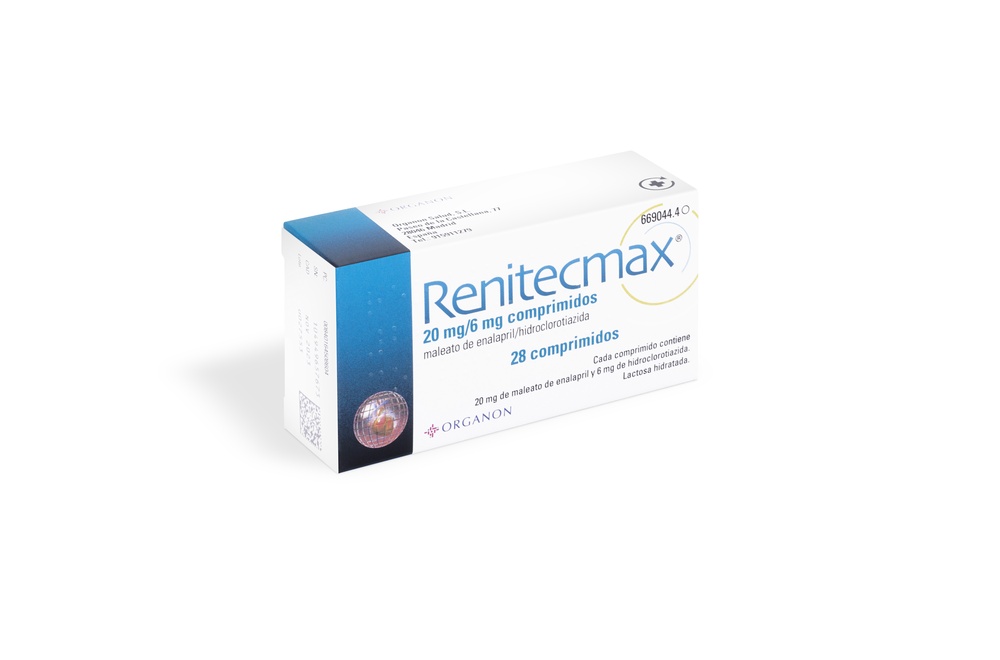
- País de registro
- Forma farmacéuticaCOMPRIMIDO, 20/6 mg/mg
- Código ATCC09BA02
- Precio medio en farmacia2.5 EUR
- Principio activo
- Requiere recetaSí
- Fabricante
- ComposiciónLACTOSA HIDRATADA (147,8 mg mg), HIDROGENOCARBONATO DE SODIO (10,0 mg mg)
- Esta información es de carácter general y no sustituye la consulta con un profesional sanitario.
- Alternativas a RENITECMAX 20 mg/ 6 mg COMPRIMIDOSForma farmacéutica: COMPRIMIDO, 20/12,5 mg/mgPrincipio activo: enalapril and diureticsFabricante: Alfasigma Espana S.L.Requiere recetaForma farmacéutica: COMPRIMIDO, 20/12,5 mg/mgPrincipio activo: enalapril and diureticsFabricante: Aristo Pharma Iberia S.L.Requiere recetaForma farmacéutica: COMPRIMIDO, 20/12,5 mg/mgPrincipio activo: enalapril and diureticsFabricante: Neuraxpharm Spain S.L.Requiere receta
Médicos online para RENITECMAX 20 mg/ 6 mg COMPRIMIDOS
Comenta la dosis, los posibles efectos secundarios, interacciones, contraindicaciones o la revisión de receta de RENITECMAX 20 mg/ 6 mg COMPRIMIDOS, sujeto a valoración médica y a la normativa local.
Obtén una receta de RENITECMAX 20 mg/ 6 mg COMPRIMIDOS online
Rellena un formulario de 2 minutos
Cuéntanos tus síntomas, historial y el medicamento que necesitas.
Elige un médico o nosotros te asignamos uno
Escoge un especialista o te conectamos con el próximo médico disponible.
El médico revisa tu caso
Normalmente en 30 minutos. Puede hacerte preguntas adicionales por chat.
Recógela en cualquier farmacia
Receta electrónica enviada a tu correo, válida en toda España.
Preguntas frecuentes
RENITECMAX 20 mg/ 6 mg COMPRIMIDOS requiere receta en España. Puedes confirmarlo con un médico online según tu caso.
El principio activo de RENITECMAX 20 mg/ 6 mg COMPRIMIDOS es enalapril and diuretics. Esta información ayuda a identificar medicamentos con la misma composición pero con diferentes nombres comerciales.
El precio medio en farmacia de RENITECMAX 20 mg/ 6 mg COMPRIMIDOS es de aproximadamente 2.5 EUR. Puede variar según el fabricante y la forma farmacéutica.
RENITECMAX 20 mg/ 6 mg COMPRIMIDOS es fabricado por Organon Salud S.L.. La marca y el envase pueden variar según el distribuidor.
Los Médicos de familia, Psiquiatras, Dermatólogos, Cardiólogos, Endocrinólogos, Gastroenterólogos, Neumólogos, Nefrólogos, Reumatólogos, Hematólogos, Infectólogos, Alergólogos, Geriatras, Pediatras, Oncólogos pueden valorar la prescripción de RENITECMAX 20 mg/ 6 mg COMPRIMIDOS cuando esté clínicamente indicado. Puedes reservar una videoconsulta para comentar tu caso y las opciones de tratamiento.
España cuenta con una infraestructura sanitaria bien desarrollada en ciudades principales como Madrid, Barcelona, Valencia y Sevilla. Las farmacias están ampliamente disponibles y operan bajo estrictas regulaciones, garantizando el acceso a medicamentos con receta.
Puedes comprar RENITECMAX 20 mg/ 6 mg COMPRIMIDOS en Madrid, Barcelona, Sevilla o Valencia en cualquier farmacia local con una receta válida.
Para obtener una receta, puedes utilizar Oladoctor:
Otros medicamentos con el mismo principio activo (enalapril and diuretics) incluyen ACEDIUR 20 mg/12.5mg comprimidos, ACETENSIL PLUS 20 mg/12,5 mg COMPRIMIDOS EFG, BARIPRIL DIU 20 mg/12,5 mg COMPRIMIDOS. Pueden tener diferentes nombres comerciales o formulaciones, pero contienen el mismo componente terapéutico. Consulta siempre con un médico antes de cambiar o iniciar un nuevo medicamento.
