



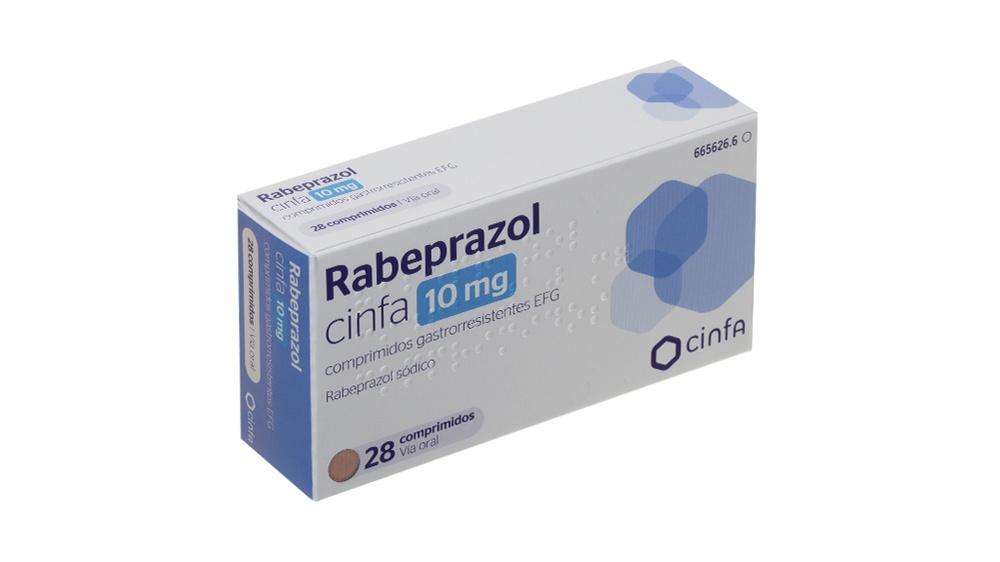
RABEPRAZOL 10 mg Comprimidos Gastroresistentes

Revisión de receta online
Un médico revisará tu caso y determinará si la prescripción es médicamente apropiada.

Habla con un médico sobre este medicamento
Comenta tus síntomas y las opciones de tratamiento en una consulta online.



Cómo usar RABEPRAZOL CINFA 10 MG COMPRIMIDOS GASTRORRESISTENTES EFG
Contenido del prospecto
- Introducción
- Qué es rabeprazol cinfa y para qué se utiliza
- Qué necesita saber antes de empezar a tomar rabeprazol cinfa.
- Cómo tomar rabeprazol cinfa
- Posibles efectos adversos
- Conservación de rabeprazol cinfa
- Contenido del envase e información adicional
Introducción
Prospecto: información para el usuario
rabeprazol cinfa 10 mg comprimidos gastrorresistentesEFG
Rabeprazol sódico
Lea todo el prospecto detenidamente antes de empezar a tomar este medicamento, porque contiene información importante para usted.
- Conserve este prospecto, ya que puede tener que volver a leerlo.
- Si tiene alguna duda, consulte a su médico o farmacéutico.
- Este medicamento se le ha recetado solamente a usted y no debe dárselo a otras personas, aunque tengan los mismos síntomas que usted, ya que puede perjudicarles.
- Si experimenta efectos adversos, consulte a su médico o farmacéutico, incluso si se trata de efectos adversos que no aparecen en este prospecto. Ver sección 4
Contenido del prospecto
- Qué es rabeprazol cinfa y para qué se utiliza
- Qué necesita saber antes de empezar a tomar rabeprazol cinfa
- Cómo tomar rabeprazol cinfa
- Posibles efectos adversos
- Conservación de rabeprazol cinfa
- Contenido del envase e información adicional
1. Qué es rabeprazol cinfa y para qué se utiliza
rabeprazol cinfa contiene el ingrediente activo rabeprazol sódico. Rabeprazol pertenece a la clase de medicamentos conocidos con el nombre de “Inhibidores de la Bomba de Protones” (IBPs), los cuales actúan reduciendo la cantidad de ácido producido por el estómago.
rabeprazol se utiliza para el tratamiento de:
- “Enfermedad por reflujo gastroesofágico” (ERGE), que puede incluir la aparición de acidez. La causa de la ERGE es el paso de ácido y comida desde el estómago hasta el esófago.
- Úlceras de estómago o úlceras de la parte alta del intestino (duodenales). Si estas úlceras están infectadas con una bacteria llamada “Helycobacter pylori” (H.pylori), necesitará la administración de antibióticos. Tomando rabeprazol y los antibióticos juntos desaparecerá la infección y la úlcera sanará. También parará la infección y la reaparición de la úlcera.
- Síndrome de Zollinger-Ellison, enfermedad que se caracteriza porque se producen cantidades muy elevadas de ácido en el estómago.

¿No estás seguro de si este medicamento es adecuado para ti?
Comenta tus síntomas y tratamiento con un médico online.
2. Qué necesita saber antes de empezar a tomar rabeprazol cinfa.
No tome rabeprazol cinfa
- Si es alérgico al rabeprazol sódico o a alguno de los demás componentes de este medicamento (incluidos en la sección 6).
- Si está embarazada o piensa que está embarazada.
- Si está en período de lactancia
No tome rabeprazol si se encuentra en alguna de las situaciones anteriores. Si no está seguro, consulte con su médico o farmacéutico antes de tomar rabeprazol.
Advertencias y precauciones
Consulte a su médico o farmacéutico antes de empezar a tomar rabeprazol cinfa
- Si es alérgico a los inhibidores de la bomba de protones o a los “compuestos benzimidazólicos sustituidos”.
- Si se han visto problemas de hígado y sanguíneos en algunos pacientes pero a menudo mejoran cuando se interrumpe el tratamiento con rabeprazol.
- Si tiene un tumor de estómago.
- Si ha tenido alguna vez problemas de hígado.
- Si está tomando atazanavir, un medicamento para la infección por el VIH.
- Si ha reducido las reservas del cuerpo o tiene factores de riesgo asociados a una reducida cantidad de B12 y reciben un tratamiento a largo plazo con rabeprazol sódico. Al igual que con todos los agentes que reducen la acidez, el rabeprazol sódico puede conducir a reducir la absorción de vitamina B12.
- Si alguna vez ha tenido una reacción en la piel después del tratamiento con un medicamento similar a rabeprazol para reducir la acidez de estómago.
- Si sufre una erupción cutánea, especialmente en zonas de la piel expuestas al sol, consulte a su médico lo antes posible, ya que puede ser necesario interrumpir el tratamiento con rabeprazol. Recuerde mencionar cualquier otro síntoma que pueda notar, como dolor en las articulaciones.
- Si está previsto que le realicen un análisis específico de sangre (Cromogranina A).
Si tiene dudas acerca de si lo anterior le afecta, consulte con su médico o farmacéutico antes de tomar rabeprazol.
Durante el tratamiento con rabeprazol, se puede producir inflamación en su riñón. Entre los signos y síntomas se incluyen: disminución del volumen de orina o sangre en la orina y/o reacciones de hipersensibilidad tales como, fiebre, erupción cutánea y rigidez de las articulaciones. Usted debe notificar estos signos a su médico.
Niños
Rabeprazol no debe administrarse a niños.
Si usted experimenta una diarrea grave (acuosa o sanguinolenta) con síntomas como fiebre, dolor abdominal o sensibilidad, deje de tomar rabeprazol y vea a su médico inmediatamente.
Tomar un inhibidor de la bomba de protones como rabeprazol, especialmente durante un período de más de un año, podría aumentar ligeramente el riesgo de fractura en la cadera, muñeca o columna vertebral. Informe a su médico si usted tiene osteoporosis o si está tomando corticoesteroides (los cuales pueden aumentar el riesgo de osteoporosis).
Toma de rabeprazol cinfa con otrosmedicamentos
Informe a su médico o farmacéutico si está tomando, ha tomado recientemente o pudiera tener que tomar cualquier otro medicamento.
En particular, informe a su médico o farmacéutico si está tomando cualquiera de los siguientes medicamentos:
- Ketoconazol o itraconazol, medicamentos para las infecciones producidas por hongos. Rabeprazol podría disminuir la cantidad en sangre de estos medicamentos. Su médico podría necesitar ajustarle la dosis.
- Atazanavir, un medicamento utilizado para el tratamiento de la infección por VIH. Rabeprazol puede disminuir la cantidad de este tipo de medicamentos en sangre por lo tanto no deben usarse conjuntamente.
- Metotrexato (un medicamento de quimioterapia utilizado a dosis altas para tratar el cáncer) – si usted está tomando una dosis alta de metotrexato, su médico puede parar temporalmente su tratamiento con rabeprazol.
Si tiene dudas de si lo anterior le afecta, consulte con su médico o farmacéutico antes de tomar rabeprazol.
Toma de rabeprazol cinfa con alimentos ybebidas
Los comprimidos deben tragarse junto con un poco de agua. Si se requiere un tratamiento diario, los comprimidos deberían tomarse preferiblemente antes del desayuno.
Embarazo,lactancia y fertilidad
Si está embarazada o en período de lactancia, cree que podría estar embarazada o tiene intención de quedarse embarazada, consulte a su médico o farmacéutico antes de utilizar este medicamento.
- No tome rabeprazol si está embarazada o si piensa que puede estarlo.
- No tome rabeprazol durante la lactancia o si planea iniciar un período de lactancia.
Conducción y uso demáquinas
Es poco probable que rabeprazol afecte a su capacidad para conducir o manejar maquinaria. Sin embargo, si siente sensación de sueño evite conducir o manejar maquinaria.
Rabeprazol cinfa contiene sodio.
Este medicamento contiene menos de 23 mg de sodio (1 mmol) por comprimido; esto es, esencialmente “exento de sodio”.
3. Cómo tomar rabeprazol cinfa
Siga exactamente las instrucciones de administración de este medicamento indicadas por su médico o farmacéutico. En caso de duda, consulte de nuevo a su médico o farmacéutico.
Toma de este medicamento
- Solo saque un comprimido del blíster cuando sea la hora de tomar su medicamento.
- Trague el comprimido entero junto con un poco de agua. No machaque ni mastique el comprimido.
- Su médico le dirá la cantidad de comprimidos que debe tomar y la duración de su tratamiento, que dependerá de su indicación.
- Si está tomando este medicamento durante un largo tiempo, su médico querrá controlarle.
Adultos y pacientes de edad avanzada
Para la “enfermedad por reflujo gastroesofágico” (ERGE)
Tratamiento de los síntomas moderados a graves (ERGE sintomático)
La dosis normal recomendada es un
comprimido de rabeprazol 10 mg una vez al día hasta 4 semanas
- Tome el comprimido por la mañana antes de comer
- Si sus síntomas reaparecen después de 4 semanas de tratamiento, su médico le dirá que tome un comprimido de rabeprazol 10 mg cuando lo necesite (“a demanda”)
Tratamiento de los síntomas más graves (ERGE erosivo o ulcerativo)
- La dosis recomendada es un comprimido de rabeprazol 20 mg una vez al día, durante 4 a 8 semanas
- Tome el comprimido por la mañana antes de comer
Tratamiento a largo plazo de los síntomas (ERGE de mantenimiento)
- La dosis recomendada es un comprimido de rabeprazol 10 mg o 20 mg una vez al día durante tanto tiempo como su médico le haya indicado
- Tome el comprimido por la mañana antes de comer
- Su médico querrá verle a intervalos regulares para chequear sus síntomas y la dosis
Para úlceras de estómago (úlceras pépticas)
- La dosis recomendada es un comprimido de rabeprazol 20 mg una vez al día durante 6 semanas
- Tome el comprimido por la mañana antes de comer
- Su médico podría decirle que tome rabeprazol durante otras 6 semanas más si sus síntomas no mejoran.
Para úlceras del intestino (úlceras duodenales)
- La dosis recomendada es un comprimido de rabeprazol 20 mg una vez al día durante 4 semanas
- Tome el comprimido por la mañana antes de comer
- Su médico podría decirle que tome rabeprazol durante otras 4 semanas más si sus síntomas no mejoran
Para úlceras causadas por la infección de H. pylori y para evitar recaídas
- La dosis recomendada es un comprimido de rabeprazol 20 mg dos veces al día durante siete días
- Su médico también le dirá que tome antibióticos llamados amoxicilina y claritromicina
Para más información sobre los otros medicamentos usados para el tratamiento de H. pylori, lea los prospectos de cada uno de ellos.
Síndrome de Zollinger-Ellison dondese produce un exceso de ácido en el estómago
- La dosis recomendada es tres comprimidos de rabeprazol 20 mg una vez al día al comienzo
- La dosis podría ajustarse por su médico dependiendo de cómo responda al tratamiento. Si está en un tratamiento de larga duración necesitará ver a su médico a intervalos regulares para la revisión de la dosis y de sus síntomas
Pacientes con problemas en el hígado.Consúltelo a su médico quien tendrá un especial cuidado en el inicio y durante el tratamiento con rabeprazol.
Si toma más rabeprazol cinfa del que debe
Si toma más rabeprazol del que debe hable con su médico o vaya a un hospital inmediatamente. Lleve el medicamento con usted.
En caso de sobredosis o ingestión accidental consulte inmediatamente a su médico o farmacéutico o llame al Servicio de Información Toxicológica, teléfono 91 562 04 20, indicando el medicamento y la cantidad ingerida.
Si olvidó tomar rabeprazol cinfa
- Si olvidó tomar un comprimido, en cuanto se de cuenta tome uno y luego continúe de forma habitual.
- Sin embargo, si es casi el momento de tomar el siguiente comprimido, simplemente sáltese la toma del comprimido que olvidó y continúe de forma habitual.
- Si olvidó tomar su medicamento durante más de 5 días, consulte con su médico antes de tomar más medicamento
- No tome una dosis doble para compensar las dosis olvidadas.
Si interrumpe el tratamiento con rabeprazol cinfa
El alivio de los síntomas normalmente ocurrirá antes de que la úlcera se haya curado completamente. Es importante que no interrumpa el tratamiento hasta que su médico se lo indique.
Si tiene cualquier otra duda sobre el uso de este medicamento, pregunte a su médico o farmacéutico.

¿Has empezado a tomar el medicamento y tienes preguntas?
Comenta tus síntomas y tratamiento con un médico online.
4. Posibles efectos adversos
Al igual que todos los medicamentos, este medicamento puede producir efectos adversos, aunque no todas las personas los sufran.
Los efectos adversos son normalmente leves y mejoran sin que usted interrumpa el tratamiento.
Deje de tomar rabeprazol y vea a su médico inmediatamente si nota cualquiera de los siguientes efectos adversos – puede necesitar tratamiento médico urgente:
- Reacciones alérgicas – los signos pueden incluir: hinchazón repentina de su cara, dificultad en la respiración o presión sanguínea baja que puede causar desmayo o colapso
- Infecciones frecuentes, tales como dolor de garganta o temperatura alta (fiebre), o úlceras en su boca o garganta
- Cardenales o facilidad para sangrar.
Estos efectos adversos son raros (pueden afectar hasta 1 de cada 1.000 pacientes)
- Ampollas graves en la piel, o llagas o úlceras en su boca y garganta.
Estos efectos adversos son muy raros (pueden afectar hasta 1 de cada 10.000 pacientes)
Otros posibles efectos adversos:
Frecuentes (pueden afectar hasta 1 de cada 10 pacientes)
- Infecciones
- Dificultad para dormir
- Dolor de cabeza o vértigo
- Tos, moqueo o dolor de garganta (faringitis)
- Efectos en su estómago o intestino tales como dolor de estómago, diarrea, gases (flatulencia), sentirse enfermo (náuseas), estar enfermo (vómitos) o estreñimiento
- Dolores o dolor de espalda
- Debilidad o síntomas parecidos a una gripe (pseudogripales)
- Pólipos benignos en el estómago.
Poco frecuentes (pueden afectar hasta 1 de cada 100 pacientes)
- Sentirse nervioso o somnoliento
- Infección de pecho (bronquitis)
- Senos dolorosos y bloqueados (sinusitis)
- Sequedad de boca
- Indigestión o eructos
- Sarpullido en la piel o enrojecimiento
- Dolor muscular, de las piernas o articulaciones
- Fracturas en la cadera, muñeca y columna
- Infección de la vejiga (infección del tracto urinario)
- Dolor de pecho
- Escalofríos o fiebre
- Cambios en el funcionamiento de su hígado (mostrado en los análisis de sangre)
Raros (pueden afectar hasta 1 de cada 1.000 pacientes)
- Pérdida del apetito (anorexia)
- Depresión
- Hipersensibilidad (incluido reacciones alérgicas)
- Trastornos visuales
- Boca inflamada (estomatitis) o trastornos del gusto
- Trastorno estomacal o dolor de estómago
- Problemas de hígado que incluyen color amarillento de la piel y del blanco de los ojos (ictericia)
- Erupción con picor o ampollas
- Sudoración
- Problemas de riñón
- Aumento de peso
- Cambios en las células blancas de la sangre (mostrado en los análisis de sangre) que puede ocasionar una infección frecuente
- Disminución de las plaquetas de la sangre que puede producir sangrado o aparición de hematomas con más facilidad de lo normal
Frecuencia no conocida (no puede estimarse a partir de los datos disponibles)
- Hinchazón de los pechos en los hombres
- Retención de líquidos
- Inflamación del intestino (que da lugar a diarrea)
- Bajos niveles de sodio en sangre que pueden causar cansancio y confusión, espasmos musculares, convulsiones y coma.
- Pacientes que han tenido previamente problemas en el hígado, pueden desarrollar de forma muy rara una encefalopatía (enfermedad del cerebro)
- Erupción cutánea, posiblemente con dolor en las articulaciones.
Si usted toma rabeprazol durante más de tres meses es posible que sus niveles de magnesio en sangre disminuyan. Niveles bajos de magnesio pueden manifestarse como cansancio, contracciones musculares involuntarias, desorientación, convulsiones, mareos, aumento del ritmo cardíaco. Si usted tiene alguno de estos síntomas, por favor informe a su médico inmediatamente. Los niveles bajos de magnesio también pueden dar lugar a una reducción de los niveles de potasio o de calcio en sangre. Su médico puede decidir realizar análisis de sangre periódicos para controlar sus niveles de magnesio.
No se preocupe por la lista de efectos adversos. Podría no experimentar ninguno de ellos.
Comunicación de efectos adversos
Si experimenta cualquier tipo de efecto adverso, consulte a su médico o farmacéutico, incluso si se trata de posibles efectos adversos que no aparecen en este prospecto. También puede comunicarlos directamente a través del Sistema Español de Farmacovigilancia de Medicamentos de Uso Humano: https://www.notificaram.es. Mediante la comunicación de efectos adversos usted puede contribuir a proporcionar más información sobre la seguridad de este medicamento.
5. Conservación de rabeprazol cinfa
Mantener este medicamento fuera de la vista y del alcance de los niños.
No conservar a temperatura superior a 25ºC.
Conservar en el envase original.
No utilice este medicamento después de la fecha de caducidad que aparece en el envase después de “CAD”. La fecha de caducidad es el último día del mes que se indica.
Los medicamentos no se deben tirar por los desagües ni a la basura. Deposite los envases y los medicamentos que no necesita en el Punto SIGRE de la farmacia. En caso de duda pregunte a su farmacéutico cómo deshacerse de los envases y de los medicamentos que no necesita. De esta forma ayudará a proteger el medio ambiente.
6. Contenido del envase e información adicional
Composición de rabeprazol cinfa
- El principio activo es rabeprazol sódico.
- Los demás componentes son:
Núcleo del comprimido: Manitol, óxido de magnesio (E-530), hidroxipropilcelulosa (E-463), estearato de magnesio (E-470b).
Recubrimiento intermedio: etilcelulosa, óxido de magnesio (E-530).
Recubrimiento entérico: ftalato de hipromelosa, sebacato de dibutilo, talco, dióxido de titanio (E-171), óxido de hierro rojo (E-172).
Aspecto del producto y contenido del envase
rabeprazol cinfase presenta en forma de comprimidos recubiertos de color rosa, biconvexos con un 1 en una de las caras del comprimido. Cada envase contiene 14, 28 o 120 (envase clínico) comprimidos.
Puede que solamente estén comercializados algunos tamaños de envases.
Titular de la autorización de comercialización y responsable de la fabricación
Titular de la autorización de comercialización
Laboratorios Cinfa, S.A.
Carretera Olaz-Chipi, 10. Polígono Industrial Areta
31620 Huarte (Navarra)- España
Responsable de la fabricación
Laboratorios Cinfa, S.A.
Carretera Olaz-Chipi, 10. Polígono Industrial Areta
31620 Huarte (Navarra)- España
LICONSA, S.A.
Avda. Miralcampo, Nº 7,
Pol. Ind. Miralcampo
(Azuqueca de Henares (Guadalajara))
- 19200 –
España
Fecha de la última revisiónde este prospecto:Septiembre 2022
La información detallada de este medicamento está disponible en la página Web de la Agencia Española de Medicamentos y Productos Sanitarios (AEMPS) http://www.aemps.gob.es/.
Puede acceder a información detallada y actualizada sobre este medicamento escaneando con su teléfono móvil (smartphone) el código QR incluido en prospecto y cartonaje. También puede acceder a esta información en la siguiente dirección de internet https://cima.aemps.es/cima/dochtml/p/72745/P_72745.html
Código QR a: https://cima.aemps.es/cima/dochtml/p/72745/P_72745.html
- País de registro
- Forma farmacéuticaCOMPRIMIDO, 10 mg
- Código ATCA02BC04
- Precio medio en farmacia12.19 EUR
- Principio activo
- Requiere recetaSí
- Fabricante
- ComposiciónMANITOL (E-421) (20,00 mg mg), ETANOL ANHIDRO (- - mg), ETANOL ANHIDRO (8,60 mg mg), ETANOL ANHIDRO (79,20 mg mg)
- Esta información es de carácter general y no sustituye la consulta con un profesional sanitario.
- Alternativas a RABEPRAZOL CINFA 10 MG COMPRIMIDOS GASTRORRESISTENTES EFGForma farmacéutica: COMPRIMIDO, 10 mgPrincipio activo: rabeprazolFabricante: Janssen Cilag S.A.Requiere recetaForma farmacéutica: COMPRIMIDO, 20 mgPrincipio activo: rabeprazolFabricante: Janssen Cilag S.A.Requiere recetaForma farmacéutica: COMPRIMIDO, 20 mgPrincipio activo: rabeprazolFabricante: Almus Farmaceutica S.A.U.Requiere receta
Médicos online para RABEPRAZOL CINFA 10 MG COMPRIMIDOS GASTRORRESISTENTES EFG
Comenta la dosis, los posibles efectos secundarios, interacciones, contraindicaciones o la revisión de receta de RABEPRAZOL CINFA 10 MG COMPRIMIDOS GASTRORRESISTENTES EFG, sujeto a valoración médica y a la normativa local.









Obtén una receta de RABEPRAZOL CINFA 10 MG COMPRIMIDOS GASTRORRESISTENTES EFG online
Rellena un formulario de 2 minutos
Cuéntanos tus síntomas, historial y el medicamento que necesitas.
Elige un médico o nosotros te asignamos uno
Escoge un especialista o te conectamos con el próximo médico disponible.
El médico revisa tu caso
Normalmente en 30 minutos. Puede hacerte preguntas adicionales por chat.
Recógela en cualquier farmacia
Receta electrónica enviada a tu correo, válida en toda España.
Preguntas frecuentes
RABEPRAZOL CINFA 10 MG COMPRIMIDOS GASTRORRESISTENTES EFG requiere receta en España. Puedes confirmarlo con un médico online según tu caso.
El principio activo de RABEPRAZOL CINFA 10 MG COMPRIMIDOS GASTRORRESISTENTES EFG es rabeprazol. Esta información ayuda a identificar medicamentos con la misma composición pero con diferentes nombres comerciales.
El precio medio en farmacia de RABEPRAZOL CINFA 10 MG COMPRIMIDOS GASTRORRESISTENTES EFG es de aproximadamente 12.19 EUR. Puede variar según el fabricante y la forma farmacéutica.
RABEPRAZOL CINFA 10 MG COMPRIMIDOS GASTRORRESISTENTES EFG es fabricado por Laboratorios Cinfa S.A.. La marca y el envase pueden variar según el distribuidor.
Los Médicos de familia, Psiquiatras, Dermatólogos, Cardiólogos, Endocrinólogos, Gastroenterólogos, Neumólogos, Nefrólogos, Reumatólogos, Hematólogos, Infectólogos, Alergólogos, Geriatras, Pediatras, Oncólogos pueden valorar la prescripción de RABEPRAZOL CINFA 10 MG COMPRIMIDOS GASTRORRESISTENTES EFG cuando esté clínicamente indicado. Puedes reservar una videoconsulta para comentar tu caso y las opciones de tratamiento.
España cuenta con una infraestructura sanitaria bien desarrollada en ciudades principales como Madrid, Barcelona, Valencia y Sevilla. Las farmacias están ampliamente disponibles y operan bajo estrictas regulaciones, garantizando el acceso a medicamentos con receta.
Puedes comprar RABEPRAZOL CINFA 10 MG COMPRIMIDOS GASTRORRESISTENTES EFG en Madrid, Barcelona, Sevilla o Valencia en cualquier farmacia local con una receta válida.
Para obtener una receta, puedes utilizar Oladoctor:
Otros medicamentos con el mismo principio activo (rabeprazol) incluyen PARIET 10 mg COMPRIMIDOS GASTRORRESISTENTES, PARIET 20 mg COMPRIMIDOS GASTRORRESISTENTES, RABEPRAZOL ALMUS 20 MG COMPRIMIDOS GASTRORRESISTENTES EFG. Pueden tener diferentes nombres comerciales o formulaciones, pero contienen el mismo componente terapéutico. Consulta siempre con un médico antes de cambiar o iniciar un nuevo medicamento.
