



PROHANCE 279,3 mg/ml SOLUCIÓN INYECTABLE EN JERINGA PRECARGADA

Revisión de receta online
Un médico revisará tu caso y determinará si la prescripción es médicamente apropiada.

Habla con un médico sobre este medicamento
Comenta tus síntomas y las opciones de tratamiento en una consulta online.



Cómo usar PROHANCE 279,3 mg/ml SOLUCION INYECTABLE EN JERINGA PRECARGADA
Contenido del prospecto
- Introducción
- Qué es ProHance y para qué se utiliza
- Qué necesita saber antes de empezar a usar ProHance
- Cómo usar ProHance
- Posibles efectos adversos
- Conservación de ProHance
- Contenido del envase e información adicional
Introducción
Prospecto: información para el usuario
ProHance 279,3 mg/ml solución inyectable en jeringa precargada
Gadoteridol
Lea todo el prospecto detenidamente antes de empezar a usar el medicamento, porque contiene información importante para usted.
- Conserve este prospecto, ya que puede tener que volver a leerlo.
- Si tiene alguna duda, consulte a su médico o farmacéutico.
- Este medicamento se le ha recetado solamente a usted y no debe dárselo a otras personas, aunque tengan los mismos síntomas que usted, ya que puede perjudicarles.
- Si experimenta efectos adversos, consulte a su médico o farmacéutico, incluso si se trata de efectos adversos que no aparecen en este prospecto. Ver sección 4.
Contenido del prospecto
- Qué es ProHance y para qué se utiliza
- Qué necesita saber antes de empezar a usar ProHance
- Cómo usar ProHance
- Posibles efectos adversos
- Conservación de ProHance
- Contenido del envase e información adicional
1. Qué es ProHance y para qué se utiliza
Este medicamento es únicamente para uso diagnóstico.
ProHance pertenece al grupo de medicamentos denominado Medios de contraste paramagnéticos.
- ProHance se utiliza como medio de contraste en Resonancia Magnética para mejorar la visualización (con respecto a la Resonancia Magnética sin contraste) del encéfalo, médula espinal y tejidos circundantes cuando existen lesiones con vascularización anómala o que determinan una alteración de la barrera hematoencefálica.
- ProHance puede usarse también en Resonancia Magnética en todo el cuerpo, incluyendo patologías en cabeza, cuello, hígado, pecho, sistema músculo esquelético y tejidos blandos.

¿No estás seguro de si este medicamento es adecuado para ti?
Comenta tus síntomas y tratamiento con un médico online.
2. Qué necesita saber antes de empezar a usar ProHance
ProHance solo debe ser administrado en hospitales o clínicas donde haya equipos y personal médico formado para tratar reacciones alérgicas.
No use ProHance
- si es alérgico (hipersensible) al gadoteridol o a cualquiera de los demás componentes de este medicamento (incluidos en la sección 6).
- si es alérgico a otro medio de contraste que contenga gadolinio.
Advertencias y precauciones
Consulte a su médico antes de empezar a usar ProHance si:
- tiene antecedentes de alergia
- tiene antecedentes de epilepsia o lesiones cerebrales
- sus riñones no funcionan correctamente
- si recientemente se le ha realizado, o pronto se le va a realizar, un trasplante de hígado
Su médico puede decidir realizarle un análisis de sangre para comprobar el correcto funcionamiento de sus riñones antes de decidir el uso de ProHance, especialmente si usted tiene 65 años o es mayor.
La administración de ProHance se ha relacionado en algunos casos con cambios transitorios clínicamente irrelevantes en la concentración sérica de hierro (dentro del intervalo normal en la mayoría de los casos).
Neonatos y lactantes
Como la función renal es inmadura en los recién nacidos de hasta 4 semanas y los lactantes de hasta 1 año de edad, ProHance solo se utilizará en estos pacientes tras una valoración cuidadosa del médico.
Uso de ProHance con otros medicamentos
Informe a su médico o farmacéutico si está utilizando, ha utilizado recientemente o podría tener que utilizar cualquier otro medicamento.
No se conoce ninguna interacción medicamentosa con gadoteridol. Durante los ensayos clínicos realizados con ProHance no se apreciaron cambios clínicamente significativos ni tampoco anomalías en las pruebas de laboratorio.
Embarazo y lactancia
Consulte a su médico o farmacéutico antes de utilizar cualquier medicamento.
Embarazo:
El gadoteridol atraviesa la placenta. Se desconoce si puede afectar al feto. Debe informar a su médico si está embarazada o cree que pudiera estarlo ya que ProHance no debe utilizarse durante el embarazo a menos que sea estrictamente necesario.
Lactancia:
Informe a su médico si está amamantando a su hijo/a o a punto de empezar. Su médico valorará si usted debe continuar la lactancia o si debe interrumpirla 24 horas después de la administración de ProHance.
Conducción y uso de máquinas
No hay información sobre los efectos de ProHance para conducir o utilizar herramientas o máquinas. Pregunte a su médico si puede conducir y si es segura la utilización de cualquier herramienta o máquina.
ProHance contiene hidróxido de sodio
Este medicamento contiene menos de 23 mg (1 mmol) de sodio por dosis, por lo que se considera esencialmente “exento de sodio”.
3. Cómo usar ProHance
Siga exactamente las instrucciones de administración de ProHance indicadas por su médico. En caso de duda, consulte de nuevo a su médico o farmacéutico.
ProHance es un agente de contraste que se utiliza para la realización de una prueba diagnóstica, la cual debe realizarse en presencia de personal cualificado o preferiblemente bajo la supervisión de un médico que le indicará en todo momento las instrucciones a seguir.
ProHance no debe mezclarse con ningún otro medicamento.
ProHance se administrará vía intravenosa.
La dosis recomendada de ProHance en adultos para realizar la exploración completa de la mayoría de las patologías de cerebro y de médula espinal es de 0,1 mmol/Kg (0,2 ml/Kg). Sin embargo, dosis de 0,3 mmol/Kg han demostrado ser eficaces en pacientes sospechosos de padecer metástasis cerebral u otras lesiones cerebrales pobremente realzadas.
La dosis recomendada para Resonancia Magnética de todo el cuerpo es de 0,1 mmol/Kg.
Si a criterio del radiólogo se considera conveniente administrar una inyección adicional de ProHance a fin de ampliar y mejorar el estudio, se puede administrar una dosis complementaria de 0,1 mmol/Kg aproximadamente a los 30 minutos de la primera inyección. Si estuviera indicado realizar exploraciones de repetición, debe transcurrir, al menos, un periodo de 6 horas para que se elimine ProHance.
Uso en poblaciones especiales
El uso de ProHance no está recomendado en pacientes con problemas renales graves o en pacientes a los que recientemente se les haya, o pronto se les va a realizar, un trasplante de hígado. Sin embargo, si se requiere el uso, durante una exploración sólo se le debe administrar una dosis de ProHance y no debe administrársele una segunda inyección hasta que hayan transcurrido al menos 7 días.
Uso en niños desde neonatos a término
La dosis recomendada de ProHance para patologías cerebrales y espinales es de 0,1 mmol/Kg (0,2 ml/Kg).
La seguridad y la eficacia de dosis mayores a 0,1 mmol/Kg y administraciones secuenciales o repetidas no han sido establecidas.
En niños menores de 18 años no está recomendado el uso para Resonancia Magnética de cuerpo entero.
Neonatos y lactantes
Como en recién nacidos de hasta 4 semanas y en lactantes de hasta 1 año de edad la función renal es inmadura, solo debe administrarse ProHance en estos pacientes tras una valoración cuidadosa del médico y a una dosis no superior de 0,1 mmol/Kg de peso corporal. Durante una exploración sólo se debe administrar a los neonatos y lactantes una dosis de ProHance y no debe administrárseles una segunda inyección hasta que hayan transcurrido al menos 7 días.
Pacientes de edad avanzada
Si usted tiene 65 años o es mayor no es necesario que se le ajuste la dosis pero podría realizársele un análisis de sangre para comprobar el correcto funcionamiento de sus riñones.
Si usa más ProHance del que debe
No se han descrito casos de sobredosificación hasta la fecha; por consiguiente, no se conocen los signos ni tampoco los síntomas de intoxicación por ProHance. En los estudios clínicos, donde se han administrado dosis de hasta 0,3 mmol/Kg, no se han observado alteraciones clínicas derivadas del incremento de la dosis. En caso de sobredosificación, el paciente debe ser sometido a observación clínica y tratamiento sintomático.
En caso de sobredosis o ingestión accidental, consultar al Servicio de Información Toxicológica. Teléfono (91) 562 04 20, indicando el medicamento y la cantidad administrada.

¿Has empezado a tomar el medicamento y tienes preguntas?
Comenta tus síntomas y tratamiento con un médico online.
4. Posibles efectos adversos
Al igual que todos los medicamentos, ProHance puede producir efectos adversos, aunque no todas las personas los sufran.
Cuando se utilice ProHance en la unidad de Resonancia Magnética, se tendrán en cuenta las mismas normas y procedimientos de seguridad habituales.
Si observa alguno de los efectos adversos siguientes, informe a su médico inmediatamente ya que puede necesitar tratamiento médico urgente.
Frecuente (más de 1 de cada 100 personas y menos de 1 de cada 10 personas)
- Sensación de malestar (náuseas)
Poco frecuentes (más de 1 de cada 1.000 personas y menos de 1 de cada 100 personas)
- Dolor de cabeza, cambio en las sensaciones, mareos, alteración del gusto
- Aumento del lagrimeo
- Rubor, presión sanguínea baja
- Sequedad bucal, vómitos
- Tendencia a picar, erupción en la piel, picores
- Dolor en el lugar de inyección
- Reacción en el lugar de inyección (aparece con el tiempo debido a la extravasación del medio de contraste)
- Aumento de los latidos cardiacos
- Fatiga
Raras (más de 1 de cada 10.000 personas y menos de 1 de cada 1.000 personas)
- Reacciones de hipersensibilidad (los síntomas notificados frecuentemente incluyen opresión de garganta, irritación de garganta, dificultad para respirar, molestias en el pecho, sensación de calor, dificultad al tragar, sensación de ardor, hinchazón de garganta y presión sanguínea baja).
- Ansiedad
- Confusión, coordinación anormal de movimientos, convulsiones
- Zumbido en los oídos
- Cambios en el ritmo cardiaco
- Espasmos de la garganta, dificultad para respirar, secreción nasal, tos, ausencia temporal de la respiración, sonidos durante la respiración
- Dolor abdominal, hinchazón de la lengua, picor en la boca, inflamación de las encías, diarrea
- Hinchazón de la cara
- Músculos rígidos
- Dolor en el pecho, fiebre
Frecuencia no conocida (no puede estimarse a partir de los datos disponibles)
- Pérdida de consciencia
- Coma
- Paro cardiaco
- Paro respiratorio, liquido en los pulmones
- Fallo renal
- Reacción vasovagal (los síntomas que se experimentan con frecuencia incluyen nauseas, mareos y sudoración excesiva. En casos graves, los síntomas pueden incluir palidez, sudoración excesiva, ritmo cardiaco lento y posible pérdida de consciencia. Síntomas adicionales pueden ser miedo o ansiedad, inquietud, desfallecimiento y salivación excesiva)
Se han notificado casos de fibrosis nefrogénica sistémica (que provoca un endurecimiento de la piel y puede afectar también a los tejidos blandos y los órganos internos), la mayoría de los cuales fueron en pacientes a los que se les administró ProHance conjuntamente con otros medios de contraste de gadolinio.
Población pediátrica
El perfil de seguridad de ProHance es similar en niños y adultos.
Si experimenta efectos adversos, consulte a su médico o farmacéutico, incluso si se trata de efectos adversos que no aparecen en este prospecto.
Comunicación de efectos adversos
Si experimenta cualquier tipo de efecto adverso, consulte a su médico o enfermero, incluso si se trata de posibles efectos adversos que no aparecen en este prospecto. También puede comunicarlos directamente a través del Sistema Español de Farmacovigilancia de medicamentos de Uso Humano: https://www.notificaram.es. Mediante la comunicación de efectos adversos usted puede contribuir a proporcionar más información sobre la seguridad de este medicamento.
5. Conservación de ProHance
Mantener este medicamento fuera de la vista y del alcance de los niños.
Conservar el producto a temperatura ambiente (entre 15ºC y 30ºC).
Conservar la jeringa en el embalaje exterior para protegerla de la luz.
No congelar. Las jeringas congeladas deben ser descartadas.
No utilice este medicamento después de la fecha de caducidad que aparece en el envase después de CAD. La fecha de caducidad es el último día del mes que se indica.
6. Contenido del envase e información adicional
Composición deProHance
- El principio activo es gadoteridol.
Cada jeringa contiene:
Gadoteridol D.C.I…………………………...........……………………279,3 mg/ml (500 milimolar)
- Los demás componentes son calteridol cálcico, trometamina, ácido clorhídrico, hidróxido de sodio y agua para preparaciones inyectables.
Aspecto del producto y contenido del envase
ProHance es una solución inyectable en jeringa precargada con 279,3 mg/ml (500 milimolar) de gadoteridol.
Cada envase contiene una jeringa de 10, 15 ó 17 ml. La jeringa es de vidrio tipo I con tapón de goma butílica y émbolo de polipropileno.
Titular de la autorización de comercialización y responsable de la fabricación
Titular de la autorización de comercialización:
BRACCO INTERNATIONAL BV
3051 Strawinskylaan
1077 ZX Amsterdam
Holanda
Responsable de la fabricación:
BRACCO IMAGING S.p.A.
Bioindustry Park
Via Ribes, 5
10010 Colleretto Giacosa (TO)
Italia
Pueden solicitar más información respecto a este medicamento dirigiéndose al representante local del titular de la autorización de comercialización:
Laboratorios Farmacéuticos ROVI, S.A.
Julián Camarillo, 35
28037 Madrid
España
Fecha de la última revisión de este prospecto: mayo 2024
Otras fuentes de información
La información detallada y actualizada de este medicamento está disponible en la página Web de la Agencia Española de Medicamentos y Productos Sanitarios (AEMPS) http://www.aemps.gob.es/
--------------------------------------------------------------------------------------------------------------------------
Esta información está destinada únicamente a médicos o profesionales del sector sanitario:
La ficha técnica completa de ProHance se suministra como un documento separado en el envase del producto, con el fin de proporcionar a los profesionales sanitarios otra información científica y práctica adicional sobre la administración y el uso de este medicamento.
Por favor, consulte la ficha técnica (la ficha técnica debe estar incluida en la caja).
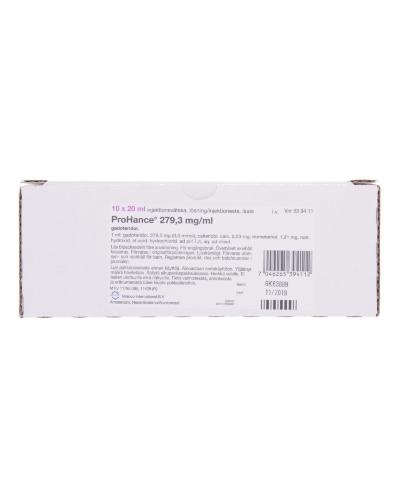
- País de registro
- Forma farmacéuticaINYECTABLE, 279,3 mg gadoteridol
- Código ATCV08CA04
- Principio activo
- Requiere recetaSí
- Fabricante
- ComposiciónHIDROXIDO DE SODIO (E 524) (c.s.p. PH 7,4 - mg)
- Esta información es de carácter general y no sustituye la consulta con un profesional sanitario.
- Alternativas a PROHANCE 279,3 mg/ml SOLUCION INYECTABLE EN JERINGA PRECARGADAForma farmacéutica: INYECTABLE, 279,3 mg gadoteridol/mlPrincipio activo: GadoteridolFabricante: Bracco International B.V.Requiere recetaForma farmacéutica: INYECTABLE, 0,5 mmol/mlPrincipio activo: Gadoterico acidoFabricante: Ge Healthcare Bio-Sciences, S.A.U.Requiere recetaForma farmacéutica: INYECTABLE, 0,5 mmol/mlPrincipio activo: Gadoterico acidoFabricante: Ge Healthcare Bio-Sciences, S.A.U.Requiere receta
Médicos online para PROHANCE 279,3 mg/ml SOLUCION INYECTABLE EN JERINGA PRECARGADA
Comenta la dosis, los posibles efectos secundarios, interacciones, contraindicaciones o la revisión de receta de PROHANCE 279,3 mg/ml SOLUCION INYECTABLE EN JERINGA PRECARGADA, sujeto a valoración médica y a la normativa local.









Obtén una receta de PROHANCE 279,3 mg/ml SOLUCION INYECTABLE EN JERINGA PRECARGADA online
Rellena un formulario de 2 minutos
Cuéntanos tus síntomas, historial y el medicamento que necesitas.
Elige un médico o nosotros te asignamos uno
Escoge un especialista o te conectamos con el próximo médico disponible.
El médico revisa tu caso
Normalmente en 30 minutos. Puede hacerte preguntas adicionales por chat.
Recógela en cualquier farmacia
Receta electrónica enviada a tu correo, válida en toda España.
Preguntas frecuentes
PROHANCE 279,3 mg/ml SOLUCION INYECTABLE EN JERINGA PRECARGADA requiere receta en España. Puedes confirmarlo con un médico online según tu caso.
El principio activo de PROHANCE 279,3 mg/ml SOLUCION INYECTABLE EN JERINGA PRECARGADA es Gadoteridol. Esta información ayuda a identificar medicamentos con la misma composición pero con diferentes nombres comerciales.
PROHANCE 279,3 mg/ml SOLUCION INYECTABLE EN JERINGA PRECARGADA es fabricado por Bracco International B.V.. La marca y el envase pueden variar según el distribuidor.
Los Médicos de familia, Psiquiatras, Dermatólogos, Cardiólogos, Endocrinólogos, Gastroenterólogos, Neumólogos, Nefrólogos, Reumatólogos, Hematólogos, Infectólogos, Alergólogos, Geriatras, Pediatras, Oncólogos pueden valorar la prescripción de PROHANCE 279,3 mg/ml SOLUCION INYECTABLE EN JERINGA PRECARGADA cuando esté clínicamente indicado. Puedes reservar una videoconsulta para comentar tu caso y las opciones de tratamiento.
España cuenta con una infraestructura sanitaria bien desarrollada en ciudades principales como Madrid, Barcelona, Valencia y Sevilla. Las farmacias están ampliamente disponibles y operan bajo estrictas regulaciones, garantizando el acceso a medicamentos con receta.
Puedes comprar PROHANCE 279,3 mg/ml SOLUCION INYECTABLE EN JERINGA PRECARGADA en Madrid, Barcelona, Sevilla o Valencia en cualquier farmacia local con una receta válida.
Para obtener una receta, puedes utilizar Oladoctor:
Otros medicamentos con el mismo principio activo (Gadoteridol) incluyen PROHANCE 279,3 mg/ml SOLUCION INYECTABLE, CLARISCAN 0,5 MMOL/ML SOLUCION INYECTABLE EFG, CLARISCAN 0,5 MMOL/ML SOLUCION INYECTABLE EN JERINGA PRECARGADA EFG. Pueden tener diferentes nombres comerciales o formulaciones, pero contienen el mismo componente terapéutico. Consulta siempre con un médico antes de cambiar o iniciar un nuevo medicamento.
