



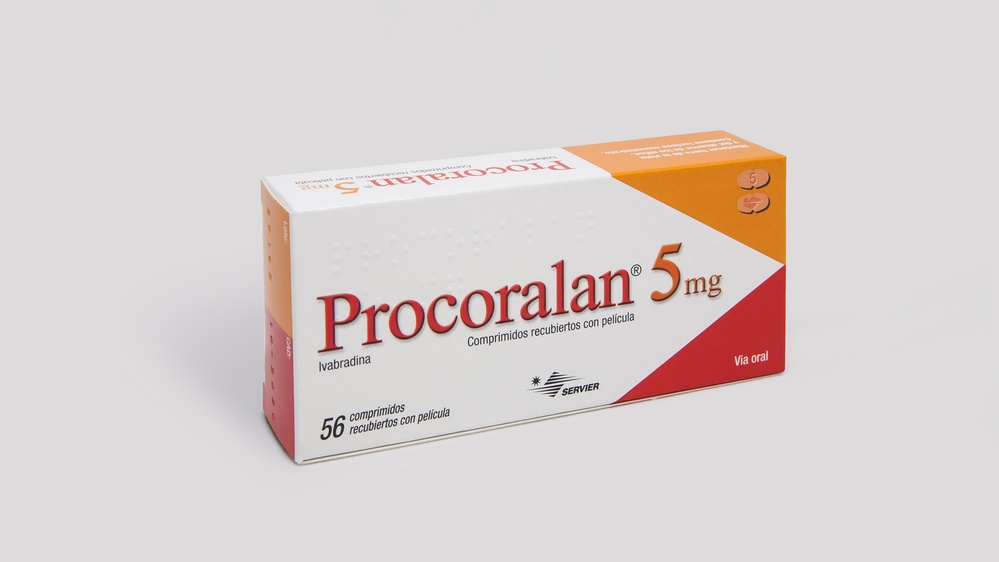
PROCORALAN 5 mg Comprimidos Recubiertos Con Pelicula

Revisión de receta online
Un médico revisará tu caso y determinará si la prescripción es médicamente apropiada.

Habla con un médico sobre este medicamento
Comenta tus síntomas y las opciones de tratamiento en una consulta online.



Cómo usar PROCORALAN 5 MG COMPRIMIDOS RECUBIERTOS CON PELICULA
Contenido del prospecto
- Introducción
- Qué es Procoralan y para qué se utiliza
- Qué necesita saber antes de empezar a tomar Procoralan
- Cómo tomar Procoralan
- Posibles efectos adversos
- Conservación de Procoralan
- Contenido del envase e información adicional
Introducción
Prospecto: información para el paciente
Procoralan 5 mg comprimidos recubiertos con película
Procoralan 7,5 mg comprimidos recubiertos con películaivabradina
Lea todo el prospecto detenidamente antes de empezar a tomar este medicamento, porque contiene información importante para usted.
- Conserve este prospecto, ya que puede tener que volver a leerlo.
- Si tiene alguna duda, consulte a su médico o farmacéutico.
- Este medicamento se le ha recetado solamente a usted, y no debe dárselo a otras personas aunque tengan los mismos síntomas que usted, ya que puede perjudicarles.
- Si experimenta efectos adversos, consulte a su médico o farmacéutico, incluso si se trata de efectos adversos que no aparecen en este prospecto. Ver sección 4.
Contenido del prospecto:
- Qué es Procoralan y para qué se utiliza
- Qué necesita saber antes de empezar a tomar Procoralan
- Cómo tomar Procoralan
- Posibles efectos adversos
- Conservación de Procoralan
- Contenido del envase e información adicional
1. Qué es Procoralan y para qué se utiliza
Procoralan (ivabradina) es un medicamento para el corazón que sirve para tratar:
- La angina de pecho estable sintomática (que causa dolor de pecho) en pacientes adultos cuya frecuencia cardiaca es mayor o igual a 70 latidos por minuto. Se utiliza en pacientes adultos que no toleran o no pueden tomar medicamentos para el corazón llamados beta-bloqueantes. También se utiliza en asociación con beta-bloqueantes en pacientes adultos cuya enfermedad no está completamente controlada con un beta-bloqueante.
- La insuficiencia cardíaca crónica en pacientes adultos cuya frecuencia cardíaca es mayor o igual a 75 latidos por minuto. Se utiliza en asociación con el tratamiento habitual, incluyendo el tratamiento con beta-bloqueantes o cuando los beta-bloqueantes están contraindicados o no se toleran.
Acerca de la angina de pecho estable (normalmente conocida como “angina”)
La angina de pecho estable es una enfermedad cardíaca que sucede cuando el corazón no recibe suficiente oxígeno. El síntoma más frecuente de la angina es el dolor o molestia en el pecho.
Acerca de la insuficiencia cardíaca crónica:
La insuficiencia cardíaca crónica es una enfermedad del corazón que ocurre cuando su corazón no puede bombear suficiente sangre al resto del cuerpo. Los síntomas más frecuentes de insuficiencia cardíaca son dificultad al respirar, fatiga, cansancio e hinchazón de los tobillos.
¿Cómo actúa Procoralan?
La acción específica de bajada de la frecuencia cardíaca de ivabradina ayuda a:
- controlar y a reducir el número de ataques de angina disminuyendo la necesidad de oxígeno del corazón,
- mejorar el funcionamiento del corazón y el pronóstico vital en pacientes con insuficiencia cardíaca crónica.

¿No estás seguro de si este medicamento es adecuado para ti?
Comenta tus síntomas y tratamiento con un médico online.
2. Qué necesita saber antes de empezar a tomar Procoralan
No tome Procoralan
- si es alérgico a la ivabradina o a cualquiera de los demás componentes de este medicamento (incluidos en la sección 6);
- si su ritmo cardíaco en reposo antes del tratamiento es demasiado lento (por debajo de 70 latidos por minuto);
- si sufre shock cardiogénico (un problema cardíaco tratado en el hospital);
- si sufre un trastorno del ritmo cardíaco (síndrome del nodo sinusal enfermo, bloqueo sinoauricular, bloqueo A-V de 3er grado);;
- si está teniendo un infarto cardíaco;
- si sufre tensión arterial muy baja;
- si sufre angina inestable (un tipo de angina grave en la que el dolor de pecho aparece muy frecuentemente con o sin ejercicio);
- si tiene insuficiencia cardíaca que ha empeorado recientemente;
- si su frecuencia cardíaca está exclusivamente determinada por su marcapasos;
- si sufre problemas hepáticos graves;
- si está tomando medicamentos para el tratamiento de infecciones por hongos (tales como ketoconazol, itraconazol), antibióticos del grupo de los macrólidos (tales como josamicina, claritromicina, telitromicina o eritromicina administrada por vía oral), medicamentos para tratar infecciones por VIH (tales como nelfinavir, ritonavir) o nefazodona (medicamento para tratar la depresión) o diltiazem, verapamilo (utilizados para el tratamiento de la tensión arterial alta o angina de pecho);
- si es una mujer en edad fértil y no utiliza métodos anticonceptivos fiables;
- si está embarazada o está intentando quedarse embarazada;
- si está en periodo de lactancia.
Advertencias y precauciones
Consulte a su médico o farmacéutico antes de empezar a tomar Procoralan:
- si sufre trastornos del ritmo cardíaco (como latido irregular del corazón, palpitaciones, aumento de dolor en el pecho) o fibrilación auricular sostenida (un tipo de latido irregular del corazón), o una anomalía en el electrocardiograma (ECG) denominada “Síndrome del QT prolongado”,
- si tiene síntomas tales como cansancio, mareo o dificultad al respirar (esto puede significar que su corazón va demasiado despacio),
- si padece síntomas de fibrilación auricular (pulso en reposo inusualmente alto (por encima de 110 latidos por minuto) o irregular, sin ninguna razón aparente, que dificulte su medición),
- si ha tenido un ictus reciente (ataque cerebral),
- si sufre tensión arterial baja de leve a moderada,
- si sufre tensión arterial no controlada, especialmente después de un cambio en su tratamiento antihipertensivo,
- si sufre insuficiencia cardíaca grave o insuficiencia cardiaca con anomalía del ECG denominado “Bloqueo de rama”,
- si sufre enfermedad retiniana del ojo crónica,
- si sufre problemas hepáticos moderados,
- si sufre problemas renales graves.
Si reúne alguna de estas condiciones, consulte inmediatamente a su médico antes o durante el tratamiento con Procoralan.
Niños
No administre este medicamento a niños y adolescentes menores de 18 años. Los datos disponibles son insuficientes en este grupo de edad.
Uso de Procoralan con otros medicamentos
Informe a su médico o farmacéutico si está utilizando, ha utilizado recientemente o podría tener que utilizar cualquier otro medicamento.
Asegúrese de informar a su médico si está tomando algunos de los siguientes medicamentos, ya que puede ser necesario un ajuste de dosis de Procoralan o una monitorización:
- fluconazol (un medicamento antifúngico)
- rifampicina (un antibiótico)
- barbitúricos (para problemas del sueño o epilepsia)
- fenitoína (para la epilepsia)
- Hypericum perforatumo Hierba de San Juan (planta medicinal para el tratamiento de la depresión)
- Medicamentos que prolongan el intervalo QT para tratar trastornos del ritmo cardíaco u otras alteraciones:
- quinidina, disopiramida, ibutilida, sotalol, amiodarona (para tratar trastornos del ritmo cardíaco)
- bepridil (para tratar la angina de pecho)
- ciertos tipos de medicamentos para tratar la ansiedad, esquizofrenia u otras psicosis (tales como pimozida, ziprasidona, sertindol)
- medicamentos antimaláricos (tales como mefloquina o halofantrina)
- eritromicina intravenosa(un antibiótico)
- pentamidina (un medicamento antiparasitario)
- cisaprida (contra el reflujo gastroesofágico)
- Algunos tipos de diuréticos que pueden causar una reducción en el nivel de potasio en sangre, tales como furosemida, hidroclorotiazida, indapamida (utilizados para tratar el edema, la tensión arterial alta).
Toma de Procoralan con alimentos y bebidas
Evite el zumo de pomelo durante el tratamiento con Procoralan.
Embarazo y lactancia
Si está embarazada o en periodo de lactancia, cree que podría estar embarazada o tiene intención de quedarse embarazada, consulte a su médico o farmacéutico antes de utilizar este medicamento.
No tome Procoralan si está embarazada o tiene intención de quedarse embarazada (ver “No tome Procoralan”).
Si está embarazada y ha tomado Procoralan, consulte a su médico.
No tome Procoralan si está en edad fértil a menos que utilice métodos anticonceptivos fiables (ver “No tome Procoralan”).
No tome Procoralan si está en periodo de lactancia (ver “No tome Procoralan”). Hable con su médico si está en período de lactancia o tiene intención de comenzar la lactancia, ya que se debe interrumpir la lactancia si está tomando Procoralan.
Conducción y uso de máquinas
Procoralan puede causar fenómenos visuales luminosos pasajeros (una luminosidad pasajera en el campo de visión, ver “Posibles efectos adversos”). Si esto le sucede, tenga cuidado al conducir o utilizar maquinaria en situaciones donde puedan producirse cambios bruscos en la intensidad de la luz, especialmente cuando conduzca de noche.
Procoralan contiene lactosa
Si su médico le ha dicho que tiene intolerancia a algunos azúcares, contacte con su médico antes de tomar este medicamento.
3. Cómo tomar Procoralan
Siga exactamente las instrucciones de administración de este medicamento indicadas por su médico o farmacéutico. En caso de duda, consulte de nuevo a su médico o farmacéutico.
Procoralan se debe tomar con el desayuno y la cena.
Procoralan 5 mg comprimidos se puede dividir en dosis iguales
Si está siendo tratado para la angina de pecho estable
La dosis de inicio no debe superar un comprimido de Procoralan 5 mg dos veces al día. Si todavía tiene síntomas de angina y si ha tolerado bien la dosis de 5 mg dos veces al día, se puede aumentar la dosis. La dosis de mantenimiento no debe superar los 7,5 mg dos veces al día. Su médico le prescribirá la dosis correcta para usted. La dosis habitual es un comprimido por la mañana y un comprimido por la noche. En algunos casos (por ejemplo, si usted tiene 75 años o más), su médico puede prescribirle la mitad de la dosis, es decir, medio comprimido de Procoralan 5 mg (que corresponde con 2,5 mg de ivabradina) por la mañana y medio comprimido de 5 mg por la noche.
Si está siendo tratado para la insuficiencia cardíaca crónica
La dosis normal inicial recomendada es un comprimido de Procoralan 5 mg dos veces al día aumentándose si fuera necesario a un comprimido de Procoralan 7,5 mg dos veces al día. Su médico decidirá la dosis adecuada para usted. La dosis normal es un comprimido por la mañana y un comprimido por la noche. En algunos casos (por ejemplo, si usted tiene 75 años o más), su médico puede prescribirle la mitad de la dosis, es decir, medio comprimido de Procoralan 5 mg (correspondiente a 2,5 mg de ivabradina) por la mañana y medio comprimido de 5 mg por la noche.
Si toma más Procoralan del que debe
Una dosis excesiva de Procoralan puede hacerle sentirse cansado o con dificultad para respirar debido a que su corazón va demasiado despacio. Si esto sucede, contacte con su médico inmediatamente.
Si olvidó tomar Procoralan
Si olvidó tomar una dosis de Procoralan, tome la siguiente dosis a la hora prevista. No tome una dosis doble para compensar las dosis olvidadas.
El calendario impreso en el blíster que contiene los comprimidos le ayudará a recordar cuando tomó un comprimido de Procoralan por última vez.
Si interrumpe el tratamiento con Procoralan
Generalmente el tratamiento de la angina de pecho o de la insuficiencia cardiaca crónica es de por vida, por lo que debe consultar con su médico antes de dejar de tomar este medicamento.
Si piensa que la acción de Procoralan es demasiado fuerte o débil, comuníqueselo a su médico o farmacéutico.
Si tiene cualquier otra duda sobre el uso de este medicamento, pregunte a su médico o farmacéutico.

¿Has empezado a tomar el medicamento y tienes preguntas?
Comenta tus síntomas y tratamiento con un médico online.
4. Posibles efectos adversos
Al igual que todos los medicamentos, este medicamento puede producir efectos adversos, aunque no todas las personas los sufran.
Las reacciones adversas más frecuentes con este medicamento son dosis dependientes y están relacionadas con su mecanismo de acción:
Muy frecuentes(pueden afectar a más de 1 de cada 10 personas)
Fenómenos visuales luminosos (breves momentos de luminosidad aumentada, causados casi siempre por cambios bruscos en la intensidad de la luz). Pueden ser descritos también como un halo, destellos de colores, descomposición de la imagen o imágenes múltiples. Estos generalmente aparecen durante los dos primeros meses de tratamiento después de lo cual pueden ocurrir repetidamente y resolverse durante o después del tratamiento.
Frecuentes(pueden afectar hasta 1 de cada 10 personas)
Modificación del funcionamiento del corazón (los síntomas son un enlentecimiento del ritmo cardíaco). Esto sucede especialmente en los primeros 2 a 3 meses tras el inicio del tratamiento.
Se han comunicado también otros efectos adversos:
Frecuentes(pueden afectar hasta 1 de cada 10 personas)
Contracción irregular rápida del corazón (fibrilación auricular), sensación de latido cardiaco anormal (bradicardia, extrasístoles ventriculares, bloqueo A-V de 1er grado (prolongación del intervalo PQ en el ECG)), tensión arterial no controlada, dolor de cabeza, mareos y visión borrosa (visión nublada).
Poco frecuentes (pueden afectar hasta 1 de cada 100 personas)
Palpitaciones y latidos cardíacos adicionales, sensación de mareo (náuseas), estreñimiento, diarrea, dolor abdominal, sensación de dar vueltas (vértigo), dificultad al respirar (disnea), espasmos musculares, niveles elevados en sangre de ácido úrico, un exceso de eosinófilos (un tipo de células de la serie blanca) y niveles de creatinina elevados en sangre (un producto de degradación del músculo), erupción cutánea, angioedema (como inflamación de la cara, lengua o garganta, dificultad para respirar o tragar), tensión arterial baja, desfallecimiento, sensación de cansancio, sensación de debilidad, electrocardiograma anormal, visión doble, alteración visual.
Raras(pueden afectar hasta 1 de cada 1.000 personas)
Urticaria, picor, enrojecimiento de la piel, indisposición.
Muy raras(pueden afectar hasta 1 de cada 10.000 personas)
Latidos irregulares del corazón (bloqueo A-V de 2º grado, bloqueo A-V de 3er grado, síndrome del nodo sinusal enfermo)..
Comunicación de efectos adversos
Si experimenta efectos adversos, consulte a su médico o farmacéutico, incluso si se trata de efectos adversos que no aparecen en este prospecto. También puede comunicarlos directamente a través del sistema nacional de notificación incluido en el Apéndice V. Mediante la comunicación de efectos adversos usted puede contribuir a proporcionar más información sobre la seguridad de este medicamento.
5. Conservación de Procoralan
Mantener este medicamento fuera de la vista y del alcance de los niños.
No utilice este medicamento después de la fecha de caducidad que aparece en el envase, después de CAD. La fecha de caducidad es el último día del mes que se indica.
Este medicamento no requiere condiciones especiales de conservación.
Los medicamentos no se deben tirar por los desagües ni a la basura. Pregunte a su farmacéutico cómo deshacerse de los envases y de los medicamentos que ya no necesita. De esta forma, ayudará a proteger el medio ambiente.
6. Contenido del envase e información adicional
Composición de Procoralan
- El principio activo es ivabradina (como clorhidrato).
Procoralan 5 mg comprimidos recubiertos con película:
Cada comprimido recubierto con película contiene 5 mg de ivabradina (como clorhidrato).
Procoralan 7,5 mg comprimidos recubiertos con película:
Cada comprimido recubierto con película contiene 7,5 mg de ivabradina como clorhidrato).
- Los demás componentes son:
- Núcleo del comprimido:lactosa monohidrato, estearato de magnesio (E 470 B), almidón de maíz, maltodextrina, sílice coloidal anhidra (E 551)
- Recubrimiento: hipromelosa (E 464), dióxido de titanio (E 171), macrogol 6000, glicerol (E 422), estearato de magnesio (E 470 B), óxido de hierro amarillo (E 172), óxido de hierro rojo (E 172).
Aspecto del producto y contenido del envase
Los comprimidos de Procoralan 5 mg están recubiertos con película, son de color salmón, oblongos, ranurados por ambos lados, grabados con “5” en una cara y en la otra.
Los comprimidos de Procoralan 7,5 mg están recubiertos con película, son de color salmón, triangulares, grabados con “7,5” en una cara y en la otra.
Los comprimidos se presentan en envases calendario (blísters de Aluminio/PVC) de 14, 28, 56, 84, 98, 100 ó 112 comprimidos.
Es posible que no se comercialicen todas las presentaciones.
Titular de la autorización de comercialización:
Les Laboratoires Servier
50, rue Carnot
92284 Suresnes cedex - Francia
Responsable de la fabricación:
Les Laboratoires Servier Industrie
905 route de Saran
45520 Gidy - Francia
Servier (Ireland) Industries Ltd
Gorey Road
Arklow - Co. Wicklow - Irlanda
Przedsiebiorstwo Farmaceutyczne ANPHARM S.A.
ul. Annopol 6B – 03-236 Warszawa – Polonia
Laboratorios Servier, S.L.
Avda. de los Madroños, 33
28043 Madrid
España
Pueden solicitar más información respecto a este medicamento dirigiéndose al representante local del titular de la autorización de comercialización.
België/Belgique/Belgien S.A. Servier Benelux N.V. Tél/Tel: +32 (0)2 529 43 11 | Lietuva UAB ”SERVIER PHARMA” Tel: +370 (5) 2 63 86 28 |
???????? ?????? ??????? ???? ???.: +359 2 921 57 00 | Luxembourg/Luxemburg S.A. Servier Benelux N.V. Tél/Tel: +32 (0)2 529 43 11 |
Ceská republika Servier s.r.o. Tel: +420 222 118 111 | Magyarország Servier Hungaria Kft. Tel.: + 36 1 238 77 99 |
Danmark Servier Danmark A/S Tlf: +45 36 44 22 60 | Malta V.J. Salomone Pharma Ltd Tel: + 356 21 22 01 74 |
Deutschland Servier Deutschland GmbH Tel: +49 (0)89 57095 01 | Nederland Servier Nederland Farma B.V. Tel: +31 (0)71 5246700 |
Eesti Servier Laboratories OÜ Tel:+ 372 664 5040 | Norge Servier Danmark A/S Tlf: +45 36 44 22 60 |
Ελλ?δα ΣΕΡΒΙΕ ΕΛΛΑΣ ΦΑΡΜΑΚΕΥΤΙΚΗ ΕΠΕ Τηλ: +30 210 939 1000 | Österreich Servier Austria GmbH Tel: +43 (1) 524 39 99 |
España Laboratorios Servier S.L. Tel: +34 91 748 96 30 | Polska Servier Polska SP. Z O.O. Tel.: + 48 (0) 22 594 90 00 |
France Les Laboratoires Servier Tél: +33 (0)1 55 72 60 00 | Portugal Servier Portugal, Lda Tel: +351 21 312 20 00 |
Hrvatska Servier Pharma, d. o. o. Tel.: +385 (0)1 3016 222 | România Servier Pharma SRL Tel: +4 021 528 52 80 |
Ireland Servier Laboratories (Ireland) Ltd. Tel: +353 (0)1 663 8110 | Slovenija Servier Pharma d.o.o. Tel: + 386 (0)1 563 48 11 |
Ísland Servier Laboratories C/o Icepharma hf Sími: +354 540 8000 | Slovenská republika Servier Slovensko spol. s r.o. Tel: +421 (0) 2 5920 41 11 |
Italia Servier Italia S.p.A. Tel: +39 06 669081 | Suomi/Finland Servier Finland Oy P./Tel: +358 (0)9 279 80 80 |
Κ?προς C.A. Papaellinas Ltd. Τηλ: +357 22741741 | Sverige Servier Sverige AB Tel: +46(8)5 225 08 00 |
Latvija SIA Servier Latvia Tel: + 371 67502039 | United Kingdom (Irlanda del norte) Servier Laboratories (Irlanda) Ltd Tel: +44 (0)1753 666409 |
Fecha de la última revisión de este prospecto:
La información detallada de este medicamento está disponible en la página web de la Agencia Europea de Medicamentos: http://www.ema.europa.eu.
- País de registro
- Forma farmacéuticaCOMPRIMIDO, 5 mg
- Código ATCC01EB17
- Precio medio en farmacia28.85 EUR
- Principio activo
- Requiere recetaSí
- Fabricante
- ComposiciónGLICEROL (E 422) (0 - mg), LACTOSA MONOHIDRATO (0 - mg)
- Esta información es de carácter general y no sustituye la consulta con un profesional sanitario.
- Alternativas a PROCORALAN 5 MG COMPRIMIDOS RECUBIERTOS CON PELICULAForma farmacéutica: COMPRIMIDO, 5 mgPrincipio activo: ivabradinaFabricante: Medochemie LimitedRequiere recetaForma farmacéutica: COMPRIMIDO, 7,5 mgPrincipio activo: ivabradinaFabricante: Medochemie LimitedRequiere recetaForma farmacéutica: COMPRIMIDO, 5 mgPrincipio activo: ivabradinaFabricante: Les Laboratoires ServierRequiere receta
Médicos online para PROCORALAN 5 MG COMPRIMIDOS RECUBIERTOS CON PELICULA
Comenta la dosis, los posibles efectos secundarios, interacciones, contraindicaciones o la revisión de receta de PROCORALAN 5 MG COMPRIMIDOS RECUBIERTOS CON PELICULA, sujeto a valoración médica y a la normativa local.
Obtén una receta de PROCORALAN 5 MG COMPRIMIDOS RECUBIERTOS CON PELICULA online
Rellena un formulario de 2 minutos
Cuéntanos tus síntomas, historial y el medicamento que necesitas.
Elige un médico o nosotros te asignamos uno
Escoge un especialista o te conectamos con el próximo médico disponible.
El médico revisa tu caso
Normalmente en 30 minutos. Puede hacerte preguntas adicionales por chat.
Recógela en cualquier farmacia
Receta electrónica enviada a tu correo, válida en toda España.
Preguntas frecuentes
PROCORALAN 5 MG COMPRIMIDOS RECUBIERTOS CON PELICULA requiere receta en España. Puedes confirmarlo con un médico online según tu caso.
El principio activo de PROCORALAN 5 MG COMPRIMIDOS RECUBIERTOS CON PELICULA es ivabradina. Esta información ayuda a identificar medicamentos con la misma composición pero con diferentes nombres comerciales.
El precio medio en farmacia de PROCORALAN 5 MG COMPRIMIDOS RECUBIERTOS CON PELICULA es de aproximadamente 28.85 EUR. Puede variar según el fabricante y la forma farmacéutica.
PROCORALAN 5 MG COMPRIMIDOS RECUBIERTOS CON PELICULA es fabricado por Les Laboratoires Servier. La marca y el envase pueden variar según el distribuidor.
Los Médicos de familia, Psiquiatras, Dermatólogos, Cardiólogos, Endocrinólogos, Gastroenterólogos, Neumólogos, Nefrólogos, Reumatólogos, Hematólogos, Infectólogos, Alergólogos, Geriatras, Pediatras, Oncólogos pueden valorar la prescripción de PROCORALAN 5 MG COMPRIMIDOS RECUBIERTOS CON PELICULA cuando esté clínicamente indicado. Puedes reservar una videoconsulta para comentar tu caso y las opciones de tratamiento.
España cuenta con una infraestructura sanitaria bien desarrollada en ciudades principales como Madrid, Barcelona, Valencia y Sevilla. Las farmacias están ampliamente disponibles y operan bajo estrictas regulaciones, garantizando el acceso a medicamentos con receta.
Puedes comprar PROCORALAN 5 MG COMPRIMIDOS RECUBIERTOS CON PELICULA en Madrid, Barcelona, Sevilla o Valencia en cualquier farmacia local con una receta válida.
Para obtener una receta, puedes utilizar Oladoctor:
Otros medicamentos con el mismo principio activo (ivabradina) incluyen APREDONAV 5 MG COMPRIMIDOS RECUBIERTOS CON PELICULA EFG, APREDONAV 7,5 MG COMPRIMIDOS RECUBIERTOS CON PELICULA EFG, CORLENTOR 5 MG COMPRIMIDOS RECUBIERTOS CON PELICULA. Pueden tener diferentes nombres comerciales o formulaciones, pero contienen el mismo componente terapéutico. Consulta siempre con un médico antes de cambiar o iniciar un nuevo medicamento.
