



POTELIGEO 4 mg /Ml Concentrado Para Solución Para Perfusión

Revisión de receta online
Un médico revisará tu caso y determinará si la prescripción es médicamente apropiada.

Habla con un médico sobre este medicamento
Comenta tus síntomas y las opciones de tratamiento en una consulta online.



Cómo usar POTELIGEO 4 MG/ML CONCENTRADO PARA SOLUCION PARA PERFUSION
Contenido del prospecto
- Introducción
- Qué es POTELIGEO y para qué se utiliza
- Qué necesita saber antes de empezar a usar POTELIGEO
- Cómo se administra POTELIGEO
- Posibles efectos adversos
- Conservación de POTELIGEO
- Contenido del envase e información adicional
Introducción
Prospecto: Información para el paciente
POTELIGEO 4mg/ml concentrado para solución para perfusión.
Mogamulizumab
Lea todo el prospecto detenidamente antes de empezar a usar este medicamento, porque contiene información importante para usted.
- Conserve este prospecto, ya que puede tener que volver a leerlo.
- Si tiene alguna duda, consulte a su médico o enfermero.
- Si experimenta efectos adversos, consulte a su médico o enfermero, incluso si se trata de posibles efectos adversos que no aparecen en este prospecto. Ver sección 4.
Contenido del prospecto
- Qué es POTELIGEO y para qué se utiliza
- Qué necesita saber antes de empezar a usar POTELIGEO
- Cómo se administra POTELIGEO
- Posibles efectos adversos
- Conservación de POTELIGEO
- Contenido del envase e información adicional
1. Qué es POTELIGEO y para qué se utiliza
POTELIGEO contiene el principio activo mogamulizumab, que pertenece a un grupo de medicamentos denominados anticuerpos monoclonales. El mogamulizumab ataca a las células cancerosas que son luego destruidas por el sistema inmunológico (las defensas del organismo).
Este medicamento se utiliza para el tratamiento de adultos con micosis fungoide y síndrome de Sézary, que son tipos de los cánceres denominados linfomas cutáneos de células T. Este medicamento se utiliza en pacientes que han recibido como mínimo un medicamento administrado por vía oral o inyectable.

¿No estás seguro de si este medicamento es adecuado para ti?
Comenta tus síntomas y tratamiento con un médico online.
2. Qué necesita saber antes de empezar a usar POTELIGEO
No use POTELIGEO:
- si es alérgico al mogamulizumab o a alguno de los demás componentes de este medicamento (incluidos en la sección 6).
Advertencias y precauciones
Consulte a su médico o enfermero antes de empezar a usar POTELIGEO si:
- alguna vez ha tenido una reacción cutánea grave con este medicamento.
- alguna vez ha tenido una reacción a la perfusión con este medicamento (los síntomas posibles de una reacción a la perfusión se enumeran en la sección 4).
- tiene el virus de inmunodeficiencia humana (VIH), herpes, citomegalovirus (CMV) o infección por hepatitis B o C, u otras infecciones en curso.
- ha sido sometido o planea someterse a un trasplante de células madre, ya fuere utilizando sus propias células o de donante.
- ha tenido síndrome de lisis tumoral (una complicación que involucra la destrucción de las células cancerosas) tras un tratamiento previo.
- tiene problemas cardíacos.
Informe a la persona que le administra la perfusión u obtenga atención médica de inmediato si sufre una reacción durante o después de cualquier perfusión con POTELIGEO.
Informe a su médico de inmediato si experimenta cualquiera de los efectos adversos enumerados en la sección 4 tras iniciar el tratamiento con POTELIGEO.
Otros medicamentos y POTELIGEO
Informe a su médico si está tomando, ha tomado recientemente o pudiera tener que tomar cualquier otro medicamento.
Niños y adolescentes
Este medicamento no debe usarse en niños ni adolescentes menores de 18 años.
Embarazo y lactancia
Se desconocen los efectos de POTELIGEO durante el embarazo y la lactancia. Debido al mecanismo de acción de este medicamento, podría afectar a su hijo si se le administra mientras está embarazada o en periodo de lactancia.
Si puede quedarse embarazada, deberá usar un método anticonceptivo efectivo durante el tratamiento y como mínimo durante los seis meses posteriores a este.
Si está en periodo de lactancia, deberá analizar con su médico si puede dar el pecho durante o después del tratamiento con POTELIGEO.
Si está embarazada o en periodo de lactancia, cree que podría estar embarazada o tiene intención de quedarse embarazada, consulte a su médico o enfermero.
Conducción y uso de máquinas
Es improbable que POTELIGEO afecte la capacidad para conducir y usar máquinas. Sin embargo, el medicamento puede provocar cansancio en algunas personas, de modo que debe tener especial cuidado al conducir y usar máquinas hasta que no tenga la certeza de que este medicamento no le afecta.
POTELIGEO contiene sodio
Este medicamento contiene menos de 1 mmol (23 mg) de sodio por vial, esto es, esencialmente «exento de sodio».
POTELIGEO contiene polisorbato
Este medicamento contiene 1 mg de polisorbato 80 en cada vial, lo que equivale a 0,2 mg/ml. Los polisorbatos pueden causar reacciones alérgicas. Informe a su médico si tiene cualquier alergia conocida.
3. Cómo se administra POTELIGEO
Su médico calculará la cantidad de POTELIGEO que va a recibir en función de su peso corporal. La dosis recomendada es 1 mg de POTELIGEO por cada kilo de peso corporal.
POTELIGEO se le administrará a través de una vena (perfusión intravenosa) durante un mínimo de 60 minutos. Para empezar, las perfusiones se le administrarán una vez por semana para las primeras 5 dosis, y posteriormente una vez cada 2 semanas. El tratamiento deberá continuar a menos que usted sufra efectos adversos graves o el linfoma cutáneo de células T comience a empeorar.

¿Has empezado a tomar el medicamento y tienes preguntas?
Comenta tus síntomas y tratamiento con un médico online.
4. Posibles efectos adversos
Al igual que todos los medicamentos, este medicamento puede producir efectos adversos, aunque no todas las personas los sufran.
Efectos adversos graves
Informe a su médico o enfermero u obtenga atención médica de inmediato si tiene cualquiera de los siguientes signos y síntomas tras el inicio de la administración de POTELIGEO:
Efectosadversos muy frecuentes (pueden afectar a más de 1 de cada 10personas):
- escalofríos, náuseas o vómitos, dolor de cabeza, sibilancia, picor, rubefacción (enrojecimiento), erupción, mareo o sensación de desmayo, dificultad para respirar y fiebre, que pueden ser signos de una reacción a la perfusión. Si esto ocurre, puede que deba interrumpirse la perfusión y puede que requiera tratamiento adicional. Cuando los síntomas desaparezcan, se puede seguir normalmente la administración de POTELIGEO, pero más lentamente. Su médico puede suspender el tratamiento con POTELIGEO si su reacción es grave.
- signos de infección, que pueden incluir fiebre, sudoración o escalofríos, síntomas similares a los de la gripe, dolor de garganta o dificultad para tragar, tos, falta de aire, dolor de estómago, náuseas o vómitos, diarrea o malestar intenso.
- erupción cutánea (que puede agravarse) o dolor de boca. En algunas personas que recibieron POTELIGEO para otros tipos de cáncer, se produjo dolor/sensación de escozor en la piel, picor, ampollas/descamación de la piel o úlceras en la boca, los labios o los genitales, que son signos posibles de una reacción cutánea grave, como síndrome de Stevens-Johnson o necrólisis epidérmica tóxica (que afectó hasta 1 de cada 100 personas).
Efectos adversos frecuentes (pueden afectar hasta a 1 de cada 10 personas):
- Diarrea acuosa, más deposiciones de lo habitual, dolor abdominal intenso o sensibilidad a la palpación que son posibles signos de inflamación del intestino grueso (colitis).
Efectos adversos poco frecuentes (pueden afectar hasta 1 de cada 100personas):
- fiebre, escalofríos, náuseas, vómitos, confusión, falta de aire, convulsiones, latidos irregulares, orina oscura o turbia, cansancio inusual y/o dolor muscular o articular. La destrucción de las células cancerosas y la reacción del organismo ante ella puede, muy ocasionalmente, llevar a un problema llamado síndrome de lisis tumoral.
- dolor torácico, falta de aire, latido cardiaco rápido o lento, sudoración, mareos, náuseas o vómitos, debilidad, sensación de desmayo y malestar. Si bien es improbable que sean provocados por este medicamento, estos pueden ser signos de un trastorno cardíaco.
Frecuencia no conocida (no puede estimarse a partir de los datos disponibles):
- Si va a ser sometido a un trasplante de células madre, es posible que en tal caso pueda desarrollar complicaciones (enfermedad de injerto contra huésped) que son difíciles de manejar. Los síntomas pueden incluir erupciones cutáneas o ampollas, náuseas o diarrea que no desaparece, dolor de estómago o vómitos, dolor o rigidez en las articulaciones, ojos secos o irritados o visión borrosa, úlceras, irritación o dolor en la boca, tos que no desaparece o dificultad para respirar, sensibilidad en los genitales, ictericia (ponerse amarillo), orina oscura y cualquier tipo de hinchazón.
Otros efectos adversos
Consulte a su médico si tiene cualquier otro efecto adverso. Estos pueden incluir los siguientes:
Efectos adversos muy frecuentes (pueden afectar a más de 1 de cada 10 personas):
- Falta de energía (fatiga)
- Estreñimiento
- Hinchazón de piernas o tobillos
- Dolor de cabeza
Efectos adversos frecuentes (pueden afectar hasta 1 de cada 10 personas)
- Anemia (reducción en la cantidad de glóbulos rojos)
- Reducción de plaquetas (trombocitopenia)
- Reducción de glóbulos blancos (neutropenia y leucopenia) o reducción de linfocitos
- Análisis de sangre que indican aumento de los niveles de enzimas hepáticas
- Tiroides hipoactiva
Efectos adversos poco frecuentes (pueden afectar hasta 1 de cada 100 personas):
- Inflamación del hígado (hepatitis)
Comunicación de efectos adversos
Si experimenta cualquier tipo de efecto adverso, consulte a su médico o enfermero, incluso si se trata de posibles efectos adversos que no aparecen en este prospecto. También puede comunicarlos directamente a través del sistema nacional de notificación incluido en el Apéndice V. Mediante la comunicación de efectos adversos usted puede contribuir a proporcionar más información sobre la seguridad de este medicamento.
5. Conservación de POTELIGEO
Mantener este medicamento fuera de la vista y del alcance de los niños.
No utilice este medicamento después de la fecha de caducidad que aparece en la caja y en el vial después de CAD. La fecha de caducidad es el último día del mes que se indica.
Vial cerrado: Conservar en nevera (entre 2 ºC y 8 ºC). No congelar.
Conservar en el envase original para protegerlo de la luz.
Solución reconstituida/diluida: Usar de inmediato o conservar en nevera (entre 2 ºC y 8 ºC) y utilizar dentro de las 24 horas posteriores.
No utilice este medicamento si observa signos de deterioro, como material particulado o decoloración.
Los medicamentos no se deben tirar por los desagües ni a la basura. De esta forma, ayudará a proteger el medio ambiente.
6. Contenido del envase e información adicional
Composición de POTELIGEO
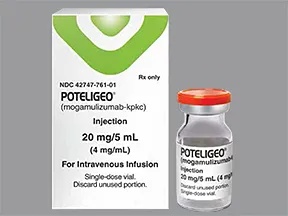
- Cada vial contiene 20 mg de mogamulizumab en 5 ml de concentrado, correspondiente a 4 mg/ml.
- Los demás excipientes son ácido cítrico monohidratado, glicina, polisorbato 80, hidróxido de sodio, ácido clorhídrico y agua para preparaciones inyectables. Ver sección 2, «POTELIGEO contiene sodio».
Aspecto del producto y contenido del envase
POTELIGEO es una solución transparente e incolora. El envase contiene un vial de vidrio con 5 ml de concentrado para solución para perfusión.
Titular de la autorización de comercialización
Kyowa Kirin Holdings B.V.
Bloemlaan 2
2132 NP Hoofddorp
Países Bajos
Responsable de la fabricación
allphamed PHARBIL Arzneimittel GmbH
Hildebrandstr. 10-12
37081 Göttingen
Alemania
Kyowa Kirin Holdings B.V.
Bloemlaan 2
2132 NP Hoofddorp
Países Bajos
Fecha de la última revisión de este prospecto:<{MM/AAAA}> <{mes AAAA}.>
Otras fuentes de información
La información detallada de este medicamento está disponible en la página web de la Agencia Europea de Medicamentos: http://www.ema.europa.eu. También existen enlaces a otras páginas web sobre enfermedades raras y medicamentos huérfanos.
- País de registro
- Forma farmacéuticaINYECTABLE PERFUSION, 4 mg/ml
- Código ATCL01FX09
- Principio activo
- Requiere recetaSí
- Fabricante
- ComposiciónPOLISORBATO 80 (1 mg mg), HIDROXIDO DE SODIO (E 524) (C.S.P. pH mg)
- Esta información es de carácter general y no sustituye la consulta con un profesional sanitario.
- Alternativas a POTELIGEO 4 MG/ML CONCENTRADO PARA SOLUCION PARA PERFUSIONForma farmacéutica: INYECTABLE PERFUSION, 50 MGPrincipio activo: Brentuximab vedotinaFabricante: Takeda Pharma A/SRequiere recetaForma farmacéutica: INYECTABLE PERFUSION, 100 mgPrincipio activo: belantamab mafodotinFabricante: Glaxosmithkline Trading Services LimitedRequiere recetaForma farmacéutica: INYECTABLE PERFUSION, 70 mgPrincipio activo: belantamab mafodotinFabricante: Glaxosmithkline Trading Services LimitedRequiere receta
Médicos online para POTELIGEO 4 MG/ML CONCENTRADO PARA SOLUCION PARA PERFUSION
Comenta la dosis, los posibles efectos secundarios, interacciones, contraindicaciones o la revisión de receta de POTELIGEO 4 MG/ML CONCENTRADO PARA SOLUCION PARA PERFUSION, sujeto a valoración médica y a la normativa local.
Obtén una receta de POTELIGEO 4 MG/ML CONCENTRADO PARA SOLUCION PARA PERFUSION online
Rellena un formulario de 2 minutos
Cuéntanos tus síntomas, historial y el medicamento que necesitas.
Elige un médico o nosotros te asignamos uno
Escoge un especialista o te conectamos con el próximo médico disponible.
El médico revisa tu caso
Normalmente en 30 minutos. Puede hacerte preguntas adicionales por chat.
Recógela en cualquier farmacia
Receta electrónica enviada a tu correo, válida en toda España.
Preguntas frecuentes
POTELIGEO 4 MG/ML CONCENTRADO PARA SOLUCION PARA PERFUSION requiere receta en España. Puedes confirmarlo con un médico online según tu caso.
El principio activo de POTELIGEO 4 MG/ML CONCENTRADO PARA SOLUCION PARA PERFUSION es Mogamulizumab. Esta información ayuda a identificar medicamentos con la misma composición pero con diferentes nombres comerciales.
POTELIGEO 4 MG/ML CONCENTRADO PARA SOLUCION PARA PERFUSION es fabricado por Kyowa Kirin Holdings B.V.. La marca y el envase pueden variar según el distribuidor.
Los Médicos de familia, Psiquiatras, Dermatólogos, Cardiólogos, Endocrinólogos, Gastroenterólogos, Neumólogos, Nefrólogos, Reumatólogos, Hematólogos, Infectólogos, Alergólogos, Geriatras, Pediatras, Oncólogos pueden valorar la prescripción de POTELIGEO 4 MG/ML CONCENTRADO PARA SOLUCION PARA PERFUSION cuando esté clínicamente indicado. Puedes reservar una videoconsulta para comentar tu caso y las opciones de tratamiento.
España cuenta con una infraestructura sanitaria bien desarrollada en ciudades principales como Madrid, Barcelona, Valencia y Sevilla. Las farmacias están ampliamente disponibles y operan bajo estrictas regulaciones, garantizando el acceso a medicamentos con receta.
Puedes comprar POTELIGEO 4 MG/ML CONCENTRADO PARA SOLUCION PARA PERFUSION en Madrid, Barcelona, Sevilla o Valencia en cualquier farmacia local con una receta válida.
Para obtener una receta, puedes utilizar Oladoctor:
Otros medicamentos con el mismo principio activo (Mogamulizumab) incluyen ADCETRIS 50 MG POLVO PARA CONCENTRADO PARA SOLUCION PARA PERFUSION, BLENREP 100 MG POLVO PARA CONCENTRADO PARA SOLUCION PARA PERFUSION, BLENREP 70 MG POLVO PARA CONCENTRADO PARA SOLUCION PARA PERFUSION. Pueden tener diferentes nombres comerciales o formulaciones, pero contienen el mismo componente terapéutico. Consulta siempre con un médico antes de cambiar o iniciar un nuevo medicamento.
