

POTASIO 0,04 MEQ/ML EN CLORURO DE SODIO 0,9% SOLUCION PARA PERFUSION





Cómo usar POTASIO KABI 0,04 MEQ/ML EN CLORURO DE SODIO 0,9% SOLUCION PARA PERFUSION EFG
Traducción generada por IA
Este contenido ha sido traducido automáticamente y se ofrece solo con fines informativos. No sustituye la consulta con un profesional sanitario.
Ver originalContenido del prospecto
- Introducción
- Qué es Potasio Kabi 0,04 mEq/ml en Cloruro de sodio 0,9% y para qué se utiliza
- Qué necesita saber antes de que le administren Potasio Kabi 0,04 mEq/ml en Cloruro de sodio 0,9%
- Cómo le van a administrar Potasio Kabi 0,04 mEq/ml en Cloruro de sodio 0,9%
- Posibles efectos adversos
- Conservación de Potasio Kabi 0,04 mEq/ml en Cloruro de sodio 0,9%
- Contenido del envase e información adicional
Introducción
Prospecto: Información para el usuario
Potasio Kabi 0,04 mEq/ml en Cloruro de sodio 0,9% solución para perfusión EFG
cloruro de potasio y cloruro de sodio
Lea todo el prospecto detenidamente antes de empezar a usar este medicamento porque contiene información importante para usted.
- Conserve este prospecto, ya que puede tener que volver a leerlo.
- Si tiene alguna duda, consulte a su médico o enfermero.
- Si experimenta efectos adversos, consulte a su médico o enfermero, incluso si se trata de efectos adversos que no aparecen en este prospecto. Ver sección 4.
Contenido del prospecto:
- Qué es Potasio Kabi 0,04 mEq/ml en Cloruro de sodio 0,9% y para qué se utiliza
- Qué necesita saber antes de que le administren Potasio Kabi 0,04 mEq/ml en Cloruro de sodio 0,9%
- Cómo le van a administrar Potasio Kabi 0,04 mEq/ml en Cloruro de sodio 0,9%
- Posibles efectos adversos
- Conservación de Potasio Kabi 0,04 mEq/ml en Cloruro de sodio 0,9%
- Contenido del envase e información adicional
1. Qué es Potasio Kabi 0,04 mEq/ml en Cloruro de sodio 0,9% y para qué se utiliza
Potasio Kabi 0,04 mEq/ml en Cloruro de sodio 0,9% es una solución de cloruro de potasio y cloruro de sodio en agua. El cloruro de potasio y el cloruro de sodio son sustancias químicas (comúnmente llamadas sales) que se encuentran en la sangre.
Este medicamento se usa para tratar y prevenir:
- una pérdida de potasio del cuerpo (por ejemplo, después del tratamiento con ciertos diuréticos)
- un nivel bajo de potasio en la sangre (hipopotasemia), en situaciones que pueden producir la pérdida de agua y de cloruro de potasio incluyendo:
- cuando no puede comer o beber, debido a una enfermedad o tras una intervención quirúrgica
- sudor excesivo causado por fiebre alta
condiciones de pérdida de cloruro de sodio y agua

2. Qué necesita saber antes de que le administren Potasio Kabi 0,04 mEq/ml en Cloruro de sodio 0,9%
No se le deberá administrar Potasio Kabi 0,04 mEq/ml en Cloruro de sodio 0,9%si sufre alguna de las siguientes situaciones clínicas:
- si su sangre contiene niveles altos de potasio superiores a los normales (hiperpotasemia)
- si su sangre contiene niveles altos de cloruros superiores a los normales (hipercloremia)
- si su sangre contiene niveles altos de sodio superiores a los normales (hipernatremia)
- si sus riñones no funcionan bien (produce poca orina o no orina)
- si presenta insuficiencia cardíaca que no está adecuadamente tratada (insuficiencia cardiaca no compensada), que ocasiona síntomas como:
- dificultad respiratoria
- hinchazón de los tobillos
- si presenta una enfermedad en que las glándulas adrenales no funcionan correctamente (enfermedad de Addison).
Advertencias y precauciones
Este medicamento tiene mayor concentración que la sangre (solución hipertónica). Su médico tendrá esto en cuenta al calcular la cantidad de solución que le administrará.
Consulte a su médico o enfermero antes de que le administren Potasio Kabi 0,04 mEq/ml en Cloruro de sodio 0,9% si:
- padece cualquier tipo de enfermedad del corazón o insuficiencia cardiaca
- tiene insuficiencia renal
- padece una enfermedad de las glándulas adrenales que afecta a la cantidad de hormonas esteroideas en el organismo (insuficiencia adrenocortical)
- está muy deshidratado (una pérdida de agua del organismo, por ejemplo vómitos o diarrea)
- tiene dañada de forma grave un área extensa de la piel, como ocurre en quemaduras
- tiene la tensión arterial elevada
- tiene hinchazón bajo la piel, particularmente alrededor de los tobillos (edema periférico) o en los pulmones (edema pulmonar)
- tiene la tensión arterial elevada durante el embarazo (preeclampsia)
- tiene cualquier otra condición en la que el organismo retiene demasiado sodio (retención de sodio)
Cuando le estén administrando este medicamento, su médico le tomará muestras de sangre y orina para controlar su estado, sobre todo si tiene problemas de corazón o de riñón.
Uso de Potasio Kabi 0,04 mEq/ml en Cloruro de sodio 0,9% con otros medicamentos
Informe a su médico o farmacéutico si está utilizando, ha utilizado recientemente o podría tener que utilizar cualquier otro medicamento. Es particularmente importante que informe a su médico si está tomando:
- glucósidos cardíacos utilizados en el tratamiento de la insuficiencia cardiaca (tales como digoxina)
- medicamentos antiarrítmicos utilizados para suprimir el ritmo anormal del corazón (tales como quinidina, hidroquinidina, procainamida)
- medicamentos que incrementan la concentración de potasio en sangre, tales como:
- diuréticos ahorradores de potasio, conocidos como comprimidos que ayudan a eliminar agua (tales como amilorida, espirolactona, triamtereno)
- inhibidores de la enzima convertidora de angiotensina (ECA) (principalmente utilizados para el tratamiento de la tensión arterial elevada)
- antagonistas de receptores de la angiotensina II (usados para el tratamiento de la tensión arterial elevada)
- ciclosporinas (usadas para prevenir rechazo de trasplantes)
- tacrolimus (usado para prevenir rechazo de trasplantes y para el tratamiento de algunas alteraciones de la piel)
- medicamentos que contienen potasio
- corticosteroides (medicamentos antiinflamatorios)
Embarazo y lactancia
Si está embarazada o en periodo de lactancia, cree que podría estar embarazada o tiene intención de quedarse embarazada, consulte a su médico antes de utilizar este medicamento.
Este medicamento puede administrarse durante el embarazo y la lactancia. La cantidad de medicamento que le administren será cuidadosamente controlada por su médico. Su médico le realizará análisis de sangre para controlar los niveles de sustancias químicas en su sangre. Esto es debido a que los cambios en los niveles de potasio en la sangre pueden afectar la forma de trabajar tanto de su corazón como el de su bebé no nacido.
Su médico controlará cuidadosamente su tensión arterial ya que el cloruro de sodio puede incrementarla (riesgo de preeclampsia).
Conducción y uso de máquinas
Este medicamento no afecta a su capacidad para conducir o usar máquinas.
3. Cómo le van a administrar Potasio Kabi 0,04 mEq/ml en Cloruro de sodio 0,9%
Este medicamento le será administrado por un médico o un enfermero.
Su médico decidirá qué cantidad necesita y cuando le será administrada, lo que dependerá de su edad, peso, condición clínica y biológica y de su estado de hidratación (cantidad de agua en su organismo). La cantidad que reciba también puede verse influida por otros tratamientos que reciba.
Potasio Kabi 0,04 mEq/ml en Cloruro de sodio 0,9% se administra lentamente en una vena en forma de perfusión. La velocidad de perfusión será determinada por su médico. Si usted requiere un gran volumen o una perfusión rápida del medicamento, su médico controlará su ECG (gráfico del corazón).
Cuando se le administre Potasio Kabi 0,04 mEq/ml en Cloruro de sodio 0,9% su médico podrá realizar análisis de su sangre para controlar sus niveles sanguíneos de potasio y otros electrolitos (como sodio o cloruros) que normalmente están en la sangre. Su médico también controlará si orina de forma normal (adecuada producción de orina).
Si recibe más Potasio Kabi 0,04 mEq/ml en Cloruro de sodio 0,9% del que debe
Si le administran demasiada cantidad del medicamento puede experimentar: hormigueo o quemazón en los brazos y las piernas (parestesia), debilidad muscular, incapacidad de moverse (parálisis), latido cardíaco irregular (arritmia), bloqueo cardíaco (latidos cardíacos muy lentos), parada cardíaca (el corazón deja de latir), confusión mental, acumulación de líquidos en los pulmones haciendo difícil la respiración (edema pulmonar), acumulación de líquidos bajo la piel, particularmente alrededor de los tobillos (edema periférico), acidificación de la sangre (acidosis) que conduce a cansancio, confusión, letargo y aumento del ritmo respiratorio.
Si observa alguno de estos síntomas, deberá informar a su médico inmediatamente. Le deberán dejar de administrar el medicamento y recibir tratamiento dependiendo de los síntomas.
Si tiene cualquier otra duda sobre el uso de este medicamento, pregunte a su médico o enfermero.

4. Posibles efectos adversos
Al igual que todos los medicamentos, este medicamento puede producir efectos adversos, aunque no todas las personas los sufran.
Las siguientes reacciones adversas se han notificado durante el uso post-comercialización del medicamento. La frecuencia del acontecimiento no puede estimarse a partir de los datos disponibles. Los efectos adversos pueden estar asociadas con la técnica de administración.
Informe a su médico o enfermero si observa cualquiera de los siguientes efectos adversos:
- infección en el punto de inyección
- aumento anormal en el volumen de sangre (hipervolemia)
- administración de la solución en los tejidos que rodean la vena (extravasación), lo que puede dañar los tejidos y provocar la aparición de cicatrices
- dolor o irritación en el lugar de inyección
- inflamación de la vena en la se ha perfundido la solución (flebitis). Esto puede ocasionar enrojecimiento, hinchazón y dolor o quemazón a lo largo de la vena en la que se ha administrado la solución
- formación de un coágulo en el lugar de inyección que causa dolor, hinchazón o enrojecimiento en el área del coágulo
- fiebre
Comunicación de efectos adversos
Si experimenta cualquier tipo de efecto adverso, consulte a su médico o enfermero, incluso si se trata de posibles efectos adversos que no aparecen en este prospecto. También puede comunicarlos directamente a través del Sistema Español de Farmacovigilancia de Medicamentos de Uso Humano: https://www.notificaram.es. Mediante la comunicación de efectos adversos usted puede contribuir a proporcionar más información sobre la seguridad de este medicamento.
5. Conservación de Potasio Kabi 0,04 mEq/ml en Cloruro de sodio 0,9%
Mantener este medicamento fuera de la vista y del alcance de los niños.
Este medicamento no requiere condiciones especiales de conservación.
No utilice este medicamento después de la fecha de caducidad que aparece en el envase. La fecha de caducidad es el último día del mes que se indica.
No utilizar este medicamento si la solución no es transparente o tiene partículas visibles. No utilizar este medicamento si el envase está dañado de algún modo.
Desde un punto de vista microbiológico, el producto se debe utilizar inmediatamente. Si no se utiliza inmediatamente, el tiempo y las condiciones de almacenamiento durante el uso son responsabilidad del usuario.
Los medicamentos no se deben por los desagües ni a la basura. Pregunte a su farmacéutico cómo deshacerse de los envases y de los medicamentos que ya no necesita. De esta forma ayudará a proteger el medio ambiente.
6. Contenido del envase e información adicional
Composición de Potasio Kabi 0,04 mEq/ml en Cloruro de sodio 0,9%
- Los principios activos son cloruro de potasio y cloruro de sodio. Cada ml contiene 3,00 mg de cloruro de potasio y 9,00 mg de cloruro de sodio.
Cada frasco de 500 ml contiene 1,50 g de cloruro de potasio y 4,5 g de cloruro de sodio
Cada frasco de 1000 ml de contiene 3,00 g de cloruro de potasio y 9,00 g de cloruro de sodio
- Los demás componentes son agua para preparaciones inyectables, hidróxido de sodio y ácido clorhídrico para ajuste del pH
Aspecto del producto y contenido del envase
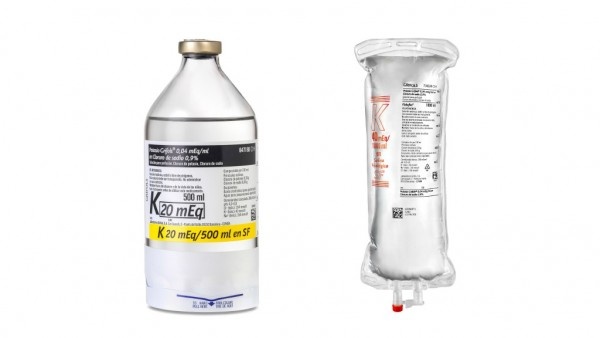
Potasio Kabi 0,04 mEq/ml en Cloruro de sodio 0,9% es una solución transparente e incolora, sin partículas visibles. Está disponible en frascos de polietileno de 500 ml y 1000 ml, cerrados con una cápsula de poliolefina conteniendo un tapón de goma poliisoprénica. Se suministra en envases de 10 frascos.
Puede que solamente estén comercializados algunos tamaños de envases.
Titular de la autorización de comercialización y responsable de la fabricación
Titular de la autorización de comercialización
Fresenius Kabi España, S.A.U.
C/ Marina 16-18,
08005-Barcelona
España
Responsable de la fabricación
Fresenius Kabi Deutschland GmbH
Else-Kröner-Straße 1,
61352 Bad Homburg v.d.H.
Alemania
o
Labesfal –Laborarios Almiro S.A.
Zona Industrial do Lagedo,
Santiago de Besteiros, 3465 – 157
Portugal
Este medicamento está autorizado en los estados miembros del Espacio Económico Europeo con los siguientes nombres:
Nombre del estado miembro | Nombre del medicamento |
Bélgica | KCl 0.3% w/v & NaCl 0.9% w/v Fresenius Kabi, oplossing voor infusie |
Estonia | Potassium Chloride/Sodium Chloride Fresenius |
Francia | Chlorure de potassium 0,3% et chlorure de sodium 0,9% Kabi, solution pour perfusion |
Irlanda | Potassium Chloride 0.3% w/v & Sodium chloride 0.9% w/v Solution for Infusion |
Italia | Sodio Cloruro e Potassio Cloruro Kabi |
Letonia | Potassium Chloride/ Sodium Chloride Fresenius 3 mg/9 mg/ml škidums infuzijam |
Lituania | Potassium Chloride/ Sodium Chloride Fresenius 3 mg/9 mg/ml infuzinis tirpalas |
Polonia | Kalii chloridum 0,3% + Natrii chloridum 0,9% Kabi |
Portugal | Cloreto de Potássio 0,3% p/v e Cloreto de Sódio 0,9% p/v Kabi |
Eslovenia | Kalijev klorid/natrijev klorid Kabi 3 mg/9 mg v 1 ml raztopina za infundiranje |
España | Potasio Kabi 0,04 mEq/ml en Cloruro de sodio 0,9% solución para perfusión EFG |
Países Bajos | KCl 0.3% w/v & NaCl 0.9% w/v Fresenius Kabi, oplossing voor infusie |
Reino Unido | Potassium Chloride 0.3% w/v & Sodium chloride 0.9% w/v Solution for Infusion |
Fecha de la última revisión de esteprospecto: Abril2015
La información detallada y actualizada de este medicamento está disponible en la página Web de la Agencia Española de Medicamentos y Productos Sanitarios (AEMPS) http://www.aemps.gob.es/.
------------------------------------------------------------------------------------------------------------------------------
Esta información está destinada únicamente a profesionales del sector sanitario:
Manejo y preparación
Este medicamento es para un solo uso. Desechar el contenido no utilizado.
Usar sólo si la solución es transparente, sin partículas visibles y si el envase no está dañado.
Via de administración
La administración se realiza mediante perfusión intravenosa usando un equipo estéril y apirógeno.
El potasio por vía intravenosa debe administrarse a través de una vena periférica grande o vena central para disminuir el riesgo de esclerosis. Si se perfunde por vena central, asegurar que el catéter no esté en la aurícula o ventrículo para evitar hiperpotasemia localizada.
Las soluciones que contienen potasio deben administrarse lentamente.
Velocidad de administración
El potasio no debe administrarse por vía intravenosa a una velocidad mayor de 15 a 20 mmoles por hora para evitar una hiperpotasemia peligrosa.
En cualquier caso, no debe excederse la dosis indicada en el apartado “Posología general”
Posología general
La dosificación recomendada para el tratamiento de la depleción de líquido isotónico (deshidratación extracelular) por medio de cualquier solución intravenosa es:
- para adultos: 500 ml a 3 litros cada 24 horas
- para bebés y niños: 20 a 100 ml cada 24 horas y por kilo de peso corporal dependiendo de la edad y la masa corporal total.
Posología
- Adultos, personas de edad avanzada y adolescentes:
Las dosis típicas de potasio para la prevención de la hipopotasemia pueden ser de hasta 50 mmoles diarios y dosis similares pueden ser adecuadas en deficiencias leves de potasio. Cuando se use para el tratamiento de la hipopotasemia, la dosis recomendada es de 20 mmoles de potasio en 2 ó 3 horas (es decir 7-10 mmol/h) bajo control electrocardiográfico (ECG).
- Población pediátrica
Cuando se utiliza para el tratamiento de la hipopotasemia, la dosis recomendada es de 0,3 – 0,5 mmoles/kg de peso corporal/hora. Debe ajustarse la dosis en función de los valores de laboratorio obtenidos habitualmente.
La dosis máxima recomendada de potasio es de 2 a 3 mmoles/kg de peso corporal/día.
- Pacientes con insuficiencia renal
Los pacientes con insuficiencia renal deben recibir dosis menores
Potasio Kabi 0,04 mEq/ml en Cloruro de sodio 0,9% es una solución hipertónica, con una osmolaridad aproximada de 388 mOsm/l.
La administración debe realizarse bajo supervisión continua y cuidadosa. Es esencial la monitorización constante del estado clínico, concentraciones plasmáticas de electrolitos, niveles plasmáticos de creatinina, nivel BUN, equilibrio ácido-básico, y ECG en pacientes que reciben una terapia de potasio, particularmente aquellos con disfunciones renales o cardíacas.
Es esencial mantener un flujo adecuado de orina y monitorizar el balance de líquidos.
Las sales de potasio deben administrarse con precaución a pacientes con enfermedades cardiacas o condiciones que predispongan a la hiperpotasemia, tales como insuficiencia renal o adrenocortical, deshidratación aguda o destrucción masiva de tejidos, como ocurre en grandes quemados. Es obligatorio el control constante de los niveles plasmáticos de potasio en pacientes en tratamiento con digitálicos.
Las sales de sodio deben administrarse con precaución a pacientes con hipertensión, fallo cardiaco, edema periférico o pulmonar, disfunción renal, preeclampsia u otras condiciones asociadas con la retención de sodio.
Período de validez durante el uso (Aditivos)
Antes del uso, se debe establecer la estabilidad física y química de cualquier medicamento añadido al pH de la solución de cloruro de potasio 0,04 mEq/ml en cloruro de sodio 0,9%.
En ausencia de estudios de compatibilidad, este medicamento no debe mezclarse con otros medicamentos.
Es responsabilidad del médico evaluar la incompatibilidad de cualquier medicación añadida con la solución de cloruro de potasio 0,04 mEq/ml en cloruro de sodio 0,9%, comprobando un posible cambio de color y/o una posible formación de un precipitado, complejos insolubles o aparición de cristales. También se debe consultar la ficha técnica del medicamento añadido.
Se debe comprobar la incompatibilidad de medicamentos añadidos a Potasio Kabi 0,04 mEq/ml en Cloruro de sodio 0,9% antes de su adición.
Se deben consultar las instrucciones de uso del medicamento que va a ser añadido. Antes de añadir un medicamento, verificar si es soluble y/o estable en agua al pH de la solución de cloruro de potasio 0,04 mEq/ml en cloruro de sodio 0,9% (pH: 4,5 a 7,0).
No utilizar aditivos que se conozca que son incompatibles.
Desde un punto de vista microbiológico, el producto se debe utilizar inmediatamente. Si no se utiliza inmediatamente, el tiempo y las condiciones de almacenamiento durante el uso son responsabilidad del usuario.

-

- País de registro
- Forma farmacéuticaINYECTABLE PERFUSION, 0,9% + 0,04 mEq/ml
- Código ATCB05BB01
- Principio activo
- Requiere recetaSí
- Fabricante
- ComposiciónHIDROXIDO DE SODIO (E 524) (0-0,123 mg mg)
- Esta información es de carácter general y no sustituye la consulta con un profesional sanitario.
- Alternativas a POTASIO KABI 0,04 MEQ/ML EN CLORURO DE SODIO 0,9% SOLUCION PARA PERFUSION EFGForma farmacéutica: INYECTABLE, 1361 mgPrincipio activo: electrolytesFabricante: Fresenius Kabi España, S.A.U.Requiere recetaForma farmacéutica: INYECTABLE PERFUSION, 2 % sodio cloruro/ 100 mlPrincipio activo: electrolytesFabricante: Fresenius Kabi España, S.A.U.Requiere recetaForma farmacéutica: INYECTABLE PERFUSION, 33 mg / 30 mg / 860 mgPrincipio activo: electrolytesFabricante: Fresenius Kabi España, S.A.U.Requiere receta
Médicos online para POTASIO KABI 0,04 MEQ/ML EN CLORURO DE SODIO 0,9% SOLUCION PARA PERFUSION EFG
Comenta la dosis, los posibles efectos secundarios, interacciones, contraindicaciones o la revisión de receta de POTASIO KABI 0,04 MEQ/ML EN CLORURO DE SODIO 0,9% SOLUCION PARA PERFUSION EFG, sujeto a valoración médica y a la normativa local.









Obtén una receta de POTASIO KABI 0,04 MEQ/ML EN CLORURO DE SODIO 0,9% SOLUCION PARA PERFUSION EFG online
Rellena un formulario de 2 minutos
Cuéntanos tus síntomas, historial y el medicamento que necesitas.
Elige un médico o nosotros te asignamos uno
Escoge un especialista o te conectamos con el próximo médico disponible.
El médico revisa tu caso
Normalmente en 30 minutos. Puede hacerte preguntas adicionales por chat.
Recógela en cualquier farmacia
Receta electrónica enviada a tu correo, válida en toda España.
Preguntas frecuentes
¿Se requiere receta para POTASIO KABI 0,04 MEQ/ML EN CLORURO DE SODIO 0,9% SOLUCION PARA PERFUSION EFG?
POTASIO KABI 0,04 MEQ/ML EN CLORURO DE SODIO 0,9% SOLUCION PARA PERFUSION EFG requires receta en España. Puedes confirmarlo con un médico online según tu caso.
¿Cuál es el principio activo de POTASIO KABI 0,04 MEQ/ML EN CLORURO DE SODIO 0,9% SOLUCION PARA PERFUSION EFG?
El principio activo de POTASIO KABI 0,04 MEQ/ML EN CLORURO DE SODIO 0,9% SOLUCION PARA PERFUSION EFG es electrolytes. Esta información ayuda a identificar medicamentos con la misma composición pero con diferentes nombres comerciales.
¿Quién fabrica POTASIO KABI 0,04 MEQ/ML EN CLORURO DE SODIO 0,9% SOLUCION PARA PERFUSION EFG?
POTASIO KABI 0,04 MEQ/ML EN CLORURO DE SODIO 0,9% SOLUCION PARA PERFUSION EFG es fabricado por Fresenius Kabi España, S.A.U.. La marca y el envase pueden variar según el distribuidor.
¿Qué médicos pueden recetar POTASIO KABI 0,04 MEQ/ML EN CLORURO DE SODIO 0,9% SOLUCION PARA PERFUSION EFG online?
Los Médicos de familia, Psiquiatras, Dermatólogos, Cardiólogos, Endocrinólogos, Gastroenterólogos, Neumólogos, Nefrólogos, Reumatólogos, Hematólogos, Infectólogos, Alergólogos, Geriatras, Pediatras, Oncólogos pueden valorar la prescripción de POTASIO KABI 0,04 MEQ/ML EN CLORURO DE SODIO 0,9% SOLUCION PARA PERFUSION EFG cuando esté clínicamente indicado. Puedes reservar una videoconsulta para comentar tu caso y las opciones de tratamiento.
¿Cómo comprar POTASIO KABI 0,04 MEQ/ML EN CLORURO DE SODIO 0,9% SOLUCION PARA PERFUSION EFG en España?
España cuenta con una infraestructura sanitaria bien desarrollada en ciudades principales como Madrid, Barcelona, Valencia y Sevilla. Las farmacias están ampliamente disponibles y operan bajo estrictas regulaciones, garantizando el acceso a medicamentos con receta.
Puedes comprar POTASIO KABI 0,04 MEQ/ML EN CLORURO DE SODIO 0,9% SOLUCION PARA PERFUSION EFG en Madrid, Barcelona, Sevilla o Valencia en cualquier farmacia local con una receta válida.
Para obtener una receta, puedes utilizar Oladoctor:
¿Cuáles son las alternativas a POTASIO KABI 0,04 MEQ/ML EN CLORURO DE SODIO 0,9% SOLUCION PARA PERFUSION EFG?
Otros medicamentos con el mismo principio activo (electrolytes) incluyen ACETATO SODICO 1M FRESENIUS KABI CONCENTRADO PARA SOLUCION PARA PERFUSION, APIROSERUM CLORURO SODICO 2% SOLUCIÓN PARA PERFUSION, APIROSERUM SOLUCION RINGER SOLUCION PARA PERFUSION. Pueden tener diferentes nombres comerciales o formulaciones, pero contienen el mismo componente terapéutico. Consulta siempre con un médico antes de cambiar o iniciar un nuevo medicamento.
