



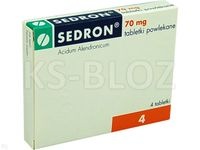
SEDRON 70 mg Film-Coated Tablets

Prescription review online
A doctor will review your case and decide whether a prescription is medically appropriate.

Talk to a doctor about this medicine
Discuss your symptoms and possible next steps in a quick online consultation.



How to use Sedron 70 mg tabletki povlekane
Contents of the leaflet
- Package Leaflet: Information for the Patient
- Sedron, 70 mg, Film-Coated Tablets
- What is Sedron and What is it Used For
- Important Information Before Taking Sedron
- How to Take Sedron
- Possible Side Effects
- How to Store Sedron
- Contents of the Package and Other Information
Package Leaflet: Information for the Patient
Sedron, 70 mg, Film-Coated Tablets
Alendronic Acid
Read the Package Leaflet Carefully Before Taking the Medication, as it Contains Important Information for the Patient
- Keep this leaflet, you may need to read it again.
- If you have any further questions, ask your doctor or pharmacist.
- This medication has been prescribed for you only. Do not pass it on to others. It may harm them, even if their symptoms are the same as yours.
- If you experience any side effects, including those not listed in this leaflet, tell your doctor or pharmacist. See section 4.
Table of Contents of the Leaflet:
- 1. What is Sedron and What is it Used For
- 2. Important Information Before Taking Sedron
- 3. How to Take Sedron
- 4. Possible Side Effects
- 5. How to Store Sedron
- 6. Contents of the Package and Other Information

Not sure if this medicine is right for you?
Discuss your symptoms and treatment with a doctor online.
1. What is Sedron and What is it Used For
What is Sedron?
Sedron contains the active substance alendronic acid. Sedron belongs to a group of non-hormonal medicines called bisphosphonates. Sedron prevents bone loss, mainly in postmenopausal women, and helps to rebuild bone. It reduces the risk of vertebral and hip fractures.
What is Osteoporosis?
Osteoporosis is a disease that causes bones to become thinner and weaker. It is common in postmenopausal women. During menopause, the ovaries stop producing the female hormone estrogen, which helps to maintain bone health. As a result, bone density decreases and bones become weaker. The earlier a woman is postmenopausal, the higher the risk of osteoporosis.
How Can Osteoporosis be Treated?
Osteoporosis can be treated, and it's never too late to start treatment. Sedron not only prevents bone loss but also helps to rebuild lost bone tissue and reduces the risk of vertebral and hip fractures.
2. Important Information Before Taking Sedron
When Not to Take Sedron:
- if you are allergic to alendronic acid or any of the other ingredients of this medicine (listed in section 6),
- if you have a condition of the esophagus (the esophagus is the tube that connects the mouth to the stomach), such as esophageal stricture or difficulty swallowing,
- if you are unable to stand or sit upright for at least 30 minutes,
- if you have low calcium levels in your blood.
If any of the above conditions apply to you, do not take the tablets. You should first talk to your doctor and follow their advice.
Warnings and Precautions
Before starting to take Sedron, you should discuss with your doctor:
- if you have kidney disease,
- if you have difficulty swallowing or indigestion,
- if you have been diagnosed with esophageal Barrett's (a condition related to changes in the cells lining the lower part of the esophagus),
- if you have problems with mineral absorption in the stomach or intestines (malabsorption syndrome),
- if you have low calcium levels in your blood,
- if you have oral health problems, gum disease, a planned tooth extraction, or do not follow proper dental hygiene recommendations,
- if you have cancer,
- if you are undergoing chemotherapy or radiation therapy,
- if you are taking corticosteroids (such as prednisone or dexamethasone),
- if you smoke or have smoked (this may increase the risk of oral problems).
It is recommended to have a dental examination before starting Sedron. It is essential to maintain good oral hygiene during Sedron treatment. You should have regular dental check-ups during treatment. If you experience any oral or dental problems, such as loose teeth, pain, or swelling, contact your doctor or dentist.
Children and Adolescents
Sedron should not be given to children and adolescents under 18 years of age.
Sedron and Other Medicines
Tell your doctor or pharmacist about all medicines you are taking or have recently taken, as well as any medicines you plan to take.
Taking Sedron with Food and Drink
It is likely that food and drinks (including mineral water) will reduce the effectiveness of Sedron if taken at the same time. Therefore, it is essential to follow the instructions in section 3.
Pregnancy and Breastfeeding
Sedron is intended only for postmenopausal women. You should not take Sedron if you are pregnant, think you may be pregnant, or are breastfeeding.
Driving and Using Machines
There have been reports of side effects (such as vision disturbances, dizziness, severe bone, muscle, or joint pain) after taking Sedron, which may affect your ability to drive or operate machinery (see section 4).
Sedron Contains Sodium
This medicine contains less than 1 mmol (23 mg) of sodium per film-coated tablet, which is essentially 'sodium-free'.

Started taking the medicine and have questions?
Discuss your symptoms and treatment with a doctor online.
3. How to Take Sedron
Always take this medicine exactly as your doctor has told you. If you are not sure, ask your doctor or pharmacist.
Recommended Dose of Sedron is One Tablet Once a Week.
Read the following instructions carefully to ensure you get the most out of your treatment.
- 1. Choose a day of the week that best fits your schedule. Take one Sedron tablet on the same day every week.
To help the tablet reach your stomach and reduce the risk of local irritation of the esophagus (the esophagus is the tube that connects the mouth to the stomach), follow points 2, 3, 4, 5, and 6.
- 2. After getting up from bed on the designated day, before eating or drinking anything, or taking any other medicine, swallow the Sedron tablet with a full glass of plain water (not mineral water, at least 200 ml).
- Do not take with mineral water (still or sparkling).
- Do not take with coffee or tea.
- Do not take with fruit juices or milk.
Do not chew or suck the tablets and do not let them dissolve in your mouth.
- 3. After swallowing the tablet, do not lie down - stay upright (sitting, standing, or walking) for at least 30 minutes, and do not lie down until after your first food of the day.
- 4. Do not take Sedron at bedtime or before getting up for the day.
- 5. If you experience difficulty or pain when swallowing, chest pain, or new or worsening heartburn, stop taking Sedron and contact your doctor immediately.
- 6. After swallowing the Sedron tablet, wait at least 30 minutes before taking your first food, drink, or other oral medications, including antacids, calcium, and vitamin supplements. Sedron is effective only if taken on an empty stomach.
How Long to Take Sedron
The optimal duration of treatment has not been established. Your doctor will periodically reassess the need for continued treatment, especially after 5 years or more of treatment.
Overdose of Sedron
If you accidentally take too many Sedron tablets, drink a full glass of milk and contact your doctor immediately. Do not lie down or induce vomiting.
Missing a Dose of Sedron
If you miss a dose, take one Sedron tablet the next morning after you remember. Do not take two tablets on the same day. Then return to your original schedule of taking one tablet once a week on the same day.
Stopping Sedron Treatment
It is essential to continue taking Sedron for the entire period prescribed by your doctor. Sedron is effective in treating osteoporosis only if you continue to take the tablets.
4. Possible Side Effects
Like all medicines, Sedron can cause side effects, although not everybody gets them.
If you experience any of the following symptoms, stop taking Sedron and contact your doctor immediately:
- Common (may affect up to 1 in 10 people): heartburn; difficulty swallowing; pain when swallowing; esophageal ulcers (which may cause chest pain, heartburn, or difficulty swallowing).
Rare (may affect up to 1 in 1,000 people):
- allergic reactions, such as hives, face, lip, tongue, and/or throat swelling, potentially leading to difficulty breathing or swallowing (angioedema).
- rare cases of potentially life-threatening skin rashes have been reported with alendronate, appearing as skin conditions with painful blisters and bleeding in the mouth, eyes, skin, and genitals (Stevens-Johnson syndrome) or severe skin reactions, which start with the formation of painful red areas, then large blisters, and end with peeling of the skin layers. This is accompanied by fever and chills, muscle and general feeling of being unwell (toxic epidermal necrolysis).
- mouth and/or jaw pain, swelling, or ulcers in the mouth, numbness or a feeling of heaviness in the jaw or loosening of teeth. These may be symptoms of jawbone damage (jaw necrosis), usually associated with delayed healing and local infection, often following tooth extraction.
- in patients treated long-term for osteoporosis, rare cases of atypical femoral fractures have occurred. If you experience pain, weakness, or discomfort in the thigh, hip, or groin, contact your doctor, as these may be early signs of a possible femoral fracture.
- severe bone, muscle, and/or joint pain.
Very Rare (may affect up to 1 in 10,000 people):
- ear pain, discharge from the ear, and/or ear infection. These may be symptoms of bone damage in the ear. If you experience such symptoms, tell your doctor.
Other Possible Side Effects:
- Very Common (may affect more than 1 in 10 people): muscle, bone, or joint pain, which can be severe.
Common (may affect up to 1 in 10 people):
- joint swelling
- stomach pain, discomfort in the stomach, or heartburn after eating, constipation, feeling full or bloated, diarrhea
- headache
- hair loss
- weakness
- dizziness
- swelling of hands or feet
- itching
Uncommon (may affect up to 1 in 100 people):
- nausea, vomiting
- irritation or inflammation of the esophagus or stomach
- black or tarry stools
- rash, redness of the skin
- taste disturbances
- blurred vision, eye pain, or redness
- transient flu-like symptoms, such as muscle pain, general feeling of being unwell, sometimes with fever, usually at the start of treatment
Rare (may affect up to 1 in 1,000 people):
- symptoms of low calcium levels in the blood, such as muscle cramps and/or tingling sensation in the fingers and around the mouth
- stomach ulcers or gastrointestinal ulcers (sometimes serious or leading to bleeding)
- esophageal stricture
- skin rash worsening in sunlight
- mouth ulcers, occurring when tablets are chewed or sucked
Reporting Side Effects
If you experience any side effects, including those not listed in this leaflet, tell your doctor or pharmacist, or nurse. You can also report side effects directly to the Department of Medicines Monitoring, Office for Registration of Medicinal Products, Medical Devices, and Biocidal Products, Al. Jerozolimskie 181C, 02-222 Warsaw, Tel.: 22 49-21-301, Fax: 22 49-21-309, website: https://smz.ezdrowie.gov.pl, or to the marketing authorization holder. By reporting side effects, you can help provide more information on the safety of this medicine.
5. How to Store Sedron
Keep this medicine out of the sight and reach of children.
Store in a temperature below 25°C.
Do not use this medicine after the expiry date stated on the packaging.
The expiry date refers to the last day of that month.
Medicines should not be disposed of via wastewater or household waste. Ask your pharmacist how to dispose of medicines no longer required. These measures will help protect the environment.
6. Contents of the Package and Other Information
What Sedron Contains
- The active substance is alendronic acid. Each film-coated tablet contains 70 mg of alendronic acid.
- The other ingredients are: tablet core:microcrystalline cellulose (E 460), silica colloidal anhydrous (E 551), sodium croscarmellose (E 468), magnesium stearate (E 572). tablet coating (Opadry QX White 321A180025):copolymer of methacrylic acid and ethyl acrylate (E 553b), titanium dioxide (E 171), glycerol monokaprylokaprylate, polyvinyl alcohol (partially hydrolyzed) (E 1203).
What Sedron Looks Like and Contents of the Package
Sedron film-coated tablets are white, round, biconvex, with the symbol "M14" engraved on one side.
The package contains 2, 4, or 12 film-coated tablets in blisters.
Not all pack sizes may be marketed.
Marketing Authorization Holder
GEDEON RICHTER POLSKA Sp. z o.o., ul. ks. J. Poniatowskiego 5, 05-825 Grodzisk Mazowiecki, Poland
Manufacturer
GEDEON RICHTER POLSKA Sp. z o.o., ul. ks. J. Poniatowskiego 5, 05-825 Grodzisk Mazowiecki, Poland, Gedeon Richter Plc., Gyömrői út 19-21, 1103 Budapest, Hungary
Date of Last Revision of the Leaflet: June 2021
((logo of the marketing authorization holder))
((pharmaceutical company logo))
- Country of registration
- Dosage formTablets, 70 mg
- ATC codeM05BA04
- Active substance
- Prescription requiredYes
- Manufacturer
- ImporterGedeon Richter Plc. Gedeon Richter Polska Sp. z o.o.
- This information is for reference only and does not constitute medical advice. Always consult a doctor before taking any medication. Oladoctor is not responsible for medical decisions based on this content.
- Alternatives to Sedron 70 mg tabletki povlekaneDosage form: Tablets, 70 mgActive substance: alendronic acidManufacturer: Cemelog BRS Kft. Farmacol S.A. Ranbaxy Ireland Ltd.Prescription requiredDosage form: Tablets, 70 mgActive substance: alendronic acidPrescription requiredDosage form: Tablets, 70 mgActive substance: alendronic acidManufacturer: Bluefish Pharmaceuticals ABPrescription required
Online doctors for Sedron 70 mg tabletki povlekane
Discuss questions about Sedron 70 mg tabletki povlekane, including use, safety considerations and prescription review, subject to medical assessment and local regulations.



Get Sedron 70 mg tabletki povlekane Prescription Online
Fill in a 2-min form
Tell us your symptoms, history, and what medicine you're requesting.
Pick a doctor or let us assign
Choose a specialist or we'll match you with the next available doctor.
Doctor reviews your case
Usually within 30 minutes. They may ask follow-up questions via chat.
Collect from any pharmacy
Electronic prescription sent to your email — valid across Spain.
Frequently Asked Questions
Sedron 70 mg tabletki povlekane requires a prescription in Poland. You can check with a doctor online whether this medicine may be appropriate for your situation.
The active ingredient in Sedron 70 mg tabletki povlekane is alendronic acid. This information helps identify medicines with the same composition but different brand names.
Sedron 70 mg tabletki povlekane is manufactured by Gedeon Richter Plc. Gedeon Richter Polska Sp. z o.o.. Pharmacy brands and packaging may differ depending on the distributor.
Doctors such as Family doctors, Psychiatrists, Dermatologists, Cardiologists, Endocrinologists, Gastroenterologists, Pulmonologists, Nephrologists, Rheumatologists, Hematologists, Infectious disease physicians, Allergists, Geriatricians, Paediatricians, Oncologists may assess whether Sedron 70 mg tabletki povlekane is appropriate, depending on your situation and local regulations. You can book an online consultation to discuss your symptoms and possible next steps.
Spain has a well-developed healthcare infrastructure across major cities such as Madrid, Barcelona, Valencia, and Seville. Pharmacies are widely available and operate under strict regulations, ensuring access to prescribed medications.
You can buy Sedron 70 mg tabletki povlekane in Madrid, Barcelona, Seville, or Valencia at any local pharmacy with a valid prescription.
To obtain a prescription, you can use Oladoctor:
Other medicines with the same active substance (alendronic acid) include Alendran 70, Alendrogen, Alendronat Bluefish. These may have different brand names or formulations but contain the same therapeutic ingredient. Always consult a doctor before switching or starting a new medicine.
