


Pluvicto 1 000 MBq/ml solución inyectable

Revisión de receta online
Un médico revisará tu caso y determinará si la prescripción es médicamente apropiada.

Habla con un médico sobre este medicamento
Comenta tus síntomas y las opciones de tratamiento en una consulta online.



Cómo usar PLUVICTO 1 000 MBQ/ML SOLUCION INYECTABLE Y PARA PERFUSION
Contenido del prospecto
- Introducción
- Qué es Pluvicto y para qué se utiliza
- Qué necesita saber antes de que le administren Pluvicto
- Cómo se administra Pluvicto
- Posibles efectos adversos
- Conservación de Pluvicto
- Contenido del envase e información adicional
Introducción
Prospecto: información para el paciente
Pluvicto 1000MBq/mL solución inyectable y para perfusión
lutecio (177Lu) vipivotida tetraxetán
Este medicamento está sujeto a seguimiento adicional, lo que agilizará la detección de nueva información sobre su seguridad. Puede contribuir comunicando los efectos adversos que pudiera usted tener. La parte final de la sección 4 incluye información sobre cómo comunicar estos efectos adversos.
Lea todo el prospecto detenidamente antes de empezar a usar este medicamento, porque contiene información importante para usted.
- Conserve este prospecto, ya que puede tener que volver a leerlo.
- Si tiene alguna duda, consulte a su médico nuclear que supervisará el procedimiento.
- Si experimenta efectos adversos, consulte a su médico nuclear, incluso si se trata de efectos adversos que no aparecen en este prospecto. Ver sección 4.
Contenido del prospecto
- Qué es Pluvicto y para qué se utiliza
- Qué necesita saber antes de que le administren Pluvicto
- Cómo se administra Pluvicto
- Posibles efectos adversos
- Conservación de Pluvicto
- Contenido del envase e información adicional
1. Qué es Pluvicto y para qué se utiliza
Qué es Pluvicto
Pluvicto contiene lutecio (177Lu) vipivotida tetraxetán. Este medicamento es un radiofármaco sólo para tratamiento.
Para qué se utiliza Pluvicto
Pluvicto se utiliza en adultos con cáncer de próstata resistente a la castración progresivo que se ha diseminado a otras partes del organismo (metastásico) y que ya ha sido tratado con otros tratamientos contra el cáncer. El cáncer de próstata resistente a la castración es un cáncer de próstata (glándula del sistema reproductor masculino) que no responde al tratamiento para reducir las hormonas masculinas. Pluvicto se usa si las células de cáncer de próstata tienen una proteína en su superficie llamada antígeno prostático específico de membrana (PSMA).
Cómo funciona Pluvicto
Pluvicto se une a PSMA que se encuentra en la superficie de las células del cáncer de próstata. Una vez unida, la sustancia radiactiva en Pluvicto, lutecio-177, emite una radiación que provoca la muerte de las células cancerosas de la próstata.
Su médico le realizará pruebas para ver si PSMA está presente en la superficie de las células cancerosas. Es más probable que su cáncer responda al tratamiento con Pluvicto si el resultado de la prueba es positivo.
El uso de Pluvicto implica exposición a cantidades de radiactividad. Su médico y el médico nuclear han considerado que el beneficio clínico que usted obtendrá del procedimiento con el radiofármaco supera el riesgo de la radiación.
Si tiene cualquier duda sobre cómo funciona Pluvicto o por qué se le ha recetado este medicamento a usted, consulte a su médico nuclear.

¿No estás seguro de si este medicamento es adecuado para ti?
Comenta tus síntomas y tratamiento con un médico online.
2. Qué necesita saber antes de que le administren Pluvicto
Siga atentamente todas las instrucciones que le dé su médico nuclear. Pueden diferir de la información general contenida en este prospecto.
No le deben administrar Pluvicto
- si es alérgico a lutecio (177Lu) vipivotida tetraxetán o a alguno de los demás componentes de este medicamento (incluidos en la sección 6).
Advertencias y precauciones
Si le aplica alguna de estas condiciones, informe a su médico nuclear antes de recibir Pluvicto:
- si tiene niveles bajos de ciertos tipos de células en la sangre (células rojas de la sangre, células blancas de la sangre, neutrófilos, plaquetas)
- si tiene o ha tenido cansancio, debilidad, piel pálida, dificultad para respirar, sangrado o hematomas espontáneos o su sangrado dura más de lo habitual, o infecciones frecuentes con signos como fiebre, escalofríos, dolor de garganta o úlceras en la boca (posibles signos de mielosupresión [una condición en la que la médula ósea no puede producir suficientes células sanguíneas])
- si tiene o ha tenido problemas de riñón
- si tiene o ha tenido cualquier otro tipo de cáncer o tratamiento para el cáncer, ya que Pluvicto contribuye a su exposición general a la radiación acumulada a largo plazo
Antes de la administración de Pluvicto usted debe:
- beber agua abundantemente para mantenerse hidratado y orinar con la mayor frecuencia posible durante las primeras horas después de la administración
Niños y adolescentes
La seguridad y eficacia de este medicamento en niños y adolescentes menores de 18 años aún no se han establecido. Este medicamento no se debe administrar a niños o adolescentes menores de 18 años porque no hay datos disponibles en este grupo de edad.
Embarazo, lactancia y fertilidad
La seguridad y eficacia de Pluvicto no se han establecido en mujeres. Pluvicto no está destinado para su uso en mujeres.
Antes de recibir Pluvicto, informe a su médico nuclear si es sexualmente activo, ya que todos los radiofármacos, incluido Pluvicto, tienen el potencial de causar daño en el feto.
Fertilidad
Pluvicto podría causar infertilidad. Consulte a su médico nuclear cómo le puede afectar esto, especialmente si está planeando tener hijos en el futuro. Es posible que desee buscar asesoramiento sobre la conservación de los espermatozoides antes de comenzar el tratamiento.
Anticoncepción en hombres
- Usted debe evitar la actividad sexual durante los 7 días posteriores a la administración de Pluvicto.
- Usted debe evitar el embarazo y debe usar un preservativo en las relaciones sexuales a lo largo del tratamiento con Pluvicto y durante 14 semanas después de su última dosis.
- Informe inmediatamente a su médico de medicina nuclear si engendra un hijo en cualquier momento durante este período de tiempo.
Conducción y uso de máquinas
Se considera improbable que Pluvicto afecte la capacidad de conducir y utilizar máquinas.
Pluvicto contiene sodio
Este medicamento contiene hasta 88,75 mg de sodio (componente principal de la sal de mesa/para cocinar) en cada vial. Esto equivale al 4,4% de la ingesta diaria máxima de sodio recomendada para un adulto.
3. Cómo se administra Pluvicto
Hay normas estrictas sobre el uso, manipulación y eliminación de radiofármacos. Pluvicto se utilizará únicamente en áreas controladas especiales. Este radiofármaco sólo se manipulará y administrará por personal formado y cualificado para usarlo de forma segura. Esas personas pondrán especial cuidado en el uso seguro de este radiofármaco y le informarán de sus acciones.
Cuánto Pluvicto se administra
La pauta de tratamiento recomendada de Pluvicto es de 7 400 MBq (megabecquerel, unidad utilizada para expresar radiactividad), que se administra aproximadamente cada 6 semanas hasta un total de 6 dosis.
Administración de Pluvicto y realización del procedimiento
Pluvicto se administra directamente en una vena.
Duración del procedimiento
Su médico nuclear le informará de la duración habitual del procedimiento.
Si tiene dudas sobre cuánto tiempo recibirá Pluvicto, consulte con su médico nuclear.
Supervisión del tratamiento
Su médico nuclear le realizará análisis de sangre antes y durante el tratamiento para comprobar su estado y detectar cualquier efecto secundario lo antes posible. Según los resultados, su médico nuclear puede decidir retrasar, cambiar o suspender su tratamiento con Pluvicto si fuera necesario.
Después de la administración de Pluvicto, usted deberá:
- beber mucha agua durante 2 días para mantenerse hidratado y orinar con la mayor frecuencia posible para eliminar el radiofármaco de su organismo
Como que se trata de un medicamento radiactivo, debe seguir las instrucciones que se describen a continuación para minimizar la exposición a la radiación de otras personas, a menos que su médico nuclear le indique lo contrario.
Contacto con otras personas que conviven con usted, niños y/o mujeres embarazadas
- Limite el contacto estrecho (menos de 1 metro) con:
- las personas que conviven con usted durante 2 días
- niños y mujeres embarazadas durante 7 días
- Duerma en una habitación separada de:
- otras personas convivientes durante 3 días
- niños durante 7 días
- mujeres embarazadas durante 15 días
- Evite la actividad sexual durante 7 días
- Evite el embarazo y use un preservativo en las relaciones sexuales durante el tratamiento con Pluvicto y durante 14 semanas después de su última dosis.
Uso de inodoros
Tome precauciones especiales para evitar la contaminación durante los 2 días después de la administración:
- Debe sentarse siempre cuando use el inodoro.
- Es esencial que use papel higiénico cada vez que use el inodoro.
- Lave siempre bien sus manos después de haber usado el inodoro.
- Tire todas las toallitas y/ papel higiénico al inodoro inmediatamente después de usarlos.
- Tire al inodoro los pañuelos de papel o cualquier otro material que contenga alguna sustancia de su cuerpo, tales como sangre, orina o heces. Las cosas que no se pueden tirar al inodoro, como compresas, se pondrán en bolsas de basura de plástico separadas (conforme a la recomendación que se muestra en la sección «Recomendaciones para el desecho» más abajo).
- Cualquier equipo médico que pudiera contaminarse con sus fluidos corporales (p.ej. bolsas de catéteres, bolsas de colostomía, orinales, boquillas de agua) se debe vaciar inmediatamente en el inodoro y se debe limpiar después.
Ducha y lavandería
- Dúchese todos los días como mínimo hasta 7 días después de la administración.
- Lave la ropa interior, pijamas, sábanas y prendas de vestir que contengan sudor, sangre u orina por separado del resto de la colada de otras personas de su hogar, utilizando un ciclo de lavado estándar. No es necesario usar lejía ni realizar aclarados extra.
Personas cuidadoras
Durante 2‑3 días después de la administración:
- Las personas que deben permanecer en la cama o tienen movilidad reducida recibirán preferentemente asistencia de un cuidador. Se recomienda que cuando se preste asistencia en el cuarto de baño el cuidador lleve guantes desechables.
- Los cuidadores que retiran vómitos, sangre, orina o heces deben llevar guantes de plástico que deben desechar en una bolsa de desechos de plástico separada (ver “Recomendaciones para el desecho” más adelante).
Recomendaciones para el desecho
- Todos los materiales que se vayan a desechar deben tirarse en una bolsa de basura de plástico separada que se use solo con este propósito.
- Guarde las bolsas de desechos de plástico separadas del resto de la basura y mantenga las bolsas fuera del alcance de los niños y animales.
- Un miembro del personal del hospital le comentará cómo y cuándo puede deshacerse de estas bolsas de desechos.
Hospitalización y atención de urgencia
- Si por alguna razón requiere asistencia médica de urgencia o una hospitalización no planeada en los 7 primeros días después de la administración, debe informar a los profesionales sanitarios acerca del nombre, la fecha y la dosis de su tratamiento radiactivo.
Otras precauciones
- El médico nuclear le informará si es necesario que tome alguna otra precaución especial después de recibir este medicamento. Consulte con su médico nuclear si tiene alguna duda.
Si se le ha administrado más Pluvicto del que debe
Es poco probable que se produzca una sobredosis porque sólo recibirá Pluvicto en dosis controladas meticulosamente por el médico nuclear que supervisa el procedimiento. Una sobredosis es poco probable. Sin embargo, en el caso de una sobredosis, recibirá el tratamiento adecuado.
Si olvidó recibir Pluvicto
Si no acudió a una cita para recibir Pluvicto, hable con su médico nuclear lo antes posible para reprogramarla.
Si tiene cualquier otra duda sobre el uso de Pluvicto, pregunte al médico nuclear que supervisa el procedimiento.

¿Has empezado a tomar el medicamento y tienes preguntas?
Comenta tus síntomas y tratamiento con un médico online.
4. Posibles efectos adversos
Al igual que todos los medicamentos, este medicamento puede producir efectos adversos, aunque no todas las personas los sufran.
Algunos efectos adversos pueden ser graves
Si experimenta cualquier efecto adverso grave, informe a su médico nuclear inmediatamente.
Muy frecuentes:pueden afectar a más de 1 de cada 10 personas
- cansancio, debilidad, piel pálida o dificultad para respirar (posibles signos de niveles bajos de glóbulos rojos [anemia])
- sangrado o hematomas espontáneos o su sangrado dura más de lo habitual (posibles signos de niveles bajos de plaquetas [trombocitopenia])
- infecciones frecuentes con signos como fiebre, dolor de garganta o úlceras en la boca (posibles signos de niveles bajos de glóbulos blancos [leucopenia, linfopenia]).
Frecuentes:pueden afectar hasta 1 de cada 10 personas
- orinar con menos frecuencia o en cantidades mucho más pequeñas de lo habitual (posibles signos de problemas de riñon [lesión renal aguda])
- cansancio, debilidad, piel pálida, dificultad para respirar, sangrado o hematomas espontáneos o su sangrado dura más de lo habitualo infecciones frecuentes con signos como fiebre, escalofríos, dolor de garganta o úlceras en la boca (posibles signos de niveles bajos de células sanguíneas [pancitopenia])
Otros efectos adversos posibles
Otros efectos adversos incluyen los listados más abajo. Si esos efectos adversos llegan a ser graves, informe a su médico nuclear.
Muy frecuentes:pueden afectar a más de 1 de cada 10 personas
- cansancio (fatiga)
- boca seca
- náuseas
- pérdida del apetito
- cambios en las deposiciones (estreñimiento o diarrea)
- vómitos
- orinar frecuentemente con dolor o sensación de ardor (infección del tracto urinario)
- dolor abdominal
- pérdida de peso
Frecuentes:pueden afectar hasta 1 de cada 10 personas
- hinchazón de manos, tobillos o pies (edema periférico)
- mareo
- dolor de cabeza
- alteración del sentido del gusto (disguesia)
- fiebre (pirexia)
- ojos secos
- mareo, con sensación de dar vueltas (vértigo)
Comunicación de efectos adversos
Si experimenta cualquier tipo de efecto adverso, consulte a su médico nuclear, incluso si se trata de posibles efectos adversos que no aparecen en este prospecto. También puede comunicarlos directamente a través del sistema nacional de notificación incluido en el Apéndice V. Mediante la comunicación de efectos adversos usted puede contribuir a proporcionar más información sobre la seguridad de este medicamento.
5. Conservación de Pluvicto
No tendrá que almacenar este medicamento. Este medicamento se almacena bajo la responsabilidad del especialista en instalaciones apropiadas. El almacenamiento de radiofármacos se realizará conforme a la normativa nacional sobre materiales radiactivos.
La siguiente información está destinada únicamente al especialista:
- Mantener este medicamento fuera de la vista y del alcance de los niños.
- No congelar.
- Mantener en el envase original para protegerse de la radiación ionizante (blindaje con plomo).
- Pluvicto no se debe utilizar después de la fecha y hora de caducidad que aparecen en las etiquetas del contenedor de blindaje de plomo y del vial después de CAD.
- La eliminación del medicamento no utilizado y de todos los materiales que hayan estado en contacto con él se realizará de acuerdo con la normativa local.
6. Contenido del envase e información adicional
Composición de Pluvicto
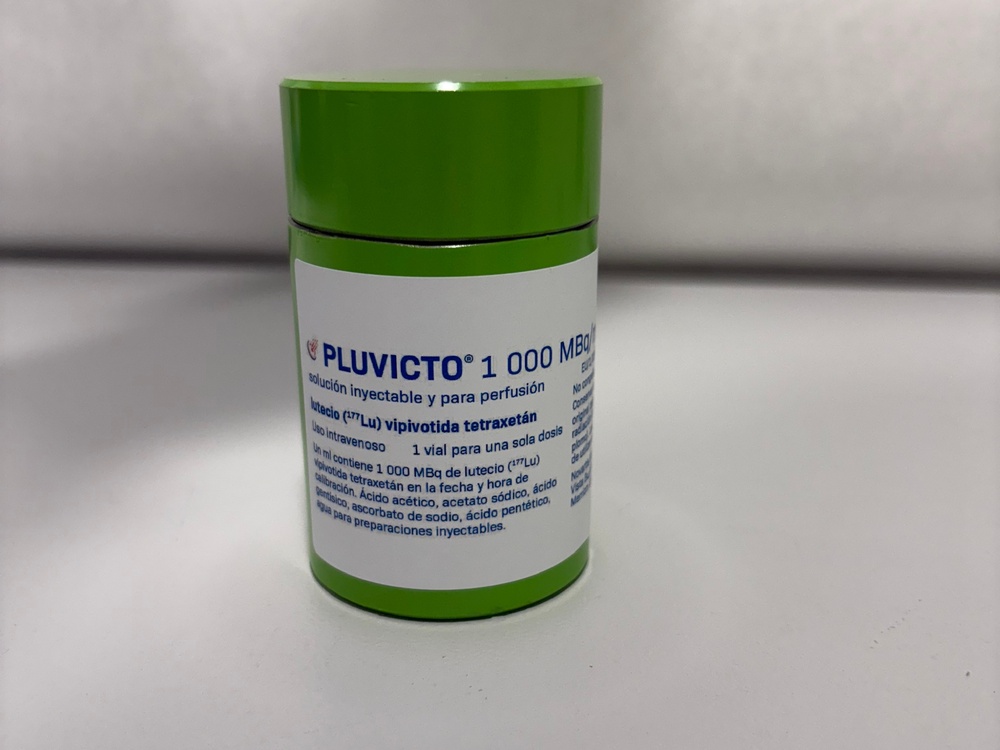
- El principio activo es lutecio (177Lu) vipivotida tetraxetán. Un ml de solución contiene 1 000 MBq de lutecio (177Lu) vipivotida tetraxetán en la fecha y hora de calibración.
- Los demás componentes son: ácido acético, acetato sódico, ácido gentísico, ascorbato de sodio, ácido pentético, agua para preparaciones inyectables (ver sección 2 “Pluvicto contiene sodio”).
Aspecto de Pluvicto y contenido del envase
Pluvicto es una solución transparente, incolora o ligeramente amarilla, que se suministra en un vial de vidrio tipo I incoloro y transparente, cerrado con un tapón de caucho de bromobutilo y un sello de aluminio.
Cada vial contiene un volumen de solución que puede oscilar entre 7,5 ml y 12,5 ml correspondiente a una radiactividad de 7 400 MBq ±10% en la fecha y hora de administración.
El vial está dentro de un contenedor plomado como blindaje protector.
Titular de la autorización de comercialización
Novartis Europharm Limited
Vista Building
Elm Park, Merrion Road
Dublin 4
Irlanda
Responsable de la fabricación
Advanced Accelerator Applications (Italy) S.R.L.
Via Ribes 5
10010
Colleretto Giacosa (TO)
Italia
Advanced Accelerator Applications Ibérica, S.L.U.
Polígono Industrial la Cuesta – Sector 3
Parcelas 1 y 2 La Almunia de Doña Godina
50100 Zaragoza
España
Pueden solicitar más información respecto a este medicamento dirigiéndose al representante local del titular de la autorización de comercialización:
België/Belgique/Belgien Novartis Pharma N.V. Tél/Tel: +32 2 246 16 11 | Lietuva SIA Novartis Baltics Lietuvos filialas Tel: +370 5 269 16 50 |
| Luxembourg/Luxemburg Novartis Pharma N.V. Tél/Tel: +32 2 246 16 11 |
Ceská republika Novartis s.r.o. Tel: +420 225 775 111 | Magyarország Novartis Hungária Kft. Tel.: +36 1 457 65 00 |
Danmark Novartis Sverige AB Tel: +46 8 732 32 00 | Malta Novartis Pharma Services Inc. Tel: +356 2122 2872 |
Deutschland Novartis Pharma GmbH Tel: +49 911 273 0 | Nederland Novartis Pharma B.V. Tel: +31 88 04 52 111 |
Eesti SIA Novartis Baltics Eesti filiaal Tel: +372 66 30 810 | Norge Novartis Sverige AB Tlf: +46 8 732 32 00 |
Ελλ?δα ΒΙΟΚΟΣΜΟΣ ΑΕΒΕ Τηλ: +30 22920 63900 ? Novartis (Hellas) A.E.B.E. Τηλ: +30 210 281 17 12 | Österreich Novartis Pharma GmbH Tel: +43 1 86 6570 |
España Advanced Accelerator Applications Ibérica, S.L.U. Tel: +34 97 6600 126 | Polska Advanced Accelerator Applications Polska Sp. z o.o. Tel.: +48 22 275 56 47 |
France Advanced Accelerator Applications Tél: +33 1 55 47 63 00 | Portugal Novartis Farma - Produtos Farmacêuticos, S.A. Tel: +351 21 000 8600 |
Hrvatska Novartis Hrvatska d.o.o. Tel. +385 1 6274 220 | România Novartis Pharma Services Romania SRL Tel: +40 21 31299 01 |
Ireland Novartis Ireland Limited Tel: +353 1 260 12 55 | Slovenija Novartis Pharma Services Inc. Tel: +386 1 300 75 50 |
Ísland Novartis Sverige AB Sími: +46 8 732 32 00 | Slovenská republika Novartis Slovakia s.r.o. Tel: +421 2 5542 5439 |
Italia Novartis Farma S.p.A. Tel: +39 02 96 54 1 | Suomi/Finland Novartis Sverige AB Puh/Tel: +46 8 732 32 00 |
Κ?προς ΒΙΟΚΟΣΜΟΣ ΑΕΒΕ Τηλ: +30 22920 63900 ? Novartis Pharma Services Inc. Τηλ: +357 22 690 690 | Sverige Novartis Sverige AB Tel: +46 8 732 32 00 |
Latvija SIA Novartis Baltics Tel: +371 67 887 070 |
Fecha de la última revisión de este prospecto
Otras fuentes de información
La información detallada de este medicamento está disponible en la página web de la Agencia Europea de Medicamentos: http://www.ema.europa.eu
‑‑‑‑‑‑‑‑‑‑‑‑‑‑‑‑‑‑‑‑‑‑‑‑‑‑‑‑‑‑‑‑‑‑‑‑‑‑‑‑‑‑‑‑‑‑‑‑‑‑‑‑‑‑‑‑‑‑‑‑‑‑‑‑‑‑‑‑‑‑‑‑‑‑‑‑‑‑‑‑‑‑‑‑‑‑‑‑‑‑‑‑‑‑‑‑‑‑‑‑‑‑‑‑‑‑‑‑‑‑‑‑‑‑‑‑
Esta información está destinada únicamente a profesionales sanitarios:
La ficha técnica completa de Pluvicto se incluye como un documento separado en el envase del producto, con el objetivo de proporcionar a los profesionales sanitarios otra información científica y práctica adicional sobre la administración y el uso de este radiofármaco.
Por favor, consulte la ficha técnica.
- País de registro
- Forma farmacéuticaINYECTABLE, 1 000 MBq/ml
- Código ATCV10XX05
- Principio activo
- Requiere recetaSí
- Fabricante
- ComposiciónACETATO SODICO (0,41 mg/ml mg), ASCORBATO DE SODIO (50,0 mg/ml mg)
- Esta información es de carácter general y no sustituye la consulta con un profesional sanitario.
- Alternativas a PLUVICTO 1 000 MBQ/ML SOLUCION INYECTABLE Y PARA PERFUSIONForma farmacéutica: INYECTABLE PERFUSION, 370 MBq/mlPrincipio activo: Lutecio (177lu) oxodotreotidaFabricante: Advanced Accelerator ApplicationsRequiere recetaForma farmacéutica: INYECTABLE, 1000 kBq/ml a fecha de referenciaPrincipio activo: radium (223Ra) dichlorideFabricante: Bayer AgRequiere recetaForma farmacéutica: RADIOFARMACO, 1,6 mg/mlPrincipio activo: ibritumomab tiuxetan (90Y)Fabricante: Ceft Biopharma S.R.O.Requiere receta
Médicos online para PLUVICTO 1 000 MBQ/ML SOLUCION INYECTABLE Y PARA PERFUSION
Comenta la dosis, los posibles efectos secundarios, interacciones, contraindicaciones o la revisión de receta de PLUVICTO 1 000 MBQ/ML SOLUCION INYECTABLE Y PARA PERFUSION, sujeto a valoración médica y a la normativa local.









Preguntas frecuentes
PLUVICTO 1 000 MBQ/ML SOLUCION INYECTABLE Y PARA PERFUSION requiere receta en España. Puedes confirmarlo con un médico online según tu caso.
El principio activo de PLUVICTO 1 000 MBQ/ML SOLUCION INYECTABLE Y PARA PERFUSION es lutetium (177Lu) vipivotide tetraxetan. Esta información ayuda a identificar medicamentos con la misma composición pero con diferentes nombres comerciales.
PLUVICTO 1 000 MBQ/ML SOLUCION INYECTABLE Y PARA PERFUSION es fabricado por Novartis Europharm Limited. La marca y el envase pueden variar según el distribuidor.
Los Médicos de familia, Psiquiatras, Dermatólogos, Cardiólogos, Endocrinólogos, Gastroenterólogos, Neumólogos, Nefrólogos, Reumatólogos, Hematólogos, Infectólogos, Alergólogos, Geriatras, Pediatras, Oncólogos pueden valorar la prescripción de PLUVICTO 1 000 MBQ/ML SOLUCION INYECTABLE Y PARA PERFUSION cuando esté clínicamente indicado. Puedes reservar una videoconsulta para comentar tu caso y las opciones de tratamiento.
La receta la emite un médico tras valorar tu estado de salud. En España, PLUVICTO 1 000 MBQ/ML SOLUCION INYECTABLE Y PARA PERFUSION se dispensa en las farmacias con esa receta médica. Una consulta online no garantiza su emisión: la decisión corresponde siempre al médico.
Para solicitar una valoración puedes usar Oladoctor:
Otros medicamentos con el mismo principio activo (lutetium (177Lu) vipivotide tetraxetan) incluyen LUTATHERA 370 MBQ/ML SOLUCION PARA PERFUSION, Xofigo 1100 kBq/ml solucion inyectable, ZEVALIN 1,6 mg/ml, EQUIPO REACTIVO PARA LA PREPARACION DE UN RADIOFARMACO PARA PERFUSION. Pueden tener diferentes nombres comerciales o formulaciones, pero contienen el mismo componente terapéutico. Consulta siempre con un médico antes de cambiar o iniciar un nuevo medicamento.
