



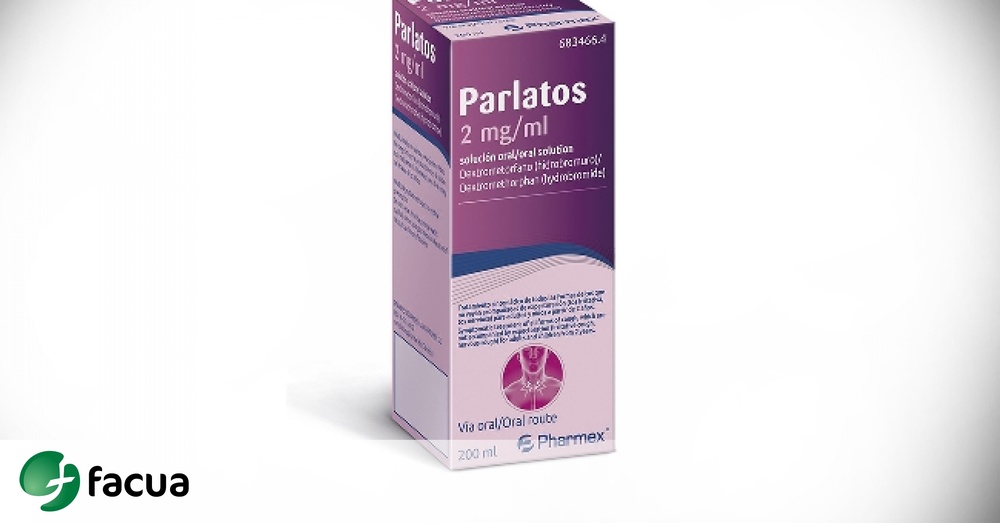
PARLATOS 2,6 MG/ML SOLUCIÓN ORAL

Revisión de receta online
Un médico revisará tu caso y determinará si la prescripción es médicamente apropiada.

Habla con un médico sobre este medicamento
Comenta tus síntomas y las opciones de tratamiento en una consulta online.



Cómo usar PARLATOS 2,6 MG/ML SOLUCIÓN ORAL
Contenido del prospecto
- Introducción
- Prospecto
- Qué es Parlatos y para qué se utiliza
- Que necesita saber antes de empezar a tomar Parlatos
- Conducción y uso de máquinas
- Cómo tomar Parlatos
- Posibles efectos adversos
- Conservación de Parlatos
- Contenido del envase e información adicional
- Composición de Parlatos
- Aspecto del producto y contenido del envase
Introducción
Prospecto
Parlatos 2,6 mg/ml solución oral
Dextrometorfano hidrobromuro

¿No estás seguro de si este medicamento es adecuado para ti?
Comenta tus síntomas y tratamiento con un médico online.
Lea todo el prospecto detenidamente antes de empezar a tomar este medicamento, porque contiene información importante para usted.
Siga exactamente las instrucciones de administración del medicamento contenidas en este prospecto o las indicadas por su médico o farmacéutico.
- Conserve este prospecto, ya que puede tener que volver a leerlo.
- Si necesita consejo o más información, consulte a su farmacéutico.
- Si experimenta efectos adversos, consulte a su médico o farmacéutico, incluso si se trata de efectos adversos que no aparecen en este prospecto. Ver sección 4.
- Debe consultar a un médico si empeora o si no mejora después de 7 días de tratamiento, o si la tos va acompañada de fiebre alta, erupciones en la piel o dolor de cabeza persistente.
Contenido del prospecto
- Qué es Parlatos y para qué se utiliza
- Qué necesita saber antes de empezar a tomar Parlatos
- Cómo tomar Parlatos
- Posibles efectos adversos
5 Conservación de Parlatos
- Contenido del envase e información adicional
1. Qué es Parlatos y para qué se utiliza
El dextrometorfano, principio activo de este medicamento, es un antitusivo que inhibe el reflejo de la tos.
Está indicado para el tratamiento sintomático de la tos que no vaya acompañada de expectoración (tos irritativa, tos nerviosa) en adultos y niños a partir de 2 años.
Debe consultar a un médico si empeora o si no mejora después de 7 días de tratamiento.

¿Has empezado a tomar el medicamento y tienes preguntas?
Comenta tus síntomas y tratamiento con un médico online.
2. Que necesita saber antes de empezar a tomar Parlatos
No tomeParlatos
- Si es alérgico al dextrometorfano o a alguno de los demás componentes de este medicamento (incluidos en la sección 6).
- En caso de tos persistente o crónica, como la debida al tabaco, asma o enfisema, o cuando la tos va acompañada de abundantes secreciones.
- Niños menores de 2 años.
- Si tiene asma bronquial.
- Si tiene enfermedad pulmonar obstructiva crónica (EPOC).
- Si tiene neumonía.
- Si tiene insuficiencia respiratoria.
- Si tiene depresión respiratoria.
- Si está en periodo de lactancia.
- Si tiene tos acompañada de abundantes secreciones (por ejemplo en pacientes con enfermedades como bronquiectasia (enfermedad donde los bronquios están dilatados y con pus) o fibrosis quística).
- Si está en tratamiento o lo ha estado durante las 2 semanas anteriores con algún medicamento inhibidor de la monoaminooxidasa (IMAO) utilizado para el tratamiento de la depresión, para la enfermedad de Parkinson u otras enfermedades así como otros medicamentos inhibidores de la recaptación de la serotonina utilizados para el tratamiento de la depresión como fluoxetina y paroxetina; o también con bupropión que es un medicamento utilizado para dejar de fumar o con linezolid que es un medicamento antibacteriano (ver apartado de otros medicamentos).
Advertencias y precauciones
Consulte a su médico o farmacéutico antes de empezar a tomar Parlatos:
- Si padece tos persistente o crónica, como la debida al tabaco. Especialmente en los niños la tos crónica podría ser un síntoma temprano de asma.
- Si está tomando medicamentos serotoninérgicos (diferentes de IMAO) como antidepresivos tricíclicos (ver sección Otros medicamentos y Parlatos).
- En pacientes con enfermedades neurológicas asociadas a un reflejo de la tos notablemente reducido (como ictus, enfermedad de Parkinson y demencia), el tratamiento con Parlatos debe ser administrado con especial precaución y sólo después de evaluar cuidadosamente el beneficio riesgo (ver sección Otros medicamentos y Parlatos).
- Si tiene enfermedad del hígado o de los riñones.
- Si tiene dermatitis atópica (enfermedad inflamatoria de la piel caracterizada por eritema, picor, exudación, costras y descamación, que comienza en la infancia en individuos con predisposición alérgica hereditaria) y/o mastocitosis (aumento de los mastocitos en sangre).
- Si está sedado, debilitado o encamado.
- El dextrometorfano tiene un potencial adictivo leve. Su uso prolongado ( por ejemplo si se excede el periodo de tiempo recomendado) puede producir tolerancia o dependencia mental y física. Las personas con tendencia al abuso o dependencia sólo deberían tomarlo bajo estricto control médico y por períodos cortos de tiempo.
- Si padece Insuficiencia respiratoria
- Si padece tos acompañada de expectoración
Los pacientes con enfermedades hepáticas deben consultar al médico antes de utilizar este medicamento.
Se han descrito casos de abuso con medicamentos que contienen dextrometorfano en adolescentes, por lo tanto, deberá tenerse en cuenta esta posibilidad, debido a que pueden ocasionarse efectos adversos graves (ver epígrafe “Si toma más Parlatos del que debe”).
Este medicamento puede provocar dependencia. Por lo tanto el tratamiento debe ser de corta duración.
Consulte con su médico o farmacéutico o enfermero antes de tomar Parlatos:
- Si usted está tomando otros medicamentos como antidepresivos o antipsicóticos, Parlatos puede interactuar con estos medicamentos y es posible que experimente cambios en su estado mental (p. ej. agitación, alucinaciones, coma) y otros efectos como temperatura corporal superior a los 38º C, aumento de la frecuencia cardíaca, hipertensión arterial y exageración de los reflejos, rigidez muscular, falta de coordinación y/o síntomas gastrointestinales (p. ej., náuseas, vómitos y diarrea).
Población pediátrica
Pueden producirse efectos adversos graves en niños en caso de sobredosis, incluidas alteraciones neurológicas. Los cuidadores no deben exceder la dosis recomendada.
No administrar a niños menores de 2 años.
Otros medicamentos y Parlatos
Informe a su médico o farmacéutico si está utilizando, ha utilizado recientemente o pudiera tener que utilizar cualquier otro medicamento.No tome este medicamento durante el tratamiento, ni en las 2 semanas posteriores al mismo con los siguientes medicamentos, ya que se puede producir excitación, tensión arterial alta y fiebre más alta de 40ºC (hiperpirexia):
- Antidepresivos inhibidores de la monoaminooxidasa (IMAO) (moclobemida, tranilcipromina).
- Antidepresivos inhibidores de la recaptación de serotonina (como fluoxetina o paroxetina).
- Bupropión (utilizado para dejar de fumar).
- Linezolid (utilizado como antibacteriano).
- Procarbazina (utilizado para tratar el cáncer).
- Selegilina (utilizado para el tratamiento del parkinson).
- Terbinafina (utilizado como antifúngico).
Antes de tomar este medicamento debe consultar a su médico si está utilizando alguno de los siguientes medicamentos porque podría ser necesario modificar la dosis de alguno de ellos o interrumpir el tratamiento:
- Medicamentos para tratar las arritmias del corazón como amiodarona, quinidina, flecainida y propafenona.
- Medicamentos antiinflamatorios como celecoxib, parecoxib o valdecoxib.
- Medicamentos depresores del sistema nervioso central utilizados para tratar enfermedades mentales, alergia, enfermedad de Parkinson.
- Medicamentos utilizados para eliminar flemas y mocos expectorantes y mucolíticos, especialmente si tiene una enfermedad pectoral como bronquiectasia (enfermedad pulmonar donde los bronquios están dilatados y con pus) o fibrosis quística.
- Medicamentos para el tratamiento de la psicosis ( estados mentales en los que existe una pérdida de contacto con la realidad) como haloperidol y tioridazina.
- Medicamentos para el tratamiento del VIH como ritonavir.
- Medicamentos a base de plantas como berberina.
- Medicamentos para el tratamiento del hiperparatiroidismo como cinacalcet.
- Medicamentos antifúngicos como terbinafina.
- Medicamentos para el tratamiento de la acidez estomacal como cimetidina.
Toma de Parlatos con alimentos, bebidasy alcohol
No deben consumirse bebidas alcohólicas durante el tratamiento, porque puede aumentar la aparición de efectos adversos.
No tomar conjuntamente con zumo de pomelo o de naranja amarga porque pueden aumentar los efectos adversos de este medicamento.
Embarazo, lactancia y fertilidad
Si está embarazada o en periodo de lactancia, o cree que podría estar embarazada o tiene intención de quedarse embarazada, consulte a su médico o farmacéutico antes de utilizar este medicamento.
Consulte con su médico o farmacéutico antes de utilizar cualquier medicamento. Las mujeres en periodo de lactancia no deben tomar este medicamento sin consultar con su médico.
Las mujeres embarazadas no deben tomar este medicamento sin consultar al médico.
Conducción y uso de máquinas
En raras ocasiones, durante el tratamiento, pueden aparecer somnolencia y mareos, leves, por lo que si notase estos síntomas no deberá conducir automóviles ni manejar máquinas peligrosas.
Parlatos contiene sacarosa, rojo cochinilla A (E-124) y sodio
Este medicamento contiene sacarosa. Si su médico le ha indicado que padece una intolerancia a ciertos azúcares, consulte con él antes de tomar este medicamento.
Este medicamento puede producir reacciones alérgicas porque contiene rojo cochinilla A. Puede provocar asma, especialmente en pacientes alérgicos al ácido acetilsalicílico.
Este medicamento contiene menos de 1 mmol de sodio (23 mg) en cada ml; esto es, esencialmente “exento de sodio”.
3. Cómo tomar Parlatos
Siga exactamente las instrucciones de administración del medicamento indicadas por su médico o farmacéutico. En caso de duda pregunte a su médico o farmacéutico.
La dosis recomendada es:
Adultos y adolescentes a partir de 12 años: tomar de 4 a 7 ml (equivalente a 10,4 mg – 19,5 mg de dextrometorfano hidrobromuro), dependiendo de la intensidad de la tos, cada 4-6 horas.
No sobrepasar las 6 tomas diarias.
La cantidad máxima que se puede tomar en 24 horas es de 45 ml repartidos en varias tomas.
Uso en niños
Niños entre 6-11 años: tomar de 2 a 3,5 ml (equivalente a 5,2 mg – 9,1 mg de dextrometorfano hidrobromuro), dependiendo de la intensidad de la tos, cada 4 – 6 horas.
No sobrepasar las 6 tomas diarias.
La cantidad máxima que se puede tomar en 24 horas es de 21 ml repartidos en varias tomas.
Niños entre 2-5 años: tomar de 1 a 1,5 ml (equivalente a 2,6 mg – 3,9 mg de dextrometorfano hidrobromuro), dependiendo de la intensidad de la tos, cada 4-6 horas.
No sobrepasar las 6 tomas diarias.
La cantidad máxima que se puede tomar en 24 horas es de 9 ml repartidos en varias tomas.
Niños menores de 2 años:
Este medicamento está contraindicado en niños menores de 2 años.
Cómo tomar:
El medicamento se toma por vía oral. Tomar la cantidad de solución oral correspondiente, según la dosis recomendada, medida con la ayuda de la jeringa que se incluye.
No exceder la dosis recomendada.
Se puede tomar con o sin alimento.
No tomar con zumo de pomelo o de naranja amarga ni con bebidas alcohólicas (ver sección “Toma de Parlatos con alimentos, bebidas y alcohol”).
Si empeora o si la tos persiste más de 7 días de tratamiento, o si va acompañada de fiebre alta, erupciones en la piel o de dolor de cabeza persistente, consulte con su médico.
Si toma más Parlatos del que debe
Si toma más Parlatos del recomendado podrá notar especialmente en niños y adolescentes o en caso de abuso: nauseas, vómitos, molestias gastrointestinales, mareos, fatiga, somnolencia y alucinaciones.
Asimismo, la inquietud y la excitabilidad pueden transformarse en agitación con el aumento de la sobredosis. Además, se pueden producir síntomas como disminución de la concentración y de la conciencia hasta el coma como síntoma de intoxicación grave, cambios en el estado de ánimo como disforia y euforia, trastornos psicóticos como desorientación y delirios hasta estados de confusión o paranoicos, tono muscular incrementado, ataxia (movimientos descoordinados), disartria, nistagmo (movimiento incontrolado e involuntario de los ojos) y alteraciones visuales, así como pueden ocurrir depresión respiratoria, cambios en la presión arterial ( tensión alta o baja) y taquicardia ( aceleración de los latidos del corazón).
El dextrometorfano puede aumentar el riesgo de síndrome serotoninérgico y este riesgo se ve incrementado en casos de sobredosis, en especial si se toma con otros agentes serotoninérgicos.
Si toma más Parlatos de lo indicado, puede experimentar los siguientes síntomas: náuseas y vómitos, contracciones musculares involuntarias, agitación, confusión, somnolencia, trastornos de la consciencia, movimientos oculares involuntarios y rápidos, trastornos cardíacos (aceleración del ritmo cardíaco), trastornos de coordinación, psicosis con alucinaciones visuales e hiperexcitabilidad.
Otros síntomas en caso de sobredosis masiva pueden ser: coma, problemas respiratorios graves y convulsiones.
Póngase en contacto con su médico u hospital inmediatamente si experimenta cualquiera de los síntomas mencionados.
En casos de sobredosis o ingestión accidental, acudir inmediatamente a un centro médico o llamar al Servicio de Información Toxicológica, Tfno: 91 562 04 20, indicando el medicamento y la cantidad ingerida.
Si olvidó tomar Parlatos
No tome una dosis doble para compensar las dosis olvidadas.
Si tiene cualquier otra duda sobre el uso de este medicamento, pregunte a su médico o farmacéutico.
4. Posibles efectos adversos
Al igual que todos los medicamentos, este medicamento puede producir efectos adversos, aunque no todas las personas los sufran.
Efectos adversos frecuentes : pueden afectar hasta uno de cada 10 pacientes.
- Mareos
- Nauseas
- Vómitos
- Molestias gastrointestinales
- Fatiga
Efectos adversos muy raros: pueden afectar hasta uno de cada 10.000 pacientes.
- Alucinaciones
- Somnolencia
- Dependencia en personas que han abusado del dextrometorfano.
Efectos adversos con frecuencia no conocida (no puede estimarse a partir de datos disponibles).
- Reacciones de hipersensibilidad incluyendo reacciones anafilácticas , angioedema, urticaria, prurito,sarpullido y eritema.
- Erupción fija por medicamentos (EMF)
- Confusión mental, dolor de cabeza, estreñimiento.
Comunicación de efectos adversos
Si experimenta cualquier tipo de efecto adverso, consulte a su médico o farmacéutico, incluso si se trata de posibles efectos adversos que no aparecen en este prospecto. También puede comunicarlos directamente a través del Sistema Español de Farmacovigilancia de Medicamentos de Uso Humano: www.notificaRAM.es. Mediante la comunicación de efectos adversos usted puede contribuir a proporcionar más información sobre la seguridad de este medicamento.
5. Conservación de Parlatos
Mantener este medicamento fuera de la vista y del alcance de los niños.
No congelar
No utilice Parlatos después de la fecha de caducidad que aparece en el envase después de CAD.:. La fecha de caducidad es el último día del mes que se indica.
Los medicamentos no se deben tirar por los desagües ni a la basura. Deposite los envases y los medicamentos que no necesita en el Punto SIGRE de la farmacia. En caso de duda pregunte a su farmacéutico cómo deshacerse de los envases y de los medicamentos que no necesita. De esta forma, ayudará a proteger el medio ambiente.
6. Contenido del envase e información adicional
Composición de Parlatos
El principio activo es dextrometorfano hidrobromuro. Cada ml de solución oral contiene 2,6 mg de dextrometorfano hidrobromuro.
Los demás componentes (excipientes) son:
Sacarosa, Sacarina sódica, hidróxido sódico, ácido sórbico (E-200), edetato disódico, esencia de menta, rojo cochinilla A (E-124) y agua.
Aspecto del producto y contenido del envase
Frasco con 200 ml de solución oral. Cada envase está provisto de una jeringa dosificadora con una escala de 0,5 ml a 5 ml
Titular de la autorización de comercialización y responsable de la fabricación
Titular de la autorización de comercialización:
PHARMEX ADVANCED LABORATORIES, S.L.
Ctra. A-431 Km.19
14720 Almodóvar del Río (Córdoba)
España
Responsable de la fabricación:
PHARMEX ADVANCED LABORATORIES, S.L.
Ctra. A-431 Km.19
14720 Almodóvar del Río (Córdoba)
España
Fecha de la última revisión de este prospecto:Junio 2022
La información detallada y actualizada de este medicamento está disponible en la página Web de la Agencia española de Medicamentos y Productos Sanitarios (AEMPS) http://www.aemps.gob.es/
- País de registro
- Forma farmacéuticaSOLUCIÓN/SUSPENSIÓN ORAL, 13 mg dextrometorfano hidrobromuro/ 5 ml
- Código ATCR05DA09
- Principio activo
- Requiere recetaNo
- Fabricante
- ComposiciónSACARINA SODICA (10 mg mg), EDETATO DE DISODIO (2,5 mg mg), SACAROSA (3.350 mg mg), ACIDO SORBICO (12,5 mg mg), HIDROXIDO DE SODIO (E 524) (4,5 mg mg), COLORANTE ROJO COCHINILLA (E-124) (0,375 mg mg)
- Esta información es de carácter general y no sustituye la consulta con un profesional sanitario.
- Alternativas a PARLATOS 2,6 MG/ML SOLUCIÓN ORALForma farmacéutica: SOLUCIÓN/SUSPENSIÓN ORAL, 500 mg dextrometorfano hidrobromuroPrincipio activo: dextromethorphanFabricante: Pharminicio S.L.No requiere recetaForma farmacéutica: SOLUCIÓN/SUSPENSIÓN ORAL, 10 mg dextrometorfano hidrobromuro/5 mlPrincipio activo: dextromethorphanFabricante: Opella Healthcare Spain S.L.No requiere recetaForma farmacéutica: COMPRIMIDO BUCAL/PARA CHUPAR, 10 mgPrincipio activo: dextromethorphanFabricante: Laboratorios Cinfa S.A.No requiere receta
Médicos online para PARLATOS 2,6 MG/ML SOLUCIÓN ORAL
Comenta la dosis, los posibles efectos secundarios, interacciones, contraindicaciones o la revisión de receta de PARLATOS 2,6 MG/ML SOLUCIÓN ORAL, sujeto a valoración médica y a la normativa local.









Obtén una receta de PARLATOS 2,6 MG/ML SOLUCIÓN ORAL online
Rellena un formulario de 2 minutos
Cuéntanos tus síntomas, historial y el medicamento que necesitas.
Elige un médico o nosotros te asignamos uno
Escoge un especialista o te conectamos con el próximo médico disponible.
El médico revisa tu caso
Normalmente en 30 minutos. Puede hacerte preguntas adicionales por chat.
Recógela en cualquier farmacia
Receta electrónica enviada a tu correo, válida en toda España.
Preguntas frecuentes
PARLATOS 2,6 MG/ML SOLUCIÓN ORAL no requiere receta en España. Puedes confirmarlo con un médico online según tu caso.
El principio activo de PARLATOS 2,6 MG/ML SOLUCIÓN ORAL es dextromethorphan. Esta información ayuda a identificar medicamentos con la misma composición pero con diferentes nombres comerciales.
PARLATOS 2,6 MG/ML SOLUCIÓN ORAL es fabricado por Pharmex Advanced Laboratories S.L.. La marca y el envase pueden variar según el distribuidor.
Los Médicos de familia, Psiquiatras, Dermatólogos, Cardiólogos, Endocrinólogos, Gastroenterólogos, Neumólogos, Nefrólogos, Reumatólogos, Hematólogos, Infectólogos, Alergólogos, Geriatras, Pediatras, Oncólogos pueden valorar la prescripción de PARLATOS 2,6 MG/ML SOLUCIÓN ORAL cuando esté clínicamente indicado. Puedes reservar una videoconsulta para comentar tu caso y las opciones de tratamiento.
España cuenta con una infraestructura sanitaria bien desarrollada en ciudades principales como Madrid, Barcelona, Valencia y Sevilla. Las farmacias están ampliamente disponibles y operan bajo estrictas regulaciones, garantizando el acceso a medicamentos con receta.
Puedes comprar PARLATOS 2,6 MG/ML SOLUCIÓN ORAL en Madrid, Barcelona, Sevilla o Valencia en cualquier farmacia local con una receta válida.
Para obtener una receta, puedes utilizar Oladoctor:
Otros medicamentos con el mismo principio activo (dextromethorphan) incluyen BICASAN 2 MG/ML JARABE, BISOLVON ANTITUSIVO 2 mg/ ml JARABE, CINFATOS 10 mg PASTILLAS PARA CHUPAR. Pueden tener diferentes nombres comerciales o formulaciones, pero contienen el mismo componente terapéutico. Consulta siempre con un médico antes de cambiar o iniciar un nuevo medicamento.
