


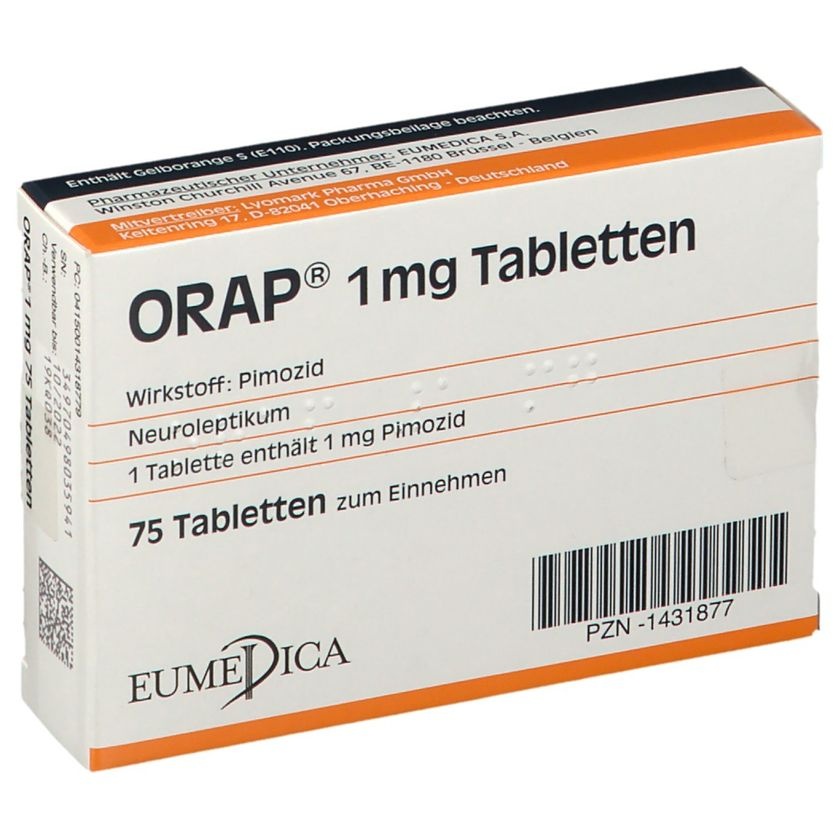
Orap 1 mg comprimidos

Revisión de receta online
Un médico revisará tu caso y determinará si la prescripción es médicamente apropiada.

Habla con un médico sobre este medicamento
Comenta tus síntomas y las opciones de tratamiento en una consulta online.



Cómo usar ORAP 1 mg COMPRIMIDOS
Contenido del prospecto
- Introducción
- Qué es Orap y para qué se utiliza
- Qué necesita saber antes de empezar a tomar Orap
- Cómo tomar Orap
- Posibles efectos adversos
- Conservación de Orap
- Contenido del envase e información adicional
Introducción
Prospecto: información para el usuario
Orap®1 mg comprimidos
Pimozida
Lea todo el prospecto detenidamente antes de empezar a tomar este medicamento, porque contiene información importante para usted.
- Conserve este prospecto, ya que puede tener que volver a leerlo.
- Si tiene alguna duda, consulte a su médico o farmacéutico.
- Este medicamento se le ha recetado solamente a usted, y no debe dárselo a otras personas aunque tengan los mismos síntomas que usted, ya que puede perjudicarles.
- Si experimenta efectos adversos, consulte a su médico o farmacéutico, incluso si se trata de efectos adversos que no aparecen en este prospecto. Ver sección 4.
Contenido del prospecto
- Qué es Orap y para qué se utiliza
- Qué necesita saber antes de empezar a tomar Orap
- Cómo tomar Orap
- Posibles efectos adversos
- Conservación de Orap
- Contenido del envase e información adicional
1. Qué es Orap y para qué se utiliza
Orap pertenece a un grupo de medicamentos llamados antipsicóticos.
Orap se utiliza en el tratamiento de psicosis (pérdida de contacto con la realidad) agudas (en un determinado momento) y crónicas (durante periodos de tiempo prolongados) así como para el trastorno de ansiedad.

¿No estás seguro de si este medicamento es adecuado para ti?
Comenta tus síntomas y tratamiento con un médico online.
2. Qué necesita saber antes de empezar a tomar Orap
No tome Orap si:
- Es alérgico al pimozida o a alguno de los demás componentes de este medicamento (incluidos en la sección 6).
- Padece depresión.
- Padece enfermedad de Parkinson.
- Padece arritmias cardíacas (alteraciones del ritmo cardíaco) o las ha padecido.
- Sufre bradicardia (ritmo cardíaco lento) con síntomas.
- Está tomando otros medicamentos (ver apartado toma de otros medicamentos).
- Padece de problemas de corazón, particularmente si el ritmo cardiaco es irregular, si existen anormalidades en la actividad eléctrica del corazón, (a veces, denominadas “Prolongación del intervalo QT”), historial en la familia de anormalidades en las actividades eléctricas del corazón o si usa medicamentos que pueden cambiar la actividad eléctrica del corazón.
- Si los niveles de minerales en sangre (electrolitos) están por debajo de los niveles normales. Su médico le advertirá al respecto.
Pacientes de edad avanzada con demencia
Si usted es un paciente de edad avanzada con demencia, que es una enfermedad que causa deterioro mental con síntomas como pérdida de memoria, pérdida de atención y una mayor dificultad para hablar, tomar Orap podría estar asociada con riesgos adicionales. Su médico lo comentará con usted.
Advertencias y precauciones
Consulte a su médico, farmacéutico o enfermero antes de empezar a tomar Orap.
- Si padece alguna enfermedad de hígado.
- Si presenta un estado de agitación o ansiedad muy severo.
- Si usted o alguien de su familia tiene antecedentes de coágulos sanguíneos, estos medicamentos pueden asociarse con la formación de los mismos.
- Si hace ejercicio intenso en algún lugar que haga mucho calor o no puede beber suficiente líquido.
Necesitará esperar algún tiempo antes de empezar a notar los efectos del medicamento. Solamente si el médico se lo indica deje de tomar Orap; si se interrumpe el tratamiento demasiado pronto, sin que se lo haya indicado su médico, pueden volver a aparecer los problemas. Por tanto manténgase en contacto con su médico cuando interrumpa el tratamiento.
Informe a su médico inmediatamente si usted experimenta:
- Fiebre, rigidez muscular grave, sudoración o disminución del nivel de conciencia (un trastorno llamado “síndrome neuroléptico maligno”). Puede ser necesario tratamiento médico urgente.
- Movimientos rítmicos involuntarios de la lengua, boca o cara. En este caso, sería necesaria la interrupción del tratamiento con Orap.
Informe a su médico si usted experimenta:
- Anomalías en la coordinación o movimientos musculares involuntarios (también conocidos como “síntomas extrapiramidales” {SEP} o Parkinsonismo). Los síntomas pueden incluir movimientos lentos, rigidez o espasmos de las extremidades, cuello, cara, ojos o la boca y la lengua, que pueden resultar en una postura inusual, involuntaria o expresiones faciales raras. Es necesario parar estos efectos adversos para poder comenzar la medicación.
- Cambios hormonales que pueden causar:
- Algunas mujeres produzcan leche materna de forma inesperada;
- Algunas mujeres experimenten hinchazón de sus pechos, menstruaciones irregulares, menstruaciones infrecuentes o muy leves o que no tengan menstruación;
- Algunos hombres experimenten hinchazón de sus pechos o dificultad en la erección.
Uso de Orap con otros medicamentos
Informe a su médico o farmacéutico si está utilizando, ha utilizado recientemente o pudiera tener que utilizar cualquier otro medicamento, incluso los adquiridos sin receta médica.
No debe combinar Orap con ciertos medicamentos como:
- Ciertos medicamentos llamados azoles que se emplean para el tratamiento de las infecciones producidas por hongos, como: ketoconazol, itraconazol, miconazol y fluconazol.
- Antibióticos llamados macrólidos tales como eritromicina, claritromicina, diritromicina o troleandomicina. Sin embargo, si se utilizan estos medicamentos en forma de cremas, lociones u óvulos vaginales junto con Orap, la combinación no representaría ningún problema.
- Ciertos medicamentos anti-SIDA tales como ritonavir, saquinavir, indinavir y nelfinavir.
- Ciertos medicamentos antidepresivos como nefazodona, amitriptilina, maprotilina, sertralina, citalopram, escitalopram, fluoxetina, paroxetina y fluvoxamina.
- Ciertos medicamentos para el tratamiento de enfermedades mentales tales como clorpromazina y sertindol.
- Ciertos medicamentos que tienen acción sobre el corazón tales como quinidina, disopiramida, procainamida, amiodarona, sotalol y bepridil.
- Ciertos antihistamínicos como astemizol y terfenadina.
- Cisaprida, un medicamento empleado en ciertos problemas digestivos.
- El antimalárico halofantrina.
- El antibiótico esparfloxacino.
- Ciertos medicamentos que alteran el nivel de minerales (electrolitos) en su cuerpo y ciertos medicamentos utilizados para eliminar el exceso de agua en el cuerpo e incrementar la cantidad de orina (“diuréticos”).
Orap puede alterar el efecto de los medicamentos para el tratamiento del parkinson.
Informe a su médico si está tomando cualquiera de estos medicamentos. Su médico le indicará qué medicamentos puede utilizar junto con Orap.
Toma de Orap con alimentos, bebidas y alcohol
Orap incrementa el efecto del alcohol, por tanto debe evitar tomar alcohol mientras esté tomando este medicamento.
Además, debería evitarse el empleo conjunto de zumo de pomelo y Orap.
Embarazo, lactancia y fertilidad
Embarazo
Consulte a su médico o farmacéutico antes de utilizar cualquier medicamento.
Si está embarazada o en periodo de lactancia, cree que podría estar embarazada o tiene intención de quedarse embarazada, consulte a su médico antes de utilizar este medicamento. Él le indicará si debe tomar Orap.
Puede aparecer temblor, rigidez y/o debilidad muscular, somnolencia, agitación, problemas de la respiración o dificultad en la alimentación, en recién nacidos cuya madre ha utilizado Orap en el último trimestre del embarazo. Si su hijo recién nacido presenta cualquiera de estos síntomas póngase en contacto con su médico.
Lactancia
En la leche materna se pueden encontrar pequeñas cantidades de Orap. Si está tomando Orap no debe dar el pecho.
Conducción y uso de máquinas
Orap puede causar somnolencia, especialmente al comienzo del tratamiento. Ésta puede disminuir su estado de alerta y por tanto su habilidad para conducir, por lo cual solo debe manejar maquinaria peligrosa o conducir si su médico se lo permite.
Información importante sobre algunos de los componentes de Orap
Este medicamento puede producir reacciones alérgicas porque contiene amarillo anaranjado S (E110).
Puede provocar asma, especialmente en pacientes alérgicos al ácido acetilsalicílico.
3. Cómo tomar Orap
Siga exactamente las instrucciones de administración de Orap indicadas por su medico. En caso de duda, consulte de nuevo a su medico o farmacéutico.
Se recomienda para todos los pacientes una dosis única, preferiblemente por las mañanas.
Recuerde tomar su medicamento.
Es muy importante que tome la dosis correcta de Orap. Su médico cambiará la dosis hasta encontrar la más adecuada para usted. Su médico le dirá, exactamente, cuantos comprimidos necesita usted.
Adultos
Ansiedad: la dosis recomendada es de 2 miligramos (2 comprimidos de Orap 1 mg) una vez al día.
Psicosis: la dosis inicial recomendada es de 2 a 4 miligramos (de 2 a 4 comprimidos de Orap 1 mg) una vez al día. Su médico podrá aumentar la dosis gradualmente hasta obtener los efectos deseados. La dosis máxima diaria que se puede tomar es de 20 miligramos.
Ancianos
Se recomienda iniciar el tratamiento con la mitad de la dosis inicial recomendada para adultos. Su médico podría ajustar la dosis dependiendo del efecto obtenido.
Niños
Orap se ha utilizado principalmente en niños mayores de tres años.
Los niños deberían de tomar dosis inferiores a las de los adultos. Su médico determinará la dosis y la ajustará dependiendo de los resultados obtenidos.
Importante:
Tenga en cuenta que se necesita algún tiempo antes de empezar a notar los efectos del medicamento, por lo tanto no interrumpa el tratamiento. Solamente si el médico se lo indica, deje de tomar Orap; si se interrumpe el tratamiento demasiado pronto, sin el consentimiento del médico, pueden volver a aparecer los problemas.
Si toma más Orap del que debe
Si cree que usted u otra persona puede haber tomado demasiados comprimidos de Orap inmediatamente, póngase en contacto con su médico, vaya al hospital más cercano o consulte al Servicio de Información Toxicológica, Teléfono 915 620 420. Hágalo incluso cuando no observe molestias o signos de intoxicación. Lleve el envase de Orap si acude al médico o al hospital.
Los posibles signos de una sobredosis son: rigidez muscular no habitual, incapacidad para moverse o estar sentado y latido cardiaco irregular.
Información para el médico en caso de sobredosis
- Considerar lavado gástrico y administración de carbón activado.
- Establecer una vía aérea patente y aplicar medidas de soporte.
- Considerar el traslado al hospital.
- Monitorizar el ECG y los signos vitales hasta que el ECG sea normal.
- Recuerde que Orap es un fármaco de acción prolongada.
- No hay un antídoto específico, pero las reacciones extrapiramidales pueden ser controladas mediante la inyección de un medicamento antiparkinsoniano.
Si olvidó tomar Orap
No tome una dosis doble para compensar las dosis olvidadas.

¿Has empezado a tomar el medicamento y tienes preguntas?
Comenta tus síntomas y tratamiento con un médico online.
4. Posibles efectos adversos
Al igual que todos los medicamentos, Orap puede producir efectos adversos, aunque no todas las personas los sufran.
Los efectos adversos incluyen:
Efectos adversos muy frecuentes (pueden afectar a más de 1 de cada 10 pacientes):
- Mareos, somnolencia, sudoración excesiva, orinar en exceso durante la noche
Efectos adversos frecuentes (pueden afectar hasta 1 de cada 10 pacientes):
- Pérdida de apetito, boca seca, producción excesiva de saliva, vómitos, estreñimiento
- Depresión, dificultad en irse a dormir o permanecer despierto, inquietud o agitación
- Anormalidades de la coordinación o movimientos musculares involuntarios (también conocidos como “síntomas extrapiramidales” o parkinsonismo), dolor de cabeza, temblor
- Lentitud
- Rigidez, músculos sin flexibilidad
- Visión borrosa
- Piel grasienta
- Micción frecuente
- Impotencia o disfunción eréctil (“DE”)
- Cansancio extremo
- Dificultad para permanecer quieto
Efectos adversos poco frecuentes (pueden afectar hasta 1 de cada 100 pacientes):
- Movimientos lentos, rígidos o espasmódicos de las extremidades, rigidez en rueda dentada al intentar doblar una extremidad, postura inusual, involuntaria o expresiones faciales raras, dificultad para hablar, movimiento espástico de los glóbulos oculares en una posición fija, generalmente hacia arriba.
- Pérdida de periodos menstruales
- Hinchazón de la cara
Efectos adversos muy raros (pueden afectar hasta 1 de cada 10.000 pacientes):
- Azúcar alta en sangre en pacientes con diabetes, azúcar en la orina
- Aumento de la hormona prolactina en su sangre, agrandamiento de las mamas, incluso en hombres, descarga de líquido de los pezones, pérdida de la libido
- Disminución de la temperatura corporal
- Cantidad insuficiente de sodio en la sangre
- Urticaria
- Erupción cutánea, picor de la piel
- Rigidez de los músculos del cuello
- Síndromes extrapiramidales graves asociados con fiebre alta
- Convulsiones
- Movimientos musculares involuntarios de la cara, ojos o boca y lengua. Estos efectos pueden continuar, a veces, después de haber dejado de tomar el medicamento, cuando éste se usa a largo plazo, o aparecer tras dejar de tomar el medicamento.
- Alteraciones graves en el ritmo del corazón que dan como resultado pérdida de efectividad en el bombeo del corazón
- Anormalidades en el registro cardiaco (electrocardiograma), en el electroencefalograma
- Anormalidades en la prueba de actividades eléctricas de su cerebro (EEG).
- Aumento de peso
Efectos adversos con una frecuencia no conocida (no puede estimarse a partir de los datos disponibles):
Coágulos de sangre en las venas, especialmente en las piernas (los síntomas incluyen hinchazón, dolor y enrojecimiento en la pierna), estos coágulos se pueden desplazar a través de los vasos sanguíneos hasta los pulmones, causando dolor en el pecho y dificultad para respirar. Si usted presenta cualquiera de estos síntomas acuda inmediatamente a su médico.
Importante:
Debe acudir al médico inmediatamente si durante el tratamiento con Orap presenta alguno de los siguientes síntomas: palpitaciones, mareos, desmayo, fiebre alta, rigidez muscular generalizada, respiración rápida, sudoración anormal o disminución de la alerta mental.
Comunicación de efectos adversos
Si experimenta cualquier tipo de efecto adverso, consulte a su médico, farmacéutico o enfermero, incluso si se trata de posibles efectos adversos que no aparecen en este prospecto. También puede comunicarlos directamente a través del Sistema Español de Farmacovigilancia de Medicamentos de Uso Humano: https://www.notificaram.es/. Mediante la comunicación de efectos adversos usted puede contribuir a proporcionar más información sobre la seguridad de este medicamento.
5. Conservación de Orap
No conservar a temperatura superior a 30ºC.
Mantener fuera de la vista y del alcance de los niños.
No utilice Orap después de la fecha de caducidad que aparece en el envase después de CAD. La fecha de caducidad es el último día del mes que se indica.
Los medicamentos no se deben tirar por los desagües ni a la basura. Pregunte a su farmacéutico cómo deshacerse de los envases y de los medicamentos que ya no necesita. De esta forma, ayudará a proteger el medio ambiente.
6. Contenido del envase e información adicional
Composición de Orap
- Cada comprimido contiene como principio activo: pimozida 1 miligramo.
- Los demás componentes son: fosfato ácido cálcico dihidratado, almidón de maíz sin gluten, celulosa microcristalina, polividona K30, talco, aceite de semillas de algodón hidrogenado, óxido férrico amarillo (E172). amarillo anaranjado S (E110).
Aspecto del producto y contenido del envase
Orap se presenta en cajas de 30 y 75 comprimidos.
Los comprimidos de Orap 1 mg son naranjas, circulares, biconvexos, con la inscripción “ORAP 1” en un lado.
Titular de la autorización de comercialización y responsable de la fabricación
Titular: EUMEDICA N.V.
Winston Churchill Avenue 67
BE-1180 Brussels
Bélgica
Responsable de la fabricación: Lusomedicamenta Sociedade Técnica Farmacêutica S.A.
Estrada Consiglieri Pedroso, 69 – B
Queluz de Baixo
2730 - 055 Barcarena
Portugal
o
Eumedica N.V.
Chemin de Nauwelette 1
BE-7170 Manage
Bélgica
Fecha de la última revisión de esteprospecto: 09/2017
La información detallada y actualizada de este medicamento está disponible en la página web de la Agencia Española de Medicamentos y Productos Sanitarios (AEMPS) http://www.aemps.gob.es/
- País de registro
- Forma farmacéuticaCOMPRIMIDO, 1 mg pimozida
- Código ATCN05AG02
- Precio medio en farmacia3.25 EUR
- Principio activo
- Requiere recetaSí
- Fabricante
- ComposiciónLACA DE AMARILLO ANARANJADO S (E 110, CI=15985) (0,06 mg mg)
- Esta información es de carácter general y no sustituye la consulta con un profesional sanitario.
- Alternativas a ORAP 1 mg COMPRIMIDOSForma farmacéutica: SOLUCIÓN/SUSPENSIÓN ORAL, 1 mg/mlPrincipio activo: AripiprazolFabricante: Kern Pharma S.L.Requiere recetaForma farmacéutica: COMPRIMIDO BUCODISPERSABLE/LIOTAB, 10 mgPrincipio activo: AripiprazolFabricante: Kern Pharma S.L.Requiere receta
Médicos online para ORAP 1 mg COMPRIMIDOS
Comenta la dosis, los posibles efectos secundarios, interacciones, contraindicaciones o la revisión de receta de ORAP 1 mg COMPRIMIDOS, sujeto a valoración médica y a la normativa local.







Preguntas frecuentes
ORAP 1 mg COMPRIMIDOS requiere receta en España. Puedes confirmarlo con un médico online según tu caso.
El principio activo de ORAP 1 mg COMPRIMIDOS es pimozide. Esta información ayuda a identificar medicamentos con la misma composición pero con diferentes nombres comerciales.
El precio medio en farmacia de ORAP 1 mg COMPRIMIDOS es de aproximadamente 3.25 EUR. Puede variar según el fabricante y la forma farmacéutica.
ORAP 1 mg COMPRIMIDOS es fabricado por Eumedica.. La marca y el envase pueden variar según el distribuidor.
Los Médicos de familia, Psiquiatras, Dermatólogos, Cardiólogos, Endocrinólogos, Gastroenterólogos, Neumólogos, Nefrólogos, Reumatólogos, Hematólogos, Infectólogos, Alergólogos, Geriatras, Pediatras, Oncólogos pueden valorar la prescripción de ORAP 1 mg COMPRIMIDOS cuando esté clínicamente indicado. Puedes reservar una videoconsulta para comentar tu caso y las opciones de tratamiento.
La receta la emite un médico tras valorar tu estado de salud. En España, ORAP 1 mg COMPRIMIDOS se dispensa en las farmacias con esa receta médica. Una consulta online no garantiza su emisión: la decisión corresponde siempre al médico.
Para solicitar una valoración puedes usar Oladoctor:
Otros medicamentos con el mismo principio activo (pimozide) incluyen ORAP FUERTE 4 mg COMPRIMIDOS, ABIK 1 MG/ML SOLUCION ORAL EFG, ABIK 10 MG COMPRIMIDOS BUCODISPERSABLES EFG. Pueden tener diferentes nombres comerciales o formulaciones, pero contienen el mismo componente terapéutico. Consulta siempre con un médico antes de cambiar o iniciar un nuevo medicamento.
