


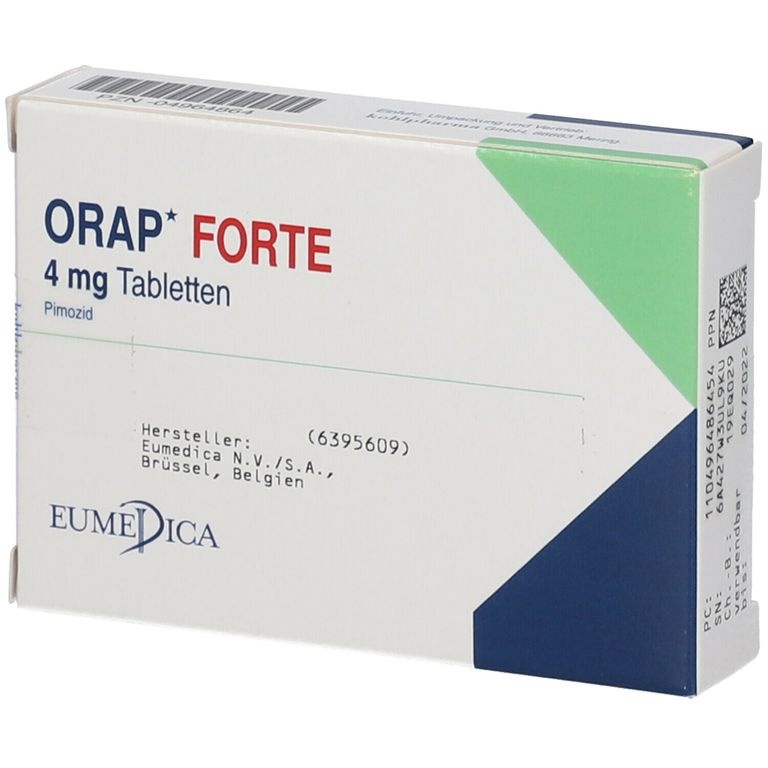
Orap Fuerte 4 mg comprimidos

Prescription review online
A doctor will review your case and decide whether a prescription is medically appropriate.

Talk to a doctor about this medicine
Discuss your symptoms and possible next steps in a quick online consultation.



How to use ORAP FUERTE 4 mg TABLETS
Contents of the leaflet
- Introduction
- What is Orap Strong and what is it used for
- What you need to know before you take Orap Strong
- How to take Orap Strong
- Possible side effects
- Storage of Orap Strong
- Contents of the pack and other information
Introduction
Package Leaflet: Information for the User
Orap Strong®4 mg tablets
Pimozide
Read all of this leaflet carefully before you start taking this medicine, because it contains important information for you.
- Keep this leaflet, as you may need to read it again.
- If you have any further questions, ask your doctor or pharmacist.
- This medicine has been prescribed for you only. Do not pass it on to others. It may harm them, even if their symptoms are the same as yours.
- If you experience any side effects, talk to your doctor or pharmacist. This includes any possible side effects not listed in this leaflet. See section 4.
Contents of the package leaflet
- What is Orap Strong and what is it used for
- What you need to know before you take Orap Strong
- How to take Orap Strong
- Possible side effects
- Storage of Orap Strong
- Contents of the pack and other information
1. What is Orap Strong and what is it used for
Orap Strong belongs to a group of medicines called antipsychotics.
Orap Strong is used in the treatment of psychosis (loss of contact with reality) acute (at a given time) and chronic (over long periods of time), as well as for anxiety disorder.

Not sure if this medicine is right for you?
Discuss your symptoms and treatment with a doctor online.
2. What you need to know before you take Orap Strong
Do not take Orap Strong if:
- You are allergic to pimozide or any of the other ingredients of this medicine (listed in section 6).
- You suffer from depression.
- You suffer from Parkinson's disease.
- You suffer from heart rhythm disorders (arrhythmias) or have had them.
- You suffer from bradycardia (slow heart rate) with symptoms.
- You are taking other medicines (see section on taking other medicines).
- You have heart problems, particularly if your heart rhythm is irregular, if there are abnormalities in the electrical activity of the heart (sometimes called "QT interval prolongation"), a family history of heart electrical activity abnormalities, or if you use medicines that can change the electrical activity of the heart.
- If the levels of minerals in your blood (electrolytes) are below normal levels. Your doctor will advise you about this.
Elderly patients with dementia
If you are an elderly patient with dementia, which is a disease that causes mental deterioration with symptoms such as memory loss, loss of attention, and increased difficulty speaking, taking Orap Strong may be associated with additional risks. Your doctor will discuss this with you.
Warnings and precautions
Talk to your doctor, pharmacist, or nurse before you start taking Orap Strong.
- If you have liver disease.
- If you have a state of severe agitation or anxiety.
- If you or a family member have a history of blood clots, these medicines may be associated with the formation of clots.
- If you engage in intense exercise in a hot place or cannot drink enough fluids.
You will need to wait some time before you start to feel the effects of the medicine. Only stop taking Orap Strong if your doctor tells you to; if you interrupt treatment too early, without your doctor's advice, the problems may come back. Therefore, stay in touch with your doctor when you stop treatment.
Tell your doctor immediately if you experience:
- Fever, severe muscle stiffness, sweating, or decreased level of consciousness (a disorder called "neuroleptic malignant syndrome"). Urgent medical treatment may be necessary.
- Involuntary rhythmic movements of the tongue, mouth, or face. In this case, it would be necessary to interrupt treatment with Orap Strong.
Tell your doctor if you experience:
- Abnormalities in coordination or involuntary muscle movements (also known as "extrapyramidal symptoms" or parkinsonism). Symptoms may include slow movements, stiffness, or spasms of the limbs, neck, face, eyes, or mouth and tongue, which can result in an unusual posture, involuntary or rare facial expressions. It is necessary to stop these side effects to start the medication.
- Hormonal changes that can cause:
- Some women to produce breast milk unexpectedly;
- Some women to experience breast swelling, irregular menstruation, infrequent or very light menstruation, or no menstruation;
Some men may experience breast swelling or difficulty with erection.
Using Orap Strong with other medicines
Tell your doctor or pharmacist if you are using, have recently used, or might use any other medicines, including those bought without a prescription.
Do not combine Orap Strong with certain medicines such as:
- Certain medicines called azoles used to treat fungal infections, such as ketoconazole, itraconazole, miconazole, and fluconazole.
- Antibiotics called macrolides, such as erythromycin, clarithromycin, dirithromycin, or troleandomycin. However, if these medicines are used in the form of creams, lotions, or vaginal ovules with Orap Strong, the combination would not pose any problem.
- Certain anti-HIV medicines such as ritonavir, saquinavir, indinavir, and nelfinavir.
- Certain antidepressants such as nefazodone, amitriptyline, maprotiline, sertraline, citalopram, escitalopram, fluoxetine, paroxetine, and fluvoxamine.
- Certain medicines for the treatment of mental illnesses such as chlorpromazine and sertindole.
- Certain medicines that affect the heart, such as quinidine, disopyramide, procainamide, amiodarone, sotalol, and bepridil.
- Certain antihistamines such as astemizole and terfenadine.
- Cisapride, a medicine used for certain digestive problems.
- The antimalarial halofantrine.
- The antibiotic sparfloxacin.
- Certain medicines that alter the level of minerals (electrolytes) in your body and certain medicines used to eliminate excess water in the body and increase the amount of urine ("diuretics").
Orap Strong may alter the effect of medicines for the treatment of Parkinson's disease.
Tell your doctor if you are taking any of these medicines. Your doctor will tell you which medicines you can use with Orap Strong.
Taking Orap Strong with food, drinks, and alcohol
Orap Strong increases the effect of alcohol; therefore, you should avoid drinking alcohol while taking this medicine.
Additionally, the use of grapefruit juice and Orap Strong should be avoided.
Pregnancy, breastfeeding, and fertility
Pregnancy
Ask your doctor or pharmacist for advice before taking any medicine.
If you are pregnant or breastfeeding, think you may be pregnant, or plan to become pregnant, ask your doctor for advice before taking this medicine. He will tell you whether you can take Orap Strong.
Tremors, stiffness, and/or muscle weakness, drowsiness, agitation, breathing problems, or difficulty feeding may occur in newborns whose mother has used Orap Strong in the last trimester of pregnancy. If your newborn baby has any of these symptoms, contact your doctor.
Breastfeeding
Small amounts of Orap Strong can be found in breast milk. If you are taking Orap Strong, you should not breastfeed.
Driving and using machines
Orap Strong can cause drowsiness, especially at the beginning of treatment. This may reduce your alertness and, therefore, your ability to drive or operate machinery. You should only drive or operate hazardous machinery if your doctor advises you to do so.
3. How to take Orap Strong
Follow the instructions for taking Orap Strong exactly as indicated by your doctor. If you are unsure, consult your doctor or pharmacist again.
A single dose is recommended for all patients, preferably in the morning.
Remember to take your medicine. It is very important that you take the correct dose of Orap Strong. Your doctor will adjust the dose until the most suitable one for you is found. Your doctor will tell you exactly how many tablets you need to take.
Adults
Anxiety: the recommended dose is 2 milligrams (it is recommended to use 1 mg Orap tablets) once a day.
Psychosis: the recommended initial dose is 2 to 4 milligrams (half to 1 Orap Strong 4 mg tablet) once a day. Your doctor may gradually increase the dose until the desired effect is achieved. The maximum daily dose that can be taken is 20 milligrams.
Elderly
It is recommended to start treatment with half the initial dose recommended for adults. Your doctor may adjust the dose depending on the effect obtained.
Children
Orap Strong has been used mainly in children over three years old.
Children should take lower doses than adults. Your doctor will determine the dose and adjust it depending on the results obtained.
The tablet can be divided into two equal parts.
Important:
Keep in mind that it takes some time before you start to feel the effects of the medicine; therefore, do not interrupt treatment. Only stop taking Orap Strong if your doctor tells you to; if you interrupt treatment too early, without your doctor's consent, the problems may come back.
If you take more Orap Strong than you should
If you think you or someone else may have taken too many Orap Strong tablets, contact your doctor, go to the nearest hospital, or consult the Toxicology Information Service, Telephone 915 620 420, immediately. Do this even if you do not notice any discomfort or signs of poisoning. Take the Orap Strong packaging with you if you go to the doctor or hospital.
Possible signs of an overdose are: unusual muscle stiffness, inability to move or sit, and irregular heartbeat.
Information for the doctor in case of overdose
- Consider gastric lavage and administration of activated charcoal.
- Establish a patent airway and apply supportive measures.
- Consider hospitalization.
- Monitor the ECG and vital signs until the ECG is normal.
- Remember that Orap Strong is a long-acting medicine.
- There is no specific antidote, but extrapyramidal reactions can be controlled with the injection of an antiparkinsonian medicine.
If you forget to take Orap Strong
Do not take a double dose to make up for forgotten doses.

Started taking the medicine and have questions?
Discuss your symptoms and treatment with a doctor online.
4. Possible side effects
Like all medicines, Orap Strong can cause side effects, although not everybody gets them.
Side effects include:
Very common side effects (may affect more than 1 in 10 people):
- Dizziness, drowsiness, excessive sweating, frequent urination at night.
Common side effects (may affect up to 1 in 10 people):
- Lack of appetite, dry mouth, excessive saliva production, vomiting, constipation.
- Depression, difficulty sleeping or staying awake, restlessness or agitation.
- Abnormalities in coordination or involuntary muscle movements (also known as "extrapyramidal symptoms" or parkinsonism), headache, tremors.
- Slowness.
- Stiffness, inflexible muscles.
- Blurred vision.
- Oily skin.
- Frequent urination.
- Impotence or erectile dysfunction ("ED").
- Extreme fatigue.
- Difficulty staying still.
Uncommon side effects (may affect up to 1 in 100 people):
- Slow, stiff, or spastic movements of the limbs, stiffness when trying to bend a limb, unusual posture, involuntary or rare facial expressions, difficulty speaking, spastic movement of the eyeballs in a fixed position, usually upwards.
- Loss of menstrual periods.
- Facial swelling.
Rare side effects (may affect up to 1 in 10,000 people):
- High blood sugar in diabetic patients, sugar in the urine.
- Increased prolactin hormone in the blood, breast enlargement, even in men, discharge of fluid from the nipples, loss of libido.
- Decreased body temperature.
- Insufficient sodium in the blood.
- Hives.
- Skin rash, itching.
- Stiffness of the neck muscles.
- Severe extrapyramidal syndromes associated with high fever.
- Seizures.
- Involuntary muscle movements of the face, eyes, or mouth and tongue. These effects can continue, sometimes, after stopping the medicine, when it is used for a long time, or appear after stopping the medicine.
- Severe heart rhythm disorders that result in loss of effectiveness in the pumping of the heart.
- Abnormalities in the heart record (electrocardiogram), in the electroencephalogram.
- Abnormalities in the test of brain electrical activity (EEG).
- Weight gain.
Side effects with unknown frequency (cannot be estimated from the available data):
Blood clots in the veins, especially in the legs (symptoms include swelling, pain, and redness in the leg), these clots can move through the blood vessels to the lungs, causing chest pain and difficulty breathing. If you experience any of these symptoms, go to your doctor immediately.
Important:
You should go to the doctor immediately if, during treatment with Orap Strong, you experience any of the following symptoms: palpitations, dizziness, fainting, high fever, generalized muscle stiffness, rapid breathing, abnormal sweating, or decreased mental alertness.
Reporting of side effects
If you experience any side effects, talk to your doctor, pharmacist, or nurse. This includes any possible side effects not listed in this leaflet. You can also report side effects directly through the Spanish Medicines and Healthcare Products Agency (AEMPS) website: https://www.notificaram.es/. By reporting side effects, you can help provide more information on the safety of this medicine.
5. Storage of Orap Strong
Do not store above 30°C.
Keep out of the sight and reach of children.
Do not use Orap Strong after the expiry date stated on the packaging after EXP. The expiry date is the last day of the month indicated.
Medicines should not be disposed of via wastewater or household waste. Ask your pharmacist how to dispose of medicines no longer required. This will help protect the environment.
6. Contents of the pack and other information
Composition of Orap Strong
- Each tablet contains as active ingredient: pimozide 4 milligrams.
- The other ingredients are: calcium phosphate dihydrate, cornstarch, microcrystalline cellulose, povidone K30, talc, hydrogenated cottonseed oil, and colorants (iron oxide yellow E172 and aluminum sodium indigotin E132 lacquer).
Appearance of the product and packaging contents
Orap Strong is available in boxes of 20 tablets.
The Orap Strong tablets are green, circular, biconvex, with the inscription "ORAP 4" on one side and scored on the other side.
Marketing authorization holder and manufacturer
Marketing authorization holder: EUMEDICA N.V.
Winston Churchill Avenue 67
BE-1180 Brussels
Belgium
Manufacturer: Lusomedicamenta Sociedade Técnica Farmacêutica S.A.
Estrada Consiglieri Pedroso, 69 – B
Queluz de Baixo
2730 - 055 Barcarena
Portugal
or
Eumedica N.V.
Chemin de Nauwelette 1
BE-7170 Manage
Belgium
Date of last revision of this leaflet: 09/2017
Detailed and updated information on this medicine is available on the website of the Spanish Agency for Medicines and Healthcare Products (AEMPS) http://www.aemps.gob.es/
- Country of registration
- Dosage formTABLET, 4 mg
- ATC codeN05AG02
- Average pharmacy price4.93 EUR
- Active substance
- Prescription requiredYes
- Manufacturer
- This information is for reference only and does not constitute medical advice. Always consult a doctor before taking any medication. Oladoctor is not responsible for medical decisions based on this content.
- Alternatives to ORAP FUERTE 4 mg TABLETSDosage form: ORAL SOLUTION/SUSPENSION, 1 mg/mlActive substance: aripiprazoleManufacturer: Kern Pharma S.L.Prescription requiredDosage form: ORALLY DISINTEGRATING TABLET/LIOTAB, 10 mgActive substance: aripiprazoleManufacturer: Kern Pharma S.L.Prescription required
Online doctors for ORAP FUERTE 4 mg TABLETS
Discuss questions about ORAP FUERTE 4 mg TABLETS, including use, safety considerations and prescription review, subject to medical assessment and local regulations.







Frequently Asked Questions
ORAP FUERTE 4 mg TABLETS requires a prescription in Spain. You can check with a doctor online whether this medicine may be appropriate for your situation.
The active ingredient in ORAP FUERTE 4 mg TABLETS is pimozide. This information helps identify medicines with the same composition but different brand names.
The average pharmacy price for ORAP FUERTE 4 mg TABLETS is around 4.93 EUR. Prices may vary depending on the manufacturer and dosage form.
ORAP FUERTE 4 mg TABLETS is manufactured by Eumedica.. Pharmacy brands and packaging may differ depending on the distributor.
Doctors such as Family doctors, Psychiatrists, Dermatologists, Cardiologists, Endocrinologists, Gastroenterologists, Pulmonologists, Nephrologists, Rheumatologists, Hematologists, Infectious disease physicians, Allergists, Geriatricians, Paediatricians, Oncologists may assess whether ORAP FUERTE 4 mg TABLETS is appropriate, depending on your situation and local regulations. You can book an online consultation to discuss your symptoms and possible next steps.
The prescription is issued by a doctor after assessing your health. In Spain, ORAP FUERTE 4 mg TABLETS is then dispensed in pharmacies with that prescription. An online consultation does not guarantee that a prescription will be issued: the decision always rests with the doctor.
To request a review, you can use Oladoctor:
Other medicines with the same active substance (pimozide) include ORAP 1 mg TABLETS, ABIK 1 mg/ml ORAL SOLUTION, ABIK 10 mg ORALLY DISINTEGRATING TABLETS. These may have different brand names or formulations but contain the same therapeutic ingredient. Always consult a doctor before switching or starting a new medicine.
