


Ondexxya 200 mg polvo para solución para perfusión

Revisión de receta online
Un médico revisará tu caso y determinará si la prescripción es médicamente apropiada.

Habla con un médico sobre este medicamento
Comenta tus síntomas y las opciones de tratamiento en una consulta online.



Cómo usar ONDEXXYA 200 MG POLVO PARA SOLUCION PARA PERFUSION
Contenido del prospecto
- Introducción
- Qué es Ondexxya y para qué se utiliza
- Qué necesita saber antes de empezar a recibir Ondexxya
- Cómo usar Ondexxya
- Posibles efectos adversos
- Conservación de Ondexxya
- Contenido del envase e información adicional
Introducción
Prospecto: información para el paciente y el usuario
Ondexxya 200mg polvo para solución para perfusión
andexanet alfa
Este medicamento está sujeto a seguimiento adicional, lo que agilizará la detección de nueva información sobre su seguridad. Puede contribuir comunicando los efectos adversos que pudiera usted tener. La parte final de la sección 4 incluye información sobre cómo comunicar estos efectos adversos.
Lea todo el prospecto detenidamente, porque contiene información importante para usted. Tenga en cuenta que este medicamento se utiliza principalmente en situaciones de urgencia en las que su médico ha decidido que lo necesita.
- Conserve este prospecto, ya que puede tener que volver a leerlo.
- Si tiene alguna duda, consulte a su médico o enfermero.
- Si experimenta cualquier tipo de efecto adverso, consulte a su médico o enfermero, incluso si se trata de posibles efectos adversos que no aparecen en este prospecto. Ver sección 4.
Contenido del prospecto
- Qué es Ondexxya y para qué se utiliza
- Qué necesita saber antes de empezar a recibir Ondexxya
- Cómo usar Ondexxya
- Posibles efectos adversos
- Conservación de Ondexxya
- Contenido del envase e información adicional
1. Qué es Ondexxya y para qué se utiliza
Ondexxya contiene el principio activo andexanet alfa. Revierte los efectos de ciertos anticoagulantes llamados inhibidores del factor Xa (apixabán o rivaroxabán). Los inhibidores del factor Xa se administran para evitar coágulos en los vasos sanguíneos. Su médico puede decidir administrarle Ondexxya para revertir rápidamente los efectos del anticoagulante en caso de una hemorragia potencialmente mortal o descontrolada.

¿No estás seguro de si este medicamento es adecuado para ti?
Comenta tus síntomas y tratamiento con un médico online.
2. Qué necesita saber antes de empezar a recibir Ondexxya
Nouse Ondexxya:
- si es alérgico a andexanet alfa o a alguno de los demás componentes de este medicamento (incluidos en la sección 6).
- si es alérgico a las proteínas de hámster
- si está recibiendo heparina
Advertencias y precauciones
La reversión del efecto del inhibidor del factor Xa con Ondexxya puede incrementar el riesgo de coágulos sanguíneos. Después del tratamiento con Ondexxya su médico decidirá cuándo reiniciar el tratamiento anticoagulante.
El posible efecto procoagulante independiente de andexanet alfa podría conllevar un riesgo adicional de desarrollar trombosis.
Si experimenta un efecto adverso durante la administración de Ondexxya mediante perfusión intravenosa, su médico puede decidir reducir la velocidad de la perfusión o detener el tratamiento. Su médico le puede administrar un antihistamínico para aliviar los efectos adversos (ver sección 4).
Se debe evitar Ondexxya si tiene planificada una cirugía en la que se necesite anticoagulación con heparina.
Niños y adolescentes
No se dispone de datos sobre el uso de Ondexxya en niños y adolescentes.
Otros medicamentos y Ondexxya
Informe a su médico si está tomando, ha tomado recientemente o pudiera tener que tomar cualquier otro medicamento.
Este medicamento solo se ha desarrollado para revertir los efectos de los medicamentos inhibidores del factor Xa. Es poco probable que Ondexxya interfiera con el efecto de otros medicamentos, o que otros medicamentos interfieran con Ondexxya.
El tratamiento con Ondexxya se debe evitar si se necesita anticoagulación con heparina. Ondexxya causa falta de respuesta a la heparina.
Embarazo y lactancia
Si está embarazada o en periodo de lactancia, cree que podría estar embarazada o tiene intención de quedarse embarazada, consulte a su médico.
Ondexxya no se recomienda durante el embarazo ni en mujeres en edad fértil que no utilicen anticonceptivo.
No dé el pecho a su hijo cuando esté tomando este medicamento. Se desconoce si andexanet alfa pasa a la leche materna.
Conducción y uso de máquinas
Es improbable que este medicamento influya sobre su capacidad de conducir y usar máquinas.
3. Cómo usar Ondexxya
Este medicamento es únicamente para uso hospitalario.
Su médico o enfermero le administrarán este medicamento mediante inyección o perfusión en una vena.
Su médico o enfermero decidirán la dosis de medicamento que usted necesita. Dicha dosis se basa en el medicamento anticoagulante que esté tomando, así como en la dosis y el tiempo transcurrido desde la última vez que tomó el anticoagulante.
Después de la administración de Ondexxya, su médico decidirá cuándo reiniciar el tratamiento anticoagulante.
Al final de este prospecto se incluyen instrucciones detalladas para el médico o el enfermero sobre cómo administrar Ondexxya (ver «Instrucciones de uso»).
Si tiene cualquier otra duda sobre el uso de este medicamento, pregunte a su médico.

¿Has empezado a tomar el medicamento y tienes preguntas?
Comenta tus síntomas y tratamiento con un médico online.
4. Posibles efectos adversos
Al igual que todos los medicamentos, este medicamento puede producir efectos adversos, aunque no todas las personas los sufran.
Lista de efectos adversos observados en personas con hemorragia
Frecuentes(pueden afectar hasta a 1 de cada 10 personas)
- Accidente cerebrovascular
- Infarto
- Coágulos sanguíneos en piernas, brazos, pulmones o cerebro
- Fiebre
Poco frecuentes(pueden afectar hasta a 1 de cada 100 personas)
- Mini-ictus
- Paro cardíaco
- Signos/síntomas de reacciones relacionadas con la perfusión, como escalofríos, presión arterial alta, dificultad para respirar, confusión o agitación.
Comunicación de efectos adversos
Si experimenta cualquier tipo de efecto adverso, consulte a su médico o enfermero, incluso si se trata de posibles efectos adversos que no aparecen en este prospecto. También puede comunicarlos directamente a través del sistema nacional de notificación incluido en el Apéndice V. Mediante la comunicación de efectos adversos usted puede contribuir a proporcionar más información sobre la seguridad de este medicamento.
5. Conservación de Ondexxya
Este medicamento se almacena en el hospital, y estas instrucciones están destinadas solo para el personal hospitalario.
Mantener este medicamento fuera de la vista y del alcance de los niños.
No utilice este medicamento después de la fecha de caducidad que aparece en el vial y en la caja después de CAD/EXP.
La fecha de caducidad es el último día del mes que se indica.
Conservar en nevera (entre 2 ºC y 8 ºC).
No congelar.
Una vez reconstituido, Ondexxya es para uso inmediato.
6. Contenido del envase e información adicional
Composición de Ondexxya
- El principio activo es andexanet alfa.
- Los demás componentes son tris base, hidrocloruro de tris, hidrocloruro de L-arginina, sacarosa, manitol y polisorbato 80.
Aspecto del producto y contenido del envase
Ondexxya se suministra en viales de vidrio como polvo para solución para perfusión de color blanco a blancuzco, que se reconstituye (disuelve) antes del uso. La solución reconstituida es transparente, incolora o ligeramente amarilla.
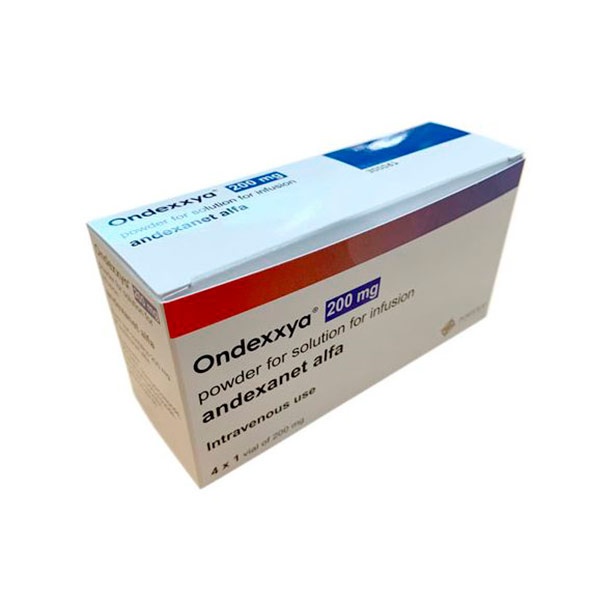
Cada envase contiene cuatro o cinco viales.
Puede que solamente estén comercializados algunos tamaños de envases.
Titular de la autorización de comercialización
AstraZeneca AB
SE-151 85 Södertälje
Suecia
Responsable de la fabricación
Alexion Pharma International Operations Limited
Alexion Dublin Manufacturing Facility
College Business and Technology Park
Blanchardstown Rd North
Dublin D15 R925
Irlanda
Pueden solicitar más información respecto a este medicamento dirigiéndose al representante local del titular de la autorización de comercialización:
België/Belgique/Belgien AstraZeneca S.A./N.V. Tel: +32 2 370 48 11 | Lietuva UAB AstraZeneca Lietuva Tel: +370 5 2660550 |
| Luxembourg/Luxemburg AstraZeneca S.A./N.V. Tél/Tel: +32 2 370 48 11 |
Ceská republika AstraZeneca Czech Republic s.r.o. Tel: +420 222 807 111 | Magyarország AstraZeneca Kft. Tel.: +36 1 883 6500 |
Danmark AstraZeneca A/S Tlf: +45 43 66 64 62 | Malta Associated Drug Co. Ltd Tel: +356 2277 8000 |
Deutschland AstraZeneca GmbH Tel: +49 40 809034100 | Nederland AstraZeneca BV Tel: +31 85 808 9900 |
Eesti AstraZeneca Tel: +372 6549 600 | Norge AstraZeneca AS Tlf: +47 21 00 64 00 |
Ελλ?δα AstraZeneca A.E. Τηλ: +30 210 6871500 | Österreich AstraZeneca Österreich GmbH Tel: +43 1 711 31 0 |
España AstraZeneca Farmacéutica Spain, S.A. Tel: +34 91 301 91 00 | Polska AstraZeneca Pharma Poland Sp. z o.o. Tel.: +48 22 245 73 00 |
France AstraZeneca Tél: +33 1 41 29 40 00 | Portugal AstraZeneca Produtos Farmacêuticos, Lda. Tel: +351 21 434 61 00 |
Hrvatska AstraZeneca d.o.o. Tel: +385 1 4628 000 | România AstraZeneca Pharma SRL Tel: +40 21 317 60 41 |
Ireland AstraZeneca Pharmaceuticals (Ireland) DAC Tel: +353 1609 7100 | Slovenija AstraZeneca UK Limited Tel: +386 1 51 35 600 |
Ísland Vistor hf. Sími: +354 535 7000 | Slovenská republika AstraZeneca AB, o.z. Tel: +421 2 5737 7777 |
Italia AstraZeneca S.p.A. Tel: +39 02 00704500 | Suomi/Finland AstraZeneca Oy Puh/Tel: +358 10 23 010 |
Κ?προς Αλ?κτωρ Φαρµακευτικ? Λτδ Τηλ: +357 22490305 | Sverige AstraZeneca AB Tel: +46 8 553 26 000 |
Latvija SIA AstraZeneca Latvija Tel: +371 67377100 | United Kingdom (Northern Ireland) AstraZeneca UK Ltd Tel: +44 1582 836 836 |
Fecha de la última revisión de este prospecto:
Este medicamento se ha autorizado con una «aprobación condicional». Esta modalidad de aprobación significa que se espera obtener más información de este medicamento.
La Agencia Europea de Medicamentos revisará la información nueva de este medicamento al menos una vez al año y este prospecto se actualizará cuando sea necesario.
Otras fuentes de información
La información detallada de este medicamento está disponible en la página web de la Agencia Europea de Medicamentos: http://www.ema.europa.eu.
------------------------------------------------------------------------------------------------------------------------
Esta información está destinada únicamente a profesionales sanitarios:
Andexanet no ha demostrado ser eficaz para, y no está indicado para, el tratamiento de hemorragias asociadas a cualquier inhibidor del factor Xa distintos al rivaroxabán o apixabán. Asimismo, tampoco revierte los efectos de los no inhibidores del factor Xa.
Posología y forma de administración:
Andexanet alfa se administra como bolo intravenoso (IV) a un ritmo objetivo de aproximadamente 30 mg/min durante 15 (dosis baja) o 30 minutos (dosis alta), seguido inmediatamente de la administración de una perfusión continua de 4 mg (dosis baja) o 8 mg (dosis alta) por minuto durante 120 minutos (ver tabla 1).
Tabla1: Esquema de administración
Boloinicialintravenoso | Perfusión intravenosa continua | Número totalde viales de200mg necesarios | |
Dosis baja | 400 mg a un ritmo objetivo de 30 mg/min | 4 mg/min durante 120 minutos (480 mg) | 5 |
Dosis alta | 800 mg a un ritmo objetivo de 30 mg/min | 8 mg/min durante 120 minutos (960 mg) | 9 |
Las recomendaciones para la dosis se han definido a partir de los efectos de andexanet alfa en voluntarios sanos, a quienes se les administró un inhibidor directo del factor Xa, y a partir de la capacidad de revertir los niveles de la actividad del factor anti-Xa. La dosis se utilizó en un estudio con pacientes con hemorragia grave aguda.
Reversión de apixabán
El esquema de administración recomendado de andexanet alfa depende de la dosis de apixabán que el paciente esté tomando en el momento de la reversión de la anticoagulación, así como del tiempo transcurrido desde su última dosis de apixabán (ver tabla 2). Si se desconoce la concentración de la última dosis de anticoagulante o el intervalo entre la última dosis y el episodio hemorrágico, no se dispone de recomendación de dosis. La medición del nivel basal de anti‑factor Xa debe respaldar la decisión clínica de iniciar el tratamiento (si se dispone de dicho nivel en un plazo de tiempo aceptable).
Tabla2: Resumen de la dosificación para la reversión de apixabán
Inhibidor del factor Xa | Última dosis del inhibidor del factor Xa | Tiempo desde la última dosis del inhibidor del factor Xa antes del inicio del tratamiento conandexanetalfa | |
<8horas | ≥8horas | ||
Apixabán | ≤ 5 mg | Dosis baja | Dosis baja |
> 5 mg | Dosis alta |
Reversión de rivaroxabán
El esquema de administración recomendado de andexanet alfa depende de la dosis de rivaroxabán que el paciente esté tomando en el momento de la reversión de la anticoagulación, así como del tiempo transcurrido desde su última dosis de rivaroxabán (ver tabla 3). Si se desconoce la concentración de la última dosis de anticoagulante o el intervalo entre la última dosis y el episodio hemorrágico, no se dispone de recomendación de dosis. La medición del nivel basal de anti‑factor Xa debe respaldar la decisión clínica de iniciar el tratamiento (solo si se dispone de dicho nivel en un plazo de tiempo aceptable).
Tabla3: Resumen de la dosificación para la reversión de rivaroxabán
Inhibidor del factor Xa | Última dosis del inhibidor del factor Xa | Tiempo desde la última dosis del inhibidor del factor Xa antes del inicio del tratamiento conandexanetalfa | |
<8horas | ≥8horas | ||
Rivaroxabán | ≤ 10 mg | Dosis baja | Dosis baja |
> 10 mg | Dosis alta |
Los pacientes en tratamiento con inhibidor del factor Xa tienen una enfermedad subyacente que les predispone a episodios tromboembólicos. El tratamiento para la reversión del inhibidor del factor Xa expone a los pacientes al riesgo trombótico de su enfermedad subyacente. Para reducir este riesgo se debe considerar reanudar el tratamiento anticoagulante tan pronto como sea médicamente adecuado.
Instrucciones de uso:
Después de reconstituir andexanet alfa, la solución de 10 mg/ml se transfiere sin diluirla más a jeringas estériles de gran volumen si para la administración se utiliza una bomba de perfusión de jeringa o a bolsas para perfusión intravenosa vacías adecuadas de poliolefina (PO) o de cloruro de polivinilo (PVC). Antes de su administración por perfusión IV se debe usar un filtro en línea con baja afinidad por las proteínas de polietersulfona (PES) o equivalente de 0,2 o 0,22 micras.
Se ha demostrado que la estabilidad química y física en uso de las soluciones reconstituidas es de al menos ocho horas a 25 °C. Desde un punto de vista microbiológico, el medicamento se debe usar inmediatamente. Si no se utiliza inmediatamente, es responsabilidad del usuario cumplir los tiempos y condiciones de conservación en uso antes de utilizarlo.
Reconstitución
Antes de comenzar con la reconstitución necesita tener:
- El número de viales calculado como se indica en la tabla 1.
- El mismo número de jeringas con disolvente de 20 ml (o más) con una aguja del calibre 20 (o superior).
- Toallitas con alcohol.
- Una jeringa estéril grande (50 ml o más). Si la administración se hace con una bomba de perfusión de jeringa se deben utilizar varias jeringas para contener el volumen final del producto reconstituido.
- Bolsas para perfusión intravenosa de poliolefina (PO) o de cloruro de polivinilo (PVC) (150 ml o más) para contener el volumen del medicamento reconstituido (si la administración se hace con bolsas para perfusión intravenosa).
- Agua para preparaciones inyectables
- Un filtro en línea con baja afinidad por las proteínas de polietersulfona (PES) o equivalente de 0,2 o 0,22 micras.
No es necesario que andexanet alfa alcance la temperatura ambiente antes de su reconstitución o administración al paciente. Use una técnica aséptica durante la reconstitución.
Reconstituya cada vial siguiendo las instrucciones a continuación:
- Quite las tapas de cierre de todos los viales.
- Frote los tapones de goma de los viales con una toallita con alcohol.
- Extraiga 20 ml de agua para preparaciones inyectables con una jeringa de 20 ml (o superior) y una aguja de calibre 20 (o mayor).
- Atraviese el centro del tapón de goma con la aguja de la jeringa.
- Presione el émbolo hacia abajo para inyectar lentamente los 20 ml del agua para preparaciones inyectables en el vial. Dirija el chorro hacia la pared interior del vial para reducir al mínimo la generación de espuma.
- Remueva suavemente cada vial con movimientos circulares hasta que se haya disuelto todo el polvo. NO AGITE los viales porque se podría generar espuma. El tiempo de disolución de cada vial es aproximadamente de tres a cinco minutos.
- Antes de la administración se debe comprobar si la solución contiene partículas o ha cambiado de color. No la utilice si presenta partículas opacas o ha cambiado de color.
- Para conseguir una reconstitución eficaz de la dosis necesaria y reducir al mínimo los errores, inyecte en cada vial que vaya a necesitar 20 ml de agua para preparaciones inyectables antes de pasar al siguiente paso.
- Utilice andexanet alfa en las ocho horas posteriores a la reconstitución si la mantiene a temperatura ambiente.
Administración con una bomba de perfusión de jeringa
- Después de reconstituir todos los viales necesarios, extraiga la solución reconstituida de cada vial con una jeringa para gran volumen (50 ml o más) con una aguja del calibre 20 (o superior).
- Prepare el bolo y la perfusión en dos jeringas para gran volumen distintas.
- Debido al volumen adicional, tanto el bolo de dosis alta como la perfusión se deben separar en jeringas adicionales (dos jeringas para cada uno).
- Para evitar la transferencia inadvertida de aire sujete la aguja con la jeringa hacia arriba y no baje la jeringa entre las extracciones de los viales.
- Monte el equipo complementario (es decir, tubos de extensión, filtro en línea con baja afinidad por las proteínas de polietersulfona (PES) o equivalente de 0,2 o 0,22 micras, bomba de perfusión continua) necesario para la administración.
- Administre la solución reconstituida a la velocidad adecuada.
- Deseche las jeringas usadas, las agujas y los viales, además de la solución reconstituida que no haya utilizado.
Administración usando bolsas para perfusión intravenosa
- Después de reconstituir todos los viales necesarios, extraiga la solución reconstituida de cada vial con una jeringa para gran volumen (50 ml o más) con una aguja del calibre 20 (o superior).
- Transfiera la solución reconstituida desde la jeringa hasta las bolsas para perfusión intravenosa adecuadas.
- Repita los pasos 1 y 2 las veces que sea necesario para pasar todo el volumen del bolo y la perfusión a bolsas para perfusión intravenosa de PO o PVC.
- Se recomienda dividir el bolo y la perfusión en dos bolsas por separado para asegurar la velocidad de administración correcta. Aunque también está permitido usar una bolsa para perfusión intravenosa de PO o PVC para el bolo y la perfusión.
- Monte el equipo complementario (es decir, tubos de extensión, filtro en línea con baja afinidad por las proteínas de polietersulfona (PES) o equivalente de 0,2 o 0,22 micras, bomba IV) necesario para la administración.
- Administre la solución reconstituida a la velocidad adecuada.
Eliminación
Todas las jeringas, las agujas y los viales usados, además de la solución reconstituida no utilizada, se deben eliminar de acuerdo con la normativa local.
- País de registro
- Forma farmacéuticaINYECTABLE PERFUSION, 200 mg
- Código ATCV03AB38
- Principio activo
- Requiere recetaSí
- Fabricante
- ComposiciónSACAROSA (207 mg mg), MANITOL (E-421) (518 mg mg), POLISORBATO 80 (2,1 mg mg)
- Esta información es de carácter general y no sustituye la consulta con un profesional sanitario.
- Alternativas a ONDEXXYA 200 MG POLVO PARA SOLUCION PARA PERFUSIONForma farmacéutica: INYECTABLE, 0,5 mg/5 mlPrincipio activo: flumazeniloFabricante: Cheplapharm Arzneimittel GmbhRequiere recetaForma farmacéutica: INYECTABLE, 1 mg flumazenilo/10 mlPrincipio activo: flumazeniloFabricante: Cheplapharm Arzneimittel GmbhRequiere recetaForma farmacéutica: INYECTABLE, 100 mgPrincipio activo: SugammadexFabricante: Merck Sharp & Dohme B.V.Requiere receta
Médicos online para ONDEXXYA 200 MG POLVO PARA SOLUCION PARA PERFUSION
Comenta la dosis, los posibles efectos secundarios, interacciones, contraindicaciones o la revisión de receta de ONDEXXYA 200 MG POLVO PARA SOLUCION PARA PERFUSION, sujeto a valoración médica y a la normativa local.









Preguntas frecuentes
ONDEXXYA 200 MG POLVO PARA SOLUCION PARA PERFUSION requiere receta en España. Puedes confirmarlo con un médico online según tu caso.
El principio activo de ONDEXXYA 200 MG POLVO PARA SOLUCION PARA PERFUSION es andexanet alfa. Esta información ayuda a identificar medicamentos con la misma composición pero con diferentes nombres comerciales.
ONDEXXYA 200 MG POLVO PARA SOLUCION PARA PERFUSION es fabricado por Astrazeneca Ab. La marca y el envase pueden variar según el distribuidor.
Los Médicos de familia, Psiquiatras, Dermatólogos, Cardiólogos, Endocrinólogos, Gastroenterólogos, Neumólogos, Nefrólogos, Reumatólogos, Hematólogos, Infectólogos, Alergólogos, Geriatras, Pediatras, Oncólogos pueden valorar la prescripción de ONDEXXYA 200 MG POLVO PARA SOLUCION PARA PERFUSION cuando esté clínicamente indicado. Puedes reservar una videoconsulta para comentar tu caso y las opciones de tratamiento.
La receta la emite un médico tras valorar tu estado de salud. En España, ONDEXXYA 200 MG POLVO PARA SOLUCION PARA PERFUSION se dispensa en las farmacias con esa receta médica. Una consulta online no garantiza su emisión: la decisión corresponde siempre al médico.
Para solicitar una valoración puedes usar Oladoctor:
Otros medicamentos con el mismo principio activo (andexanet alfa) incluyen ANEXATE 0,5 mg/5 ml SOLUCION INYECTABLE, ANEXATE 1 mg/10 ml SOLUCION INYECTABLE, BRIDION 100 MG/ML SOLUCION INYECTABLE. Pueden tener diferentes nombres comerciales o formulaciones, pero contienen el mismo componente terapéutico. Consulta siempre con un médico antes de cambiar o iniciar un nuevo medicamento.
