



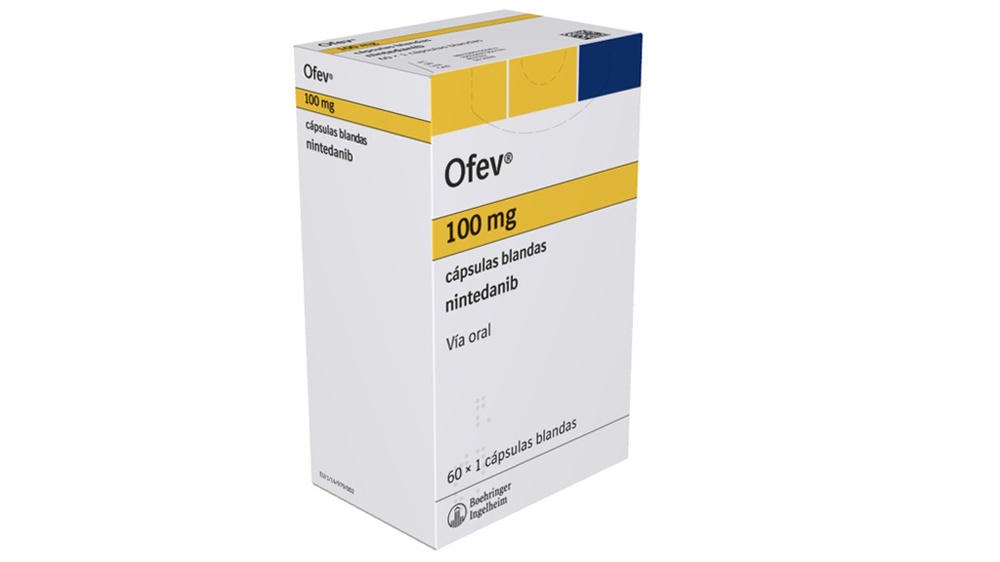
OFEV 100 mg Cápsulas Blandas

Revisión de receta online
Un médico revisará tu caso y determinará si la prescripción es médicamente apropiada.

Habla con un médico sobre este medicamento
Comenta tus síntomas y las opciones de tratamiento en una consulta online.



Cómo usar OFEV 100 MG CAPSULAS BLANDAS
Contenido del prospecto
- Introducción
- Qué es Ofev y para qué se utiliza
- Qué necesita saber antes de empezar a tomar Ofev
- Cómo tomar Ofev
- Posibles efectos adversos
- Conservación de Ofev
- Contenido del envase e información adicional
Introducción
Prospecto: información para el paciente
Ofev 100mg cápsulas blandas
nintedanib
Lea todo el prospecto detenidamente antes de empezar a tomar este medicamento, porque contiene información importante para usted.
- Conserve este prospecto, ya que puede tener que volver a leerlo.
- Si tiene alguna duda, consulte a su médico o farmacéutico.
- Este medicamento se le ha recetado solamente a usted, y no debe dárselo a otras personas aunque tengan los mismos síntomas que usted, ya que puede perjudicarles.
- Si experimenta efectos adversos, consulte a su médico o farmacéutico, incluso si se trata de efectos adversos que no aparecen en este prospecto. Ver sección 4.
Contenido del prospecto
- Qué es Ofev y para qué se utiliza
- Qué necesita saber antes de empezar a tomar Ofev
- Cómo tomar Ofev
- Posibles efectos adversos
- Conservación de Ofev
- Contenido del envase e información adicional
1. Qué es Ofev y para qué se utiliza
Ofev contiene el principio activo nintedanib, un medicamento que pertenece a la clase de los denominados inhibidores de la tirosina cinasa, y se usa para tratar las siguientes enfermedades:
Fibrosis pulmonar idiopática (FPI) en adultos
La FPI es una enfermedad que provoca engrosamiento, endurecimiento y cicatrización del tejido de sus pulmones a lo largo del tiempo. En consecuencia, la cicatrización reduce la capacidad para transferir oxígeno desde los pulmones al torrente sanguíneo, por lo que resulta difícil respirar profundamente. Ofev ayuda a reducir la aparición de más cicatrización y endurecimiento de los pulmones.
Otras enfermedades pulmonares intersticiales (EPI) fibrosantes crónicas con un fenotipo progresivo en adultos
Además de la FPI, hay otras enfermedades en las que el tejido de sus pulmones presenta engrosamiento, endurecimiento y cicatrización a lo largo del tiempo (fibrosis pulmonar) y sigue empeorando (fenotipo progresivo). Algunos ejemplos de estas enfermedades son la neumonitis por hipersensibilidad, las EPI autoinmunes (como la EPI asociada a artritis reumatoide), la neumonía intersticial idiopática inespecífica, la neumonía intersticial idiopática inclasificable y otras EPI. Ofev ayuda a reducir la aparición de más cicatrización y endurecimiento de los pulmones.
Enfermedades pulmonares intersticiales (EPI) fibrosantes progresivas clínicamente significativas en niños y adolescentes de entre 6 y 17 años de edad
Se puede producir fibrosis pulmonar en pacientes con enfermedad pulmonar intersticial infantil. En este caso, el tejido de los pulmones de los niños y adolescentes presenta engrosamiento, endurecimiento y cicatrización a lo largo del tiempo. Ofev ayuda a reducir la aparición de más cicatrización y endurecimiento de los pulmones.
Enfermedad pulmonar intersticial asociada a la esclerosis sistémica (EPI-ES) en adultos, adolescentes y niños de 6 años de edad y mayores
La esclerosis sistémica (ES), también conocida como esclerodermia (y esclerosis sistémica juvenil en niños y adolescentes), es una enfermedad autoinmunitaria crónica rara que afecta al tejido conjuntivo en muchas partes del cuerpo. La ES causa fibrosis (cicatrización y endurecimiento) de la piel y otros órganos internos, como los pulmones. Cuando los pulmones se ven afectados por la fibrosis, se denomina enfermedad pulmonar intersticial (EPI) y, por tanto, la enfermedad se llama EPI-ES. La fibrosis en los pulmones reduce la capacidad para transferir oxígeno al torrente sanguíneo y se reduce la capacidad para respirar. Ofev ayuda a reducir la aparición de más cicatrización y endurecimiento de los pulmones.

¿No estás seguro de si este medicamento es adecuado para ti?
Comenta tus síntomas y tratamiento con un médico online.
2. Qué necesita saber antes de empezar a tomar Ofev
No tome Ofev
- si está embarazada,
- si es alérgico a nintedanib, a los cacahuetes, a la soja o a alguno de los demás componentes de este medicamento (incluidos en la sección 6).
Advertencias y precauciones
Consulte a su médico o farmacéutico antes de empezar a tomar Ofev
- si tiene o ha tenido problemas de hígado,
- si tiene o ha tenido problemas de riñón, o si se le ha detectado un aumento de la cantidad de proteínas en la orina,
- si tiene o ha tenido problemas de hemorragias,
- si toma medicamentos para diluir la sangre (como warfarina, fenprocumón o heparina) para prevenir los coágulos de sangre,
- si toma pirfenidona, ya que esta puede aumentar el riesgo de sufrir diarrea, náuseas, vómitos y problemas de hígado,
- si tiene o ha tenido problemas de corazón (como un ataque al corazón),
- si se ha sometido recientemente a una intervención quirúrgica. Nintedanib puede afectar a la forma en la que se curan las heridas. Por lo tanto, el tratamiento con Ofev se interrumpirá por lo general durante un tiempo si se somete a una intervención quirúrgica. Su médico decidirá cuándo reanudar el tratamiento con este medicamento.
- si tiene hipertensión arterial,
- si tiene una presión sanguínea anormalmente alta en los vasos sanguíneos de los pulmones (hipertensión pulmonar),
- si tiene o ha tenido un aneurisma (aumento y debilitamiento de la pared de un vaso sanguíneo) o un desgarro en la pared de un vaso sanguíneo.
Basándose en esta información, su médico puede realizar algunos análisis de sangre, por ejemplo, para comprobar su función hepática. Su médico comentará los resultados de estas pruebas con usted para decidir si puede tomar Ofev.
Informe a su médico inmediatamente mientras esté tomando este medicamento
- si tiene diarrea. Es importante tratar la diarrea de forma temprana (ver sección 4, “Posibles efectos adversos”);
- si tiene vómitos o ganas de vomitar (náuseas);
- si tiene síntomas sin causa aparente como coloración amarillenta de la piel o del blanco de los ojos (ictericia), orina oscura o marrón (del color del té), dolor en el lado superior derecho de la zona del estómago (abdomen), hemorragia o aparecen moretones con más facilidad de lo normal o se siente cansado. Podrían ser síntomas de problemas graves de hígado;
- si tiene dolor agudo en el estómago, fiebre, escalofríos, mareos, vómitos o rigidez o hinchazón abdominal, pues estos podrían ser síntomas de tener un agujero en la pared de los intestinos (“perforación gastrointestinal”). Informe también a su médico si ha padecido úlceras pépticas o enfermedad diverticular en el pasado o si está siendo tratado a la vez con medicamentos antiinflamatorios (AINE) (utilizados para aliviar el dolor y la hinchazón) o esteroides (utilizados contra la inflamación y las alergias), ya que todo ello puede aumentar este riesgo;
- si tiene una combinación de dolor intenso o de tipo cólico en el estómago, sangre roja en las heces o diarrea, ya que estos podrían ser síntomas de inflamación intestinal por una irrigación sanguínea insuficiente;
- si tiene dolor, hinchazón, enrojecimiento o calor en una extremidad, pues estos podrían ser síntomas de tener un coágulo de sangre en una de sus venas (un tipo de vaso sanguíneo);
- si tiene presión o dolor en el pecho, normalmente en el lado izquierdo del cuerpo, dolor en el cuello, la mandíbula, el hombro o el brazo, aceleración en los latidos del corazón, dificultad para respirar, náuseas o vómitos, pues estos podrían ser síntomas de un ataque al corazón;
- si tiene una hemorragia importante;
- si experimenta formación de hematomas, hemorragia, fiebre, cansancio y confusión, ya que pueden ser un signo de una lesión de los vasos sanguíneos conocida como microangiopatía trombótica (MAT);
- si experimenta síntomas tales como dolor de cabeza, cambios en la visión, confusión, convulsiones u otras alteraciones neurológicas como debilidad en un brazo o una pierna, con o sin hipertensión arterial, que podrían ser síntomas de un trastorno cerebral denominado síndrome de encefalopatía posterior reversible (SEPR).
Niños y adolescentes
Los niños menores de 6 años no deben tomar Ofev.
Es posible que su médico le haga exámenes dentales periódicos al menos cada 6 meses hasta la finalización del desarrollo de los dientes y que supervise su crecimiento una vez al año (estudio de imagen ósea) mientras esté tomando este medicamento.
Otros medicamentos y Ofev
Informe a su médico o farmacéutico si está tomando, ha tomado recientemente o pudiera tener que tomar cualquier otro medicamento, incluidas las plantas medicinales y los medicamentos obtenidos sin receta.
Ofev puede interaccionar con otros medicamentos. Los siguientes medicamentos pueden
aumentar los niveles en sangre de nintedanib y, por lo tanto, aumentar el riesgo de sufrir efectos
adversos (ver sección 4, “Posibles efectos adversos”):
- un medicamento utilizado para tratar infecciones por hongos (ketoconazol)
- un medicamento utilizado para tratar infecciones bacterianas (eritromicina)
- un medicamento que afecta a su sistema inmunitario (ciclosporina)
Los siguientes medicamentos son ejemplos que pueden disminuir los niveles en sangre de nintedanib y, de este modo, reducir la eficacia de Ofev:
- un antibiótico utilizado para tratar la tuberculosis (rifampicina)
- medicamentos utilizados para tratar las convulsiones (carbamazepina, fenitoína)
- una planta medicinal utilizada para tratar la depresión (hierba de San Juan)
Embarazo y lactancia
Si está embarazada o en periodo de lactancia, cree que podría estar embarazada o tiene intención de quedarse embarazada, consulte a su médico o farmacéutico antes de utilizar este medicamento.
Embarazo
No tome este medicamento durante el embarazo, ya que puede dañar al feto y causar defectos congénitos.
Se le debe realizar una prueba de embarazo para asegurarse de que no está embarazada antes de comenzar el tratamiento con Ofev. Consulte a su médico.
Anticoncepción
- Las mujeres que puedan quedarse embarazadas deben utilizar un método anticonceptivo altamente efectivo para evitar el embarazo cuando empiecen a tomar Ofev, mientras estén tomando Ofev y durante al menos 3 meses después de interrumpir el tratamiento.
- Consulte con su médico los métodos anticonceptivos más apropiados para usted.
- Los vómitos y/o la diarrea u otros trastornos gastrointestinales pueden afectar a la absorción de los anticonceptivos hormonales orales, como las píldoras anticonceptivas, y pueden reducir su eficacia. Por lo tanto, si experimenta alguna de estas situaciones, consulte a su médico para valorar un método anticonceptivo alternativo más apropiado.
- Informe a su médico o farmacéutico de inmediato si se queda embarazada o cree que puede estar embarazada durante el tratamiento con Ofev.
Lactancia
No dé el pecho a su bebé durante el tratamiento con Ofev, ya que puede provocar daños al lactante.
Conducción y uso de máquinas
Ofev influye poco en la capacidad para conducir y utilizar máquinas. No debe conducir ni utilizar máquinas si se siente mareado.
Ofev contiene lecitina de soja
Si es alérgico a la soja o a los cacahuetes, no tome este medicamento (ver sección 2, “No tome Ofev”).
3. Cómo tomar Ofev
Siga exactamente las instrucciones de administración de este medicamento indicadas por su médico o farmacéutico. En caso de duda, consulte de nuevo a su médico o farmacéutico.
Tome las cápsulas dos veces al día con unas 12 horas de diferencia y aproximadamente a la misma hora del día; por ejemplo, una cápsula por la mañana y una cápsula por la noche. De este modo, garantizará que se mantiene un nivel constante de nintedanib en su sangre. Trague las cápsulas enteras con agua, sin masticarlas. Se recomienda tomar las cápsulas con alimentos, es decir, durante las comidas o inmediatamente antes o después de las mismas. No abra ni parta la cápsula (ver sección 5, “Conservación de Ofev”).
Para que le resulte más sencillo tragar las cápsulas, puede tomarlas con una pequeña cantidad (una cucharadita) de un alimento blando frío o a temperatura ambiente, como compota de manzana o pudin de chocolate. Trague las cápsulas inmediatamente y no las mastique para garantizar que permanezcan intactas.
Adultos
La dosis recomendada es una cápsula de 100 mg dos veces al día (un total de 200 mg al día).
No tome más de la dosis recomendada de dos cápsulas de Ofev 100 mg al día.
Si no tolera la dosis recomendada de dos cápsulas de Ofev 100 mg al día (ver posibles efectos adversos en la sección 4), su médico puede recomendarle que deje de tomar este medicamento. No reduzca la dosis ni interrumpa el tratamiento por sí mismo sin consultar antes a su médico.
Uso en niños y adolescentes
La dosis recomendada depende del peso del paciente.
Informe a su médico si en algún momento durante el tratamiento el peso del paciente es inferior a 13,5 kg.
Informe a su médico si tiene problemas de hígado.
Su médico determinará la dosis correcta. Su médico puede ajustar la dosis durante el curso del tratamiento.
Si no tolera la dosis diaria recomendada de Ofev cápsulas (ver los posibles efectos adversos en la sección 4), su médico puede reducir la dosis diaria de Ofev.
No reduzca la dosis ni interrumpa el tratamiento por sí mismo sin consultar antes a su médico.
Posología basada en el peso para Ofev cápsulas en niños y adolescentes:
Intervalo de peso enkilogramos (kg) | Dosis de Ofev en miligramos (mg) |
13,5‑22,9 kg | 50 mg (dos cápsulas de 25 mg) dos veces al día |
23,0‑33,4 kg | 75 mg (tres cápsulas de 25 mg) dos veces al día |
33,5‑57,4 kg | 100 mg (una cápsula de 100 mg o cuatro cápsulas de 25 mg) dos veces al día |
57,5 kg o más | 150 mg (una cápsula de 150 mg o seis cápsulas de 25 mg) dos veces al día |
Si toma más Ofev del que debe
Póngase en contacto inmediatamente con su médico o farmacéutico.
Si olvidó tomar Ofev
No tome dos cápsulas juntas si ha olvidado tomar su dosis anterior. Debe tomar su dosis siguiente de Ofev según la pauta establecida a la siguiente hora programada y recomendada por su médico o farmacéutico.
Si interrumpe el tratamiento con Ofev
No deje de tomar Ofev sin consultarlo antes con su médico. Es importante tomar este medicamento todos los días mientras su médico se lo recete.
Si tiene cualquier otra duda sobre el uso de este medicamento, pregunte a su médico o farmacéutico.

¿Has empezado a tomar el medicamento y tienes preguntas?
Comenta tus síntomas y tratamiento con un médico online.
4. Posibles efectos adversos
Al igual que todos los medicamentos, este medicamento puede producir efectos adversos, aunque no todas las personas los sufran.
Debe prestar especial atención si experimenta los siguientes efectos adversos durante el tratamiento con Ofev:
Diarrea(muy frecuente, puede afectar a más de 1de cada 10personas):
La diarrea puede producir deshidratación: una pérdida de líquidos y sales importantes del cuerpo (electrolitos, tales como el sodio o el potasio). Ante los primeros síntomas de diarrea, beba abundante líquido y consulte con su médico de inmediato. Inicie lo antes posible un tratamiento antidiarreico apropiado, por ejemplo, tomando loperamida.
Los siguientes efectos adversos también se han observado durante el tratamiento con este medicamento.
Consulte a su médico si experimenta cualquier tipo de efecto adverso.
Fibrosis pulmonar idiopática (FPI)
Efectos adversos muy frecuentes (pueden afectar a más de 1de cada 10personas)
- Ganas de vomitar (náuseas)
- Dolor en la mitad inferior del cuerpo (abdomen)
- Resultados anómalos en las pruebas hepáticas
Efectos adversos frecuentes (pueden afectar a hasta 1de cada 10personas)
- Vómitos
- Pérdida de apetito
- Pérdida de peso
- Hemorragia
- Erupción
- Dolor de cabeza
Efectos adversos poco frecuentes (pueden afectar a hasta 1de cada 100personas)
- Pancreatitis
- Inflamación del intestino grueso
- Problemas hepáticos graves
- Recuento bajo de plaquetas (trombocitopenia)
- Presión arterial alta (hipertensión)
- Ictericia, es decir, color amarillo en la piel y en el blanco de los ojos debido a niveles altos de bilirrubina
- Picor
- Ataque cardiaco
- Pérdida de pelo (alopecia)
- Aumento de la cantidad de proteínas en la orina (proteinuria)
Frecuencia no conocida (no puede estimarse a partir de los datos disponibles)
- Fallo renal
- Aumento y debilitamiento de la pared de un vaso sanguíneo o desgarro de la pared de un vaso sanguíneo (aneurismas y disecciones arteriales)
- Trastorno cerebral con síntomas tales como dolor de cabeza, cambios en la visión, confusión, convulsiones u otras alteraciones neurológicas como debilidad en un brazo o una pierna, con o sin hipertensión arterial (síndrome de encefalopatía posterior reversible)
Otras enfermedades pulmonares intersticiales (EPI) fibrosantes crónicas con un fenotipo progresivo
Efectos adversos muy frecuentes (pueden afectar a más de 1de cada 10personas)
- Ganas de vomitar (náuseas)
- Vómitos
- Pérdida de apetito
- Dolor en la mitad inferior del cuerpo (abdomen)
- Resultados anómalos en las pruebas hepáticas
Efectos adversos frecuentes (pueden afectar a hasta 1de cada 10personas)
- Pérdida de peso
- Presión arterial alta (hipertensión)
- Hemorragia
- Problemas hepáticos graves
- Erupción
- Dolor de cabeza
Efectos adversos poco frecuentes (pueden afectar a hasta 1de cada 100personas)
- Pancreatitis
- Inflamación del intestino grueso
- Recuento bajo de plaquetas (trombocitopenia)
- Ictericia, es decir, color amarillo en la piel y en el blanco de los ojos debido a niveles altos de bilirrubina
- Picor
- Ataque cardiaco
- Pérdida de pelo (alopecia)
- Aumento de la cantidad de proteínas en la orina (proteinuria)
Frecuencia no conocida (no puede estimarse a partir de los datos disponibles)
- Fallo renal
- Aumento y debilitamiento de la pared de un vaso sanguíneo o desgarro de la pared de un vaso sanguíneo (aneurismas y disecciones arteriales)
- Trastorno cerebral con síntomas tales como dolor de cabeza, cambios en la visión, confusión, convulsiones u otras alteraciones neurológicas como debilidad en un brazo o una pierna, con o sin hipertensión arterial (síndrome de encefalopatía posterior reversible)
Enfermedad pulmonar intersticial asociada a la esclerosis sistémica (EPI-ES)
Efectos adversos muy frecuentes (pueden afectar a más de 1de cada 10personas)
- Ganas de vomitar (náuseas)
- Vómitos
- Dolor en la mitad inferior del cuerpo (abdomen)
- Resultados anómalos en las pruebas hepáticas
Efectos adversos frecuentes (pueden afectar a hasta 1de cada 10personas)
- Hemorragia
- Presión arterial alta (hipertensión)
- Pérdida de apetito
- Pérdida de peso
- Dolor de cabeza
Efectos adversos poco frecuentes (pueden afectar a hasta 1de cada 100personas)
- Inflamación del intestino grueso
- Problemas hepáticos graves
- Fallo renal
- Recuento bajo de plaquetas (trombocitopenia)
- Erupción
- Picor
Frecuencia no conocida (no puede estimarse a partir de los datos disponibles)
- Ataque cardiaco
- Pancreatitis
- Ictericia, es decir, color amarillo en la piel y en el blanco de los ojos debido a niveles altos de bilirrubina
- Aumento y debilitamiento de la pared de un vaso sanguíneo o desgarro de la pared de un vaso sanguíneo (aneurismas y disecciones arteriales)
- Pérdida de pelo (alopecia)
- Aumento de la cantidad de proteínas en la orina (proteinuria)
- Trastorno cerebral con síntomas tales como dolor de cabeza, cambios en la visión, confusión, convulsiones u otras alteraciones neurológicas como debilidad en un brazo o una pierna, con o sin hipertensión arterial (síndrome de encefalopatía posterior reversible)
Enfermedades pulmonares intersticiales (EPI) fibrosantes en niños y adolescentes
Los efectos adversos en niños y adolescentes fueron similares a los efectos adversos en pacientes adultos.
Informe a su médico si experimenta cualquier tipo de efecto adverso.
Comunicaciónde efectos adversos
Si experimenta cualquier tipo de efecto adverso, consulte a su médico o farmacéutico, incluso si se trata de posibles efectos adversos que no aparecen en este prospecto. También puede comunicarlos directamente a través del sistema nacional de notificación incluido en el Apéndice V. Mediante la comunicación de efectos adversos usted puede contribuir a proporcionar más información sobre la seguridad de este medicamento.
5. Conservación de Ofev
Mantener este medicamento fuera de la vista y del alcance de los niños.
No utilice este medicamento después de la fecha de caducidad que aparece en la caja y en el blíster. La fecha de caducidad es el último día del mes que se indica.
No conservar a una temperatura superior a 25 °C.
Conservar en el embalaje original para protegerlo de la humedad.
No utilice este medicamento si observa que el blíster que contiene las cápsulas está abierto o que una cápsula está rota.
Si entra en contacto con el contenido de la cápsula, lávese las manos inmediatamente con abundante agua (ver sección 3, “Cómo tomar Ofev”).
Los medicamentos no se deben tirar por los desagües ni a la basura. Pregunte a su farmacéutico cómo deshacerse de los envases y de los medicamentos que ya no necesita. De esta forma, ayudará a proteger el medio ambiente.
6. Contenido del envase e información adicional
Composición de Ofev
- El principio activo es nintedanib. Cada cápsula contiene 100 mg de nintedanib (como esilato).
- Los demás componentes son:
Contenido de la cápsula: triglicéridos de cadena media, grasa dura, lecitina de soja (E322) (ver sección 2, “No tome Ofev”)
Cubierta exterior de la cápsula: gelatina, glicerol (85 %), dióxido de titanio (E171), óxido de hierro rojo (E172), óxido de hierro amarillo (E172)
Aspecto del producto y contenido del envase
Ofev 100 mg cápsulas son cápsulas de gelatina blanda oblongas, opacas y de color melocotón (de aproximadamente 16 × 6 mm), marcadas en un lado con el logotipo de la empresa Boehringer Ingelheim y la cifra “100”.
Existen dos tamaños de envase de Ofev 100 mg cápsulas:
- 30 × 1 cápsulas blandas en blísteres precortados unidosis de aluminio/aluminio
- 60 × 1 cápsulas blandas en blísteres precortados unidosis de aluminio/aluminio
Puede que solamente estén comercializados algunos tamaños de envases.
Titular de la autorización de comercialización
Boehringer Ingelheim International GmbH
Binger Strasse 173
55216 Ingelheim am Rhein
Alemania
Responsable de la fabricación
Boehringer Ingelheim Pharma GmbH & Co. KG
Binger Strasse 173
55216 Ingelheim am Rhein
Alemania
Boehringer Ingelheim France
100-104 Avenue de France
75013 Paris
Francia
Pueden solicitar más información respecto a este medicamento dirigiéndose al representante local del titular de la autorización de comercialización:
België/Belgique/Belgien Boehringer Ingelheim SComm Tél/Tel: +32 2 773 33 11 | Lietuva Boehringer Ingelheim RCV GmbH & Co KG Lietuvos filialas Tel: +370 5 2595942 |
???????? ????????? ????????? ??? ???? ? ??. ?? – ???? ???????? ???: +359 2 958 79 98 | Luxembourg/Luxemburg Boehringer Ingelheim SComm Tél/Tel: +32 2 773 33 11 |
Ceská republika Boehringer Ingelheim spol. s r.o. Tel: +420 234 655 111 | Magyarország Boehringer Ingelheim RCV GmbH & Co KG Magyarországi Fióktelepe Tel: +36 1 299 89 00 |
Danmark Boehringer Ingelheim Danmark A/S Tlf.: +45 39 15 88 88 | Malta Boehringer Ingelheim Ireland Ltd. Tel: +353 1 295 9620 |
Deutschland Boehringer Ingelheim Pharma GmbH & Co. KG Tel: +49 (0) 800 77 90 900 | Nederland Boehringer Ingelheim B.V. Tel: +31 (0) 800 22 55 889 |
Eesti Boehringer Ingelheim RCV GmbH & Co KG Eesti filiaal Tel: +372 612 8000 | Norge Boehringer Ingelheim Danmark Norwegian branch Tlf: +47 66 76 13 00 |
Ελλ?δα Boehringer Ingelheim Ελλ?ς Μονοπρ?σωπη A.E. Tηλ: +30 2 10 89 06 300 | Österreich Boehringer Ingelheim RCV GmbH & Co KG Tel: +43 1 80 105-7870 |
España Boehringer Ingelheim España, S.A. Tel: +34 93 404 51 00 | Polska Boehringer Ingelheim Sp. z o.o. Tel: +48 22 699 0 699 |
France Boehringer Ingelheim France S.A.S. Tél: +33 3 26 50 45 33 | Portugal Boehringer Ingelheim Portugal, Lda. Tel: +351 21 313 53 00 |
Hrvatska Boehringer Ingelheim Zagreb d.o.o. Tel: +385 1 2444 600 | România Boehringer Ingelheim RCV GmbH & Co KG Viena – Sucursala Bucuresti Tel: +40 21 302 2800 |
Ireland Boehringer Ingelheim Ireland Ltd. Tel: +353 1 295 9620 | Slovenija Boehringer Ingelheim RCV GmbH & Co KG Podružnica Ljubljana Tel: +386 1 586 40 00 |
Ísland Vistor ehf. Sími: +354 535 7000 | Slovenská republika Boehringer Ingelheim RCV GmbH & Co KG organizacná zložka Tel: +421 2 5810 1211 |
Italia Boehringer Ingelheim Italia S.p.A. Tel: +39 02 5355 1 | Suomi/Finland Boehringer Ingelheim Finland Ky Puh/Tel: +358 10 3102 800 |
Κ?προς Boehringer Ingelheim Ελλ?ς Μονοπρ?σωπη A.E. Tηλ: +30 2 10 89 06 300 | Sverige Boehringer Ingelheim AB Tel: +46 8 721 21 00 |
Latvija Boehringer Ingelheim RCV GmbH & Co KG Latvijas filiale Tel: +371 67 240 011 |
Fecha de la última revisión de este prospecto:
La información detallada de este medicamento está disponible en la página web de la Agencia Europea de Medicamentos: https://www.ema.europa.eu.
- País de registro
- Forma farmacéuticaCAPSULA, 100 MG
- Código ATCL01EX09
- Principio activo
- Requiere recetaSí
- Fabricante
- ComposiciónGLICEROL (E 422) (49,36 mg mg)
- Esta información es de carácter general y no sustituye la consulta con un profesional sanitario.
- Alternativas a OFEV 100 MG CAPSULAS BLANDASForma farmacéutica: CAPSULA, 100 mgPrincipio activo: NintedanibFabricante: Accord Healthcare S.L.U.Requiere recetaForma farmacéutica: CAPSULA, 150 mgPrincipio activo: NintedanibFabricante: Accord Healthcare S.L.U.Requiere recetaForma farmacéutica: CAPSULA, 100 mgPrincipio activo: NintedanibFabricante: Accord Healthcare S.L.U.Requiere receta
Médicos online para OFEV 100 MG CAPSULAS BLANDAS
Comenta la dosis, los posibles efectos secundarios, interacciones, contraindicaciones o la revisión de receta de OFEV 100 MG CAPSULAS BLANDAS, sujeto a valoración médica y a la normativa local.
Obtén una receta de OFEV 100 MG CAPSULAS BLANDAS online
Rellena un formulario de 2 minutos
Cuéntanos tus síntomas, historial y el medicamento que necesitas.
Elige un médico o nosotros te asignamos uno
Escoge un especialista o te conectamos con el próximo médico disponible.
El médico revisa tu caso
Normalmente en 30 minutos. Puede hacerte preguntas adicionales por chat.
Recógela en cualquier farmacia
Receta electrónica enviada a tu correo, válida en toda España.
Preguntas frecuentes
OFEV 100 MG CAPSULAS BLANDAS requiere receta en España. Puedes confirmarlo con un médico online según tu caso.
El principio activo de OFEV 100 MG CAPSULAS BLANDAS es Nintedanib. Esta información ayuda a identificar medicamentos con la misma composición pero con diferentes nombres comerciales.
OFEV 100 MG CAPSULAS BLANDAS es fabricado por Boehringer Ingelheim International Gmbh. La marca y el envase pueden variar según el distribuidor.
Los Médicos de familia, Psiquiatras, Dermatólogos, Cardiólogos, Endocrinólogos, Gastroenterólogos, Neumólogos, Nefrólogos, Reumatólogos, Hematólogos, Infectólogos, Alergólogos, Geriatras, Pediatras, Oncólogos pueden valorar la prescripción de OFEV 100 MG CAPSULAS BLANDAS cuando esté clínicamente indicado. Puedes reservar una videoconsulta para comentar tu caso y las opciones de tratamiento.
España cuenta con una infraestructura sanitaria bien desarrollada en ciudades principales como Madrid, Barcelona, Valencia y Sevilla. Las farmacias están ampliamente disponibles y operan bajo estrictas regulaciones, garantizando el acceso a medicamentos con receta.
Puedes comprar OFEV 100 MG CAPSULAS BLANDAS en Madrid, Barcelona, Sevilla o Valencia en cualquier farmacia local con una receta válida.
Para obtener una receta, puedes utilizar Oladoctor:
Otros medicamentos con el mismo principio activo (Nintedanib) incluyen NINTEDANIB ACCORD 100 MG CAPSULAS BLANDAS EFG, NINTEDANIB ACCORD 150 MG CAPSULAS BLANDAS EFG, NINTEDANIB ACCORDPHARMA 100 MG CÁPSULAS BLANDAS EFG. Pueden tener diferentes nombres comerciales o formulaciones, pero contienen el mismo componente terapéutico. Consulta siempre con un médico antes de cambiar o iniciar un nuevo medicamento.
