



NINOXAN 50 %/50 % GAS COMPRIMIDO MEDICINAL

Revisión de receta online
Un médico revisará tu caso y determinará si la prescripción es médicamente apropiada.

Habla con un médico sobre este medicamento
Comenta tus síntomas y las opciones de tratamiento en una consulta online.



Cómo usar NINOXAN 50 %/50 % GAS COMPRIMIDO MEDICINAL
Contenido del prospecto
- Introducción
- Qué es Ninoxan y para qué se utiliza
- Qué necesita saber antes de empezar a usar Ninoxan
- Cómo usar Ninoxan
- Posibles efectos adversos
- Conservación de Ninoxan
- Contenido del envase e información adicional
Introducción
Prospecto: información para el usuario
NINOXAN50%/50% gas comprimido medicinal.
Óxido nitroso / Oxígeno
Lea todo el prospecto detenidamente antes de empezar a usar este medicamento, porque contiene información importante para usted.
- Conserve este prospecto, ya que puede tener que volver a leerlo.
- Si tiene alguna duda, consulte a su médico o farmacéutico.
- Este medicamento se le ha recetado solamente a usted y no debe dárselo a otras personas aunque tengan los mismos síntomas que usted, ya que puede perjudicarles.
- Si experimenta efectos adversos, consulte a su médico o farmacéutico, incluso si se trata de efectos adversos que no aparecen en este prospecto. Consulte apartado 4
Contenido del prospecto
- Qué es Ninoxan y para qué se utiliza
- Qué necesita saber antes de empezar a usar Ninoxan
- Cómo usar Ninoxan
- Posibles efectos adversos
- Conservación de Ninoxan
- Contenido del envase e información adicional
1. Qué es Ninoxan y para qué se utiliza
Ninoxan contiene una mezcla preparada de óxido nitroso (“gas hilarante” medicinal, N2O) y oxígeno (oxígeno medicinal, O2), 50% de cada uno, y debe usarse respirando la mezcla de gases.
Los efectos del Ninoxan:
El óxido nitroso constituye el 50% de la mezcla de gases. El óxido nitroso tiene un efecto analgésico, reduce la sensación de dolor, y aumenta el umbral del dolor. El óxido nitroso también tiene un efecto relajante y ligeramente calmante. Estos efectos se producen por la acción del óxido nitroso sobre las sustancias que envían las señales en su sistema nervioso.
La concentración de 50 % de oxígeno, alrededor del doble de la que hay en el aire del ambiente, garantiza un contenido de oxígeno seguro en el gas inspirado.
Para que se usa el Ninoxan:
Ninoxan debe usarse cuando se desea un efecto analgésico de rápida aparición y resolución para dolencias de intensidad de leve a moderada y de duración limitada.
Ninoxan produce efecto analgésico después de unas pocas aspiraciones y el efecto analgésico disminuye en unos minutos después de cesar su uso.
Niños:
Ninoxan puede utilizarse en niños mayores de 1 mes de edad

¿No estás seguro de si este medicamento es adecuado para ti?
Comenta tus síntomas y tratamiento con un médico online.
2. Qué necesita saber antes de empezar a usar Ninoxan
No use Ninoxan:
Antes de usar Ninoxan debería decir a su médico si tiene alguno de los siguientes síntomas/condiciones:
- Cavidades con gas o burbujas de gas: si como resultado de una enfermedad, o por cualquier otra razón, puede sospechar que haya aire en sus cavidades pleurales fuera de los pulmones, o burbujas de gas en la sangre, o en cualquier otro órgano (por ejemplo, si se ha sumergido con el equipo de buceo y puede tener burbujas de gas en la sangre (enfermedad por descompresión); o si ha recibido alguna inyección de gas intraocular, por ejemplo, por un desprendimiento de retiniana, o similar) estas burbujas de gas pueden expandirse y causar daño.
- Enfermedad cardíaca: si usted tiene insuficiencia cardíaca o un funcionamiento deficiente del corazón, ya que el efecto leve de relajación del óxido nitroso sobre el músculo cardíaco puede deteriorar más la función cardíaca.
- Tras el tratamiento con la máquina de corazón-pulmón o by-pass coronario.
- Lesión del sistema nervioso central: si usted tiene una presión en el cerebro elevada, por ejemplo, como resultado de un tumor o hemorragia cerebral, el óxido nitroso puede aumentar más la presión en el cerebro con riesgo potencial de daños.
- Deficiencia de vitaminas: Si usted sufre deficiencia diagnosticada pero no tratada de vitamina B12, o deficiencia de ácido fólico, el uso de óxido nitroso puede empeorar los síntomas causados por la deficiencia de vitamina B12 y de ácido fólico.
- Dilatación intestinal (Íleus o Íleo): si usted tiene malestar abdominal severo: si hay síntomas que pueden indicar íleo, Ninoxan pueden aumentar más la dilatación de los intestinos.
- En pacientes con lesiones en la cara el uso de máscaras puede presentar dificultades o riesgos.
- Disminución del nivel de consciencia o deterioro de la capacidad de cooperar y seguir instrucciones, debido al riesgo de que la sedación más prolongada con el óxido nitroso puede afectar reflejos protectores naturales.
Advertencias y precauciones
Hable con su médico o enfermera antes de recibir Ninoxan si usted
- hace o ha hecho abuso de drogas / medicamentos porque existe un mayor riesgo de desarrollar dependencia al óxido nitroso si lo toma repetidamente. Su médico decidirá si el tratamiento con Ninoxan es posible en su caso
Consulte a su médico antes de empezar a usar Ninoxan
Informe a su médico si tiene alguno de los siguientes síntomas:
- Molestias en el oído: Por ejemplo inflamación del oído, ya que el Ninoxan puede incrementar la presión en el oído medio.
- Deficiencia de vitaminas: si sospecha tener deficiencia de vitamina B12 o deficiencia de ácido fólico, por ejemplo, si se ha reducido la ingesta o toma de vitamina B12 o ácido fólico, o se padece un trastorno genético que afecta el metabolismo de estas vitaminas o si se está inmunodeprimido. El uso del óxido nitroso puede empeorar los síntomas causados por la deficiencia de vitamina B12 y de ácido fólico.
Su médico decidirá si el Ninoxan está indicado para su uso
El uso repetido o prolongado de óxido nitroso puede aumentar el riesgo de deficiencia de vitamina B12, lo que puede provocar daños en la médula ósea o el sistema nervioso. Su médico puede iniciar análisis de sangre antes y después del tratamiento para evaluar las consecuencias de la posible deficiencia de vitamina B12.
Niños
Ninoxan no debe utilizarse en niños menores de 1 mes de edad.
Su médico decidirá si es apropiado el uso del Ninoxan
Uso de Ninoxan con otros medicamentos
Comunique a su médico o farmacéutico que está tomando, ha tomado recientemente o podría tener que tomar cualquier otro medicamento.
Si usted está tomando otros medicamentos que afecten al cerebro o a las funciones cerebrales, por ej. benzodiacepinas (tranquilizantes) o medicamentos tipo-morfina, debe informar a su médico. Ninoxan puede aumentar los efectos de estos medicamentos. Ninoxan, tomado conjuntamente con otros sedantes o medicamentos que afecten al sistema nervioso central, aumenta el riesgo de efectos secundarios.
También debe informar a su médico si está tomando medicamentos que contienen metotrexato (por ej. para el tratamiento de la artritis reumatoide), bleomicina (tratamiento del cáncer), nitrofurantoína y otros antibióticos (tratamiento de infecciones) o amiodarona (tratamiento de enfermedades cardíacas). Ninoxan aumenta los efectos secundarios de estos medicamentos.
Embarazo y lactancia:
Si está embarazada o en periodo de lactancia, cree que podría estar embarazada o tiene intención de quedarse embarazada, consulte a su médico o farmacéutico antes de utilizar este medicamento.
Embarazo
Ninoxan se puede utilizar durante el embarazo si su médico considera que es clínicamente necesario. También se puede utilizar durante el parto.
Si se utiliza Ninoxan cerca del parto, debe observarse a su bebé por posibles efectos adversos.
Lactancia
Ninoxan se puede utilizar durante la lactancia, pero no se debe utilizar en el momento de amamantar.
Conducción y uso de máquinas:
Ninoxan tiene un efecto sedante, y ello puede a afectar al comportamiento de su mente y cuerpo. Por razones de seguridad, usted debe evitar conducir, manejar máquinas o la realización de tareas complicadas hasta que se haya recuperado por completo. Compruebe con su profesional de la salud cuándo él piensa que usted se encuentra totalmente recuperado.
3. Cómo usar Ninoxan
Ninoxan se debe administrar siempre en presencia de personal familiarizado con este tipo de medicamento y equipo Durante el período en que utilice Ninoxan, tanto usted, como la administración del medicamento, deben monitorizarse para asegurar que éste se administra de forma segura. Tras finalizar el tratamiento, usted deberá estar controlado por personal competente hasta que se haya recuperado.
.Su médico debe explicarle cómo utilizar Ninoxan, cómo funciona Ninoxan, y qué efectos se derivan de su uso.
Siga exactamente las instrucciones de administración de este medicamento indicadas por su médico. En caso de duda pregunte a su médico.
Normalmente el Ninoxan se inhala mediante una mascarilla con una válvula especial, teniendo pleno control del flujo de gas mediante su propia respiración. La válvula está abierta solamente durante la inspiración. Ninoxan se puede administrar también con una mascarilla nasal.
Con independencia de qué máscara se use, debe respirar con normalidad, con respiraciones normales en la máscara. Lo ideal es mantener la máscara por sí mismo.
Usted debe comenzar a usar Ninoxan poco antes de requerirse el efecto analgésico y continuar durante el proceso del dolor. El efecto de Ninoxan desaparece a los pocos minutos después de la interrupción de la inhalación.
Después de dejar de usar Ninoxan, debe descansar y recuperarse hasta que se sienta mentalmente recuperado.
Medidas de seguridad:
- Fumar y la presencia de llamas quedan terminantemente prohibidas en la habitación donde tenga lugar el tratamiento con Ninoxan.
- Ninoxan es exclusivamente para uso medicinal.
Uso en niños
Ninoxan no debe utilizarse en niños menores de 1 mes de edad.
Si usa más Ninoxan del que debiera:
Es poco probable que reciba un exceso de gas, puesto que la aplicación de gas está controlada por su propia respiración y la mezcla de gases es fija (con 50% de óxido nitroso y 50% de oxígeno).
Si respira más deprisa de lo normal, recibiendo así más óxido nitroso que con la respiración normal, se puede sentir perceptiblemente cansado y perder hasta cierto punto el contacto con su entorno. En tal caso, debe informar inmediatamente al personal médico e interrumpir la inhalación de Ninoxan.
Si tiene cualquier pregunta adicional sobre el uso de este producto, pregunte a su médico o profesional de la salud.
En caso de sobredosis o ingestión accidental, consulte al Servicio de Información Toxicológica.
Teléfono 91 562 04 20.

¿Has empezado a tomar el medicamento y tienes preguntas?
Comenta tus síntomas y tratamiento con un médico online.
4. Posibles efectos adversos
Al igual que todos los medicamentos, Ninoxan puede producir efectos adversos, aunque no todas las personas los sufran.
Los siguientes efectos adversos han sido reportados:
Efectos adversos y su frecuencia:
Frecuentes(pueden afectar a 1 de cada 10 pacientes):
- Mareos, vértigos, sensación de desmayo.
- Dolor de cabeza leve.
- Euforia.
- Náuseas y vómitos.
Poco frecuentes(pueden afectar a 1 de cada 100 pacientes):
- Fatiga grave.
- Sensación de presión en el oído medio, si se utiliza Ninoxan durante un período prolongado.
- Hinchazón abdominal, porque Ninoxan aumenta lentamente el volumen de los gases intestinales.
Muy raros(pueden afectar a 1 de cada 10,000 pacientes):
- Efectos sobre la función nerviosa, sensaciones de entumecimiento y debilidad, generalmente en las piernas.
Frecuencia no conocida(no puede estimarse a partir de los datos disponibles):
- Efectos sobre la médula ósea, que pueden causar anemia. Bajos niveles de glóbulos blancos
- Efectos psiquiátricos, como psicosis, confusión y ansiedad.
- Depresión respiratoria.
- Dolor de cabeza.
- Convulsiones generalizadas
- Adicción
- Efectos sobre la función nerviosa, sensaciones de entumecimiento y debilidad, generalmente en las piernas.
Comunicación de efectos adversos
Si experimenta efectos adversos, consulte a su médico, incluso si se trata de efectos adversos que no aparecen en este prospecto.
También puede comunicarlos directamente a través del sistema nacional de notificación incluido en el Apéndice V. Mediante la comunicación de efectos adversos usted puede contribuir a proporcionar más información sobre la seguridad de este medicamento.
5. Conservación de Ninoxan
Mantener este medicamento fuera de la vista y del alcance de los niños.
No utilice este medicamento después de la fecha de caducidad que aparece en la bala de gas. La fecha de caducidad es el último día del mes que se indica.
La mezcla es inestable por debajo de -5ºC. No lo almacene a menos de -5°C. Si sospecha que Ninoxan se ha almacenado a temperaturas por debajo de -5ºC, las balas se deben poner en posición horizontal a una temperatura mayor de +10 ºC al menos 48 horas antes de su uso.
Cuando se use en vehículos de servicios de emergencias, las balas deberán protegerse del frío y estar firmemente aseguradas tanto en el interior como en el exterior del vehículo.
Guarde la bala en un lugar de almacenaje reservado para gases medicinales.
Diferentes tipos de gases deben separarse los unos de los otros. Balas de gases llenas y vacías deben almacenarse separadamente.
No fumar. No debe exponerse a calor fuerte.
Los vapores del gas pueden producir somnolencia y mareos
Debe mantenerse lejos de material combustible.
Si hay riesgo de incendio, muévala a un lugar seguro.
Mantenga la bala limpia, seca y libre de aceite y grasa.
Mantenga la bala en posición vertical.
Asegúrese de que la bala no haya sufrido impactos ni caídas.
Se debe almacenar y transportar con las válvulas cerradas.
6. Contenido del envase e información adicional
Composición de Ninoxan:
- Los principios activos son:
Óxido nitroso 50% = gas hilarante medicinal (término químico: N2O) y oxígeno 50% = oxígeno medicinal (término químico: O2).
- Ninoxan no contiene ningún otro ingrediente.
Aspecto del producto y contenido del envase
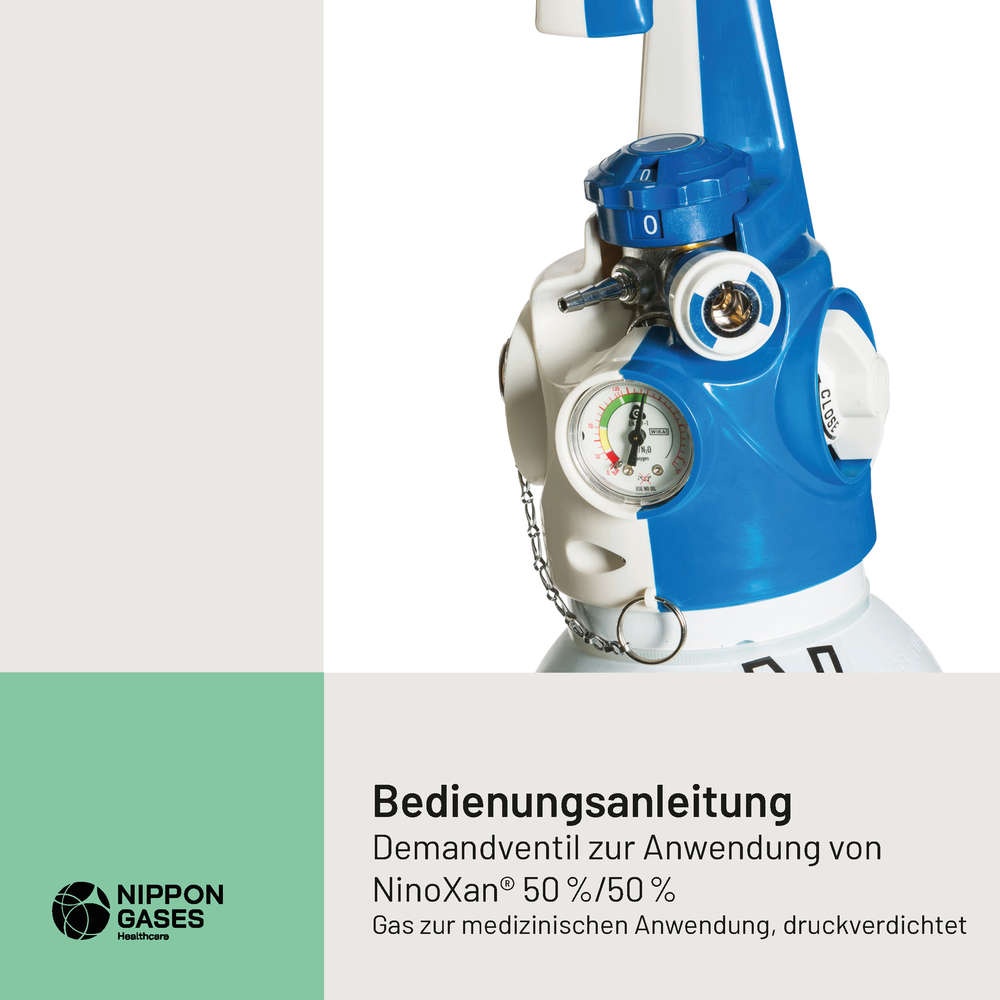
Ninoxan es un gas incoloro, inodoro, que se suministra en una bala de acero o aluminio con una válvula para controlar el flujo de gas.
Las balas se identifican mediante colores específicos (cuerpo blanco con hombro azul y blanco, con dos bandas horizontales siendo azul la inferior).
Envases
Bala de aluminio con válvula integrada o válvula normal de presión residual (VPR):
- de 2-litros llena a 170 bar que proporciona 0,56 m3 de gas a presión atmosférica y a 15ºC.
- de 5-litros llena a 170 bar que proporciona 1,4 m3 de gas a presión atmosférica y a 15ºC.
- de 10-litros llena a 170 bar que proporciona 2,8 m3 de gas a presión atmosférica y a 15ºC
Bala de acero sin soldadura con válvula integrada o válvula normal VPR:
- de 5-litros llena a 170 bar que proporciona 1,4 m3 de gas a presión atmosférica y a 15ºC.
- de 10-litros llena a 170 bar que proporciona 2,8 m3 de gas a presión atmosférica y a 15ºC
Bala de acero sin soldadura con válvula normal VPR:
- de 50-litros llena a 170 bar que proporciona 14 m3 de gas a presión atmosférica y a 15ºC.
Puede que solamente estén comercializados algunos tamaños de envase.
Titular de la autorización de comercialización y responsable de la fabricación
Titular de la autorización:
NIPPON GASES ESPAÑA S.L.U.
C/Orense, 11 28020 Madrid. España
Responsable de la fabricación:
NIPPON GASES ESPAÑA S.L.U.
Calle Embajadores, 474
28053 Madrid, España
Fecha de la última revisión de este prospecto: 06/2020
La información detallada de este medicamento está disponible en la página Web de la Agencia Española de Medicamentos y Productos Sanitarios (AEMPS) http:// www.aemps.gob.es.
--------------------------------------------------------------------------------------------------------------------
Esta información está destinada únicamente a los profesionales del sector sanitario:
Instrucciones de seguridad
Deben adoptarse precauciones especiales al trabajar con el óxido nitroso. El óxido nitroso se debe administrar según las directrices locales.
La administración repetida o la exposición al óxido nitroso pueden provocar adicción. Se debe tener precaución en los profesionales sanitarios con exposición ocupacional al óxido nitroso.
Ninoxan se debe utilizar solamente en áreas que estén bien ventiladas y donde haya equipo especial para extraer el exceso de gas. Usando un sistema extractor y asegurando buena ventilación, se evitan altas concentraciones atmosféricas de óxido nitroso en el aire ambiente. Las altas concentraciones de óxido nitroso en el aire pueden causar efectos adversos sobre la salud del personal y personas de los alrededores al lugar de la administración. Existen valores nacionales para la concentración de óxido nitroso en el aire. Estos valores no se deben exceder para garantizar que el personal no esté expuesto a riesgos.
Los llamados “valores límite umbral” de exposición ocupacional a químicos, son expresados a menudo como: TWA (time weight averageo media ponderada por día), que es el valor medio durante un día laborable, y STEL (shortterm exposure limito límite de exposición a corto plazo), que es el valor medio durante una exposición más corta.
Ninoxan es una mezcla inestable por debajo de -5 º C. Temperaturas inferiores puede causar una licuefacción temporal del óxido nitroso, que daría lugar a la inhalación de la mezcla desigual, con un exceso de oxígeno en el inicio de la administración (mezcla con poco efecto analgésico) y demasiado óxido nitroso al final (mezcla hipóxica) de la inhalación.
Si se sospecha que la bala ha sido almacenada por debajo de -5 º C, las balas deberán ser almacenadas en posición horizontal a una temperatura por encima de los 10ºC durante al menos 48 horas antes de su uso. Se recomienda agitar la bala completamente invirtiéndola al menos tres veces consecutivas para garantizar la homogeneización antes de usarla.
Guardar las balas en un área de almacenamiento reservada para gases medicinales. Diferentes tipos de gas deben separarse los unos de los otros. Balas de gas llenas y vacías deben almacenarse separadamente.
Cuando se use en vehículos de servicios de emergencias, las balas deberán protegerse del frío y estar firmemente aseguradas tanto en el interior como en el exterior del vehículo
Otras instrucciones:
- Manténgase lejos de materiales combustibles. No fumar
- Abrir la válvula lenta y cuidadosamente. Nunca utilice aceites o grasas, incluso ante dificultad de abrir la válvula o si el regulador es difícil de conectar. Nunca fuerce la válvula, usar sólo los dispositivos de conexión y juntas compatibles con la mezcla específica de gas y de gases oxidantes. Nunca use una herramienta para conectar un regulador de presión/flujo de conexión manual, ya que esto puede dañar el acoplamiento.
- Cierre la válvula de la bala en caso de incendio, o si no está funcionando. Almacenar y transportar las balas siempre con las válvulas cerradas, incluso cuando están vacías.
- Durante el uso de la bala, ésta debe fijarse con un soporte adecuado. Mantener los recipientes en posición vertical, no obstante, las balas deben ser almacenadas en posición horizontal cuando se sospeche que la bala ha sido almacenada a temperaturas inferiores a -5ºC.
- La bala de gas debe sustituirse cuando la presión en la bala haya caído a un punto en donde el indicador de la válvula esté dentro del campo amarillo.
- Cuando quede una pequeña cantidad del gas en la bala, la válvula de la bala debe cerrarse. Es importante que una pequeña cantidad de presión permanezca en la bala para evitar la entrada de contaminantes. Mantenga separados los envases llenos de los vacíos.
- Tras el uso, la válvula de la bala se debe cerrar con la mano. Despresurice el regulador o la conexión.
Para conocer más detalles, lea el Resumen de las Características del Producto (RCP) o póngase en contacto con el proveedor.
- País de registro
- Forma farmacéuticaINHALACIÓN PULMONAR, 50% Oxido Nitroso / 50% de Oxigeno
- Código ATCN01AX63
- Principio activo
- Requiere recetaSí
- Fabricante
- Esta información es de carácter general y no sustituye la consulta con un profesional sanitario.
- Alternativas a NINOXAN 50 %/50 % GAS COMPRIMIDO MEDICINALForma farmacéutica: INHALACIÓN PULMONAR, 50% / 50% v/vPrincipio activo: nitrous oxide, combinationsFabricante: Sociedad Española De Carburos Metalicos S.A.Requiere recetaForma farmacéutica: INHALACIÓN PULMONAR, 50%/50% (V/V)Principio activo: nitrous oxide, combinationsFabricante: Sol France Sucursal En EspanaRequiere recetaForma farmacéutica: INHALACIÓN PULMONAR, 50%/ 50%Principio activo: nitrous oxide, combinationsFabricante: Linde Sverige AbRequiere receta
Médicos online para NINOXAN 50 %/50 % GAS COMPRIMIDO MEDICINAL
Comenta la dosis, los posibles efectos secundarios, interacciones, contraindicaciones o la revisión de receta de NINOXAN 50 %/50 % GAS COMPRIMIDO MEDICINAL, sujeto a valoración médica y a la normativa local.









Obtén una receta de NINOXAN 50 %/50 % GAS COMPRIMIDO MEDICINAL online
Rellena un formulario de 2 minutos
Cuéntanos tus síntomas, historial y el medicamento que necesitas.
Elige un médico o nosotros te asignamos uno
Escoge un especialista o te conectamos con el próximo médico disponible.
El médico revisa tu caso
Normalmente en 30 minutos. Puede hacerte preguntas adicionales por chat.
Recógela en cualquier farmacia
Receta electrónica enviada a tu correo, válida en toda España.
Preguntas frecuentes
NINOXAN 50 %/50 % GAS COMPRIMIDO MEDICINAL requiere receta en España. Puedes confirmarlo con un médico online según tu caso.
El principio activo de NINOXAN 50 %/50 % GAS COMPRIMIDO MEDICINAL es nitrous oxide, combinations. Esta información ayuda a identificar medicamentos con la misma composición pero con diferentes nombres comerciales.
NINOXAN 50 %/50 % GAS COMPRIMIDO MEDICINAL es fabricado por Nippon Gases Espana Slu. La marca y el envase pueden variar según el distribuidor.
Los Médicos de familia, Psiquiatras, Dermatólogos, Cardiólogos, Endocrinólogos, Gastroenterólogos, Neumólogos, Nefrólogos, Reumatólogos, Hematólogos, Infectólogos, Alergólogos, Geriatras, Pediatras, Oncólogos pueden valorar la prescripción de NINOXAN 50 %/50 % GAS COMPRIMIDO MEDICINAL cuando esté clínicamente indicado. Puedes reservar una videoconsulta para comentar tu caso y las opciones de tratamiento.
España cuenta con una infraestructura sanitaria bien desarrollada en ciudades principales como Madrid, Barcelona, Valencia y Sevilla. Las farmacias están ampliamente disponibles y operan bajo estrictas regulaciones, garantizando el acceso a medicamentos con receta.
Puedes comprar NINOXAN 50 %/50 % GAS COMPRIMIDO MEDICINAL en Madrid, Barcelona, Sevilla o Valencia en cualquier farmacia local con una receta válida.
Para obtener una receta, puedes utilizar Oladoctor:
Otros medicamentos con el mismo principio activo (nitrous oxide, combinations) incluyen ACTYNOX 50%/50% GAS COMPRIMIDO MEDICINAL, DONOPA 50 %/50 % GAS COMPRIMIDO MEDICINAL, ENTONOX 50 %/50% GAS MEDICINAL COMPRIMIDO. Pueden tener diferentes nombres comerciales o formulaciones, pero contienen el mismo componente terapéutico. Consulta siempre con un médico antes de cambiar o iniciar un nuevo medicamento.
