



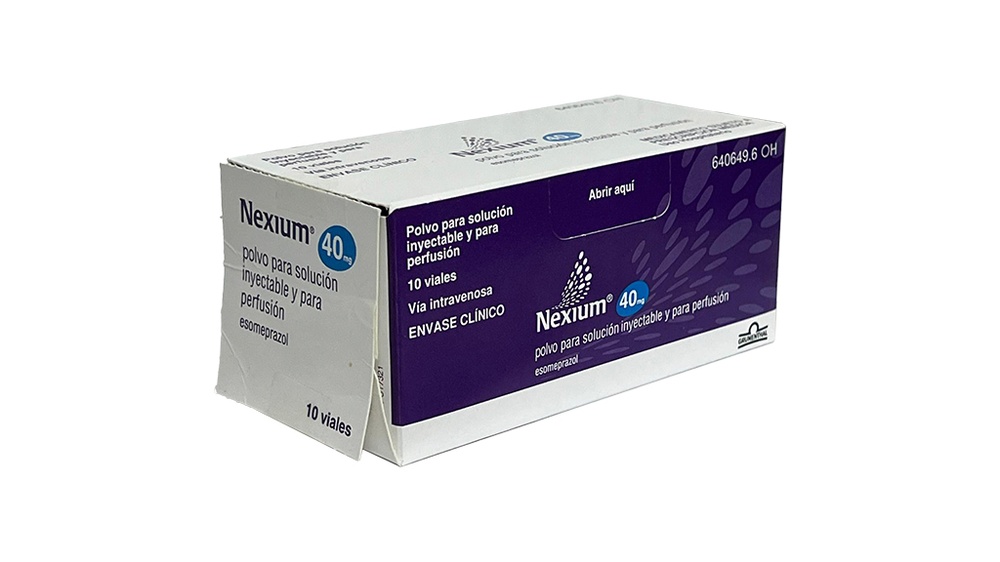
NEXIUM 40 mg Polvo Para Solución Injectable

Revisión de receta online
Un médico revisará tu caso y determinará si la prescripción es médicamente apropiada.

Habla con un médico sobre este medicamento
Comenta tus síntomas y las opciones de tratamiento en una consulta online.



Cómo usar NEXIUM 40 mg POLVO PARA SOLUCION INYECTABLE Y PARA PERFUSION
Contenido del prospecto
- Introducción
- Qué es Nexium y para qué se utiliza
- Qué necesita saber antes de que le administren Nexium
- Cómo se le administrará Nexium
- Posibles efectos adversos
- Conservación de Nexium
- Contenido del envase e información adicional
Introducción
Prospecto: información para el usuario
Nexium 40 mg Polvo para solución inyectable y para perfusión
esomeprazol
Lea todo el prospecto detenidamente antes de empezar a usar este medicamento, porque contiene información importante para usted.
- Conserve este prospecto, ya que puede tener que volver a leerlo.
- Si tiene alguna duda, consulte a su médico, farmacéutico o enfermero.
- Si experimenta efectos adversos, consulte a su médico, farmacéutico o enfermero, incluso si se trata de efectos adversos que no aparecen en este prospecto. Ver sección 4.
Contenido del prospecto
- Qué es Nexium y para qué se utiliza
- Qué necesita saber antes de que le administren Nexium
- Cómo se le administrará Nexium
- Posibles efectos adversos
- Conservación de Nexium
- Contenido del envase e información adicional
1. Qué es Nexium y para qué se utiliza
Nexium contiene un medicamento llamado esomeprazol que pertenece a un grupo de medicamentos llamados “inhibidores de la bomba de protones”. Estos funcionan reduciendo la cantidad de ácido que produce el estómago.
Nexium se utiliza para el tratamiento de los siguientes trastornos, cuando el tratamiento vía oral no es posible:
Adultos
- Enfermedad por reflujo gastroesofágico (ERGE). Se produce cuando el ácido del estómago asciende por el esófago (el tubo que va de la garganta al estómago) produciendo dolor, inflamación y ardor.
- Úlceras gástricas provocadas por medicamentos llamados AINE (Antiinflamatorios no esteroideos). Nexium también pueden emplearse para prevenir la formación de úlceras si está tomando AINE.
- Prevención del resangrado tras una endoscopia terapéutica realizada en caso de hemorragia aguda por úlcera gástrica o duodenal.
Niños y adolescentes de 1 a 18 años de edad
- Enfermedad por reflujo gastroesofágico (ERGE). Se produce cuando el ácido del estómago asciende por el esófago (el tubo que va de la garganta al estómago) produciendo dolor, inflamación y ardor.

¿No estás seguro de si este medicamento es adecuado para ti?
Comenta tus síntomas y tratamiento con un médico online.
2. Qué necesita saber antes de que le administren Nexium
No le administrarán Nexium
- Si es alérgico al esomeprazol o a alguno de los demás componentes de este medicamento (incluidos en la sección 6).
- Si es alérgico a otros medicamentos del grupo de los inhibidores de la bomba de protones (e.j. pantoprazol, lansoprazol, rabeprazol, omeprazol).
- Si está tomando un medicamento que contenga nelfinavir (utilizado en el tratamiento de la infección por VIH).
- Si alguna vez ha desarrollado una erupción cutánea grave o descamación de piel, formación de ampollas o úlceras en la boca después de tomar Nexium u otros medicamentos relacionados.
Si se encuentra en alguna de estas situaciones no le administrarán Nexium. Si no está seguro, consulte a su médico, farmacéutico o enfermero antes de que le administren este medicamento.
Advertencias y precauciones
Consulte a su médico o enfermero antes de que le administren Nexium si:
- Tiene problemas de hígado graves.
- Tiene problemas de riñón graves.
- Alguna vez ha tenido una reacción en la piel después del tratamiento con un medicamento similar a Nexium para reducir la acidez de estómago.
- Está previsto que le realicen un análisis específico de sangre (Cromogranina A).
Nexium puede enmascarar los síntomas de otras enfermedades. Por lo tanto, si se observa alguno de los siguientes acontecimientos antes de que le administren Nexium o tras su administración, contacte con su médico inmediatamente:
- Pierde mucho peso sin razón y tiene problemas para tragar.
- Presenta dolor de estómago o indigestión.
- Comienza a vomitar alimentos o sangre.
- Las heces aparecen negras (manchadas de sangre).
Tomar un inhibidor de la bomba de protones como Nexium, especialmente durante un período de más de un año, puede aumentar ligeramente el riesgo de que se fracture la cadera, muñeca o columna vertebral. Informe a su médico si tiene usted osteoporosis o si está tomando corticosteroides (que pueden aumentar el riesgo de osteoporosis).
Erupciones y síntomas cutáneos
Si sufre una erupción cutánea, especialmente en zonas de la piel expuestas al sol, consulte a su médico lo antes posible, ya que puede ser necesario interrumpir el tratamiento con Nexium. Recuerde mencionar cualquier otro síntoma que pueda notar, como dolor en las articulaciones.
Se han notificado reacciones cutáneas graves que incluyen síndrome de Stevens-Johnson, necrólisis epidérmica tóxica, reacción a fármaco con eosinofilia y síntomas sistémicos (DRESS), en relación con el tratamiento con Nexium. Deje de tomar Nexium y solicite atención médica inmediatamente si advierte alguno de los síntomas relacionados con estas reacciones cutáneas graves descritas en la sección 4.
Uso de Nexium con otros medicamentos
Informe a su médico o enfermero si está tomando, ha tomado recientemente o pudiera tener que tomar cualquier otro medicamento. Esto incluye los medicamentos adquiridos sin receta. Esto es porque Nexium puede afectar a la forma en que algunos medicamentos actúan y algunos medicamentos pueden influir sobre el efecto de Nexium.
No le administrarán Nexium si está tomando un medicamento que contenga nelfinavir (utilizado para el tratamiento de la infección por VIH).
Informe a su médico si está utilizando alguno de los siguientes medicamentos:
- Atazanavir (utilizado para el tratamiento de la infección por VIH).
- Clopidogrel (utilizado para la prevención de coágulos de sangre).
- Ketoconazol, itraconazol o voriconazol (para las infecciones producidas por hongos).
- Erlotinib (utilizado en el tratamiento del cáncer).
- Citalopram, imipramina, clomipramina (para el tratamiento de la depresión).
- Diazepam (utilizado para el tratamiento de la ansiedad, como relajante muscular o para la epilepsia).
- Fenitoína (para la epilepsia). Si está tomando fenitoína, su médico necesitará controlar cuándo empieza o cuándo termina de tomar Nexium.
- Medicamentos que se utilizan para hacer la sangre más fluida tales como warfarina. Puede que su médico necesite controlar cuándo empieza o cuándo termina de tomar Nexium.
- Cilostazol (utilizado para el tratamiento de la claudicación intermitente – dolor en las piernas al caminar causado por un bombeo sanguíneo insuficiente).
- Cisaprida (utilizado para la indigestión y ardor de estómago).
- Digoxina (utilizada para problemas cardíacos).
- Metotrexato (medicamento quimioterápico utilizado a dosis altas en el tratamiento del cáncer) – si está tomando dosis altas de metotrexato, su médico puede interrumpir temporalmente su tratamiento con Nexium.
- Tacrolimus (trasplante de órganos).
- Rifampicina (utilizada para el tratamiento de la tuberculosis).
- Hierba de San Juan (Hypericum perforatum) (utilizada para tratar la depresión).
Embarazo, lactancia y fertilidad
Si está embarazada o en periodo de lactancia, cree que podría estar embarazada o tiene intención de quedarse embarazada, consulte a su médico o farmacéutico antes de que le administren este medicamento. Su médico decidirá si puede administrársele Nexium durante este periodo.
Se desconoce si Nexium pasa a la leche materna. Por lo tanto, no se debe tomar Nexium durante la lactancia.
Conducción y uso de máquinas
No es probable que Nexium afecte a su capacidad para conducir o utilizar herramientas o máquinas. Sin embargo, pueden suceder con poca frecuencia efectos adversos tales como mareos o visión borrosa (ver sección 4). No debe conducir o usar máquinas si nota alguno de estos efectos.
3. Cómo se le administrará Nexium
Nexium puede administrarse a niños y adolescentes de 1 a 18 años y a adultos, incluyendo pacientes de edad avanzada.
Administración de Nexium
Uso en adultos
- Nexium será administrado por su médico que decidirá la dosis que necesita.
- La dosis recomendada es de 20 mg o 40 mg una vez al día.
- Si tiene problemas de hígado graves, la dosis máxima es de 20 mg al día (ERGE).
- El medicamento se administrará como una inyección o como una perfusión en una de sus venas. Esto durará hasta 30 minutos.
- La dosis recomendada para la prevención del resangrado debido a úlcera gástrica o duodenal es de 80 mg administrados en perfusión intravenosa durante 30 minutos seguidos de 8 mg/h en perfusión continua durante 3 días. Si tiene problemas de hígado graves, 4 mg/h en perfusión continua durante 3 días puede ser suficiente.
Uso en niños y adolescentes
- Nexium será administrado por su médico que decidirá la dosis que necesita.
- Para niños de 1 a 11 años, la dosis recomendada es de 10 ó 20 mg una vez al día.
- Para niños de 12 a 18 años, la dosis recomendada es de 20 ó 40 mg una vez al día.
- El medicamento se administrará como una inyección o como una perfusión en una de sus venas. Esto durará hasta 30 minutos.
Si le administran más Nexium del que deben
Si considera que le han administrado demasiado Nexium, consulte con su médico inmediatamente.
En caso de sobredosis o ingestión accidental, consultar al Servicio de Información Toxicológica. Teléfono 91 5620420, indicando el medicamento y la cantidad administrada.

¿Has empezado a tomar el medicamento y tienes preguntas?
Comenta tus síntomas y tratamiento con un médico online.
4. Posibles efectos adversos
Al igual que todos los medicamentos, este medicamento puede producir efectos adversos, aunque no todas las personas los sufran.
Si observa alguno de los siguientes efectos adversos graves, deje de tomar Nexium y contacte con un médico inmediatamente:
- Piel amarilla, orina oscura y cansancio que pueden ser síntomas de problemas hepáticos.
Estos efectos son raros y pueden afectar hasta 1 de cada 1.000 personas.
- Una repentina dificultad para respirar, hinchazón de labios, lengua y garganta o cuerpo en general, erupción cutánea, desmayos o dificultad al tragar (reacción alérgica grave).
Estos efectos son raros y pueden afectar hasta 1 de cada 1.000 personas.
- Aparición repentina de una erupción cutánea grave o enrojecimiento de la piel con ampollas o descamación, incluso después de varias semanas de tratamiento. También pueden aparecer ampollas importantes y sangrado de los labios, ojos, boca, nariz y genitales. Las erupciones cutáneas pueden convertirse en daños cutáneos graves y generalizados (descamación de la epidermis y de las membranas mucosas superficiales) con consecuencias potencialmente mortales. Podría tratarse de un “eritema multiforme”, “Síndrome de Stevens-Johnson”, “necrólisis epidérmica tóxica”. Estos efectos son muy raros y pueden afectar hasta 1 de cada 10.000 personas.
- Erupción diseminada, temperatura corporal alta y aumento del tamaño de los nódulos linfáticos (síndrome de DRESS o síndrome de hipersensibilidad a fármaco). Estos efectos son muy raros y pueden afectar hasta 1 de cada 10.000 personas.
Otros efectos adversos incluyen:
Frecuentes (pueden afectar hasta 1 de cada 10 personas)
- Dolor de cabeza.
- Efectos sobre el estómago o intestino: dolor de estómago, estreñimiento, diarrea, gases (flatulencia).
- Náuseas o vómitos.
- Reacción en el lugar de inyección.
- Pólipos benignos en el estómago.
Poco frecuentes (pueden afectar hasta 1 de cada 100 personas)
- Hinchazón de pies y tobillos.
- Alteración del sueño (insomnio).
- Mareo, sensación de hormigueo y entumecimiento, somnolencia.
- Trastornos oculares tales como visión borrosa.
- Sensación de vértigo.
- Boca seca.
- Alteración de los análisis de sangre que determinan el funcionamiento del hígado.
- Erupción cutánea, urticaria, picor de piel.
- Fractura de cadera, muñeca o columna vertebral (si se usa Nexium a dosis altas y durante un período largo).
Raros (pueden afectar hasta 1 de cada 1.000 personas)
- Trastornos de la sangre tales como disminución del número de células blancas o plaquetas. Esto puede provocar debilidad, hematomas o aumentar la probabilidad de infecciones.
- Niveles bajos de sodio en sangre. Esto puede provocar debilidad, vómitos y calambres.
- Agitación, confusión o depresión.
- Alteración del gusto.
- Sensación repentina de falta de aire o dificultad para respirar (broncoespasmo).
- Inflamación en el interior de la boca.
- Una infección conocida como “candidiasis” que puede afectar al esófago y que está causada por un hongo.
- Problemas hepáticos incluyendo ictericia que puede provocar piel amarillenta, orina oscura y cansancio.
- Pérdida del cabello (alopecia).
- Dermatitis por exposición a la luz solar.
- Dolor en las articulaciones (artralgia) o dolor muscular (mialgia).
- Sensación general de malestar y falta de energía.
- Aumento de la sudoración.
Muy raros (pueden afectar hasta 1 de cada 10.000 personas)
- Cambios en el número de células en sangre, incluyendo agranulocitosis (disminución del número de glóbulos blancos).
- Agresividad.
- Ver, sentir u oír cosas que no existen (alucinaciones).
- Trastornos del hígado que pueden llevar a una insuficiencia hepática o inflamación del cerebro.
- Aparición repentina de erupción cutánea grave, ampollas o descamación de la piel. Estos síntomas pueden ir acompañados de fiebre alta y dolor en las articulaciones (Eritema multiforme, Síndrome de Stevens-Johnson, Necrólisis epidérmica tóxica, Reacción a medicamento con eosinofilia y síntomas sistémicos).
- Debilidad muscular.
- Trastornos renales graves.
- Aumento del tamaño de las mamas en hombres.
Frecuencia no conocida (la frecuencia no puede estimarse a partir de los datos disponibles)
- Si usted está en tratamiento con Nexium durante más de tres meses, es posible que sus niveles de magnesio en la sangre disminuyan. Los niveles bajos de magnesio pueden manifestarse como fatiga, contracciones musculares involuntarias, desorientación, convulsiones, mareos o aumento del ritmo cardíaco. Si usted tiene alguno de estos síntomas, informe a su médico de inmediato. Los niveles bajos de magnesio también pueden llevar a una reducción en los niveles de potasio o de calcio en la sangre. Su médico podría decidir llevar a cabo análisis periódicos para controlar sus niveles de magnesio.
- Inflamación en el intestino (puede dar lugar a diarrea).
- Erupción cutánea, posiblemente con dolor en las articulaciones.
En casos muy raros, Nexium puede afectar a los glóbulos blancos provocando una deficiencia inmunitaria. Si tiene una infección con síntomas como fiebre con un empeoramiento gravedel estado general o fiebre con síntomas de una infección local como dolor en el cuello, garganta, boca o dificultad para orinar, debe consultar a su médico lo antes posible para descartar una disminución del número de glóbulos blancos (agranulocitosis) mediante un análisis de sangre. Es importante que, en este caso, informe sobre su medicación.
Comunicación de efectos adversos
Si experimenta cualquier tipo de efecto adverso, consulte a su médico, incluso si se trata de posibles efectos adversos que no aparecen en este prospecto. También puede comunicarlos directamente a través del Sistema Español de Farmacovigilancia de medicamentos de Uso Humano: https://www.notificaram.es. Mediante la comunicación de efectos adversos usted puede contribuir a proporcionar más información sobre la seguridad de este medicamento.
5. Conservación de Nexium
- Mantener este medicamento fuera de la vista y del alcance de los niños.
- El médico y el farmacéutico del hospital son responsables de la correcta conservación, manejo y eliminación de Nexium.
- No utilice este medicamento después de la fecha de caducidad que aparece en el envase y en el vial después de EXP. La fecha de caducidad es el último día del mes que se indica.
- No conservar a temperatura superior a 30ºC.
Conservar el vial en el embalaje exterior para protegerlo de la luz. Sin embargo, los viales pueden ser conservados fuera del embalaje expuestos a la luz interior hasta 24 horas.
6. Contenido del envase e información adicional
Composición de Nexium
- El principio activo es esomeprazol de sodio. Cada vial de polvo para solución inyectable y para perfusión contiene 42,5 mg de esomeprazol de sodio, equivalente a 40 mg de esomeprazol.
- Los demás componentes son edetato de disodio e hidróxido de sodio. Este medicamento contiene menos de 23 mg (1 mmol) de sodio por vial, por lo que se considera esencialmente “exento de sodio”.
Aspecto del producto y contenido del envase
Nexium es una torta porosa o polvo de color blanco a blanquecino. Antes de que se lo administren, éste se reconstituye en una solución.
Envases: 1 vial, 10 viales. Puede que solamente estén comercializados algunos tamaños de envases.
Titular de la autorización de comercialización y responsable de la fabricación
Titular de la autorización de comercialización:
Grünenthal Pharma, S.A.
Doctor Zamenhof, 36 – 28027 Madrid, España
Responsable de la fabricación
AstraZeneca AB, 152 57Södertälje, Suecia
Grünenthal GmbH, Zieglerstrasse 6- D- 52078 Aachen, Alemania
Este medicamento está autorizado en los estados miembros del Espacio Económico Europeo con los siguientes nombres:
Estado Miembro | Nombre del medicamento |
Austria, Dinamarca, Finlandia, Grecia, Islandia, Irlanda, Italia, Holanda, Noruega, Polonia, España, Suecia | Nexium |
Bélgica, Luxemburgo | Nexiam |
Francia | Inexium |
Portugal | Nexium I.V. |
Fecha de la última revisión de este prospecto: Mayo 2025
Otras fuentes de información
La información detallada y actualizada de este medicamento está disponible en la página web de la Agencia Española de Medicamentos y Productos Sanitarios (AEMPS) http://www.aemps.gob.es/.
Esta información está destinada únicamente a profesionales del sector sanitario:
Nexium 40 mg contiene 40 mg de esomeprazol, como sal de sodio. Cada vial también contiene edetato de disodio e hidróxido de sodio (<1 mmol de sodio).
Los viales son para un único uso. Si no se utiliza el contenido completo del vial reconstituido para una única dosis, debe desecharse la solución no utilizada.
Para mayor información sobre las recomendaciones de dosis y condiciones de conservación, consultar las secciones 3 y 5, respectivamente.
Preparación y administración de la solución reconstituida:
Para la reconstitución de la solución, retirar la tapa de plástico de color de la parte superior del vial de Nexium y perforar el tapón en el centro del círculo marcado, manteniendo la aguja en posición vertical, con el fin de poder atravesar el tapón correctamente.
La solución reconstituida para inyección o perfusión debe ser transparente y de incolora a ligeramente amarilla. Debe ser inspeccionado visualmente para detectar partículas y decoloración antes de la administración y sólo se debe utilizar la solución transparente.
Se ha demostrado la vida útil tras la reconstitución en términos de estabilidad físicos y químicos durante 12 horas a 30ºC. Sin embargo, desde un punto de vista microbiológico, se debe usar inmediatamente el producto.
Inyección de Nexium
Para preparar una solución para inyección:
Inyección de 40mg
Para una solución reconstituida de 8 mg/ml de esomeprazol: Preparar la solución añadiendo 5 ml de cloruro de sodio 0,9% para uso intravenoso al vial de esomeprazol 40 mg.
La solución reconstituida para inyección debe ser administrada por vía intravenosa durante un período de al menos 3 minutos.
Para mayor información sobre la administración de las dosis, por favor, ver la ficha técnica, sección 4.2.
Perfusión de Nexium
Para preparar una solución para perfusión:
Infusión 40mg
Disolver el contenido de un vial de esomeprazol 40 mg en hasta 100 ml de cloruro de sodio 0,9% para uso intravenoso.
Infusión 80mg
Disolver el contenido de dos viales de esomeprazol 40 mg en hasta 100 ml de cloruro de sodio 0,9% para uso intravenoso.
Para mayor información sobre la administración de la dosis, por favor consultar la ficha técnica, sección 4.2.
Eliminación
Debe eliminarse cualquier resto de medicamento o material de deshecho de acuerdo con los procedimientos locales.
- País de registro
- Forma farmacéuticaINYECTABLE, 40 mg esomeprazol
- Código ATCA02BC05
- Principio activo
- Requiere recetaSí
- Fabricante
- ComposiciónEDETATO DISODICO DIHIDRATADO (1,5 mg mg), HIDROXIDO DE SODIO (E 524) (0,2-1 mg mg)
- Esta información es de carácter general y no sustituye la consulta con un profesional sanitario.
- Alternativas a NEXIUM 40 mg POLVO PARA SOLUCION INYECTABLE Y PARA PERFUSIONForma farmacéutica: COMPRIMIDO, 20 mg esomeprazolPrincipio activo: EsomeprazolFabricante: Grünenthal Pharma S.A.Requiere recetaForma farmacéutica: COMPRIMIDO, 40 mg esomeprazolPrincipio activo: EsomeprazolFabricante: Grünenthal Pharma S.A.Requiere recetaForma farmacéutica: CAPSULA, 20 MGPrincipio activo: EsomeprazolFabricante: Krka D.D. Novo MestoNo requiere receta
Médicos online para NEXIUM 40 mg POLVO PARA SOLUCION INYECTABLE Y PARA PERFUSION
Comenta la dosis, los posibles efectos secundarios, interacciones, contraindicaciones o la revisión de receta de NEXIUM 40 mg POLVO PARA SOLUCION INYECTABLE Y PARA PERFUSION, sujeto a valoración médica y a la normativa local.









Obtén una receta de NEXIUM 40 mg POLVO PARA SOLUCION INYECTABLE Y PARA PERFUSION online
Rellena un formulario de 2 minutos
Cuéntanos tus síntomas, historial y el medicamento que necesitas.
Elige un médico o nosotros te asignamos uno
Escoge un especialista o te conectamos con el próximo médico disponible.
El médico revisa tu caso
Normalmente en 30 minutos. Puede hacerte preguntas adicionales por chat.
Recógela en cualquier farmacia
Receta electrónica enviada a tu correo, válida en toda España.
Preguntas frecuentes
NEXIUM 40 mg POLVO PARA SOLUCION INYECTABLE Y PARA PERFUSION requiere receta en España. Puedes confirmarlo con un médico online según tu caso.
El principio activo de NEXIUM 40 mg POLVO PARA SOLUCION INYECTABLE Y PARA PERFUSION es Esomeprazol. Esta información ayuda a identificar medicamentos con la misma composición pero con diferentes nombres comerciales.
NEXIUM 40 mg POLVO PARA SOLUCION INYECTABLE Y PARA PERFUSION es fabricado por Grünenthal Pharma S.A.. La marca y el envase pueden variar según el distribuidor.
Los Médicos de familia, Psiquiatras, Dermatólogos, Cardiólogos, Endocrinólogos, Gastroenterólogos, Neumólogos, Nefrólogos, Reumatólogos, Hematólogos, Infectólogos, Alergólogos, Geriatras, Pediatras, Oncólogos pueden valorar la prescripción de NEXIUM 40 mg POLVO PARA SOLUCION INYECTABLE Y PARA PERFUSION cuando esté clínicamente indicado. Puedes reservar una videoconsulta para comentar tu caso y las opciones de tratamiento.
España cuenta con una infraestructura sanitaria bien desarrollada en ciudades principales como Madrid, Barcelona, Valencia y Sevilla. Las farmacias están ampliamente disponibles y operan bajo estrictas regulaciones, garantizando el acceso a medicamentos con receta.
Puedes comprar NEXIUM 40 mg POLVO PARA SOLUCION INYECTABLE Y PARA PERFUSION en Madrid, Barcelona, Sevilla o Valencia en cualquier farmacia local con una receta válida.
Para obtener una receta, puedes utilizar Oladoctor:
Otros medicamentos con el mismo principio activo (Esomeprazol) incluyen AXIAGO 20 mg COMPRIMIDOS GASTRORRESISTENTES, AXIAGO 40 mg COMPRIMIDOS GASTRORRESISTENTES, EMANERA 20 MG CÁPSULAS DURAS GASTRORRESISTENTES EFG. Pueden tener diferentes nombres comerciales o formulaciones, pero contienen el mismo componente terapéutico. Consulta siempre con un médico antes de cambiar o iniciar un nuevo medicamento.
