



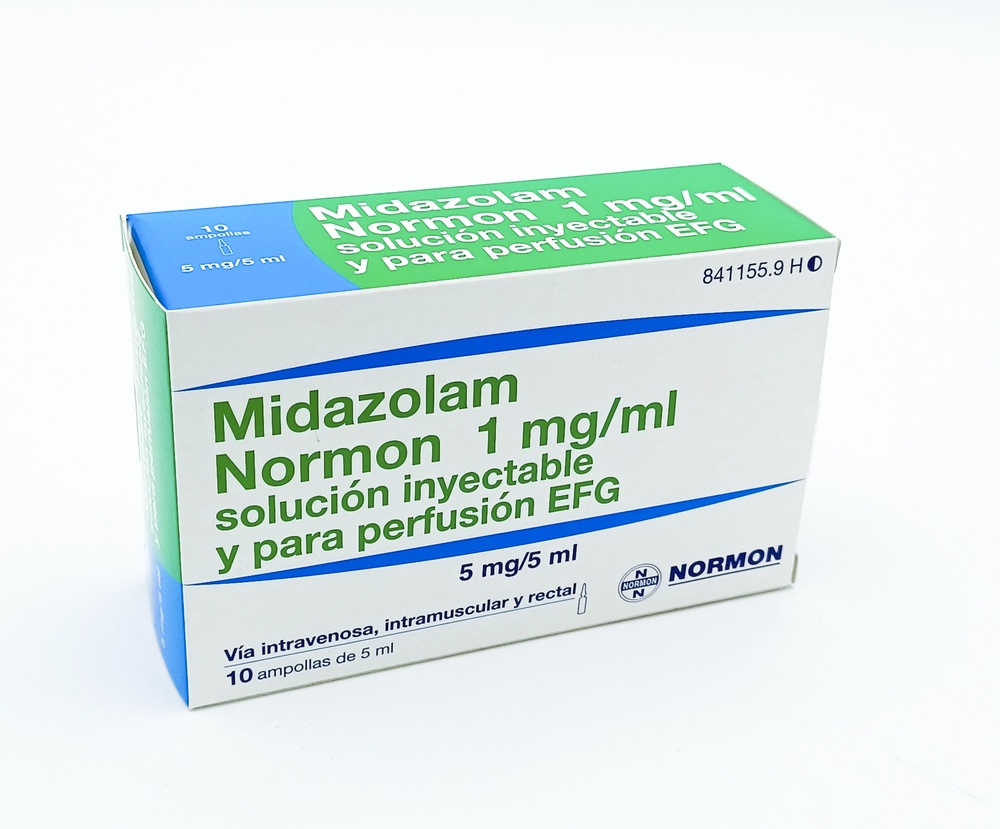
MIDAZOLAM 5 mg /5 Ml Solución Inyectable

Revisión de receta online
Un médico revisará tu caso y determinará si la prescripción es médicamente apropiada.

Habla con un médico sobre este medicamento
Comenta tus síntomas y las opciones de tratamiento en una consulta online.



Cómo usar MIDAZOLAM NORMON 1 MG/ML SOLUCIÓN INYECTABLE Y PARA PERFUSIÓN EFG
Contenido del prospecto
- Introducción
- Prospecto: información para el usuario
- Midazolam Normon 1 mg/ml solución inyectable y para perfusión EFG
- Qué es Midazolam Normon y para qué se utiliza
- Qué necesita saber antes de empezar a usar Midazolam Normon
- Cómo usar Midazolam Normon
- Posibles efectos adversos
- Conservación de Midazolam Normon
- Contenido del envase e información adicional
Introducción
Prospecto: información para el usuario

¿No estás seguro de si este medicamento es adecuado para ti?
Comenta tus síntomas y tratamiento con un médico online.
Midazolam Normon 1 mg/ml solución inyectable y para perfusión EFG
Lea todo el prospecto detenidamente antes de empezar a usar este medicamento, porque contiene información importante para usted.
- Conserve este prospecto, ya que puede tener que volver a leerlo.
- Si tiene alguna duda, consulte a su médico o farmacéutico.
- Este medicamento se le ha recetado solamente a usted, y no debe dárselo a otras personas aunque tengan los mismos síntomas que usted, ya que puede perjudicarles.
- Si experimenta efectos adversos, consulte a su médico o farmacéutico, incluso si se trata de efectos adversos que no aparecen en este prospecto. Ver sección 4.
Contenido del prospecto
- Qué es Midazolam Normon y para qué se utiliza
- Qué necesita saber antes de empezar a usar Midazolam Normon
- Cómo usar Midazolam Normon
- Posibles efectos adversos
- Conservación de Midazolam Normon
- Contenido del envase e información adicional

¿Has empezado a tomar el medicamento y tienes preguntas?
Comenta tus síntomas y tratamiento con un médico online.
1. Qué es Midazolam Normon y para qué se utiliza
El principio activo de Midazolam Normon es midazolam. Pertenece al grupo de las benzodiazepinas, fármacos denominados hipnóticos (inductores del sueño) y sedantes (fármacos que disminuyen la excitación nerviosa).
Midazolam está indicado:
En adultos para:
- Sedación conscienteantes y durante procedimientos diagnósticos o terapéuticos con o sin anestesia local.
- Anestesia:
Premedicación antes de la inducción de la anestesia.
Inducción de la anestesia.
Como componente sedante en la anestesia combinada.
- Sedación en Unidades de Cuidados Intensivos (UCI).
En niños para:
- Sedación conscienteantes y durante procedimientos diagnósticos o terapéuticos con o sin anestesia local.
- Anestesia:Premedicación antes de la inducción de la anestesia.
- Sedación en Unidades de Cuidados Intensivos (UCI).
2. Qué necesita saber antes de empezar a usar Midazolam Normon
Este medicamento se debe utilizar sólo cuando se disponga de equipos de reanimación adecuados para cada tipo de paciente, pues la administración intravenosa de este medicamento puede deprimir la contractilidad miocárdica (disminución de las contracciones del corazón) y causar apnea (pausa en la respiración).
No use Midazolam Normon
- Si es alérgico al midazolam, a las benzodiazepinas o a alguno de los demás componentes de este medicamento (incluidos en la sección 6).
- En sedación consciente si el paciente tiene insuficiencia respiratoria grave o depresión respiratoria aguda.
Advertencias y precauciones
Consulte a su médico o enfermero antes de empezar a usar este medicamento, si se administra en:
- Adultos mayores de 60 años.
- Pacientes pediátricos, especialmente aquellos con inestabilidad cardiovascular.
- Pacientes con enfermedades crónicas o debilitados como:
- Pacientes con insuficiencia respiratoria crónica.
- Pacientes con insuficiencia renal crónica.
- Pacientes con la función cardiaca alterada.
- Pacientes con la función hepática alterada.
- Pacientes con miastenia gravis (debilidad muscular severa).
Estos pacientes de alto riesgo requieren dosis menores y se les debe vigilar continuamente para detectar signos precoces de alteraciones de las funciones vitales.
- Pacientes con antecedentes de abuso de alcohol o de drogas.
- Pacientes para premedicación, es obligatorio observar atentamente al paciente después de la administración porque la sensibilidad interindividual es variable y pueden sobrevenir síntomas de sobredosis.
Así mismo se deberán tener en cuenta los siguientes aspectos que se pueden producir mientras esté en tratamiento con este medicamento:
Tolerancia:
Se ha descrito cierta disminución de la eficacia cuando midazolam se utiliza para sedación prolongada en las unidades de cuidados intensivos (UCI).
Dependencia:
Cuando midazolam se emplea para sedación prolongada en la UCI, hay que tener en cuenta que puede producir dependencia física. El riesgo de dependencia aumenta con la dosis y la duración del tratamiento.
Síntomas de abstinencia:
Durante el tratamiento prolongado con midazolam en la UCI puede aparecer dependencia física. Por tanto, la interrupción brusca del tratamiento se acompañará de síntomas de abstinencia. Se pueden producir los siguientes síntomas: dolor de cabeza, mialgias (dolores musculares), ansiedad, tensión, inquietud, confusión, irritabilidad, insomnio de rebote, alteraciones del estado de ánimo, alucinaciones y convulsiones. Como el riesgo de síntomas de abstinencia es mayor después de suspender bruscamente el tratamiento, se recomienda disminuir las dosis de modo gradual (ver sección 3).
Amnesia:
Midazolam causa amnesia anterógrada (pérdida parcial o total de la memoria referente a lo acontecido, justo después de la recuperación de la consciencia; a menudo este efecto es muy deseable en situaciones como antes y durante intervenciones quirúrgicas y procedimientos diagnósticos), cuya duración guarda una relación directa con la dosis administrada. La amnesia prolongada puede plantear problemas en el caso de los pacientes ambulatorios, para los que se prevé el alta después de la intervención. Tras recibir midazolam por vía parenteral, los pacientes pueden abandonar el hospital o el consultorio solo si van acompañados de otra persona.
Reacciones paradójicas:
Se han descrito con midazolam reacciones paradójicas, como agitación, movimientos involuntarios (convulsiones tónicas/clónicas y temblor muscular), hiperactividad, hostilidad, reacción de ira, agresividad, excitación paroxística (ataques de excitación) y amenazas e insultos. Estas reacciones pueden producirse con dosis elevadas o cuando la inyección se administra con rapidez. Tales reacciones se caracterizan por una máxima incidencia en el caso de los niños y las personas de edad avanzada.
Niños y adolescentes
No se recomienda el uso para niños menores de 6 meses en sedación consciente y anestesia.
Otros medicamentos y Midazolam Normon
Informe a su médico si está utilizando, ha utilizado recientemente o pudiera tener que utilizar cualquier otro medicamento.
Ciertos medicamentos pueden interaccionar con midazolam; en estos casos puede ser necesario cambiar la dosis o interrumpir el tratamiento con alguno de ellos.
Es importante que informe a su médico si está tomando o ha tomado recientemente alguno de los siguientes medicamentos:
- Itraconazol, fluconazol y ketoconazol (fármacos para el tratamiento de las infecciones por hongos).
- Verapamilo y diltiazem (fármacos antagonistas del calcio).
- Eritromicina y claritromicina (antibióticos macrólidos).
- Cimetidina y ranitidina (fármaco para el tratamiento de la úlcera gastroduodenal).
- Saquinavir y otros inhibidores de la proteasa (fármacos empleados en el tratamiento de infección por VIH (SIDA)).
- Depresores del Sistema Nervioso Central (opiáceos antipsicóticos y otras benzodiazepinas).
- Opiáceos, fenobarbital y benzodiazepinas. Es necesario vigilar especialmente un incremento adicional de la depresión respiratoria en caso de tratamiento de estos fármacos junto con Midazolam.
Se debe tener en cuenta la sedación adicional cuando midazolam se combina con fármacos sedantes.
La administración intravenosa de midazolam disminuye la concentración alveolar mínima (CAM) de los anestésicos en inhalación necesarios para la anestesia general.
Toma de Midazolam Normon con alimentos, bebidas y alcohol
El alcohol puede potenciar considerablemente el efecto sedante de midazolam. Hay que evitar el consumo de alcohol cuando se administre midazolam.
Embarazo, lactancia y fertilidad
Si está embarazada o en periodo de lactancia, cree que podría estar embarazada o tiene intención de quedarse embarazada, consulte a su médico o farmacéutico antes de utilizar este medicamento.
Embarazo
No se debe utilizar midazolam durante el embarazo a menos que sea absolutamente necesario. Es preferible no usarlo para la cesárea.
Se debe tener en cuenta el riesgo para el feto al administrar midazolam para cualquier intervención quirúrgica cerca del final del embarazo.
Lactancia
Se recomienda a las madres en periodo de lactancia que la suspendan hasta 24 horas después de la administración de midazolam.
Conducción y uso de máquinas
Midazolam es un medicamento que produce sueño. No conduzca ni utilice máquinas si siente somnolencia o si nota que su atención y capacidad de reacción se encuentran reducidas. Preste especial atención al inicio del tratamiento o si se aumenta la dosis.
El médico decidirá cuándo se pueden reanudar dichas actividades.
Se recomienda que el paciente vaya acompañado al volver a su casa después del alta.
Midazolam Normon contiene sodio
Este medicamento contiene menos de 23 mg de sodio (1 mmol) por ampolla; esto es, esencialmente “exento de sodio”.
3. Cómo usar Midazolam Normon
Siga exactamente las instrucciones de administración de este medicamento indicadas por su médico. En caso de duda, consulte de nuevo a su médico. Su médico le indicará la duración de su tratamiento con Midazolam Normon.
Midazolam es un potente sedante que requiere ajuste de la dosis y administración lenta. Su médico adaptará la dosis según las necesidades clínicas, el estado físico, la edad, el peso y los fármacos que se le administren conjuntamente.
Midazolam Normon puede administrarse como bolus intravenoso, perfusión intravenosa, inyección intramuscular y vía rectal.
Si usa más Midazolam Normon del que debe
Síntomas:
Los síntomas de sobredosis son: somnolencia, confusión mental, letargo y relajación muscular o excitación paradójica. Los síntomas más graves consistirían en arreflexia (ausencia de reflejos normales), hipotensión, depresión cardiorrespiratoria, apnea (pausa en la respiración) y coma.
Si usted toma más Midazolam Normon del que debiera, consulte inmediatamente a su médico o farmacéutico.
En caso de sobredosis o ingestión accidental, consultar al Servicio de Información Toxicológica. Teléfono (91) 562 04 20.
Tratamiento en caso de sobredosis:
En la mayoría de los casos, sólo basta con controlar las funciones vitales. En el tratamiento de la sobredosis se debe prestar una atención especial a las funciones respiratoria y cardiovascular en la unidad de cuidados intensivos (UCI).
4. Posibles efectos adversos
Al igual que todos los medicamentos, este medicamento puede producir efectos adversos, aunque no todas las personas los sufran.
Los efectos adversos pueden producirse con ciertas frecuencias, que se definen a continuación:
Muy frecuentes (pueden afectar a más de 1 de cada 10 personas).
Frecuentes (pueden afectar hasta 1 de cada 10 personas).
Poco frecuentes (pueden afectar hasta 1 de cada 100 personas).
Raros (pueden afectar hasta 1 de cada 1.000 personas).
Muy raros (pueden afectar hasta 1 de cada 10.000 personas).
Frecuencia no conocida (no puede estimarse a partir de los datos disponibles).
Se han descrito (muy rara vez) las siguientes reacciones adversas al administrar midazolam:
Trastornos de la piel y los anejos: erupción cutánea (enrojecimiento de la piel), urticaria (alergia), picor, hinchazón de la cara, los labios, la lengua o la garganta que hace difícil tragar o respirar.
Trastornos del sistema nervioso central y periférico y psiquiátricos: somnolencia y sedación prolongada, disminución de la alerta, confusión, euforia, alucinaciones, fatiga, dolor de cabeza, mareos, ataxia (descoordinación de los movimientos), sedación postquirúrgica y amnesia anterógrada (cuya duración se relaciona directamente con la dosis administrada). La amnesia anterógrada puede persistir al final del procedimiento y en casos aislados se ha descrito una amnesia prolongada.
Se han descrito reacciones paradójicas, como agitación, movimientos involuntarios (movimientos tónico/clónicos y temblor muscular), hiperactividad, hostilidad, reacción de ira, agresividad, excitación paroxística y amenazas e insultos, particularmente en el caso de los niños y las personas de edad avanzada.
Se han registrado con más frecuencia convulsiones en el caso de los lactantes y recién nacidos prematuros.
El uso de midazolam, incluso en dosis terapéuticas, puede favorecer el desarrollo de dependencia física tras la administración intravenosa prolongada; la interrupción brusca del fármaco puede acompañarse de síntomas de abstinencia, como convulsiones.
Trastornos del aparato digestivo: náuseas, vómitos, hipo, estreñimiento y sequedad de boca.
Trastornos cardiorrespiratorios: acontecimientos adversos cardiorrespiratorios graves: depresión respiratoria, apnea (pausa en la respiración), parada respiratoria o parada cardíaca, hipotensión, alteración de la frecuencia cardíaca, efectos vasodilatadores, disnea (sensación de falta de aire) y laringoespasmo. Los incidentes potencialmente mortales son más probables en el caso de los adultos mayores de 60 años y aquellos pacientes con insuficiencia respiratoria previa o alteración de la función cardíaca, particularmente cuando la inyección se administra con demasiada rapidez o cuando se aplica una dosis elevada.
Trastornos generales: reacciones de alergia generalizada: reacciones cutáneas, reacciones cardiovasculares, broncoespasmo, shock anafiláctico (reacción alérgica grave).
Deje de tomar Midazolam Normon y acuda al médico inmediatamente si nota alguno de los siguientes efectos secundarios. Pueden ser potencialmente mortales y puede necesitar tratamiento médico urgente:
- Choque anafiláctico (una reacción alérgica potencialmente mortal). Los signos pueden incluir una erupción repentina, picor o erupción grumosa (urticaria) e hinchazón de la cara, labios, lengua u otras partes del cuerpo. También puede tener falta de aliento, sibilancias o problemas para respirar, o piel pálida, pulso débil y rápido, o sensación de pérdida de la consciencia. Además, puede experimentar dolor en el pecho, que puede ser un signo de una reacción alérgica potencialmente grave denominada síndrome de Kounis.
Trastornos en el lugar de aplicación: eritema (enrojecimiento) y dolor en el lugar de inyección, alteraciones circulatorias (tromboflebitis y trombosis).
Comunicación de efectos adversos
Si experimenta cualquier tipo de efecto adverso, consulte a su médico, enfermero o farmacéutico, incluso si se trata de posibles efectos adversos que no aparecen en este prospecto.
También puede comunicarlos directamente a través del Sistema Español de Farmacovigilancia de Medicamentos de Uso Humano: www.notificaRAM.es. Mediante la comunicación de efectos adversos usted puede contribuir a proporcionar más información sobre la seguridad de este medicamento.
5. Conservación de Midazolam Normon
Mantener este medicamento fuera de la vista y del alcance de los niños.
No congelar. Además, puede formarse un precipitado que se disuelve al agitar el contenido a temperatura ambiente.
No utilice este medicamento después de la fecha de caducidad que aparece en el envase después de CAD. La fecha de caducidad es el último día del mes que se indica.
6. Contenido del envase e información adicional
Composición de Midazolam Normon 1 mg/ml solución inyectable y para perfusión
- El principio activo es midazolam. Cada ampolla de 5 ml contiene 5 mg de midazolam como hidrocloruro.
- Los demás componentes son: cloruro de sodio, ácido clorhídrico (para ajuste de pH) y agua para preparaciones inyectables.
Aspecto del producto y contenido del envase
Midazolam Normon 1 mg/ml es una solución estéril, transparente e incolora o prácticamente incolora. Se presenta como solución inyectable en ampollas de 5 ml. Cada envase contiene 10 o 50 ampollas.
Puede que solamente estén comercializados algunos tamaños de envase.
Titular de la autorización de comercialización y responsable de la fabricación
LABORATORIOS NORMON, S.A.
Ronda de Valdecarrizo, 6 - 28760 Tres Cantos - Madrid (ESPAÑA)
Fecha de la última revisión de este prospecto:junio 2023.
----------------------------------------------------------------------------------------------------------------------------
Esta información está destinada únicamente a profesionales sanitarios
Para la sedación consciente antes de una intervención diagnóstica o quirúrgica se administrará midazolam por vía IV. La dosis debe individualizarse y adaptarse, y no debe administrarse en una inyección rápida en una sola embolada. El inicio de la sedación puede variar individualmente según el estado físico del paciente y las circunstancias detalladas de la posología. Si es necesario, pueden administrarse dosis posteriores con arreglo a las necesidades individuales. El medicamento empieza a actuar aproximadamente 2 minutos después de la inyección. Se obtiene un efecto máximo en un plazo de 5 a 10 minutos.
Compatibilidad con soluciones para perfusión:
La solución de Midazolam Normon 1 mg/ml solución inyectable y para perfusión puede diluirse con cloruro de sodio 0,9%, dextrosa 5% y 10%, levulosa 5%, solución de Ringer y de Hartmann en una mezcla de 15 mg de midazolam por 100-1.000 ml de solución. Estas soluciones se mantienen estables durante 24 horas a temperatura ambiente o 3 días en el frigorífico de 2 a 8 ºC. La solución de Midazolam Normon 1 mg/ml solución inyectable y para perfusión no se puede diluir con Macrodex 6% en glucosa o mezclado con inyecciones alcalinas.
Adultos:
La inyección IV de midazolam debe administrarse con lentitud a una velocidad de aproximadamente 1 mg en 30 segundos.
Niños:
No se recomienda el uso para niños menores de 6 meses en sedación consciente y anestesia, pues apenas se dispone de datos de esta población.
- Administración IV: la dosis de midazolam debe ajustarse con lentitud hasta obtener el efecto clínico deseado. La dosis inicial de midazolam debe administrarse durante 2 o 3 minutos. Se deben esperar de 2 a 5 minutos más para comprobar con exactitud el efecto sedante antes de iniciar el procedimiento o repetir la dosis. Si se necesita más sedación, hay que continuar ajustando la posología con pequeños incrementos hasta conseguir el grado de sedación apropiado.
- Administración rectal: la dosis total de midazolam suele variar entre 0,3 y 0,5 mg/kg. La administración rectal de la solución de la ampolla se realiza mediante un aplicador de plástico fijado en el extremo de la jeringa. Si el volumen que se ha de administrar es demasiado pequeño, se puede añadir agua hasta un volumen total de 10 ml. La dosis total debe administrarse de una vez y hay que evitar la administración rectal repetida.
- Administración IM: Esta vía sólo se debe utilizar en casos excepcionales. Es preferible la administración rectal, pues la inyección IM es dolorosa.
Tratamiento en caso de sobredosis:
En la mayoría de los casos, sólo basta con controlar las funciones vitales. En el tratamiento de la sobredosis se debe prestar una atención especial a las funciones respiratoria y cardiovascular en la unidad de cuidados intensivos (UCI). El flumazenilo, un antagonista de las benzodiazepinas, está indicado en caso de intoxicación grave acompañada de coma o depresión respiratoria. Se debe ser precavido al emplear el flumazenilo en caso de sobredosis farmacológica mixta y para pacientes con epilepsia ya tratada con benzodiazepinas. El flumazenilo no se debe utilizar para los pacientes tratados con antidepresivos tricíclicos o fármacos epileptógenos ni para los enfermos con anomalías en el electrocardiograma (prolongación de QRS o QT).
-
- País de registro
- Forma farmacéuticaINYECTABLE, 5 mg midazolam/5 ml
- Código ATCN05CD08
- Principio activo
- Requiere recetaSí
- Fabricante
- ComposiciónCLORURO DE SODIO (45 mg mg)
- Esta información es de carácter general y no sustituye la consulta con un profesional sanitario.
- Alternativas a MIDAZOLAM NORMON 1 MG/ML SOLUCIÓN INYECTABLE Y PARA PERFUSIÓN EFGForma farmacéutica: GEL/PASTA/LIQUIDO BUCAL, 10 mg midazolam hidrocloruroPrincipio activo: MidazolamFabricante: Neuraxpharm Pharmaceuticals S.L.Requiere recetaForma farmacéutica: GEL/PASTA/LIQUIDO BUCAL, 2,5 mg midazolam hidrocloruroPrincipio activo: MidazolamFabricante: Neuraxpharm Pharmaceuticals S.L.Requiere recetaForma farmacéutica: GEL/PASTA/LIQUIDO BUCAL, 5 mg midazolam hidrocloruroPrincipio activo: MidazolamFabricante: Neuraxpharm Pharmaceuticals S.L.Requiere receta
Médicos online para MIDAZOLAM NORMON 1 MG/ML SOLUCIÓN INYECTABLE Y PARA PERFUSIÓN EFG
Comenta la dosis, los posibles efectos secundarios, interacciones, contraindicaciones o la revisión de receta de MIDAZOLAM NORMON 1 MG/ML SOLUCIÓN INYECTABLE Y PARA PERFUSIÓN EFG, sujeto a valoración médica y a la normativa local.







Obtén una receta de MIDAZOLAM NORMON 1 MG/ML SOLUCIÓN INYECTABLE Y PARA PERFUSIÓN EFG online
Rellena un formulario de 2 minutos
Cuéntanos tus síntomas, historial y el medicamento que necesitas.
Elige un médico o nosotros te asignamos uno
Escoge un especialista o te conectamos con el próximo médico disponible.
El médico revisa tu caso
Normalmente en 30 minutos. Puede hacerte preguntas adicionales por chat.
Recógela en cualquier farmacia
Receta electrónica enviada a tu correo, válida en toda España.
Preguntas frecuentes
MIDAZOLAM NORMON 1 MG/ML SOLUCIÓN INYECTABLE Y PARA PERFUSIÓN EFG requiere receta en España. Puedes confirmarlo con un médico online según tu caso.
El principio activo de MIDAZOLAM NORMON 1 MG/ML SOLUCIÓN INYECTABLE Y PARA PERFUSIÓN EFG es Midazolam. Esta información ayuda a identificar medicamentos con la misma composición pero con diferentes nombres comerciales.
MIDAZOLAM NORMON 1 MG/ML SOLUCIÓN INYECTABLE Y PARA PERFUSIÓN EFG es fabricado por Laboratorios Normon S.A.. La marca y el envase pueden variar según el distribuidor.
Los Médicos de familia, Psiquiatras, Dermatólogos, Cardiólogos, Endocrinólogos, Gastroenterólogos, Neumólogos, Nefrólogos, Reumatólogos, Hematólogos, Infectólogos, Alergólogos, Geriatras, Pediatras, Oncólogos pueden valorar la prescripción de MIDAZOLAM NORMON 1 MG/ML SOLUCIÓN INYECTABLE Y PARA PERFUSIÓN EFG cuando esté clínicamente indicado. Puedes reservar una videoconsulta para comentar tu caso y las opciones de tratamiento.
España cuenta con una infraestructura sanitaria bien desarrollada en ciudades principales como Madrid, Barcelona, Valencia y Sevilla. Las farmacias están ampliamente disponibles y operan bajo estrictas regulaciones, garantizando el acceso a medicamentos con receta.
Puedes comprar MIDAZOLAM NORMON 1 MG/ML SOLUCIÓN INYECTABLE Y PARA PERFUSIÓN EFG en Madrid, Barcelona, Sevilla o Valencia en cualquier farmacia local con una receta válida.
Para obtener una receta, puedes utilizar Oladoctor:
Otros medicamentos con el mismo principio activo (Midazolam) incluyen BUCCOLAM 10 MG SOLUCION BUCAL, BUCCOLAM 2,5 MG SOLUCION BUCAL, BUCCOLAM 5 MG SOLUCION BUCAL. Pueden tener diferentes nombres comerciales o formulaciones, pero contienen el mismo componente terapéutico. Consulta siempre con un médico antes de cambiar o iniciar un nuevo medicamento.
