



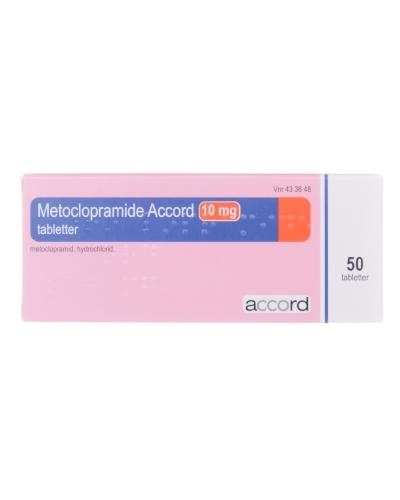
METOCLOPRAMIDA 10 mg Comprimidos

Revisión de receta online
Un médico revisará tu caso y determinará si la prescripción es médicamente apropiada.

Habla con un médico sobre este medicamento
Comenta tus síntomas y las opciones de tratamiento en una consulta online.



Cómo usar METOCLOPRAMIDA ACCORD 10 MG COMPRIMIDOS EFG
Contenido del prospecto
- Introducción
- Qué es Metoclopramida Accord y para qué se utiliza
- Qué necesita saber antes de empezar a tomar Metoclopramida Accord
- No exceder 3 meses de tratamiento por el riesgo de espasmos musculares involuntarios.
- Niños y adolescentes
- Cómo tomar Metoclopramida Accord
- Posibles efectos adversos
- Conservación de Metoclopramida Accord
- Contenido del envase e información adicional
- Nombre del medicamento
Introducción
Prospecto: información para el usuario
Metoclopramida Accord 10 mg comprimidos EFG
Metoclopramida hidrocloruro
Lea todo el prospecto detenidamente antes de empezar a tomar este medicamento, porque contiene información importante para usted.
- Conserve este prospecto, ya que puede tener que volver a leerlo.
- Si tiene alguna duda, consulte a su médico o farmacéutico.
- Este medicamento se le ha recetado solamente a usted,y no debe dárselo a otras personas aunque tengan los mismos síntomas que usted, ya que puede perjudicarles.
- Si experimenta efectos adversos, consulte a su médico o farmacéutico, incluso si se trata de efectos adversos que no aparecen en este prospecto. Ver sección 4.
Contenido del prospecto
- Qué es Metoclopramida Accord y para qué se utiliza
- Qué necesita saber antes de empezar a tomar Metoclopramida Accord
- Cómo tomar Metoclopramida Accord
- Posibles efectos adversos
- Conservación de Metoclopramida Accord
- Contenido del envase e información adicional
1. Qué es Metoclopramida Accord y para qué se utiliza
Metoclopramida Accord es un antiemético. Contiene un medicamento denominado “metoclopramida”. Actúa en una zona del cerebro que previene las náuseas o los vómitos.
Población adulta:
Metoclopramida está indicada en adultos:
- para prevenir las náuseas y vómitos retardados que pueden aparecer después de la quimioterapia
- para prevenir las náuseas y vómitos provocados por la radioterapia
- para tratar náuseas y vómitos, incluyendo las náuseas y vómitos que pueden aparecer con una migraña.
Se puede tomar metoclopramida en combinación con analgésicos orales en el caso de migraña para que los analgésicos sean más efectivos.
Población pediátrica
Metoclopramida está indicada en niños (de 1 a 18 años de edad) si otros tratamientos no funcionan o no se pueden utilizar para prevenir las náuseas y vómitos que pueden aparecer después de la quimioterapia.

¿No estás seguro de si este medicamento es adecuado para ti?
Comenta tus síntomas y tratamiento con un médico online.
2. Qué necesita saber antes de empezar a tomar Metoclopramida Accord
No tome Metoclopramida Accord :
- Si es alérgico a la metoclopramida o a cualquiera de los demás componentes de este medicamento (incluidos en la sección 6),
- Si padece hemorragia, obstrucción o perforación en su estómago o intestino.
- Si tiene o podría tener un tumor raro de la glándula suprarrenal (feocromocitoma),
- Si ha sufrido alguna vez espasmos involuntarios de los músculos (discinesia tardía), cuando se le ha tratado con un medicamento,
- Si tiene epilepsia,
- Si tiene la enfermedad de Parkinson,
- Si está tomando levodopa (un medicamento para la enfermedad de Parkinson) o agonistas dopaminérgicos (ver debajo "Uso de Metoclopramida Accord con otros medicamentos”),
- Si alguna vez ha tenido niveles anormales de pigmentos de la sangre (metahemoglobinemia) o deficiencia del NADH citocromo b5 reductasa.
No administre Metoclopramida Accord a niños menores de 1 año (ver debajo "Niños y adolescentes").
No tome Metoclopramida Accord si alguno de los casos de arriba le aplica. Si no está seguro, consulte a su médico, farmacéutico o enfermero antes de tomar Metoclopramida Accord.
Advertencias y precauciones
Consulte a su médico o farmacéutico antes de empezar a tomar Metoclopramida Accord si.
- tiene antecedentes de latidos del corazón anormales (prolongación del intervalo QT) o cualquier otro problema del corazón,
- tiene problemas con los niveles de sales en la sangre, como el potasio, sodio y magnesio,
- está usando otros medicamentos que se sabe afectan la forma en que su corazón late
- tiene algun problema neurológico (problemas en el cerebro)
- tiene problemas en el hígado o en los riñones. Se puede reducir la dosis (ver sección 3).
Su médico puede realizar análisis de sangre para controlar sus niveles de pigmentos de la sangre. En casos de niveles anormales (metahemoglobinemia) se debe interrumpir el tratamiento de forma inmediata y permanentemente.
Debe esperar al menos 6 horas entre cada dosis de metoclopramida, incluso en caso de vómitos y rechazo de la dosis, para evitar la sobredosis.
No exceder 3 meses de tratamiento por el riesgo de espasmos musculares involuntarios.

¿Has empezado a tomar el medicamento y tienes preguntas?
Comenta tus síntomas y tratamiento con un médico online.
Niños y adolescentes
Pueden aparecer movimientos incontrolables (trastornos extrapiramidales) en niños y adultos jóvenes.
Este medicamento no se debe utilizar en niños menores de 1 año de edad debido al elevado riesgo de movimientos incontrolables (ver más arriba "No tome Metoclopramida Accord si").
Uso de Metoclopramida Accord con otros medicamentos
Comunique a su médico, farmacéutico o enfermero si está tomando, ha tomado recientemente o podría tener que tomar cualquier otro medicamento. Esto se debe a que algunos medicamentos pueden afectar a la forma de actuar de Metoclopramida Accord o Metoclopramida Accord puede afectar a la forma de actuar de otros medicamentos. Estos medicamentos incluyen los siguientes:
- levodopa u otros medicamentos utilizados para tratar la enfermedad de Parkinson (ver arriba “No tome Metoclopramida Accord”)
- anticolinérgicos (medicamentos utilizados para aliviar espasmos o calambres del estómago)
- derivados de la morfina (medicamentos utilizados para tratar dolor intenso)
- medicamento sedantes
- cualquier medicamento utilizado para tratar problemas de salud mental
- digoxina (medicamento utilizado para tratar la insuficiencia del corazón)
- ciclosporina (medicamento utilizado para tratar algunos problemas del sistema inmunológico)
- mivacurio y suxametonio (medicamentos utilizados para relajar los músculos)
- fluoxetina y paroxetina (medicamentos utilizados para tratar la depresión).
- rifampicina (medicamento utilizado para tratar la tuberculosis u otras infecciones), puede reducir la cantidad de metoclopramida en la sangre si se administra al mismo tiempo.
Uso de Metoclopramida Accord con alcohol
No se debe consumir alcohol durante el tratamiento con metoclopramida porque aumenta el efecto sedante de Metoclopramida Accord.
Embarazo,lactancia y fertilidad
Si está embarazada, cree que podría estar embarazada o tiene intención de quedarse embarazada, consulte a su médico o farmacéutico antes de tomar este medicamento.
Si es necesario, se puede tomar Metoclopramida Accord durante el embarazo. Su médico decidirá si se le puede administrar o no este medicamento.
No está recomendado Metoclopramida Accord si está en periodo de lactancia porque metoclopramida pasa a la leche materna y puede afectar su bebé.
Conducción y uso de máquinas
Después de tomar Metoclopramida Accord se puede sentir somnoliento, mareado o tener movimientos incontrolables de tics, sacudidas o de torsión y tono de los músculos no usual que cause distorsión de su cuerpo. Esto puede afectar a su visión y también interferir en su capacidad para conducir y utilizar máquinas.
Metoclopramida Accord contiene lactosa.
Este medicamento contiene lactosa. Si su médico le ha indicado que padece una intolerancia a ciertos azúcares, consulte con él antes de tomar este medicamento.
3. Cómo tomar Metoclopramida Accord
Siempre tome este medicamento exactamente como su médico o farmacéutico se lo ha indicado. Consulte con su médico o farmacéutico si no está seguro.
Población adulta:
Se recomienda una dosis única de 10 mg, que se puede repetir hasta tres veces al día.
La dosis máxima diaria recomendada es de 30 mg ó 0,5mg/kg de peso corporal.
La duración máxima del tratamiento es de 5 días.
Para prevenir las náuseas y vómitos retardados que pueden aparecer después de la quimioterapia (niños de 1 – 18 años de edad)
La dosis recomendada es de 0,1 a 0,15 mg/kg de peso corporal, que se puede repetir hasta un máximo de 3 veces al día por vía oral.
La dosis máxima en 24 horas es de 0,5 mg/kg de peso corporal.
Tabla de dosis:
Edad | Peso corporal | Dosis | Frecuencia |
1-3 años | 10-14 kg | 1 mg | Hasta 3 veces al día |
3-5 años | 15-19 kg | 2 mg | Hasta3 veces al día |
5-9 años | 20-29 kg | 2,5 mg | Hasta3 veces al día |
9-18 años | 30-60 kg | 5 mg | Hasta3 veces al día |
15-18 años | Mas de 60 kg | 10 mg | Hasta3 veces al día |
Instrucciones de uso
No debe tomar este medicamento durante más de 5 días para prevenir las náuseas y vómitos retardados que pueden aparecer después de la quimioterapia.
Metoclopramida Accord no es adecuado para uso en niños que pesen menos de 30 kg. Puede ser más adecuado para la administración el uso de otras formas farmacéuticas / concentraciones para esta población.
Forma de administración
Tragar el comprimido con un vaso de agua.
Debe esperar por lo menos 6 horas entre cada dosis de metoclopramida, incluso en caso devómitos y rechazo de la dosis, para evitar la sobredosis.
Población de edad avanzada
Puede ser necesario reducir la dosis dependiendo de los problemas de los riñones, problemas en el hígado y de los problemas de salud en general.
Adultos con problemas renales
Informe a su médico si tiene problemas en los riñones. Se debe reducir la dosis si tiene problemas renales de moderados o graves.
Adultos con problemas hepáticos
Informe a su médico si tiene problemas en el hígado. Se debe reducir la dosis si tiene problemas hepáticos graves.
Niños y adolescentes
No se debe usar metoclopramida en niños menores de 1 año (ver sección 2).
Si toma más Metoclopramida Accord del que debe
Contacte inmediatamente con su médico o farmacéutico. Puede experimentar movimientos incontrolables (trastornos extrapiramidales), sentir somnolencia, tener algunos problemas de consciencia, estar confuso, tener alucinaciones y problemas en el corazón. Su médico puede recetarle un tratamiento para estos efectos si fuera necesario.
En caso de sobredosis o ingestión accidental consulte inmediatamente a su médico o farmacéutico o llame al Servicio de Información Toxicológica, teléfono 91 562 04 20, indicando el medicamento y la cantidad ingerida.
Si olvidó tomar Metoclopramida Accord
No tome una dosis doble para compensar las dosis olvidadas.
Si tiene cualquier otra duda sobre el uso de este medicamento, pregunte a su médico, enfermero o farmacéutico.
4. Posibles efectos adversos
Al igual que todos los medicamentos, Metoclopramida Accord puede producir efectos adversos, aunque no todas las personas los sufran.
Interrumpa el tratamiento e informe inmediatamente a su médico, farmacéutico si experimenta uno de los siguientes efectos adversos mientras esté usando este medicamento:
- movimientos incontrolables (que afectan a menudo a la cabeza y el cuello). Estos pueden aparecer en niños y adultos jóvenes y particularmente cuando se usan dosis altas. Estas reacciones aparecen normalmente al principio del tratamiento e incluso se pueden presentar después de una única administración. Estos movimientos cesarán cuando se traten adecuadamente.
- fiebre alta, presión arterial alta, ataques/convulsiones, sudoración, producción de saliva. Estos pueden ser signos de una condición denominada síndrome neuroléptico maligno.
- picor y erupción cutáneas, inflamación de la cara, labios, lengua o garganta, dificultad para respirar, falta de aire, piel fría y húmeda, latidos cardíacos rápidos, mareos, debilidad o desmayo. Estos pueden ser signos de una reacción alérgica, que puede ser grave (como anafilaxia, angioedema y urticaria).
Muy frecuentes(pueden afectar a más de 1 de cada 10 personas)
- sentirse somnoliento.
Frecuentes(pueden afectar hasta 1 de cada 10 personas)
- melancolía (depresión)
- movimientos incontrolables como tics, sacudidas, movimientos de torsión o contracturas en los músculos (agarrotamiento, rigidez)
- síntomas similares a la enfermedad de Parkinson (rigidez, temblor)
- sentirse inquieto
- disminución de la presión arterial (particularmente con la administración intravenosa)
- diarrea
- sentirse débil.
Poco frecuentes(pueden afectar hasta 1 de cada 100 personas)
- niveles elevados en la sangre de una hormona denominada prolactina que puede producir: producción de leche en los hombres y en mujeres que no están en periodo de lactancia
- periodos irregulares
- alucinaciones
- nivel de consciencia disminuido
- ritmo lento del corazón (particularmente con la administración intravenosa)
- alergia
- alteraciones visuales (problemas de vista) y desviación involuntaria del globo ocular.
Raros(pueden afectar hasta 1 de cada 1.000 personas)
- estado de confusión
- convulsiones (especialmente en pacientes con epilepsia).
Frecuencia no conocida(frecuencia que no se puede estimar a partir de los datos disponibles)
- niveles anormales de pigmentos de la sangre: que pueden cambiar el color de su piel
- desarrollo anormal de las mamas (ginecomastia)
- espasmos musculares involuntarios después del uso prolongado, particularmente en pacientes de edad avanzada
- fiebre alta, presión arterial alta, ataques/convulsiones, sudoración, producción de saliva. Estos pueden ser signos de una enfermedad denominada síndrome neuroléptico maligno
- cambios en los latidos del corazón, que pueden verse en un ECG (electrocardiograma)
- paro cardiaco (particularmente con la administración intravenosa)
- shock (descenso intenso de presión del corazón) (particularmente con la administración intravenosa)
- desmayo (particularmente con la administración intravenosa)
- reacción alérgica que puede ser grave (particularmente por vía intravenosa)
- presión arterial muy elevada en pacientes con o sin feocromocitoma.
- pensamientos suicidas
Comunicación de efectos adversos:Si experimenta cualquier tipo de efecto adverso, consulte a su médico o farmacéutico, incluso si se trata de posibles efectos adversos que no aparecen en este prospecto. Tambien puede comunicarlos directamente a través del Sistema Español de Farmacovigilancia de medicamentos de uso humano, https: //www.notificaRAM.es. Mediante la comunicación de efectos adversos usted puede contribuir a proporcionar más información sobre la seguridad de este medicamento
..
5. Conservación de Metoclopramida Accord
Mantener este medicamento fuera de la vista y del alcance de los niños
- Conservar por debajo de 30 ?C.
- No utilice este medicamento después de la fecha de caducidad que aparece en el envase después de CAD. La fecha de caducidad es el último día del mes que se indica.Los medicamentos no se deben tirar por los desagües ni a la basura. Deposite los envases y los medicamentos que no necesita en el Punto SIGRE de su farmacia habitual. Pregunte a su farmacéutico cómo deshacerse de los envases y de los medicamentos que no necesita. De esta forma, ayudará a proteger el medio ambiente.
6. Contenido del envase e información adicional
Composición de Metoclopramida Accord
El nombre de su medicamento es Metoclopramida Accord, y el principio activo es el hidrocloruro de metoclopramida. Cada comprimido contiene 10 mg de hidrocloruro de metoclopramida.
Los comprimidos contienen los siguientes componentes no activos:
Lactosa monohidrato, almidón de maíz pregelatinizado, almidón de maíz, sílice coloidal anhidra, estearato de magnesio.
Aspecto del producto y contenido del envase
Comprimidos redondos y biconvexos de color blanco o blancuzco, con la inscripción "BD" en una cara y una ranura en la otra.
Los comprimidos pueden dividirse en dos mitades iguales.
Los comprimidos están envasados en tiras de tipo blíster de PVC/PVdC/aluminio.
El envase contiene 20, 28, 30, 40, 50, 60, 84, 100 y 500 comprimidos.
Puede que solamente estén comercializados algunos tamaños de envase.
Titular de la autorización de comercialización y responsable de la fabricación
Titular de la autorización de comercialización
Accord Healthcare, S.L.U.
World Trade Center
Moll de Barcelona, s/n
Edifici Est 6ª planta
08039 Barcelona
Responsable de la fabricación
Accord Healthcare Polska Sp.z o.o.,
ul. Lutomierska 50,95-200
Pabianice,
Polonia
o
Accord Healthcare Single Member S.A.
64th Km National Road Athens,
Lamia, 32009,
Grecia
Este medicamento está autorizado en los estados miembros del Espacio Económico Europeo y Reino Unido (Norte de Irlanda) con los siguientes nombres:
Nombre del Estado Miembro | Nombre del medicamento |
Chipre | Metoclopramide Accord 10 mg tablety |
España | Metoclopramida Accord 10 mg comprimidos EFG |
Italia | Metoclopramide Accord |
Países Bajos | Metoclopramidemonohydrochloride Accord 10 mg Tabletten |
Reino Unido (Norte de Irlanda) | Metoclopramide Hydrochloride 10 mg tablets |
Austria | Metoclopramid hydrochloride Accord 10 mg Tabletten |
Dinamarca | Metoclopramide hydrochloride Accord |
Estonia | Metoclopramide Accord |
Finlandia | Metoclopramide hydrochloride Accord 10 mg tabletti |
Irlanda | Metoclopramide hydrochloride 10 mg tablets |
Noruega | Metoclopramide Accord |
Polonia | Metoclopramide Accord |
Suécia | Metoclopramide hydrochloride Accord 10 mg tabletter |
Fecha de la última revisión de este prospecto:Julio 2024
La información detallada y actualizada de este medicamento está disponible en la página web de la Agencia Española del Medicamento y Productos Sanitarios (AEMPS) http://www.aemps.gob.es/
- País de registro
- Forma farmacéuticaCOMPRIMIDO, 10 MG
- Código ATCA03FA01
- Principio activo
- Requiere recetaSí
- Fabricante
- ComposiciónLACTOSA MONOHIDRATO (101,240 mg mg)
- Esta información es de carácter general y no sustituye la consulta con un profesional sanitario.
- Alternativas a METOCLOPRAMIDA ACCORD 10 MG COMPRIMIDOS EFGForma farmacéutica: INYECTABLE, 5 mg/mlPrincipio activo: metoclopramideFabricante: Laboratorios Basi Industria Farmaceutica S.A.Requiere recetaForma farmacéutica: SOLUCIÓN/SUSPENSIÓN ORAL, 1 mg/mlPrincipio activo: metoclopramideFabricante: Kern Pharma S.L.Requiere recetaForma farmacéutica: INYECTABLE, 10 mg/2 mlPrincipio activo: metoclopramideFabricante: Kern Pharma S.L.Requiere receta
Médicos online para METOCLOPRAMIDA ACCORD 10 MG COMPRIMIDOS EFG
Comenta la dosis, los posibles efectos secundarios, interacciones, contraindicaciones o la revisión de receta de METOCLOPRAMIDA ACCORD 10 MG COMPRIMIDOS EFG, sujeto a valoración médica y a la normativa local.









Obtén una receta de METOCLOPRAMIDA ACCORD 10 MG COMPRIMIDOS EFG online
Rellena un formulario de 2 minutos
Cuéntanos tus síntomas, historial y el medicamento que necesitas.
Elige un médico o nosotros te asignamos uno
Escoge un especialista o te conectamos con el próximo médico disponible.
El médico revisa tu caso
Normalmente en 30 minutos. Puede hacerte preguntas adicionales por chat.
Recógela en cualquier farmacia
Receta electrónica enviada a tu correo, válida en toda España.
Preguntas frecuentes
METOCLOPRAMIDA ACCORD 10 MG COMPRIMIDOS EFG requiere receta en España. Puedes confirmarlo con un médico online según tu caso.
El principio activo de METOCLOPRAMIDA ACCORD 10 MG COMPRIMIDOS EFG es metoclopramide. Esta información ayuda a identificar medicamentos con la misma composición pero con diferentes nombres comerciales.
METOCLOPRAMIDA ACCORD 10 MG COMPRIMIDOS EFG es fabricado por Accord Healthcare S.L.U.. La marca y el envase pueden variar según el distribuidor.
Los Médicos de familia, Psiquiatras, Dermatólogos, Cardiólogos, Endocrinólogos, Gastroenterólogos, Neumólogos, Nefrólogos, Reumatólogos, Hematólogos, Infectólogos, Alergólogos, Geriatras, Pediatras, Oncólogos pueden valorar la prescripción de METOCLOPRAMIDA ACCORD 10 MG COMPRIMIDOS EFG cuando esté clínicamente indicado. Puedes reservar una videoconsulta para comentar tu caso y las opciones de tratamiento.
España cuenta con una infraestructura sanitaria bien desarrollada en ciudades principales como Madrid, Barcelona, Valencia y Sevilla. Las farmacias están ampliamente disponibles y operan bajo estrictas regulaciones, garantizando el acceso a medicamentos con receta.
Puedes comprar METOCLOPRAMIDA ACCORD 10 MG COMPRIMIDOS EFG en Madrid, Barcelona, Sevilla o Valencia en cualquier farmacia local con una receta válida.
Para obtener una receta, puedes utilizar Oladoctor:
Otros medicamentos con el mismo principio activo (metoclopramide) incluyen METOCLOPRAMIDA BASI 5 MG/ML SOLUCION INYECTABLE Y PARA PERFUSION EFG, METOCLOPRAMIDA KERN PHARMA 1 mg/ml SOLUCION ORAL EFG, METOCLOPRAMIDA KERN PHARMA 10MG/2ML SOLUCION INYECTABLE EFG. Pueden tener diferentes nombres comerciales o formulaciones, pero contienen el mismo componente terapéutico. Consulta siempre con un médico antes de cambiar o iniciar un nuevo medicamento.
