



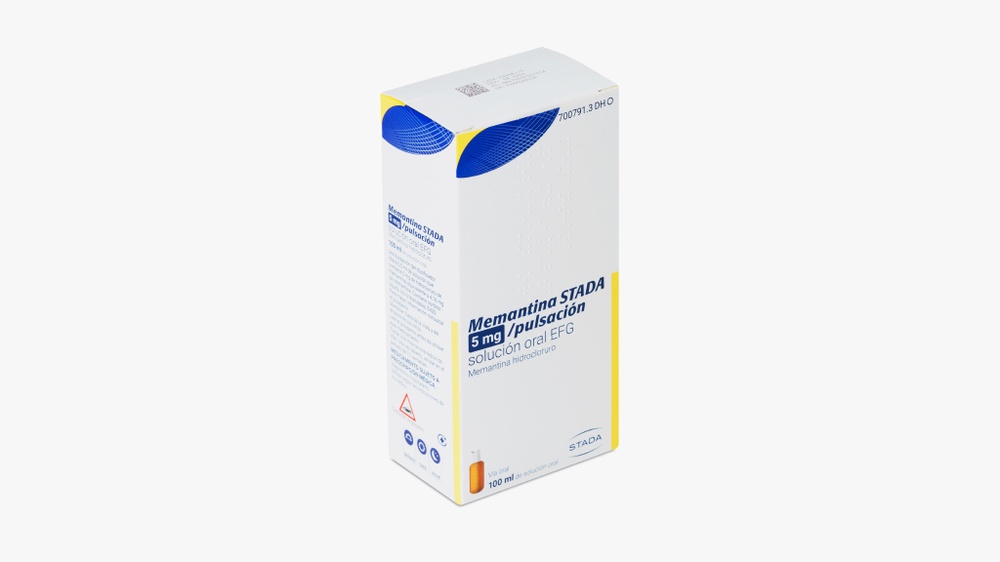
MEMANTINA 5 mg /Dose Solución Oral

Revisión de receta online
Un médico revisará tu caso y determinará si la prescripción es médicamente apropiada.

Habla con un médico sobre este medicamento
Comenta tus síntomas y las opciones de tratamiento en una consulta online.



Cómo usar MEMANTINA STADA 5 MG/PULSACION SOLUCION ORAL EFG
Contenido del prospecto
- Introducción
- Qué es Memantina Stada y para qué se utiliza
- Qué necesita saber antes de empezar a tomar Memantina Stada
- Cómo tomar Memantina Stada
- Posibles efectos adversos
- Conservación de Memantina Stada
- Contenido del envase e información adicional
Introducción
PROSPECTO: INFORMACIÓN PARA EL USUARIO
Memantina Stada5mg/pulsación,solución oral EFG
Hidrocloruro de memantina
Lea todo el prospecto detenidamente antes de empezar a tomar este medicamento, porque contiene información importante para usted.
- Conserve este prospecto, ya que puede tener que volver a leerlo.
- Si tiene alguna duda, consulte a su médico o farmacéutico.
- Este medicamento se le ha recetado solamente a usted, y no debe dárselo a otras personas aunque tengan los mismos síntomas que usted, ya que puede perjudicarles.
- Si experimenta efectos adversos, consulte a su médico o farmacéutico, incluso si se trata de efectos adversos que no aparecen en este prospecto.
Contenido del prospecto
- Qué es Memantina Stada y para qué se utiliza
- Qué necesita saber antes de empezar a tomar Memantina Stada
- Cómo tomar Memantina Stada
- Posibles efectos adversos
- Conservación de Memantina Stada
- Contenido del envase e información adicional
1. Qué es Memantina Stada y para qué se utiliza
Memantina Stada contiene memantina como principio activo.
Para qué se utiliza Memantina Stada
Memantina se utiliza en el tratamiento de pacientes adultos con enfermedad de Alzheimer de moderada a grave.
Cómo actúa Memantina Stada
Memantina pertenece a un grupo de medicamentos denominados medicamentos anti-demencia.
La pérdida de memoria en la enfermedad de Alzheimer se debe a una alteración en las señales del cerebro. El cerebro contiene los llamados receptores N-metil-D-aspartato (NMDA) que participan en la transmisión de señales nerviosas importantes en el aprendizaje y la memoria.
Memantina pertenece al grupo de medicamentos llamados antagonistas de los receptores NMDA. Memantina actúa sobre estos receptores mejorando la transmisión de las señales nerviosas y la memoria.

¿No estás seguro de si este medicamento es adecuado para ti?
Comenta tus síntomas y tratamiento con un médico online.
2. Qué necesita saber antes de empezar a tomar Memantina Stada
No tome Memantina Stada
- si es alérgico (hipersensible) al hidrocloruro de memantina o a cualquiera de los demás componentes de este medicamento (ver sección 6).
Advertencias y precauciones
Consulte a su médico o farmacéutico antes de empezar a tomar Memantina Stada.
- si tiene antecedentes de crisis epilépticas.
- si ha sufrido recientemente un infarto de miocardio (ataque al corazón), si sufre enfermedad cardiaca congestiva o si tiene hipertensión (la presión arterial elevada) no controlada.
En las situaciones anteriores, el tratamiento debe ser supervisado cuidadosamente y el médico debe reevaluar el beneficio clínico de memantina regularmente.
Si padece insuficiencia renal (problemas en los riñones), su médico debe controlar atentamente la función renal y si es necesario, adaptar las dosis de memantina en consecuencia.
Se debe evitar el uso de memantina junto con otros medicamentos como amantadina (para el tratamiento del Parkinson), ketamina (fármaco generalmente usado como anestésico), dextrometorfano (fármaco para el tratamiento de la tos) y otros antagonistas del NMDA.
Niños y adolescentes
No se recomienda el uso de memantina en niños y adolescentes menores de 18 años.
Toma deMemantina Stadacon otros medicamentos
Informe a su médico o farmacéutico si está tomando, ha tomado recientemente o podría tener que tomar cualquier otro medicamento.
En concreto, la administración de memantina puede producir cambios en los efectos de los siguientes medicamentos, por lo que puede que su médico necesite ajustar la dosis:
- amantadina, ketamina, dextrometorfano
- dantroleno, baclofeno
- cimetidina, ranitidina, procainamida, quinidina, quinina, nicotina
- hidroclorotiazida (o cualquier combinación con hidroclorotiazida)
- anticolinérgicos (sustancias generalmente utilizadas para tratar alteraciones del movimiento o espasmos intestinales)
- anticonvulsivantes (sustancias utilizadas para prevenir y eliminar las convulsiones)
- barbitúricos (sustancias generalmente utilizadas para inducir el sueño)
- agonistas dopaminérgicos (sustancias como L-dopa, bromocriptina)
- neurolépticos (sustancias utilizadas en el tratamiento de enfermedades mentales)
- anticoagulantes orales
Si ingresa en un hospital, informe a su médico que está tomando Memantina Stada.
Toma de Memantina Stada con alimentos, bebidas y alcohol
Debe informar a su médico si ha cambiado recientemente o tiene la intención de cambiar su dieta de manera sustancial (por ejemplo de dieta normal a dieta vegetariana estricta) o si padece acidosis tubular renal (ATR, exceso de sustancias productoras de ácido en la sangre debido a una disfunción renal (problema de riñón)) o infecciones graves del tracto urinario (conducto de la orina), ya que su médico puede tener que ajustar la dosis del medicamento.
Embarazo, lactancia y fertilidad
Si está embarazada o en periodo de lactancia, cree que podría estar embarazada o tiene intención de quedarse embarazada, consulte a su médico farmacéutico antes de utilizar este medicamento.
No se recomienda el uso de memantina durante el embarazo.
Las mujeres que toman memantina deben suspender la lactancia.
Conducción y uso de máquinas
Su médico le informará de si su enfermedad le permite conducir y usar máquinas con seguridad. Asimismo, memantina puede alterar su capacidad de reacción, por lo que la conducción o el manejo de máquinas pueden resultar inapropiados.
Memantina Stada contiene sorbitol
Este medicamento contiene 100 mg de sorbitol en cada ml de solución oral.
3. Cómo tomar Memantina Stada
Siga exactamente las instrucciones de administración de este medicamento indicadas por su médico o farmacéutico . En caso de duda, consulte de nuevo a su médico o farmacéutico.
Posología
Por favor siga las siguientes instrucciones al utilizar el dosificador. Se adjuntan pictogramas con las indicaciones necesarias para el uso correcto del dosificador.
Una pulsación contiene 5 mg de hidrocloruro de memantina.
La dosis recomendada de memantina en pacientes adultos y pacientes de edad avanzada es de cuatro pulsaciones del dosificador, lo que equivale a 20 mg una vez al día. Con el fin de reducir el riesgo de efectos adversos, esta dosis se alcanza gradualmente siguiendo el siguiente esquema de tratamiento diario:
semana 1 | una pulsación (equivalente a 0,5 ml) |
semana 2 | dos pulsaciones (equivalente a 1 ml) |
semana 3 | tres pulsaciones (equivalente a 1,5 ml) |
semana 4 y siguientes | cuatro pulsaciones (equivalente a 2 ml) |
La dosis habitual de inicio es de una pulsación una vez al día (5 mg) la primera semana. Esta dosis se aumenta en la segunda semana a dos pulsaciones una vez al día (10 mg) y en la tercera semana a tres pulsaciones una vez al día (15 mg). Desde la cuarta semana, la dosis recomendada es de cuatro pulsaciones una vez al día (20 mg).
Instrucciones para el uso correcto del dosificador
La solución no debe verterse o dispensarse dentro de la boca directamente desde el frasco o el dosificador.
Medir la dosis en una cuchara o dentro de un vaso de agua usando el dosificador.
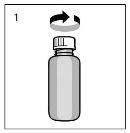
Sacar el tapón de rosca del frasco:
El tapón debe girarse en el sentido contrario a las agujas del reloj, desenroscarse completamente y sacarse (fig.1).
Montaje del dosificador en el frasco:
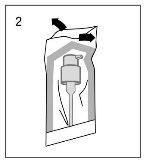
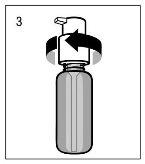
Sacar el dosificador de la bolsa de plástico (fig.2) y colocarlo encima del frasco. Introducir hacia abajo el tubo de plástico cuidadosamente dentro del frasco. Mantener el dosificador en el cuello del frasco y girar en el sentido de las agujas del reloj hasta que esté unido firmemente (fig.3). El dosificador sólo debe enroscarse una vez al iniciar el uso y nunca debe desenroscarse.
Cómo funciona el dosificador:
El cabezal del dosificador tiene dos posiciones y se gira fácilmente
- dirección contraria al sentido de las agujas del reloj para abrir
- dirección en el sentido de las agujas del reloj para cerrar
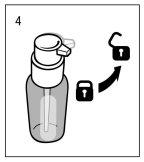
El cabezal del dosificador no debe pulsarse hacia abajo mientras esté en la posición cerrada.La solución solo puede dispensarse en la posición abierta. Para abrir, girar el cabezal del dosificador en la dirección que indica la flecha hasta que no se pueda más(alrededor de un octavo de giro, fig.4). El dosificador está entonces listo para su uso.
Preparación del dosificador:
Cuando se utiliza por primera vez, el dosificador no dispensa la cantidad correcta de solución oral. Por tanto debe prepararse (cebarse) pulsando el cabezal del dosificador hacia abajo completamente durante cinco veces seguidas (fig.5).
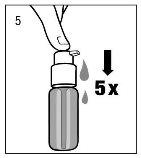
La solución así dispensada debe desecharse. La siguiente vez que el cabezal del dosificador se pulsa hacia abajo completamente (equivalente a una pulsación), ya dispensa la dosis correcta (fig.6).
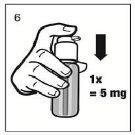
Uso correcto del dosificador:
Colocar un vaso con un poco de agua o una cuchara debajo de la boquilla. Pulsar el cabezal del dosificador hacia abajo firmemente pero tranquilamente y de forma sostenida, no demasiado despacio (fig.7,fig.8).
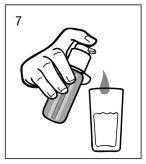
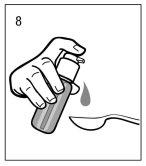
El cabezal puede entonces soltarse y está listo para la siguiente pulsación.
El dosificador debe sólo usarse con memantina solución en el frasco proporcionado, no para otros productos o envases. Si el dosificador no funciona correctamente, consulte a su médico o farmacéutico. Cierre el dosificador después de usar memantina.
Posología para pacientes con insuficiencia renal
Si padece problemas de riñón, su médico decidirá la dosis apropiada para su condición. En este caso, su médico debe controlar periódicamente su función renal.
Administración
Memantina Stada debe administrarse por vía oral una vez al día. Para sacar el máximo provecho de su medicación, deberá tomarla todos los días y a la misma hora. La solución se debe tomar con un poco de agua. La solución se puede tomar con o sin alimentos.
Duración del tratamiento
Continúe tomando memantina mientras sea beneficioso para usted. El médico debe evaluar los efectos de su tratamiento periódicamente.
Si toma más Memantina Stada de la que debe
En caso de sobredosis o ingestión accidental, consulte inmediatamente a su médico o farmacéutico o llame al Servicio de Información Toxicológica, teléfono 91 562 04 20, indicando el medicamento y la cantidad ingerida.
En general, tomar una cantidad excesiva de memantina no debería provocarle ningún daño. Puede experimentar un aumento de los síntomas descritos en la sección 4 “Posibles efectos adversos”.
Si olvidó tomar Memantina Stada
Si se da cuenta de que ha olvidado tomar su dosis de memantina, espere y tome la siguiente dosis a la hora habitual.
No tome una dosis doble para compensar la dosis olvidada.
Si interrumpe el tratamientoconMemantina Stada
Si desea detener el tratamiento antes de terminar el curso del tratamiento hable con su médico o farmacéutico.
Si tiene cualquier otra duda sobre el uso de este medicamento, pregunte a su médico o farmacéutico.

¿Has empezado a tomar el medicamento y tienes preguntas?
Comenta tus síntomas y tratamiento con un médico online.
4. Posibles efectos adversos
Al igual que todos los medicamentos, este medicamento puede producir efectos adversos, aunque no todas las personas los sufran.
En general, los efectos adversos observados son de leves a moderados.
Frecuentes (afecta a entre1 y 10 de cada 100 pacientes):
Dolor de cabeza, sueño, estreñimiento, pruebas de función hepática elevadas, vértigo, alteración del equilibrio, respiración difícil, tensión alta e hipersensibilidad al medicamento.
Poco frecuentes (afecta a entre1 y 10 de cada 1.000 pacientes):
Cansancio, infecciones por hongos, confusión, alucinaciones, vómitos, alteración de la marcha, insuficiencia cardíaca y formación de coágulos en el sistema venoso (trombosis/tromboembolismo venoso).
Muy raros (afectaa menos de 1 de cada 10.000 pacientes):
Convulsiones.
Frecuencia no conocida (la frecuencia no puede estimarse a partir de los datos disponibles):
Inflamación del páncreas, inflamación del hígado (hepatitis) y reacciones psicóticas.
La enfermedad de Alzheimer se ha relacionado con depresión, ideación suicida y suicidio. Se ha notificado la aparición de estos acontecimientos en pacientes tratados con memantina.
Comunicación de efectos adversos
Si experimenta cualquier tipo de efecto adverso, consulte a su médico o farmacéutico, incluso si se trata de efectos adversos que no aparecen en este prospecto. También puede comunicarlos directamente a través del sistema nacional de notificación incluido en el Sistema Español de Farmacovigilancia de Medicamentos de Uso Humano: https://www.notificaram.es. Mediante la comunicación de efectos adversos usted puede contribuir a proporcionar más información sobre la seguridad de este medicamento.
5. Conservación de Memantina Stada
Mantener este medicamento fuera de la vista y del alcance de los niños.
No utilice este medicamento después de la fecha de caducidad que aparece en el envase y en el frasco después de CAD. La fecha de caducidad es el último día del mes que se indica.
Este medicamento no requiere condiciones especiales de conservación.
Una vez abierto, el contenido del frasco debe ser utilizado en máximo 12 semanas.
El frasco con el dosificador montado debe guardarse y transportarse únicamente en posición vertical.
Los medicamentos no se deben tirar por los desagües ni a la basura. Deposite los envases y los medicamentos que no necesita en el Punto SIGRE de la farmacia. En caso de duda pregunte a su farmacéutico cómo deshacerse de los envases y de los medicamentos que no necesita. De esta forma, ayudará a proteger el medio ambiente.
6. Contenido del envase e información adicional
Composición deMemantina Stada
El principio activo es hidrocloruro de memantina.
Cada pulsación del dosificador (una pulsación) libera 0,5 ml de solución conteniendo 5 mg de hidrocloruro de memantina, equivalente a 4,16 mg de memantina. Cada ml de solución contiene 10 mg de hidrocloruro de memantina.
Los demás componentes son sorbato potásico (E202), sorbitol líquido (no cristalizable) (E420) y agua purificada.
Aspecto del producto y contenido del envase
Memantina Stada solución oral se presenta en forma de solución transparente, incolora de color amarillenta.
Memantina Stada solución oral está disponible en frascos de 50 ml, 100 ml o de 10 x 50 ml.
Se incluye un dosificador.
Puede que solamente estén comercializados algunos tamaños de envases.
Titular de la autorización de comercialización y responsable de la fabricación
Titular de la autorización de comercialización
Laboratorio STADA, S.L.
Frederic Mompou, 5
08960 Sant Just Desvern (Barcelona)
España
Responsable de la fabricación
Chanelle Medical
Loughrea, Co. Galway
Irlanda
o
STADA Arzneimittel AG
Stadastrasse 2 – 18, 61118 Bad Vilbel,
Alemania
o
Clonmel Healthcare Ltd
Waterford Road, Clonmel, Co. Tipperary
Irlanda
o
Centrafarm Services B.V.
Van de Reijtstraat 31-E
4814 NE Breda
Holanda
Este medicamento está autorizado en los estados miembros del Espacio Económico Europeo con los siguientes nombres
Irlanda: Memantine Clonmel 10 mg/ml Oral Solution
Holanda: Memantine CF 10 mg/ml, drankPortugal: Memantina Ciclum
España: Memantina Stada 5 mg/pulsación, solución oral EFG
Malta Memantine Clonmel 10 mg/ml oral solution
Fecha de la última revisión de este prospecto: abril 2021
La información detallada y actualizada de este medicamento está disponible en la página Web de la Agencia Española de Medicamentos y Productos Sanitarios (AEMPS) http://www.aemps.gob.es/
- País de registro
- Forma farmacéuticaSOLUCIÓN/SUSPENSIÓN ORAL, 10 mg/ml
- Código ATCN06DX01
- Principio activo
- Requiere recetaSí
- Fabricante
- ComposiciónSOLUCION DE SORBITOL 70% (100,00 mg mg), SORBATO POTASICO (2,00 mg mg)
- Esta información es de carácter general y no sustituye la consulta con un profesional sanitario.
- Alternativas a MEMANTINA STADA 5 MG/PULSACION SOLUCION ORAL EFGForma farmacéutica: COMPRIMIDO, 10 mgPrincipio activo: memantineFabricante: Merz Pharmaceuticals GmbhRequiere recetaForma farmacéutica: COMPRIMIDO, 10 mgPrincipio activo: memantineFabricante: Merz Pharmaceuticals GmbhRequiere recetaForma farmacéutica: COMPRIMIDO, 20 mgPrincipio activo: memantineFabricante: Merz Pharmaceuticals GmbhRequiere receta
Médicos online para MEMANTINA STADA 5 MG/PULSACION SOLUCION ORAL EFG
Comenta la dosis, los posibles efectos secundarios, interacciones, contraindicaciones o la revisión de receta de MEMANTINA STADA 5 MG/PULSACION SOLUCION ORAL EFG, sujeto a valoración médica y a la normativa local.









Obtén una receta de MEMANTINA STADA 5 MG/PULSACION SOLUCION ORAL EFG online
Rellena un formulario de 2 minutos
Cuéntanos tus síntomas, historial y el medicamento que necesitas.
Elige un médico o nosotros te asignamos uno
Escoge un especialista o te conectamos con el próximo médico disponible.
El médico revisa tu caso
Normalmente en 30 minutos. Puede hacerte preguntas adicionales por chat.
Recógela en cualquier farmacia
Receta electrónica enviada a tu correo, válida en toda España.
Preguntas frecuentes
MEMANTINA STADA 5 MG/PULSACION SOLUCION ORAL EFG requiere receta en España. Puedes confirmarlo con un médico online según tu caso.
El principio activo de MEMANTINA STADA 5 MG/PULSACION SOLUCION ORAL EFG es memantine. Esta información ayuda a identificar medicamentos con la misma composición pero con diferentes nombres comerciales.
MEMANTINA STADA 5 MG/PULSACION SOLUCION ORAL EFG es fabricado por Laboratorio Stada S.L.. La marca y el envase pueden variar según el distribuidor.
Los Médicos de familia, Psiquiatras, Dermatólogos, Cardiólogos, Endocrinólogos, Gastroenterólogos, Neumólogos, Nefrólogos, Reumatólogos, Hematólogos, Infectólogos, Alergólogos, Geriatras, Pediatras, Oncólogos pueden valorar la prescripción de MEMANTINA STADA 5 MG/PULSACION SOLUCION ORAL EFG cuando esté clínicamente indicado. Puedes reservar una videoconsulta para comentar tu caso y las opciones de tratamiento.
España cuenta con una infraestructura sanitaria bien desarrollada en ciudades principales como Madrid, Barcelona, Valencia y Sevilla. Las farmacias están ampliamente disponibles y operan bajo estrictas regulaciones, garantizando el acceso a medicamentos con receta.
Puedes comprar MEMANTINA STADA 5 MG/PULSACION SOLUCION ORAL EFG en Madrid, Barcelona, Sevilla o Valencia en cualquier farmacia local con una receta válida.
Para obtener una receta, puedes utilizar Oladoctor:
Otros medicamentos con el mismo principio activo (memantine) incluyen AXURA 10 mg COMPRIMIDOS RECUBIERTOS CON PELICULA, AXURA 10 mg COMPRIMIDOS RECUBIERTOS CON PELICULA, AXURA 20 mg COMPRIMIDOS RECUBIERTOS CON PELICULA. Pueden tener diferentes nombres comerciales o formulaciones, pero contienen el mismo componente terapéutico. Consulta siempre con un médico antes de cambiar o iniciar un nuevo medicamento.
