


Maxidex 1 mg/ml colirio en suspensión

Revisión de receta online
Un médico revisará tu caso y determinará si la prescripción es médicamente apropiada.

Habla con un médico sobre este medicamento
Comenta tus síntomas y las opciones de tratamiento en una consulta online.



Cómo usar MAXIDEX 1 MG/ML COLIRIO EN SUSPENSIÓN
Contenido del prospecto
- Introducción
- Qué es Maxidex colirio y para qué se utiliza
- Qué necesita saber antes de empezar a usar Maxidex colirio
- Cómo usar Maxidex colirio
- Posibles efectos adversos
- Conservación de Maxidex colirio
- Contenido del envase e información adicional
Introducción
Prospecto: información para el usuario
MAXIDEX 1 mg/ml colirio en suspensión
Dexametasona
Lea todo el prospecto detenidamente antes de empezar a usar este medicamento, porque contiene información importante para usted.
- Conserve este prospecto, ya que puede tener que volver a leerlo.
- Si tiene alguna duda, consulte a su médico o farmacéutico.
- Este medicamento se le ha recetado solamente a usted, y no debe dárselo a otras personas aunque tengan los mismos síntomas que usted, ya que puede perjudicarles.
- Si experimenta efectos adversos, consulte a su médico o farmacéutico, incluso si se trata de efectos adversos que no aparecen en este prospecto. Ver sección 4.
Contenido del prospecto
- Qué es MAXIDEX colirio y para qué se utiliza
- Qué necesita saber antes de empezar a usar MAXIDEX colirio
- Cómo usar MAXIDEX colirio
- Posibles efectos adversos
- Conservación de MAXIDEX colirio
- Contenido del envase e información adicional
1. Qué es Maxidex colirio y para qué se utiliza
Es un colirio en suspensión para los ojos que contiene como principio activo dexametasona, un potente corticosteroide con propiedades antiinflamatorias y antialérgicas principalmente, que reduce la respuesta inflamatoria provocada por agentes de naturaleza alérgica, mecánica o química.
Maxidex está indicado para el tratamiento de inflamaciones no infecciosas de los ojos que responden a los corticosteroides, tales como: uveítis anterior (inflamación de la úvea o capa media del ojo), inflamaciones del iris (iritis), del cuerpo ciliar (ciclitis) o inflamaciones conjuntas (iridociclitis). Inflamaciones de la córnea (queratitis): queratitis causada por el virus Herpes Zoster y queratitis punctata superficial (con pequeños puntos de lesión en la córnea). Complemento en el tratamiento de queratoconjuntivitis flictenular (inflamación de la córnea y de la conjuntiva caracterizada por la presencia de pequeños nódulos). Conjuntivitis primaveral y alérgica. Lesiones de la córnea por un cuerpo extraño. Quemaduras térmicas de los ojos.

¿No estás seguro de si este medicamento es adecuado para ti?
Comenta tus síntomas y tratamiento con un médico online.
2. Qué necesita saber antes de empezar a usar Maxidex colirio
No use Maxidex colirio:
- Si es alérgico a dexametasona o a alguno de los demás componentes de este medicamento (incluidos en la sección 6).
- Si tiene o piensa que tiene:
- Infección bacteriana del ojo no tratada.
- Inflamación de la córnea (queratitis) por herpes simplex o cualquier otra infección del ojo causada por virus, como viruela o varicela.
- Tuberculosis que afecte al ojo.
- Enfermedades por hongos (fúngicas) del ojo o infecciones del ojo no tratadas provocadas por parásitos.
Advertencias y precauciones
Consulte a su médico o farmacéutico antes de empezar a usar Maxidex.
- Sólo utilice este medicamento en su(s) ojo(s).
- Este medicamento puede aumentar la presión ocular, especialmente si ya tiene glaucoma o presión ocular elevada, o antecedentes familiares, por lo que debe utilizarlo bajo control médico.
- Si utiliza este medicamento durante un periodo largo de tiempo, puede:
- Desarrollar hipertensión ocular y/o glaucoma (con deterioro del nervio óptico y disminución de la agudeza visual). Debe controlar regularmente la presión del ojo mientras utiliza este medicamento. Consulte a su médico en caso de dudas. El riesgo de presión intraocular elevada y/o formación de cataratas inducido por corticosteroides es mayor en pacientes propensos (p.ej. diabetes).
- Desarrollar cataratas. Debería visitar a su médico con frecuencia.
- Desarrollar el síndrome de Cushing y/o supresión de la función de la glándula suprarrenal debido a que el medicamento llegue hasta la sangre. Consulte a su médico si sufre hinchazón y aumento de peso alrededor del tronco y en la cara, ya que éstas son por lo general las primeras manifestaciones de un síndrome llamado síndrome de Cushing. Se puede producir una supresión de la función de la glándula adrenal tras interrumpir un tratamiento intensivo o a largo plazo con Maxidex. Consulte a su médico antes de interrumpir el tratamiento por su cuenta. Estos riesgos son especialmente importantes en niños y pacientes tratados con un medicamento llamado ritonavir o cobicistat.
- Si sus síntomas empeoran o vuelven repentinamente, por favor, contacte con su médico. Puede volverse más sensible a infecciones del ojo con el uso de este medicamento. Los corticosteroides también pueden enmascarar los signos de una infección o intensificarla, especialmente con el uso prolongado en infecciones de los ojos con pus.
- Si ya tiene una infección bacteriana en los ojos, debe consultar al médico sobre su tratamiento.
- El uso prolongado de corticosteroides en el ojo podría producir infecciones por hongos en la córnea. En caso de producirse, debe suprimirse el tratamiento. El uso de corticosteroides en el ojo en dosis excesivas puede retrasar la curación de heridas del mismo. También se sabe que los AINEs (Antiinflamatorios No Esteroideos) oftálmicos enlentecen o retrasan la cicatrización (ver apartado "Otros medicamentos y Maxidex colirio"). Si sufre un trastorno causante de adelgazamiento del tejido ocular (las capas más externas del ojo) la utilización de este medicamento podría producir perforación de la córnea.
- Póngase en contacto con su médico si presenta visión borrosa u otras alteraciones visuales.
Si utiliza lentes de contacto:
- Llevar lentes de contacto (duras o blandas) no está recomendado durante el tratamiento de una inflamación del ojo.
Niños
No se ha establecido la seguridad y eficacia de este medicamento en niños. Por tanto, no está recomendado su uso en niños.
El posible aumento de presión intraocular asociado al uso prolongado de este medicamento, es especialmente importante en pacientes pediátricos; el riesgo de hipertensión ocular inducido por corticosteroides puede ser mayor en niños y ocurrir antes que en adultos.
Otros medicamentos y Maxidex colirio
Informe a su médico o farmacéutico si está utilizando, ha utilizado recientemente o pudiera tener que utilizar cualquier otro medicamento.
Informe a su médico si está utilizando AINEs (Antiinflamatorios No Esteroideos) oftálmicos. El uso concomitante de esteroides y AINEs oftálmicos puede aumentar los problemas de cicatrización de la córnea.
Informe a su médico si está usando ritonavir o cobicistat, ya que puede provocar un aumento de la cantidad de dexametasona en la sangre.
Embarazo, lactancia y fertilidad
Si está embarazada o en periodo de lactancia, cree que podría estar embarazada o tiene intención de quedarse embarazada, consulte a su médico o farmacéutico antes de utilizar este medicamento.
No se recomienda el uso de Maxidex durante el embarazo.
Si usted está en periodo de lactancia, debe decidir si es necesario interrumpir la lactancia o interrumpir el tratamiento con este medicamento, teniendo en cuenta el beneficio de la lactancia para el niño y el beneficio del tratamiento para la madre.
Conducción y uso de máquinas
Puede notar que su visión se vuelve borrosa durante un rato después de aplicarse el colirio. No conduzca ni utilice máquinas hasta que haya desaparecido este efecto.
Maxidex contiene cloruro de benzalconio y fosfatos
Este medicamento contiene 0,5 mg de cloruro de benzalconio en cada frasco de 5 ml, equivalente a 0,1 mg/ml.
El cloruro de benzalconio se puede absorber por las lentes de contacto blandas alterando su color. Retirar las lentes de contacto antes de usar este medicamento y esperar 15 minutos antes de volver a colocarlas.
El cloruro de benzalconio puede causar irritación ocular, especialmente si padece de ojo seco u otras enfermedades de la córnea (capa transparente de la zona frontal del ojo). Consulte a su médico si siente una sensación extraña, escozor o dolor en el ojo después de usar este medicamento.
Este medicamento contiene 6,5 mg de fosfatos en cada frasco de 5 ml, equivalente a 1,3 mg/ml.
Si sufre de daño grave en la córnea (la capa trasparente de la parte frontal del ojo) el tratamiento con fosfatos, en casos muy raros, puede provocar visión borrosa por acumulación de calcio.
3. Cómo usar Maxidex colirio
Siga exactamente las instrucciones de administración de este medicamento indicadas por su médico. En caso de duda, consulte de nuevo a su médico o farmacéutico.
Vía oftálmica (en los ojo/s).
La dosis recomendada es:
Adultos:
En general instilar 1 o 2 gotas en el ojo afectado, 5 o 6 veces al día.
Cuando se observe una respuesta satisfactoria a los 3-4 días puede reducirse gradualmente la frecuencia de administración a menos veces al día.
La duración máxima recomendada del tratamiento es de 14 días salvo que su médico le haya dado otras indicaciones distintas.
Recomendaciones de uso:
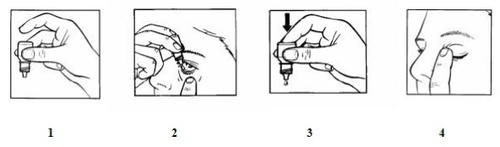
- Lávese las manos.
- Coja el frasco (envase cuentagotas) y agítelo bien antes de usar.
- Después de abrir el frasco por primera vez, debe retirar el anillo de plástico del precinto si está suelto.
- Sostenga el frasco, boca abajo, entre los dedos (figura 1).
- Incline la cabeza hacia atrás. Separe suavemente el párpado del ojo con un dedo hasta que se forme una bolsa entre el párpado y su ojo, en la que deberá caer la gota (figura 2).
- Acerque la punta del frasco al ojo. Puede serle útil el espejo.
- No toque el ojo o el párpado, zonas próximas ni otras superficies con el cuentagotas. Las gotas podrían contaminarse.
- Apriete suavemente la base del frasco para que caiga una gota cada vez (figura 3).
- Después de utilizar este colirio, presione con el dedo el borde del ojo junto a la nariz. Esto ayuda a evitar que este medicamento pase al resto del cuerpo (figura 4).
- Si se aplica gotas en ambos ojos, repita todos los pasos anteriores con el otro ojo.
- Cierre bien el frasco inmediatamente después de utilizar el producto.
Si una gota cae fuera del ojo, inténtelo de nuevo.
Si está utilizando otros medicamentos oftálmicos,espere al menos 5 minutos entre la administración de este colirio y los otros medicamentos oftálmicos. Las pomadas oftálmicas deben administrarse en último lugar.
Si usa más Maxidex del que debe
Una sobredosis en los ojos puede eliminarla lavando los ojos con agua templada. No se aplique más gotas hasta la siguiente dosis.
En caso de sobredosis o ingestión accidental, consulte inmediatamente a su médico o farmacéutico, o llame al Servicio de Información Toxicológica, teléfono 91 562 04 20, indicando el medicamento y la cantidad utilizada.
Si olvidó usar Maxidex
No se aplique una dosis doble para compensar las dosis olvidadas.
Aplíquese una única dosis tan pronto como se dé cuenta y continúe con la siguiente dosis que estaba prevista. Sin embargo, si ya es casi la hora de la siguiente dosis, no se aplique la dosis olvidada y continúe con la siguiente dosis de su régimen habitual.
Si tiene cualquier otra duda sobre el uso de este medicamento, pregunte a su médico o farmacéutico.

¿Has empezado a tomar el medicamento y tienes preguntas?
Comenta tus síntomas y tratamiento con un médico online.
4. Posibles efectos adversos
Al igual que todos los medicamentos, este medicamento puede producir efectos adversos, aunque no todas las personas los sufran.
Los efectos adversos se clasifican por frecuencias, que se definen como: muy frecuentes (pueden afectar a más de 1 de cada 10 personas); frecuentes (pueden afectar hasta 1 de cada 10 personas); poco frecuentes (pueden afectar hasta 1 de cada 100 personas); raras (pueden afectar hasta 1 de cada 1.000 personas); muy raras (pueden afectar hasta 1 de cada 10.000 personas); frecuencia no conocida (no puede estimarse a partir de los datos disponibles).
Se han notificado con este medicamento los siguientes efectos adversos:
Efectos adversos frecuentes :
- Efectos en el ojo: molestia en el/los ojo/s.
Efectos adversos poco frecuentes :
- Efectos en el ojo: inflamación de la superficie del ojo (queratitis), inflamación de la conjuntiva (conjuntivitis), ojo seco , mancha en la córnea, sensibilidad a la luz (fotofobia), visión borrosa, sensación anormal en el ojo, lagrimeo, costras en el párpado, picor, irritación o enrojecimiento del ojo.
- Efectos generales: alteración del sentido del gusto (mal sabor).
Frecuencia no conocida :
- Efectos en el ojo: glaucoma (aumento de la presión ocular con disminución de la agudeza visual), úlcera corneal, incremento de la presión en el ojo(s), visión reducida, daño en la córnea, caída del párpado, dolor en el ojo, aumento en el tamaño de la pupila.
- Efectos generales: hipersensibilidad (alergia), mareo, dolor de cabeza.
- Problemas hormonales: crecimiento excesivo de vello corporal (particularmente en las mujeres), debilidad y desgaste muscular, estrías moradas en la piel del cuerpo, aumento de la presión arterial, menstruaciones irregulares o ausentes, cambios en los niveles de proteínas y calcio del cuerpo, retraso en el crecimiento en niños y adolescentes e hinchazón y aumento de peso del cuerpo y la cara (síndrome de Cushing) (ver sección 2, "Advertencias y precauciones").
El uso prolongado de corticosteroides en los ojos tambien puede ocasionar:
- Aumento de la presión ocular con daño del nervio óptico y disminución de la agudeza visual.
- Formación de cataratas.
- Retraso en la cicatrización de la cornea.
- En enfermedades que causan adelgazamiento de la córnea, existe un mayor riesgo de perforación.
Los corticosteroides pueden reducir la resistencia a infecciones oculares favoreciendo su aparición.
Comunicación de efectos adversos
Si experimenta cualquier tipo de efecto adverso, consulte a su médico o farmacéutico, incluso si se trata de posibles efectos adversos que no aparecen en este prospecto. También puede comunicarlos directamente a través del Sistema Español de Farmacovigilancia de Medicamentos de Uso Humano: https://www.notificaRAM.es.Mediante la comunicación de efectos adversos usted puede contribuir a proporcionar más información sobre la seguridad de este medicamento.
5. Conservación de Maxidex colirio
Mantener este medicamento fuera de la vista y del alcance de los niños.
No conservar a temperatura superior a 30ºC.
No utilice este medicamento después de la fecha de caducidad que aparece en el frasco y en la caja después de CAD. La fecha de caducidad es el último día del mes que se indica.
Para evitar infecciones, debe desechar el frasco 4 semanas después de haberlo abierto por primera vez.
Anote la fecha de apertura del frasco en el recuadro reservado para esta finalidad en la caja.
Los medicamentos no se deben tirar por los desagües ni a la basura. Deposite los envases y los medicamentos que no necesita en el Punto SIGRE de la farmacia. En caso de duda pregunte a su farmacéutico cómo deshacerse de los envases y de los medicamentos que ya no necesita. De esta forma, ayudará a proteger el medio ambiente.
6. Contenido del envase e información adicional
Composición de MAXIDEX colirio
- El principio activo es dexametasona. 1 ml de suspensión contiene 1 mg de dexametasona (0,1%).
- Los demás componentes son: cloruro de benzalconio, hidrogenofosfato de disodio anhidro, polisorbato 80, edetato de disodio, cloruro de sodio, hipromelosa, ácido cítrico monohidrato y/o hidróxido de sodio y agua purificada.
Aspecto del producto y contenido del envase
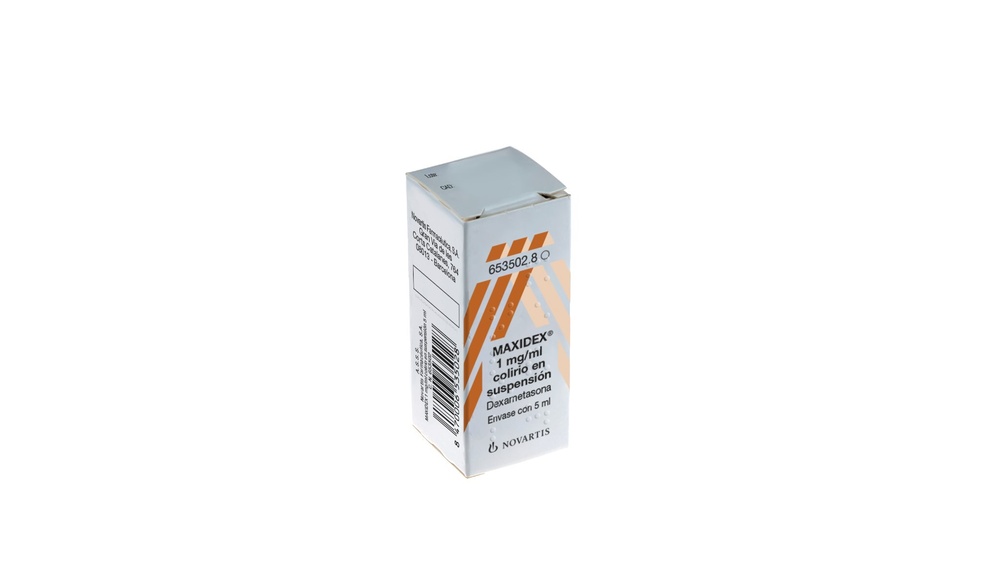
Maxidex es un colirio en suspensión blanco o ligeramente amarillento. Se presenta en envase cuentagotas (frasco de plástico con tapón de rosca).
Cada envase contiene 5 ml de colirio.
Titular de la autorización de comercialización
Novartis Farmacéutica, S.A.
Gran Via de les Corts Catalanes, 764
08013 – Barcelona -España
Responsable de la fabricación
Siegfried El Masnou, S.A.
C/Camil Fabra, 58
08320 El Masnou – Barcelona, España
o
Novartis Farmacéutica, S.A.
Gran Via de les Corts Catalanes, 764
08013 Barcelona, España
o
Novartis Pharma GmbH
Roonstrasse 25
90429 Nuremberg, Alemania
Fecha de la última revisión de este prospecto:Enero 2021
La información detallada de este medicamento está disponible en la página Web de la Agencia Española de Medicamentos y Productos Sanitarios (AEMPS) http://www.aemps.gob.es/
- País de registro
- Forma farmacéuticaCOLIRIO, 0,1% dexametasona
- Código ATCS01BA01
- Precio medio en farmacia2.5 EUR
- Principio activo
- Requiere recetaSí
- Fabricante
- ComposiciónBENZALCONIO, CLORURO DE (0,1 mg mg), CLORURO DE SODIO (7 mg mg), EDETATO DE DISODIO (0,1 mg mg), FOSFATO SODICO ANHIDRO (2 mg mg), POLISORBATO 80 (0,5 mg mg), HIDROXIDO DE SODIO (E 524) (c.s.p.ajuste pH - mg)
- Esta información es de carácter general y no sustituye la consulta con un profesional sanitario.
- Alternativas a MAXIDEX 1 MG/ML COLIRIO EN SUSPENSIÓNForma farmacéutica: COLIRIO, 1 mg/mlPrincipio activo: DexametasonaFabricante: Pharmaselect International Beteiligungs GmbhRequiere recetaForma farmacéutica: COLIRIO, 0,1 %Principio activo: DexametasonaFabricante: Fidia Farmaceutici S.P.A.Requiere recetaForma farmacéutica: COLIRIO, 1mg/mlPrincipio activo: DexametasonaFabricante: Laboratoires TheaRequiere receta
Médicos online para MAXIDEX 1 MG/ML COLIRIO EN SUSPENSIÓN
Comenta la dosis, los posibles efectos secundarios, interacciones, contraindicaciones o la revisión de receta de MAXIDEX 1 MG/ML COLIRIO EN SUSPENSIÓN, sujeto a valoración médica y a la normativa local.









Preguntas frecuentes
MAXIDEX 1 MG/ML COLIRIO EN SUSPENSIÓN requiere receta en España. Puedes confirmarlo con un médico online según tu caso.
El principio activo de MAXIDEX 1 MG/ML COLIRIO EN SUSPENSIÓN es Dexametasona. Esta información ayuda a identificar medicamentos con la misma composición pero con diferentes nombres comerciales.
El precio medio en farmacia de MAXIDEX 1 MG/ML COLIRIO EN SUSPENSIÓN es de aproximadamente 2.5 EUR. Puede variar según el fabricante y la forma farmacéutica.
MAXIDEX 1 MG/ML COLIRIO EN SUSPENSIÓN es fabricado por Novartis Farmaceutica S.A.. La marca y el envase pueden variar según el distribuidor.
Los Médicos de familia, Psiquiatras, Dermatólogos, Cardiólogos, Endocrinólogos, Gastroenterólogos, Neumólogos, Nefrólogos, Reumatólogos, Hematólogos, Infectólogos, Alergólogos, Geriatras, Pediatras, Oncólogos pueden valorar la prescripción de MAXIDEX 1 MG/ML COLIRIO EN SUSPENSIÓN cuando esté clínicamente indicado. Puedes reservar una videoconsulta para comentar tu caso y las opciones de tratamiento.
La receta la emite un médico tras valorar tu estado de salud. En España, MAXIDEX 1 MG/ML COLIRIO EN SUSPENSIÓN se dispensa en las farmacias con esa receta médica. Una consulta online no garantiza su emisión: la decisión corresponde siempre al médico.
Para solicitar una valoración puedes usar Oladoctor:
Otros medicamentos con el mismo principio activo (Dexametasona) incluyen AMEXXINE 1 MG/ML COLIRIO EN SOLUCION, COLIRCUSI DEXAMETASONA 1 mg/ml colirio en solución, DEXAFREE 1 MG/ML COLIRIO EN SOLUCION EN ENVASE UNIDOSIS. Pueden tener diferentes nombres comerciales o formulaciones, pero contienen el mismo componente terapéutico. Consulta siempre con un médico antes de cambiar o iniciar un nuevo medicamento.
