


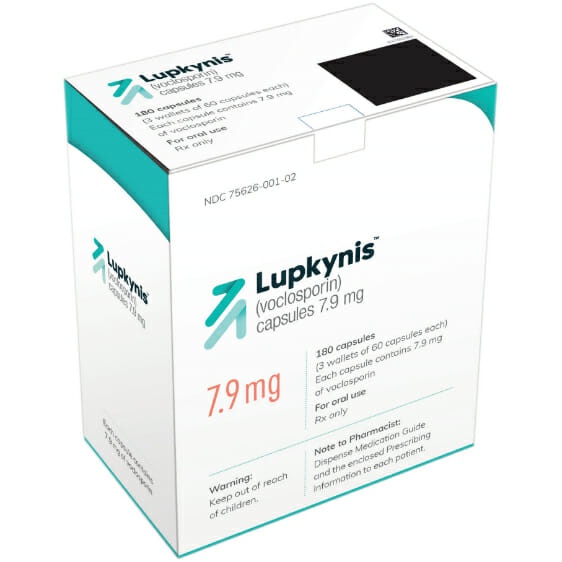
Lupkynis 7,9 mg cápsulas blandas

Solicitud de receta online
Un médico revisará tu caso y determinará si la prescripción es médicamente apropiada.

Habla con un médico sobre este medicamento
Comenta tus síntomas y las opciones de tratamiento en una consulta online.



Cómo usar LUPKYNIS 7,9 MG CAPSULAS BLANDAS
Contenido del prospecto
- Introducción
- Qué es Lupkynis y para qué se utiliza
- Qué necesita saber antes de empezar a tomar Lupkynis
- Cómo tomar Lupkynis
- Posibles efectos adversos
- Conservación de Lupkynis
- Contenido del envase e información adicional
Introducción
Prospecto: información para el paciente
Lupkynis 7,9 mg cápsulas blandas
voclosporina
Este medicamento está sujeto a seguimiento adicional, lo que agilizará la detección de nueva información sobre su seguridad. Puede contribuir comunicando los efectos adversos que pudiera usted tener. La parte final de la sección 4 incluye información sobre cómo comunicar estos efectos adversos.
Lea todo el prospecto detenidamente antes de empezar a usar este medicamento, porque contiene información importante para usted.
- Conserve este prospecto, ya que puede tener que volver a leerlo.
- Si tiene alguna duda, consulte a su médico o enfermero.
- Este medicamento se le ha recetado solamente a usted, y no debe dárselo a otras personas aunque tengan los mismos síntomas que usted, ya que puede perjudicarles.
- Si experimenta efectos adversos, consulte a su médico o enfermero, incluso si se trata de efectos adversos que no aparecen en este prospecto. Ver sección 4.
Contenido del prospecto
- Qué es Lupkynis y para qué se utiliza
- Qué necesita saber antes de empezar a tomar Lupkynis
- Cómo tomar Lupkynis
- Posibles efectos adversos
- Conservación de Lupkynis
- Contenido del envase e información adicional
1. Qué es Lupkynis y para qué se utiliza
Lupkynis contiene el principio activo voclosporina. Se utiliza para el tratamiento de la nefritis lúpica (inflamación del riñón causada por el lupus) en adultos a partir de 18 años.
El principio activo de Lupkynis pertenece a un grupo de medicamentos conocidos como inhibidores de la calcineurina que se pueden utilizar para controlar la respuesta inmunitaria del organismo (inmunosupresores). En el lupus, el sistema inmunitario (las defensas naturales del organismo) ataca por error partes de su propio cuerpo, incluidos los riñones (nefritis lúpica). Al reducir la respuesta del sistema inmunitario, el medicamento reduce la inflamación de los riñones y disminuye los síntomas como, por ejemplo, la hinchazón de las piernas, los tobillos o los pies, la hipertensión arterial y el cansancio, además de mejorar la función renal.

¿No estás seguro de si este medicamento es adecuado para ti?
Comenta tus síntomas y tratamiento con un médico online.
2. Qué necesita saber antes de empezar a tomar Lupkynis
No tome Lupkynis:
- Si es alérgico a voclosporina o a alguno de los demás componentes de este medicamento (incluidos en la sección 6).
- Si está tomando otros medicamentos como comprimidos de ketoconazol (utilizados para tratar el síndrome de Cushing cuando el organismo produce un exceso de cortisol), itraconazol o claritromicina (utilizados para tratar ciertas infecciones fúngicas y bacterianas).
Advertencias y precauciones
Consulte a su médico o farmacéutico antes de empezar a tomar Lupkynis si presenta alguna de estas situaciones:
- Si su enfermedad renal empeora, puede ser necesario cambiar la dosis de este medicamento. Su médico comprobará regularmente el funcionamiento de sus riñones.
- Si presenta factores de riesgo de aplasia pura de la serie roja (APSR), un trastorno raro en el que la médula ósea no produce suficientes glóbulos rojos. Dichos factores de riesgo son una infección previa con el parvovirus B19 o la administración previa de tratamientos que puedan causar APSR.
- Si padece o desarrolla hipertensión arterial. Su médico le tomará la tensión arterial cada dos semanas durante el primer mes y, a partir de entonces, regularmente. Es posible que le dé un medicamento para bajar la tensión arterial o que le diga que deje de tomar este medicamento.
- Este medicamento puede aumentar el riesgo de afecciones del sistema nervioso como, por ejemplo, dolor de cabeza, temblores, cambios en la visión, convulsiones, confusión o debilidad en una o más extremidades. Si presenta alguno de estos nuevos síntomas o un empeoramiento de los existentes, su médico puede considerar la posibilidad de suspender o reducir la dosis de este medicamento (ver sección 4).
- Si tiene previsto vacunarse o se ha vacunado en los últimos 30 días. Este medicamento puede afectar a la respuesta a la vacunación, y la vacunación durante el tratamiento con este medicamento puede ser menos eficaz.
- Si ha experimentado previamente reacciones alérgicas repentinas potencialmente mortales (reacciones anafilácticas) a la soja o al cacahuete, no tome este medicamento.
Este medicamento puede aumentar los niveles de potasio en la sangre, lo cual puede ser grave y requerir tratamiento. Su médico comprobará periódicamente sus niveles de potasio durante el tratamiento.
Este medicamento no se ha estudiado en pacientes con un deterioro renal grave y, por lo tanto, no se recomienda en estos pacientes.
Este medicamento puede afectar la actividad eléctrica de su corazón (prolongación del intervalo QT). Esto puede dar lugar a graves trastornos del ritmo cardíaco. Los primeros síntomas son mareos y desmayos.
Luz solar y luz ultravioleta
Este medicamento puede aumentar el riesgo de desarrollar ciertos tipos de cáncer, especialmente de piel. Debe evitar o limitar su exposición a la luz solar y a los rayos ultravioleta utilizando ropa protectora adecuada y aplicando con frecuencia un protector solar con un factor de protección elevado.
Infecciones
Este medicamento puede aumentar el riesgo de desarrollar infecciones, algunas de las cuales pueden ser graves o incluso mortales. Póngase en contacto con su médico si tiene algún signo de infección como, por ejemplo, fiebre, escalofríos o dolor de garganta. Su médico decidirá si debe dejar de tomar este medicamento (ver sección 4).
Niños y adolescentes
No tome este medicamento si tiene menos de 18 años porque no se ha estudiado en este grupo de edad.
Pacientes de edad avanzada
Este medicamento no se recomienda si tiene más de 75 años porque no se ha estudiado en este grupo de edad.
Otros medicamentos y Lupkynis
Informe a su médico o farmacéutico si está tomando, ha tomado recientemente o pudiera tener que tomar cualquier otro medicamento.
En particular, informe a su médico si toma:
- Medicamentos utilizados para el tratamiento de las infecciones fúngicas, como itraconazol y fluconazol.
- Medicamentos utilizados para tratar el síndrome de Cushing (cuando el organismo produce un exceso de cortisol), como comprimidos de ketoconazol.
- Medicamentos utilizados para tratar la hipertensión o los problemas cardíacos, como digoxina, diltiazem y verapamilo.
- Medicamentos para prevenir la formación de coágulos sanguíneos, como dabigatrán etexilato.
- Medicamentos utilizados para tratar la epilepsia, como carbamazcepina y fenobarbital.
- Preparados de fitoterapia con hierba de San Juan utilizados para tratar la depresión leve.
- Medicamentos para el alivio de los síntomas asociados a la rinitis alérgica estacional, como la fexofenadina.
- Medicamentos antibióticos utilizados para el tratamiento de las infecciones bacterianas, como rifampicina, claritromicina y eritromicina.
- Medicamentos que reducen el colesterol, como simvastatina, atorvastatina, rosuvastatina y pravastatina.
- Medicamentos utilizados para el tratamiento de las infecciones por VIH, como el antirretroviral efavirenz.
Toma de Lupkynis con alimentos y bebidas
Este medicamento se puede tomar con o sin alimentos. Evite comer pomelo y beber zumo de pomelo durante el tratamiento con este medicamento, ya que pueden afectar a su funcionamiento.
Embarazo, lactancia y fertilidad
Si está embarazada o en periodo de lactancia, cree que podría estar embarazada o tiene intención de quedarse embarazada, consulte a su médico antes de utilizar este medicamento.
No se recomienda tomar este medicamento durante el embarazo, ni en mujeres en edad fértil que no estén utilizando métodos anticonceptivos.
Informe a su médico si está amamantando. Se desconoce si el medicamento puede pasar a la leche materna y afectar a su bebé. Su médico le indicará si debe interrumpir el tratamiento con este medicamento mientras esté amamantando o si debe interrumpir la lactancia.
No hay datos sobre el efecto de este medicamento en la fertilidad humana.
Conducción y uso de máquinas
No se espera que Lupkynis tenga ningún efecto sobre su capacidad para conducir y utilizar máquinas.
Lupkynis contiene alcohol
Este medicamento contiene 21,6 mg de alcohol (etanol) en cada cápsula. Por lo tanto, una dosis de 3 cápsulas de Lupkynis contiene 64,8 mg de etanol, que equivale a menos de 2 ml de cerveza o 1 ml de vino. La pequeña cantidad de alcohol que contiene este medicamento no produce ningún efecto perceptible.
Lupkynis contiene sorbitol
Este medicamento contiene 28,7 mg de sorbitol en cada cápsula.
Lupkynis puede contener lecitina de soja
Este medicamento puede contener trazas de lecitina de soja. Si experimenta reacciones anafilácticas a la soja o al cacahuete, no debe utilizar este medicamento.
3. Cómo tomar Lupkynis
Siga exactamente las instrucciones de administración de este medicamento indicadas por su médico o farmacéutico. En caso de duda, consulte de nuevo a su médico o farmacéutico.
La dosis recomendada de Lupkynis es de tres cápsulas dos veces al día por vía oral. Las cápsulas se deben tragar enteras y se pueden tomar con o sin alimentos.
Tome las dosis diarias aproximadamente a la misma hora cada día, con un intervalo de separación de al menos 8 horas e idealmente con un intervalo lo más cercano posible a 12 horas (por ejemplo, a las 8:00 de la mañana y a las 8:00 de la tarde).
Este medicamento se debe utilizar en combinación con otro medicamento inmunosupresor denominado micofenolato de mofetilo.
Si toma más Lupkynis del que debe
Si ha tomado accidentalmente demasiadas cápsulas, póngase en contacto inmediatamente con su médico o con el servicio de urgencias del hospital más cercano. Los síntomas de una sobredosis pueden incluir latidos rápidos del corazón y temblores (sacudidas o temblores incontrolados en una o más partes del cuerpo).
Si olvidó tomar Lupkynis
Si olvida tomar una dosis, debe tomarla lo antes posible y dentro de las 4 horas siguientes a la omisión de la dosis. Si han pasado más de 4 horas desde la hora a la que normalmente toma el medicamento, simplemente sáltese esa dosis y tome la siguiente a la hora habitual. No tome una dosis doble para compensar las dosis olvidadas.
Si interrumpe el tratamiento con Lupkynis
No interrumpa el tratamiento a menos que su médico se lo indique.
Si tiene cualquier otra duda sobre el uso de este medicamento, pregunte a su médico o farmacéutico.

¿Has empezado a tomar el medicamento y tienes preguntas?
Comenta tus síntomas y tratamiento con un médico online.
4. Posibles efectos adversos
Al igual que todos los medicamentos, este medicamento puede producir efectos adversos, aunque no todas las personas los sufran. Los siguientes efectos adversos pueden ocurrir con este medicamento:
Efectos adversos graves
Si se produce alguno de estos casos, acuda inmediatamente al médico, ya que éste puede aconsejarle que deje de tomar este medicamento o que reduzca la dosis.
Muy frecuentes(pueden afectar a más de 1 de cada 10 personas)
- Síntomas de infección (como fiebre, dolores corporales, sensación de cansancio, tos o estornudos, náuseas, vómitos o diarrea)
Frecuentes(pueden afectar hasta 1 de cada 10 personas)
- Nuevos síntomas de problemas nerviosos o cerebrales, como convulsiones
Otros efectos adversos
Muy frecuentes(pueden afectar a más de 1 de cada 10 personas)
- Infección de la parte superior del tórax
- Reducción del número de glóbulos rojos, lo que puede hacer que la piel se vuelva pálida y causar debilidad o falta de aliento (anemia)
- Dolor de cabeza
- Aumento de la tensión arterial
- Tos
- Diarrea
- Dolor en el abdomen (vientre)
- Cambios en la función renal que podrían reducir la cantidad de orina que produce y que pueden provocar hinchazón nueva o que empeora en las piernas o en los pies
Frecuentes(pueden afectar hasta 1 de cada 10 personas)
- Infecciones, que pueden ser bacterianas, como las infecciones del tracto urinario, o víricas, como el herpes
- Inflamación del estómago y los intestinos
- Gripe
- Aumento de los niveles de potasio observados en los análisis de sangre
- Disminución del apetito
- Temblores
- Náuseas
- Hinchazón anormal, sangrado y/o inflamación de las encías
- Indigestión
- Pérdida de cabello
- Crecimiento excesivo y/o anormal de vello en cualquier parte del cuerpo
Comunicación de efectos adversos
Si experimenta cualquier tipo de efecto adverso, consulte a su médico o farmacéutico, incluso si se trata de posibles efectos adversos que no aparecen en este prospecto. También puede comunicarlos directamente a través del sistema nacional de notificación incluido en el Apéndice V. Mediante la comunicación de efectos adversos usted puede contribuir a proporcionar más información sobre la seguridad de este medicamento.
5. Conservación de Lupkynis
Mantener este medicamento fuera de la vista y del alcance de los niños.
No utilice este medicamento después de la fecha de caducidad que aparece en el estuche y en el blíster después de «CAD». La fecha de caducidad es el último día del mes que se indica.
Conservar en el blíster original para protegerlo de la humedad.
Los medicamentos no se deben tirar por los desagües ni a la basura. Pregunte a su farmacéutico cómo deshacerse de los envases y de los medicamentos que ya no necesita. De esta forma, ayudará a proteger el medio ambiente.
6. Contenido del envase e información adicional
Composición de Lupkynis
- El principio activo es voclosporina. Cada cápsula blanda de Lupkynis contiene 7,9 mg de voclosporina.
- Los demás componentes son:
Contenido de la cápsula: etanol, succinato de polietilenglicol de vitamina E (E307) (tocofersolán), polisorbato 40 y triglicéridos de cadena media.
Cubierta de la cápsula: gelatina, sorbitol, glicerina, agua purificada, dióxido de titanio (E171), óxido de hierro rojo (E172) y óxido de hierro amarillo (E172).
Aditivo de procesamiento:lecitina de soja.
Aspecto del producto y contenido del envase
Lupkynis 7,9 mg se presenta en forma de cápsulas blandas de color rosa/naranja de aproximadamente 13 mm × 6 mm envasadas en blísteres. Cada blíster contiene 18 cápsulas blandas. Cada estuche contiene 180 o 576 cápsulas blandas.
Puede que solamente estén comercializados algunos tamaños de envases.
Titular de la autorización de comercialización
Otsuka Pharmaceutical Netherlands B.V.
Herikerbergweg 292
1101 CT Amsterdam
Países Bajos
Responsable de la fabricación
Millmount Healthcare Limited
Block-7, City North Business Campus, Stamullen, Co. Meath, K32 YD60,
Irlanda
Pueden solicitar más información respecto a este medicamento dirigiéndose al representante local del titular de la autorización de comercialización:
België/Belgique/Belgien Otsuka Pharmaceutical Netherlands B.V. Tél/Tel: +31 (0) 20 85 46 555 | Lietuva Otsuka Pharmaceutical Netherlands B.V. Tel: +31 (0) 20 85 46 555 |
Otsuka Pharmaceutical Netherlands B.V. Teπ: +31 (0) 20 85 46 555 | Luxembourg/Luxemburg Otsuka Pharmaceutical Netherlands B.V. Tél/Tel: +31 (0) 20 85 46 555 |
Ceská republika Otsuka Pharmaceutical Netherlands B.V. Tel: +31 (0) 20 85 46 555 | Magyarország Otsuka Pharmaceutical Netherlands B.V. Tel: +31 (0) 20 85 46 555 |
Danmark Otsuka Pharma Scandinavia AB Tlf: +46 (0) 8 545 286 60 | Malta Otsuka Pharmaceutical Netherlands B.V. Tel: +31 (0) 20 85 46 555 |
Deutschland Otsuka Pharma GmbH Tel: +49 (0) 69 1700 860 | Nederland Otsuka Pharmaceutical Netherlands B.V. Tel: +31 (0) 20 85 46 555 |
Eesti Otsuka Pharmaceutical Netherlands B.V. Tel: +31 (0) 20 85 46 555 | Norge Otsuka Pharma Scandinavia AB Tlf: +46 (0) 8 545 286 60 |
Ελλáδα Otsuka Pharmaceutical Netherlands B.V. Thλ: +31 (0) 20 85 46 555 | Österreich Otsuka Pharmaceutical Netherlands B.V. Tel: +31 (0) 20 85 46 555 |
España Otsuka Pharmaceutical S.A Tel: +34 (0) 93 208 1020 | Polska Otsuka Pharmaceutical Netherlands B.V. Tel: +31 (0) 20 85 46 555 |
France Otsuka Pharmaceutical France SAS Tél: +33 (0) 1 47 08 00 00 | Portugal Otsuka Pharmaceutical Netherlands B.V. Tel: +31 (0) 20 85 46 555 |
Hrvatska Otsuka Pharmaceutical Netherlands B.V. Tel: +31 (0) 20 85 46 555 | România Otsuka Pharmaceutical Netherlands B.V. Tel: +31 (0) 20 85 46 555 |
Ireland Otsuka Pharmaceutical Netherlands B.V. Tel: +31 (0) 20 85 46 555 | Slovenija Otsuka Pharmaceutical Netherlands B.V. Tel: +31 (0) 20 85 46 555 |
Ísland Otsuka Pharma Scandinavia AB Sími: +46 (0) 8 545 286 60 | Slovenská republika Otsuka Pharmaceutical Netherlands B.V. Tel: +31 (0) 20 85 46 555 |
Italia Otsuka Pharmaceutical Italy S.r.l. Tel: +39 (0) 2 0063 2710 | Suomi/Finland Otsuka Pharma Scandinavia AB Puh/Tel: +46 (0) 8 545 286 60 |
Κúπρος Otsuka Pharmaceutical Netherlands B.V. Thλ: +31 (0) 20 85 46 555 | Sverige Otsuka Pharma Scandinavia AB Tel: +46 (0) 8 545 286 60 |
Latvija Otsuka Pharmaceutical Netherlands B.V. Tel: +31 (0) 20 85 46 555 | United Kingdom (Northern Ireland) Otsuka Pharmaceutical Netherlands B.V. Tel: +31 (0) 20 85 46 555 |
Fecha de la última revisión de este prospecto:MM/AAAA.
Otras fuentes de información
La información detallada de este medicamento está disponible en la página web de la Agencia Europea de Medicamentos: http://www.ema.europa.eu. También existen enlaces a otras páginas web sobre enfermedades raras y medicamentos huérfanos.
- País de registro
- Forma farmacéuticaCAPSULA, 7,9 MG
- Código ATCL04AD03
- Principio activo
- Requiere recetaSí
- Fabricante
- ComposiciónALCOHOL ETILICO ANHIDRO (21,57 mg mg), POLISORBATO 40 (43,13 mg mg), LECITINA DE SOJA (trazas mg mg)
- Esta información es de carácter general y no sustituye la consulta con un profesional sanitario.
- Alternativas a LUPKYNIS 7,9 MG CAPSULAS BLANDASForma farmacéutica: CAPSULA, 0,5 mgPrincipio activo: TacrolimusFabricante: Sandoz Farmaceutica S.A.Requiere recetaForma farmacéutica: CAPSULA, 1 mgPrincipio activo: TacrolimusFabricante: Sandoz Farmaceutica S.A.Requiere recetaForma farmacéutica: CAPSULA, 2 mgPrincipio activo: TacrolimusFabricante: Sandoz Farmaceutica S.A.Requiere receta
Médicos online para LUPKYNIS 7,9 MG CAPSULAS BLANDAS
Comenta la dosis, los posibles efectos secundarios, interacciones, contraindicaciones o si una receta es apropiada para LUPKYNIS 7,9 MG CAPSULAS BLANDAS, sujeto a valoración médica y a la normativa local.
Preguntas frecuentes
LUPKYNIS 7,9 MG CAPSULAS BLANDAS requiere receta en España. Puedes confirmarlo con un médico online según tu caso.
El principio activo de LUPKYNIS 7,9 MG CAPSULAS BLANDAS es Voclosporina. Esta información ayuda a identificar medicamentos con la misma composición pero con diferentes nombres comerciales.
LUPKYNIS 7,9 MG CAPSULAS BLANDAS es fabricado por Otsuka Pharmaceutical Netherlands B.V.. La marca y el envase pueden variar según el distribuidor.
Los Médicos de familia, Psiquiatras, Dermatólogos, Cardiólogos, Endocrinólogos, Gastroenterólogos, Neumólogos, Nefrólogos, Reumatólogos, Hematólogos, Infectólogos, Alergólogos, Geriatras, Pediatras, Oncólogos pueden valorar la prescripción de LUPKYNIS 7,9 MG CAPSULAS BLANDAS cuando esté clínicamente indicado. Puedes reservar una videoconsulta para comentar tu caso y las opciones de tratamiento.
La receta la emite un médico tras valorar tu estado de salud. En España, LUPKYNIS 7,9 MG CAPSULAS BLANDAS se dispensa en las farmacias con esa receta médica. Una consulta online no garantiza su emisión: la decisión corresponde siempre al médico.
Para solicitar una valoración puedes usar Oladoctor:
Otros medicamentos con el mismo principio activo (Voclosporina) incluyen ADOPORT 0,5 mg CAPSULAS DURAS EFG, ADOPORT 1 mg CAPSULAS DURAS EFG, ADOPORT 2 MG CAPSULAS DURAS. Pueden tener diferentes nombres comerciales o formulaciones, pero contienen el mismo componente terapéutico. Consulta siempre con un médico antes de cambiar o iniciar un nuevo medicamento.
