



LETYBO 50 UNIDADES SOLUCIÓN INYECTABLE

Revisión de receta online
Un médico revisará tu caso y determinará si la prescripción es médicamente apropiada.

Habla con un médico sobre este medicamento
Comenta tus síntomas y las opciones de tratamiento en una consulta online.



Cómo usar LETYBO 50 UNIDADES POLVO PARA SOLUCION INYECTABLE
Contenido del prospecto
- Introducción
- Qué es Letybo y para qué se utiliza
- Qué necesita saber antes de empezar a usar Letybo
- Cómo usar Letybo
- Posibles efectos adversos
- Conservación de Letybo
- Contenido del envase e información adicional
Introducción
Prospecto: información para el usuario
Letybo 50unidades polvo para solución inyectable
toxina botulínica tipo A
Lea todo el prospecto detenidamente antes de empezar a usar este medicamento, porque contiene información importante para usted.
- Conserve este prospecto, ya que puede tener que volver a leerlo.
- Si tiene alguna duda, consulte a su médico, o farmacéutico.
- Si experimenta efectos adversos, consulte a su médico o farmacéutico, incluso si se trata de posibles efectos adversos que no aparecen en este prospecto. Ver sección 4.
Contenido del prospecto
- Qué es Letybo y para qué se utiliza
- Qué necesita saber antes de empezar a usar Letybo
- Cómo usar Letybo
- Posibles efectos adversos
- Conservación de Letybo
- Contenido del envase e información adicional
1. Qué es Letybo y para qué se utiliza
Letybo contiene el principio activo toxina botulínica tipo A. Actúa bloqueando los impulsos nerviosos que van a los músculos en los que se ha inyectado. De esta forma, evita que los músculos se contraigan, causando una parálisis temporal.
Letybo se emplea en adultos menores de 75 años para mejorar temporalmente las líneas verticales entre las cejasde moderadas a graves, cuando su presencia tiene un impacto psicológico importante en estas personas.

¿No estás seguro de si este medicamento es adecuado para ti?
Comenta tus síntomas y tratamiento con un médico online.
2. Qué necesita saber antes de empezar a usar Letybo
No use Letybo:
- si es alérgico a la toxina botulínica tipo A o a alguno de los demás componentes de este medicamento (incluidos en la sección 6)
- si padece algún trastorno de la actividad muscular, como miastenia grave, síndrome de Lambert-Eaton o esclerosis lateral amiotrófica
- si tiene una infección aguda o inflamación en las zonas de inyección propuestas
Advertencias y precauciones
Consulte a su médico antes de empezar a usar Letybo si tiene:
- algún trastorno que afecte a los músculos y/o su control directo por parte del sistema nervioso
- dificultades para tragar o respirar, o si las ha tenido anteriormente
- un trastorno relacionado con el sangrado
Si tiene antecedentes de estos problemas, no se recomienda que utilice Letybo.
El dolor relacionado con las agujas o el miedo a las inyecciones pueden causar una sensación de pérdida de conocimiento debido a una repentina caída de la presión arterial.
Se han notificado muy raramente efectos adversos causados por la difusión de la toxina botulínica lejos de la zona de inyección, por ejemplo, debilidad muscular excesiva. Las dificultades para respirar y tragar son graves y pueden causar la muerte.
Si tiene problemas al tragar, hablar o respirar, solicite ayuda médica inmediatamente.
Niños y adolescentes
Letybo no está recomendado para niños y adolescentes menores de 18 años.
Otros medicamentos y Letybo
Informe a su médico o farmacéutico si está utilizando, ha utilizado recientemente o pudiera tener que utilizar cualquier otro medicamento.
Los siguientes medicamentos podrían afectar o verse afectados por Letybo:
- medicamentos que afectan a la transferencia de impulsos nerviosos a los músculos
- algunos medicamentos que se usan para tratar infecciones bacterianas, como la espectinomicina o los antibióticos denominados aminoglicósidos
- otros medicamentos que contengan una toxina botulínica.
Embarazo y lactancia
Si está embarazada o en periodo de lactancia, cree que podría estar embarazada o tiene intención de quedarse embarazada, consulte a su médico antes de utilizar este medicamento.
No se recomienda utilizar Letybo durante el embarazo o la lactancia, ni en mujeres en edad fértil que no estén utilizando métodos anticoncepción.
Conducción y uso de máquinas
La toxina botulínica tipo A puede provocar debilidad, mareo y trastornos visuales. No conduzca ni utilice máquinas si su capacidad para reaccionar se ve reducida.
Letybo contiene sodio
Este medicamento contiene menos de 1 mmol de sodio (23 mg) por dosis; esto es, esencialmente “exento de sodio”.
3. Cómo usar Letybo
Esta unidad de toxina botulínica es específica de Letybo. Esto quiere decir que es distinta de otras unidades de toxina botulínica y no puede intercambiarse con las que se usan en otras preparaciones de toxina botulínica.
Letybo ha sido recetado exclusivamente para usted por un médico debidamente competente que cuenta con el equipo correcto para este tratamiento. La descripción detallada de la preparación de la solución y las instrucciones de uso se describen en la sección “Esta información está destinada únicamente a profesionales del sector sanitario” al final del prospecto.
La dosis recomendada es
20 unidades divididas en cinco inyecciones de 0,1 ml (4 unidades). Cada inyección se administra en los músculos situados encima o entre las cejas.
Letybo se administra por vía intramuscular (vía IM).
Una vez que se ha reconstituido la solución, el vial solo debe usarse en una sesión por paciente. Cualquier solución sin usar debe desecharse, tal y como se explica después de la sección 6 de la información para profesionales sanitarios.
Se recomienda dejar pasar un mínimo de 3 meses entre dos tratamientos con Letybo.
Si se le ha administrado más Letybo del que debe
Las sobredosis pueden causar parálisis de los músculos y/o los nervios. Es posible que los signos de sobredosis no aparezcan inmediatamente después de la inyección.
En caso de sobredosis, el médico le tendrá en observación por si presenta síntomas, como debilidad general o parálisis muscular. Se le ingresará en el hospital si presenta síntomas de intoxicación con toxina botulínica tipo A, tales como:
- debilidad generalizada
- caída del párpado superior o visión doble
- trastornos del habla o al tragar
- parálisis parcial de los músculos que controlan la respiración.
Si tiene cualquier otra duda sobre el uso de este medicamento, pregunte a su médico o farmacéutico.

¿Has empezado a tomar el medicamento y tienes preguntas?
Comenta tus síntomas y tratamiento con un médico online.
4. Posibles efectos adversos
Al igual que todos los medicamentos, este medicamento puede producir efectos adversos, aunque no todas las personas los sufran.
La mayoría de los efectos adversos son de intensidad leve a moderada, se producen los primeros días después de la inyección y son pasajeros.
Algunos efectos adversos pueden ser muy graves. Si experimenta alguno de los siguientes efectos adversos, informe a su médico inmediatamente o pídale a sus familiares que informen a su médico y acuda al servicio de urgencias más cercano:
Poco frecuentes, pueden afectar a 1 de cada 100 personas
- caída del párpado superior, espasmo del párpado
Raros, pueden afectar a 1 de cada 1 000 personas
- trastorno sensitivo del párpado, caída de la ceja
- sangrado en la conjuntiva
- dolor ocular, ojo seco, defecto del campo visual, visión borrosa
- sensibilidad reducida en la garganta
- estreñimiento
- trastorno de la articulación
Muy raros, pueden afectar a 1 de cada 10 000 personas
- debilidad muscular
- dificultad para tragar
- infección de las vías respiratorias o pulmones causada por la aspiración de alimentos o líquido
- dificultad para respirar
Además de estos posibles efectos adversos, una reacción alérgica grave podría causar los siguientes síntomas:
- dificultad para tragar, respirar o hablar debido a hinchazón en la cara, los labios, la boca o la garganta; además de estos síntomas, podrían producirse habones urticariales (ver sección 2)
Otros efectos adversos conocidos pueden producirse con las siguientes frecuencias. Informe a su médico o farmacéutico si son graves:
Frecuentes, pueden afectar a 1 de cada 10 personas
- cefalea
- reacciones en la zona de inyección
Poco frecuentes, pueden afectar a 1 de cada 100 personas
- molestias de cabeza
- hinchazón local, por ejemplo en el párpado, la cara o alrededor de los ojos
- dolor, cardenales, hinchazón, picazón, aumento del volumen o presión en la zona de inyección
- cardenales, por ejemplo alrededor de los ojos
- infección, como una infección vírica de las vías respiratorias altas, p. ej.: resfriado
- efecto Mefisto (elevación lateral de las cejas)
Raros, pueden afectar a 1 de cada 1 000 personas
- migraña
- inflamación de los folículos pilosos
- mareo
- sensaciones anormales, como pinchazos, sensación de hormigueo y picor
- náuseas
- piel seca, erupción, picazón
- dolor facial
- fiebre
- herpes oral
- potasio en sangre elevado
- síndrome pseudogripal
Comunicación de efectos adversos
Si experimenta efectos adversos, consulte a su médico o farmacéutico, incluso si se trata de posibles efectos adversos que no aparecen en este prospecto. También puede comunicarlos directamente a través del Sistema Español de Farmacovigilancia de Medicamentos de Uso Humano, https://www.notificaram.es. Mediante la comunicación de efectos adversos usted puede contribuir a proporcionar más información sobre la seguridad de este medicamento.
5. Conservación de Letybo
Mantener este medicamento fuera de la vista y del alcance de los niños.
No utilice este medicamento después de la fecha de caducidad que aparece en la etiqueta y la caja después de “CAD” o “EXP”. La fecha de caducidad es el último día del mes que se indica.
Conservar y transportar refrigerado (2 °C – 8 °C).
Solución reconstituida
Se ha demostrado la estabilidad química y física en uso durante 24 horas a 2°C.
Desde un punto de vista microbiológico, el producto se debe usar inmediatamente. Si no se usa de inmediato, los tiempos de conservación durante el uso y las condiciones previas al uso son responsabilidad del usuario y normalmente no pasarán de 24 horas a una temperatura de entre 2 y 8 °C, a menos que la reconstitución/dilución (etc.) se haya realizado en condiciones asépticas controladas y validadas.
Los medicamentos no se deben tirar por los desagües ni a la basura. Pregunte a su farmacéutico cómo deshacerse de los envases y de los medicamentos que ya no necesita. De esta forma, ayudará a proteger el medio ambiente.
6. Contenido del envase e información adicional
Composición de Letybo
- El principio activo es toxina botulínica tipo A.
- Un vial contiene 50 unidades de toxina botulínica tipo A producida por Clostridium botulinum.
- Tras la reconstitución, la solución contiene 4 unidades por cada 0,1 ml.
- Los demás excipientes son albúmina humana, cloruro de sodio.
Aspecto del producto y contenido del envase
Letybo es un polvo para solución inyectable de color blanco suministrado en un vial de vidrio transparente con un tapón de goma y un precinto de seguridad de aluminio.
El envase individual contiene 1 o 2 viales.
El envase múltiple contiene 2 cajas, cada una con un vial.
El envase múltiple contiene 6 cajas, cada una con un vial.
Puede que solamente estén comercializados algunos tamaños de envases
Titular de la autorización de comercialización
CROMA‑PHARMA GmbH
Industriezeile 6
2100 Leobendorf
Austria
Responsable de la fabricación
Croma-Pharma GmbH
Cromazeile 2
2100 Leobendorf
Austria
Fecha de la última revisión de este prospecto:Julio 2023
‑‑‑‑‑‑‑‑‑‑‑‑‑‑‑‑‑‑‑‑‑‑‑‑‑‑‑‑‑‑‑‑‑‑‑‑‑‑‑‑‑‑‑‑‑‑‑‑‑‑‑‑‑‑‑‑‑‑‑‑‑‑‑‑‑‑‑‑‑‑‑‑‑‑‑‑‑‑‑‑‑‑‑‑‑‑‑‑‑‑‑‑‑‑‑‑‑‑‑‑‑‑‑‑‑‑‑‑‑‑‑‑‑‑‑‑‑‑‑‑‑‑‑
Esta información está destinada únicamente a profesionales sanitarios:
Las unidades de toxina botulínica no se pueden intercambiar de un producto a otro. Las dosis recomendadas en unidades son distintas de las de otras preparaciones con toxina botulínica.
Se deben seguir de forma estricta las instrucciones de uso, manipulación y eliminación.
Preparación de la solución
La reconstitución se debe realizar de acuerdo con las normas de buenas prácticas, especialmente con respecto a la asepsia.
Para la reconstitución de Letybo, se debe usar como diluyente una solución inyectable de 9 mg/ml (0,9 %) de cloruro de sodio y debe añadirse a un volumen de 1,25 ml.
La práctica recomendada es reconstituir el contenido del vial y preparar la jeringa sobre toallas de papel revestido con plástico para recoger cualquier vertido. La solución inyectable de 9 mg/ml (0,9 %) de cloruro de sodio se introduce en la jeringa y debe inyectarse suavemente en el vial, para evitar la formación de espuma/burbujas o una agitación vigorosa que podría causar desnaturalización. El vial debe descartarse si el vacío no absorbe el solvente al interior del vial. Una vez reconstituido, Letybo es una solución transparente e incolora, libre de partículas. Antes de su uso, debe hacerse una inspección visual del vial para asegurar que el producto esté libre de partículas extrañas.
Letybo no debe usarse si la solución reconstituida tiene una apariencia turbia o contiene partículas.
Solución reconstituida
Se ha demostrado la estabilidad química y física en uso durante 24 horas a 2°C.
Desde un punto de vista microbiológico, el producto se debe usar inmediatamente. Si no se usa de inmediato, los tiempos de conservación durante el uso y las condiciones previas al uso son responsabilidad del usuario y normalmente no pasarán de 24 horas a una temperatura de entre 2 y 8 °C, a menos que la reconstitución/dilución (etc) se haya realizado en condiciones asépticas controladas y validadas.
Se debe desechar cualquier solución inyectable que se haya conservado más de 24 horas.
La eliminación del medicamento no utilizado y de todos los materiales que hayan estado en contacto con él se realizará de acuerdo con la normativa local.
Instrucciones de uso
Las inyecciones intramusculares deben realizarse con una jeringa estéril de las que se usan para insulina o tuberculina de 1 ml, con graduación de 0,01 ml y una aguja con calibre de 30 a 31 G.
Se debe introducir en la jeringa estéril un volumen de 0,5 ml de la solución de Letybo, ya reconstituida adecuadamente, y se deben expulsar las burbujas de aire presentes en el barril de la jeringa. La aguja empleada para reconstituir el medicamento se debe extraer y reemplazar por otra para la administración.
Se debe tener cuidado de no inyectar Letybo en un vaso sanguíneo.
Para reducir las complicaciones por blefaroptosis, deben evitarse las inyecciones cerca del levator palpebrae superioris, sobre todo en pacientes con complejo ceja-depresor grande. Al inyectar en dos zonas de cada músculo corrugator supercilii, la primera inyección debe hacerse justo por encima del margen medio de las cejas. La segunda inyección se hará aproximadamente 1 cm por encima del arco superciliar (límites óseos rígidos palpables sobre la parte superior del párpado superior), donde se juntan las líneas medias de las cejas. La zona de inyección del músculo proceruses justo por encima de la línea media del puente nasal, donde se forman arrugas horizontales entre los extremos mediales de las cejas. Al inyectar en los extremos mediales de los músculos corrugator superciliiy en las líneas medias de las cejas, las zonas de inyección deben estar al menos a 1 cm de distancia del arco superciliar (límites óseos rígidos palpables sobre la parte superior del párpado superior).
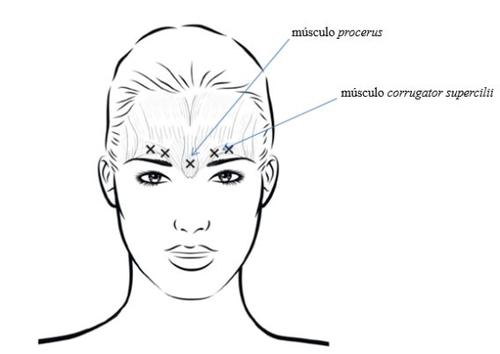
Las inyecciones se deben administrar con cuidado para evitar una inyección intravascular. Antes de la inyección, se puede colocar con firmeza el dedo pulgar o índice bajo el arco superciliar para evitar el derrame del medicamento a esa zona. La aguja debe orientarse en dirección superior y medial.
En caso de tratamiento fallido un mes después de una sesión previa, es decir, en ausencia de una mejoría significativa respecto al inicio, se pueden considerar las siguientes estrategias:
- Análisis de las causas del fallo; p. ej. inyección en los músculos incorrectos, técnica de inyección, formación de anticuerpos neutralizantes de la toxina, dosis insuficiente
- Volver a evaluar si es apropiado el tratamiento con toxina botulínica tipo A
En ausencia de efectos secundarios no deseados como resultado de una sesión de tratamiento anterior, es posible iniciar otra sesión de tratamiento con un intervalo mínimo de tres meses entre las sesiones de tratamiento.
Procedimiento a seguir para la eliminación segura de los viales, las jeringas y los materiales usados
Para la eliminación segura, Letybo sin reconstituir debe reconstituirse en el vial con una pequeña cantidad de agua y, después, esterilizarse con autoclave. Los viales vacíos, viales que contengan restos de la solución, jeringas o vertidos se deben esterilizar con autoclave. Como alternativa, el Letybo restante se puede inactivar con una solución de hidróxido de sodio diluida (0,1 N NaOH) o con una solución de hipoclorito de sodio diluida (0,5 % o 1 % NaOCl).
Tras la inactivación, los viales, jeringas y materiales usados no deben vaciarse y deben desecharse en contenedores apropiados y eliminarse de acuerdo con las normativas locales.
Recomendaciones en caso de que se produjera algún incidente durante la manipulación de toxina botulínica
- Cualquier vertido del producto se debe recoger: con material absorbente impregnado con una solución de hipoclorito de sodio en el caso del polvo, o con material absorbente seco en el caso del producto reconstituido.
- Las superficies contaminadas deben limpiarse con material absorbente impregnado con una solución de hipoclorito de sodio y, a continuación, secarse.
- Si se rompe un vial, proceda de la forma indicada anteriormente recogiendo con cuidado los pedazos de cristal roto y limpiando el producto. Evite hacerse cortes en la piel.
- Si el medicamento entra en contacto con la piel, lave la zona afectada con una solución de hipoclorito de sodio y enjuáguela con abundante agua.
- Si el medicamento entra en contacto con los ojos, lávelos concienzudamente con abundante agua o con una solución oftálmica para lavado de ojos.
Si el medicamento entra en contacto con una herida o piel cortada o lacerada, lávela concienzudamente con abundante agua y tome las medidas médicas adecuadas conforme a la dosis inyectada.
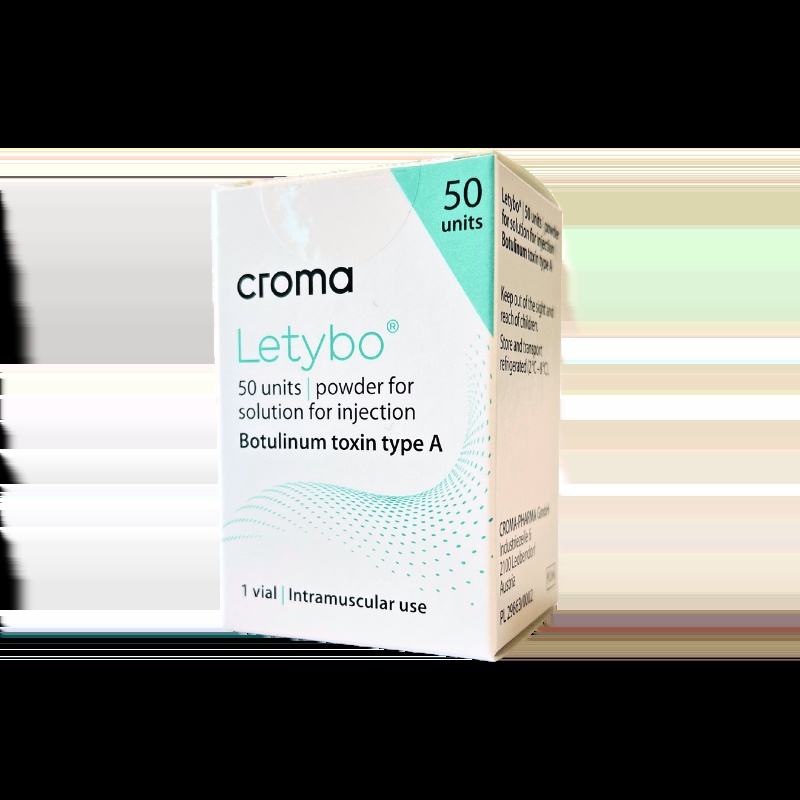
- País de registro
- Forma farmacéuticaINYECTABLE, 50 U
- Código ATCM03AX01
- Principio activo
- Requiere recetaSí
- Fabricante
- ComposiciónCLORURO DE SODIO (0,45 mg mg)
- Esta información es de carácter general y no sustituye la consulta con un profesional sanitario.
- Alternativas a LETYBO 50 UNIDADES POLVO PARA SOLUCION INYECTABLEForma farmacéutica: INYECTABLE, 200 U/mlPrincipio activo: Botulinum toxinFabricante: Ipsen PharmaRequiere recetaForma farmacéutica: INYECTABLE, 125 Unidades SpeywoodPrincipio activo: Botulinum toxinFabricante: Ipsen Pharma S.A.U.Requiere recetaForma farmacéutica: INYECTABLE, 100 unidadesPrincipio activo: Botulinum toxinFabricante: Merz Pharmaceuticals GmbhRequiere receta
Médicos online para LETYBO 50 UNIDADES POLVO PARA SOLUCION INYECTABLE
Comenta la dosis, los posibles efectos secundarios, interacciones, contraindicaciones o la revisión de receta de LETYBO 50 UNIDADES POLVO PARA SOLUCION INYECTABLE, sujeto a valoración médica y a la normativa local.









Obtén una receta de LETYBO 50 UNIDADES POLVO PARA SOLUCION INYECTABLE online
Rellena un formulario de 2 minutos
Cuéntanos tus síntomas, historial y el medicamento que necesitas.
Elige un médico o nosotros te asignamos uno
Escoge un especialista o te conectamos con el próximo médico disponible.
El médico revisa tu caso
Normalmente en 30 minutos. Puede hacerte preguntas adicionales por chat.
Recógela en cualquier farmacia
Receta electrónica enviada a tu correo, válida en toda España.
Preguntas frecuentes
LETYBO 50 UNIDADES POLVO PARA SOLUCION INYECTABLE requiere receta en España. Puedes confirmarlo con un médico online según tu caso.
El principio activo de LETYBO 50 UNIDADES POLVO PARA SOLUCION INYECTABLE es Botulinum toxin. Esta información ayuda a identificar medicamentos con la misma composición pero con diferentes nombres comerciales.
LETYBO 50 UNIDADES POLVO PARA SOLUCION INYECTABLE es fabricado por Croma-Pharma Gmbh. La marca y el envase pueden variar según el distribuidor.
Los Médicos de familia, Psiquiatras, Dermatólogos, Cardiólogos, Endocrinólogos, Gastroenterólogos, Neumólogos, Nefrólogos, Reumatólogos, Hematólogos, Infectólogos, Alergólogos, Geriatras, Pediatras, Oncólogos pueden valorar la prescripción de LETYBO 50 UNIDADES POLVO PARA SOLUCION INYECTABLE cuando esté clínicamente indicado. Puedes reservar una videoconsulta para comentar tu caso y las opciones de tratamiento.
España cuenta con una infraestructura sanitaria bien desarrollada en ciudades principales como Madrid, Barcelona, Valencia y Sevilla. Las farmacias están ampliamente disponibles y operan bajo estrictas regulaciones, garantizando el acceso a medicamentos con receta.
Puedes comprar LETYBO 50 UNIDADES POLVO PARA SOLUCION INYECTABLE en Madrid, Barcelona, Sevilla o Valencia en cualquier farmacia local con una receta válida.
Para obtener una receta, puedes utilizar Oladoctor:
Otros medicamentos con el mismo principio activo (Botulinum toxin) incluyen ALLUZIENCE 200 UNIDADES SPEYWOOD/ML SOLUCION INYECTABLE, AZZALURE 125 UNIDADES SPEYWOOD POLVO PARA SOLUCION INYECTABLE, BOCOUTURE 100 UNIDADES POLVO PARA SOLUCION INYECTABLE. Pueden tener diferentes nombres comerciales o formulaciones, pero contienen el mismo componente terapéutico. Consulta siempre con un médico antes de cambiar o iniciar un nuevo medicamento.
