



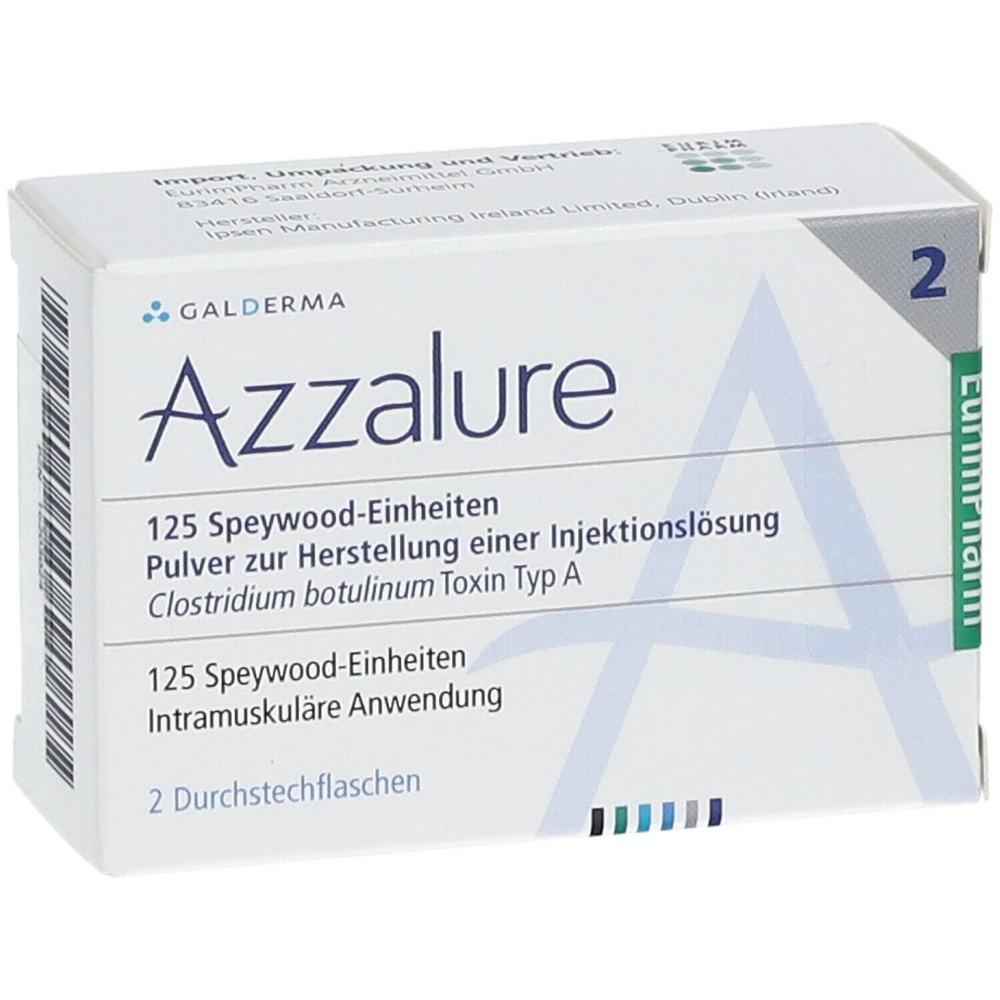
AZZALURE 125 units SPEYWOOD Injectable solution

Prescription review online
A doctor will review your case and decide whether a prescription is medically appropriate.

Talk to a doctor about this medicine
Discuss your symptoms and possible next steps in a quick online consultation.



How to use AZZALURE 125 units SPEYWOOD powder for injectable solution
Contents of the leaflet
- Introduction
- What Azzalure is and what it is used for
- What you need to know before using Azzalure
- How to use Azzalure
- Possible side effects
- Storage of Azzalure
- Further information
Introduction
Patient Information Leaflet: Information for the User
Azzalure, 125 Units Speywood, Powder for Solution for Injection
(Botulinum Toxin Type A)
Read all of this leaflet carefully before you start using this medicine because it contains important information for you.for you.
- Keep this leaflet, you may need to read it again.
- If you have any further questions, ask your doctor.
- If you experience any side effects, talk to your doctor, even if they are not listed in this leaflet. See section 4.
Contents of the Pack
- What Azzalure is and what it is used for
- What you need to know before you use Azzalure
- How to use Azzalure
- Possible side effects
- Storage of Azzalure
- Contents of the pack and other information
1. What Azzalure is and what it is used for
Azzalure contains a substance, botulinum toxin type A, that causes muscles to relax. Azzalure acts on the connection between nerves and muscles, blocking the release of a chemical messenger called acetylcholine at the nerve endings. This phenomenon prevents muscle contraction. Muscle relaxation is temporary and gradually recovers.
Some people feel unwell when wrinkles appear on their face. Azzalure can be used in adults under 65 years of age for the temporary improvement of the appearance of glabellar lines (vertical expression lines between the eyebrows) and lateral canthal lines (crow's feet), moderate or severe.

Not sure if this medicine is right for you?
Discuss your symptoms and treatment with a doctor online.
2. What you need to know before using Azzalure
Do not use Azzalure:
- if you are allergic to botulinum toxin type A or any of the other ingredients of this medicine (listed in section 6).
- if you have an infection at the site where you plan to inject.
- if you have severe myasthenia gravis, Eaton-Lambert syndrome, or amyotrophic lateral sclerosis.
Warnings and precautions
Talk to your doctor before starting to use Azzalure:
- if you have any neuromuscular disorder or defect.
- if you often have difficulty swallowing (dysphagia).
- if you often have problems with food or drink entering your airways, causing choking or coughing.
- if you have any inflammation at the proposed injection site.
- if the muscles where you will be injected are weak.
- if you have any bleeding disorder, which means you may bleed more than normal, such as hemophilia (a hereditary bleeding disorder caused by a deficiency of a clotting factor).
- if you have had or will have facial surgery or other surgery soon.
- if you have already been injected with other botulinum toxin injections.
- if after your last treatment with botulinum toxin, you did not experience any improvement in your glabellar lines.
This information will help your doctor make a decision about the risks and benefits of your treatment.
When you receive treatment with Azzalure, your eyes may become dry. Azzalure can cause your eyes to blink less frequently or produce fewer tears, which could damage the surface of your eyes.
Special precautions:
Very rarely, botulinum toxin produces a muscle weakness effect in areas of the body away from the injection site.
When botulinum toxin has been used at more frequent intervals of 12 weeks or at higher doses to treat other conditions, it has been observed very rarely that antibodies are produced. The formation of neutralizing antibodies can reduce the effectiveness of treatment.
If you go to the doctor for any reason, make sure to inform them that you are being treated with Azzalure.
Children and adolescents
Azzalure is not indicated in subjects under 18 years of age.
Using Azzalure with other medicines
Tell your doctor if you are taking, have recently taken, or might take any other medicine, as Azzalure may affect other medicines, especially
- antibiotics to treat an infection (e.g., aminoglycosides such as gentamicin or amikacin) or
- other muscle relaxants.
Using Azzalure with food and drink
Azzalure injections can be given before or after eating or drinking.
Pregnancy and breastfeeding
You should not use Azzalure during pregnancy. Treatment with Azzalure is not recommended if you are breastfeeding. If you are pregnant or think you may be pregnant or if you are breastfeeding, consult your doctor before using any medicine.
Driving and using machines
You may experience blurred vision, muscle weakness, or temporary generalized weakness after treatment with Azzalure. If this happens, do not drive or use machines.
3. How to use Azzalure
Azzalure can only be administered by doctors with the appropriate qualification and experience in this treatment and who have the necessary equipment.
Your doctor will prepare and administer the injections. A vial of Azzalure should be used for a single patient and a single treatment session.
The recommended dose of Azzalure is:
- For glabellar lines: 50 units; 10 units will be administered at each of the 5 injection sites on the forehead, at the top of the nose, and the eyebrows.
- For lateral canthal lines: 60 units administered as 10 units at each of the 6 injection sites for both sides.
The units used in different botulinum toxin products are not the same. The Speywood units of Azzalure are not interchangeable with other botulinum toxin products.
The effect of treatment should be noticeable a few days after injection.
Your doctor will decide on the appropriate interval between each treatment with Azzalure. This interval should not be less than 12 weeks.
Azzalure is not indicated for patients under 18 years of age.
If you use more Azzalure than you should
If you receive more Azzalure than necessary, other muscles different from those treated may begin to weaken. This may not happen immediately. If these symptoms appear, inform your doctor as soon as possible.
In case of overdose or accidental administration, call the Toxicology Information Service, phone: 91 562 04 20 (indicating the medicine and the amount administered).

Started taking the medicine and have questions?
Discuss your symptoms and treatment with a doctor online.
4. Possible side effects
Like all medicines, Azzalure can cause side effects, although not everybody gets them.
Seek medical attention if:
- You have difficulty breathing, swallowing, or speaking.
- Your face swells or your skin turns red, or you have a rough rash with itching. You may be suffering an allergic reaction to Azzalure.
Tell your doctor if you experience any of these side effects:
For glabellar lines:
Very common (may affect more than 1 in 10 people)
- Redness, swelling, irritation, rash, itching, tingling, pain, discomfort, burning, or bruising at the injection site
- Headache
Common (may affect up to 1 in 10 people)
- Eyelid drooping, eye dryness, or decreased vision, eyelid swelling, tearing, dry eye, contraction of the muscles around the eye
- Temporary facial paralysis
Uncommon (may affect up to 1 in 100 people)
- Altered vision, blurred vision, or double vision
- Dizziness
- Itching, rash
- Allergic reactions
Rare (may affect up to 1 in 1,000 people)
- Itching and rough rash
- Alteration of eye movement
Frequency not known (cannot be estimated from the available data)
- Numbness
- Muscle mass loss
- Generalized weakness
- Fatigue
- Flu-like symptoms
For lateral canthal lines:
Common (may affect up to 1 in 10 people)
- Headache
- Eyelid swelling
- Bruising, itching, and swelling around the eyes
- Eyelid drooping
- Temporary facial paralysis
Uncommon (may affect up to 1 in 100 people)
- Dry eye
Frequency not known (cannot be estimated from the available data)
- Allergic reactions
- Numbness
- Muscle mass loss
- Generalized weakness
- Fatigue
- Flu-like symptoms
Usually, these side effects occur in the first week after injection and do not last long. Usually, they are mild to moderate.
Very rarely, side effects with botulinum toxin have been reported in muscles other than those at the injection site. These effects include excessive muscle weakness, difficulty swallowing, and a feeling of choking when swallowing (if liquids or food enter the airways when trying to swallow, respiratory problems such as pneumonia can occur). If this happens, inform your doctor immediately.
Reporting side effects:
If you experience any side effects, talk to your doctor, even if they are not listed in this leaflet. You can also report them directly through the Spanish Pharmacovigilance System for Human Use Medicines: https://www.notificaRAM.es. By reporting side effects, you can help provide more information on the safety of this medicine.
5. Storage of Azzalure
Keep Azzalure out of the sight and reach of children.
Your doctor should not use Azzalure after the expiry date stated on the label. The expiry date is the last day of the month stated.
Store Azzalure in a refrigerator (2°C - 8°C). Do not freeze.
Your doctor will dissolve Azzalure in a liquid solution for injection.
Once reconstituted, it has been shown to have chemical and physical stability for 24 hours between 2-8°C. From a microbiological point of view, unless the reconstitution method excludes the risk of microbial contamination, the medicinal product should be used immediately. In the case that it is not used immediately, the time and conditions of storage after reconstitution are the responsibility of the user.
6. Further information
Composition of Azzalure
- The active substance is botulinum toxin type A*. One vial contains 125 Speywood units.
- The other ingredients are human albumin 200g/L and lactose monohydrate.
*Botulinum toxin type A from Clostridium botulinum(a bacterium) - hemagglutinin complex.
The Speywood units of Azzalure are specific to the product and are not interchangeable with other treatments containing botulinum toxin.
Appearance and pack contents
Azzalure is a powder for solution for injection. The pack is 1 or 2 vials.
Azzalure is a white powder.
Marketing authorisation holder and manufacturer
Marketing authorisation holder:
Ipsen Pharma, S.A.U. Gran Via de les Corts Catalanes 130-136. 08038, Barcelona - Spain
Local representative:
Laboratorios Galderma SA
Serrano Galvache, 56. 28033 Madrid - Spain
Tel: 902 02 75 95
Manufacturer:
Ipsen Manufacturing Ireland Limited
Blanchardstown Industrial Park
Blanchardstown, Dublin 15, Ireland
This leaflet was approved in February 2025.
If you want to obtain more information or are interested in the leaflet in a different format, contact Laboratorios Galderma SA, tel. 902 02 75 95.
Detailed and updated information on this medicine is available on the website of the Spanish Agency for Medicines and Health Products (AEMPS) http://www.aemps.gob.es/.
-----------------------------------------------------------------------------------------------------------------
This information is intended only for healthcare professionals:
Dosage and administration:
See section 3 of the Patient Information Leaflet.
Special precautions for disposal and other handling
Instructions for use, handling, and disposal should be strictly followed.
Reconstitution should be performed in accordance with good practice guidelines, especially respecting aseptic conditions.
Azzalure should be reconstituted with a 9 mg/ml (0.9%) sodium chloride injection solution.
In the dilution table below, the amount of 9 mg/ml (0.9%) sodium chloride injection solution required to be placed in a syringe to obtain a clear and colorless reconstituted solution with the following concentrations is indicated:
Amount of solvent added (sodium chloride 0.9% solution) for a vial of 125 U | Resulting dose |
0.63 ml 1.25 ml | 10 U for 0.05 ml 10 U for 0.1 ml |
To measure exactly 0.63 ml or 1.25 ml, a graduated syringe in increments of 0.1 ml and 0.01 ml will be used.
RECOMMENDATIONS FOR THE DISPOSAL OF CONTAMINATED MATERIALS
Immediately after use and before disposal, the reconstituted Azzalure solution (in the vial or syringe) that has not been used should be inactivated with 2 ml of 0.55% or 1% sodium hypochlorite solution (Dakin's solution).
The vials, syringes, and materials used should not be emptied but should be placed in suitable containers and disposed of according to local procedures.
RECOMMENDATIONS IN CASE OF ACCIDENT DURING HANDLING OF BOTULINUM TOXIN
- Any remaining product should be cleaned with an absorbent material soaked in a sodium hypochlorite solution (bleach), if it is the powder, or with a dry absorbent material, if it is the reconstituted product.
- Contaminated surfaces should be cleaned with an absorbent material soaked in a sodium hypochlorite solution (bleach) and then dried.
- If a vial breaks, proceed as mentioned above, carefully collecting the glass fragments and cleaning the product, avoiding cuts with the broken glass.
- If the product comes into contact with the skin, wash the affected area with a sodium hypochlorite solution (bleach) and rinse with plenty of water.
- If the product comes into contact with the eyes, clean them carefully with plenty of water or with an eye cleaning solution.
- If the product comes into contact with a wound, cut, or broken skin, clean it carefully with plenty of water and take appropriate medical measures according to the dose injected.
These instructions for use, handling, and disposal should be strictly followed.
- Country of registration
- Dosage formINJECTABLE, 125 Speywood Units
- ATC codeM03AX01
- Active substance
- Prescription requiredYes
- Manufacturer
- CompositionLACTOSA MONOHIDRATO (2,5 mg mg)
- This information is for reference only and does not constitute medical advice. Always consult a doctor before taking any medication. Oladoctor is not responsible for medical decisions based on this content.
- Alternatives to AZZALURE 125 units SPEYWOOD powder for injectable solutionDosage form: INJECTABLE, 200 U/mlActive substance: botulinum toxinManufacturer: Ipsen PharmaPrescription requiredDosage form: INJECTABLE, 100 unitsActive substance: botulinum toxinManufacturer: Merz Pharmaceuticals GmbhPrescription requiredDosage form: INJECTABLE, 4 units/ 0.1 mlActive substance: botulinum toxinManufacturer: Merz Pharmaceuticals GmbhPrescription required
Online doctors for AZZALURE 125 units SPEYWOOD powder for injectable solution
Discuss questions about AZZALURE 125 units SPEYWOOD powder for injectable solution, including use, safety considerations and prescription review, subject to medical assessment and local regulations.









Get AZZALURE 125 units SPEYWOOD powder for injectable solution Prescription Online
Fill in a 2-min form
Tell us your symptoms, history, and what medicine you're requesting.
Pick a doctor or let us assign
Choose a specialist or we'll match you with the next available doctor.
Doctor reviews your case
Usually within 30 minutes. They may ask follow-up questions via chat.
Collect from any pharmacy
Electronic prescription sent to your email — valid across Spain.
Frequently Asked Questions
AZZALURE 125 units SPEYWOOD powder for injectable solution requires a prescription in Spain. You can check with a doctor online whether this medicine may be appropriate for your situation.
The active ingredient in AZZALURE 125 units SPEYWOOD powder for injectable solution is botulinum toxin. This information helps identify medicines with the same composition but different brand names.
AZZALURE 125 units SPEYWOOD powder for injectable solution is manufactured by Ipsen Pharma S.A.U.. Pharmacy brands and packaging may differ depending on the distributor.
Doctors such as Family doctors, Psychiatrists, Dermatologists, Cardiologists, Endocrinologists, Gastroenterologists, Pulmonologists, Nephrologists, Rheumatologists, Hematologists, Infectious disease physicians, Allergists, Geriatricians, Paediatricians, Oncologists may assess whether AZZALURE 125 units SPEYWOOD powder for injectable solution is appropriate, depending on your situation and local regulations. You can book an online consultation to discuss your symptoms and possible next steps.
Spain has a well-developed healthcare infrastructure across major cities such as Madrid, Barcelona, Valencia, and Seville. Pharmacies are widely available and operate under strict regulations, ensuring access to prescribed medications.
You can buy AZZALURE 125 units SPEYWOOD powder for injectable solution in Madrid, Barcelona, Seville, or Valencia at any local pharmacy with a valid prescription.
To obtain a prescription, you can use Oladoctor:
Other medicines with the same active substance (botulinum toxin) include ALLUZIENCE 200 Units/mL Injectable Solution, BOCOUTURE 100 units powder for injectable solution, BOCOUTURE 50 units powder for injectable solution. These may have different brand names or formulations but contain the same therapeutic ingredient. Always consult a doctor before switching or starting a new medicine.
