



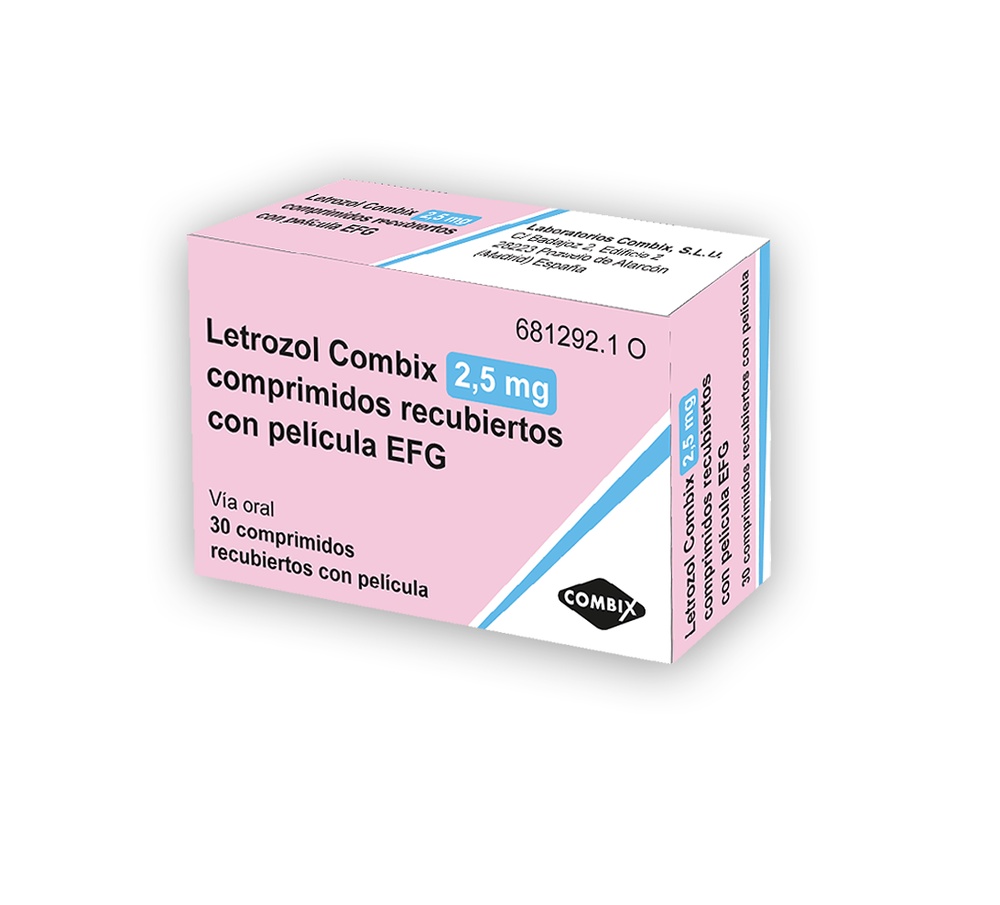
LETROZOL 2,5 mg Comprimidos recubiertos con película

Revisión de receta online
Un médico revisará tu caso y determinará si la prescripción es médicamente apropiada.

Habla con un médico sobre este medicamento
Comenta tus síntomas y las opciones de tratamiento en una consulta online.



Cómo usar LETROZOL COMBIX 2,5 mg COMPRIMIDOS RECUBIERTOS CON PELICULA EFG
Contenido del prospecto
- Introducción
- Qué es Letrozol Combix y para qué se utiliza
- Qué necesita saber antes de empezar a tomar Letrozol Combix
- Cómo tomar Letrozol Combix
- Posibles efectos adversos
- Conservación de Letrozol Combix
- Contenido del envase e información adicional
Introducción
Prospecto: información para el paciente
Letrozol Combix 2,5 mg comprimidos recubiertos con película EFG
Lea todo el prospecto detenidamente antes de empezar a tomar este medicamento, porque contiene información importante para usted.
- Conserve este prospecto, ya que puede tener que volver a leerlo.
- Si tiene alguna duda, consulte a su médico o farmacéutico.
- Este medicamento se le ha recetado solamente a usted y no debe dárselo a otras personas, aunque tengan los mismos síntomas que usted, ya que puede perjudicarles.
- Si experimenta efectos adversos, consulte a su médico o farmacéutico, incluso si se trata de efectos adversos que no aparecen en este prospecto. Ver sección 4.
Contenido del prospecto
- Qué es Letrozol Combix y para qué se utiliza
- Qué necesita saber antes de empezar a tomar Letrozol Combix
- Cómo tomar Letrozol Combix
- Posibles efectos adversos
- Conservación de Letrozol Combix
- Contenido del envase e información adicional
1. Qué es Letrozol Combix y para qué se utiliza
Qué es Letrozol Combix y cómo actúa
Letrozol Combix contiene un principio activo denominado letrozol. Pertenece a un grupo de medicamentos denominados inhibidores de la aromatasa. Es un tratamiento hormonal (o “endocrino”) del cáncer de mama. El crecimiento del cáncer de mama está estimulado habitualmente por estrógenos, que son las hormonas sexuales femeninas. Letrozol Combix reduce la cantidad de estrógeno mediante el bloqueo de una enzima (“aromatasa”) implicada en la producción de estrógenos y por tanto puede bloquear el crecimiento de cánceres de mama que necesitan los estrógenos para crecer. Como consecuencia, las células del tumor crecen de forma más lenta o bien paran el crecimiento y/o la extensión a otras partes del cuerpo.
Para qué se utiliza Letrozol Combix
Letrozol Combix se utiliza para tratar el cáncer de mama en mujeres que han pasado la menopausia, es decir el cese de los periodos menstruales.
Se utiliza para prevenir que el cáncer de mama aparezca de nuevo. Se puede utilizar como el primer tratamiento antes de la cirugía de cáncer de mama, en caso que no sea adecuada la cirugía de forma inmediata, o se puede utilizar como primer tratamiento después de la cirugía de cáncer de mama, o después de cinco años de tratamiento con tamoxifeno. Letrozol Combix también se utiliza para prevenir que el tumor de mama se extienda a otras partes del cuerpo en pacientes con un cáncer de mama avanzado.
Si tiene alguna pregunta sobre cómo actúa Letrozol Combix o el motivo por el que le han recetado este medicamento, consulte con su médico.

¿No estás seguro de si este medicamento es adecuado para ti?
Comenta tus síntomas y tratamiento con un médico online.
2. Qué necesita saber antes de empezar a tomar Letrozol Combix
Siga cuidadosamente todas las instrucciones de su médico. Pueden ser diferentes de la información general contenida en este prospecto.
No tome Letrozol Combix
- si es alérgico a letrozol o a cualquiera de los demás componentes de este medicamento (incluidos en la sección 6),
- si todavía tiene ciclos menstruales, es decir, no ha llegado a la menopausia,
- si está embarazada,
- si está en periodo de lactancia.
Si alguno de estos casos es aplicable a usted, no tome este medicamento e informe a su médico.
Advertencias y precauciones
Consulte a su médico o farmacéutico antes de empezar a tomar Letrozol Combix
- si sufre una enfermedad grave del riñón,
- si sufre una enfermedad grave del hígado,
- si tiene antecedentes de osteoporosis o fracturas de huesos (ver también “Control del tratamiento con Letrozol Combix” en la sección 3).
Si alguno de estos casos es aplicable a usted, informe a su médico. Su médico lo tendrá en cuenta durante su tratamiento con Letrozol Combix.
Niños y adolescentes (menores de 18 años)
Los niños y adolescentes no deben utilizar este medicamento.
Pacientes de edad avanzada (a partir de 65 años)
Las personas a partir de 65 años pueden utilizar este medicamento a la misma dosis que para los adultos.
Toma de Letrozol Combix con otros medicamentos
Informe a su médico o farmacéutico si está tomando, ha tomado recientemente o podría tener que tomar cualquier otro medicamento.
Embarazo, lactancia y fertilidad
Si está embarazada o en periodo de lactancia, cree que podría estar embarazada o tiene intención de quedarse embarazada, consulte a su médico o farmacéutico antes de utilizar este medicamento.
- Sólo debe tomar Letrozol Combix si ha pasado la etapa de la menopausia. Sin embargo, su médico deberá comentar con usted el uso de una anticoncepción eficaz, puesto que todavía podría quedarse embarazada durante el tratamiento con Letrozol Combix.
- No debe tomar Letrozol Combix si está embarazada o en periodo de lactancia ya que puede dañar a su bebé.
Conducción y uso de máquinas
Si se siente mareada, cansada, si tiene somnolencia o no se siente bien, no conduzca ni maneje herramientas o máquinas hasta que se sienta bien de nuevo.
Letrozol Combixcontiene lactosa. Si su médico le ha indicado que padece una intolerancia a ciertos azúcares, consulte con él antes de tomar este medicamento.
Uso en deportistas
Este medicamento contiene letrozol que puede producir un resultado positivo en las pruebas de control de dopaje.
El letrozol puede causar inflamación de los tendones o lesiones en los tendones (ver sección 4). Ante cualquier signo de dolor o inflamación de los tendones, ponga en reposo la zona dolorosa y póngase en contacto con su médico.
3. Cómo tomar Letrozol Combix
Siga exactamente las instrucciones de administración de este medicamento indicadas por su médico o farmacéutico. En caso de duda, consulte de nuevo a su médico o farmacéutico.
La dosis recomendada es de un comprimido de Letrozol Combix una vez al día. Si toma Letrozol Combix a la misma hora cada día, le ayudará a recordar cuándo debe tomar el comprimido.
El comprimido se puede tomar con o sin comida y se debe tragar entero con un vaso de agua u otro líquido.
Durante cuánto tiempo tomarLetrozol Combix
Continúe tomando Letrozol Combix cada día durante el tiempo que le indique su médico. Puede necesitar tomarlo durante meses o incluso años. Si tiene alguna duda sobre cuánto tiempo debe tomar Letrozol Combix, consulte a su médico.
Control del tratamiento con Letrozol Combix
Sólo debe tomar este medicamento bajo un estricto control médico. Su médico va a controlar periódicamente su situación para comprobar que el tratamiento tiene el efecto adecuado.
Letrozol Combix puede ocasionar una disminución del grosor del hueso o una pérdida de hueso (osteoporosis) debido a la disminución de estrógenos en el cuerpo. Su médico puede decidir realizar medidas de la densidad de hueso (una manera de controlar la osteoporosis) antes, durante y después del tratamiento.
Si toma másLetrozol Combixdel que debe
Si ha tomado demasiados comprimidos de Letrozol Combix, o si accidentalmente otra persona ha tomado los comprimidos, contacte con su médico o acuda al hospital inmediatamente. Muéstreles el envase de los comprimidos. Puede ser que necesite tratamiento médico. También puede llamar al Servicio de Información Toxicológica, teléfono: 915620420, indicando el medicamento y la cantidad tomada.
Si olvidó tomarLetrozol Combix
- Si es casi la hora del siguiente comprimido (p.ej. faltan 2 ó 3 horas), no tome la dosis que olvidó y tome la siguiente dosis a la hora que le tocaba.
- De lo contrario, tome la dosis tan pronto como lo recuerde, y tome después el siguiente comprimido como lo haría normalmente.
- No tome una dosis doble para compensar las dosis olvidadas.
Si interrumpe el tratamiento conLetrozol Combix
No deje de tomar Letrozol Combix a menos que se lo diga su médico. Ver también la sección “Durante cuánto tiempo tomar Letrozol Combix”.
Si tiene cualquier otra duda sobre el uso de este medicamento, pregunte a su médico o farmacéutico.

¿Has empezado a tomar el medicamento y tienes preguntas?
Comenta tus síntomas y tratamiento con un médico online.
4. Posibles efectos adversos
Al igual que todos los medicamentos, este medicamento puede producir efectos adversos, aunque no todas las personas los sufran.
La mayoría de los efectos adversos son leves a moderados y generalmente desaparecen después de pocos días o pocas semanas de tratamiento.
Algunos de estos efectos adversos, como los sofocos, la pérdida de cabello o las hemorragias vaginales, pueden ser debidos a la falta de estrógenos.
No se alarme por esta lista de posibles efectos adversos. Puede ser que no experimente ninguno de ellos.
Algunos efectos adversos pueden ser graves:
Efectos adversos raros o poco frecuentes(es decir, pueden afectar a 1 a 100 de cada 10.000 pacientes):
- Debilidad, parálisis o pérdida de sensibilidad en alguna parte del cuerpo (particularmente brazo o pierna), pérdida de coordinación, náuseas, o dificultad al hablar o respirar (signo de una alteración en el cerebro, p. ej., accidente cerebrovascular).
- Dolor opresivo y de aparición repentina en el pecho (signo de alteración del corazón).
- Dificultad para respirar, dolor en el pecho, desvanecimiento, ritmo cardiaco rápido, coloración azulada de la piel, o dolor repentino en el brazo, la pierna o el pie (signos de que se ha formado un coágulo en la sangre).
- Hinchazón y enrojecimiento en una vena que es extremadamente blanda y posiblemente dolorosa al tocarla.
- Fiebre grave, resfriado o úlceras en la boca debidas a infecciones (falta de glóbulos blancos).
- Visión borrosa grave de forma continuada.
- Rotura de un tendón (tejido conjuntivo que conecta los músculos con los huesos).
Si se encuentra en alguno de los casos anteriores, informe a su médico inmediatamente.
También debe informar a su médico inmediatamente si presenta alguno de los siguientes síntomas durante el tratamiento con Letrozol Combix:
- Hinchazón principalmente en la cara y la garganta (signos de reacción alérgica).
- Color amarillo en la piel y los ojos, náuseas, pérdida de apetito, oscurecimiento del color de la orina (signos de hepatitis).
- Erupción, enrojecimiento de la piel, ampollas en los labios, ojos o boca, descamación de la piel, fiebre (signos de alteración de la piel).
Algunos efectos adversos son muy frecuentes.Estos efectos adversos pueden afectar más de 10 de cada 100 pacientes.
- Sofocos.
- Nivel elevado de colesterol (hipercolesterolemia).
- Fatiga
- Aumento de sudoración.
- Dolor en los huesos y articulaciones (artralgia).
Si alguno de estos efectos le afecta de forma grave, consulte con su médico.
Algunos efectos adversos son frecuentes. Estos efectos adversos puedenafectar de 1 a 10 de cada 100 pacientes.
- Erupción en la piel.
- Dolor de cabeza.
- Mareo.
- Malestar general.
- Trastornos gastrointestinales como náuseas, vómitos, indigestión, estreñimiento, diarrea.
- Aumento o disminución del apetito.
- Dolor muscular.
- Adelgazamiento o pérdida de huesos (osteoporosis), que provoca fracturas en los huesos en algunos casos (ver también la sección “Control del tratamiento con Letrozol Combix en la sección 3”).
- Hinchazón de brazos, manos, pies, tobillos (edema).
- Depresión.
- Aumento de peso.
- Pérdida de cabello.
- Aumento de la presión arterial (hipertensión).
- Dolor abdominal.
- Sequedad de la piel.
- Hemorragia vaginal.
- Palpitaciones, frecuencia cardiaca rápida.
- Rigidez articular (artritis).
- Dolor torácico.
Si alguno de estos le afecta a usted de forma grave, informe a su médico.
Algunos efectos adversos son poco frecuentes.Estos efectos adversos pueden afectar de 1 a 10 de cada 1.000 pacientes.
- Trastornos nerviosos como ansiedad, nerviosismo, irritabilidad, adormecimiento, problemas de memoria, somnolencia, insomnio.
- Problemas de sensibilidad, especialmente en el tacto.
- Alteraciones de los ojos como visión borrosa, irritación de los ojos.
- Trastornos en la piel como picor (urticaria).
- Descargas o sequedad vaginal.
- Dolor en los pechos.
- Fiebre.
- Sed, trastorno del gusto, sequedad de la boca.
- Sequedad de las membranas mucosas.
- Disminución del peso.
- Infección del tracto urinario, aumento de la frecuencia para orinar.
- Tos.
- Aumento del nivel de enzimas.
- Coloración amarillenta de la piel y los ojos.
- Niveles sanguíneos elevados de bilirrubina (un producto de la descomposición de los glóbulos rojos).
- Tendinitis o inflamación de un tendón (tejido conjuntivo que conecta los músculos con los huesos).
Si alguno de estos le afecta a usted de forma grave, informe a su médico.
Comunicación de efectos adversos
Si experimenta cualquier tipo de efecto adverso, consulte a su médico o farmacéutico, incluso si se trata de posibles efectos adversos que no aparecen en este prospecto. También puede comunicarlos directamente a través del Sistema Español de Farmacovigilancia de Medicamentos de Uso Humano: https:// www.notificaram.es. Mediante la comunicación de efectos adversos usted puede contribuir a proporcionar más información sobre la seguridad de este medicamento.
5. Conservación de Letrozol Combix
Mantener este medicamento fuera de la vista y del alcance de los niños.
No utilice este medicamento después de la fecha de caducidad que aparece en el envase después de “CAD”. La fecha de caducidad es el último día del mes que se indica.
No conservar a temperatura superior a 30ºC. Conservar en el embalaje original para protegerlo de la humedad.
No utilice ningún envase que esté dañado o muestre signos de manipulación.
Los medicamentos no se deben tirar por los desagües ni a la basura. Deposite los envases y los medicamentos que no necesita en el Punto SIGRE de la farmacia. En caso de duda pregunte a su farmacéutico cómo deshacerse de los envases y de los medicamentos que no necesita. De esta forma ayudará a proteger el medio ambiente.
6. Contenido del envase e información adicional
Composición deLetrozol Combix
- El principio activo es letrozol. Cada comprimido recubierto con película contiene 2,5 mg de letrozol.
- Los demás componentes (excipientes) son: lactosa monohidrato (lactosa), celulosa microcristalina (E460i), carboximetilalmidón sódico de patata (almidón de patata), almidón de maíz, sílice coloidal anhidra (E551), estearato de magnesio (E470b). El recubrimiento se compone de hipromelosa (E464), dióxido de titanio (E171) y macrogol (E1521).
Aspecto de Letrozol Combix y contenido del envase
- Letrozol Combix se presenta como comprimidos recubiertos con película. Los comprimidos son de color blanco, redondos, biconvexos, marcados con “ZF5” por una cara y lisos por la otra.
- Cada envase con blísteres contiene 30 comprimidos recubiertos con película.
Titular de la autorización de comercialización y responsable de la fabricación
Titular de la autorización de comercialización
Laboratorios Combix, S.L.U.
C/ Badajoz 2, Edificio 2
28223 Pozuelo de Alarcón (Madrid)
España
Responsable de la fabricación
Zydus France
ZAC Les Hautes Patures
Parc d'activités des Peupliers
25 Rue des Peupliers
92000 Nanterre
Francia
ó
Centre Spécialités Pharmaceutiques
ZAC des Suzots
35 rue de la Chapelle
63450 Saint Amant Tallende
Francia
Fecha de la última revisión de este prospecto: Agosto 2019
La información detallada y actualizada de este medicamento está disponible en la página Web de la Agencia Española de Medicamentos y Productos Sanitarios (AEMPS) http://www.aemps.gob.es/.
- País de registro
- Forma farmacéuticaCOMPRIMIDO, 2,5 mg/comprimido recubierto con película
- Código ATCL02BG04
- Precio medio en farmacia92.1 EUR
- Principio activo
- Requiere recetaSí
- Fabricante
- ComposiciónLACTOSA MONOHIDRATO (75,800 mg mg), CARBOXIMETILALMIDON SODICO (5,000 mg mg), CARBOXIMETILALMIDON SODICO (2,000 mg mg)
- Esta información es de carácter general y no sustituye la consulta con un profesional sanitario.
- Alternativas a LETROZOL COMBIX 2,5 mg COMPRIMIDOS RECUBIERTOS CON PELICULA EFGForma farmacéutica: COMPRIMIDO, 2.5 mg de letrozolPrincipio activo: letrozolFabricante: Novartis Farmaceutica S.A.Requiere recetaForma farmacéutica: COMPRIMIDO, 2.5 mgPrincipio activo: letrozolFabricante: Gp Pharm S.A.Requiere recetaForma farmacéutica: COMPRIMIDO, 2.5 MGPrincipio activo: letrozolFabricante: Accord Healthcare S.L.U.Requiere receta
Médicos online para LETROZOL COMBIX 2,5 mg COMPRIMIDOS RECUBIERTOS CON PELICULA EFG
Comenta la dosis, los posibles efectos secundarios, interacciones, contraindicaciones o la revisión de receta de LETROZOL COMBIX 2,5 mg COMPRIMIDOS RECUBIERTOS CON PELICULA EFG, sujeto a valoración médica y a la normativa local.


Obtén una receta de LETROZOL COMBIX 2,5 mg COMPRIMIDOS RECUBIERTOS CON PELICULA EFG online
Rellena un formulario de 2 minutos
Cuéntanos tus síntomas, historial y el medicamento que necesitas.
Elige un médico o nosotros te asignamos uno
Escoge un especialista o te conectamos con el próximo médico disponible.
El médico revisa tu caso
Normalmente en 30 minutos. Puede hacerte preguntas adicionales por chat.
Recógela en cualquier farmacia
Receta electrónica enviada a tu correo, válida en toda España.
Preguntas frecuentes
LETROZOL COMBIX 2,5 mg COMPRIMIDOS RECUBIERTOS CON PELICULA EFG requiere receta en España. Puedes confirmarlo con un médico online según tu caso.
El principio activo de LETROZOL COMBIX 2,5 mg COMPRIMIDOS RECUBIERTOS CON PELICULA EFG es letrozol. Esta información ayuda a identificar medicamentos con la misma composición pero con diferentes nombres comerciales.
El precio medio en farmacia de LETROZOL COMBIX 2,5 mg COMPRIMIDOS RECUBIERTOS CON PELICULA EFG es de aproximadamente 92.1 EUR. Puede variar según el fabricante y la forma farmacéutica.
LETROZOL COMBIX 2,5 mg COMPRIMIDOS RECUBIERTOS CON PELICULA EFG es fabricado por Laboratorios Combix S.L.U.. La marca y el envase pueden variar según el distribuidor.
Los Médicos de familia, Psiquiatras, Dermatólogos, Cardiólogos, Endocrinólogos, Gastroenterólogos, Neumólogos, Nefrólogos, Reumatólogos, Hematólogos, Infectólogos, Alergólogos, Geriatras, Pediatras, Oncólogos pueden valorar la prescripción de LETROZOL COMBIX 2,5 mg COMPRIMIDOS RECUBIERTOS CON PELICULA EFG cuando esté clínicamente indicado. Puedes reservar una videoconsulta para comentar tu caso y las opciones de tratamiento.
España cuenta con una infraestructura sanitaria bien desarrollada en ciudades principales como Madrid, Barcelona, Valencia y Sevilla. Las farmacias están ampliamente disponibles y operan bajo estrictas regulaciones, garantizando el acceso a medicamentos con receta.
Puedes comprar LETROZOL COMBIX 2,5 mg COMPRIMIDOS RECUBIERTOS CON PELICULA EFG en Madrid, Barcelona, Sevilla o Valencia en cualquier farmacia local con una receta válida.
Para obtener una receta, puedes utilizar Oladoctor:
Otros medicamentos con el mismo principio activo (letrozol) incluyen FEMARA 2,5 mg COMPRIMIDOS RECUBIERTOS CON PELICULA, GALDAR 2,5 mg COMPRIMIDOS RECUBIERTOS CON PELICULA EFG, LETROZOL ACCORD 2,5 mg COMPRIMIDOS RECUBIERTOS CON PELICULA EFG. Pueden tener diferentes nombres comerciales o formulaciones, pero contienen el mismo componente terapéutico. Consulta siempre con un médico antes de cambiar o iniciar un nuevo medicamento.
