



FEMARA 2.5 mg Film-coated tablets

Prescription review online
A doctor will review your case and decide whether a prescription is medically appropriate.

Talk to a doctor about this medicine
Discuss your symptoms and possible next steps in a quick online consultation.



How to use FEMARA 2.5 mg FILM-COATED TABLETS
Contents of the leaflet
- Introduction
- What is Femara and what is it used for
- What you need to know before you take Femara
- How to take Femara
- Possible side effects
- Storage of Femara
- Contents of the pack and other information
Introduction
Package Leaflet: Information for the Patient
Femara 2.5mg film-coated tablets
letrozole
Read all of this leaflet carefully before you start taking this medicine because it contains important information for you.
- Keep this leaflet, you may need to read it again.
- If you have any further questions, ask your doctor, pharmacist, or nurse.
- This medicine has been prescribed for you only. Do not pass it on to others. It may harm them, even if their signs of illness are the same as yours.
- If you get any side effects, talk to your doctor, pharmacist, or nurse. This includes any possible side effects not listed in this leaflet. See section 4.
Contents of the pack
- What is Femara and what is it used for
- What you need to know before you take Femara
- How to take Femara
- Possible side effects
- Storage of Femara
- Contents of the pack and other information
1. What is Femara and what is it used for
What is Femara and how does it work
Femara contains the active substance letrozole. It belongs to a group of medicines called aromatase inhibitors. It is a hormonal (or "endocrine") treatment for breast cancer. The growth of breast cancer is often stimulated by estrogens, which are female sex hormones. Femara reduces the amount of estrogen by blocking an enzyme (aromatase) involved in estrogen production, and thus can block the growth of breast cancers that need estrogens to grow. As a result, tumor cells grow more slowly or stop growing and/or spreading to other parts of the body.
What is Femara used for
Femara is used to treat breast cancer in women who have gone through the menopause, i.e., the cessation of menstrual periods.
It is used to prevent breast cancer from coming back. It can be used as the first treatment before breast cancer surgery, if surgery is not immediately possible, or it can be used as the first treatment after breast cancer surgery, or after 5 years of treatment with tamoxifen. Femara is also used to prevent the breast tumor from spreading to other parts of the body in patients with advanced breast cancer.
If you have any questions about how Femara works or why you have been prescribed this medicine, ask your doctor.

Not sure if this medicine is right for you?
Discuss your symptoms and treatment with a doctor online.
2. What you need to know before you take Femara
Follow carefully all instructions given to you by your doctor. They may differ from the general information contained in this leaflet.
Do not take Femara
- if you are allergic to letrozole or any of the other ingredients of this medicine (listed in section 6),
- if you still have menstrual periods, i.e., you have not reached menopause,
- if you are pregnant,
- if you are breast-feeding.
If any of these conditions apply to you, do not take this medicine and tell your doctor.
Warnings and precautions
Tell your doctor, pharmacist, or nurse before you start taking Femara
- if you have severe kidney disease,
- if you have severe liver disease,
- if you have a history of osteoporosis or bone fractures (see also "Monitoring of Femara treatment" in section 3).
If any of these conditions apply to you, tell your doctor. Your doctor will take this into account during your treatment with Femara.
Letrozole may cause tendon inflammation or tendon damage (see section 4). If you experience any signs of pain or inflammation of the tendons, rest the affected area and contact your doctor.
Children and adolescents (under 18 years)
Children and adolescents should not use this medicine.
Older people (65 years and over)
People aged 65 and over can use this medicine at the same dose as for adults.
Taking Femara with other medicines
Tell your doctor or pharmacist that you are taking, have recently taken, or might take any other medicines, including those without a prescription.
Pregnancy, breast-feeding, and fertility
- You should only take Femara if you have gone through the menopause. However, your doctor should discuss with you the use of effective contraception, as you could still become pregnant during treatment with Femara.
- Do not take Femara if you are pregnant or breast-feeding, as it may harm your baby.
Driving and using machines
If you feel dizzy, tired, sleepy, or unwell, do not drive or operate tools or machines until you feel better.
Femara contains lactose
If your doctor has told you that you have an intolerance to some sugars, consult with them before taking this medicine.
Femara contains sodium
This medicine contains less than 1 mmol of sodium (23 mg) per tablet; this is essentially "sodium-free".
Use in athletes
This medicine contains letrozole, which may produce a positive result in doping tests.
3. How to take Femara
Follow exactly the instructions of administration of this medicine given to you by your doctor or pharmacist. In case of doubt, consult your doctor or pharmacist again.
The usual dose is one Femara tablet once a day. If you take Femara at the same time every day, it will help you remember when to take the tablet.
The tablet can be taken with or without food and should be swallowed whole with a glass of water.
How long to take Femara
Continue taking Femara every day for as long as your doctor tells you to. You may need to take it for months or even years. If you are unsure how long to take Femara, consult your doctor.
Monitoring of Femara treatment
You should only take this medicine under strict medical supervision. Your doctor will periodically check your condition to ensure that the treatment has the desired effect.
Femara may cause a decrease in bone density or bone loss (osteoporosis) due to the decrease in estrogen in the body. Your doctor may decide to perform bone density measurements (a way to check for osteoporosis) before, during, and after treatment.
If you take more Femara than you should
If you have taken too many Femara tablets, or if someone else has taken your tablets, contact your doctor or go to the hospital immediately. Show them the pack of tablets. You may need medical treatment. You can also call the Toxicology Information Service, phone: 915620420, stating the medicine and the amount taken.
If you forget to take Femara
- If it is almost time for your next dose (e.g., 2 or 3 hours), do not take the missed dose and take the next dose at the scheduled time.
- Otherwise, take the dose as soon as you remember, and then take the next dose as you would normally.
- Do not take a double dose to make up for a forgotten dose.
If you stop taking Femara
Do not stop taking Femara unless your doctor tells you to. See also the section "How long to take Femara".

Started taking the medicine and have questions?
Discuss your symptoms and treatment with a doctor online.
4. Possible side effects
Like all medicines, this medicine can cause side effects, although not everybody gets them.
Most side effects are mild to moderate and usually disappear after a few days or weeks of treatment.
Some of these side effects, such as hot flashes, hair loss, or vaginal bleeding, may be due to the lack of estrogen.
Do not be alarmed by this list of possible side effects. You may not experience any of them.
Some side effects can be serious:
Uncommon(may affect up to 1 in 100 people):
- Weakness, paralysis, or loss of sensation in a part of the body (especially arm or leg), loss of coordination, nausea, or difficulty speaking or breathing (sign of a brain disorder, e.g., stroke).
- Chest pain (sign of heart disorder).
- Swelling and redness in a vein that is extremely soft and possibly painful to the touch.
- Severe fever, cold, or mouth ulcers due to infections (lack of white blood cells).
- Severe blurred vision.
- Tendinitis or tendon inflammation (connective tissue that connects muscles to bones).
Rare(may affect up to 1 in 1,000 people):
- Difficulty breathing, chest pain, fainting, rapid heartbeat, bluish discoloration of the skin, or sudden pain in the arm, leg, or foot (signs that a blood clot has formed).
- Tendon rupture (connective tissue that connects muscles to bones).
If you experience any of these, tell your doctor immediately.
You should also tell your doctor immediately if you experience any of the following symptoms during treatment with Femara:
- Swelling mainly in the face and throat (signs of allergic reaction).
- Yellowing of the skin and eyes, nausea, loss of appetite, darkening of urine color (signs of hepatitis).
- Rash, redness of the skin, blisters on the lips, eyes, or mouth, skin peeling, fever (signs of skin disorder).
Some side effects are very common(may affect more than 1 in 10 people):
- Hot flashes
- High cholesterol (hypercholesterolemia)
- Fatigue
- Increased sweating
- Bone and joint pain (arthralgia)
If any of these side effects bother you seriously, talk to your doctor.
Some side effects are common(may affect up to 1 in 10 people):
- Skin rash
- Headache
- Dizziness
- General malaise
- Gastrointestinal disorders such as nausea, vomiting, indigestion, constipation, diarrhea
- Increased or decreased appetite
- Muscle pain
- Thinning or bone loss (osteoporosis), which can cause bone fractures in some cases (see also "Monitoring of Femara treatment" in section 3)
- Swelling of arms, hands, feet, ankles (edema)
- Depression
- Weight gain
- Hair loss
- High blood pressure (hypertension)
- Abdominal pain
- Dry skin
- Vaginal bleeding
- Palpitations, rapid heartbeat
- Joint stiffness (arthritis)
- Chest pain
If any of these side effects bother you seriously, talk to your doctor.
Some side effects are uncommon(may affect up to 1 in 100 people):
- Nervous system disorders such as anxiety, nervousness, irritability, numbness, memory problems, sleepiness, insomnia
- Pain or burning sensation in the hands or wrists (carpal tunnel syndrome)
- Sensitivity disorders, especially touch
- Eye disorders such as blurred vision, eye irritation
- Skin disorders such as itching (urticaria)
- Vaginal discharge or dryness
- Breast pain
- Fever
- Thirst, taste disorder, dry mouth
- Dryness of mucous membranes
- Weight loss
- Urinary tract infection, increased frequency of urination
- Cough
- Increased enzyme levels
- Yellowing of the skin and eyes
- High blood levels of bilirubin (a product of red blood cell breakdown)
Side effects with unknown frequency(cannot be estimated from the available data)
Trigger finger, a condition in which your finger or thumb gets stuck in a bent position.
If any of these side effects bother you seriously, talk to your doctor.
Reporting of side effects
If you experience any side effects, talk to your doctor, pharmacist, or nurse. This includes any possible side effects not listed in this leaflet. You can also report side effects directly through the Spanish Medicines Agency's website: www.notificaRAM.es. By reporting side effects, you can help provide more information on the safety of this medicine.
5. Storage of Femara
- Keep this medicine out of the sight and reach of children.
- Do not use this medicine after the expiry date which is stated on the carton after EXP. The expiry date refers to the last day of that month.
- Do not store above 30°C.
- Store in the original package to protect from moisture.
- Do not use any packaging that is damaged or shows signs of tampering.
- Medicines should not be disposed of via wastewater or household waste. Return any unused medicine to a pharmacy for disposal. Ask your pharmacist how to dispose of medicines no longer required. This will help protect the environment.
6. Contents of the pack and other information
Composition of Femara
- The active substance is letrozole. Each film-coated tablet contains 2.5 mg of letrozole.
- The other ingredients (excipients) are lactose monohydrate, microcrystalline cellulose, maize starch, sodium carboxymethylcellulose (type A) potato, magnesium stearate, anhydrous colloidal silica. The coating consists of hypromellose (E-464), talc, macrogol 8000, titanium dioxide (E-171), and yellow iron oxide (E-172).
Appearance and packaging
- Femara is presented as film-coated tablets. The tablets are yellow and round. They have the marking "FV" on one side and "CG" on the other side.
- Each blister pack contains 10, 14, 28, 30, or 100 tablets. Not all pack sizes may be available in your country.
Marketing authorization holder
Novartis Farmacéutica, S.A.
Gran Via de les Corts Catalanes, 764
08013 – Barcelona, Spain
Manufacturer
Novartis Farmacéutica, S.A.
Gran Via de les Corts Catalanes, 764
08013 Barcelona, Spain
or
NOVARTIS PHARMA GMBH
Roonstrasse 25 (Nürnberg) - D-90429 - Germany
or
NOVARTIS PHARMA, S.A.S.
8-10 Rue Henri Sainte-Claire Deville (Rue ilMalmaison, Paris) - F-92500 – France
or
SALUTAS PHARMA GMBH
Otto Von GuerickeAlle, 1 (Barleben) - D-39179 - Germany
or
NOVARTIS SVERIGE AB
Torshamnsgatan 48, 164 40 Kista, Sweden
or
NOVARTIS FINLAND OY
Metsanneidonkujaq (Espoo) - FIN-02130 - Finland
or
NOVARTIS HUNGARIA KFT.
Bartok Belaut 43-47 (Budapest) - 1114 - Hungary
or
NOVARTIS PHARMA NV
Medialaan 40 (Vilvoorde) - 1800 - Belgium
or
NOVARTIS PHARMA GMBH
Jakov-Lind-Straße 5, Top 3.05 (Wien) - 1020 - Austria
or
NOVARTIS PHARMA BV
HAAKSBERGWEG 16 - 1101 BX Amsterdam - Netherlands
or
NOVARTIS FARMA S.P.A.
Via Provinciale Schito 131 (Torre Annunziata) - 80058 – Italy
or
NOVARTIS HEALTHCARE A/S
EdvardThomsensVej 14,3. (Copenhagen) - DK-2300 - Denmark
or
NOVARTIS SRO
NaPankraci 1724/129 Nusle (Praga) - 14000 - Czech Republic
or
NOVARTIS FARMA-PRODUCTOS FARMACEUTICOS, S.A.
Avenida Professor Doutor Cavaco Silva, nº 10E (Taguspark, Porto Salvo) - 2740-255 -
Portugal
or
NOVARTIS (HELLAS) S.A.
12th Km National Road Athens-Lamia (Metamorphosis) - 14451 - Greece
or
Novartis Pharma GmbH
Sophie-Germain-Strasse 10, Nuremberg 90443, Germany
or
NOVARTIS FARMA, S.P.A.,
Viale Luigi Sturzo 43, 20154, Milan (MI), Italy
This medicine is authorized in the Member States of the European Economic Area under the following names:
Member State | Marketing authorization name |
Denmark, Finland, Iceland, and Norway | Femar |
Austria, Belgium, Bulgaria, Croatia, Cyprus, Spain, Estonia, France, Germany, Greece, Hungary, Ireland, Italy, Latvia, Lithuania, Luxembourg (BE), Malta, Portugal, Slovenia, Netherlands | Femara |
Date of last revision of this leaflet: January 2021
Other sources of information
Detailed information on this medicine is available on the website of the Spanish Agency for Medicines and Health Products (AEMPS)
http://www.aemps.gob.es/
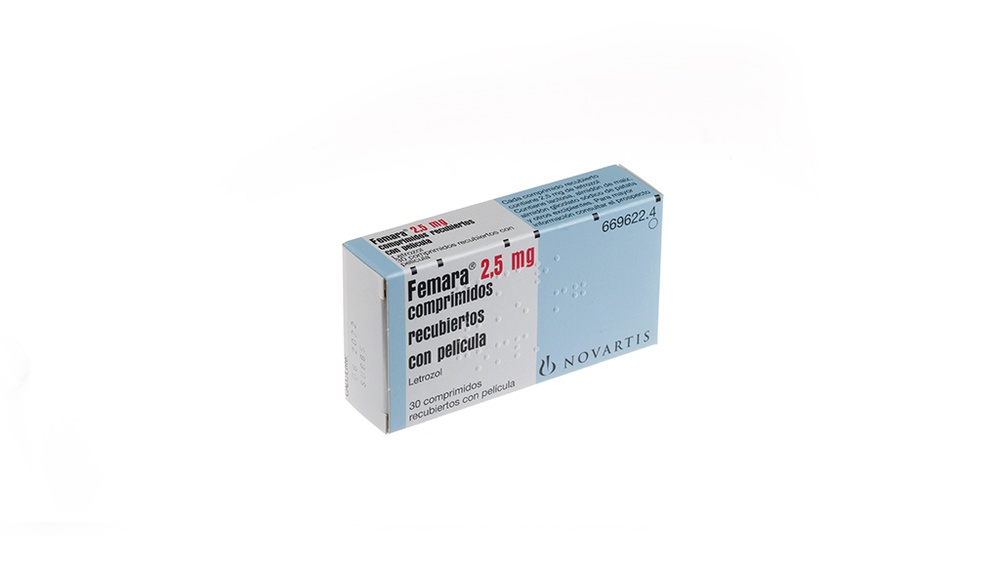
- Country of registration
- Dosage formTABLET, 2.5 mg of letrozole
- ATC codeL02BG04
- Average pharmacy price92.1 EUR
- Active substance
- Prescription requiredYes
- Manufacturer
- CompositionCARBOXIMETILALMIDON SODICO (5.000 mg mg), LACTOSA MONOHIDRATO (61.50 mg mg)
- This information is for reference only and does not constitute medical advice. Always consult a doctor before taking any medication. Oladoctor is not responsible for medical decisions based on this content.
- Alternatives to FEMARA 2.5 mg FILM-COATED TABLETSDosage form: TABLET, 2.5 mgActive substance: letrozoleManufacturer: Gp Pharm S.A.Prescription requiredDosage form: TABLET, 2.5 mgActive substance: letrozoleManufacturer: Accord Healthcare S.L.U.Prescription requiredDosage form: TABLET, 2.5 mgActive substance: letrozoleManufacturer: Almus Farmaceutica S.A.U.Prescription required
Online doctors for FEMARA 2.5 mg FILM-COATED TABLETS
Discuss questions about FEMARA 2.5 mg FILM-COATED TABLETS, including use, safety considerations and prescription review, subject to medical assessment and local regulations.


Get FEMARA 2.5 mg FILM-COATED TABLETS Prescription Online
Fill in a 2-min form
Tell us your symptoms, history, and what medicine you're requesting.
Pick a doctor or let us assign
Choose a specialist or we'll match you with the next available doctor.
Doctor reviews your case
Usually within 30 minutes. They may ask follow-up questions via chat.
Collect from any pharmacy
Electronic prescription sent to your email — valid across Spain.
Frequently Asked Questions
FEMARA 2.5 mg FILM-COATED TABLETS requires a prescription in Spain. You can check with a doctor online whether this medicine may be appropriate for your situation.
The active ingredient in FEMARA 2.5 mg FILM-COATED TABLETS is letrozole. This information helps identify medicines with the same composition but different brand names.
The average pharmacy price for FEMARA 2.5 mg FILM-COATED TABLETS is around 92.1 EUR. Prices may vary depending on the manufacturer and dosage form.
FEMARA 2.5 mg FILM-COATED TABLETS is manufactured by Novartis Farmaceutica S.A.. Pharmacy brands and packaging may differ depending on the distributor.
Doctors such as Family doctors, Psychiatrists, Dermatologists, Cardiologists, Endocrinologists, Gastroenterologists, Pulmonologists, Nephrologists, Rheumatologists, Hematologists, Infectious disease physicians, Allergists, Geriatricians, Paediatricians, Oncologists may assess whether FEMARA 2.5 mg FILM-COATED TABLETS is appropriate, depending on your situation and local regulations. You can book an online consultation to discuss your symptoms and possible next steps.
Spain has a well-developed healthcare infrastructure across major cities such as Madrid, Barcelona, Valencia, and Seville. Pharmacies are widely available and operate under strict regulations, ensuring access to prescribed medications.
You can buy FEMARA 2.5 mg FILM-COATED TABLETS in Madrid, Barcelona, Seville, or Valencia at any local pharmacy with a valid prescription.
To obtain a prescription, you can use Oladoctor:
Other medicines with the same active substance (letrozole) include GALDAR 2.5 mg FILM-COATED TABLETS, LETROZOLE ACCORD 2.5 mg FILM-COATED TABLETS, LETROZOLE ALMUS PHARMA 2.5 mg FILM-COATED TABLETS. These may have different brand names or formulations but contain the same therapeutic ingredient. Always consult a doctor before switching or starting a new medicine.
