


Leflunomida Medac 10 mg comprimidos recubiertos con película

Revisión de receta online
Un médico revisará tu caso y determinará si la prescripción es médicamente apropiada.

Habla con un médico sobre este medicamento
Comenta tus síntomas y las opciones de tratamiento en una consulta online.



Cómo usar LEFLUNOMIDA MEDAC 10 mg COMPRIMIDOS RECUBIERTOS CON PELICULA EFG
Contenido del prospecto
- Introducción
- Qué es Leflunomida medac y para qué se utiliza
- Qué necesita saber antes de empezar a tomar Leflunomida medac
- Cómo tomar Leflunomida medac
- Posibles efectos adversos
- Conservación de Leflunomida medac
- Contenido del envase e información adicional
Introducción
Prospecto: información para el usuario
Leflunomida medac 10 mg comprimidos recubiertos con película EFG
leflunomida
Lea todo el prospecto detenidamente antes de empezar a tomar este medicamento, porque contiene información importante para usted.
- Conserve este prospecto, ya que puede tener que volver a leerlo.
- Si tiene alguna duda, consulte a su médico, farmacéutico o enfermero.
- Este medicamento se le ha recetado solamente a usted, y no debe dárselo a otras personas aunque tengan los mismos síntomas que usted, ya que puede perjudicarles.
- Si experimenta efectos adversos, consulte a su médico, farmacéutico o enfermero, incluso si se trata de efectos adversos que no aparecen en este prospecto. Ver sección 4.
Contenido del prospecto
- Qué es Leflunomida medac y para qué se utiliza
- Qué necesita saber antes de empezar a tomar Leflunomida medac
- Cómo tomar Leflunomida medac
- Posibles efectos adversos
- Conservación de Leflunomida medac
Contenido del envase e información adicional
1. Qué es Leflunomida medac y para qué se utiliza
Leflunomida medac pertenece a un grupo de medicamentos denominados medicamentos antirreumáticos. Contiene leflunomida como principio activo.
Leflunomida medac se utiliza para tratar a pacientes adultos con artritis reumatoide activa o con artritis psoriásica activa.
Los síntomas de la artritis reumatoide incluyen inflamación de articulaciones, hinchazón, dificultad de movimiento y dolor. Otros síntomas que afectan a todo el cuerpo incluyen pérdida de apetito, fiebre, falta de energía y anemia (reducción del número de glóbulos rojos de la sangre).
Los síntomas de la artritis psoriásica activa incluyen inflamación de articulaciones, hinchazón, dificultad de movimiento, dolor, placas de color rojo y piel escamosa (lesiones en la piel).

¿No estás seguro de si este medicamento es adecuado para ti?
Comenta tus síntomas y tratamiento con un médico online.
2. Qué necesita saber antes de empezar a tomar Leflunomida medac
No tome Leflunomida medac
- si ha padecido alguna vez una reacción alérgicaa la leflunomida (especialmente una reacción grave en la piel, a menudo acompañada de fiebre, dolor de articulaciones, manchas rojas en la piel, o ampollas, p. ej., síndrome de Stevens-Johnson), a los cacahuetes o a la soja o a cualquiera de los demás componentes de este medicamento (incluidos en la sección 6), o si es alérgico a la teriflunomida (utilizada en el tratamiento de la esclerosis múltiple).
- si padece algún problema de hígado,
- si tiene problemas de riñónde moderados a graves,
- si tiene una disminución severa de la concentración de proteínas en la sangre(hipoproteinemia),
- si padece algún problema que afecte al sistema inmunitario, (por ejemplo SIDA),
- si padece algún problema en la médula óseao si tiene un número reducido de glóbulos rojos o blancos en la sangre o un número reducido de plaquetas,
- si padece una infección grave,
- si está embarazada, piensa que puede estar embarazadao se encuentra en periodo de lactancia.
Advertencias y precauciones
Consulte a su médico, farmacéutico o enfermero antes de empezar a tomar Leflunomida medac
- si ha padecido alguna vez inflamación del pulmón(una enfermedad pulmonar intersticial),
- si usted ha tenido alguna vez tuberculosiso si ha estado en contacto cercano con alguien que tenga o haya tenido tuberculosis. Su médico puede realizarle pruebas para ver si usted tiene tuberculosis,
- si es usted varóny desea tener hijos. Como no puede excluirse que Leflunomida medac pase al semen, se deben utilizar métodos contraceptivos fiables durante el tratamiento con Leflunomida medac. Los varones que deseen tener hijos deben contactar con su médico, quien le podría aconsejar interrumpir el tratamiento con Leflunomida medac y tomar ciertos medicamentos para eliminar Leflunomida medac de forma rápida y suficiente de su organismo. En este caso, será necesario que le realicen un análisis de sangre para asegurar que Leflunomida medac se ha eliminado lo suficiente de su organismo y después, deberá esperar al menos otros 3 meses antes de intentar tener hijos.
- si está previsto que le realicen un análisis específico de sangre (nivel de calcio). Podrá detectarse una falsa disminución de los niveles de calcio.
- si se va a someter o se ha sometido recientemente a una intervención quirúrgica importante, o si todavía tiene una herida sin cicatrizar después de una intervención quirúrgica. Leflunomida medac puede perjudicar la cicatrización de la herida.
Ocasionalmente, Leflunomida medac puede producir algunos problemas en la sangre, en el hígado, en los pulmones, o en los nervios de los brazos o las piernas. Puede también producir algunas reacciones alérgicas graves (incluyendo erupción medicamentosa con eosinofilia y síntomas sistémicos [Síndrome DRESS]), o aumentar la posibilidad de padecer una infección grave. Para más información sobre estos efectos adversos, consultar la sección 4 (Posibles efectos adversos).
El Síndrome DRESS aparece inicialmente con síntomas parecidos a los de la gripe y una erupción cutánea en la cara y a continuación una erupción cutánea extendida con fiebre, niveles elevados de enzimas hepáticas en sangre y un aumento en un tipo de glóbulos blancos (eosinofilia) y ganglios linfáticos agrandados.
Su médico le realizará análisis de sangrea intervalos regulares, antes y durante el tratamiento con Leflunomida medac, para monitorizar las células sanguíneas y el hígado. Su médico deberá también controlar su presión sanguínea regularmente ya que Leflunomida medac puede producir un aumento de la presión sanguínea.
Consulte a su médico si experimenta diarrea crónica de origen desconocido. Puede que le realicen pruebas adicionales para establecer un diagnóstico diferencial.
Informe a su médico si desarrolla una úlcera en la piel durante el tratamiento con Leflunomida medac (ver sección 4).
Niños y adolescentes
No está recomendado el uso de Leflunomida medac en niños y adolescentes menores de 18 años.
Otros medicamentos y Leflunomida medac
Informe a su médico o farmacéutico si está utilizando, ha utilizado recientemente o podría tener que utilizar cualquier otro medicamento. Esto incluye medicamentos adquiridos sin receta médica.
Esto es especialmente importante si usted está tomando:
- otros medicamentos para la artritis reumatoidetales como los antipalúdicos (por ejemplo: cloroquina e hidroxicloroquina), las sales de oro por vía intramuscular u oral, la D-penicilamina, la azatioprina y otros agentes inmunosupresores (por ejemplo: metotrexato), ya que no es recomendable la utilización de estas combinaciones.
- warfarina (usado como anticoagulante de la sangre), ya que es necesario un control para reducir el riesgo de efectos adversos de este medicamento
- teriflunomida para esclerosis múltiple
- repaglinida, pioglitazona, nateglinida, o rosiglitazona para diabetes
- daunorubicina, doxorubicina, paclitaxel, o topotecán para cáncer
- duloxetina para depresión, incontinencia urinaria o insuficiencia renal en diabéticos
- alosetron para el control de la diarrea severa
- teofilina para asma
- tizanidina, un relajante muscular
- anticonceptivos orales (que contengan etinilestradiol y levonorgestrel)
- cefaclor, bencilpenicilina (penicilina G), ciprofloxacino para infecciones
- indometacina, ketoprofeno para el dolor o inflamación
- furosemida para enfermedad del corazón (diurético, pastillas para orinar)
- zidovudina para infeccion por VIH
- rosuvastatina, simvastatina, atorvastatina, pravastatina para hipercolesterolemia (colesterol alto)
- sulfasalazina para enfermedad inflamatoria intestinal o para la artritis reumatoide
- un medicamento denominado colestiramina (utilizado para reducir el colesterol alto)o el carbón activoya que estos medicamentos pueden reducir la cantidad de Leflunomida medac absorbida por el cuerpo.
Si está tomando un fármaco antiinflamatoriono esteroideo (AINEs) y/o corticosteroides, puede continuar tomándolos después de iniciar el tratamiento con Leflunomida medac.
Vacunaciones
Consulte con su médico si tiene que vacunarse. Algunas vacunas no pueden administrarse mientras se encuentre en tratamiento con Leflunomida medac ni tampoco durante cierto tiempo después de terminar el tratamiento.
Toma de Leflunomida medac con alimentos, bebida y alcohol
Leflunomida medac puede tomarse con o sin alimentos.
Nose recomienda ingerir alcohol durante el tratamiento con Leflunomida medac. El consumo de alcohol durante el tratamiento con Leflunomida medac, puede aumentar la posibilidad de dañar el hígado.
Embarazo y lactancia
Notome Leflunomida medac si está o cree que puede estar embarazada. Si está embarazada o se queda embarazada mientras está tomando Leflunomida medac, aumenta el riesgo de tener un niño con malformaciones graves. Las mujeres en edad fértil no deben tomar Leflunomida medac sin utilizar medidas de contracepción fiables.
Informe a su médico si planea quedarse embarazada después de interrumpir el tratamiento con Leflunomida medac, puesto que es necesario asegurarse de que no quedan restos de Leflunomida medac en su cuerpo antes de que se quede embarazada. La eliminación del medicamento del organismo puede durar hasta 2 años. Este intervalo de tiempo puede reducirse a unas pocas semanas tomando ciertos medicamentos que aceleran la eliminación de Leflunomida medac del organismo. En cualquier caso, antes de quedarse embarazada, deberá realizarse un análisis de sangre para confirmar que Leflunomida medac se ha eliminado lo suficiente de su organismo y una vez realizado este análisis, deberá esperar al menos 1 mes antes de quedarse embarazada.
Para más información sobre las pruebas de laboratorio, contacte con su médico.
Si usted sospecha que pudiera estar embarazada durante el tratamiento con Leflunomida medac o en los dos años después del tratamiento, debe contactar inmediatamentecon su médico para que le haga una prueba de embarazo. Si la prueba confirma que está embarazada, su médico puede sugerirle que comience el tratamiento con ciertos medicamentos para eliminar Leflunomida medac rápida y suficientemente de su organismo, y así disminuir el riesgo para su hijo.
Notome Leflunomida medac mientras se encuentre en periodo de lactancia, puesto que leflunomida pasa a la leche materna.
Conducción y uso de máquinas
Leflunomida medac puede hacer que se sienta mareado lo que puede afectar a su capacidad para concentrarse y reaccionar. Si esto le sucede, no conduzca ni use máquinas.
Leflunomida medac contiene lactosa
Si su médico le ha indicado que padece una intolerancia a ciertos azúcares, consulte con él antes de tomar este medicamento.
Leflunomida medac contiene lecitina de soja
No utilice el medicamento si es Vd. alérgico al cacahuete o a la soja.
Leflunomida medac contiene sodio
Este medicamento contiene menos de 1 mmol de sodio (23 mg) por comprimido recubierto con película; esto es, esencialmente “exento de sodio”.
3. Cómo tomar Leflunomida medac
Siga exactamente las instrucciones de administración de este medicamento indicadas por su médico o farmacéutico. En caso de duda, consulte de nuevo a su médico o farmacéutico.
La dosis inicial habitual de Leflunomida medac es 100 mg de leflunomida una vez al día durante los tres primeros días. Después de esto, la mayoría de las personas necesitan una dosis de:
- Para la artritis reumatoide: 10 mg o 20 mg de Leflunomida medac una vez al día, dependiendo de la gravedad de la enfermedad.
- Para la artritis psoriásica: 20 mg de Leflunomida medac una vez al día.
Tragueel comprimido enteroy con bastante agua.
Puede que transcurran unas 4 semanas o incluso más tiempo hasta que empiece a notar una mejoría en su estado. Algunos pacientes pueden incluso notar una nueva mejoría tras 4 ó 6 meses de tratamiento. Por lo general, Leflunomida medac debe tomarse durante períodos de tiempo prolongados.
Si toma más Leflunomida medac del que debe
Si toma más Leflunomida medac del que debe consulte con su médico o con cualquier otro servicio sanitario. Si es posible, lleve los comprimidos o la caja para enseñárselos al médico.
Si olvidó tomar Leflunomida medac
Si olvidó tomar una dosis, tómela tan pronto como se acuerde, salvo que sea casi la hora de tomar la siguiente. No tome una dosis doble para compensar las dosis olvidadas.
Si tiene cualquier otra duda sobre el uso de este medicamento, pregunte a su médico, farmacéutico o enfermero.

¿Has empezado a tomar el medicamento y tienes preguntas?
Comenta tus síntomas y tratamiento con un médico online.
4. Posibles efectos adversos
Al igual que todos los medicamentos, este medicamento puede producir efectos adversos, aunque no todas las personas los sufran.
Informe a su médico inmediatamente y deje de tomar Leflunomida medac:
- si se siente débil, aturdido o mareado, o tiene dificultad al respirar, porque estos pueden ser síntomas de una reacción alérgica grave,
- si le aparecen erupciones en la piel o úlceras en la boca,porque puede indicar reacciones graves que en algunas ocasiones pueden llegar a ser mortales (ej. síndrome de Stevens-Johnson, necrólisis tóxica epidérmica, eritema multiforme, erupción medicamentosa con eosinofilia y síntomas sistémicos [Síndrome DRESS]), ver sección 2.
Informe a su médico inmediatamentesi experimenta:
- palidez, cansancioo moratones, porque pueden indicar problemas en la sangre causados por un desequilibrio en los diferentes tipos de células que constituyen la sangre,
- cansancio, dolor abdominalo ictericia(coloración amarilla de los ojos o de la piel), porque pueden indicar problemas graves como insuficiencia hepática, que podría llegar a ser mortal,
- cualquier síntoma de infección como fiebre, dolor de gargantao tos, porque este medicamento puede aumentar las posibilidades de padecer infecciones graves, que podrían llegar a ser mortales,
- toso problemas respiratoriosporque pueden indicar problemas de los pulmones (enfermedad pulmonar intersticial o hipertensión pulmonar),
- hormigueoinusual, debilidado doloren las manos o en los pies, porque puede indicar problemas en los nervios (neuropatía periférica).
Reacciones adversas frecuentes (pueden afectar hasta uno de cada 10 pacientes)
- disminución leve del número de glóbulos blancos de la sangre (leucopenia),
- reacciones alérgicas leves,
- pérdida de apetito, pérdida de peso (normalmente insignificante),
- cansancio (astenia),
- dolor de cabeza, mareo,
- sensaciones anormales en la piel como hormigueo (parestesia),
- aumento leve de la presión sanguínea,
- colitis,
- diarrea,
- náuseas, vómitos,
- inflamación de la boca, úlceras bucales,
- dolor abdominal,
- aumento de los resultados obtenidos en algunas pruebas de hígado,
- aumento de la caída de cabello,
- eczema, sequedad de piel, erupción cutánea y picor (prurito),
- tendinitis (dolor causado por la inflamación de la membrana que rodea los tendones de, normalmente, los pies o de las manos),
- aumento de los niveles de ciertas enzimas en la sangre (creatinina fosfoquinasa),
- problemas en los nervios de los brazos o las piernas (neuropatía periférica).
Reacciones adversas poco frecuentes (pueden afectar hasta uno de cada 100 pacientes)
- disminución del número de glóbulos rojos de la sangre (anemia) y de plaquetas (trombocitopenia),
- disminución de los niveles de potasio en sangre,
- ansiedad,
- alteraciones del gusto,
- erupción cutánea (urticaria),
- rotura de tendón,
- aumento de los niveles de grasa en la sangre (colesterol y triglicéridos),
- disminución de los niveles de fosfato en sangre.
Reacciones adversas raras (pueden afectar hasta uno de cada 1.000 pacientes)
- aumento del número de las células de la sangre denominadas eosinófilos (eosinofilia), disminución leve del número de glóbulos blancos de la sangre (leucopenia), y disminución del número de todas las células de la sangre (pancitopenia),
- fuerte subida de la presión sanguínea,
- inflamación del pulmón (enfermedad pulmonar intersticial),
- aumento de los valores de algunas pruebas hepáticas que pueden dar lugar a situaciones graves como hepatitis e ictericia,
- infecciones graves a las que se denomina sepsis, que pueden llegar a ser mortales,
- aumento en los niveles de ciertas enzimas de la sangre (lactato deshidrogenasa).
Reacciones adversas muy raras (pueden afectar hasta uno de cada 10.000 pacientes)
- disminución importante del número de ciertos glóbulos blancos de la sangre (agranulocitosis),
- reacciones alérgicas graves y reacciones alérgicas potencialmente graves,
- inflamación de los vasos sanguíneos (vasculitis, incluyendo vasculitis necrotizante cutánea),
- inflamación del páncreas (pancreatitis),
- lesiones hepáticas graves como insuficiencia hepática o necrosis que pueden llegar a ser mortales,
- reacciones graves que a veces pueden ser potencialmente mortales (síndrome de Stevens-Johnson, necrólisis epidérmica tóxica, eritema multiforme).
Otras reacciones adversas como insuficiencia renal, disminución de los niveles de ácido úrico en sangre, hipertensión pulmonar, infertilidad en el varón (este efecto es reversible una vez que finaliza el tratamiento con este medicamento), lupus cutáneo (caracterizado por erupción cutánea/eritema en las zonas de la piel expuestas a la luz), psoriasis (nueva o empeoramiento), síndrome DRESS y úlcera cutánea (llaga redonda y abierta en la piel a través de la cual se pueden ver los tejidos subyacentes), pueden ocurrir con una frecuencia no conocida.
Comunicación de efectos adversos
Si experimenta cualquier tipo de efecto adverso, consulte a su médico, farmacéutico o enfermero, incluso si se trata de posibles efectos adversos que no aparecen en este prospecto. También puede comunicarlos directamente a través del sistema nacional de notificación incluido en el Apéndice V. Mediante la comunicación de efectos adversos usted puede contribuir a proporcionar más información sobre la seguridad de este medicamento.
5. Conservación de Leflunomida medac
Mantener este medicamento fuera de la vista y del alcance de los niños.
No utilice este medicamento después de la fecha de caducidad que aparece en la caja exterior y en el frasco después de CAD. La fecha de caducidad es el último día del mes que se indica.
Mantener el frasco perfectamente cerrado para protegerlo de la humedad.
Los medicamentos no se deben tirar por los desagües ni a la basura. Pregunte a su farmacéutico cómo deshacerse de los envases y de los medicamentos que ya no necesita. De esta forma, ayudará a proteger el medio ambiente.
6. Contenido del envase e información adicional
Composición de Leflunomida medac
- El principio activo es leflunomida.
Cada comprimido de Leflunomida medac 10 mg comprimidos recubiertos con película EFG contiene 10 mg de leflunomida.
- Los demás componentes son lactosa monohidrato, hidroxipropilcelulosa de baja sustitución, ácido tartárico, lauril sulfato sódico y estearato de magnesio (E 470b) en el núcleo del comprimido, así como lecitina (alubias de soja), (alcohol) poli(vinílico), talco, dióxido de titanio (E 171) y goma xantana en el recubrimiento.
Aspecto del producto y contenido del envase
Leflunomida medac 10 mg comprimidos recubiertos con película EFG son comprimidos de color blanco a blanquecino y redondos con un diámetro de aproximadamente 6 mm.
Los comprimidos están envasados en frascos.
Leflunomida medac 10 mg comprimidos recubiertos con película EFG: Están disponibles en tamaños de envases de 30, 60 ó 100 comprimidos recubiertos con película por frasco.
Puede que solamente estén comercializados algunos tamaños de envases.
Titular de la autorización de comercialización
medac
Gesellschaft für klinische Spezialpräparate mbH
Theaterstr. 6
22880 Wedel
Alemania
Responsable de la fabricación
Haupt Pharma Münster GmbH
Schleebrüggenkamp 15
48159 Münster
Alemania
medac
Gesellschaft für klinische Spezialpräparate mbH
Theaterstr. 6
22880 Wedel
Alemania
Pueden solicitar más información respecto a este medicamento dirigiéndose al representante local del titular de la autorización de comercialización:
België/Belgique/Belgien Pharmanovia Benelux B.V. Tél/Tel: +31 76 560 0030 | Κúπρος Gidamed Medical Supplies Ltd. Τηλ: +357-257 510 30 |
| Luxembourg/Luxemburg medac GmbH Tél/Tel: +49 4103 8006-0 |
Ceská republika / Slovenská republika medac GmbH organizacni slozka Tel: +420 543 233 857 | Magyarország medac GmbH Tel: +49 4103 8006-0 |
Danmark / Sverige medac Gesellschaft für klinische Spezialpräparate G.m.b.H, Tyskland, filial Tlf: +46 44 7850 666 | Malta medac GmbH Tel: +49 4103 8006-0 |
Deutschland medac GmbH Tel: +49 4103 8006-0 | Nederland medac GmbH Tel: +49 4103 8006-0 |
Eesti / Latvija / Lietuva ViaSana Tel: +370 5 2788 414 | Norge medac Gesellschaft für klinische Spezialpräparate G.m.b.H, Tyskland, filial Tlf: + 47 90 63 81 04 |
| Österreich EVER Valinject GmbH Tel: +43 7665 20555 |
España Laboratorios Gebro Pharma, S.A. Tel: +34 93 205 86 86 | Polska medac GmbH Sp. z.o.o. Tel: +48 22 430 00 30 |
France medac s.a.s. Tél: +33 437 66 14 70 | Portugal medac GmbH - Sucursal em Portugal Tel: +351 21 410 75 83 |
Hrvatska Medis Adria d.o.o. Tel: +385 (0) 1 230 34 46 | România medac GmbH Tel: +49 4103 8006-0 |
Ireland medac GmbH Tel: +49 4103 8006-0 | Slovenija medac GmbH Tel: +49 4103 8006-0 |
Ísland Vistor hf. Sími: +354 535 7000 | Suomi/Finland medac Gesellschaft für klinische Spezialpräparate G.m.b.H, Tyskland, filial Puh/Tel: +358 10 420 4000 |
Italia medac Pharma S.r.l. Tel: +39 06 515912 1 |
Fecha de la última revisión de este prospecto: 07/2024
Otras fuentes de información
La información detallada de este medicamento está disponible en la página web de la Agencia Europea de Medicamentos: http://www.ema.europa.eu.
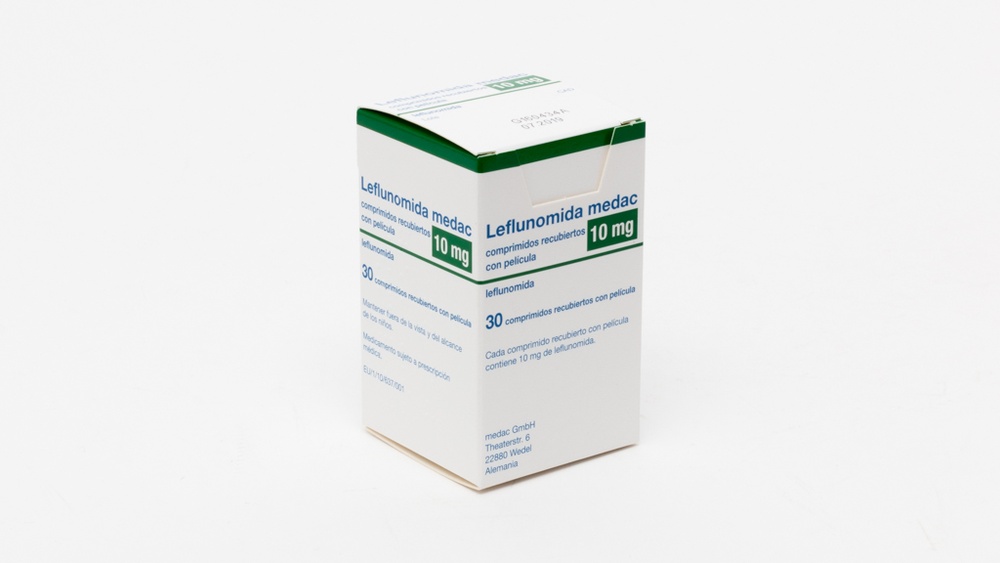
- País de registro
- Forma farmacéuticaCOMPRIMIDO, 10 mg
- Código ATCL04AK01
- Principio activo
- Requiere recetaSí
- Fabricante
- ComposiciónLAURILSULFATO DE SODIO (0 - mg), LECITINA DE SOJA (0 - mg), LACTOSA HIDRATADA (0 - mg)
- Esta información es de carácter general y no sustituye la consulta con un profesional sanitario.
- Alternativas a LEFLUNOMIDA MEDAC 10 mg COMPRIMIDOS RECUBIERTOS CON PELICULA EFGForma farmacéutica: COMPRIMIDO, 10 mgPrincipio activo: LeflunomidaFabricante: Sanofi-Aventis Deutschland GmbhRequiere recetaForma farmacéutica: COMPRIMIDO, 100 mgPrincipio activo: LeflunomidaFabricante: Sanofi-Aventis Deutschland GmbhRequiere recetaForma farmacéutica: COMPRIMIDO, 20mgPrincipio activo: LeflunomidaFabricante: Sanofi-Aventis Deutschland GmbhRequiere receta
Médicos online para LEFLUNOMIDA MEDAC 10 mg COMPRIMIDOS RECUBIERTOS CON PELICULA EFG
Comenta la dosis, los posibles efectos secundarios, interacciones, contraindicaciones o la revisión de receta de LEFLUNOMIDA MEDAC 10 mg COMPRIMIDOS RECUBIERTOS CON PELICULA EFG, sujeto a valoración médica y a la normativa local.
Preguntas frecuentes
LEFLUNOMIDA MEDAC 10 mg COMPRIMIDOS RECUBIERTOS CON PELICULA EFG requiere receta en España. Puedes confirmarlo con un médico online según tu caso.
El principio activo de LEFLUNOMIDA MEDAC 10 mg COMPRIMIDOS RECUBIERTOS CON PELICULA EFG es Leflunomida. Esta información ayuda a identificar medicamentos con la misma composición pero con diferentes nombres comerciales.
LEFLUNOMIDA MEDAC 10 mg COMPRIMIDOS RECUBIERTOS CON PELICULA EFG es fabricado por Medac Gesellschaft Für Klinische Spezialpräparate Gmbh. La marca y el envase pueden variar según el distribuidor.
Los Médicos de familia, Psiquiatras, Dermatólogos, Cardiólogos, Endocrinólogos, Gastroenterólogos, Neumólogos, Nefrólogos, Reumatólogos, Hematólogos, Infectólogos, Alergólogos, Geriatras, Pediatras, Oncólogos pueden valorar la prescripción de LEFLUNOMIDA MEDAC 10 mg COMPRIMIDOS RECUBIERTOS CON PELICULA EFG cuando esté clínicamente indicado. Puedes reservar una videoconsulta para comentar tu caso y las opciones de tratamiento.
La receta la emite un médico tras valorar tu estado de salud. En España, LEFLUNOMIDA MEDAC 10 mg COMPRIMIDOS RECUBIERTOS CON PELICULA EFG se dispensa en las farmacias con esa receta médica. Una consulta online no garantiza su emisión: la decisión corresponde siempre al médico.
Para solicitar una valoración puedes usar Oladoctor:
Otros medicamentos con el mismo principio activo (Leflunomida) incluyen ARAVA 10 mg COMPRIMIDOS RECUBIERTOS CON PELICULA, ARAVA 100 mg COMPRIMIDOS RECUBIERTOS CON PELICULA, ARAVA 20 mg COMPRIMIDOS RECUBIERTOS CON PELICULA. Pueden tener diferentes nombres comerciales o formulaciones, pero contienen el mismo componente terapéutico. Consulta siempre con un médico antes de cambiar o iniciar un nuevo medicamento.
